‘Blood Is On Their Hands’: Haitian Student Dies In Apparent Suicide After Trump Ends Deportation Protections“Because of the blatant cruelty and racism of Trump’s immigration policies, Pierre Damas Bel was denied the chance to fulfill his dreams.”

Pierre Damas Bel received his diploma at a graduation ceremony in an undated family photo.
(Photo: Instagram/family photo)
Julia Conley
Sep 01, 2026
C0MMON DREAMS
Since President Donald Trump was running for office two years ago, Springfield, Ohio has been a central target of Trump and Vice President JD Vance’s racist attacks and violent mass deportation operation, with the White House threatening the city’s Haitian population with forced removal back to their unstable home country.
On Monday, Springfield became the site of a new tragedy that immigrant rights advocates said was directly caused by the Trump administration’s xenophobic agenda, particularly its termination of Temporary Protected Status (TPS) for 350,000 Haitian migrants, when 20-year-old Pierre Damas Bel was killed by a tractor trailer on Interstate 70—apparently dying by suicide after the loss of the protections pushed him into despair.
As The Washington Post reported Tuesday, college student and aspiring doctor Bel parked on the highway’s shoulder Monday morning, got out of his car, and walked into westbound traffic. He was pronounced dead at the scene after being struck.
Ohio authorities are investigating, but Bel’s family believes his death to be a suicide.
His family told the Post that Bel had become distressed in recent weeks after the US Supreme Court allowed Trump’s termination of TPS for Haitians and Syrians.
Although he had a pending asylum case and a hearing scheduled for October, Bel was required to report to a US Immigration and Customs Enforcement (ICE) office after the Supreme Court ruled in favor of terminating TPS. Officers placed an electronic monitoring device on his ankle.
In late July, Bel wrote in an Instagram post: “I came to this country to pursue my education. I didn’t come here to commit a crime or hurt anyone. Yet now I’m walking through the streets of the United States with a GPS monitor on my leg, carrying a feeling of shame and humiliation that I never imagined I would experience.”
The Post reported that classmates bullied Bel over the bracelet, and he was unable to continue playing soccer as he had for years.
“He felt like he was treated like an animal,” his father, Pierres Ronal Bel, told the Post.
Last Friday, it appeared that Bel would not be able to continue in the Junior Reserve Officer Training Corps (JROTC) due to the Trump administration’s monitoring of him as it pursued deportation. As the Post reported:
His JROTC class instructor handed students their uniforms, which resemble those of the US armed forces, but did not give one to Bel. His father said the college student concluded it was because of the device strapped around his ankle.
“He came home that day feeling very bad,” Pierres Ronal Bel said through a translator.
Bel “killed himself because of the Trump administration’s obsession with hurting Haitians and the humiliating shame of an ICE ankle monitor,” said Aaron Reichlin-Melnick, a senior fellow at the American Immigration Council. “His blood is on their hands.”
The White House had threatened to flood Springfield with ICE agents earlier this year when it first announced it was ending TPS, which for 16 years has provided Haitians with deportation protections. During the 2024 election, Springfield ended up in Trump and Vance’s crosshairs as the two Republicans spread baseless, racist lies that Haitian community members there were eating their neighbors’ pets.
TPS was initially granted to Haitians after the 2010 earthquake that killed more than 300,000 in Haiti—one of the worst disasters in modern history and one that the country has struggled to fully recover from, as it’s also faced soaring violence and unrest following the assassination of President Jovenel Moïse in 2021. The US State Department warns Americans not to travel to Haiti for any reason due to gang violence, kidnappings, and an ongoing humanitarian crisis there.
Despite that, Homeland Security Secretary Markwayne Mullin has gloated that “the T in TPS stands for TEMPORARY” and urged Haitians who have been legally living and working in the US for years to go back to “Home Sweet Haiti”—making such comments as at least 47 people were killed and 50 were kidnapped in a gang attack near the Haitian capital of Port-au-Prince late last month.
Guerline Jozef of the Haitian Bridge Alliance told the Post that the Trump administration’s policies “are what caused [Bel’s] untimely death.”
Bel came to the US in 2024 to reunite with his parents, who had left Haiti three years earlier. Reichlin-Melnick said that “he almost certainly flew here through the [Cubans, Haitians, Nicaraguans, and Venezuelans] parole program, entering legally after a background check and probably with his parents having sponsored him. He broke not a single law. Not one.”
Rep. Jesús “Chuy” García (D-Ill.) said that “because of the blatant cruelty and racism of Trump’s immigration policies, Pierre Damas Bel was denied the chance to fulfill his dreams.”
“This never should have happened,” he said. “His blood, and the blood of all those who have died as a result of these policies, is in the hands of Trump and his top officials who have championed them.”
The 988 Suicide & Crisis Lifeline—which offers 24/7, free, and confidential support—can be reached by calling or texting 988, or through chat at 988lifeline.org.
Bari Weiss Personally Involved in CBS News Hit Piece on Abdul El-Sayed: Report
“They took a small nugget of news, forced it into something much larger, and messed up,” said one CBS News staffer.

Bari Weiss speaks with Sen. Ted Cruz (R-Texas) in Washington, DC.
(Photo by Leigh Vogel/Getty Images for Uber, X and The Free Press)
Brad Reed
Sep 01, 2026
COMMON DREAMS
A Tuesday report from Status claims that CBS News editor-in-chief Bari Weiss was personally involved with a widely criticized story that linked Democratic US Senate candidate Abdul El-Sayed to the September 11 terrorist attacks.
The CBS piece, which was published on Monday, drew criticism from Democratic lawmakers and progressive journalists for saying that El-Sayed “may be facing the risk of renewed scrutiny and fresh political attack” due to past innocuous statements he’d made about the 2001 attacks on the World Trade Center and the Pentagon.
According to Status’ sources, Weiss “personally directed” that the story’s headline be changed to “specifically mention that El-Sayed, who is vying to become the first Muslim American senator, had deleted tweets referencing” the attacks.
The two deleted posts highlighted in the story were far from scandalous, however. In the first post, El-Sayed called on Americans to unite in a common purpose to combat the Covid-19 pandemic just as they came together after the 2001 attacks, and in the second one he drew attention not just to the victims who died on 9/11, but to all the people who died afterward as a result of the US War on Terror.
Status also reported that Weiss “praised the story during the network’s daily editorial meeting Monday, signaling her support for the piece to the entire network.”
Weiss’ endorsement of the El-Sayed story came despite the fact that senior staffers at CBS raised concerns about it with the network’s standards department, Status added.
“They took a small nugget of news, forced it into something much larger, and messed up,” one staffer said.
Another staffer told Status that the story is “shameful” due to its “overt” racism.
One anonymous CBS News staffer similarly told Zeteo media columnist Justin Baragona on Monday that the Weiss-endorsed story was “trash” and “horribly Islamophobic.”
Weiss was installed as CBS editor-in-chief last year after David Ellison, the son of billionaire Oracle founder Larry Ellison, a megadonor to President Donald Trump, acquired network parent company Paramount.
In that time, CBS ratings have collapsed to record lows and Weiss has overseen a mass purge of reporters and staffers at the network’s legendary news program “60 Minutes.”
Veteran “60 Minutes” correspondent Scott Pelley, who was fired by CBS earlier this year, subsequently accused the Weiss-led management team of instructing him to “inject falsehoods and bias into a politically sensitive story.”
Jayapal and Wyden Demand Probe of ‘Unlimited Surveillance’ and Subpoena Abuses by Trump Agencies
Agencies have used their subpoena power “to surveil, intimidate, and suppress the free speech of ordinary citizens and even the free press,” said the Democrats.

Rep. Pramila Jayapal (D-Wash.)
(Photo by Bill Clark/CQ-Roll Call, Inc. via Getty Images)\
Julia Conley
Sep 02, 2026
COMMON DREAMS
Under the Trump administration, said Rep. Pramila Jayapal and Sen. Ron Wyden this week, federal agencies’ use of subpoena power to surveil Americans has become “institutionalized” in what the two Democrats called “brazen abuses of authority.”
Jayapal (Wash.) and Wyden (Ore.) wrote to US Supreme Court Chief Justice John Roberts and the acting comptroller general of the Government Accountability Office (GAO), Orice Brown, regarding what they called federal agencies’ decades-long practice of attempting “to coerce indefinite silence from private companies that receive subpoenas for customer information.”
While federal agencies have the congressionally vested authority to serve companies and service providers with administrative subpoeanas when they are seeking information about the provider’s customer or client, the recipient generally maintains the “First Amendment right to notify their customers of the demand, allowing the actual targets of the subpoenas the opportunity to assert their own legal rights or challenge the demand in court,” wrote Jayapal and Wyden.
If secrecy is required in a specific case, the agency can apply to a court for a time-limited nondisclosure order, but in the vast majority of cases, the lawmakers said in a statement, “the agencies may not gag recipients of subpoenas.”
That appears to have changed under the Trump administration.
Wyden and Jayapal pointed to one incident from July 8, 2025, when Harvard University received three immigration subpoeanas from US Immigration and Customs Enforcement (ICE) regarding international students, which contained “boilerplate requests for silence.”’
“The absurdity of this secrecy demand was demonstrated the very next day, when the Department of Homeland Security (DHS) issued a press release celebrating the very enforcement action it had just directed Harvard to keep secret,” wrote the lawmakers.
Homeland Security Investigations (HSI), which operates under ICE, has summons authority only for records relating to customs issues such as illegal imports or unpaid customs dues.
However, HSI has used its subpoena power “to surveil, intimidate, and suppress the free speech of ordinary citizens and even the free press”—in one case trying to reveal the identity of an anonymous Instagram user who had criticized and publicized ICE operations, according to the lawmakers.
Earlier this week, The Guardian reported that HSI had used the subpoenas to secretly obtain six months’ worth of phone records for Georgia Fort, a Minneapolis-based journalist who, along with former CNN anchor Don Lemon, was arrested in January for covering an anti-ICE protest at a church.
While the secrecy demands that come with subpoenas “carry no force of law,” said the lawmakers, “their coercive effect is extremely successful. This leaves customers entirely in the dark about government incursions into their personal data.”
Jayapal and Wyden noted that federal agencies were demanding secrecy from subpoenaed companies and third parties for decades before President Donald Trump took office.
For over four decades, they said, the Department of Justice (DOJ) “has treated extra-legal gag requests as standard operating procedure, regularly instructing the recipients of grand jury subpoenas not to disclose the government’s demands.”
“Given the severe, asymmetric power dynamics between federal law enforcement and civilian businesses—particularly when the subpoena recipient is a business operating within a highly regulated industry—many corporate legal departments will naturally read an official prosecutorial ‘request’ for silence as an implied command, choosing compliance over risking scrutiny from federal regulators,” wrote Wyden and Jayapal. “This coercive silence is particularly insidious because it targets corporate policies intended to protect consumers. For nearly every American industry, including telecommunications, technology, and healthcare, Congress has neither required nor prohibited notice of subpoenas. Absent a court order or statute saying otherwise, notice to customers is a protected exercise of free speech that furthers government transparency and customer privacy.”
The lawmakers called on the GAO to conduct a comprehensive audit of the DOJ and DHS as well as the agencies they oversee regarding their use of gag requests in subpoenas.
Such an audit would “help ensure that agencies do not abuse their subpoena authorities at the expense of privacy and free speech rights,” said Jayapal and Wyden.
Iran War Has Cost the Average American More Than $1,200 Over Six Months, Economist Estimates
One columnist said it’s impossible to know the true extent to which the war has hit Americans’ pocketbooks, but “this figure should be understood as a rough sketch that conveys the magnitude of Trump’s folly.”
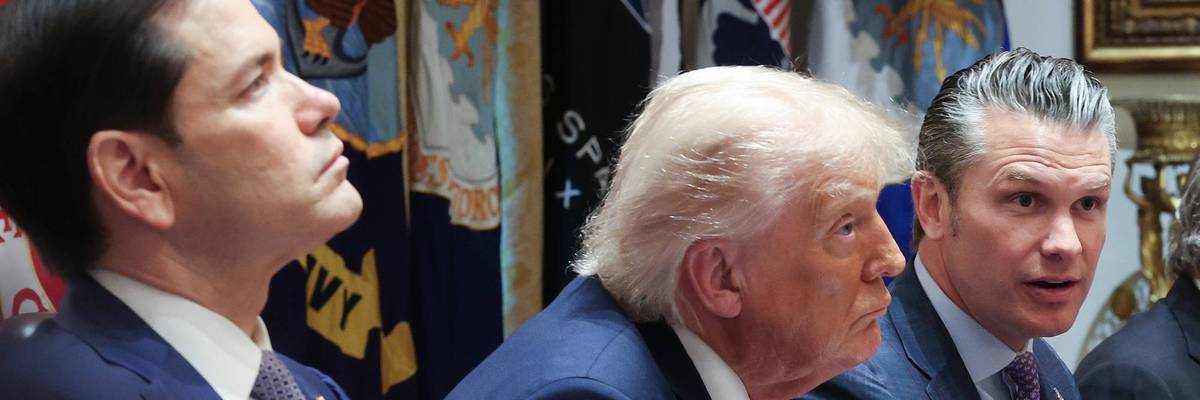
US Secretary of State Marco Rubio, President Donald Trump, and Pentagon chief Pete Hegseth attend a Cabinet meeting at the White House on May 27, 2026 in Washington, DC.
(Photo by Win McNamee/Getty Images)
Stephen Prager
Sep 01, 2026
COMMON DREAMS
As President Donald Trump’s war with Iran crosses the six-month mark without an end in sight, a new analysis calculates that it has cost the average American household at least $1,200 more than they would have paid if it had never started.
That is according to Mark Zandi, the chief economist at Moody’s Analytics, who was quoted by New Yorker columnist John Cassidy on Monday as he sought to look beyond military costs to determine the true extent to which the war has impacted Americans’ pocketbooks.

In Trump’s Second Term, Average US Family Forced to Spend $3,800 More on Essentials
Cassidy wrote that the task of reaching a solid number is “far from straightforward,” especially since, in his assessment, the Pentagon has been “less than forthright about many aspects of the conflict,” including the cost.
Defense Secretary Pete Hegseth told the Senate Appropriations Committee in July that the conflict had cost roughly $37.5 billion.
But prior to that, NBC News reported on internal Pentagon estimates that put the cost of the conflict between $80 billion and $100 billion when accounting for the cost to repair damage to US military bases, which has occurred on a level that, according to former Marine Col. Mark Cancian, has not been seen since World War II.
These costs do not include the additional $73 billion that House Republicans have approved for defense and intelligence related to the war, which will come up for a Senate vote in September.
“Whatever the true figure is, it’s a considerable sum that comes on top of the bloated trillion-dollar Pentagon budget that has already been approved for 2026, and it is money that could, in theory, be used for other purposes,” Cassidy wrote.
He cited a recent analysis by the Center for American Progress (CAP), which found that the $73 billion could “provide full Medicaid coverage for 5 million more people, with $33 billion left over.”
Some of those remaining funds could be used to provide free school lunch for every child in America, provide free childcare for 1 million children, or extend the Affordable Care Act tax credits that Republicans allowed to expire last year, which would reduce premiums for around 20 million Americans.
Trump has explicitly emphasized that funding the war is coming at the expense of other priorities.
“We’re fighting wars. We can’t take care of daycare. You gotta let a state take care of daycare, and they should pay for it too,” he said in April. “It’s not possible for us to take care of daycare, Medicaid, Medicare, all these individual things.”
Just taking the lower-bound $80 billion cost estimate would mean the average household has been forced to pay about $300 more as a result of the war, using the same methodology that the National Priorities Project used to estimate the cost to taxpayers in April. But this is only a fraction of the overall cost.
Average gasoline prices have shot up by more than $1 since the war began, while the price of diesel has risen by roughly half. Citing an energy-cost tracker maintained by the Climate Solutions Lab at Brown University’s Watson School of International and Public Affairs, Cassidy said these combined price hikes have cost Americans an additional $93 billion—more than an extra $700 per household.
Oil and fertilizer prices have also shot up, rippling through the economy and contributing to higher food prices. The overall rate of inflation has climbed to 3.4%, up from 2.4% in February. Cassidy notes that inflation has also hiked market interest rates, “raising the costs of mortgages, car loans, and other types of consumer credit.”
Combining all these added costs, Zandi estimated that the average household had paid roughly an extra $1,200 in the six months since the war started, but emphasized that this was only a conservative estimate.
“Rather than being taken as a precise number,” Cassidy added, “this figure should be understood as a rough sketch that conveys the magnitude of Trump’s folly.”
As the midterms approach, Trump’s approval rating has hit an all-time low of just 33% according to a poll out Monday from Reuters/Ipsos, which also found just 36% approval for the war.
Meanwhile, 71% of Americans, including 4 in 10 Republicans, said they disapprove of how Trump is handling the cost of living. This has caused the longstanding Republican advantage in the economy to evaporate, with 36% of registered voters saying in a poll last week they believe Democrats are better prepared to tackle the cost of living compared with 28% of Republicans.
“Absent a break in the war’s current stalemate between now and the November midterms,” Cassidy said, “the president and his party may end up paying a higher political price. But the economic costs of the conflict can’t be reversed.”
‘The President of the United States Is Mentally Unwell’: Deranged Trump Posts AI Slop of Iran Bombing
The chief executive of Iran’s government-run oil company dismissed the US president’s social media posts “laughable.”

US President Donald Trump posted an AI-generated video depicting American forces attacking Kharg Island on August 30, 2026.
(Photo: Donald Trump/Screengrab via Truth Social)
Jake Johnson
Aug 31, 2026
COMMON DREAMS
US President Donald Trump published a string of unhinged posts to his social media platform overnight and into Monday morning, including an artificial intelligence-generated video attempting to depict American forces bombing Kharg Island—Iran’s primary oil export terminal.
The post, which drew mockery from Iranian officials and alarm from observers concerned about Trump’s increasingly erratic behavior, came after US forces attacked Larak Island, which is located hundreds of miles east of Kharg in the Strait of Hormuz.
“Kharg Island being blown to smithereens!!!” Trump wrote in the caption of his post. It is unclear whether Trump, who frequently shares inane AI-generated videos with his 13 million Truth Social followers, confused Larak Island with Kharg Island, which the president has repeatedly threatened to invade.
An unnamed US official confirmed to Reuters in the wake of Trump’s post that American forces did not target Kharg Island during their Sunday attacks.
Hamid Bovard, the chief executive of Iran’s government-run oil company, called Trump’s posts “laughable” and described conditions on Kharg Island as “calm and appropriate.”
Iran retaliated for the US strike on Larak with a drone attack on two American military installations in Jordan and condemned the Trump administration’s ongoing aggression as an “obvious violation” of the United Nations Charter.
“It is obvious that full responsibility for the consequences of America’s new aggressive actions, as well as the continuation of the maritime blockade and economic war against Iran, rests with the US regime and all parties that in any way cooperate or participate in preparing and implementing the US’ illegal and unlawful actions,” the Iranian Foreign Ministry said in a statement.
The military exchange between the US and Iran was the first in weeks amid stalled efforts to achieve a lasting solution to the historically unpopular war that Trump and his Israeli counterpart, Prime Minister Benjamin Netanyahu, launched in late February, sparking a global energy crisis that has jacked up gas prices in the US and prompted fears of a global food emergency.
In a separate Truth Social post on Monday morning, Trump declared that Iran is “officially a Failed Nation,” adding in all-caps, “IT IS DEAD!”
“They have no Navy, they have no Air Force, they have no currency, they are not paying their soldiers or police, Inflation is at 300%, and their leadership is in total disarray and incapable of properly representing the country” Trump wrote.
“They must be tried for war crimes against humanity!” added the US president, who has been credibly accused of committing war crimes in Iran and elsewhere.
Trump’s attempt to convey overwhelming and unflagging US military superiority conflicts with internal assessments by top American officials, who reportedly warned Pentagon Secretary Pete Hegseth earlier this month that “prolonging large-scale operations against Iran is unsustainable and risks weakening their ability to confront threats elsewhere, including the US homeland.” US intelligence assessments have also found that, despite Trump’s claims, Iran’s government is still intact after six months of American bombing.
“The president of the United States is mentally unwell and has been for quite some time,” Rep. Ted Lieu (D-Calif.), who has supported congressional efforts to end Trump’s illegal war, wrote in a social media post on Monday. “He fantasized blowing up Iran’s Kharg Island. Except it didn’t happen.”
“And why would Trump need to blow it up if, as Trump claims, the US has total control of the Strait,” Lieu asked.
‘This Is Ethnic Cleansing’: Retired Israeli Generals Decry Settler Terrorism Against West Bank Palestinians
“Once a society behaves this way, that society is doomed.”

Israeli soldiers stand outside the homes of Palestinian families living in the Ras al-Ayn area of Qusra, south of Nablus in the West Bank, Palestine, on August 14, 2026.
(Photo by Issam Rimawi/Anadolu via Getty Images)
Brad Reed
Aug 31, 2026
COMMON DREAMS
Several retired Israel Defense Forces generals are publicly denouncing their own government for permitting settlers living in the illegally occupied West Bank to wage a campaign of violence against the Palestinian population.
As The New York Times reported on Monday, the retired generals have been touring the West Bank in recent days to witness first-hand the damage that has been done to Palestinians’ livelihoods by the Israeli settlers, whose violent actions have grown so outrageous that even US Ambassador to Israel Mike Huckabee described them as “terrorists.”
Ephraim Sneh, retired brigadier general and former minister of health, did not mince words in describing the settlers’ campaign of attacking Palestinian villages.
“This is ethnic cleansing, to put it simply,” said Sneh.
Asaf Agmon, a retired Air Force general, likened the attacks on Palestinians to the kinds of pogroms once suffered by Jews living in Europe.
Agmon also said that the Israeli government’s tacit support of these attacks bodes ill for the future of Israel.
“Once a society behaves this way,” said Agmon, “that society is doomed.”
The tours of the West Bank are being organized by Yaakov Or, a retired Israeli general who spent much of his career working inside the occupied territory.
According to the Times, Or begins every tour with a speech where he emphasizes the importance of speaking out against what he says are indefensible atrocities.
“When I take you to see what is happening in the West Bank, you will have two choices,” Or said during the start of a recent tour. “You can stay silent, and be complicit, or you can speak out, and tell everyone you know about what is happening.”
Israeli Prime Minister Benjamin Netanyahu over the weekend once again downplayed the significance of settler attacks on Palestinians, describing them as rogue actions taken by troubled individuals.
“We are talking about a very small handful of people,” Netanyahu said, “usually young people who come with all kinds of distress and problems, often from home, and I am determined to stop this.”
The Israeli prime minister also said that attacking Palestinian villages “harms the settlement movement” and “gives us a bad name around the world.”
Palestinian Christian theologian Munther Isaac pointed out that the Israeli government itself has been actively working to push Palestinians out of their homes in the West Bank, pointing to recent Israeli demolitions of homes in the town of Birzeit.
“This is what ethnic cleansing looks like in Palestine,” wrote Isaac.
Human rights organizations for months have been sounding the alarm about the situation in the West Bank, where Israeli settlers have routinely attacked Palestinians at their own homes.
An analysis published by the Carter Center last month found that “settler attacks are now the leading cause of Palestinian injuries in the West Bank,” as “more than 3,200 Palestinians have been displaced by settler attacks and home demolitions this year—double the daily rate of the previous three years.”
GOP’s Anti-Socialism Resolution Reveals the Party’s Ultra-Reactionary Nature
In essence, the resolution by Republicans denounces all policies seeking improvements in collective welfare.

C.J. Polychroniou
Sep 02, 2026Common Dreams/TRUTHOUT
On Tuesday, the US House of Representatives approved a resolution sponsored by Republican Study Committee Member Jeff Crank (R-Colo.) to condemn socialism “in all its forms.” Eight Democrats voted with Republicans in favor of this red scare tactic ahead of the November midterm elections, which accentuates the Democrat’s divide.
The ideological divide between the establishment and the Democratic Socialists of America (DSA) is profound, and the resolution condemning socialism is indeed part of a concerted strategy on the part of the GOP to wreak further havoc on the Democratic Party.
It is also important to take note of the fact that the resolution does not merely condemn socialism but opposes the implementation of all socialist policies in the United States. In essence, it denounces all policies seeking improvements in collective welfare.
Policies seeking improvements in collective welfare cover a wide range of objectives, like addressing massive economic inequalities, offering all people access to high-quality healthcare services, providing free public services, supporting individuals who experience various forms of income loss, protecting the environment, and so on. These policies may or may not be part of a strictly socialist agenda, but they are designed to promote economic justice and to enhance social cohesion and social welfare.
The claim that socialism leads inevitably to totalitarianism and tyranny is pure propaganda to scare the ignorant.
Indeed, many European countries have been actively pursuing policies seeking to bring about improvements in collective welfare at least since the end of World War II. The scope of some of these policies has shrunk considerably in the age of predatory capitalism, which is what the GOP anti-socialism resolution stands for, but no political party of any ideological stripe in the rest of the western world espouses the myth of social Darwinism to attack policies seeking to improve collective welfare. In fact, Europe’s far-right parties and movements advocate a strong welfare state and promise more government spending on native-born citizens (while excluding immigrants), especially in light of the ongoing erosion of social programs under neoliberalism.
There are many different types of socialism. For instance, European socialism (otherwise known as social democracy) has nothing to do with communism as the world experienced with the founding of the Soviet Union and bears no resemblance whatsoever to certain authoritarian and self-proclaimed socialist regimes that flourished during the Cold War in certain parts of the non-western world (Iraq under Saddam Hussein, Libya under Muammar Gaddafi, among others). The claim that socialism leads inevitably to totalitarianism and tyranny is pure propaganda to scare the ignorant. Socialist parties have ruled for long periods of time in most northern European countries, with those societies ranking globally at the top of major indexes for economic stability and personal freedoms while experiencing low rates of crime.
The Republican Party is by far the most reactionary party in the western world.
If anything, the argument has been that European socialist parties haven’t been socialistic enough. They pursued policies that improved without a doubt the condition of working-class people by striking a greater balance between capital and labor but did not go far enough with the mission of egalitarianism. DSA itself has been critical of the actual accomplishments of European socialism as it envisions a socioeconomic order based on democratic planning and participation whose sole purpose would be “to meet human needs, rather than to make profits for a few.”
Naturally, the GOP’s anti-socialism resolution paid no attention to such ideological and empirical nuances. It denounced socialism “in all its forms” and, by doing so, signaled its full support for an economic system based on predatory capitalism and a social order that advocates the notion that only the fittest members of society deserve to survive.
Policies geared toward universal healthcare, housing decommodification, strong worker rights and protections, strict financial regulation, environmental protection, and social justice? That’s the road to totalitarianism and tyranny, according to GOP’s anti-socialism resolution.
But there should be nothing surprising about this. The Republican Party is by far the most reactionary party in the western world. Yet, it continues to assert with confidence--and measurable success, no doubt--that its political and ideological positions represent the values and principles of the American people.
It is Trump’s fascism and the system of predatory capitalism that need to be denounced, not socialism.
However, the tide is turning. Americans are not only fed up with rising costs but with the way “democracy” works in their country, as a Pew Research Center poll revealed earlier in the summer. Support for capitalism has rapidly declined, especially among young people. Less than 10 percent of people younger than 30 have a “very positive” view of capitalism, according to a recent CBS/YouGov poll.
The idea propounded by the likes of Milton Friedman and implemented by Ronald Reagan and virtually every other US administration since have created one of the most unequal societies in the world while plutocrats are in control of the political system. US democracy is essentially a sham. But Trump and company have gone even further by advancing a 21st century version of fascism. It is Trump’s fascism and the system of predatory capitalism that need to be denounced, not socialism. In one of the most unequal and brutally unjust societies in the world, policies geared toward the improvement of the collective welfare represent the only realistic and humane alternative. And it appears that more and more Americans are beginning to realize that socialism is the only way out. So much so, one might add, that if Vladimir Mayakovsky were alive today and living in the United States, he might conceivably have said “Socialism is the youth of the world.”
‘So Afraid of Working-Class People’: Delia Ramirez Rips Supporters of ‘Stupid’ Anti-Socialism Resolution
“They’re afraid to get honest about who they really work for here. Spoiler alert: It’s not working people.”

Rep. Delia Ramirez (D-Ill.) attends the dedication ceremony for the opening of the Barack Obama Presidential Center in John Lewis Plaza on June 18, 2026 in Chicago, Illinois.
(Photo by Jim Vondruska/Getty Images)
Brad Reed
Sep 02, 2026
COMMON DREAMS
Rep. Delia Ramirez on Tuesday hit back at colleagues in the US House of Representatives who voted for a resolution condemning socialism “in all its forms.”
During a speech on the House floor, Ramirez (D-Ill.) slammed the anti-socialism resolution, which passed with the support of eight Democrats joining all Republicans, as a meaningless distraction.
“Today my colleagues thought it was a good use of people’s time... to come after a working people’s platform and the people working to make that platform a reality,” Ramirez said. “You know why? Because they’re afraid to get honest about who they really work for here. Spoiler alert: It’s not working people.”
The Illinois Democrat rattled off a list of Republican policies that benefit big corporations and the wealthy at the expense of working people, including cuts to Medicaid and support for President Donald Trump’s illegal war with Iran.
Ramirez then accused Republicans of pushing the resolution “because you’re so afraid of working-class people coming into the next Congress” after the 2026 midterm elections.
“So let me be clear,” she concluded. “Not only do I call on my colleagues to vote against this stupid resolution... but also to put this much energy into creating a world, a system that actually works for working people.”
Ramirez was far from the only Democrat to rip the anti-socialism resolution.
Rep. Mark Pocan (D-Wis.) likewise condemned the “stupid resolution,” which he said “ignores Americans who are more concerned about the cost of living than obsessing about socialism.”
Rep. Valerie Foushee (D-NC) suggested that a better use of Congress’ time would be to “condemn the 34-count felon in the White House, not a bunch of people who just want universal healthcare.”
Darializa Avila Chevalier, the Democratic nominee for the US House seat in New York’s 13th congressional district, slammed the eight Democrats who voted with Republicans to pass the resolution.
“Democrats love talking about a ‘big tent,’ but then they vote in line with Republicans hell-bent on destroying our democracy,” she wrote. “This resolution was aimed squarely at democratic socialists like me.”
Can DSA’s Brand of Socialism Attract the Broader Working Class?
There are a few key reasons why many working class people likely won’t embrace the vision put forth by the Democratic Socialists of America.

Members of the Democratic Socialists of America gather in New York City.
(Photo: Spencer Platt via Getty Images)Common Dreams
Members of the Democratic Socialists of America (DSA) are proud to wear their socialism on their sleeves (and on their hats.) It lets everyone know they are serious about changing capitalism into something far more humane, transforming the system into one in which working people rather than plutocrats run the economy.
Their embrace of socialism also gives its members a sense of community. It signals a commonality in opposition to the status quo, on behalf of all working people. It’s a righteous identity that signals us against them, right against wrong, justice against injustice—a moral, almost religious bonding.
However, it also pushes people away. It creates a demarcation line between in and out. It’s not just the capitalists who are excluded, but anyone who doesn’t buy into DSA’s vision of socialism.
But why wouldn’t all working people readily embrace DSA’s socialist vision?
Let’s look at how the DSA defines its socialism:Capitalism is a system designed by the owning class to exploit the rest of us for their own profit.
We must replace it with democratic socialism, a system in which ordinary people have a real voice in our workplaces, neighborhoods, and society.
The people should collectively own key economic drivers, such as energy production and transportation, that are used by all.
We want the multiracial working class united in solidarity instead of divided by fear.
We want reforms, such as Medicare for All, community-centered public safety, and the Green New Deal, that the current establishment considers radical but we think are essential for a fairer system.
So far, that sounds within the realm of progressive economic populism. Even doable, I hope, but then they go further:Work as much as you are able and no more than needed. Control your own labor and see it going to good use. Work is not just a job to pay the bills.
You have no debt. You don’t need health insurance. You don’t pay a mortgage or have a landlord, no rent, because comfortable housing is a human right.
Your retirement is publicly funded. Food, education, energy, medicine, and transportation aren’t for-profit businesses; they are common goods and utilities.
A socialist’s day off could be like any good day now. But you should be free to spend your time how you like without worrying about cost or dreading going back to work.
And college, as well as groceries, should be free.
When DSA candidates take to the field, they focus almost entirely on populist economic demands—housing and food affordability, fair taxes on billionaires, and Medicare for All. These are socialist in the sense that Social Security, libraries, fire departments, and our current Medicare are socialist, and yet they are also firmly embedded in our capitalist system.
I have yet to encounter a DSA candidate who discusses truly socialist reforms, like the elimination of large private enterprises and workers’ control of the corporations that employ them.
We have the word “socialism” and significant portions of the DSA platform that do not have significant working-class support, yet DSA doesn’t seem bothered by being out of touch with large segments of the working class they claim to be fighting for.
Then why does DSA use the word “socialist” if it does not involve their day-to-day political debates? And why use it when it is sure to turn off many of the very working people DSA claims to represent?
The Education Class Divide
There is a significant disparity among educational groups when it comes to having positive or negative views toward socialism.
Gallup’s 2025 polling found that:31 percent of people with some college, but no four-year degree, viewed socialism positively, compared with 66 percent who viewed it negatively.
Among people with a high-school education or less, the split was 38 percent positive to 57 percent negative.
College graduates were the most favorable educational group, with 47 percent viewing socialism positively, and 51 percent negatively.
Among independents, only 38 percent viewed socialism positively, compared with 57 percent who viewed it negatively.
This doesn’t mean working people oppose the policies associated with democratic socialism, like taxing billionaires. But it does mean that DSA’s use of the word “socialism” itself is likely to trigger a negative response and undermine its effectiveness among working-class voters, especially in red America.
Why use the word “socialism” when it’s going to turn off the very voters you hope to attract?
Because it doesn’t turn off DSA college-educated members. The reality is that despite their “Workers Deserve More” platform, DSA is a political organization by and for college graduates, especially disenchanted Democrats in blue areas. That demographic seems to have no problem with the idea of socialism. In fact, 66 percent of Democrats had a favorable opinion of socialism, with just 32 percent feeling negatively.
Which fits with several of the policies DSA supports that also are likely to turn off non-college working-class voters.
Immigration
For example, the DSA platform calls for legalizing migration, granting amnesty to all immigrants regardless of status, providing a path to citizenship for all permanent residents, and ending visa caps and quotas.
Some elements of this position have considerable popular support. Pew Research found that 64 percent of Americans believe undocumented immigrants should have some way to stay legally in the United States, and 60 percent favor allowing them to apply for citizenship.
But that support generally comes with conditions: 79 percent favor security background checks, and 52 percent favor requiring immigrants to have a job.
The broader DSA position is another matter. The Pew Research Center conducted in August 2024 found that 48 percent of U.S. adults wanted legal immigration kept at its present level; 24 percent wanted it increased and 26 percent wanted it decreased.
There is little evidence that working-class Americans want to eliminate visa caps and quotas altogether. In fact, non-college voters are more likely than college graduates to see large-scale migration as contributing to crime.
The distinction is important: working people can support a path to citizenship for immigrants already here while also wanting secure borders and limits on future immigration. DSA’s position largely erases that distinction.
Abolish the Police?
DSA calls for demilitarizing police departments, disempowering police unions, redirecting police funding to public services, and ultimately abolishing the police and prison system.
Here again, polling reveals a sharp divide between progressive reforms and the more sweeping DSA position. A 2020 Gallup poll taken after the George Floyd murder found that 58 percent said policing needed major changes and vast majorities supported changing police management practices so that officer abuses are punished. However, there was little to no support for abolishing police departments.
The lesson here isn’t that working people oppose police reform. Quite the contrary: there is overwhelming support for holding abusive officers accountable, improving police-community relations, and expanding community-based alternatives.
But there is a huge difference between reforming policing and abolishing it. DSA’s position goes far beyond what polling shows most working people are prepared to support.
Palestine
It’s not that working people necessarily disagree with DSA’s concern for Palestinian lives or even with major elements of its policy. Polling shows substantial support across the electorate for a ceasefire, humanitarian aid, Palestinian self-determination, and conditioning or reducing U.S. military aid to Israel.
The problem is that DSA bundles those broadly popular positions with a much more sweeping ideological program—open-ended opposition to Israel as a state, the right of return to Israel for Palestinians and their decedents who lived within its border but fled during various wars, unrestricted immigration, and prosecution of U.S. and Israeli leaders for genocide—that has not been adequately tested among working-class voters.
While justice for Palestine is a major issue for DSA members, it’s not at all clear that it is a major issue for working people without college degrees. We have no indication from polling that it ranks anywhere near as important as economic issues, nor that it influences the votes of non-college graduates. Also, it seems to rank about the same as the Russia-Ukraine war, which is not even mentioned in the DSA platform. The distinction? Palestine, not Ukraine, is a very big issue among college-educated young people and hence essential to the DSA platform.
Why would an organization that purports to be fighting on behalf of the working class develop a platform with many elements that a majority of working people do not support?
Again, the answer is that those positions do have strong support among college graduates, the real base of DSA. And those college graduates hope that most working people will support those positions, if not now, eventually.
So, we have the word “socialism” and significant portions of the DSA platform that do not have significant working-class support, yet DSA doesn’t seem bothered by being out of touch with large segments of the working class they claim to be fighting for.
That’s socialist identity politics. It lets the world know that DSA members, mostly college educated, have a vision to eliminate capitalism and the many problems it poses. While DSA would like to have broad working-class support, it is not about to give up its socialist vision and its more radical policies to get it.
And it’s doubtful to change because DSA is on a roll as it gains more and more members and support among disenchanted college graduates who they see as the new working class, or at least a large part of it. Afterall, DSA already is the largest, most active political organization in the country.
So, DSA and its members do not feel any pressure to change their political identity. They wear it proudly as the oligarchy limits opportunities for recent college graduates and drives them towards DSA.
That’s why it is highly unlikely that DSA will become a political organization of workers without college degrees. And that’s exactly why those unrepresented workers need a party of their own that reflects what they believe in and what they want from our economy and political system. (Please see my latest book for a fuller account.)
Our work is licensed under Creative Commons (CC BY-NC-ND 3.0). Feel free to republish and share widely.
Les Leopold
Les Leopold is the executive director of the Labor Institute and author of the new book, “The Billionaires Have Two Parties, We Need a Party of Our Own” (2026). His previous books include: “Wall Street’s War on Workers: How Mass Layoffs and Greed Are Destroying the Working Class and What to Do About It" (2024); "Runaway Inequality: An Activist's Guide to Economic Justice" (2015); and “The Man Who Hated Work and Loved Labor: The Life and Times of Tony Mazzocchi” (2007). Read more of his work on his substack here.
Full Bio >
Rare Earth Minerals Don’t Have to Feed the War Machine
A nation can spend billions building supply chains designed to manufacture the next generation of weapons, or it can use the same industrial capacity to build the infrastructure required for the next generation of human life. The minerals are the same.

Manzanas wind turbines stand out in the desert landscape near the Tehachapi Mountains in Rosamond, California.
(Photo by Gina Ferazzi / Los Angeles Times via Getty Images)Common Dreams
On August 24, the Department of War announced a $750 million investment to secure rare-earth elements produced by Serra Verde at its Pela Ema project in Brazil. Combined with a $300 million purchase commitment from the Defense Logistics Agency and $500 million from a major bank, the arrangement represents a $1.55 billion investment structure aimed at reducing US dependence on Chinese-controlled supply chains.
There is a legitimate problem here.
There is also a troubling choice about how we intend to solve it.
Rare-earth elements such as neodymium, praseodymium, dysprosium, and terbium are essential components of modern life. They are used in permanent magnets found in electric vehicles, wind turbines, electronics, industrial equipment, and other technologies. They are also used in fighter jets, guided missiles, nuclear submarines, drones, and other weapons systems.
A mineral dug from the ground does not know whether it will eventually become part of an offshore wind turbine or the guidance system of a missile. That decision is political.
China currently dominates this supply chain. According to the International Energy Agency, China accounted for about 60% of global mining of magnet rare earths in 2024, 91% of their refining, and 94% of sintered permanent-magnet production. That level of concentration creates a genuine economic vulnerability, particularly after Chinese export restrictions demonstrated how quickly access to these materials can become a geopolitical bargaining chip.
Diversification makes sense.
But listen carefully to the language the US government is using to describe it.
Assistant Secretary of War for Industrial Base Policy Mike Cadenazzi called resilient supply chains a “fundamental warfighting requirement.” The department says the agreement will guarantee materials necessary to manufacture “next-generation weapons systems.” Its announcement specifically highlights nuclear submarines, fighter jets, guided missiles, combat vessels, and drones.
That framing deserves scrutiny.
The United States is not simply securing minerals. It is incorporating another piece of the global economy into an increasingly militarized conception of national security.
A Mineral Can Power a Wind Turbine or a Missile
There is nothing inherently military about neodymium.
A mineral dug from the ground does not know whether it will eventually become part of an offshore wind turbine or the guidance system of a missile.
That decision is political.
And that is precisely why this $1.55 billion initiative should provoke a broader conversation about the kind of economy the United States is building.
If Washington treats critical minerals primarily as inputs for weapons, we should not be surprised when the industries surrounding them increasingly organize themselves around weapons production.
Serra Verde is an important source of these materials. Its Pela Ema operation began commercial production in 2024 and is the first large-scale producer outside Asia of all four critical magnetic rare-earth elements: neodymium, praseodymium, dysprosium, and terbium. The company expects production to reach roughly 6,400 metric tons of rare-earth oxides annually by the end of 2027.
That makes Brazil potentially important to reducing the world’s dangerous dependence on a single supplier.
But reducing dependence on China should not automatically mean subordinating a new international supply chain to the needs of the Pentagon.
Rare-earth resilience could instead be treated as civilian industrial policy: an effort to ensure reliable supplies for renewable energy, public transportation, resilient electrical grids, medical technologies, communications infrastructure, and other components of human security.
The difference is more than rhetorical.
Government priorities influence markets. Purchase guarantees influence production. Subsidies determine which industries expand. Billions of public dollars can create an ecosystem in which manufacturers orient themselves toward military customers because those customers offer enormous, guaranteed demand.
If Washington treats critical minerals primarily as inputs for weapons, we should not be surprised when the industries surrounding them increasingly organize themselves around weapons production.
Security Is Bigger Than Military Power
The Department of War’s announcement actually exposes the contradiction.
The same release that celebrates rare earths as essential to fighter aircraft and nuclear submarines acknowledges that they are vital to “energy infrastructure, transportation, aerospace, and electronics.”
Exactly.
Those civilian applications should not be an afterthought.
The United States could reproduce the very system it says it wants to escape: concentrated supply chains organized around geopolitical blocs, each treating access to minerals as leverage against the other.
Climate change threatens lives. An unreliable electrical grid threatens lives. Fragile transportation and communications systems threaten economic stability. Supply-chain disruptions can close factories and eliminate jobs.
Those are security issues too.
Yet American policymakers repeatedly define security through the narrowest possible lens: military capability first, virtually everything else second.
A peace economy asks a different question.
Instead of asking only, “What materials do we need to maintain our technological advantage in warfare?” we should ask: “What materials do people need to live safely, sustainably and prosperously—and how can we obtain them without creating new forms of exploitation, environmental destruction, or international conflict?”
That would still require diversifying the rare-earth supply chain.
It would still require investment.
It would still require cooperation with countries such as Brazil.
But the purpose would be different.
Don’t Replace One Dependency With Another
There is another danger in framing critical minerals as part of strategic competition with China.
The United States could reproduce the very system it says it wants to escape: concentrated supply chains organized around geopolitical blocs, each treating access to minerals as leverage against the other.
Minerals essential to decarbonization could become another source of great-power confrontation.
The result would not necessarily be resilience. It could be a global scramble for resources.
Countries possessing lithium, cobalt, nickel, and rare-earth deposits would increasingly become arenas for competition among powerful states. Supply agreements would become security agreements. Economic relationships would become tests of allegiance.
Minerals essential to decarbonization could become another source of great-power confrontation.
That is not a theoretical concern when officials explicitly describe access to raw materials as a “warfighting requirement.”
The alternative is not continued dependence on China. Diversification is necessary. The IEA itself has repeatedly warned that extreme concentration in rare-earth refining and magnet production represents a significant economic risk.
But diversification should mean creating many reliable suppliers and processing centers—not dividing the mineral economy into rival military camps.
Build a Peace Supply Chain
A different critical-minerals strategy is possible.
The United States could invest aggressively in recycling and recovery of rare-earth materials. It could develop domestic processing capacity while applying strong labor and environmental standards. It could enter long-term partnerships with Brazil and other producing countries that emphasize shared economic development rather than simply extracting resources for American strategic advantage.
And the government could prioritize civilian demand—renewable power, electric transportation, grid modernization, and other public infrastructure—alongside legitimate defense requirements.
It could guarantee that communities near mines and processing facilities benefit economically and retain meaningful influence over development decisions.
And the government could prioritize civilian demand—renewable power, electric transportation, grid modernization, and other public infrastructure—alongside legitimate defense requirements rather than allowing military procurement to dictate the direction of an entire emerging industry.
Serra Verde itself demonstrates why the choice matters. The company’s rare earths can supply permanent magnets for electric vehicles and wind turbines just as surely as they can supply defense and aerospace manufacturers.
The question is not whether America should secure access to critical minerals.
It should.
The question is what we intend to do with the security that access provides.
A nation can spend billions building supply chains designed to manufacture the next generation of weapons.
Or it can use the same industrial capacity to build the infrastructure required for the next generation of human life.
The minerals are the same.
The economy we build around them is a choice.
Our work is licensed under Creative Commons (CC BY-NC-ND 3.0). Feel free to republish and share widely.
Katerina Canyon
Katerina Canyon is the executive director of the Peace Economy Project, a St. Louis-based nonprofit advancing demilitarization and community-centered investment. She is also an MFA candidate whose work explores the social costs of militarization and the civic imagination.
Full Bio >


