It’s possible that I shall make an ass of myself. But in that case one can always get out of it with a little dialectic. I have, of course, so worded my proposition as to be right either way (K.Marx, Letter to F.Engels on the Indian Mutiny)
Wednesday, September 23, 2026
Imperial Oil Becomes First Major Alberta Energy Company to Oppose Separatism
Imperial Oil chief executive John Whelan has stated his opposition to Alberta separatism, making this the first major energy company in the province to take a public position on the movement, Financial Post reported, citing Bloomberg.
"As a national company, we believe a united Canada is the strongest position we can take to face the challenges and opportunities ahead," Whelan told a Calgary conference, adding that "Canada and Alberta work best when people, products, energy and investment can move freely and reliably across the country."
On October 19, Alberta will vote on whether to authorize the provincial government to pursue a binding independence referendum, which would be in the form of a procedural question, not a direct vote to separate.
A government-commissioned study from the University of Calgary School of Public Policy models two different potential outcomes. In the first, a smooth transition costs Alberta's GDP an estimated 2.2% in the short term, but leaves it 3.4% higher over the long term compared to staying in Canada. The second scenario spells out a difficult transition that costs 10.1% in the short term and 16.2% over the long term. The province's own cost estimate for the first five years runs $50 billion to $170 billion, with $40 billion to $55 billion of that in start-up costs alone.
Other Alberta energy executives have not jumped on board. Cenovus Energy chief executive Jon McKenzie said earlier this year that separatist sentiment is rooted in genuine grievances and would subside if addressed. ATCO chief executive Nancy Southern called the separatist discussion "very unhelpful”.
Whelan also lent his support to Premier Danielle Smith's production goals, saying Imperial "has the potential to double our gross operated upstream production while also advancing additional downstream biofuel production" under a supportive fiscal and regulatory framework. Imperial, a unit of Exxon Mobil, operates the Kearl oil sands mine, the Cold Lake in-situ site, and refineries in Alberta and Ontario.
The iron ore trader Radiant World may hold only $10,000 in cash, even though its most recent financial statements refer to cash balances of more than $200 million, lawyers for a Jefferies-linked fund suing Radiant over an alleged fraud said on Thursday.
LAM Trade Finance Group II, in which US bank Jefferies holds a minority stake, obtained a freezing order last month from London’s High Court against Radiant World and its founder Pinkesh Nahar as well as Sapphire Minmetals, which used to be part of the company.
Singapore’s police force last month said it was investigating Radiant World after reports that invoices provided to its banks may not have been valid.
Radiant World, which has denied the allegations, did not reply to a request for comment on Thursday. Sapphire Minmetals did not respond to a request for comment.
LAM Trade Finance Group II, which has also obtained freezing orders in Hong Kong and Singapore, says it purchased iron ore receivables from companies linked to Radiant and/or Sapphire, by which it bought the right to be paid by traders such as Glencore and Vitol.
But those receivables either did not exist or were not validly assigned, it said in its claim against Radiant World.
“It appears that the defendants used debit notes to paper over the cracks, as it is put by the claimant, for as long as they could and it is characterised that ‘the well has now run dry’,” Judge Simon Bryan said when he made the freezing order.
In trading, receivables are amounts of money that a company is owed by its customers for goods that have already been delivered but not yet paid for.
Nahar said in a document submitted by his lawyers for Thursday’s hearing that it was not clear precisely what role he was alleged to have played.
Nahar has indicated his intention to challenge the court’s jurisdiction, said the document, which described the case as “a substantial, complex, $500 million international fraud claim”.
At Thursday’s hearing, lawyers representing LAM Trade Finance Group II argued in court documents that the freezing order should remain in place because of the risk that the defendants would dissipate assets.
They said asset totals provided in a witness statement on behalf of Radiant World were “substantially different” from those in financial statements for the year to September 30, 2025.
“The audited financial statements refer to cash balances of over $200 million whereas (the statement) says that Radiant World holds only $10,000 in cash,” they said.
Radiant World is embroiled in other lawsuits. It has sued Glencore (LON: GLEN) in Singapore seeking more than $2 billion.
Judge Andrew Henshaw said on Thursday that the next London hearing was likely to take place in late December.
(Reporting by Polina Devitt; writing by Sam Tobin; Editing by Louise Heavens)
KCM signs $498 million deal with Chinese firm for copper recovery plant
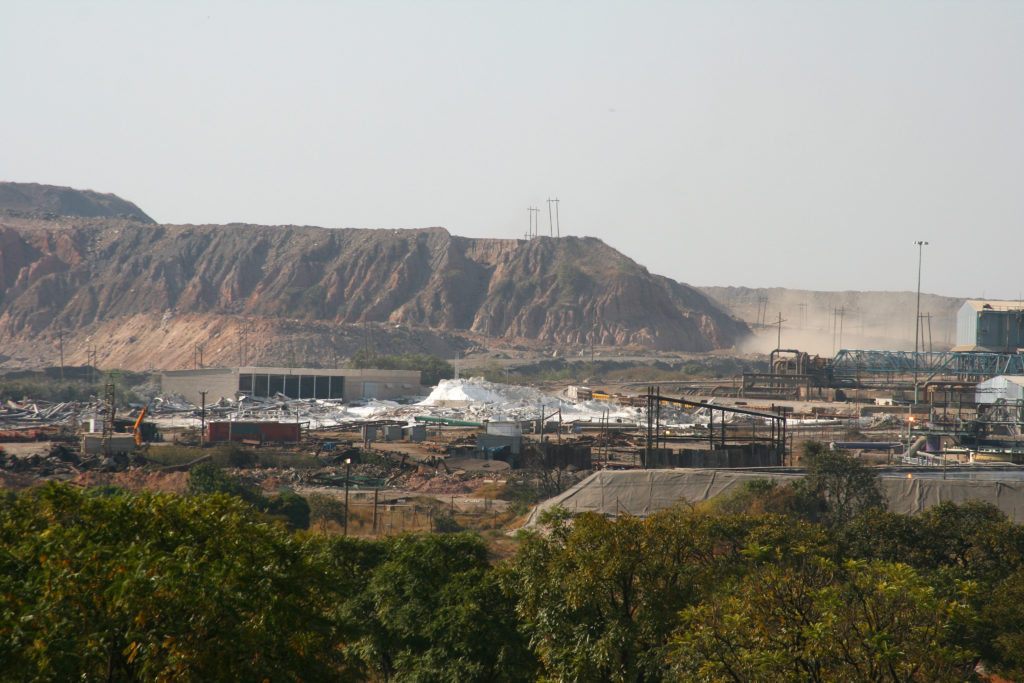
Nchanga mine in Chingola, in the Copperbelt Province of Zambia. (Image courtesy of Wikimedia Commons)
Vedanta’s (NSE: VDAN) Konkola Copper Mines (KCM) has signed a $498 million deal with China’s NERIN Engineering (SHA: 603257) to build a copper recovery plant that will add 70,000 metric tons of annual output by extracting metal from existing mine tailings.
The facility, to be built at KCM’s operations in Chingola, a town in Zambia’s copperbelt, will use leaching technology to process the mine waste and is expected to be the largest plant of its kind in Africa, the company said in a statement on Thursday.
The investment forms part of KCM’s expansion plans and Zambia’s ambition to raise annual copper output to 3 million metric tons by 2031 from 890,346 metric tons in 2025.
Under the agreement, China NERIN will provide engineering, procurement and construction services, along with support for commissioning, performance testing and training, KCM said.
Demand for copper, a key metal used in power grids, renewable energy infrastructure, data centres and electric vehicles, is expected to rise as countries pursue energy-transition goals.
Zambia is Africa’s second-largest copper producer after the Democratic Republic of Congo, whose exports of the red metal fell almost 15% in the first quarter.
(Reporting by Chris Mfula;Writing by Sfundo Parakozov;Editing by Joe Bavier)
Constellium may drop EU metal recycling plans due to scrap squeeze, CEO says
Aluminium products maker Constellium may drop plans to expand recycling in the European Union unless policymakers resolve a scrap shortfall linked to used metal being exported overseas, its CEO said on Tuesday.
The European Commission angered industry representatives this month by abandoning plans to impose an export duty on aluminium scrap, which the industry says is crucial to keeping more of the low-cost raw material in Europe. The EU’s executive is now proposing to curb scrap outflows through waste shipment rules.
Constellium, like other producers in Europe, is sceptical about the waste approach given a large number of non-OECD countries seeking exemptions, CEO Ingrid Joerg told Reuters.
“We have several recycling projects in the pipeline that we are investigating. But if there’s no scrap, they’re not going to happen,” she said.
The projects covered Constellium’s different market segments, such as packaging, auto and aerospace, and could be larger or smaller than a previous €130 million ($148.82 million) recycling expansion at its Neuf-Brisach plant in France, she said, declining further details.
Constellium recycles some of its production in a closed loop but also relies on external scrap.
The loss of scrap to exports is among grievances of an EU aluminium sector also grappling with the bloc’s carbon border-tax scheme and soaring energy prices.
Constellium welcomed changes to the carbon border levy voted by the European Parliament last week, but final adoption was needed swiftly to close loopholes, Joerg said.
The border levy is expected to push up European aluminium premiums, adding to global inflation pressures linked to energy costs, tariffs and Mideast disruption, she said.
Constellium’s US operations were benefiting overall from tariffs, with a high recycling rate and US retention of scrap offsetting the impact of tariffs on Canadian aluminium, she added.
($1 = 0.8735 euros)
(Reporting by Gus Trompiz; Additional reporting by Kate Abnett; Editing by Susan Fenton)
EU waste proposal would ban India from importing bloc’s metal scrap
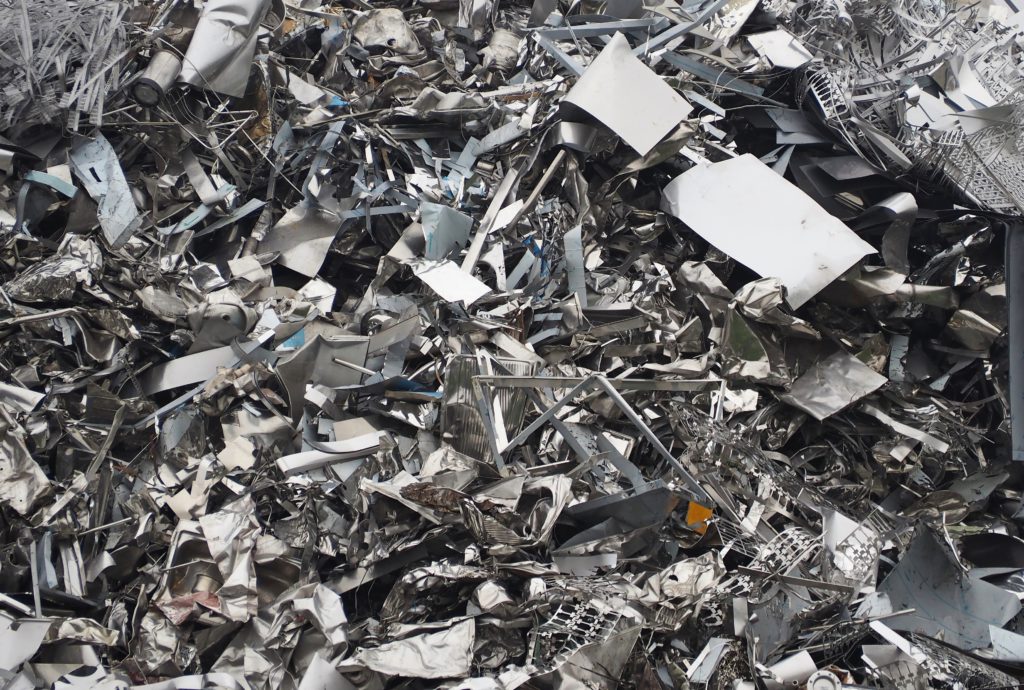
Aluminum and ferrous materials scrap ready for recycling. Stock image.
India will be among the countries barred from importing EU metal waste, including aluminium scrap, under a new law due to take effect in May 2027, according to a European Commission proposal setting out exemptions for non-OECD countries.
The Commission published the proposal on Friday, confirming an earlier Reuters report, and opened a public consultation on the exemptions list until October 16.
The move comes after the Commission earlier this month ditched a plan to impose a 15% export duty on aluminium scrap following pressure from the biggest buyer — India. Disagreements among EU officials diluted the trade proposal by exempting India, significantly reducing its impact.
The Commission has argued that the same objective can be achieved through the bloc’s waste shipment rules rather than trade measures.
Industry group European Aluminium remains unconvinced, however, having viewed the proposed export duty as crucial to keeping more of the low-cost raw material within Europe for struggling smelters.
The Waste Shipment Regulation will take effect in May 2027. The Commission said 32 non-OECD countries applied for exemptions covering non-hazardous waste categories including paper, plastics, rubber, metal and glass. Exemptions are granted only if applicants can demonstrate the waste will be treated in an “environmentally sound manner”.
Metal waste faces stricter scrutiny because it presents a “higher hazard profile … due to the potential presence of persistent and toxic heavy metals,” the Commission said.
The EU executive added that the exemptions list, known as a delegated act, will be updated regularly, at least every two years, and countries will be able to reapply.
(Reporting by Julia Payne. Editing by Mark Potter)
Prysmian, Rio Tinto partner to bring low-carbon aluminum to Amazon data center
Italian cable maker Prysmian (MIB: PRY) said on Friday it had partnered with Rio Tinto (ASX: RIO) to supply electrical cables made with low-carbon aluminium for an Amazon (Nasdaq: AMZN) data centre in Ohio.
The cables will use aluminium produced with ELYSIS “inert-anode” technology, which Prysmian said eliminates direct greenhouse gas emissions from the smelting process, releasing pure oxygen instead.
Project is the first known use of inert-anode-smelted aluminum in a data center, the company said.
“The use demonstrates that the carbon footprint of data centers can be reduced at the raw material level,” it added.
Prysmian will manufacture the cables at its Sedalia, Missouri facility.
The project builds on the collaboration announced by Prysmian and Rio Tinto in March 2026.
Joern Tinnemeyer, Vice President of Data Center Engineering at Amazon Web Services (AWS), linked the initiative to the company’s 2040 net zero target.
(Reporting by Mirko Miorelli, editing by Matt Scuffham)
Big iron ore miners deplete reserves faster than they replace
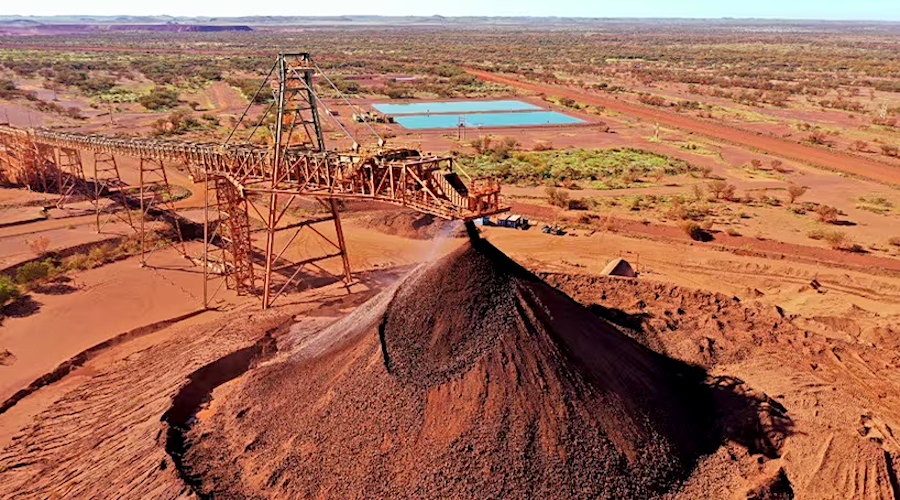
Ore at Jimblebar open-cut pit iron mine in the Pilbara region of Western Australia. (Image courtesy of BHP.)
The world’s biggest iron ore producers are depleting ore reserves faster than they can replenish them, as the cost and complexity of developing replacements continues to rise, according to Wood Mackenzie Ltd.
The six largest iron ore producers, which includes BHP Group and Rio Tinto Group, collectively depleted 11.1 billion tons of ore reserves that could be sold between 2016 and 2025, the consultancy said in a report released Thursday. Only three replaced the volume they mined over the period, and some spent five times more than others to add new reserves, it found.
The industry is increasingly facing an issue with grade depletion, which occurs when the average iron ore content in a mine drops as it ages and requires operators to dig deeper and invest more to extract. Miners are now reaching a point where it’s no longer about growth, but keeping operations running.
“The main challenge for the current iron ore industry is rising costs to maintain existing production,” said Mihir Vora, Wood Mackenzie’s research director for metals and mining. “The industry is investing to sustain production, but it is having to work harder to stand still.”
Costs for major miners have roughly doubled for some companies since 2016, Wood Mackenzie said. Cash margins across the industry peaked in 2021 and have since settled at around $50-$60 a ton, shrinking the margin to absorb rising costs and falling prices.
The analysis also found ore grades had fallen by as much as 1.6 percentage points among some miners since 2016. Higher-grade material is increasingly required to offset the depletion of lower-grade ore, while impurity levels, including alumina, are rising in some products.
(By Katharine Gemmell)
Deluge of copper arriving in US leaves New Orleans with logjam
There’s nothing outwardly remarkable about the journey of the Nord Norfolk, a Liberian-flagged bulk carrier sailing across the Atlantic toward New Orleans.
But the boat is loaded with roughly half a billion dollars of African copper, the highest market value for a single commodity shipment ever recorded by analytics firm Kpler. It’s part of a rush of copper to US shores ahead of potential import tariffs, a deluge that’s key ports are struggling to absorb.
The Port of New Orleans — a key metals gateway and major hub for CME Group’s Comex copper warehouses — is already largely full, according to people familiar with the matter. And that’s before a total of around 100,000 metric tons more of African and South American copper they say is due to arrive in September and October.
“We are seeing serious congestion at marine terminals in the New Orleans area, causing delays for loading copper and other metals and steel to trucks and railcars,” said Anton Posner, chief executive officer of logistics-services provider Mercury Resources. His firm is sending metal up the Mississippi by barge instead.
Port of New Orleans didn’t respond to an emailed request for comment.
The $500 million boatload and the New Orleans logjam are part of a long drama playing out in the global copper market as traders brace for President Donald Trump to decide whether to expand copper import levies to refined metal. He hasn’t done so months after a decision was expected, and the metal is still pouring in for now.
The strength of US copper imports has been the key force behind a record-breaking rally in copper prices, with the global benchmark set on the London Metal Exchange climbing about 50% since Trump first formally proposed tariffs on the metal in February last year. US futures have rallied even more sharply, creating huge arbitrage profits for the traders and producers that have been shipping copper to the US in record volumes.
But in recent weeks the gap between US and international prices has narrowed as doubts grow about whether Trump will ultimately push ahead with tariffs. In turn, the question of whether US imports will slow has become a crucial one in all corners of the copper industry — from investors weighing whether copper’s record rally can be sustained, to Chinese manufacturers who’ve seen costs to secure their own imports surge as copper has gravitated toward the US.
One measure puts the arbitrage gap now at $169 a ton, versus $789 at this year’s height, and it has fluctuated a lot since Trump’s return to office. The narrower premium weakens the incentive to keep shipping to the US, and some future shipments could be redirected instead to Asia. But changing course en route can be complicated and expensive.
“I wouldn’t call the arbitrage dead just yet,” said Marcos Carias, North America economist at global trade-credit insurer Coface.
Warehousing companies are seeking approval for additional capacity from Comex as US storage requirements balloon. Since the start of 2025, the exchange said it has added 20 warehouses and nearly 725,000 short tons of copper capacity. That’s equivalent to about 39% of annual US refined-copper consumption. Sites were added in Mobile, Chicago and Atlanta this year.
Shipper BBC Chartering also added Mobile — on the Alabama coast — as another stop for South American copper, according to a person with knowledge of the matter.
“The potential for tariffs alone has essentially had the effect they want from tariffs; that is, bringing lots of supply into the country and increasing domestic premiums to support domestic projects,” said Ryan McKay, senior commodity strategist at TD Securities. The White House will likely continue to delay a decision to keep this the case, he said.
(By Yvonne Yue Li, James Attwood and Julian Luk)
Attacks on mining operations on the rise in Pakistan: report
More than 30 mining operations have been attacked in Pakistan’s resource-rich Balochistan province in 2026, raising security risks as the country seeks investment to develop some of the world’s largest undeveloped copper-gold deposits.
Balochistan recorded 38 attacks connected with extractive operations between January and September, bringing the total over the past three years to more than 130, according to data from the Armed Conflict Location & Event Data (ACLED) report.
“This risks undermining Pakistan’s drive to attract international investment and develop its mineral sector amid the global scramble for critical minerals,” ACLED South Asia assistant research manager Pooja George said in a news release.
Balochistan is a region swarmed by conflict between separatists and the government especially around extraction of copper, gold, chromite, coal and natural gas. For separatists, extraction equals exploitation of the country’s wealth, causing them to target operations for what they signify.
The attacks make it more difficult for Pakistan to leverage its untapped mineral and fossil fuel wealth, as well as find safety solutions for all parties involved in the conflicts.
Transport targeted
Balochistan has reported over 130 attacks in the last three years directly connected with extractive operations, with 38 being just between January and September 2026.
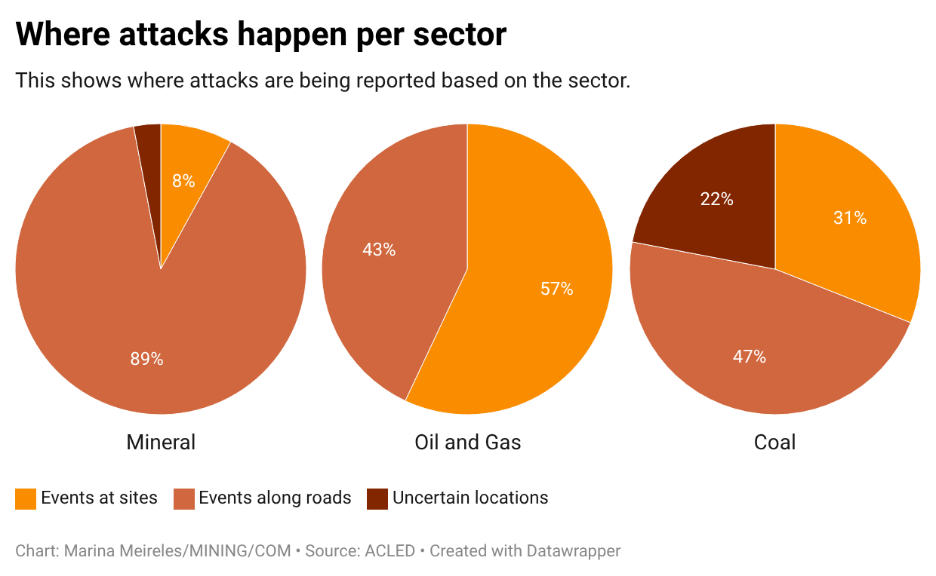
Attacks on mineral projects occur predominantly during transportation, where militants can bypass the heavier security surrounding mine sites, according to ACLED.
Flagship projects such as the Reko Diq copper mine and Saindak copper-gold mine involve foreign partners and receive protection from private and state security forces.
Publicly-owned oil and gas operations face a different pattern. More than half of the attacks against those operations take place on extraction sites, a result of less security when compared to mineral projects. Coal operations have experienced most of its attacks during transportation and about a third on site.
Nature of conflicts
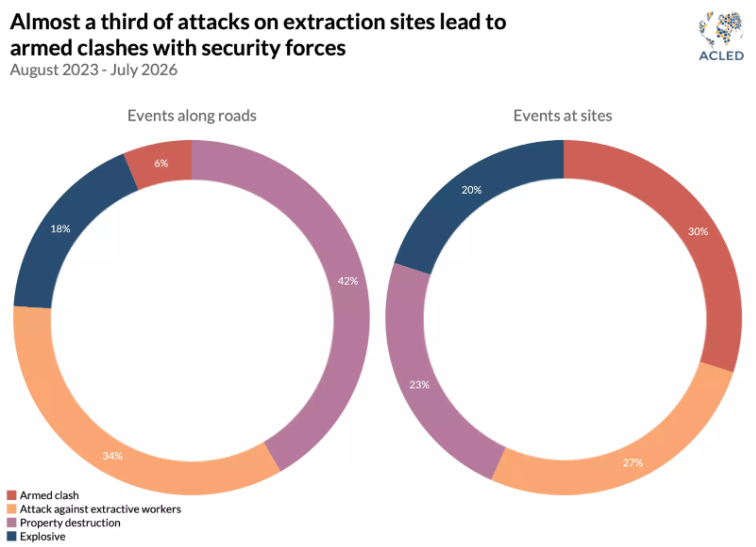
With less than 17% of attacks involving roadside bombs or landmines, ACLED suggests that the purpose of attacks is to disrupt operations by creating an insatiable atmosphere, rather than harming workers and civilians.
Nearly 90% of separatist attacks against mineral projects happen on roads. Gunmen typically fire at vehicle tires to disable trucks and sometimes set the vehicles ablaze after allowing drivers to leave, according to ACLED.
“Most attacks impacting mining involve property destruction rather than fatalities. The aim appears to be disruption: creating and amplifying a sense of instability around mining operations and making the environment increasingly difficult for companies to operate in,” George said.
Militants have also increased roadblocks and checkpoints in the region to facilitate attacks, aiming to show how the state’s authority has decreased and that fear is spreading especially along remote areas. ACLED data show that the number of such events in 2026 is on track to surpass 2025 levels.
Attacks on extractions sites can carry greater human costs because militants are more likely to encounter security forces, increasing the potential for lethal clashes.
Operations workers and companies have felt this increase in instability, with privately-owned mining operations warning about shutdowns or slower operations and workers going on strike.
Impact on Pakistan’s mining future
The stakes are rising as Pakistan courts international investment to develop Balochistan’s largely untapped mineral wealth.
Lack of well-developed and secured transportation infrastructure and the need for state security bring more risks to foreign investors, as separatists are more likely to attack their operations as the government is their biggest adversary.
ACLED also adds that another risk that comes with increased security, is the abuse of those forces, that can carry reputational costs for companies and impact local community engagement, which is key to safe operations.
Continued attacks could also draw more international attention to the separatist insurgence, giving militants a larger platform while potentially exposing them to a stronger state crackdown.
Pakistan has deployed additional security forces to Balochistan, but ACLED argues security measures alone are unlikely to resolve a conflict rooted partly in political disputes over resources, autonomy and the distribution of economic benefits.
“Opposition to resource extraction lies at the heart of the Baloch separatist insurgency, meaning attacks may escalate further as Pakistan seeks to leverage its untapped mineral wealth,” George said.
US battery startup that chose China over Kentucky opens first factory as Trump, Xi meet
A US battery startup that scrapped plans to make Kentucky the site of its first factory has instead built it in China, exposing the limits of President Donald Trump’s efforts to lure manufacturing home just as he welcomes Chinese President Xi Jinping for a summit.
EnerVenue starts mass production at its manufacturing facility in the eastern Chinese city of Changzhou on Thursday, the same day Trump meets Xi in Washington, as relations between the superpowers remain strained by a tariff war the US president launched partly to bring back manufacturing and jobs.
Chief Executive Henning Rath told Reuters the date was a coincidence, and the decision to manufacture in China instead of the US was down to skills and supply chain depth — particularly in Changzhou, which bills itself as China’s “new energy capital.”
“The secret sauce is this industrial cluster,” Rath said, citing the density of hydraulics, pneumatics and automation specialists, along with engineers able to iterate quickly on what he called a “first-of-its-kind” line.
Without building in China, Rath said, it would be “very difficult with the capital available” to prove the manufacturing process at a commercial scale.
EnerVenue’s choice exposes how Trump’s offer of lower taxes, easier permitting and other incentives may not be enough to overcome the advantages offered by places like China, even in a sector viewed as critical to US energy security and supply-chain resilience.
When Rath joined the company in April, he made building in China a precondition for taking the job.
Lower costs, deeper expertise
A floor manager at the Changzhou plant said local suppliers often develop equipment without payment until a design is adopted, unlike foreign vendors that tend to ask for money upfront.
Graduate engineers earn about 12,000 yuan ($1,792) a month, well below US salaries, he added.
EnerVenue, which has R&D in Fremont, California, and was founded by Stanford materials science professor Yi Cui, makes nickel-hydrogen batteries derived from technology NASA used in the Hubble Space Telescope and International Space Station.
It announced a Kentucky factory plan in 2023 with a first phase costing $264 million and creating 450 jobs, but abandoned it a year later.
Rath, speaking as engineers tested spinning hydraulic arms and lidar-guided robots ferried materials between production stations, said the attempted project was a “valuable learning experience,” but the technology wasn’t yet ready.
EnerVenue went on to redesign both the battery and the factory.
Expansion plans
Rath declined to disclose the cost of the Changzhou facility, which is around 95% automated and will employ about 400 workers by the end of the year, but gave a $20 million to $50 million range. Government support was limited to permitting, certification and site selection, he said.
EnerVenue raised more than $300 million in a March funding round led by Full Vision Capital, the family office of Hong Kong property heir Peter Lee Ka-kit, whose broader group includes customer Towngas, Rath said, with other investors including Saudi Aramco and SLB.
The company aims to reach annual capacity of 250 megawatt hours this year, equal to about 300 battery cells a day, rising to 1 gigawatt hours by the third quarter of 2027.
It’s unclear whether China-made cells will qualify for US clean energy tax credits, which Trump’s 2025 tax law kept for battery storage while adding restrictions on Chinese content and ownership.
“We are an American company with a Chinese footprint,” Rath said.
EnerVenue plans to open similar factories in North America, the Middle East and Europe from 2028, with sites to be chosen next year, said Rath.
But he stressed that China is the “factory of factories” and “an important stepping stone” towards global production.
Asked whether EnerVenue would open a US plant, Rath said, “We want to play in the North American market. It depends a little bit now on legislation and regulation.”
($1 = 6.6955 Chinese yuan)
(Editing by Marius Zaharia and Kevin Buckland)
Niche metals test West’s resilience to Chinese export curbs
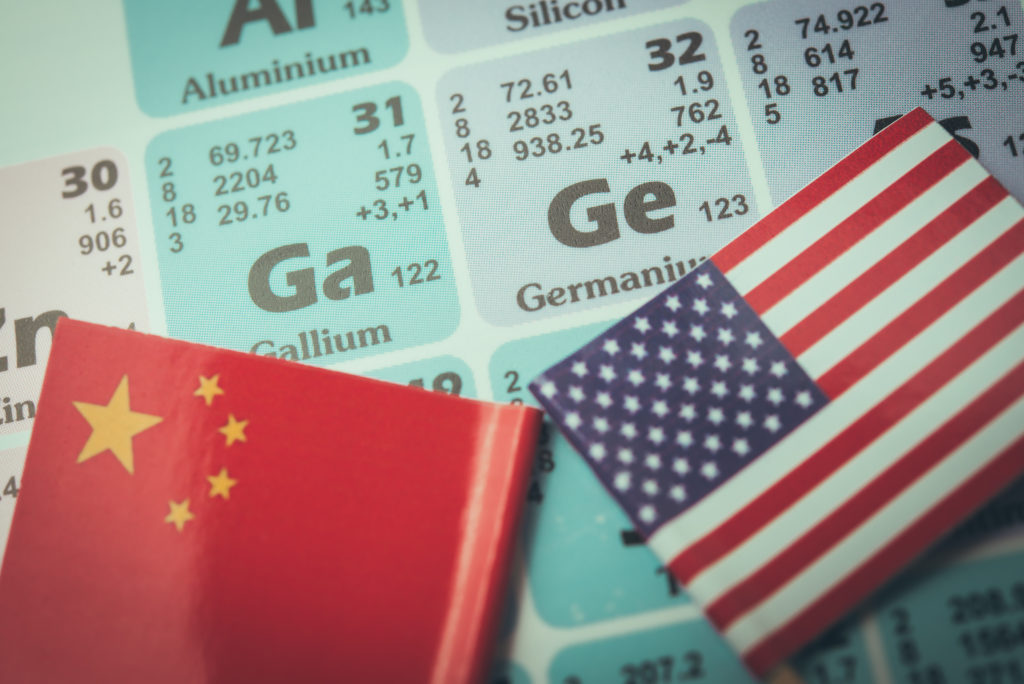
Three years on from China curbing exports of two niche metals vital to the chipmaking, clean energy and defence sectors, the West is still feeling the price pain and waiting for its own production to come to the rescue.
The export curbs on gallium and germanium have forced Western companies to stockpile, seek alternative supplies, and explore new designs and substitutes. But the decisive response is only now taking shape, with several Western production projects announced in recent months aimed at finally breaking China’s stranglehold on the niche but vital market.
With prices now at 9 to 10 times 2023 levels, that new supply cannot come soon enough.
Chart: Reuters.
“These export controls have acted as a real wake-up call… In response, companies are increasingly diversifying their procurement strategies, turning to recycling, alternative suppliers and emerging non-China projects where possible,” said Cristina Belda, senior analyst at Argus.
Manufacturers of infrared optics used in defence and thermal imaging systems have particularly struggled with tight supply, she said.
AI contributing to rising demand
While production projects take shape, the AI boom, expanding fibreoptic networks and growing use of infrared imaging are pushing up demand.
Gallium demand is seen rising by about 12% per year through 2030 from about 1,000 metric tons in 2025, preliminary S&P Global estimates show.
Global germanium demand is set to rise by 3.3% annually over the same period from an estimated 343 tons in 2025, S&P Global said.
Yet consultancy Project Blue estimates China in 2025 still accounted for 98.9% of primary gallium supply and 68.6% of germanium supply, underscoring the scant progress made so far in reducing China’s dominance.
Chart: Reuters.
In introducing its export controls in 2023, later expanded to include rare earths and other critical minerals, Beijing used that dominance as leverage in trade and other disputes.
Metals substitution
Replacing either metal — primarily byproducts of alumina and zinc processing — with other materials brings its own challenges.
“There is no one-to-one substitute for germanium,” said Jessica DeGroote Nelson, senior vice president of precision optics at US-based Edmund Optics, noting using other materials would require redesigns.
“It’s not impossible, but it is very challenging.”
A source at another optics company said it has succeeded in switching to substitutes in some applications, halving germanium use over the past 18 months, using Western suppliers and raising its prices.
“We do have many customers who are willing to purchase at current prices, the issue here is the availability of supply,” the person said.
Industry participants say gallium arsenide is being replaced by indium phosphide in some semiconductor applications while zinc selenide, zinc sulphide, silicon and chalcogenide glass are gaining traction as germanium alternatives in some infrared applications. Still, all those require costly technological adjustments that take time, industry insiders say.
Stockpiling is another response. DeGroote Nelson said some customers buy germanium before designs are even finalised in order to ensure availability when production begins.Recycling is yet another route being taken by US-based Lattice Materials, which uses germanium to produce crystals for displays in fighter jets, tanks and other military equipment.
“We don’t see supply loosening up anytime in the near-term,” company president Travis Wood told Reuters.
“Every data point we’ve seen shows prices to at least stay at current high levels or even continue the upward trend,” Wood said.
Belgium’s Umicore (EBR: UMI) has also been working with STL, a unit of Gécamines that processes mining waste in the Democratic Republic of Congo, to boost germanium recovery.
Playing catch-up
As the race to build new supply gathers momentum, the pressure from ever rising demand means some producers say they are already playing catch-up.
In Greece, METLEN (LON: MTLN), which has begun pilot-scale production and aims to produce 50 tons of gallium annually by 2028, says demand from potential customers now already exceeds that target several times.
In April, Australia and the US pledged over $3.5 billion to support a range of critical minerals projects, including gallium and germanium, nearly doubling an initial amount agreed last year.
Underscoring the need for that support, S&P Global expects ex-China gallium supply capacity to total 20 tons by the end of 2026, leaving a supply gap of about 678 tons. Non-Chinese germanium metal production is seen at 31 tons, or 177 tons short of demand.
Jack Bedder, founder and director of consultancy Project Blue, told Reuters that the emergence of credible projects with government support offers a chance for greater diversification, but the economies of scale still favour China with its enormous capacity and production costs new Western projects will struggle to match.”We think a material reduction in dependence is achievable over five years, but eliminating dependence on China is much less realistic.”
Government support such as price floors will probably be needed to bring new supply and ensure its long-term commercial viability, said Piyush Goel, consultant at London-based consultancy CRU.
By 2030, S&P Global estimates eight announced projects, including Wagerup in Australia and Clarksville in the United States, could boost ex-China gallium supply to about 386 tons from roughly 5 tons currently.
Yet even that will leave ex-China demand looking to China for 65% of its supply, Reuters calculations based on S&P data show.
New germanium projects in Canada, South Korea and the United States are expected to help lift ex-China germanium refining capacity to 126 tons by 2030. But even with five ex-China refineries potentially operating, capacity would cover only about 48% of projected ex-China demand, according to S&P.
Early stages
Several of the announced gallium projects, including those planned by METLEN in Greece, Alcoa (NYSE: AA) and Sojitz in Australia, Rio Tinto (ASX: RIO) and Indium Corporation in Canada, and Nalco (NSE: NATIONALUM) in India, are still being developed and have yet to reach full commercial production.
New entrants complement those efforts — Korea Zinc is developing gallium and germanium capacity at home and at a planned Tennessee refinery, and US-based ReElement Technologies is developing a refining complex in Indiana.
Titan Mining, a zinc and graphite producer, expects to start germanium production in New York state by year-end at 2.5 to 3 tons, or about 7% to 10% of US demand.
At the same time, a handful of established non-Chinese germanium suppliers are working to boost their output.
Canada’s Teck Resources (TSX: TECK.B) struck a deal with Ottawa in July to support an expansion of production at its facility in Trail, British Columbia.
(Reporting by Ashitha Shivaprasad; additional reporting by Eric Onstad, Ernest Scheyder, Solomon Cefai and Divya Rajagopal; editing by Pratima Desai, Tomasz Janowski and Jason Neely)