Tsikhanouskaya warns Belarus could host new Russian attacks on Ukraine
Belarusian leader Alexander Lukashenko would welcome new Russian attacks on Ukraine from his territory, exiled opposition leader Sviatlana Tsikhanouskaya told Ukrinform in interviews published on September 23.
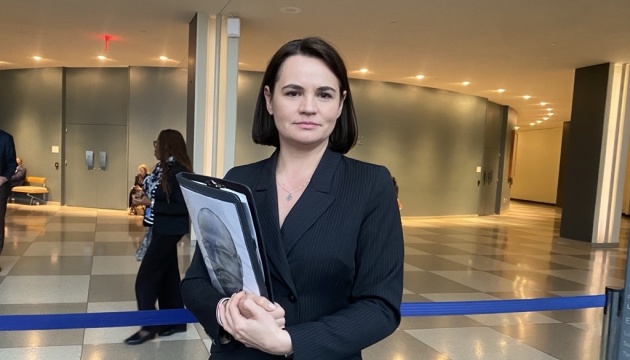
Sviatlana Tsikhanouskaya at the UN headquarters in New York during the General Assembly's high-level week. Photo: Volodymyr Ilchenko/Ukrinform
Tsikhanouskaya told Ukrinform that Lukashenko would "be very happy" to provide territory, logistics and infrastructure for such attacks. Speaking on the sidelines of the UN General Assembly in New York, she said the threat of Russian provocations from Belarusian soil was "a real possibility", and that Belarusian logistics and "antennas for directing drones" were already in use by Russia.
Her warning comes days after Kyiv said it had detected Russian drone signal relays operating inside Belarus for about a week, boosting communications for drones striking western Ukraine. Andrii Demchenko, spokesman for Ukraine's State Border Guard Service, said on September 19 that the activity had been "quite high" but that there was no build-up of Belarusian forces near the border large enough to mount an invasion. Ukrainian President Volodymyr Zelenskiy has previously demanded Lukashenko dismantle the relays guiding Russian strikes into Ukraine.
Tsikhanouskaya said the repeaters were being installed not only along the Ukrainian border but also along Belarus' borders with EU countries.
"So, the escalation or provocation may not only be against Ukraine but also against European countries. And, of course, we need to closely monitor what is happening in Belarus," she said.
Lithuania has faced a string of airspace incursions from Belarus in recent weeks, with an unidentified object travelling up to 70 km through Lithuanian airspace on September 14.
Tsikhanouskaya dismissed hopes in some Western capitals that Lukashenko can be prised away from the Kremlin. "It is impossible because they have this special symbiotic friendship; they use each other, and they need each other," she said.
Lukashenko is acting partly out of fear of Russian President Vladimir Putin, she said, but has let Russia penetrate Belarus' media, education, economy and defence industry, amounting to a quiet occupation of the country with intensive Russification carried out with his consent.
She accused Lukashenko of "making money from the blood of Ukrainians", saying 500-600 Belarusian enterprises make optics and microchips for Russia's military, buy components for it by circumventing sanctions and supply Russia with petroleum products. The regime is also building warehouses for Russian online marketplace Wildberries, she added.
A Ukrainian victory would be "a catastrophe for him personally, because a weakened Putin would mean less support for the regime in Belarus," Tsikhanouskaya said, adding that Lukashenko "would, of course, like Russia to win".
However, she doubted Belarusian troops would join any offensive, arguing in a second interview that Lukashenko would be afraid to give such an order because it could provoke discontent in the army. "There are no anti-Ukrainian sentiments among Belarusians," she said. "We have no enemies except the Russian occupation."
Even Lukashenko's own elite sees him as a "lame duck" dependent on Putin, she claimed.
"People in his circles are already talking about the post-Lukashenko era - what Belarus might look like without Lukashenko," Tsikhanouskaya said. "That is why he clings to Putin tooth and nail."
Tsikhanouskaya was in New York for a ministerial event hosted by Latvia and the EU on September 21 titled "Belarus: Accomplice in Russia's War Against Ukraine and a Threat to International Security". There she made five requests of Belarus' partners, according to a post on X: a strong resolution in the General Assembly's Third Committee on political prisoners, transnational repression and the regime's role in the war; an Arria-formula Security Council meeting on Belarus with former political prisoners and rights defenders; putting transnational repression on the international agenda with Interpol and UN experts; an internationally recognised solution for Belarusians who cannot safely renew their passports; and funding for the UN special rapporteur and the Group of Independent Experts on Belarus.
The passport issue affects Tsikhanouskaya herself, who was refused a Polish bank account in August because her Belarusian passport had expired. She also urged every leader speaking during the General Assembly's high-level week to mention Belarus, and called on the West to "give Ukraine everything it needs to defend itself and prevail".
Her appeal to keep Belarus on the UN agenda comes as Washington pursues separate talks with Minsk, which have seen Lukashenko release political prisoners in return for sanctions relief. In the latest round, the US agreed to lift sanctions on two Belarusian companies for the release of 25 prisoners, while pressing Lithuania to reopen potash transit through Klaipeda after a four-year halt.

No comments:
Post a Comment