PEOPLE'S CAPITALI$M
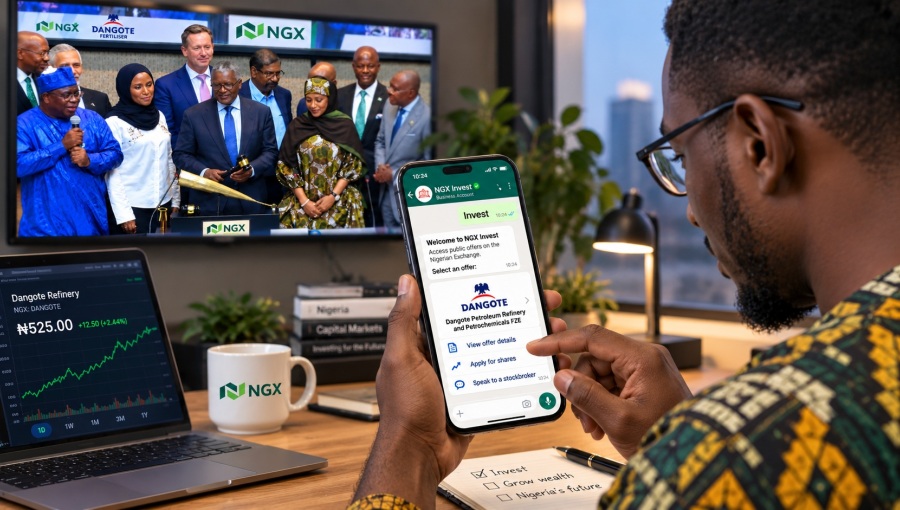
Nigeria’s capital market is moving closer to the consumer technologies through which people increasingly manage the rest of their financial lives.
Nigerian Exchange Group Plc (NGX:NGXGROUP) has made WhatsApp an official entry point to NGX Invest, the stock exchange’s electronic public-offer platform.
The move comes after the Dangote Petroleum Refinery and Petrochemicals FZE’s $1.6bn initial public offering (IPO), Africa’s largest-ever share sale, overwhelmed several of the country’s digital investment platforms as retail investors rush to participate.
Within 30 minutes of the offer opening on September 17, traffic on investment app Bamboo had risen to about 10 times normal levels, triggering outages that also affected some third-party providers. Cowrywise and InvestNaija users also reported difficulties accessing services and executing transactions.
Now, investors can send “Invest” to NGX Invest’s official WhatsApp number, +234 812 731 9521, view eligible offers and begin the subscription process without downloading a dedicated investment app. Applications are still routed through a stockbroker selected by the investor.
See: Nigeria's $1.6bn Dangote refinery IPO overwhelms fintech platforms as retail investors rush in
Dangote is offering 4.1bn new shares at NGN525 ($0.40) each, seeking NGN2.1525 trillion. The minimum application is 10 shares, costing NGN5,250 ($4), in a bid to boost retail investor involvement.
For one of Nigeria’s most recognisable companies, that low entry threshold is significant. The offer is testing whether a familiar issuer, a small minimum investment and easier digital access via WhatsApp can draw a wider group of Nigerians into public equities.
Reuters reported on September 18 that prospective investors were joking on social media about becoming business partners with company founder Aliko Dangote and joining the board of “our refinery”.
The 4.1bn base-offer shares would represent about 3.3% of the refinery’s enlarged share capital if fully allotted, leaving existing shareholders with roughly 96.7% in aggregate before any additional shares issued under the offer’s oversubscription provision.
See also: Nigeria’s Dangote refinery IPO puts Africa’s refining shift in focus
From forms to phones
MTN Group’s 2021 sale of shares in MTN Nigeria was the first Nigerian public offer to use PrimaryOffer, a digital application platform administered by Nigerian Exchange Limited.
MTN Group said more than 74% of retail subscribers applied through PrimaryOffer. MTN Nigeria separately put the digital share at more than 89%. A total of 126,720 retail investors submitted valid applications and received full allotment, with institutional participation counted separately.
NGX Invest extended that model when it launched in 2024 as an electronic offering platform approved by Nigeria’s Securities and Exchange Commission. NGX says the system has since facilitated more than 23 primary-market transactions and supported more than NGN3 trillion in capital raising. Its API network, according to the group, connects to more than 100 distribution channels spanning stockbrokers, banks, fintech companies, mobile operators and other financial institutions.
Public offers can consequently reach investors through bank branches, websites, point-of-sale terminals, ATMs and, now, NGX’s official WhatsApp channel.
Much of the underlying process remains conventional. Brokers, identity checks, payments, registrars, settlement and allotment still sit behind the transaction. The change lies in how much of that infrastructure an investor has to confront directly. NGX’s move brings that interface into the exchange group’s own distribution architecture rather than leaving it to brokers or platforms as an auxiliary channel.
The shift towards easier digital access also raises questions about infrastructure resilience and investor protection. Bamboo co-founder and chief operating officer Yanmo Omorogbe described the Dangote IPO as a stress test for Nigeria’s financial infrastructure.
Reuters reported that the surge in retail interest could also expose investors to phishing, fake investment websites and impersonation, while Financial Derivatives Company chief executive Bismarck Rewane warned more generally: “Somebody can create all sorts of scams.”
The development follows a broader migration in Nigerian finance away from branches and paper forms towards services delivered through phones. Public securities are beginning to move through some of the same channels.
Dangote tests the retail market
Few issuers are likely to draw as broad an audience as Dangote.
The refinery combines unusual name recognition with a low minimum application for a transaction of its size. Reuters also reported disruption at investment platforms Cowrywise and InvestNaija after the offer opened.
Dangote has himself leaned into the accessibility of owning shares, declaring at the launch: “This is the IPO for the people.” Applicants, however, become shareholders only if shares are ultimately allotted. No current aggregate book figure had been publicly confirmed, but the strain on investment platforms nevertheless gives some indication of the audience that can emerge when a familiar company is paired with a low subscription threshold.
An opinion column published by BusinessDay on September 23 argued that strong early demand demonstrates investor appetite but does not by itself establish that the NGN525 offer price is attractive, with returns still dependent on refining margins, utilisation and other operating assumptions.
Dangote benefits from brand recognition that most issuers cannot replicate. Its founder is Africa’s richest man, while the refinery has spent years at the centre of Nigerian debate over fuel supply, imports, prices and industrial policy.
For prospective shareholders encountering equities for the first time, the company therefore requires less explanation than a little-known industrial or financial issuer.
A population already moving money by phone
EFInA’s 2026 Access to Financial Services survey found that 79% of Nigerian adults were financially included, up from 74% in 2023. Formal financial inclusion rose to 73% from 64%, while financial exclusion fell to 21% from 26%. Mobile-money use more than tripled to 38% from 12%.
Domestic investors already dominate turnover on Nigerian Exchange. They accounted for 89.8% of transaction value in the first eight months of 2026, although institutional investors continued to trade more than retail investors within the domestic market.
The potential expansion is therefore not simply a matter of replacing foreign capital with Nigerian capital. It concerns the composition of domestic participation: whether equities can extend further beyond institutions, professional investors and established brokerage clients.
Nigeria’s fintech industry has helped normalise transfers, digital wallets and app-based financial services. Equity investing remains a more demanding proposition. Payments solve an immediate transactional need; shares require disposable income, tolerance for losses and some ability to judge valuation.
What comes after Dangote
Dangote is an unusually favourable vehicle for introducing people to equities.
Its founder is one of the continent’s best-known businessmen. The refinery is among Nigeria’s most prominent industrial projects. At about NGN2.15 trillion ($1.6bn), the base offer has been described by Reuters and other market sources as Africa’s largest-ever IPO.
Most issuers will not combine that level of public familiarity with an NGN5,250 minimum application.
The more revealing test will come later. Investors who open accounts or navigate a public offer for the first time because they want 10 Dangote shares may be easier to reach when another company comes to market. Whether they participate again will depend on factors that brand recognition can temporarily obscure: valuation, trust, liquidity and the quality of the underlying investment case.
Nigeria has already shifted much of public-offer distribution from paper towards web platforms, investment apps and API-linked channels. NGX’s move on to WhatsApp takes that process further into the consumer mainstream.
If the result is a broader retail market, the evidence will appear not in the number of Nigerians willing to buy a small stake in Dangote, but in whether those investors return when the next issuer is less famous and the decision requires more than familiarity with the name.

No comments:
Post a Comment