It’s possible that I shall make an ass of myself. But in that case one can always get out of it with a little dialectic. I have, of course, so worded my proposition as to be right either way (K.Marx, Letter to F.Engels on the Indian Mutiny)
Wednesday, September 23, 2026
‘Blood potash’: Scott Moe reacts to Trump’s Belarus deal
U.S. President Donald Trump says he is working on a “massive deal” to purchase potash from Belarus.
“The pricing would be for substantially less than we are currently paying to Canada, very good news for our Farmers and Ranchers,” he posted to Truth Social on Monday.
The leading destination of Canadian exports of potash is the United States. The U.S. imports nearly 85 per cent of its potash from Canada.
Belarus ranks third in potash production behind Russia and Canada.
According to Belarusian media reports Monday, President Alexander Lukashenko said even if there was a desire to enter western markets, there is nothing left to supply.
Reuters reported that potash from Belarus remains under EU sanctions, and the landlocked country has been barred from exporting via the Lithuanian port of Klaipeda since February 2022.
Saskatchewan Premier Scott Moe, whose province provides the U.S. with more than 86 per cent of its potash supply from Canada, said Trump’s tentative deal is “wrong and it doesn’t make sense.”
“More than 40 countries - Canada and its allies - have sanctions against Belarus for supporting war criminal Putin’s invasion of Ukraine. Buying blood potash from Belarus is supporting Russian aggression,” he posted to X Monday afternoon.
“Does anyone believe Belarusian blood potash shipped through Russia is going to be more affordable, more sustainable or more ethical than potash shipped from Saskatchewan - right here in North America?”
Potash leverage in U.S.-Canada trade war
In June, Trump told reporters that there is nothing the U.S. needs from Canada. However, U.S. Ambassador Pete Hoekstra said America needs a “tremendous amount of things” including Canadian potash, since there are “not lots of other places that you can get it.”
Canada’s premiers have been at odds about whether to leverage the critical mineral against the U.S. amid trade war tensions.
While Ontario Premier Doug Ford has previously pushed to retaliate against Trump’s tariffs by cutting U.S. access to electricity, oil and other minerals, Alberta Premier Danielle Smith and Moe said they were concerned about the long-term consequences for those industries.
Canada’s 10 active potash mines are located in Saskatchewan.
Moe has said the province would not support any kind of export taxes or withholding supply for the U.S., as losing its biggest customer would cause job losses, price hikes and a tremendous hit to the local economy.
“The United States of America, most assuredly, would switch to buying potash from other nations around the world. We would lose a long-term customer to some degree,” Moe said during trade talks.
Smith also echoed Moe in July, when she told reporters oil and potash being used as retaliatory measures is “not going to happen.”
Canadian potash has remained exempt from Trump’s tariffs amid the ongoing trade war. However, the U.S. looking to Belarus for potash supply signifies the latest escalation.
The move comes after Prime Minister Mark Carney welcomed the “ambition” to become the European Union’s first associate member, which Trump said he’ll retaliate against if he deems it to be a “hostile act.”
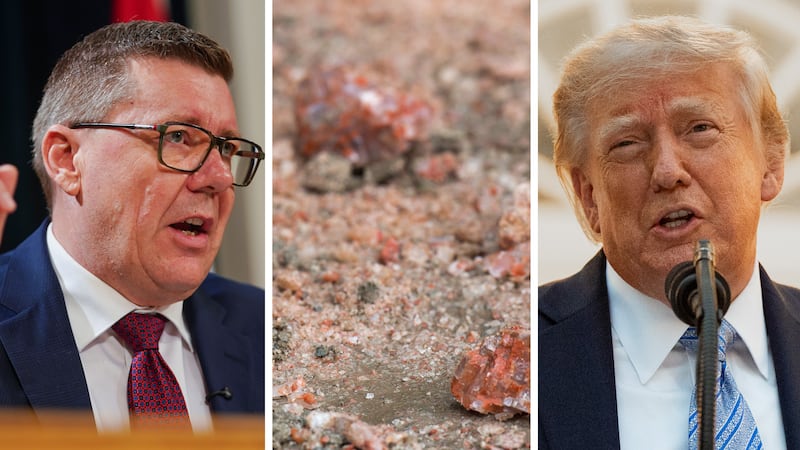
This combination photos shows Saskatchewan Premier Scott Moe, potash, and U.S. President Donald Trump. (Associated Press, Canadian Press)
Belarus sanctions
The U.S., Canada and EU have all imposed sanctions on Belarus for its crackdown on human rights and for allowing its territory to be used by Russia for its full-scale invasion of Ukraine in 2022.
However, in December 2025, the U.S. agreed to lift sanctions on Belarusian potash, after Lukashenko freed 123 prisoners with the help of Trump’s envoy.
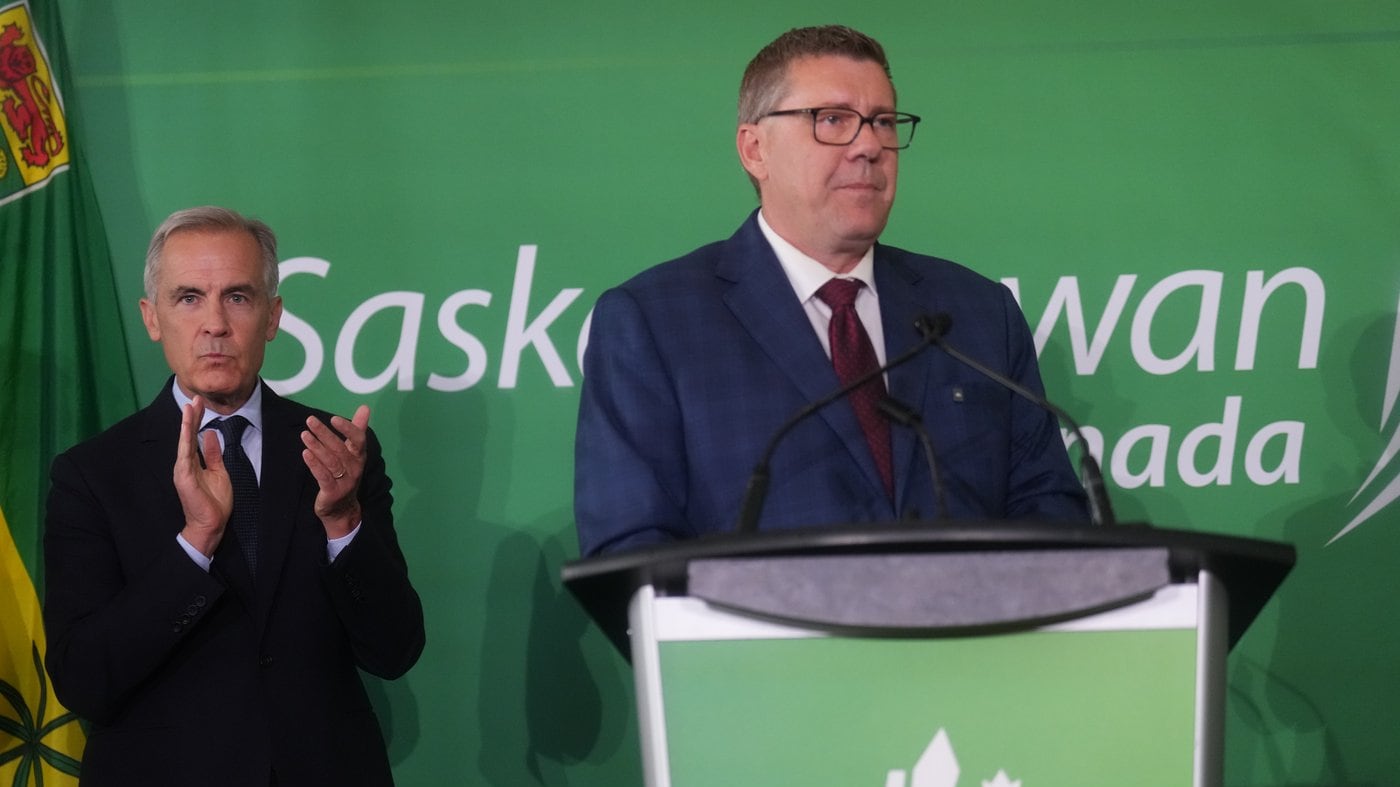
Prime Minister Mark Carney, left, applauds as Saskatchewan Premier Scott Moe speaks at Canada's national investment summit, in Toronto, on Monday, Sept. 14, 2026. THE CANADIAN PRESS/Nathan Denette
REGINA — U.S. President Donald Trump says his country will continue buying Canadian potash after all.
Trump made the comments to reporters Tuesday during a bilateral meeting at the United Nations General Assembly with Ukrainian President Volodymyr Zelenskyy.
It comes a day after Trump said he was working on a deal to buy cheaper potash from Belarus in a bid to lessen the United States’ dependence on Canada.
“Belarus has a lot of potash, and our farmers need good prices, and we want to get a lower price,” Trump told reporters when asked about the proposed deal.
“We’ll continue to go with Canada, but Belarus would like to sell it for a much lower price.”
Canada is the world’s largest producer of potash, a key component of fertilizers, and the United States is its biggest customer.
Asked about Trump’s comments, Prime Minister Mark Carney told reporters at a separate news conference that Canada’s potash is reliable and cost-effective.
He said Canada will continue to supply the United States with potash and that there’s an opportunity for both countries to grow the fertilizer industry together.
“That would be good for Canadian farmers, it would be great for American farmers,” Carney said.
All of Canada’s potash is produced in Saskatchewan.
On Monday, Saskatchewan Premier Scott Moe condemned Trump’s initial comments, saying Belarusian potash is unethical due to the country’s involvement in Russia’s invasion of Ukraine.
Industry leaders and economists have also questioned how the United States could get cheaper potash from Belarus when Canada is much closer and has reliable supply-chain infrastructure.
Belarus President Alexander Lukashenko has also said his country has limitations, saying it can’t supply the United States with large volumes of potash.
This report by The Canadian Press was first published Sept. 22, 2026
Jeremy Simes, The Canadian Press
Trump says Belarus potash deal in works amid Canada fight
President Donald Trump said the US is working with Belarus to secure more supplies of potash amid a trade fight with Canada, a major supplier of the critical ingredient used in fertilizers.
“The United States is working on a massive Deal with respect to the purchase of Potash from Belarus,” Trump said in a social media post Monday. “The pricing would be for substantially less than we are currently paying to Canada, very good news for our Farmers and Ranchers.”
Trump’s comments come amid an escalating trade war with Canada that has seen the two countries impose tit-for-tat tariffs on imports. Trump’s levies, however, don’t apply to some of the most significant natural resources the US buys from Canada, such as oil, potash and critical minerals — an indication of their importance to the US economy.
Canada is one of the world’s largest exporters of potash and any move to restrict those supplies flowing to the US could have a major impact on the American agricultural sector.
The world’s largest reserves of potash, which is mined, are located in Saskatchewan. Shares of Canadian fertilizer producer Nutrien Ltd. dropped as much as 5.2%, while Tampa-based Mosaic Co. fell 5.9% intraday before paring losses. The two companies dominate North American potash production via their joint venture Canpotex.
Trump has sought to rebuild ties with Belarus and its authoritarian leader, Alexander Lukashenko, a close ally of Russian President Vladimir Putin. The US is pushing Ukraine to ease restrictions on imports of potash fertilizers from Belarus and has urged Kyiv to encourage other European allies to do the same.
Potash was a major source of foreign-currency revenue for Belarus before western sanctions over the government’s political repression and its help for Moscow in the war on Ukraine. The US lifted some of its own restrictions on fertilizer from Belarus earlier this year as part of a deal that saw Lukashenko’s regime release hundreds of political prisoners.
Belarus, prior to US trade restrictions, shipped over 700,000 tons of potassium fertilizers to the US in 2021. That’s a fraction of the roughly 13 million tons that the US imported in 2025, with nearly 90% coming from Canada, according to the US Department of Agriculture.
Whether Trump will be able to tap additional supplies is unclear. Belarus doesn’t have enough capacity to supply large volumes to the US, because production for the year is already under contract, Russian news agency Interfax reported, citing Lukashenko. The transport of Belarusian fertilizers has also faced logistical hurdles in recent years, after Lithuania’s rail system ended its contract with state-run Belaruskali OAO in 2022.
US farmers and ranchers, key constituencies for Trump’s Republican Party ahead of November’s midterm elections, are under strain from high costs for diesel, fertilizer and other inputs, as well as disruptions in export markets as the Iran war and Trump’s tariff policies squeeze supply chains. New Orleans potash spot prices are at their highest levels since July 2023, according to Bloomberg Green Markets.
Trump has taken steps to help ease the burden on those groups, with polls showing voters largely disapprove of his party’s handling of the economy and the war.
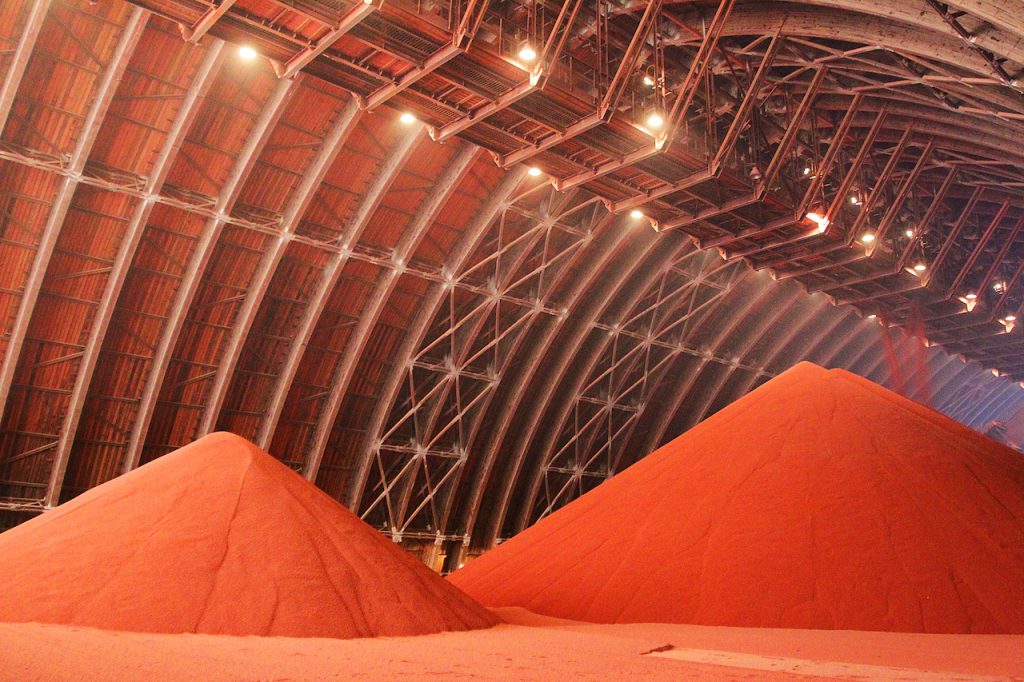
Cory underground potash mine. (Image courtesy of Nutrien.)
US President Donald Trump’s proposed “massive” potash deal with Belarus rattled fertilizer stocks, but BMO Capital Markets says limited supply and costly export routes make the country an unlikely threat to Canadian producers.
Trump said Monday that the US was working to buy Belarusian potash for “substantially less” than it currently pays Canada, which supplies about 80% of US potash imports. He gave no details on volumes, timing or proposed prices.
Belarus could resume supplying some potash to the US as relations between Washington and Minsk thaw, but those tonnes would probably sell at prevailing market prices rather than at deep discounts, BMO fertilizer and chemicals analyst Joel Jackson said in a note.
“We expect those tonnes would be sold at market-based prices, not deep discounts, and in volumes unlikely to materially alter North American potash supply dynamics,” Jackson said.
The prospect hit North American fertilizer stocks after Trump’s announcement. Nutrien (TSX: NTR)(NYSE: NTR) fell about 2.3% Monday, while Mosaic (NYSE: MOS) slipped about 0.4%.
Supply limits
Belarus, one of the world’s largest potash producers, has rebuilt much of its export business since Western sanctions disrupted its traditional routes following Russia’s 2022 invasion of Ukraine. But the landlocked country remains dependent on more expensive Russian logistics because European Union sanctions restrict access to Lithuania’s Klaipeda port.
That makes Belarus a difficult replacement for Canadian potash, which benefits from established North American transportation infrastructure and Saskatchewan’s enormous production base. Belarus produces about 12 million tonnes annually, split between granular and standard grades, while the US consumes roughly 10 million tonnes, predominantly granular product, according to BMO.
Economics also work against Trump’s suggestion that Belarus could sell large quantities at steep discounts. US potash prices of about $350 to $360 per short ton at New Orleans have risen on strong demand and offer Belarusian suppliers competitive returns relative to other major markets, Jackson said.
Belarus therefore has little incentive to discount one of its largest sources of foreign currency simply to capture US market share.
There may also be little uncommitted product available.
Belarusian President Alexander Lukashenko said Monday the country had redirected exports east and its potash production was already committed under existing contracts. Even if Western markets reopened completely, Belarus lacked additional volumes to supply them, he said.
Lithuania, meanwhile, has shown no sign of reopening the cheaper Baltic export route. EU restrictions on Belarusian potash remain in place, meaning additional shipments to the US would probably have to move through Russian ports.
Pricing pressure
The more immediate risk for Canadian producers may be psychological rather than physical, Jackson wrote. According to the analyst, the prospect of additional Belarusian tonnes could make Nutrien and Mosaic think twice before pushing North American potash prices materially higher, even if Belarus cannot supply enough product to fundamentally reshape the market.
US demand remains robust and BMO still sees room for further potash price increases. But Trump’s announcement introduces another potential source of competition into a market where Canadian producers have long enjoyed a dominant position.
For Belarus to seriously challenge that dominance, it would need substantially greater export capacity, competitive logistics and enough uncommitted granular potash to serve US buyers. These conditions, BMO’s analysis suggests, are not currently in place.
COMMENT: US-Belarus prisoner talks stall as Minsk fails to win EU potash relief
John Coale's September visit freed just 25 political prisoners in return for relief on two minor companies, as the EU's refusal to reopen potash transit blocks the bigger prize Lukashenko wants. / bne IntelliNewsFacebook
Washington's prisoners-for-sanctions deals with Belarus are losing momentum, with the latest round yielding just 25 freed prisoners and relief for two minor companies, Artyom Shraibman writes for Carnegie Politika.
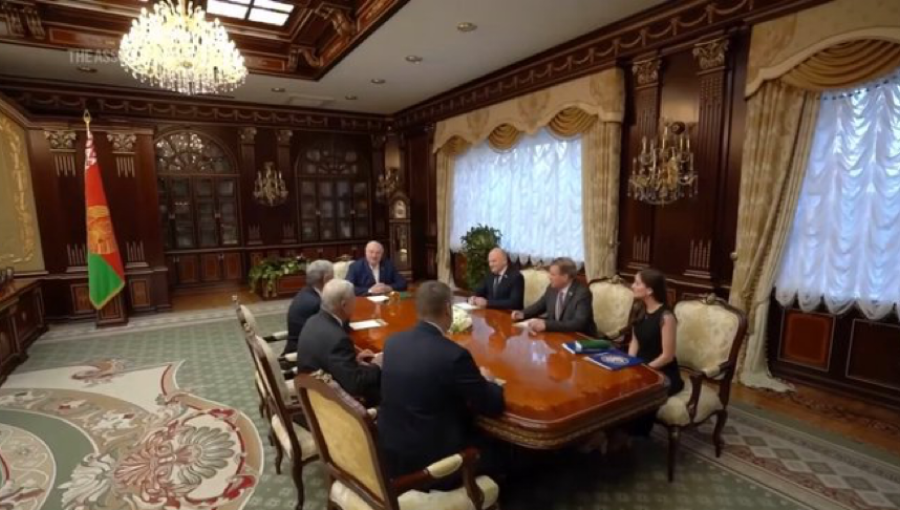
US special envoy John Coale returned to Minsk on September 15 after a six-month hiatus, but his meeting with Belarus' leader Alexander Lukashenko was less productive than previous encounters, Shraibman, a nonresident scholar at the Carnegie Russia Eurasia Center, wrote in the commentary published on September 22.
"The recent talks have demonstrated that the terrain of the negotiations is becoming increasingly boggy. The risks of delays are growing, and the process could reach a stalemate," he wrote.
Belarus released and deported 25 political prisoners, including prominent journalists and activists, to Lithuania this time, against more than 120 in December 2025 and 250 in March 2026, most of whom were allowed to stay in Belarus. On the day Coale arrived, sources said as many as 200 prisoners were being prepared for release, and their relatives had already been told.
The shrinking exchange suggests the transactional model that has run since 2025 is hitting its limits. Washington has already handed over its biggest concessions, lifting sanctions on Belarusian potash producers, national carrier Belavia and Belarusian banks, while the prize Minsk wants most - EU sanctions relief and a route for its potash exports through its neighbours - is not in the US' gift. Shraibman warned as early as March that time was running out for Lukashenko's courtship of Trump.
This time the US lifted sanctions on just two companies: paint and coatings maker Lakokraska and state-owned Bellesbumprom, which oversees companies in the timber, paper and furniture industries. The barely profitable Lakokraska is unlikely to gain much from access to the US market, Shraibman wrote, while Bellesbumprom's main problem is the EU ban on exports to or via the bloc, which forces it to sell through Russia. Ending US sanctions will only make it easier to take payment from those third countries.
Ahead of the talks Lukashenko had demanded that the US unfreeze around $44mn apparently held in a Citibank account, part of Citigroup (NYSE: C), because of sanctions. Coale agreed to submit a request to the bank to release the funds, but no final decision has been announced.
Until now each round had been more substantial than the last and followed a simple script - a Coale visit, a prisoner release and a lifting of sanctions, then quiet negotiations before the next trip. This was the first time plans changed while a meeting was under way. Lukashenko's first words before the cameras were that the two sides should implement previous agreements, "a rather chilly opening," and for the first time Prime Minister Alexander Turchin sat in on the meeting, apparently to spell out what had not been done.
The main unresolved problem is the EU, Shraibman argued. Brussels has no desire to lift sanctions on Belarus and keeps imposing new ones. In the spring Washington asked Lithuania, Poland and Ukraine to let Belarusian potash through to their ports, but they refused, and the US has since stepped up pressure on Lithuania to reopen the Klaipeda route.
Minsk is also creating new political prisoners as fast as it frees them. Since the March release another 224 names have been added to the country's list of political prisoners, and even though hundreds have left prison after serving their sentences, the total still hovers at about 900. Belarus has jailed more people than it has released under the US deal.
"Even for the administration of President Donald Trump - not known for its concern about human rights - a deal in which the United States is gradually lifting sanctions while Belarus releases political prisoners at the same rate it's jailing new ones makes little sense," Shraibman wrote.
Lukashenko would like Minsk's neighbours brought into the process because they control the transit of Belarusian potash, and Belarusian officials meeting European experts and diplomats behind closed doors often ask for the releases to be seen as a concession to the EU as well as to Washington, he said.
Ukraine is very unlikely to play along, with Russia still destroying its port infrastructure and relations between Kyiv and Minsk in crisis; in mid-September Ukrainian security officials again alleged that Belarus lets Russian drones bound for western Ukraine use its relay stations and mobile networks. Minsk has courted Poland for months, freeing Andrzej Poczobut, one of the leaders of Belarus' Polish minority, and later allowing him to travel back to Belarus for meetings.
Lithuania is likely to come under the most US pressure. Vilnius is unhappy about the talks, but newly elected Prime Minister Mindaugas Sinkevicius, leader of the Social Democratic Party, is slightly more open to negotiations, and Coale met him in Vilnius after seeing Lukashenko and discussed potash transit, according to The New York Times. Latvia, which once handled Belarusian potash, has little reason to help after Minsk redirected migrants it had been pushing towards the Polish border to the Latvian frontier instead.
In any case, EU sanctions bar all three from allowing Belarusian potash exports. Those sanctions come up for renewal in February 2027, and if the dialogue is still alive by then Washington may look for allies inside the EU to block the extension unless potash is exempted, Shraibman wrote.
Trump raised the stakes on September 21 with a post on Truth Social saying the US was negotiating a "massive deal" to buy Belarusian potash at prices "substantially less than we are currently paying to Canada," The Guardian reported on September 22. Canada supplies nearly 85% of US potash imports, according to BNN Bloomberg, and Lukashenko countered that Belarus had no spare volumes for Western markets because its output was already contracted.
The post changes little, Shraibman argued. Lithuania has already said the deal does not concern it, hinting that the US is welcome to buy Belarusian potash through Russia's northern ports - financing both the Lukashenko regime and Russia's war economy. Framing the deal as a blow to Canada could make EU consent even harder to secure.
"It is one thing to help the United States achieve the humanitarian goal of freeing Belarusian political prisoners. It is another to stab Canada, a close EU ally, in the back to help Trump in his trade war with Ottawa," he wrote.
"The irony of the situation is that having railed at US hegemony for over three decades, Lukashenko is now a victim of the weakening of that very hegemony," Shraibman concluded. "Washington's loss of influence in Europe is one of the reasons he cannot get what he wants."
All roads do not lead to Rome – new study rewrites ancient narrative, points to Istanbul
Network representation of the roads of the Roman Empire. The line width represents time-weighted "edge betweenness", illustrating the comparative importance of a road. / nature.com
Byzantium, today’s Istanbul, was the true hub of continental trade and transit in the Roman Empire, a structural analysis of 300,000 kilometres of ancient roads has shown.
The study, entitled “Network science reveals the structure and lasting impact of the Roman road system”, was published on September 15 by Nature.
In 20 BC, Emperor Augustus erected the Milliarium Aureum (The Golden Milestone) in the Roman Forum to signify the ultimate point of origin of the ancient world’s most ambitious transport network. For two millennia, the adage "All roads lead to Rome" stood as an unchallenged truth in historical geopolitics and infrastructure planning.
However, a comprehensive study led by classical archaeologists at Denmark’s Aarhus University and the Autonomous University of Barcelona, suggests that history's most famous logistics hub was misplaced.
The empire’s operational centre of gravity actually lay not on the banks of the Tiber but on the shores of the Bosporus. Byzantium, known from late antiquity as Constantinople, was structurally far more central to continent-wide transit than Rome ever was.
Rome on the periphery
While Rome functioned as an effective maritime terminal on Italy's Tyrrhenian coast, it sat on the periphery of the broader multi-continental overland grid. Within Italy itself, structural modelling revealed that the peninsula’s most heavily trafficked artery ran along the opposite Adriatic coastline, bypassing the capital entirely.
The network prioritised efficiency at the regional level. Provincial capitals such as Ankara (Turkey), Corinth (Greece) and London (Britain) exhibited exceptionally high local network centrality. This layout allowed the imperial administration to optimise local commerce, military dispatch and revenue collection long before goods or taxes were remitted toward the capital.
Where continents meet
Situated directly at the nexus where Europe meets Asia, Constantinople served as an indispensable bottleneck for transcontinental trade. Ferry crossings across the Bosporus bridged European and Asian road corridors, turning the new capital into the hyper-connected node that Rome had symbolically claimed to be.
The longevity of these trade corridors represents one of the most enduring capital investments in human history. Following the fall of the Western Roman Empire in 476 AD and the Eastern Empire (Byzantine) in 1453, the underlying grid continued to anchor European and Near Eastern transit.
These roads in many places served as the main communications throughout the medieval period until the development of railroads in the 19th century and highways in the 20th century.
In numerous regions, contemporary transport links directly inherit Roman blueprints. Spain's modern N-340 motorway, for instance, stretching from Cadiz toward the Pyrenees, directly overlays the ancient Via Augusta, passing beneath the Roman Arc de Bera, the triumphal arch in proximity to Tarragona.
Turkey signs US grant deal to prepare for small nuclear reactors
A US-funded study will map out the rules and financing Turkey needs for small modular reactors, giving American reactor makers an early foothold in a market led by Russia's Rosatom. / bne IntelliNewsFacebook
The US will pay for a study to help Turkey prepare the ground for small modular nuclear reactors (SMRs), as Ankara looks to cut its reliance on Russia for nuclear power.
The US Trade and Development Agency (USTDA) signed a grant agreement with Turkey's state-owned nuclear developer TUNAS in New York on September 22, the agency said. Energy Minister Alparslan Bayraktar and USTDA Deputy Director Thomas Hardy oversaw the ceremony, Al-Monitor reported the same day.
The deal opens the door to US reactor vendors in a country whose only nuclear plant is being built by Russia's state nuclear corporation Rosatom, and turns into a signed contract what Hardy trailed in July, when he told a Washington roundtable to watch for USTDA nuclear announcements in Turkey.
The grant will fund technical assistance for TUNAS to draw up the regulatory, institutional and financial rules Turkish private companies would need to deploy SMRs, and will assess how leading US reactor designs could meet Turkey's needs. No value was disclosed, but the work is a study costing around $2mn that will run for at least a year, according to Turkish business broadcaster Bloomberg HT.
"Our goal is to advance TUNAS' efforts to create conditions for deploying SMRs, which can increase energy security for Turkiye while providing opportunities for US companies," said Hardy.
"USTDA's program would certainly help strengthen our technical and institutional foundations for future SMR and advanced reactor projects," Bayraktar said, and wrote on X: "We are determined to diversify our energy mix."
Bayraktar said in November 2025 that Turkey aims to have 12 large conventional reactors and 5,000 MW of SMR capacity by 2050, enough for nuclear to supply 10-15% of the country's electricity. A parliamentary committee in July approved tax incentives for nuclear investments, including VAT refunds on plant construction until the end of 2045.
The roughly $20bn Akkuyu plant in Mersin province on the Mediterranean coast is being built by Rosatom under a build-own-operate model and will have four reactors with a combined 4,800 MW. Rosatom said in June that construction of the first unit was complete and testing had begun, and Ankara is aiming for first power this year after delays of two to three years.
Turkey is seeking partners for eight more conventional reactors, four at Sinop on the Black Sea and four in the northwestern Thrace region, and Bayraktar has said Ankara is in talks with South Korea, Canada, China and Russia.
In March Ankara asked Seoul and Korea Electric Power Corp. (KRX: 015760) for a binding proposal for a Black Sea plant, and Bayraktar said Turkey could sign an SMR memorandum with France's EDF. On September 8 Turkey signed a thorium research deal with Denmark's Copenhagen Atomics, a molten salt reactor developer.
USTDA will invite proposals from US companies to carry out the TUNAS work. Hardy said in July that the agency's job is to "seed the ground" so countries can make investment decisions once SMRs are ready for fleet deployment.
Contracts announced as Pickering refurb approaches
The Province of Ontario has announced the signature of more than CAD3 billion (USD2.1 billion) worth of contracts for the refurbishment of four units at Ontario Power Generation's Pickering plant as site construction for the project gets under way.
Aecon's Samantha Roussy, an operating engineer working with the Pickering Refurbishment team, speaking at the contract announcement watched by Minister Lecce (Image: Aecon)
Ontario Power Generation's (OPG) Pickering units 5 to 8 - together known as Pickering B - are to be removed from service by the end of September for refurbishment to officially begin in January 2027, subject to final regulatory approval. After the major project - which will include the replacement of 1,520 fuel channels, 48 boilers and building a 1.5-kilometre deep-water intake - the refurbished station will supply up to 2,200 MW of power.
As site construction began on 21 September, the Province of Ontario announced that a CAD1.7 billion contract for the execution phase of the Retube, Feeder and Boiler Replacement (RFBR) for Pickering 5 has been awarded to a 50:50 joint venture of Aecon Group Inc and Candu Energy, an AtkinsRéalis company. A consortium of Aecon and Siemens Energy Canada has been awarded a contract worth CAD1.3 billion for the Turbine Generator Replacement. The refurbishment project as a whole is expected to contribute CAD41.6 billion to Canada's GDP.
The scope of the Retube, Feeder and Boiler Replacement work is a critical component of the Pickering refurbishment project, including the replacement of steam generators, fuel channels and feeders. The contract covers engineering and design services, project delivery, as well as programme and project management associated with the CANDU reactors, including work that would enable Unit 5 to operate until the 2060s, AtkinsRéalis said. Similar work will need to be carried out on units 6, 7 and 8 in subsequent phases of the refurbishment project.
The Turbine Generator Replacement scope includes installation of 14 new steam turbine rotors, the overhaul of four generators (including stator rewinds), as well as the delivery of new auxiliary systems, and a control and monitoring system. Aecon holds a majority interest in the consortium with Siemens, and will provide construction services and material procurement.
Both projects are currently nearing completion of collaborative development work, with further prerequisite work expected to start this month, Aecon said.
"Advancing the Pickering Nuclear Refurbishment Project is another significant milestone in Ontario's clean energy future and further demonstrates the strength of Aecon's comprehensive nuclear construction expertise," Aecon Group President and CEO Jean-Louis Servranckx said. "Building on decades of experience successfully delivering the largest and most complex nuclear projects across North America, our teams are proud to support OPG in extending the life of this important nuclear generating station while helping ensure a reliable supply of low-carbon electricity for Ontario."
"AtkinsRéalis brings decades of hands-on experience refurbishing Canadian-owned CANDU reactors in Ontario, with a proven track record of delivering complex life-extension work safely, reliably and with the discipline required for on-time and on-budget performance," AtkinsRéalis President and CEO Ian Edwards said. "This work at the Pickering station will help ensure Ontario continues to benefit from reliable, affordable and low-carbon electricity for decades to come."
Pickering units 5-8 began operations in the mid-1980s and had been scheduled to end electricity production this year, but in 2022 the provincial government directed OPG to keep them in operation until 2026 and to reassess the feasibility of refurbishing the units. The government gave OPG the go-ahead to begin the initiation phase of the refurbishment project in January 2024, and one year later, it gave its permission for the start of the project definition phase. In November, the Ontario government formally approved OPG's refurbishment plan, clearing the way for the execution phase of the project to begin.
Over the years, Pickering Nuclear has consistently met up to 14% of Ontario's electricity needs, according to OPG. President and CEO Nicolle Butcher said that since the first unit at Pickering A began operating in 1971, the plant has established itself as one of the world's largest and best-performing nuclear facilities. "Through its refurbishment, we will ensure this important station continues to play a vital role in powering Ontario for future generations," she said. The last of the Pickering A units, Pickering unit 4, was permanently shut down at the end of 2024.
"When the previous government planned to shut down Pickering, our government chose to protect 4,500 jobs and create 30,500 new jobs by doubling down on Canadian workers, technology and energy sovereignty," Stephen Lecce, Ontario's Minister of Energy and Mines, said. "Today, we are marking a national achievement as we begin work on Canada's largest clean energy infrastructure project and strengthen our made-in-Ontario nuclear supply chain."
SGE confident of UK SMR fleet prospects
By Alex Hunt
World Nuclear News, in London
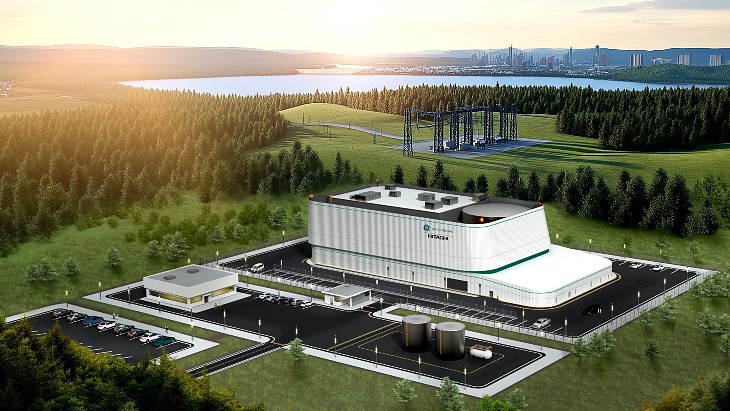
The team behind plans for a fleet of 14 BWRX-300 small modular reactors in the UK says they are confident of the economic model and supply chain capability to deliver these units.
How a BWRX-300 could look (Image: GE Vernaova Hitachi)
SGE (formerly Synthos Green Energy) in July submitted an application under the UK's Advanced Nuclear Framework for reactors which could provide 4.2 GW of capacity, equivalent to 11% of current UK power demand.
Poland's SGE - whose deployment team includes Samsung C&T, Laing O'Rourke, Aecon Group and Google Cloud - says it will privately finance the deployment of the fleet of GE Vernova Hitachi’s BWRX-300 small modular reactors (SMRs) across three sites in the UK.
The plan is for the initial site to host six of the 300 MW SMRs, with four each at two subsequent sites. The locations of the proposed sites have not yet been disclosed, pending final negotiations.
Rafał Kasprów, CEO of SGE, told World Nuclear News, "I think the UK market has amazing opportunities for SMR developers, and especially us with a fleet approach".
From the financial point of view he says "we are bringing this investment to the UK … with the disruptive model of not asking government to cover everything on the development and construction phase. We are asking the UK government for Contract for Differences for a fleet of reactors. So it is only when electrons are delivered to the grid that we can benefit from the Contract for Difference model".
The Contract for Difference (CfD) would work by a future price being agreed for electricity generated by the SMRs - if the price of electricity is higher, the developer will pay the extra back, and if the price of electricity is below the agreed level, the difference is provided to the developer. In the energy sector, a CfD acts as a very long-term price stabilisation mechanism. The UK used a Contract for Difference funding model for Hinkley Point C, but moved away from it for the Sizewell C project.
SGE's project is currently going through the "deep dive" stage of the UK's Advanced Nuclear Framework which they believe will conclude in October or November and allow them to be part of the pipeline, and start to execute the project.
As an investor in the project, SGE says that it knows what it needs to do internally to de-risk the project "so we know how to translate that same conversation to markets".
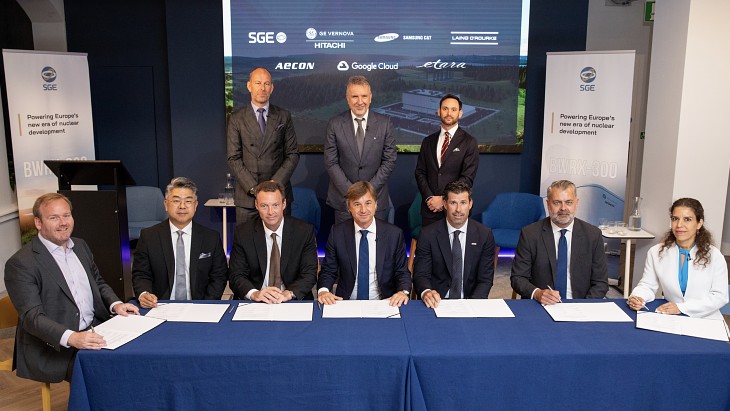
Kasprów, seated, centre, at June's event outlining its UK fleet plan (Image: SGE)
The company has also developed plans for a fleet of SMRs in Poland and in June submitted its contract for difference application to the government there. As to which country's projects might happen first, Kasprów says that the UK project could happen at the same time, praising the UK regulatory regime and its infrastructure.
He also rejected concerns about the capacity of supply chains and workforce to cope with the construction of Sizewell C and a number of SMR projects at the same time. He stressed the maturity of the BWRX-300 technology, its use of existing nuclear fuels and the example and experience of the first unit being constructed in Canada.
"We are using existing supply chains - there is also an advantage to the fleet approach because there are places where the supply chain exists, but maybe needs to scale up, and by coming to market with a 14-unit project as our starting point those companies can see a clear path to making that investment worthwhile," said Robert Rudich, Chief Business Development Manager.
They also stress that the non-nuclear part of the plant is similar to conventional power plants, with the industrial giants GE Vernova and Hitachi as partners and all part of a Europe-wide supply chain.
GE Vernova Hitachi Nuclear Energy's BWRX-300 is a 300 MWe water-cooled, natural circulation SMR with passive safety systems that leverages the design and licensing basis of the company's US Nuclear Regulatory Commission-certified ESBWR boiling water reactor design and its existing, licensed GNF2 fuel design, a unique combination that GE Vernova Hitachi Nuclear Energy says positions it to deliver an "innovative, carbon-free baseload power generation source" this decade.
The first BWRX-300 is under construction at Ontario Power Generation's Darlington site in Canada, with completion expected by the end of the decade. The Darlington project is a reference project for OSGE.
Luba Kotzeva, founder and CEO of advisory and consultancy group Etara and part of the project team, said there had been "good engagement" with the UK side on the issue of a Contract for Difference funding model and stressed the importance of the proposal being for a fleet programme: "I think that is essential to getting the economies of scale, to getting the economics to flow, to getting the private capital."
The example of the first SMR being built in a G7 country, at Darlington in Canada, is also seen as a key development. Kasprów said: "It's extremely important, it is the difference between having something and nothing. It's not about promises anymore - it's happening."
Škoda JS to supply control rod drives for Rolls-Royce SMR's reactors
Czech company Škoda JS has been chosen as sole supplier of control rod drive mechanisms for Rolls-Royce SMR's future small modular reactors.
(Image: CEZ)
Škoda JS is part of the Czech majority state-owned CEZ Group, which also has a 20% stake in UK-based Rolls-Royce SMR.
Earlier this year Škoda JS and Doosan Enerbility were selected by Rolls-Royce SMR for pre-production work for key components - including the reactor pressure vessel - with work which encompasses "early supplier engagement, design finalisation and manufacturing readiness to support the delivery of first power at the earliest possible date".
The Pilsen-based firm has now added the contract for the control rod drive mechanisms, which are key bits of equipment in a nuclear reactor, ensuring the precise movement of the control rods which control the reactor’s power, ensuring its safe operation. According to CEZ "each drive is a unique electromechanical linear motor, almost eight metres long and weighing 450 kg, capable of safely controlling the nuclear reactor in all operating modes".
Czech Minister of Industry and Trade Karel Havlíček said: "Small modular reactors are a technological opportunity for our companies with global reach. The contracts that Škoda JS has already concluded with Rolls-Royce SMR are clear proof of this. Small modular reactors will not only strengthen the energy security and self-sufficiency of our country, but will also create new jobs and create opportunities for follow-up investments."
The first of Rolls-Royce SMR's 470 MWe small modular reactors is due to be built in North Wales in the UK, with the first in the Czech Republic to be built at Temelín, with an expected operational date "in the second half of the 2030s" and with five or six more units to follow across three sites.
Rolls-Royce SMR CEO Chris Cholerton said: "Škoda JS has proven that it is one of the few companies in Europe capable of providing one of the most important components of our power plant … our cooperation shows the clear benefits that this project brings to industrial companies."
Daniel Beneš, Chairman and CEO of ČEZ, said: "A global supply chain for small modular reactors is now being formed, and it is essential for our industrial companies to act quickly and now. This opportunity is unique. If they manage to get involved in this chain right from the start, they can win attractive contracts for the next decades. Škoda JS now faces the task of developing a prototype directly for small modular reactors so that it can subsequently supply them to Rolls-Royce SMR all over the world."
Background
The Rolls-Royce SMR is a 470 MWe design based on a small pressurised water reactor. It will provide consistent baseload generation for at least 60 years. Ninety percent of the SMR - measuring about 16 metres by 4 metres - will be built in factory conditions, limiting activity on-site primarily to assembly of pre-fabricated, pre-tested, modules which significantly reduces project risk and has the potential to drastically shorten build schedules.
In October 2024, Rolls-Royce SMR was selected by ČEZ to deploy up to 3 GW of electricity in the Czech Republic, and ČEZ took a 20% stake in Rolls-Royce SMR. The plan is for the first SMR to be deployed in the area of the Temelín site (which already has two gigawatt-scale VVER-1000 units), with further projects being developed for coal-fired power plant sites, including Tušimice.
In June 2025, Rolls-Royce SMR was selected as the UK government's preferred technology for the country's first SMR project. In November, the UK government announced that Wylfa on the island of Anglesey, North Wales, would be the site to host the three Rolls-Royce SMR units. It said the site - where a Magnox plant is being decommissioned - could potentially host up to eight SMRs. A final investment decision is expected to be taken in 2029.
Škoda JS has long experience in the construction and servicing of nuclear power plants, including manufacturing 21 VVER-440 reactors and three VVER-1000 reactors, as well as supplying engineering, equipment and servicing for nuclear power plants, research reactors and spent nuclear fuel storage facilities in Central and Eastern Europe, Scandinavia, France, Germany, the USA, Austria, Finland, Belgium, the UK, China and Armenia.
GE Vernova, Hitachi, SGE and Samsung C&T sign BWRX-300s MoU
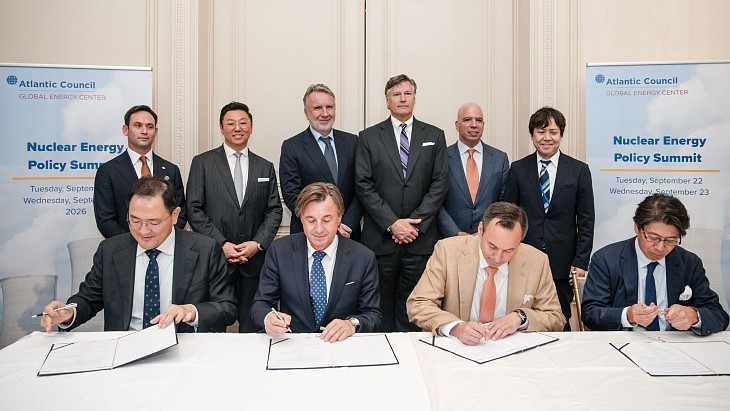
An agreement to work together to identify and develop market opportunities for the deployment of BWRX-300 small modular reactors in Europe was signed on the sidelines of the United Nations General Assembly in New York.
The signing took place during the Atlantic Council Nuclear Energy Policy Summit (Image: SGE)
The signatories of the memorandum of understanding - Poland's SGE, the US's GE Vernova, Japan's Hitachi and South Korea's Samsung C&T - will establish "a framework for cooperation on market development and commercial opportunities" for the deployment of the BWRX-300 small modular reactor (SMR).
GE Vernova Hitachi Nuclear Energy, a joint venture between GE Vernova and Hitachi, is the designer of the BWRX-300. Samsung Construction and Trading Corporation (Samsung C&T) has considerable experience in major nuclear and energy infrastructure projects. SGE is already developing projects for a fleet of BWRX-300 reactors in Europe, notably in Poland and the UK.
The official announcement of the MOU signing said it was "linked to the memorandum of cooperation for SMR deployment in third countries signed on the margins of this year's NATO summit by United States Secretary of State Marco Rubio, Japan Foreign Minister Motegi Toshimitsu, and Republic of Korea Foreign Minister Cho Hyun".
It said the US Department of State saw it as "a concrete industry effort to advance BWRX-300 deployment across Europe and deepen government-industry cooperation on global energy security".
In quotes
Roger Martella, GE Vernova's Chief Corporate Officer and Chief Sustainability Officer, said: "GE Vernova has a long-standing history and presence across the European continent. This collaboration brings together complementary capabilities to help advance BWRX-300 deployment across multiple markets and build on the momentum already behind the technology."
Yasunori Inada, CEO of Nuclear Energy Business Unit, Hitachi, said: "This collaboration brings together the strengths and expertise of each partner, and Hitachi will contribute to exploring the deployment of the BWRX-300 in Europe by drawing on the technological capabilities cultivated through our nuclear business and on our collaboration with qualified Japanese suppliers."
Jung Wook Kim, Executive Vice President and Head of Global Business Unit and Global Operation, Samsung C&T, said: "Samsung C&T is honoured to open a new chapter in Europe's SMR business together with GE Vernova, Hitachi and SGE. Building on Samsung C&T's proven EPC capabilities, we will fully leverage the synergy created by this four-way partnership to strengthen Europe's energy security and contribute to the realisation of carbon neutrality."
Michał Sołowow, founder of SGE, said: "Europe and the UK need a scalable commercial model for new nuclear, built on proven technology, established supply chains and world-class delivery partners. By combining GE Vernova Hitachi's BWRX-300 technology, Hitachi's industrial capabilities and Samsung C&T's global construction expertise, SGE is creating a platform to deploy standardised nuclear fleets across multiple markets."
Background
The BWRX-300 is a 300 MWe water-cooled, natural circulation SMR with passive safety systems that leverages the design and licensing basis of GVH's US Nuclear Regulatory Commission-certified ESBWR boiling water reactor design and its existing, licensed GNF2 fuel design, a unique combination that GVH says positions it to deliver an "innovative, carbon-free baseload power generation source" this decade.
The first BWRX-300 is under construction at Ontario Power Generation's Darlington site in Canada, with completion expected by the end of the decade.
SGE has a number of potential projects under way across Europe - including in Poland, where a decision in principle has been issued for 26 BWRX-300 SMRs, and in the UK where a proposal for a fleet of 14 of the SMRs across three sites is being considered under the UK’s Advanced Nuclear Framework programme.
China's giant crane for nuclear power plant construction
China General Nuclear says the 250,000-ton-metre lifting torque ring-rail crane rolled off the production line last month to support the construction of Hualong One 2.0 nuclear power plants.
(Image: CGN)
The equipment uses a combination of a 137-metre and a 66-metre ultra-long boom, with a maximum height of 207 metres. According to the developers, under large-radius operating conditions in nuclear power plants, its lifting capacity is about 50% higher than that of similar foreign products, and it can meet the relevant hoisting operation requirements at a single station and under a single operating condition.
In terms of operation, the equipment adopts a fully electric drive mode and can be directly connected to 10kV industrial mains power, featuring zero emissions and low noise. According to project calculations, the application of this equipment is expected to shorten the construction period of nuclear power projects by 15%, reduce operating costs to about one-quarter of traditional oil-fired equipment, and decrease site costs and logistics costs by 20% and 30%, respectively.
In terms of safety control, the crane is equipped with digital systems such as intelligent anti-collision, 360-degree surround view, remote fault diagnosis, cable tangling detection, facial recognition, and work behaviour recognition to enhance risk identification and protection capabilities during on-site hoisting.
The crane - jointly developed by Sany Heavy Machinery and China Energy Engineering Guangdong Thermal Power Special Equipment Co Ltd - was produced at Sany's Huzhou Industrial Park in Zhejiang.
This crane was developed to meet the construction needs of the Hualong One 2.0 nuclear power plant's "one machine, two islands" system - this is where one ring-rail crane is positioned between two nuclear islands, allowing for the lifting of all modules and main equipment of both units with a single positioning and boom length.
"This marks a key breakthrough in the localisation of ultra-large tonnage nuclear power plant lifting equipment in China," China General Nuclear (CGN) said. It added that it "represents the culmination of seven years of technological research, achieving breakthroughs in structural design, manufacturing processes, and assembly control".
Hualong One 2.0
On 31 July, the construction of three pairs of Hualong One (HPR1000) reactors at the Jinqimen, Taipingling and Zhuanghe sites, as well as two Guohe One (CAP1400) reactors at the Laiyang site was approved by the State Council. The Phase II units (3 and 4) of China National Nuclear Corporation's Jinqimen plant in Zhejiang Province and the Phase III units (5 and 6) of CGN's Taipingling plant in Guangdong Province have been designated as demonstration projects of the Hualong One 2.0.
The Hualong One 2.0 is described as "an advanced pressurised water reactor nuclear power technology combining third-generation and advanced technologies, developed through independent innovation and overall collaboration, based on feedback from the construction and operation experience of Hualong One". So far, 10 Hualong One units are commercially operational both domestically and internationally, with another 37 units approved for construction.
CGN said the new crane "will be used at Taipingling Phase III and subsequent Hualong One 2.0 projects".
Framatome secures first contract for higher enriched fuel
Framatome announced it has signed a commercial contract to deliver the world's first nuclear fuel reload with uranium-235 enrichment above the industry standard of 5%, to an operating nuclear reactor in the USA.
(Image: Framatome)
Under the agreement - and as part of its Advanced Fuel Management (AFM) programme - Framatome will supply a series of higher enriched fuel reloads using AFM technology, beginning with delivery in early 2028. These reloads will support the long term deployment of AFM fuel for the reactor, with options for additional future reloads included in the contract. The company did not reveal the name of the reactor where the fuel will be deployed.
Uranium-235 is the main fissile isotope of uranium and occurs at a concentration of about 0.7% in natural uranium. Standard fuel used in today's operating light water reactors uses low-enriched uranium (LEU), with enrichment levels up to about 4.8% U-235. But higher-enriched fuel containing up to 10% U-235 - also known as LEU+ - can potentially offer improved nuclear fuel cycle economics for currently operating reactors.
AFM is a globally integrated Framatome programme designed to deliver fuel with higher enrichment and burnup limits. The company says enriching uranium oxide past the traditional 5% threshold, combined with its latest technology, allows reactor operators to maximise their energy production. The increases in enrichment and burnup support improved economic performance by extracting more cycle energy from the reactor core and reducing operations and maintenance costs. The AFM programme encompasses all aspects of the nuclear fuel cycle including enrichment services, regulatory licensing and fuel fabrication infrastructure.
This advanced fuel solution has been developed by Framatome and will be manufactured at its facility in Richland, Washington. The facility has undergone upgrades and modifications over the past four years to support implementation of this innovative technology, and received US Nuclear Regulatory Commission (NRC) approval for the fabrication of fuel with increased uranium enrichments and to manufacture fuel with higher burnup limits.
Framatome said the fuel supply agreement "represents a major advancement for the global nuclear industry, enabling the first reactor in operation to extend its cycle lengths and burnup rates through this advanced technology. The contract establishes a new benchmark for innovation, performance and industry collaboration."
It said the agreement builds on ongoing deliveries of standard GAIA fuel, Framatome's most advanced pressurised water reactor fuel design, which serves as the foundation for these AFM enabled reloads. "With AFM, the US customer will extend its fuel cycle length from 18 to 24 months, reducing outage frequency and enhancing operational efficiency and power generation," it said.
"This contract reflects the strength of our long standing relationship with our customer and our shared commitment to advancing nuclear fuel technology," said Lionel Gaiffe, Framatome's Senior Executive Vice President, Fuel Business Unit. "Collaborating on this milestone project underscores the trust our customers place in Framatome's expertise and the innovative capabilities of our Advanced Fuel Management technology."
Framatome submitted a licence amendment request to the NRC in September 2024, seeking permission for the plant to handle uranium enriched up to 10%, up from the current 6.5% so that it can expand domestic capacity for advanced reactor fuels and support the acceleration of deployment of next-generation reactors. The NRC approved Framatome's request in July this year.
In October 2023, Southern Nuclear has announced it has received authorisation from the NRC to use Westinghouse advanced nuclear fuel enriched up to 6% uranium-235 at Vogtle unit 2. This marked the first time a US commercial reactor had been authorised to use fuel with over 5% enrichment.
Bechtel steps away from TerraPower project
TerraPower says it intends to rebid the engineering, procurement and construction contract for the project to build the first-of-a-kind Natrium reactor in Kemmerer, Wyoming, following the two companies' decision to move forward separately.
Excavation work at the Kemmerer site (Image: X/TerraPower)
TerraPower named Bechtel as its design, licensing, procurement and construction partner in a federal grant application to build a demonstration Natrium plant as long ago as 2020. A ground-breaking ceremony for the 345 MWe sodium-cooled fast reactor and its accompanying molten salt-based energy storage system was held at the Wyoming site in June 2024, with TerraPower announcing the official start of construction in April this year.
EPC (engineering, procurement and construction) and project management specialist Bechtel said it will remain on site to complete the plant's Sodium Test & Fill Facility and support an orderly transition.
"Bechtel has supported TerraPower’s Natrium project through several significant milestones, including securing the NRC construction permit, the first ever issued for a commercial non-lightwater reactor in the United States; completing the exterior enclosure of the Sodium Test & Fill Facility; placing major procurements; and beginning foundational work for Kemmerer Unit 1," Bechtel spokeswoman Molly Edwards told World Nuclear News.
"This work was performed under an earlier phase of the contract, prior to full EPC scope. As we considered the next phase of the project, Bechtel and TerraPower decided to move forward separately."
In late August, TerraPower announced it had selected 12 equipment vendors to receive contracts to support the construction of the Natrium plant and completion of the sodium facility, as it builds a supply chain to bring an envisaged fleet of Natrium reactors online in the coming decade. The company said it does not expect the latest development to affect the construction timeline.
"Bechtel will remain on site to complete the Sodium Test and Fill Facility, and we look forward to continuing our work with them on that first-of-a-kind facility," a TerraPower spokesperson told World Nuclear News. "Construction in Kemmerer will maintain its current schedule with the exemplary subcontractor teams and EPC support services from commercial-grade firms that have been working on site. TerraPower is managing this transition to protect the overall construction schedule for Kemmerer Unit 1 and will rebid the EPC contract."
News of the split emerged after Reston, Virginia-headquartered Bechtel filed a Worker Adjustment and Retraining Notification (WARN) Act Notification with the State of Virginia, in which it said it would be scaling down its operations supporting the project and reducing staffing levels as work is completed, with around 200 positions and employees affected. The reductions are expected to commence "on or about" 16 November, but Bechtel told the State it is "actively collaborating with our team to identify the next assignments for these employees".
"Our people will move to other nuclear projects under way across the company, where demand for these skills continues to grow. While the WARN notices are a legal requirement, we do not expect any actual layoffs," Edwards said.
France prepares to start dismantling first UNGG reactor
EDF subsidiary Cyclife announced the Chinon A nuclear power plant dismantling project has reached a major milestone with the validation of the contractual strategy for dismantling the Chinon A2 plant's heat exchangers.
Chinon A2 (Image: Cyclife)
Chinon A2 is one of six gas-cooled reactors (Uranium Naturel Graphite Gaz¸ or UNGG) at Bugey, Chinon and St Laurent-des-Eaux currently being decommissioned by EDF in France. The six UNGG reactors entered service between 1963 and 1972. With the exception of Chinon A1, which closed in 1973, all operated for more than 20 years. Chinon A2 is the lead site for EDF's immediate dismantling strategy for its UNGG fleet. The company's objective is to dismantle the facilities in the shortest timeframe possible.
With the validation of the contractual strategy for dismantling Chinon A2's heat exchangers, the project "has reached a decisive milestone", Cyclife said. "After more than three and a half years of studies conducted jointly by the teams from EDF's Deconstruction and Waste Projects Department (DP2D) and Cyclife Engineering, this milestone paves the way for the launch of the first operational phase of the dismantling of the world's first UNGG reactor."
Subject to the entry into force of the dismantling decree, this first operation will consist of dismantling in series the equipment present in the four heat exchanger rooms of Chinon A2. The heat exchangers made it possible to transfer the heat from the carbon dioxide, heated in the core of the reactor, to the water of the secondary circuit which then turned into steam.
Teams from EDF and Cyclife Engineering visting the heat exchangers of Chinon A2 (Image: Cyclife)
Cyclife said the dismantling operation will "fully benefit" from the lessons learned during the dismantling of the Chinon A3 reactor heat exchangers.
The start of operations is planned for mid-2028, following the public inquiry into the UNGG reactor dismantling strategy, scheduled for 2027. The project is expected to take six years.
"This is an essential step forward in preparing for an exceptional industrial project, which is set to serve as a benchmark for EDF's entire UNGG programme," said Stéphanie Proust, EDF Chinon A-AMI project manager.
In December 2019, EDF and Veolia established the Graphitech joint venture for the decommissioning of reactors that use graphite technology. Graphitech's first objective was to provide EDF with an optimised scenario for decommissioning the Chinon A2 reactor in 2028 and to offer a testing programme to evaluate the technological solutions needed to complete the project. This programme began in 2022 with a development and qualification phase using full-scale models to prepare the remote-operation tools to be used in decommissioning the Chinon reactor.
Graphitech has produced an outline decommissioning methodology for the five remaining UNGG reactors: where possible, transposition of the Chinon A2 methodology to the other reactors; and where not possible, identification of additional engineering work required.
Graphitech will seek contracts for assisting in the dismantling of gas-cooled reactors in France, Italy, Japan, Lithuania, Spain and the UK.





_42437.jpg)
_62512.jpg)
_90809.jpg)
_76412.jpg)
_38809.jpg)
_9f1a9511.jpg)