It’s possible that I shall make an ass of myself. But in that case one can always get out of it with a little dialectic. I have, of course, so worded my proposition as to be right either way (K.Marx, Letter to F.Engels on the Indian Mutiny)
Sunday, September 27, 2026
Mercuria commits $500 million to US strategic minerals reserve initiative
Swiss-based commodities trader Mercuria announced a $500 million commitment to Project Vault on Wednesday, aimed at ensuring US industry participants retain access to critical minerals during periods of supply disruption or market dislocation.
Project Vault, designed with support from the Export-Import Bank of the United States, seeks to build strategic inventories of critical minerals for use by the US.
Mercuria announced its commitment to the initiative in New York during the United Nations General Assembly summit.
Switzerland-based mining company Glencore also announced on Wednesday its selection by the US government to be a founding partner in the project.
Meanwhile, US President Donald Trump has taken a less combative approach than usual ahead of his meeting with Chinese President Xi Jinping this week, largely due to China’s near-total control of rare earth minerals, experts said.
China controls up to 70% of global rare-earth mining, 85% of refining capacity, and about 90% of rare-earth metal alloy and magnet production, according to consultancy AlixPartners.
Some Chinese rare earth suppliers are declining to ship to the US for fear of repercussions from Beijing, three sources said, underscoring how access to the materials remains an issue for the US.
(Reporting by Pablo Sinha in Bengaluru; Editing by Elaine Hardcastle)
High copper prices support miners in Chile, but investments dent gains
Despite strong copper prices, growing investment demands are offsetting much of the gains posted by mining companies in Chile, Moody’s said in a report on Thursday.
Chile, the world’s largest producer of the red metal, is undergoing an investment cycle focused largely on maintaining production levels and replacing depleted reserves as large deposits age.
Moody’s said that the current investment cycle in the industry favors reserve replacement and strengthens long-term competitiveness, although it requires substantial financing at a time of rising costs and operational risks.
“High copper prices support profits, but capital expenditures absorb much of that profit and leave high-cost producers exposed to a price correction,” the report said.
Copper prices are up 9% so far this quarter on the London Metal Exchange.
Moody’s said that projects linked to desalination plants and complementary infrastructure have helped to resolve relevant operational constraints, especially those related to access to water in the north of the country.
However, the industry continues to face pressures stemming from declining ore grades and increased operational complexity, factors that have raised production costs along with the rising cost of labor, energy, and other inputs.
The report noted how recent tax and permitting system reforms could gradually support the development of new projects.
Chile’s state-owned Codelco operates in the country alongside global players such as BHP (ASX: BHP), Glencore (LON: GLEN) and Anglo American (LON: AAL).
(Reporting by Fabian Cambero, writing by Paolo Laudani. Editing by Lucinda Elliott)
Outokumpu announces brand for low-carbon metals technology
Finnish stainless steel maker Outokumpu on Thursday announced the launch of EvoMaterials, a brand for its proprietary low-CO2 metals processing technology.
The technology is based on an advanced sulfidation process and is designed to increase the chromium content and chromium-to-iron ratio in ferrochrome.
It also has potential applications in nickel, molybdenum and metal recovery from industrial side streams, according to Outokumpu’s press release.
“As the only chrome mine in the EU, Outokumpu’s Kemi mine in Finland provides a unique strategic asset, enabling EvoMaterials to start with enriched ferrochrome and chromium metal,” the release said.
The company plans to scale up the technology at a pilot plant in New Hampshire, which is expected to become operational in the first half of 2027, with an industrial-scale facility targeted by 2030.
The announcement highlights growing efforts by western producers to secure critical mineral supply chains and develop lower-carbon metal production technologies.
(Reporting by Anjana Anil in Bengaluru; Editing by Cynthia Osterman)
Indonesian coal miner Bayan Resources lifts force majeure after quota revision approval
Indonesian coal miner PT Bayan Resources (IDX: BYAN) said on Thursday that it has lifted a force majeure declaration on coal supply deals after the government granted additional production quotas to the company for this year.
Bayan and three of its units declared force majeure on their coal supply obligations last week because proposed revisions to their mining quotas had not yet been issued.
The companies’ production quota revisions were obtained on September 23, Bayan said in a stock exchange filing.
Bayan said it expects the units to resume operations soon.
Indonesia granted an additional quota of around 15 million to 20 million metric tons for Bayan’s three units, a mining ministry official said earlier this week.
In the first half of this year, Bayan produced 32.9 million tons of coal, versus 27.7 million tons in the same period of last year.
Bayan announced last week that its biggest shareholders, Low Tuck Kwong and Elaine Low, had signed a conditional agreement to sell 10 billion shares to PT Jhonlin Baratama, a company controlled by tycoon Haji Isam.
(Reporting by Fransiska Nangoy, Bernadette Christina; Editing by David Stanway)
Hedge fund with 235% return says gold price decline is temporary
Australian hedge fund manager Raphael Lamm, whose long-short gold fund has delivered a net return of more than 200% to investors since its launch last year, sees the recent decline in bullion as temporary, arguing that the key forces underpinning its long-term rally remain intact.
The “unsustainability of fiscal situations in key markets,” particularly US government debt of more than $40 trillion, as well as the growing central-bank allocations will support gold over the medium to long term, said Lamm, who co-manages the A$1.5 billion ($1.1 billion) L1 Gold Fund with Mark Landau. In the near term, prices are set to be driven by developments in the US-Iran war, real interest rates and inflation data, he said.
Gold has been under pressure since hitting a record in January, as surging energy prices and bets on Federal Reserve rate hikes weigh on the non-yielding metal. It is down about 16% since the US-Iran war erupted in late February.
“While there’s been some headwinds to gold markets and the gold price since the Iran war, we think they’re very temporary in nature,” Lamm said in an interview. “Most of the key drivers of demand for gold are going to remain intact or even strengthen over the medium term.”
Bullion traded at $4,286.01 an ounce on Thursday evening in Sydney.
Lamm’s fund, which pairs long positions in gold-related stocks with a short position in gold futures as a hedge, has returned a net 235% through August since its launch in February last year, according to a spokesperson. That compares with a gain of about 148% for VanEck Gold Miners ETF and 55% advance in physical gold prices over the same period.
Part of the Melbourne-based L1 Group Ltd., which manages about $14 billion in assets, the L1 Gold Fund is using the decline in bullion to add to its long gold equity positions. Most of its holdings are in companies with market value of at least $5 billion, Lamm said. To protect against downside risk, the fund also shorts some gold stocks it views as expensive or facing operational headwinds, he said.
“We started to increase our long positions relatively aggressively when the gold price got below $4,000, and now we’re keeping it where it is, which is in the low- to mid-60% net long,” said Lamm. The fund will consider trimming long positions only if its expectations of further upside to gold price materialize, he said.
Lamm and Landau have also doubled down on their gold strategy with their own money. Both increased their personal stakes in L1 Gold Fund through an entitlement offer that raised A$160 million ($114 million) in August. The fund listed on the Australian exchange in April, and has posted a net 18% return for its clients through August even as gold prices fell 6%, according to its most-recent statement.
“We’ve been very active in materials equities, particularly resources, gold and base metals over the last 12 years,” said Lamm. The mid-cap gold equities space that L1 Gold Fund invests is “over a trillion dollars of addressable market cap and we think there’s a really strong angle for a specialist group to focus on that space,” he said.
L1 Group’s clients include large superannuation funds, pension funds, family offices, high net worth and retail investors.
The fund’s stock-picking strategy focuses on companies with lower valuations and near-term cash flows in the gold-mine development space. Its biggest position is in Canadian miner Eldorado Gold Corp. The fund is also the largest shareholder of K92 Mining Inc., which operates the Kainantu Gold Mine in Papua New Guinea.
Consolidation in the mining sector has also boosted the fund’s returns, and Lamm expects more dealmaking in the gold industry. OceanaGold Corp.’s recent acquisition of Australian miner Ausgold Ltd. for A$1.36 a share is set to deliver a sizable gain for the fund, which added the stock to its portfolio at about A$0.50 apiece, according to an August investor update.
“We’re really excited about some of the returns that are gonna come through M&A,” said Lamm. “We think a lot of our developers are gonna be extremely attractive targets for the mid-cap and the large-cap players.”
(By Carmeli Argana and Yihui Xie)
Metals are stock puppets, Bloomberg strategist says
The stock market now functions as the economy, and metals are its puppets in the ups and downs, senior commodity strategist at Bloomberg Intelligence, Mike McGlone says.
“It is the economy and the metals are complete stock puppets, unfortunately, as a broad sector,” he told MINING.COM host Devan Murugan in a recent Top of Mine episode.
McGlone argues that, out of all metals, copper is the one that follows the stock market the most.
“Copper is just a stock puppet. Stock market goes up, it goes up at a higher volatility and a lesser performance. Stock market goes down, it’s the same thing,” he said. “But the key thing is if and when we ever get that normal 10% correction in the stock market, copper will probably drop 20 or 30%.”
This is also the time for investors to be cautious about what to do with gold, according to McGlone.
“The signals are very scary. I point out the basic facts, but you have to point out the stuff behind the market that are the warning signals and that to me is a warning sign,” he said. “The bottom line I repeat is when gold gets exciting it’s usually best for investors to be cautious. You’re supposed to be selling when they’re yelling and this is just too peakish for me and I have to be bold enough to say it.”
Fed hikes, checks and balances
For McGlone, the Fed’s recent decision to increase interest rates shows how the US government still balances power.
“The first time I heard Mr. Warsh speak, I [thought] ‘this might be a guy who’s willing to push back and actually hike rates when the person who hired him asked him to cut rates,’” he said. “It’s just such an example of the checks and balances and the self-correcting mechanism of this country kicking in.”
“This is the best thing to curtail inflation, which is the number one issue. It’s going to bring down mortgage rates, but it shows the responsibility of the system,” he added.
McGlone warns that the first sign we’ll see of post-inflation deflation will be the stock market going down.
“That’s the number one force for the Fed to reverse and the number one force to alleviate this massive wealth effect inflation in this country,” he says.
Watch the full episode:
South Africa seeks partners for $2.7 billion manganese corridor
South Africa’s state-owned ports and rail operator is looking for a private partner to expand and operate a key manganese corridor that will cost as much as 44 billion rand ($2.7 billion) to roll out.
Transnet SOC Ltd. issued a request for qualifications for the Ngqura manganese export corridor that runs from mines in the Northern Cape province to ports in the Eastern Cape on Friday.
The harbors at Port Elizabeth and Ngqura — two of several where the steelmaking ingredient leaves South Africa — have become “fragmented and inefficient, ” resulting in significant road haulage, increased logistics costs and growing environmental and social impacts.
The upgrade will form part of the logistics giant’s private sector participation program “through which the company seeks to attract investment and leverage private-sector expertise to strengthen infrastructure performance,” it said.
The southern African country has some of the world’s largest reserves of the mineral, used in steel production and battery manufacturing.
The deadline for applications is Feb. 26.
(By Bonolo Mokonoto)
Vitol told bank Radiant World contracts with CFO’s signature were fake
Vitol Group told Deutsche Bank AG in early August that contracts with Radiant World purportedly signed by Vitol’s chief financial officer weren’t real, according to a court ruling in Singapore.
The confirmation from Vitol was one of the key factors that led Deutsche Bank to conclude that it had likely been defrauded by Radiant World, according to an order by the judge who on Thursday placed Radiant under interim judicial management.
Details in the ruling show how Deutsche Bank had got in touch with Vitol and Glencore Plc following the story to check the veracity of documents underpinning loans it had extended to Radiant World earlier in the year. The German bank had purchased seven receivables from Radiant that were backed by invoices showing purported sales of iron ore to the two trading houses.
But in exchanges in early August, Vitol told the bank that it didn’t have any records of six of those invoices in its system. Moreover, contracts Radiant World had provided showing the name and signature of Vitol’s CFO, Jay Ng, had not been executed or authorized by him, according to the judge’s ruling, which was made following a petition by Mizuho Bank Ltd, another lender to Radiant.
Vitol also told Deutsche Bank on Aug. 4 that documents provided by Radiant World to the bank as evidence of Vitol’s assent to the transactions “were all false,” the judge said.
A day later, Deutsche Bank notified Radiant World that it had reasonable grounds to believe that three of the Vitol transactions were false or fraudulent, and demanded that Radiant repurchase of the relevant receivables for about $48.6 million. It also transferred about $11.25 million of funds held in Radiant World accounts to Deutsche Bank’s Singapore subsidiary.
On the same day, Deutsche Bank was also notified by Glencore that paperwork submitted by Radiant World referenced a transaction that had happened, but with different dates and under contractual terms that did not allow for Radiant to use the deal to raise finance elsewhere. On Aug. 7, Deutsche Bank demanded repayment of the remaining four receivables from Radiant World, saying it believed the Vitol receivables were false or fraudulent, and the Glencore receivable didn’t exist.
Radiant World via its lawyers denied Deutsche Bank’s allegations that the documents it had sent were false. It has repeatedly denied wrongdoing. A spokesperson did not respond to a request for comment.
A spokesperson for Deutsche Bank declined to comment on the order, but referred to an earlier statement noting that it has a maximum exposure to Radiant World of $102.59 million, and is pursuing all available recovery options.
Spokespeople for Vitol and Glencore declined to comment.
(By Archie Hunter and Andrea Tan)
KPMG appointed interim manager for Singapore iron ore trader Radiant, sources say
A Singapore court appointed KPMG as interim judicial managers of iron ore trader Radiant World after creditor Mizuho Bank withdrew its push for rival Deloitte to take the role, according to two people with knowledge of the matter.
Radiant’s lawyers objected to Deloitte as the accountant, arguing the firm was conflicted because it audits London-listed Glencore (LON: GLEN), which is being sued by the iron ore trader for $2 billion in Singapore, according to one of the sources and a draft of a court document seen by Reuters.
The appointment of KPMG by the court was first reported by Bloomberg News.
Deloitte had filed a statutory declaration saying it was not conflicted, the source said, but Japan’s Mizuho (TYO: 8411) withdrew its nomination, the source said.
A spokesperson for Radiant World confirmed that its Singapore operating entity had been placed under interim judicial management, with KPMG appointed as the judicial managers.
Interim judicial managers typically take over management of companies while the court decides whether to appoint a full judicial manager. They effectively take control of bank accounts, contracts and counterparty relationships to keep the business functioning without initiating new business.
Glencore, KPMG and Mizuho declined to comment. Deloitte did not respond to a request for comment.
Radiant World has faced mounting challenges since banks and counterparties began distancing themselves due to concerns that invoices provided to its banks may not have been valid.
Singapore’s police force said last month that it was investigating Radiant World after receiving reports about the company, without giving further details.
Radiant World has denied any wrongdoing, calling the claims inaccurate and unsubstantiated and saying it “conducts its business to the highest commercial and legal standards”.
(Reporting by Solomon Cefai and Pratima DesaiEditing by Tony Munroe, Barbara Lewis and Ros Russell)
Gemfields takes $125M hit as Montepuez grades disappoint
Rubies from Montepuez. (Image courtesy of Gemfields.)
Gemfields (LON: GEM)(JSE: GML) expects to report a $73.5 million loss for the six months to June after taking a $125.2 million impairment against its Montepuez ruby mine in Mozambique, where it recovered fewer high-quality rubies than expected.
The coloured gemstones miner also increased an impairment on the mine taken in its 2025 financial year from $35 million to $65 million after identifying a further $30 million adjustment. It did not explain what caused the adjustment, saying only that more detail would be given with its interim results on September 30.
Gemfields said ruby recoveries had been lower than expected during the first half, although there had recently been some improvement.
“The first half of 2026 was a challenging period for Gemfields, driven by lower-than-expected premium ruby recoveries at MRM, which had a significant impact on the Group’s financial performance,” interim CEO David Lovett said.
The writedown raises the stakes for Gemfields’ efforts to improve output at Montepuez, one of the world’s most significant ruby deposits and a key source of the company’s revenue. Management is trying to determine the cause of weaker grades while improving mine planning and operating reliability as the company seeks to rebuild its balance sheet after two difficult years.
Eyes on new plant
Gemfields said the impairment reflects a more conservative forecast for recovered grades, particularly premium rubies, after disappointing production during the first half. Recent performance has shown early improvement, although the company said more evidence is needed before it can draw firm conclusions.
Management’s attention is also on PP2, the second processing plant at Montepuez. The plant has reached and at times exceeded its designed throughput, but final commissioning and optimization work continues.
PP2 is intended to triple Montepuez’s processing capacity to 600 tonnes per hour from 200 tonnes and help the mine work through stockpiles while providing greater flexibility to process ore from different parts of its large licence area.
The project has faced repeated setbacks. Completion was delayed last year by difficulties obtaining work permits for specialist electrical work, transportation problems that included damage to a key transformer, and security and operational disruptions related to illegal mining.
Further commissioning problems emerged after PP2 began operating in September 2025, including excessive wear on some components, equipment defects and choking in parts of the plant. Gemfields said in June that the problems had affected plant availability and operating consistency.
Montepuez generated $76.1 million in revenue during the first half, nearly double the $38.9 million recorded a year earlier.
Gemfields cautioned that the periods are not directly comparable because a mixed-quality ruby auction originally scheduled for December 2025 was deferred until February.
Kagem, its emerald mine in Zambia, generated $26.7 million compared with $21.1 million a year earlier. Gemfields said the operation performed well and recovered good-quality premium emeralds, although operating costs remained elevated.
Financial pressure
Gemfields has been cutting costs and selling assets to shore up its finances after production interruptions constrained output, auction frequency and cash generation. The company reduced group operating costs by 17%, completed a $30-million rights offer and sold luxury jewellery brand Fabergé for $50 million as management prioritized debt reduction and financial flexibility.
Reliable production and regular auctions have become increasingly important as Gemfields seeks to convert gemstone inventories into cash while funding operations and investment.
Another risk lies outside the gemstone market. Rising geopolitical tensions in the Middle East have increased fuel costs and created potential supply problems for Gemfields’ diesel-dependent operations in Mozambique and Zambia. The company has warned of a possible fuel “pinch point” and considered measures including additional storage and alternative supply arrangements.
For now, Montepuez remains the immediate test. Lovett said Gemfields’ priority for the rest of 2026 is to demonstrate that the recent improvement in ruby recoveries can be sustained while maintaining financial discipline and flexibility.
About 80% of the world’s rhodium production goes into catalytic converters. (Stock image by Toa555.)
Rhodium prices are poised to fall as weakening autocatalyst demand pushes the market into surplus next year, though exceptionally thin inventories leave the rare metal vulnerable to sharp supply-driven rallies, according to TD Commodity Strategy.
TD projects rhodium will fall from about $9,000 an ounce to $7,600 in 2027 and $6,500 in 2028. After four consecutive years of deficits, the bank expects a 20,000-oz. surplus next year as rising mine and recycled supply combines with flat-to-declining consumption.
The shift would mark the market’s first surplus since 2022 and follow a projected deficit of about 50,000 oz. this year. TD said the balance could have turned earlier had production at South Africa’s Amandelbult platinum-group metals mine not been delayed by shaft collapses in 2025.
The bearish longer-term outlook comes with a significant caveat. Above-ground inventories are expected to fall to little more than three months of demand, leaving little room to absorb an unexpected disruption at a major mine or refinery.
Supply squeeze
Rhodium’s unusually long processing cycle compounds the risk. Moving material from mine production to refined metal takes more than three months, compared with just over a month for platinum and palladium, according to TD.
That constraint could produce sudden price spikes even as the broader market moves towards surplus because the industry is already operating near full capacity. A disruption could leave producers unable to quickly replace lost supply.
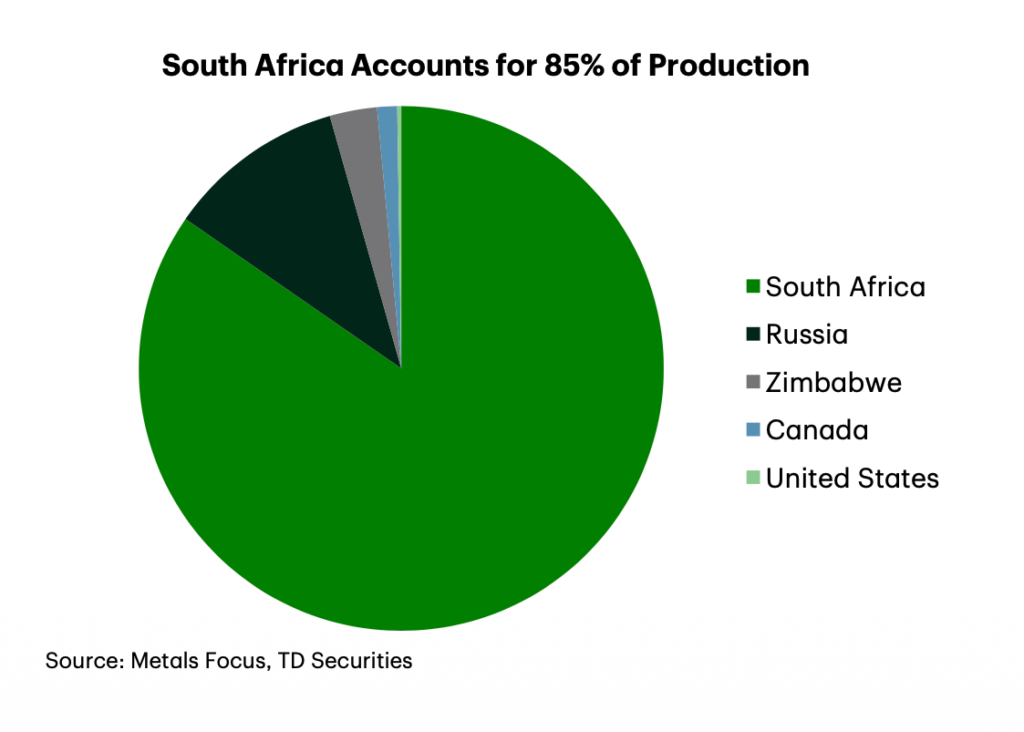
The vulnerability is heightened by extreme geographic concentration. South Africa supplies about 85% of the world’s primary rhodium, while only five of the country’s PGM mines account for roughly half of global output. Smaller South African operations, along with mines in Russia and Zimbabwe, produce most of the remainder.
Rhodium supply also responds poorly to its own price because the metal is largely produced as a by-product of platinum and palladium mining. Rhodium represents only about a quarter of mined PGM revenue, leaving development and production decisions primarily dependent on the economics of the broader PGM basket.
That structure creates an unusual market dynamic: falling rhodium demand may produce a surplus without necessarily encouraging miners to rapidly cut output, while supply disruptions can still have an outsized effect because inventories offer such a small buffer.
Auto slowdown
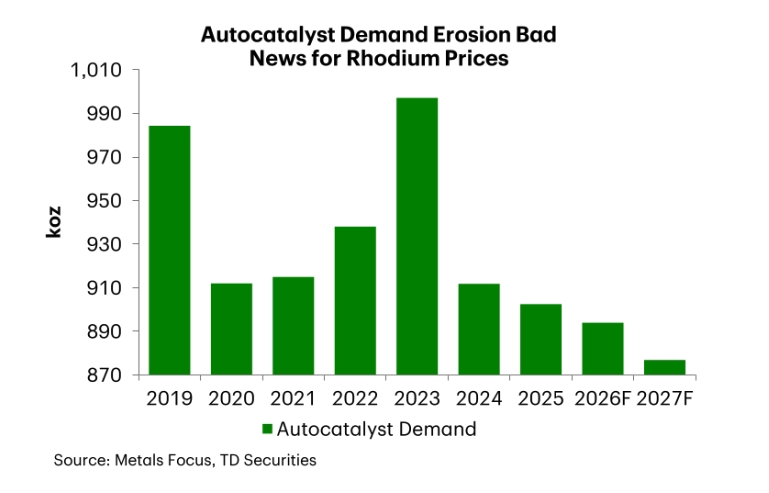
Demand presents the more persistent challenge. Autocatalysts account for most rhodium consumption, tying the metal closely to internal combustion engine vehicle production.
After years of expansion, autocatalyst demand has flattened as electric vehicles take a larger share of the automotive market. TD expects declining ICE vehicle sales to weigh further on rhodium consumption over the coming years.
Slower-than-anticipated EV adoption should temper that decline in the near term and reduce the likelihood of a prolonged price collapse. Longer vehicle lifespans also delay the return of rhodium contained in older catalytic converters to the recycling market.
Secondary supply should nevertheless increase steadily as older vehicles carrying heavier rhodium loadings reach the end of their lives. High metal prices have also encouraged greater recovery from scrap, although recycling remains constrained by imperfect recovery rates and limited processing equipment in some vehicle-retirement markets.
Substitution offers another potential pressure valve, but replacing rhodium is neither quick nor straightforward. Palladium is the usual alternative, yet TD estimates implementation can take 18 to 24 months and require five to eight times as much palladium as the rhodium being replaced.
Investors, meanwhile, have begun returning to the market. Rhodium exchange-traded funds have recorded positive inflows for the first time in more than a decade as retail and institutional investors seek physical precious-metals exposure.
Holdings remain well below levels reached in the early 2010s, leaving the market caught between weakening structural demand and a supply chain with little margin for error. The result could be lower prices over the next several years punctuated by abrupt rallies whenever production falters.









.jpg)