It’s possible that I shall make an ass of myself. But in that case one can always get out of it with a little dialectic. I have, of course, so worded my proposition as to be right either way (K.Marx, Letter to F.Engels on the Indian Mutiny)
Friday, October 02, 2026
Moroccan intelligence accused of spying on journalists and human rights activists
Morocco’s domestic intelligence service has deployed Pegasus spyware and hidden cameras in a sweeping campaign of surveillance against journalists and human rights activists, according to a report by Amnesty International.
Amnesty said in their report released on Thursday that the apparatus operated by Morocco's domestic intelligence agency – the Direction Générale de la Surveillance du Territoire (DGST) – included Israel’s Pegasus spyware.
It also said phones were deliberately infected with malware and surveillance cameras secretly installed in private homes, and found there had been systematic interception of telephone calls.
The report draws on testimony from a former DGST employee, digital forensic evidence and internal documents from surveillance technology companies, including NSO Group, Hacking Team and Verint.
The Moroccan authorities have repeatedly denied using Pegasus and maintain that they respect the confidentiality of private communications.
The former DGST employee, identified by Amnesty under the pseudonym Safir, described an intelligence operation ranging from sophisticated remote hacking to methods requiring physical access to a target.
According to his testimony, journalists and activists were secretly filmed and recorded while in detention, in offices, cars and cafés – and even in their bedrooms.
Telephone calls were routinely intercepted and location data used to track targets and their associates, Amnesty said.
Safir also described arrangements with second-hand phone shops through which DGST agents could supply apparently new devices that had already been infected with spyware, giving the authorities access to their users’ communications.
Amnesty said the DGST also relied on cooperation from at least one Moroccan telecommunications provider.
Its investigation found that some Pegasus attacks were carried out through “network injection”, allowing targeted devices to be redirected towards spyware infrastructure while connected to the Maroc Telecom network.
The report says Morocco also purchased other surveillance systems over more than a decade.
The DGST and Morocco’s High Council for National Defence had contracts from at least 2009 with the Italian company Hacking Team, while Morocco also purchased Verint’s Reliant surveillance platform in 2014, according to internal records cited by Amnesty.
Pegasus targets
Amnesty said its analysis provided further evidence that the DGST began using NSO Group’s Pegasus spyware from September 2017.
Pegasus can give an operator extensive access to the contents of an infected smartphone, including messages, photographs, location information and the phone's microphone and camera.
Internal NSO documents disclosed during a US court case involving WhatsApp and its parent company Meta identified the Moroccan customer under the codename “Morgen”, Amnesty said.
Amnesty identified 103 Moroccan phone numbers entered into the Pegasus system between September and December 2017, including dozens belonging to human rights activists, journalists, lawyers and academics. It said the evidence showed civil society figures were among the DGST’s priority targets.
The NGO said Morocco used Pegasus between 2017 and 2021 and possibly later.
It called for an independent investigation into the DGST and urged governments to halt exports of intrusive surveillance technology to Morocco until stronger safeguards are in place.
Ethiopia's new rebel war redraws alliances across the Horn of Africa
Ethiopia and Eritrea have cut diplomatic ties as a new rebel offensive grips northern Ethiopia, putting two countries that fought together during the last Tigray war on opposing sides. Ethiopia accuses its neighbour of supporting a new anti-government alliance.
Ethiopia announced on Thursday that it was closing its embassy in the Eritrean capital, Asmara, and expelling 10 Eritrean diplomats suspected of activities posing "a direct threat to national security".
Citing "hostile and warlike acts", Addis Ababa gave the diplomats 48 hours to leave.
"Eritrea has no option but to reciprocate in kind and sever all diplomatic ties with Ethiopia," the Eritrean foreign ministry said hours later, describing the expulsion of its ambassador as "astounding".
Ethiopian federal forces are battling an alliance of armed groups that includes the Tigray People's Liberation Front (TPLF) and the Amhara Fano National Movement, whose fighters backed the federal government against the TPLF during the last Tigray war.
Fighting is under way across parts of Tigray and the neighbouring regions of Afar and Amhara, in the most serious hostilities since a peace agreement ended the Tigray war in 2022.
Ethiopia had already accused Eritrea, Sudan and Egypt on Sunday of supporting the offensive launched on 22 September. Eritrea denies the accusation.
"The dispute between the two countries goes back a very long way – for months and months, Asmara and Addis Ababa have regularly traded insults," Horn of Africa specialist René Lefort told RFI.
The immediate trigger for Ethiopia's action, he added, was its accusation that Eritrea was directly and indirectly helping the armed rebellion now engaged in large-scale fighting with the federal government.
The question now is whether the escalation stops there or the authorities in Addis Ababa go further, Lefort said.
The split marks a dramatic reversal from 2018, when Ethiopian Prime Minister Abiy Ahmed restored ties with Eritrea after two decades of hostility.
The two countries had fought a war over their border from 1998 to 2000. Their reconciliation helped earn Abiy the Nobel Peace Prize in 2019.
Eritrean troops later fought alongside Ethiopian federal forces against the TPLF during the 2020-2022 Tigray war.
This time, the two countries are on opposing sides.
Relations have also deteriorated over Ethiopia's push for direct access to the Red Sea. The country lost its coastline when Eritrea became independent in 1993.
Sea access is essential to the country's long-term economic and security interests, Abiy has argued, while Eritrea accuses his government of having ambitions over Eritrean ports.
Members of the Tigrayan forces patrol a street in Mekelle, northern Ethiopia, as tensions rise following the launch of a major offensive against the federal government, 24 September 2026. @ REUTERS
Earlier this week explosions hit the headquarters of the Ethiopian National Defence Force in western Addis Ababa. The capital had never previously been targeted by military action – not even during the Tigray war.
No link has been established between the blasts and the diplomatic rupture with Eritrea.
The attack has been blamed on a rebel alliance known as the Coalition for Survival, but none of its armed groups has claimed it, RFI's correspondent in Ethiopia reported. A diplomatic source nonetheless considers their involvement very likely.
"We are at war, so our only aim is to damage the regime's infrastructure," a coalition member said when questioned about the explosions.
Ethiopia's national intelligence service had banned all drone flights over and around Addis Ababa the day before the explosions. Last week, a drone struck the Bishoftu air force base, 40 kilometres from the capital, the conflict-monitoring network Acled said.
Focusing attacks on military targets is an "effective strategy", an analyst who asked not to be named told RFI. If the rebels are behind the blasts, they "spare civilians" and "do not unnecessarily risk the lives of their fighters".
Striking the enemy on its own ground also sends "a message" and makes it "more vulnerable", the analyst added.
The TPLF joined six other armed movements in September to form the Coalition for Survival, whose stated objective is to remove Abiy's government from power.
Reports say federal forces and their allies appear to have made gains in southern Tigray and are advancing towards the regional capital, Mekelle.
At least 52 civilians were killed during three days of intense fighting in the town of Alamata, a doctor told the BBC earlier this week.
A member of the Afar Special Forces, a regional force established by the federal government, outside a house damaged during fighting between Tigrayan and Ethiopian federal forces near the village of Bisober, in Ethiopia's Tigray region. @ AFP - EDUARDO SOTERAS
The TPLF has also been fighting in neighbouring Afar, which lies along Ethiopia's important transport corridor to Djibouti and the sea. Tens of thousands of people are estimated to have fled their homes there.
Eritrean soldiers have been involved on the front lines, a pro-government militia commander fighting in Tigray told the BBC, which has not independently verified the claim.
For now, Eritrean President Isaias Afwerki is reportedly giving the rebels access through his country to the coast and the outside world. During the previous Tigray war, Tigrayan forces were cut off on all sides.
Ethiopia's military chief has accused Sudan and Egypt of supporting Eritrean operations inside Ethiopia. Both countries deny any meddling.
Egypt and Sudan are also at odds with Ethiopia over the Grand Ethiopian Renaissance Dam on the Blue Nile. Both are downstream and fear the dam could threaten their water supplies, while Ethiopia sees it as crucial to its economic development.
Drone activity and air strikes are putting civilians, vital infrastructure and aid operations at risk, while insecurity and road closures are restricting relief efforts in northern Ethiopia, United Nations spokesman Stéphane Dujarric warned on Thursday.
Sudan's own war has added another layer to the regional tensions. Its army has been fighting the paramilitary Rapid Support Forces for three years, with some Tigrayan forces fighting alongside it.
Several diplomats told Reuters that Khartoum also hosted meetings that led to the creation of the new Ethiopian rebel alliance.
(with newswires)
Gaza documentary ‘NAZA’ beating ‘Avengers Endgame: Encore’ at box office
'NAZA', the award-winning documentary which examines "the systems behind the mass killing of Palestinian civilians", is currently beating the recently re-released Marvel film ‘Avengers Endgame: Encore’ at the Italian box office. The documentary is set to be released globally this month.
NAZA, the Venice-winning documentary about the Israeli attacks on Gaza, is currently beating Marvel’s Avengers Endgame: Encore at the Italian box office
Directed by Oscar-winners Yuval Abraham and Rachel Szor, the Israeli filmmakers behind No Other Land, NAZA shows “in detail the systems behind Israel’s calculated mass killing of Palestinian civilians in Gaza,” according to its official synopsis.
Shot in secrecy at night on the rooftops of Tel Aviv during the ongoing Gaza war, it features interviews with 24 Israeli military intelligence officers, soldiers and whistleblowers. They describe how Palestinians are targeted and how strikes are carried out using AI and automated surveillance in military targeting systems - despite Israel being aware that civilians are present in targeted areas. The participants' faces and voices were digitally altered to protect their identities.
The 80-minute hot-button doc builds on reporting between 2023 and 2025 published by the Israeli-Palestinian +972 Magazine, the Hebrew-language outlet Local Call, and The Guardian. It left this year's Venice Film Festival with the Special Jury Prize and received a record-breaking 25-minute standing ovation at the festival.
Directors Rachel Szor and Yuval Abraham, winners of the special jury prize for the film 'Naza' - 12 September 2026AP Photo
NAZA premiered in Italian cinemas on Monday (28 September) and by Tuesday, had taken a reported €1.1 million at the box office. By comparison, Avengers Endgame: Encore - a rerelease of the 2019 blockbuster featuring new scenes that tie the film to the upcoming Avengers: Doomsday, made €356,000 over the same period (via The Guardian).
NAZA was originally booked for a three-day theatrical run but that’s now been extended due to sold-out screenings. More than 150 other cinemas in Italy are expected to extend programming.
“As long as theatres want to show it, NAZA will continue to be screened,” Andrea Romeo, founder of I Wonder Pictures, the film’s distributor in Italy, told La Repubblica.
“We made this film out of a sense of obligation to use our position as Israelis to examine the systems behind the mass killing of Palestinian civilians for which our country is responsible,” explained Abraham and Szor.
“While filming over the past three years, we found ourselves asking the very questions that were asked by our grandparents’ generation and throughout the 20th century: how does one group of people allow the total dehumanisation of another? What do the inner workings of such a system look like?”
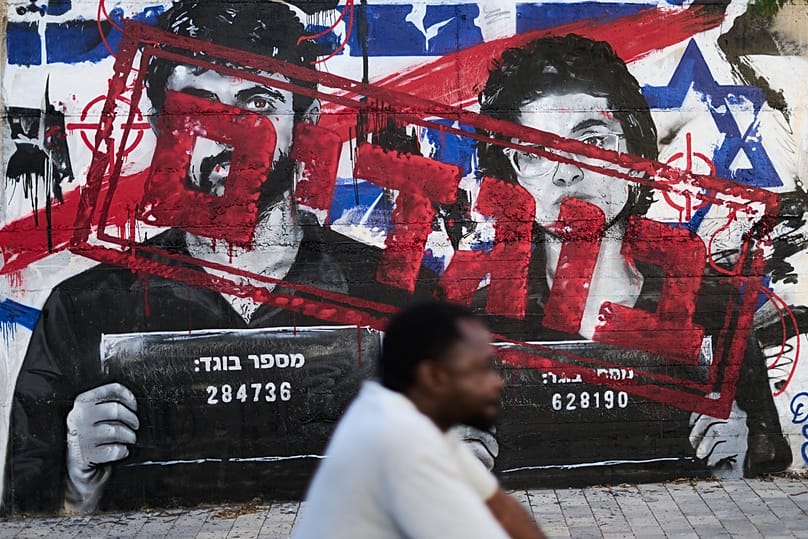
Graffiti showing directors Rachel Szor and Yuval Abraham with the Hebrew for "traitors" in Ashdod, Israel - 15 September 2026AP Photo
Israeli Prime Minister Benjamin Netanyahu hasattacked the makers of NAZA, accusing the film of contributing to “global antisemitic incitement”.
“It’s shocking. We are fighting global antisemitic incitement and when it comes from within us it is intolerable,” Netanyahu said in a video posted on Telegram. “And now two Israeli directors portraying the IDF (Israel Defense Forces) as war criminals receive applause at the Venice festival.”
Netanyahu's comments followed those of Israeli Culture Minister Miki Zohar, who directly equated criticism of Israel's actions to antisemitism and announced that he would “act immediately to revoke the Israeli citizenship” of the Israeli directing duo Yuval Abraham and Rachel Szor.
NAZA will be released in more than 50 territories in the coming weeks before being made free-to-watch on The Guardian’s website in November.
Schools closed, services slowed and flights cancelled: strikes hit Portugal
Three CGTP unions have called a strike for Friday, disrupting schools, public services, councils and rubbish collection. An easyJet cabin crew walkout is also causing flight delays nationwide.
More than 350,000 public administration workers are covered by the strikes called by three CGTP-affiliated unions for this Friday in Portugal. The biggest effects are being felt in education, with dozens of schools closing their doors due to a lack of staff.
"We have schools closed from the north to the south of the country, in the Azores and Madeira as well," explained Sebastião Santana, speaking to TVI. Outside the Francisco Arruda School in Lisbon, which kept its gates shut this morning, the coordinator of the Common Front highlighted the "strong turnout" for the protest.
The union leader was speaking at the Francisco Arruda School in Lisbon, which did not open because of the 24-hour stoppage.
The protest was called by the National Federation of Public and Social Service Workers' Unions (FNSTFPS), the National Union of Local and Regional Administration Workers, Public Companies, Concessionaires and Related Entities (STAL) and the Lisbon Municipal Workers' Union (STML), covering operational assistants, technical assistants and senior technicians.
As well as school closures, the strike may also cause disruptions to social security services, registry and notary offices, the justice system and rubbish collection.
The walkout may also have some impact on local health units and other bodies under the Ministry of Health.
Dozens of people have gathered in Lisbon for a march between Praça da Figueira and the Ministry of Finance.
The unions are calling for the immediate upgrading of these professionals' career structures.
EasyJet: union reports strong support and hundreds of flights cancelled
easyJet cabin crew launched a five-day protest action on Friday, with the strike continuing until Tuesday. The National Union of Civil Aviation Flight Personnel (SNPVAC) reports strong participation and expects 80% of flights to be cancelled during the five days of stoppage.
Speaking to the Lusa news agency, SNPVAC president Ricardo Penarroias said that 443 flights have already been cancelled for the coming days at Lisbon, Porto and Faro airports.
Also speaking to Lusa, an official easyJet source said it expects to operate around 55% of its schedule during the strike period, through minimum services and flights operated from other European bases.
"The company will carry out the minimum services, which are compulsory, and the other flights it has not cancelled (...) are flights it will operate illegally," said the union president.
The workers' demands include more stable rosters, pay progression based on seniority and the conditions proposed as part of the negotiations for the company agreement.
A second stoppage has been scheduled for 19 to 23 December.
Hundreds of French schools remain closed as riot police clash with student protesters
Some 400 French schools were closed Friday as the student protests that began in high schools in the Paris region last week have spread across France and grown increasingly violent. The students are protesting against teacher shortages, dilapidated school buildings and overcrowding in classrooms.
Tear gas choked the streets in the eastern city of Strasbourg, fireworks were aimed at police lines in Marseille in the south and rubbish bins set ablaze in Rennes in the west.
Rights groups have accused the police of using heavy-handed tactics against minors, including the use of batons, tear gas and non-lethal flash-ball guns. French authorities have opened four investigations to examine accusations of police violence.
One such probe will examine the case of a 16-year-old, who suffered an eye injury after police fired rubber bullets into a crowd of protesters, according to his friends.
In Rennes, the tension was already palpable outside the Jean-Mace high school with students dressed in black, wearing balaclavas and standing not far from a heavy police presence.
“As far as we’re concerned, we’ve won – our school is closed this morning,” said Lola, 16, who declined to give her last name.
She condemned what she said was police violence.
“It makes us even angrier – the police have no right to hit us or use tear gas on us.”
James, a high school student in the northern city of Lille, also denounced what he called "extremely violent police repression, which inevitably fuels students' anger."
"When we see fellow students being beaten, choked, blinded in one eye, and tear-gassed from all sides while we're simply trying to have a dialogue with the government, of course it makes people angry," he said. 'Outsiders'
Some 170 students have been wounded since the start of the movement, Education Minister Édouard Geffray said, while more than 100 high schools have suffered “severe damage”.
Speaking Friday evening, he said that some 735 high schools out of the country's 3,700 had been affected "in one way or another" – though he stressed that this was 30 percent fewer than Thursday.
At least 65 staff members – including 40 high school principals – have also been injured as the protests have at times turned violent. Geffray said that three staff members had been injured on Friday, compared with 31 the day before.
In La Ciotat, near Marseille, a young person sprayed petrol at a teacher, said a spokesperson for that region's educational authority. In a social media clip broadcast by BFM TV, a man is seen wiping his face after a hooded person wearing a face-mask sprays a liquid from a bottle at him. Reuters was not able to verify the circumstances. 'Apocalyptic scenes' as France school protests escalate
Protesters in Pantin, on the outskirts of Paris, set items including fences on fire and threw firecrackers at riot police, before running away.
Interior Minister Laurent Nunez said images from the eastern city of Belfort showing a group of youths encircle a lone policeman and kick him to the ground were of a "rare violence and intolerable".
He said police had arrested 1,747 on Friday, adding there had been "projectiles thrown, attacks on law enforcement, teachers, journalists, passersby".
After a government crisis meeting on Thursday, a source close to the prime minister said the demonstrations had morphed from a protest movement to urban violence, and Justice Minister Gérald Darmanin has said it had been hijacked by "outsiders".
Several students in the Paris region whom Reuters spoke to earlier in the week said they were staying away from the protests on Friday due to escalating violence. 'A real state of anxiety'
Six months before next year's presidential election, opinion polls consistently show the deep unpopularity of Macron and his centre-right government. Planned budget cuts, which exacerbate the funding crisis in education, have fuelled the discontent.
Trade unions meanwhile called a teachers’ strike for Tuesday, a week after public-sector workers walked out.
"(The violence) is regrettable, but ... when demands go unheard for years, and given the political and geopolitical context, there are several conditions that put ... students in a real state of anxiety," teacher Sandra Champain-Seller said.
The protests erupted in the Paris region last week but have turned increasingly violent as they spread nationwide.
Four hundred high schools – roughly one in 10 – were closed on Friday due to the unrest, while Geffray urged parents to keep their children from protesting.
Some parents supported the protests.
Vincent Martin joined his daughter outside Hélène Boucher high school, in Paris, saying students were "fundamentally right to demand ... better learning conditions". Budget cuts
The students blockading the high schools have voiced anger over overcrowding in classrooms, regular shortages of teachers and rundown buildings, blaming years of under-investment.
"We are 35 per class, we don’t have enough chairs in classrooms, the one-hour lunch break (is too short) for everyone to get food," 15-year-old Kesia told Reuters in the Paris suburb of Pantin before running off as the police used tear gas.
Under the draft 2027 budget presented by the government on Thursday, the education budget is set to increase by a below-inflation 1.7 percent to €65.53 billion ($73.77 billion), excluding teacher pensions.
Education is traditionally the largest budget item, but that changes next year with debt servicing costs expected to reach €74.5 billion, according to the draft bill.
According to the OECD global policy forum, French spending on education is in the middle of the range among member countries and increased between 2015 and 2022, but its share of the budget has slightly decreased.
Intelligence agencies reportedly told the crisis meeting that the protest movement had been initiated by politicians from the left-wing France Unbowed party (LFI).
Senior LFI lawmakers dismissed the allegations, accusing the government of politicising the protests ahead of the election.
(FRANCE 24 with Reuters and AFP)
France closes 400 schools as student unrest over conditions continues
France has closed hundreds of secondary schools amid violent student protests, as ministers urged parents to keep children away from blockades and warned families could be billed for damage.
Issued on: 02/10/2026 - RFI
A sixth-form student adds fuel to a burning barrier during a protest outside Le Corbusier Lycée in Aubervilliers, north of Paris, on 1 October 2026. AFP - LOU BENOIST
Around 400 of France’s 3,700 secondary schools were closed on Friday on the orders of police prefects, with many schools switching to online lessons.
Education Minister Edouard Geffray urged parents to intervene, warning that young people were putting themselves at risk.
“Children are in danger on the streets,” he told BFMTV. “Parents must, quite clearly, take action and tell their children not to go [to the blockades]."
The protests began over staffing, funding and school conditions and have spread rapidly across the country.
The Interior Ministry said 1,027 secondary schools were affected on Thursday, including 222 that were blockaded. Around 30 university campuses were also blocked.
It said 1,949 people were arrested on Thursday alone, mainly in connection with violence, unlawful gatherings and attacks on people in positions of authority.
A total of 305 police officers, gendarmes and firefighters were injured during Thursday’s unrest, while Geffray said 170 pupils and 65 education staff had been hurt since the movement began.
More than 100 secondary schools had also suffered serious damage, he said.
Riot police face off with protesting students carrying out blockading action at the Lycee Kerichen secondary school, in Brest in western France, on 1 October. AFP - FRED TANNEAU
Justice Minister Gerald Darmanin said he had asked prosecutors to seek civil liability against parents whose children were responsible for vandalism, potentially leaving families to pay for repairs.
“When schools are vandalised, when bus shelters are attacked, when public transport is targeted, we will now hold parents civilly liable,” he told radio network RTL.
“It’s not the minor who pays, it’s the parents,” Darmanin said, arguing that the approach could prove “far more useful than detention”.
He said around 90 percent of those detained were minors, while roughly a third of those arrested had been held in connection with violence against other people.
Darmanin described those responsible as an “active and violent minority” and questioned whether all of them were secondary school students.
He said the unrest had moved beyond a conventional student protest to become a matter of “public order”, with the authorities concerned about further violence over the weekend and during a national day of action scheduled for Tuesday.
The government has accused the hard-left France Unbowed party (LFI) of contributing to the radicalisation of the movement and seeking to exploit the unrest.
The prime minister’s office has described the protests as a “manoeuvre organised by LFI and its proxies on the far left”.
LFI coordinator Manuel Bompard rejected the accusation and urged the government “not to descend into conspiracy theories”.
The government’s claims that LFI has orchestrated the unrest have not been independently established.
At the same time, the government has made its first concrete concession to the movement.
On Thursday night, Geffray announced that a proposal in the 2027 budget to introduce registration fees for non-scholarship students in BTS vocational higher education courses and those in preparatory classes for entrance exams for France's elite universities would be dropped.
The planned charges – €178 for BTS students and €270 for those in preparatory classes – had drawn criticism from student groups, trade unions and parties on the left.
Geffray was due to meet secondary school organisations, parents’ associations, education unions and representatives of the national student council on Friday.
“One of the difficulties with this movement is that there is no single national demand,” he said. “It all stemmed from a fairly diverse range of local demands.”
Student organisations are nevertheless calling for protests to continue, with the movement now looking towards Tuesday’s national day of action.
Hundreds of high schools in France cose as new protests against conditions erupt
The students say their school hours are excessively long, conditions inadequate including overheated classrooms, and that there are too many staff absences.
French high school students lit fires outside schools and faced off with police on Friday as a protest movement that has forced the closure of some 400 establishments showed no sign of abating.
The movement, which began last week in the Paris region and rapidly spread nationwide, has seen teenage pupils at lycées in their final years of schooling block access to buildings and clash with police.
The Ministry of Education said earlier on Friday that 564 schools had "been the subject of actions or disruptions since the start of the day."
The students say their school hours are excessively long, conditions inadequate including overheated classrooms, and that there are too many staff absences
The government says the grievances are legitimate but has condemned what it has described as "urban violence."
Students have accused police of using excessive force and causing injuries by regularly firing tear gas canisters to disperse the protests.
In Paris on Friday, fire damaged the entrances of two high schools, Leonard de Vinci in the south of the city and Gaston-Bachelard in the southeast, with the fire brigade called to extinguish the blazes, an AFP photographer said.
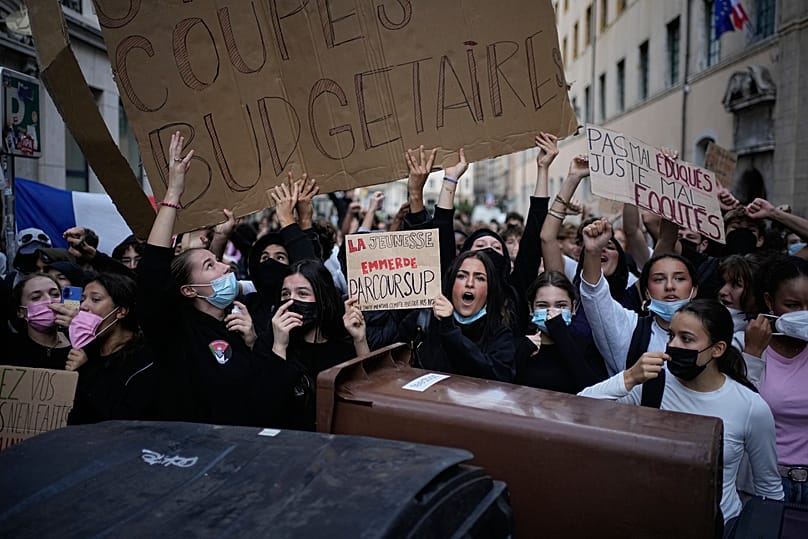
Students hold a sign reading "Stop budget cuts" as they protest against under-resourced schools in Lyon, 2 October, 2026 AP Photo
'Held hostage'
Education Minister Edouard Geffray said "the high school student movement is being held hostage by ultra-violent fringe groups," adding that nearly 400 high schools out of the 3,700 in the country were expected to be closed on Friday.
Many high schools have also planned to conduct classes remotely, particularly in the southern city of Marseille.
At least 65 staff members have been injured, including 40 high school principals, since the start of the movement, Geffray told BFMTV.
Some 170 students have been wounded while over 100 high schools have suffered "severe damage."
"Parents must clearly step up and tell their children not to go" to the protests, he added. "What matters now is ensuring our children are no longer out on the streets, because they are in danger."
Justice Minister Gérald Darmanin said he has asked prosecutors to hold parents liable for damage caused by their children during the protests and "pay for repairs."
Since the start of the movement, around 2,000 people have been taken into police custody," 90% of whom were minors," Darmanin told RTL.
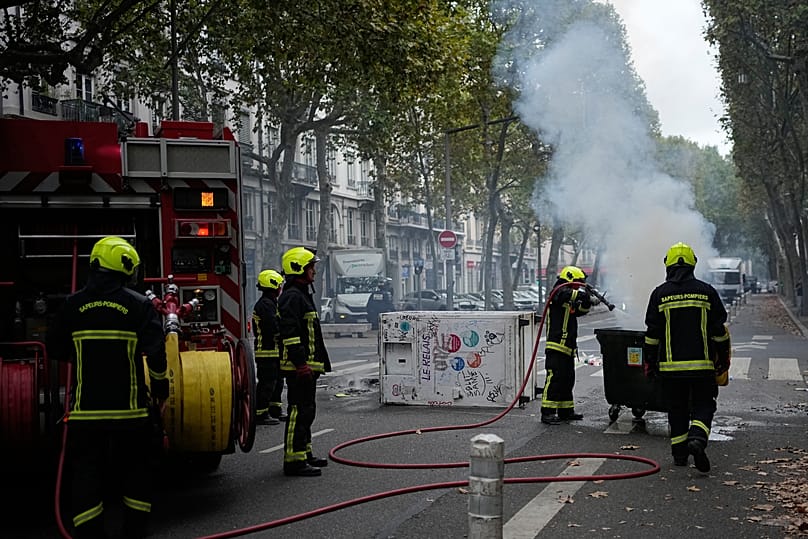
Firefighters extinguish a fire as students protest against under-resourced schools in Lyon, 2 October, 2026 AP Photo 'We've won'
In the western city of Rennes, the tension was already palpable outside the Jean-Mace high school with students dressed in black and wearing balaclavas standing not far from a heavy police presence.
"As far as we're concerned, we've won, our school is closed this morning," said Lola, 16, who declined to give her last name.
She condemned what she said was police violence. "It makes us even angrier, the police have no right to hit us or use tear gas on us."
Related
Police used tear gas at the Kerichen high school in Brest, in western France, an AFP photographer said.
The protests have also made a strong political echo just over half a year before presidential elections, with the government accusing the hard left France Unbowed (LFI), whose firebrand leader Jean-Luc Melenchon is again standing for the presidency, of being behind the movement.
French police clash with teens blockading
schools as unions stage day of protests
French teenagers on Tuesday clashed with police as they kept up a blockade of high schools in cities across the country to demand better conditions and more teacher hirings. The escalating standoff came as unions staged a day of demonstrations against a cost-cutting budget drafted by Prime Minister Sébastien Lecornu's embattled government.
French teenagers on Tuesday set fire to rubbish bins and hurled projectiles at police who responded with batons and tear gas, as pupils kept up blockades and protests at hundreds of high schools, demanding better conditions.
The movement in the lycées, which handle the final years of school in France, has angered the government.
Since last week, high school students have staged protests outside their schools over grievances including timetables, class sizes and a shortage of teachers as well as overheated classrooms during the recent heatwaves.
The protests started in the Ile-de-France region around Paris but have now spread to other cities nationwide.
According to the education ministry, 400 schools were affected by protests or disruptions on Tuesday, out of some 3,700 across the country.
Some 40 were blockaded and 44 faced attempted blockades. Ten people, both students and staff, were wounded and hundreds, most of them minors, were detained.
"440 were detained across national territory," Interior Minister Laurent Nunez said on BFMTV. "We don't have the final tally yet, but I'm told two thirds led to police custody."
Education Minister Édouard Geffray condemned the violence.
"Legal proceedings have been initiated against these actions. This violence is unspeakable," Geffray posted to X.
"To legitimise it or ... call for an expansion of the blockades is to endanger both our students and public officials. It is irresponsible."
In one lycée in the Paris suburbs, teachers formed a line around protesting students in a bid to protect them from the police.
Masked pupils gathered outside the Lycée César Baggio in Lille, in northern France, setting bins on fire, an AFP photographer reported.
Bus shelters and advertising billboards were vandalised, with bottles, paving stones and various objects hurled at police, who responded by firing tear gas.
There were 40 arrests on Tuesday and 10 people -- students and staff -- were wounded.
In the western city of Nantes, teens piled up dozens of bins to prevent entrance to the Lycée Gabriel Guist'hau, while in Paris there was an uneasy standoff between 30 students and a contingent of police at the Arago school.
Similar clashes were also reported in cities including Marseille in the south, Bordeaux in the west and Lyon in the southeast. 'Children of the suburbs'
Around 80 students gathered outside the Lamartine school in Paris, brandishing slogans including "More hours of lessons than sleep" and "8am to 6pm: are we pupils or under arrest?"
There were tense scenes at the Lycée Brequigny in the northwestern city of Rennes – Brittany's largest high school – where around a hundred students hurled projectiles at the building, an AFP video journalist said.
The actions came as unions staged a day of nationwide demonstrations and strikes over the budget of Prime Minister Sébastien Lecornu, a close ally of President Emmanuel Macron.
The CGT union said 300,000 marched across France, including 70,000 in the capital. Police put the Paris figure at 30,000, including 8,000 firefighters. Public transport was not badly affected however.
"The anger is immense. I warn the government – it must address the demands and revise the draft budget, which is dangerous for the country and is driving us straight into the wall of recession at 200 kilometres an hour," the head of the CGT union Sophie Binet told BFM TV.
Lecornu said on Monday any escalation of demonstrations at high schools would be "irresponsible" and lashed out at the hard-left France Unbowed (LFI) party, who he accused of encouraging the protests.
Interior Minister Laurent Nunez said 164 arrests took place on Monday and 180 schools were affected, adding: "We cannot tolerate excesses."
In the low-income Paris suburb of Seine-Saint-Denis, the district's LFI mayor Bally Bagayoko joined a protest of hundreds of students at the Lycée Paul-Eluard.
Leading students in a rendition of the national hymn, the Marseillaise, he described the protests as "completely legitimate" and complained that low-income areas received less resources than higher-income ones.
When a crowd formed, police with anti-riot shields struck the students and an AFP journalist with batons.
"We, the children of the suburbs, are abandoned and neglected," said 16-year-old Victoire, a student at the school, denouncing conditions at the establishment as "unsanitary".
"Sometimes, violence can be legitimate," Bagayoko, who denied accusations he had set fire to a bin at the school, told BFM TV on Tuesday. "But whenever it can be avoided, it is better," he added.
(FRANCE 24 with AFP)
Transport suspended in some French cities as school protests continue
French Prime Minister Sébastien Lecornu convened a crisis meeting Thursday as students staged new protests against understaffing, onerous schedules and overheated classrooms, with public transport affected in several cities. More than 1,900 people, most of them students, have been detained and hundreds of police injured amid the increasingly violent protests, the interior ministry reported.
French students set fire to bins and erected blockades outside schools in several cities, protesting against overcrowded classrooms, teacher shortages and crumbling facilities.
Several school principals were injured, harassed or assaulted during blockades at high schools on Thursday, according to reports from regional education authorities, prefectures and union representatives.
Riot police have lined up against the students, and the force has launched internal probes after accusations of brutality against three pupils, said Interior Minister Laurent Nunez.
Police have already detained hundreds of protesters at the lycées, which students aged 15 to 18 attend for their final three years of secondary education in France.
In the Parisian suburb of Saint-Denis, crowds of young people massed in front of a line of police. One student held up a sign that read: "Can we explain ourselves without being teargassed?"
The interior ministry said police and gendarmes had made 1,949 arrests on Thursday, while 305 officers had been injured. Nunez condemned what he described as "unbridled violence".
Hundreds held, dozens wounded as French school protests escalate
Prime Minister Sébastien Lecornu convened a crisis meeting in the afternoon, asking his ministers to cancel their travel plans over the coming days due to the blockades led by high school students in order to let prefects handle the situation, his entourage reported.
The government said the demonstrations had become "urban violence" and cited the intelligence service to justify claims that it had been organised by the radical left.
Manuel Bompard, a leading figure in the left-wing France Unbowed party (LFI), quickly dismissed the claim, accusing the government of "sinking into conspiratorial thinking".
"LFI has always advocated non-violent demonstrations," LFI lawmaker Louis Boyard told BFM TV after a readout of the crisis meeting was shared with reporters.
"The government, by turning it into a political battle, has added fuel to the fire by insulting and repressing high school students," he added.
"This sense of frustration will not be dealt with through batons; it will be dealt with by showing consideration for these young people," he said.
This latest wave of social unrest comes with tensions already running high over inflation, particularly soaring fuel prices – and just seven months away from France's presidential election, where opinion polls suggest far-right leader Marine Le Pen is the frontrunner.
A security source said there had been 900 blockades or related incidents across the country on Thursday.
More than 160 schools were shut down, and university students joined the protests in Paris, Marseille and other cities.
And the authorities in the Paris region said around 50 schools had been "the scene of violence, clashes and damage". 'It's unbearable'
Since last week, pupils have staged protests outside schools over a range of grievances. They range from timetables, class sizes and a shortage of teachers to overheated classrooms during this year's heatwaves.
The protests have spread across the country from the Paris suburbs.
University students also joined in Thursday, blocking access to around 30 campuses, a student union said.
Among reports of school staff being targeted was one incident in the southern port city of Marseille when a school principal and his deputy were inadvertently splashed with petrol as protesters were trying to fill containers.
In the northwestern city of Nantes, firefighters had to intervene to extinguish a fire in the entrance of a high school "following a gathering marked by violence towards staff", the regional education board said.
Authorities reported violence near high schools, mainly in Nantes, blaming "violent individuals" who "join the students to carry out acts of vandalism".
In the northeastern city of Strasbourg, trams were ordered to halt to "restrict the movements of rioters and demonstrators", the regional prefect said.
Raphael, a 17-year-old who did not give his surname for fear of reprisals, was among the protesters outside a school in Strasbourg, where some used barriers to obstruct the nearby tramway tracks.
"There are 35 of us per classroom. With 35°C in summer, it's unbearable. There aren't enough toilets, and there are water leaks in some rooms," Raphael said.
"The building is falling apart, the cafeteria is too small. There's zero budget, zero resources, not enough supervisors," he said.
Nearby, students took photos of themselves in front of burning rubbish bins, holding up the sign with their school's name ripped off the tram stop.
Most pupils did not take part in any vandalism, instead breaking into a sprint down an avenue when the police fired tear gas.
In the southern city of Toulouse, hundreds of young people flooded the tram tracks, some toppling trash cans and starting fires, hurling projectiles or smashing bus shelters, AFP journalists said.
In the northern city of Lille, AFP reporters saw young people wearing black hoodies destroy the glass of a bus stop. Firefighters intervened to put out the flames on upturned dustbins set on fire.
The government has accused the left-wing LFI of encouraging the protests.
But LFI's candidate for the 2027 presidential election, Jean-Luc Mélenchon, said on Wednesday that his party "called for non-violent methods of struggle".
In neighbouring Belgium, there were protests and damage at a handful of schools in the eastern city of Liège, police said.