Showing posts sorted by relevance for query LAKE MONSTER. Sort by date Show all posts

Friday, March 20, 2020


Canada’s mysterious lake monster

For generations, a mythical beast has been said to lurk in the depths of Okanagan Lake. But now a new view on British Columbia’s most revered serpent is taking hold.


By Lisa Kadane BBC 10 March 2020


Not long after I moved to Kelowna, a city in southern British Columbia known for its wineries, water sports and hiking trails, I saw a news story about a monster sighting. Two brothers had seen something undulating across the water in the middle of Okanagan Lake, an 84-mile long lake that curves down the Okanagan Valley past Kelowna in the shape of a serpent. The wave crested and fanned out like a wake, but there wasn’t a boat in sight. They were adamant it was Ogopogo.


Ogopogo is to Kelowna what Nessie is to Loch Ness

You can’t live in Kelowna for any length of time without hearing about its mysterious lake creature. Ogopogo is to Kelowna what Nessie is to Loch Ness: a yet-to-be-identified cryptid that reputedly resides in the lake’s depths and surfaces just often enough to keep the legend alive.


For generations, a mysterious beast has been rumoured to lurk in Okanagan Lake's depths (Credit: Moccasin Trails)

It’s been described as a multi-humped serpentine beast, with green or black skin and the head of a horse, snake or sheep. Drawings depict a coiling sea dragon like what you might see on an old mariner’s map where it says, “Here there be monsters.” Around town, Ogopogo takes on a benign cartoonish form as a 15-foot-long green- and cream-coloured statue on the waterfront, the smiling mascot for the local WHL hockey team and as plush toys at souvenir shops. Like its palindrome name, its physical appearance – and very existence – is something no one can make heads nor tails of.

Ogopogo mania peaked in the 1980s when the region’s tourism association offered a $1m reward for proof of the creature’s existence. Greenpeace came forward and named it an endangered species, demanding that Ogopogo be captured only on film, and not in the flesh. American TV shows of the era, including In Search Of and Unsolved Mysteries, even reported on the Okanagan Valley’s mysterious inhabitant.

A 15-foot-long green- and cream-coloured statue of Ogopogo greets visitors along Kelowna's Waterfront Walk (Credit: Lisa Kadane)

Yet, it wasn’t until I attended the International Indigenous Tourism Conference in Kelowna last autumn that I realised the Ogopogo of Canadian popular culture – a creature that 16% of British Columbians believe in – only came about through miscommunication between Canada’s early European settlers and the Okanagan Valley’s original inhabitants, the Okanagan/syilx.

It’s not really a monster, it’s a spirit of the lake and it protects this valley from one end to the other

“It’s not really a monster, it’s a spirit of the lake and it protects this valley from one end to the other,” said Pat Raphael of the Westbank First Nation, a member nation of the larger Okanagan/syilx Nation Alliance, who guided me through the syilx’s ancestral lands bordering Okanagan Lake. As our bus drove south along the water, she explained that while many in Canada know the creature as Ogopogo, to the syilx, it’s n ̓x̌ax̌aitkʷ (n-ha-ha-it-koo), which means “the sacred spirit of the lake.” Raphael pointed out the brown hump of Rattlesnake Island across the water, where the spirit is said to dwell. She also had us practice saying n ̓x̌ax̌aitkʷ in nsyilxcən, the syilx language.

“It’s not Ogopogo! What are you, colonised?” she joked when a few of us struggled with the pronunciation and reverted to saying Ogopogo.

According to the Okanagan Valley’s original inhabitants, the Okanagan/syilx, the spirit of ̓x̌ax̌aitkʷ watches over the lake (Credit: laughingmango/Getty Images)


Before European fur traders arrived in the valley in 1809, the syilx had been living in the area for at least 12,000 years. They had their own laws, justice system and beliefs. Chief among them was the importance of water, represented by n ̓x̌ax̌aitkʷ. It existed in two forms: a spiritual form and a physical, tangible form, which was embodied by the lake itself. Sometimes, though, the spirit would reveal itself from within the lake.

“In our stories, [n ̓x̌ax̌aitkʷ is] actually very dark in colour and it’s got the head of a horse and the antlers of a deer,” said Coralee Miller, assistant manager at the new Sncəwips Heritage Museum in West Kelowna. “Missionaries saw our water spirit and the habit was to demonise our spiritual beliefs.”

The syilx fed n ̓x̌ax̌aitkʷ symbolically, with tobacco and sage, and occasionally an offering of Kokanee salmon to thank the lake for providing food and water. “That’s where I think that misunderstanding came from – settlers saw us throw a little bit of meat in the water,” Miller explained.


Many tall tales of Ogopogo spread over the years, and there was once even a $1m reward for proof of the creature’s existence (Credit: Lisa Kadane)

Pioneers were soon telling stories of a serpent in Okanagan Lake that needed a live animal sacrifice to appease it and ensure a safe passage across the water. Once the idea of a bloodthirsty lake serpent took hold, it grew out of control – settlers began patrolling the lake with guns because they were nervous the beast would attack.

But by the 1920s (and likely in the absence of any actual human predation), cooler heads prevailed. Tourism officials named the creature Ogopogo after a catchy English folk song, whose lyrics included: “His mother was an earwig; his father was a whale; a little bit of head; and hardly any tail; and Ogopogo was his name.” N ̓x̌ax̌aitkʷ had transformed from a revered spirit into a cartoon-like creature that would lure tourists.

Over time, Ogopogo is what made Kelowna a household name in Canada

It’s hard to know just how many people have travelled to Kelowna over the last century in the hope of seeing the mythical lake monster, but over time, Ogopogo is what made Kelowna a household name in Canada. For years, the creature appeared on Kelowna’s parade float, both in town and at larger parades in the Pacific Northwest and Alberta. Gift shops hawked gimmick jars of Ogopogo’s “eggs” and even its “feces” that would fly off shelves. While the tourism office no longer actively promotes Ogopogo today, the legend remains as popular as ever.

Many Ogopogo sightings have taken place over the William R Bennett Bridge (Credit: Andrew Strain, Destination BC Photography)

Yet, the misappropriation and commodification of n ̓x̌ax̌aitkʷ is a sensitive issue. To Miller, a member of the Westbank First Nation, n ̓x̌ax̌aitkʷ and Ogopogo are two separate entities and shouldn’t be conflated. One of the museum’s missions is to tell the story of the area’s Indigenous people, and talk about the importance of n ̓x̌ax̌aitkʷ in protecting the lake. It’s part of what she calls “de-programming;” questioning or deconstructing the colonial perspective on local history and culture. This is also an important step towards reconciliation, an ongoing, countrywide process of establishing and maintaining respectful relationships between Indigenous and non-Indigenous Canadians.

This spring, Indigenous tour company Moccasin Trails is launching paddling tours on Okanagan Lake where guides will discuss n ̓x̌ax̌aitkʷ as a spiritual talisman – not a physical lake monster – and explain how it became appropriated.

We want people to leave our experiences with a better understanding of Indigenous culture

The canoe journeys begin with a feeding of the water ceremony. As the canoe glides across the lake’s glassy surface, a syilx cultural leader scatters sage and tobacco in the water while summoning the spirit world and telling his ancestors to keep everyone safe. Moccasin Trails co-owner Greg Hopf says the ceremony is powerful, and meant to illustrate the connection Indigenous people have with the earth, which is highly personal.

“It’s kind of what each person interprets the spirit to be,” he said. “We want people to leave our experiences with a better understanding of Indigenous culture.”


Indigenous-led tours will soon take visitors out onto Okanagan Lake to explain the importance of n ̓x̌ax̌aitkʷ (Credit: Moccasin Trails)

In downtown Kelowna, the Okanagan Heritage Museum works with the Westbank First Nation to tell a more thorough story of the region’s history. It redid its entire gallery in 2019 and represents syilx as a living culture, rather than focusing solely on the people’s way of life pre-colonisation. According to Kelowna Museums’ executive director, Linda Digby, sylix knowledge and perspective is now woven into every era depicted in the museum, and a display on Ogopogo explains how n ̓x̌ax̌aitkʷ was misunderstood by settlers and grew into a tourism boon.

“To settlers [Ogopogo] was a real thing,” said Digby. “They definitely misinterpreted what they heard from the Indigenous community and had no qualms about making up their own stories and appropriating from them, and it wouldn’t have even occurred to them they were doing that.”

As time wore on, the settlers’ inventory of stories grew – their neighbour saw the creature, or they themselves saw something strange in the lake. “You live here long enough everyone’s going to see something,” Digby said.

The Okanagan Heritage Museum recently redid their displays to tell a more balanced story of the region’s history (Credit: Matt Ferguson, Tourism Kelowna)

During my quest to understand n ̓x̌ax̌aitkʷ, I encountered a few people who are true believers based on what they’ve seen in Okanagan Lake. And they are far from alone: the museum’s archives are filled with newspaper clippings of Ogopogo sightings over the decades, along with stories about how a lake monster is good for the city’s bottom line.

“Ogopogo is great for tourism. It adds colour and panache and atmosphere,” said Robert Young, a University of British Columbia Okanagan earth sciences professor who is often called on as a voice of reason when an Ogopogo sighting occurs or new “footage” surfaces.

For Young, Ogopogo isn’t a question in biology, it’s a question in earth science processes – the way water moves over the surface of the earth. Thermal stratification in a lake can cause a wave to appear from nowhere when a denser layer of water slides beneath a more buoyant layer, as often happens in the spring or autumn, he explained. He calls it an “Ogopogo wave”.

Some locals are hesitant to want to disprove Ogopogo's existence, saying it's good for tourism (Credit: Meghan Reading, Tourism Kelowna)

This theory offers a plausible explanation for what people might be seeing on the water. But while Young is all for critical thinking about Ogopogo, he’s also loathe to disprove its existence. It should persist, he says, saying that Ogopogo is a Canadian cultural icon, and n ̓x̌ax̌aitkʷ is an important part of syilx beliefs.

I don’t worry a lake creature will nibble my toes when I go for a dip, but the power of nature gives me pause. I’ve started many days with a morning walk that leads to a ridge ringed by mountains overlooking Okanagan Lake and the rounded hills and extinct volcanoes of the Thompson Plateau behind it. I’m in awe I live in such a stunning place. When the wind ripples the water and sways the ponderosa pine trees growing on the hillside, I feel a connection to the natural beauty of my home. Maybe that spirit of place is my interpretation of n ̓x̌ax̌aitkʷ.


https://plawiuk.blogspot.com/search?q=CRYPTOZOOLOGY

https://plawiuk.blogspot.com/search?q=LAKE+MONSTERS

Monday, February 10, 2020

#CRYPTOZOOLOGY #CRYPTID #LAKEMONSTER
Gator or monster snake? Photo at South Carolina lake resurrects talk of tribal legend
BY MARK PRICE DECEMBER 30, 2019


Legends of a monster snake in the Catawba River date back for centuries, and some cited proof of it in a grainy photo posted taken over the weekend at Sunset Point picnic area on Lake Wylie. JESSICA PLATE PHOTO

The legend of a monster snake in the Catawba River dates back centuries, but some see new proof in a grainy photo taken over the weekend at Sunset Point on Lake Wylie.

The photo, posted online Sunday, shows what could be the head of something sticking out of the lake, with a sinuous wake spinning several feet behind it.

Within hours of it being posted online, talk of alligators, giant water snakes and a monster were being shared on Nextdoor.com, a community networking site. Lake Wylie, which does not have alligators, is a dammed section of the Catawba River, south of Charlotte.

“Lake Wylie monster?” Jessica Plate posted with her photo.

“I know this picture isn’t the greatest, but tonight while walking around the lake in our neighborhood we saw this 3 to 4 foot ‘thing’ moving in the water. At first, I thought it was a dog or deer, shoot, maybe a scuba diver!”

The photo was taken around 7:15 p.m. Saturday, and the thing appeared at first to be swimming toward her, then turned away, she wrote. “The wake it made was enormous! Please, does anyone know what it was!”
Play Video
Duration 2:32

Bigfoot The Sasquatch Museum is dedicated to answering question: Is Bigfoot real?

Expedition: Bigfoot The Sasquatch Museum, located near in north Georgia near North Carolina and Tennessee, is dedicated to the existence of the creature. BY JOHN D. SIMMONS

Plate told McClatchy news she wasn’t aware of the river snake myth until she started reading the responses posted to the photo.

She thinks the sensible explanation is that it was an alligator, despite the fact alligators don’t live in Lake Wylie. Commenters on the photo had a long list of other possibilities.

One person suggested it was a “a big nasty snake,” while another said it was nothing more than a floating log

“Beavers, muskrats, and otters were a few other guesses,” Plate said. “There is no way, this creature was way too big!”

The Catawba Nation, a tribe of indigenous people based in the same area, has folklore that tells of multiple river monsters. One involves “monstrously large snakes” that prey on people in the rapids and giant “leech-like creatures,” reported John Hairr in the 2013 book “Monsters of North Carolina: Mysterious Creatures in the Tar Heel State.”

As in the case with the infamous Loch Ness monster, proof has never been found of anything large or monstrous in the river, though alligators have been found occasionally in the Catawba.

Lake Norman, another site near Charlotte created by damming the river, is said to be home to a creature called the Lake Norman Monster. A website is devoted to alleged sightings of it, which some say is a giant fish more than a monster snake.


Jessica Plate remains curious about whatever it was she saw and intends to keep investigating.

“Definitely will go back to the shore (with more people for evidence) to try and catch another glimpse!” she told McClatchy.

Thursday, February 20, 2020


Tetrapod Zoology
My New Book Hunting Monsters: Cryptozoology and the Reality Behind the Myths

Much of my 2015 was taken up by the writing of several books, some of which are, I’m pleased to say, due to see print in 2016. Today I’m happy to announce that the first of these is out: it’s my Arcturus book Hunting Monsters: Cryptozoology and the Reality Behind the Myths (Naish 2016)...

By Darren Naish on February 16, 2016


Right now, Hunting Monsters only exists as an ebook. If you’re at all like me, this might be something of a disappointment, since I don’t get much satisfaction from ebooks and think of them more as badly formatted word documents, not as books at all.
Front cover of Naish (2016). I like it.

Anyway, if it sells well enough in digital format, we’ll then be releasing a hardcopy version. The good news is that the ebook version is criminally cheap (£2.39, US$3.45). Also, remember that you don’t need a kindle to read it – you can download a kindle app, for free, for any device, and thereby read it on your smartphone or PC or whatever.

There are a large number of books out there on cryptozoology already, so what’s special about this one? Hunting Monsters is a sceptical, pro-science take on cryptozoology; something along the lines of Binns (1984), Campbell (1986), Radford & Nicklin (2006) and Loxton & Prothero (2013). But that doesn’t mean that it’s a vicious debunking that leaves us all sad and disheartened – we can get something positive out of this; read on.
ADVERTISEMENT
Hugh Gray's Loch Ness monster photo is not a swimming dog or a giant salamander or worm-like animal, but a swan with a submerged head. This explains why it's so white. Look carefully and you can see the wings, tail and ankle joint. Swan image by Peter Gray (no relation... I presume!), from Naish (2016).

A reasonable amount of novel investigation of cryptid sightings and images is recounted. Classic water monster episodes like the Daedalus and Valhalla accounts and the Sandra Mansi photo are discussed in view of recent evaluations, and I’ve also included much of the new work on lake monster images released by Dick Raynor. Without giving too much away, I want to say that the famous Hugh Gray Loch Ness monster photo of 1933 is not a swimming dog, or a salamander-like beast, or giant anachronistic Tullimonstrum… but a swan. Yes, a swan. And the infamous Peter O’Connor photo of 1960 – the one that depicts what looks like an inflated plastic bag with a stick for a head – has proved to be the inverted hull of a kayak called a Tyne Prefect. You can even see the base of the rudder support!
Cropped version of the O'Connor Loch Ness monster photo - note how the far left part of the image (normally cropped out!) looks weird for what's meant to be part of an animal's body. It's a good match for the corresponding part of an inverted kayak (see Dick Raynor's study here).

And then there are my evaluations of Rilla Martin’s Ozenkadnook tiger photo, various of the key yeti and bigfoot accounts, a critical appraisal of the kraken (no, it is not the same thing as Architeuthis), the St Augustine blob and other sea monster carcasses, and more. I even obtained and read Jonathan Whitcomb’s ropen book…
Rilla Martin’s 1964 Ozenkadnook tiger photo - shown at left - has always been enigmatic and difficult to interpret. What's with the tall shoulders and pale stripes? (as per the interpretation at right, by Darren Naish). See Naish (2016) for current thoughts.

While previous authors have focused on the ecological and morphological problems attached to the superstar cryptids (for example: could a beast the size of Nessie really make a living in Loch Ness?; how could a creature like bigfoot evade detection in modern North America?), few have discussed the fact that cryptozoological hypotheses invoke very specific models pertaining to evolutionary history.
In recent years, some apparently good evidence for bigfoot has dissolved under scrutiny. Alleged dermal ridges have proved to be artifacts of the plaster-pouring process, as demonstrated by Matt Crowley (image of plaster ridges by Matt Crowley, used with permission). And claims that the lustrous pelt and realistic muscle tone of 'Patty' can't be replicated by a suit are highly questionable - look at the realistic tone and texture of the obviously fake suit on the right (photo by Darren Naish).

What’s notable is that, while cryptids themselves are posited as novel, exciting elements of the fauna, the evolutionary scenarios required to allow their existence virtually always involve novel, unprecedented events for which there is, alas, no evidence. The giant long-necked seals of the cryptozoological literature require that certain (unknown) pinnipeds evolved radical ecological, morphological and behavioural novelty; a view of bigfoot or the yeti as a giant, bipedal pongine requires that our views on the evolution of hominid bipedality and anatomy be substantially revised; arguments that the almas (or almasty or almasti) is a remnant Neanderthal are contingent on the idea that Neanderthals underwent radical change for which we have no evidence; and so on and on and on. Cryptozoologists have thought about this stuff a lot and written about it as well, but it has mostly evaded sceptical evaluation (for previous coverage see Conway et al. 2013).
Sea monsters and other mystery beasts - the creature shown here is Heuvelmans' 'Yellow-belly' - have taken on a life of their own ever since cryptozoologists have devised morphological configurations and evolutionary histories for them. But isn't this all a house of cards? Compare 'Yellow-belly' with the eyewitness accounts Heuvelmans based it on.

And what of the interplay between cryptozoology and creationism? I say stuff about that in my chapter on the mokele-mbembe and ropen (Naish 2016).
ADVERTISEMENT

A new frontier: cryptozoology as culture

However, I hope that Hunting Monsters is seen as more than a mere curmudgeonly debunking, or as yet another heavy-handed sceptical smackdown. One of my arguments, made repeatedly throughout the book, is that cryptozoology is culture. Even if cryptids don’t exist – in the corporeal, biological sense of the term – they still exist in the nebulous sense of their having a place in the psychological landscape, and this remains a fascinating issue worthy of further study. 
Blu Buhs (2009), required reading as goes the cultural context of bigfoot.

People ‘see’, describe and report the creatures they do because they interpret their recollections, sightings and encounters within the cultural framework in which they were raised. It is, so it seems, an inevitable consequence of being human that we imagine large, frightening creatures to lurk beneath the surface of the water, or human-shaped beasts in forests and other wild places.

There’s also a case to be made that people of a given subset will be more inclined to investigate or believe in mystery animals than others: this topic is explored at length in Blu Buhs (2009).

Indeed, the fact that belief in these creatures will not die – despite a compelling and impressive lack of evidence – makes it seem that they’re an almost immutable part of our psyche. Is there, then, really some ingrained need in humans to imagine, believe in, or see monsters? I don’t know the answer, but I think it’s a question worth asking and investigating.
 
Which Loch Ness monster would you like to believe in? We most certainly do not see consistent descriptions of a single biological entity.

Distinct from but linked to this apparent cultural role of cryptozoology is our ability to perform as witnesses and ‘data recallers’. It’s no secret that people generally perform very badly when it comes to describing and recalling observations, especially those made fleetingly or when under stress. And sceptics of cryptozoology often point to the field’s over-emphasis of the value of eyewitness data as one of its primary flaws (Loxton & Prothero 2013). How we perform as witnesses and recallers and why we fail or succeed when we do is another fascinating subject – and I say that it’s linked to the cultural role of cryptozoology because a case can be made that our preconceptions and biases are linked to cultural and societal archetypes, memes and concepts.
  
Standard reading on cryptozoological scepticism: Loxton & Prothero (2013).

We’re at an early stage in understanding this stuff. Or, at least, those of us who aren’t experts in it are at an early stage. What I’m saying – by now it’s probably clear – is that, while bigfoot and Nessie and so on might not be ‘real’, they’re likely ‘real’ enough, culturally and/or psychologically, to be significant to us. I think that that’s important. We’re calling this whole subject ‘post-cryptid cryptozoology’, and I hope that Hunting Monsters is perhaps epiphanic on this front to at least some of its readers.

So there we have it – long-time readers of Tet Zoo will know that this book represents the culmination of an evolving set of thoughts and hypotheses.
The Daedalus encounter of 1848 remains one of the most pivotal and influential of sea monster reports. Was it actually a misidentified rorqual, as argued by Galbreath (2015)? This is more compelling when you look at Lieutenant Edgar A. Drummond's sketch.

And finally...

As always with anything written by humans, there are a few errors that are making me cross. In a discussion of the Daedalus sea monster sighting, I say that the beast had no neck, and then immediately go on to say that its mane was located some way along… its neck. There’s also a contradiction as goes how the Daedalus monster is treated – it’s a skim-feeding Sei whale at one point (as per Gary Galbreath’s 2015 article) and an unresolved enigma at another. Whoops. And there are a few dumb typos and incorrect terms, as there always are. I hope you can forgive these transgressions.
For previous Tet Zoo articles relevant to the issues covered here, see...
Best lake monster image ever: the Mansi photo
A ‘lake monster’ caught on film at Lake Champlain
Rilla Martin’s 1964 photo of the ‘Ozenkadnook tiger’
Cryptozoology at the Zoological Society of London. Cryptozoology: time to come in from the cold? Or, Cryptozoology: avoid at all costs?
The amazing Hook Island sea monster photos, revisited
The Cryptozoologicon (Volume I): here, at last
Is Cryptozoology Good or Bad for Science? (review of Loxton & Prothero 2013)

Refs - -

Binns, R. 1984. The Loch Ness Mystery Solved. W.H. Allen & Co, London.

Blu Buhs, J. 2009. Bigfoot: the Life and Times of a Legend. University of Chicago Press, Chicago.

Campbell, S. 1986. The Loch Ness Monster: The Evidence. The Aquarian Press, Wellingborough, UK.
ADVERTISEMENT

Conway, J., Kosemen, C. M. & Naish, D. 2013. Cryptozoologicon Volume I. Irregular Books.

Loxton, D. & Prothero, D. R. 2013. Abominable Science! Columbia University Press, New York.

Naish, D. 2016. Hunting Monsters: Cryptozoology and the Reality Behind the Myths. Arcturus, London.

Radford, B. & Nickell, J. 2006. Lake Monster Mysteries. University of Kentucky Press, Lexington.

The views expressed are those of the author(s) and are not necessarily those of Scientific American.
Rights & Permissions
ABOUT THE AUTHOR(S)


Darren Naish


Darren Naish is a science writer, technical editor and palaeozoologist (affiliated with the University of Southampton, UK). He mostly works on Cretaceous dinosaurs and pterosaurs but has an avid interest in all things tetrapod. His publications can be downloaded at darrennaish.wordpress.com. He has been blogging at Tetrapod Zoology since 2006. Check out the Tet Zoo podcast at tetzoo.com!

Recent Articles
The End of Tetrapod Zoology, ver 3
Dinosaurs in the Wild: An Inside View
Speculative Zoology, a Discussion

Thursday, July 28, 2022

DINOSAURS

British researchers find fossils showing Loch Ness monster-type creature 'plausible'

New fossils shed light on dinosaur habitat

By Andrew Mark Miller | Fox News

The discovery of new fossils is leading British scientists to conclude that the past existence of a Loch Ness monster was "plausible."

The development came when a group of researchers found the remains of small long-necked marine reptiles known as plesiosaurs in a 100 million-year-old river system in the Sahara Desert, the Telegraph reported.

Believers in the Loch Ness monster have long believed that the lake-dwelling creature could be a prehistoric reptile similar to the plesiosaur, but critics have maintained that the monster could not live in freshwater.

The new finding, made by researchers at the University of Bath, suggests otherwise.

LOCH NESS MONSTER: A HISTORY OF THE LEGENDARY BEAST


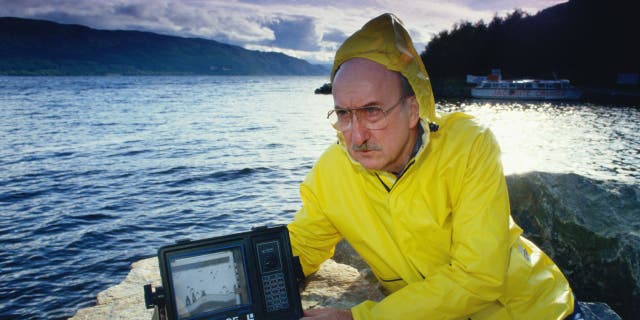
Scientist Thayne Smith Lowrance with a sonar device during one of his many attempts to find the legendary Loch Ness Monster, Scotland, February 1999. (Tom Stoddart Archive / Contributor)

The discovery, published in the journal Cretaceous Research, compares the creatures to river dolphins and the fossils found include bones and teeth from ten-foot long adults.

"What amazes me is that the ancient Moroccan river contained so many carnivores all living alongside each other," David Martill, co-author of the paper, said.

LOCH NESS MONSTER 'GIANT EEL' THEORY SUPPORTED BY NEWLY SURFACED VIDEO

Another one of the authors, Dr. Nick Longrich, said the scientists "don’t really know why the plesiosaurs are in freshwater."

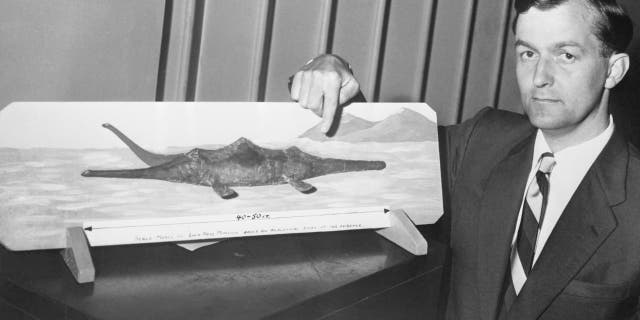
Pilot Tom Dinsdale displays a model he made of the storied Loch Ness "Monster." Dinsdale claims he saw the "monster" and even made movies of it when he was at Loch Ness, Scotland (Getty Images)

"It’s a bit controversial, but who’s to say that because we paleontologists have always called them ‘marine reptiles’, they had to live in the sea?" Longirch said. "Lots of marine lineages invaded freshwater."

LOCH NESS MONSTER MYSTERY SOLVED? STUDY CLAIMS ANCIENT DINOSAUR DISCOVERY INFLUENCED DELUSION

A press release from the university stated that the findings show the Loch Ness Monster was "on one level, plausible."

"Plesiosaurs weren’t confined to the seas, they did inhabit freshwater," the press release explained. "But the fossil record also suggests that after almost a hundred and fifty million years, the last plesiosaurs finally died out at the same time as the dinosaurs, 66 million years ago."


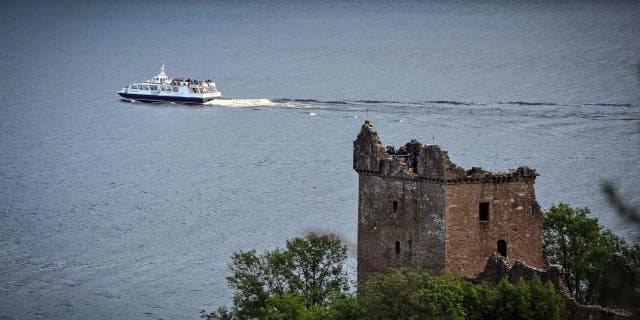
A tourist boat passes Urquhart Castle on Loch Ness in Drumnadrochit, Scotland, on September 5, 2019
. (Photo by Andy Buchanan / AFP)

The legend of the Loch Ness monster has commonly been attributed to a plesiosaur that somehow managed to survive the mass extinction event that killed off the dinosaurs.

Reports that a creature was living in the Loch Ness lake date as far back as the 6th century.

The first written account was recorded in 565 A.D. in a biography of St. Columba. According to the text, the creature bit a swimmer and was prepared to attack another man when Columba intervened. He ordered the beast to "go back" and it obeyed.

Hundreds of years later, the legend started to grow. After the construction of a road adjacent to Loch Ness was finished in 1933, giving onlookers an unobstructed view of the lake, a couple allegedly saw an enormous animal they compared to a "dragon or prehistoric monster" cross in front of their car and disappear into the water. The incident was reported in a Scottish newspaper and numerous sightings followed.

Alleged sightings continued throughout the 1900s, including a search by the so-called the Loch Ness Investigation Bureau that conducted a 10-year observational survey recording an average of 20 sightings per year and in the 1970s underwater photographs of what appeared to be a "flipper" were made public.

Additionally, several sonar explorations, most notably in 1987 and 2003, were undertaken to find the elusive beast — to no avail.

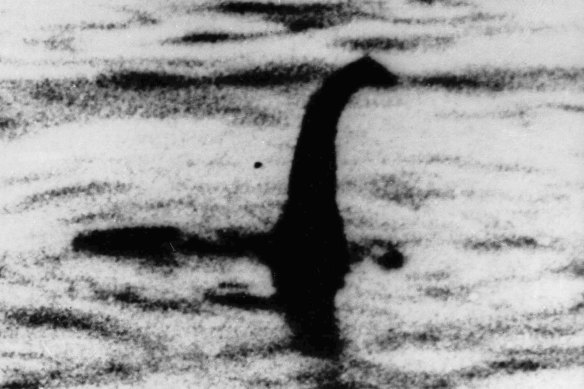
Over the years, more photographs have been taken, but most were discredited as fakes. In 1994, it was revealed that the famed "surgeon photograph" that alleged to be a photo of the monster was a hoax masterminded by a revenge seeker. The image was actually a plastic-and-wooden head attached to a toy submarine.

Fox News' Julia Musto contributed to this report

Andrew Mark Miller is a writer at Fox News. Find him on Twitter @andymarkmiller and email tips to AndrewMark.Miller@Fox.com.

Sunday, August 27, 2023

With drones and webcams, volunteer hunters join a new search for the mythical Loch Ness Monster

JILL LAWLESS
Sat, August 26, 2023 


LONDON (AP) — Mystery hunters converged on a Scottish lake on Saturday to look for signs of the mythical Loch Ness Monster.

The Loch Ness Center said researchers would try to seek evidence of Nessie using thermal-imaging drones, infrared cameras and a hydrophone to detect underwater sounds in the lake’s murky waters. The two-day event is being billed as the biggest survey of the lake in 50 years, and includes volunteers scanning the water from boats and the lakeshore, with others around the world joining in with webcams.

Alan McKenna of the Loch Ness Center said the aim was “to inspire a new generation of Loch Ness enthusiasts.”

McKenna told BBC radio the searchers were “looking for breaks in the surface and asking volunteers to record all manner of natural behavior on the loch.”

“Not every ripple or wave is a beastie. Some of those can be explained, but there are a handful that cannot,” he said.

The Loch Ness Center is located at the former Drumnadrochit Hotel, where the modern-day Nessie legend began. In 1933, manager Aldie Mackay reported spotting a “water beast” in the mountain-fringed loch, the largest body of freshwater by volume in the United Kingdom and at up to 750 feet (230 meters) one of the deepest.

The story kicked off an enduring worldwide fascination with finding the elusive monster, spawning hoaxes and hundreds of eyewitness accounts. Numerous theories have been put forward over the years, including that the creature may have been a prehistoric marine reptile, giant eels, a sturgeon or even an escaped circus elephant.

Many believe the sightings are pranks or can be explained by floating logs or strong winds, but the legend is a boon for tourism in the picturesque Scottish Highlands region.

Such skepticism did not deter volunteers like Craig Gallifrey.

“I believe there is something in the loch,” he said, though he is open-minded about what it is. “I do think that there’s got to be something that’s fueling the speculation.”

He said that whatever the outcome of the weekend search, “the legend will continue.”

“I think it’s just the imagination of something being in the largest body of water in the U.K. … There’s a lot more stories,” he said. “There’s still other things, although they’ve not been proven. There’s still something quite special about the loch.”

200 monster hunters armed with drones join the biggest search in 50 years for Scotland's fabled Loch Ness creature


Rebecca Rommen
Sat, August 26, 2023 

The 1934 "surgeon's photo" of the monster, now deemed a hoax

Getty Images

200 volunteers are searching for the Loch Ness monster this weekend.


The operation in the Scottish Highlands is the biggest of its kind in 50 years.


The search for "Nessie" has been underway for 1300 years.


The fabled Loch Ness monster is attracting the biggest search operation in 50 years. The elusive monster, affectionately nicknamed "Nessie," is a fixture of Scottish folklore and is believed to inhabit the deep lake in the Scottish Highlands.

The legendary beast has eluded capture and definitive proof it was reportedly first spotted in the 6th century. The modern myth of Nessie began more recently when, in 1933, a hotel manager claimed to have seen a whale-like creature in the loch.

The famous "surgeon's photograph" of 1934 allegedly shows the marine creature's head and neck. It was published in the Daily Mail and continues to make waves despite most now agreeing that the photo was an elaborate hoax.

This weekend, 200 monster hunters are trying to do what those before them failed to accomplish, the Washington Post reports.

They are descending on the Highlands better equipped than their predecessors, using flying and underwater drones to survey the lake, which is 788 feet deep and 23 miles long.

They are also employing infrared cameras to determine heat spots and a hydrophone that can pick up acoustic signals 60 feet below the loch's surface.

These are not just people "with binoculars and a tub of sandwiches," insists Paul Nixon, head of Loch Ness Center. The expedition is the most elaborate in the 1300-year search for Nessie, the New York Times reports.

Many have speculated that Nessie is a dinosaur lost in time


View of Loch Ness, Scottish HighlandsGetty Images

Alongside the 200 volunteers on-site, almost 300 people have signed up to follow a livestream from the search, the BBC reports.

Paul Nixon added: "The interest in our weekend of activities has been fantastic, and to see how people worldwide are still fascinated by the story of the loch and Nessie."

The effort is the biggest since 1972, when the Loch Ness Investigation Bureau carried out a study. In the meantime, other efforts to find Nessie have persisted. In 1987, 24 boats outfitted with echo sounders swept the loch's length in Operation Deepscan.

Many speculated that the creature was a plesiosaur dinosaur, a marine reptile that went extinct 65.5 million years ago. They somehow became trapped in Loch Ness when a geological rupture cut it off from the sea.

In 2019, scientists reported Nessie could be a big eel.

This weekend's operation, "The Quest," will span the 23-mile-long loch. Participants are asked to document everything they see from organized surface-watched locations.

"We are looking for breaks in the surface and asking volunteers to record all manner of natural behavior on the loch," said Alan McKenna of Loch Ness Exploration to BBC Radio's Good Morning Scotland program.

Alan Rawlinson, business development manager at Visit Inverness Loch Ness, told The Washington Post that the intrigue surrounding Nessie and Inverness draws more than one million visitors annually.

Sunday, August 06, 2023

Loch Ness ‘monster hunters’ wanted for biggest search in 50 years

ByJustine McDaniel
August 6, 2023 —

Seeking: monster hunters.

The Loch Ness Centre is calling one and all to join a massive search this month for Nessie, the mythical beast said to inhabit the waters of Scotland’s famed Loch Ness – hoping to make it the largest hunt for the monster in more than 50 years.

Experienced Nessie researchers will use modern technology that has never before scanned the waters, said the centre, which runs an exhibition and tours of the lake. They’re asking volunteers and “budding monster hunters” to join in and watch the surface of the 37-kilometre-long lake.


This photo of a shadowy shape that some people say is the Loch Ness monster in Scotland was later debunked as a hoax. CREDIT:AP

The event, scheduled for August 26 and 27, could be the largest surface watch since 1972, said Alan McKenna of Loch Ness Exploration, a volunteer research team that’s working with the Loch Ness Centre. Its organisers hope the “Quest Weekend” will draw searchers to join the centuries-long tradition of looking for the Loch Ness monster.

“It’s our hope to inspire a new generation of Loch Ness enthusiasts,” McKenna told the BBC. “You’ll have a real opportunity to personally contribute towards this fascinating mystery that has captivated so many people from around the world.”

Cradled by green slopes, the vast blue lake sits in the Scottish Highlands, near the city of Inverness and about a 3½-hour drive from Edinburgh. Though Nessie has never been proved to exist, the myth’s attraction – like that of Bigfoot or Sasquatch – has endured over the decades, sparking research, exploration and stories.


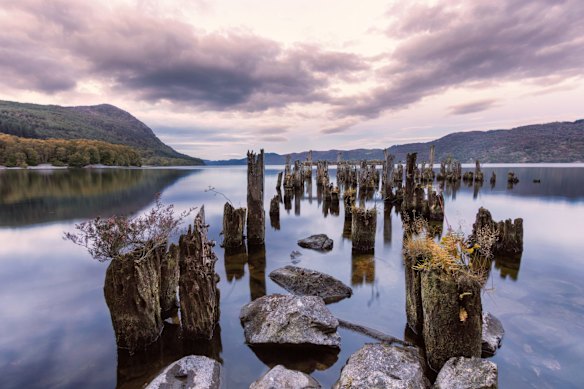
Loch Ness is a large, deep, freshwater loch in the Scottish Highlands.CREDIT:MICHELE RINALDI

McKenna told The Post on Saturday that he’d heard from many reporters and “friends from around the world” since the announcement of the project.

During Quest Weekend, the researchers will use airborne drones that make thermal images of the water with infrared cameras, according to the centre. They’ll also use a hydrophone that picks up acoustic signals – “any Nessie-like calls” – underwater.

Meanwhile, they’ll stage six surface-watch locations, and anyone who signs up to join will indicate what area they plan to observe. (They can also note whether they believe in “Nessie, nonsense, or possibilities”.)

“The weekend gives an opportunity to search the waters in a way that has never been done before, and we can’t wait to see what we find,” Paul Nixon, Loch Ness Centre’s general manager, told the Scottish Daily Express.

The Loch Ness Centre, which recently reopened after a renovation, did not immediately respond to The Washington Post’s request for comment.

Loch Ness is deep and vast, holding the largest volume of freshwater in Britain, according to the Inverness-Loch Ness tourism website. Theories about the monster said to lurk in those depths go back centuries, and they still draw enthusiasts and researchers to the lake today.

Many ideas about what type of creature could be under Loch Ness’ surface have been floated over the years, ranging from an extinct prehistoric reptile called a plesiosaur to swimming circus elephants. In 2019, scientists who analysed DNA in water samples from the lake said they found genetic material from eels but no evidence from sharks, sturgeons or prehistoric reptiles.

The earliest record of a Nessie sighting comes from 565 AD, when an Irish saint was “said to have driven a beast back into the water”, the Inverness website says. Twenty-one more sightings were recorded between the 1500s and 1800s.

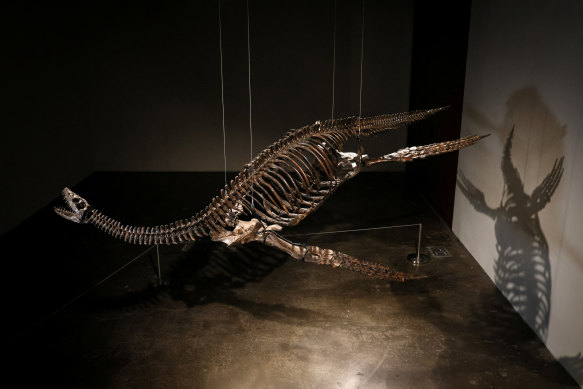
Remains of a Plesiosaur, which is believed to have inspired the legend of the Loch Ness Monster, are displayed at Sotheby’s in New York on July 10.CREDIT:REUTERS

The legend took off in the 1900s, when newspapers carried the story of Aldie MacKay at the Drumnadrochit Hotel, who reported seeing a “whale-like fish” or beast in the water in 1933, according to the Loch Ness Centre. The following year, Nessie became “an international sensation” thanks to a photograph – decades later debunked as a hoax – that seemed to show a head and neck coming out of the water, according to Visit Inverness Loch Ness.

In the 1970s, a group called the Loch Ness Phenomena Investigation Bureau set up “camera watches” on the loch, according to the UK National Archives, monitoring the loch for activity. They conducted the last major surface watch, McKenna said on Loch Ness Exploration’s Facebook page. In 1987, another team swept the loch with sonar.

In total, the Official Loch Ness Monster Sightings Register has recorded 1148 sightings. Three have been reported this year and six were reported last year, according to the register. People who snap photos often report a break or wake in the water or a dark-coloured hump or object appearing out of the water.

“As we watched a black lump appeared out of the water and sat for approximately 30 seconds before disappearing once again under the water,” one mother and daughter reported to the register in October 2022.

The late August hunt may offer enthusiasts the hope of making their own report. And even those who can’t travel to Scotland can check out a daily live stream of several spots on the lake, run by Visit Inverness Loch Ness.

Viewers who see something strange can take a screenshot, then report the sighting (the official register asks people to report to the webcam operators). The tourism website’s guide to the live streams notes that things like weather, wildlife and paddleboarders can “make a great Nessie shadow in the right light”.

To be considered as an official sighting, the footage must show “clear facial features of an unknown creature”, the website stipulates.

But, it adds, “We want you to spot the mystical legend that is our beloved Nessie.”

The Washington Post

Wednesday, February 05, 2020

What's causing mysterious 'ice rings' to form in the world's deepest lake?

The culprit was swirling beneath the ice.

A satellite view of an ice ring on Lake Baikal. Is it the one true ring to rule them all?
(Image: © MODIS/NASA)

The humongous, mysterious "ice rings" that pockmark the world's deepest lake during Siberia's winter and spring months may look like icy crop circles, but they're not due to alien activity, atmospheric conditions or even, as previously thought, methane bubbles percolating from the lake's bottom.

Rather, it appears that warm, swirling eddies of water under Lake Baikal's thick ice are responsible for these ice rings, some of which are up to 4 miles (7 kilometers) in diameter and can be seen from space, a new study finds.

Solving this mystery, however, wasn't an easy affair. An international team of researchers from France, Russia and Mongolia elected to travel to the lake biannually in 2016 and 2017, drill holes in the ice near the rings, and drop sensors into the water below. One year, their van got stuck in the ice. Twice.

Related: In living color: A gallery of stunning lakes

The researchers' van got trapped in the ice on the eastern boundary of a ring in Lake Baikal in March 2016. (Image credit: A. Kouraev)

In Siberia's colder months, Lake Baikal — the largest freshwater lake in the world, by volume — freezes over. The ice is so thick, people routinely drive over it, said study lead researcher Alexei Kouraev, an assistant professor at the Laboratory for Studies in Spatial Geophysics and Oceanography (LEGOS) at the Federal University in Toulouse, France.

"It's a no-brainer," Kouraev told Live Science. "It's a very long lake, and if you want to go from one side to another, either you do 400 kilometers [248 miles] one way and then 400 kilometers on the other coast." But the trip across the ice is just about 25 miles (40 km), "so the choice is evident," he said.

However, while the ice is thick outside of and inside these rings of thin ice, the rings themselves can put vehicles and their occupants at risk, Kouraev said.

Satellite photos show the mysterious ice rings in Siberia's Lake Baikal. The researchers focused on the rings in the dotted red box. Previously detected rings are shown in red, while newly detected rings are in orange. (Image credit: Limnology and Oceanography, 2019; CC BY-NC-ND 4.0; Corona and Landsat data are from the U.S. Geological Survey.)


The fellowship of the ice rings

Ice rings have formed on Lake Baikal since at least 1969, and can last anywhere from days to months, satellite images show. However, these rings have unpredictable behavior, and show up in different parts of the lake from year to year. Moreover, they tend to appear in late April, but can crop up as early as January or as late as May, Kouraev said.

But scientists couldn't figure out how they formed. One of the more popular theories, indeed one that Live Science reported on in 2009, suggested that the greenhouse gas methane bubbles up from the lake's deep bottom to cause these rings. But Kouraev and his colleagues noticed that some of these ice rings formed in the lake's shallower waters, areas with no known gas emissions.

After analyzing data from the sensors they had dropped into the lake, the scientists found that the lake had warm eddies flowing clockwise under its ice cover. The currents weren't as strong at the center of the eddies, which explained why the centers of these rings still had thick ice, Kouraev said. However, the current at the edge of the eddies was strong, which explained why the ice on top of this edge was thinner, he said.

The sensors revealed that the water at these eddies was 2 to 4 degrees Fahrenheit (1 to 2 degrees Celsius) warmer than the surrounding water. What's more, the eddies had a lens-like shape, a phenomenon that is common in oceans but rare in lakes.

Related: In photos: Monster waves

Notice how the ice rings change shape from March to April in 2016. (The April 17th image is not to scale with the others.) (Image credit: Limnology and Oceanography, 2019; CC BY-NC-ND 4.0; Satellite data are from MODIS and Landsat.)

But why did these eddies form in the first place? According to the sensors, which were kept underwater for 1.5 months at a time, as well as thermal-infrared satellite imagery, it appeared that the eddies formed each fall, before the lake froze over. Moreover, strong winds blowing in waters from the nearby Barguzin Bay could help them form, Kouraev said.

He noted that, so far, these ice rings have only been found in Lake Baikal, as well as the nearby Lake Hovsgol in Mongolia and Lake Teletskoye, also in Russia.

As for drivers who cross the frozen lake in their vehicles, Kouraev said that while cracks are easy to spot, the rings themselves can be harder to see at ground level because they're covered with ice. As a public service, Kouraev and his colleagues, who jokingly call themselves the Fellowship of the Ice Rings, have written booklets, given presentations and told Russia's national park service and ministry of emergencies about the rings. They also routinely update their website about the location of newly formed ice rings, which are visible in satellite images.

The study was published online in the journal Limnology and Oceanography in October 2019.
Album: Stunning photos of Antarctic ice
In photos: The vanishing ice of Baffin Island
In photos: Antarctica's Larsen C Ice Shelf through time

Originally published on Live Science.

Sunday, August 23, 2026

Monsters, Coyotes and Other Native Tales of Resistance

August 21, 2026

Part II, read Part I here.

In Necessity: Climate Resistance and the Thin Green Line, Chief Don Sampson tells a story written by beloved Umatilla storyteller Edith Motanic, “The Monster Who Comes Up the River.” He explains how the monster in this folk tale symbolizes the insatiable appetites of colonial powers that devour Native lands and how the wily coyote, spirit of Indian resistance, tricks the monster and ultimately outwits him. Chief Sampson adds that there is a moral to this contest between the monster and coyote and it concerns competing forces within the human spirit. We all carry the capacity for good and for evil. Indigenous people can become selfish betrayers of their own people.

The Windigo legend circulates similarly among First Nations Peoples. According to Shawn Smallman, author of Dangerous Spirits: The Windigo in Myth and History, the image of the windigo beast “was a means of defining moral social behavior, which could serve as a warning against greed and selfishness.” This cannibalistic forest beast takes over the spirits of victims and turns them into other windigos. Driven by insatiable hunger, the beast appears as a towering, emaciated figure emanating the odor of decaying flesh and arousing feelings of intimate horror.

For many Indigenous scholars and cultural critics, the Native cannon of windigo folklore unfolds historically alongside settler colonialism and reflects as much the anxieties of the colonizers as it does the fears of the colonized. From the late 19th through the mid twentieth centuries, Christian missionaries, white trappers, traders and anthropologists reported what came to be termed windigo psychosis, a mental disorder where the sufferer holds the delusional belief that he is possessed with the evil spirit of the windigo monster and is driven to acts of cannibalism. While a few cases of cannibalism have been documented historically, they generally occur in famine or other extreme conditions of scarcity.

Windigoism and the Psychiatric Gaza

Fascination with windigo psychosis among Western psychiatrists and anthropologists led to a hotly debated controversy in the 1980s over the historical validity of the phenomenon. The challenge for these white experts, including American psychiatrists, was to identify and diagnose cases where the person is driven by madness to acts of actual cannibalism. Scholars in the 1960s began to look more carefully at the case material on which this diagnostic picture was formed. In 1981, anthropologist Lou Marano looked back on reports that circulated in psychiatry of psychosis-induced cannibalism among First Nations peoples. “In the vast majority of cases in which the Indians employ the term there is no psychosis by either Algonkian or European criteria, much less a psychosis involving murder and cannibalism,” Marano concludes. “Unfortunately, anthropologists zeroed in on the bizarre, the grotesque, and the macabre in Landes’s reports rather than on their inconsistencies and their second-hand nature.”

The term windigoism is used very broadly among First Nations and Native peoples, Marano points out, for states associated with “going mad.” Among the Ojibwe, “almost driven to windigo” refers to madness that arises from life-threateningly harsh conditions. The term is invoked with considerable sympathy as it expresses despair and distress of people who are separated from the group or lost. To white anthropologists and psychiatrists, the search for evidence of actual cannibalism in the reports they collected blinded them to the social symbolic meaning of the story. Scholars documenting the phenomenon agree, however, that tales of windigoism circulate among the Cree, one of the largest groups of First Nations and Indigenous peoples in North America, living mostly in Canada from Quebec to Alberta. Missionary settlers among the Cree were a common source of these stories, imposing their own cure of Christian conversion on sufferers.

Decolonizing Family Memory

My mother grew up in Norway Valley, Alberta–an area of Norwegian settlers straddling a Cree Reserve. Working with Tara Houska and other Native activists fighting pipelines transporting oil from the Tar Sands fields in Alberta, led me to revisit my own family history. What do we owe to Indigenous people as descendants of white settlers? In Canada, The Truth and Reconciliation Commission (TRC), operating from 2008-2015, was one form of recognition and place for reparations. Based on legal settlement between Residential Schools Survivors, the Assembly of First Nations, Inuit representatives and the parties responsible for creation and operation of the schools, the federal government and the church bodies, the TRC opened space for uncovering repressed memories of Native suffering–repressed in white colonial narratives but also among Indigenous people themselves.

For those of us who are conscious of the debts we share as descendents of white settlers, disturbing conflicts arise over how we pass on our own family stories of hardship. As a clinical psychologist, I hold a longstanding interest in family stories passed from one generation to the next and in working through family mythologies. One debt we owe to Indigenous peoples, including the Palestinians, is that they have helped us to understand the historical inter-dependencies of the oppressors and the oppressed. And we have learned how oppressed people can become the oppressor, as we see in the brutal subjugation of Palestinians by Jewish Israelis.

My mother worked as a maid for a wealthy family in Bellingham as a young woman in the 1930s before she married my father. She had many stories about growing up dirt poor in Northern Alberta. Her parents, like many rural poor people, were drawn to Spirit-filled Pentecostalism. Their faith was forged by the hell-fire preachers at revival meetings, those seasonal gatherings of believers and backsliders in tents on the prairies.

One beloved family story passed on from my mother unfolded around her own brave and adventurous mother, Ma, following her older brother Ole who had gone before her, leaving Norway in 1906 to arrive in New York City. She then traveled to northern Minnesota where she secured a job as a cook in a hotel. Eight years after marrying my grandfather, Pa, a Norwegian farmer and carpenter, the couple migrated with their four young children to an area at the border of Alberta and Saskatchewan, not far from what are now the tar sands oil fields. My grandpa had seen a post in their town, a railway hub in Minnesota, that announced land grants for white settlers by the Canadian Pacific Railroad. White settlers served as paramilitary sites protecting the rails going through Indian country. My grandparents had seven more children in a cabin that was built by Pa at Frog Lake–an area of Scandinavian settlers that became Norway Valley. The settlement straddled the Reserve of Frog Lake Nation–a band of Cree. My mother liked to tell us stories about her brothers running away from the lashings of Pa and how the brothers found sanctuary from his abuse among the Cree.

Of the many pioneer stories about family hardships that were passed on in my family, the story that put Frog Lake in Canadian history books was not among them. In 1885, twenty-three years before my grandparents arrived at Frog Lake, the largest violent resistance to white settlers in Canadian history took place. The Frog Lake Massacre, or what the Cree call the Frog Lake Rebellion, was organized by a band of Cree that had settled in the area but had not yet accepted the government’s reserve site. In resisting treaty demands and the decimation of buffalo that had left the Cree people in a state of near starvation, Chief Big Bear and Wandering Spirit, the war chief of the band, organized a campaign to seize weapons and food supplies, targeting the Hudson Bay Company post. Cree men attacked and killed nine whites in the small settlement of Frog Lake. Eight Natives, including Wandering Spirit, were hanged on Nov. 27, 1885 in the largest mass hanging in Canada’s history.

My mother and her siblings are now dead and I have no way of knowing what they knew of this history, although a commemorative grave in their town honors the white settlers who were killed. Local records from the region suggest that the massacre was a formative cultural memory for whites as well as for Indigenous people: “After the Indian uprising of 1885 twenty-five years passed before the influx of white settlers began to move into the area…Because of the wide-spread publicity that stemmed from the rebellion, Frog Lake was the place to which the pioneers came.” My grandparents were among those pioneers, encouraged by the Royal Canadian Mounted Police to settle in Frog Lake alongside the Reserve as part of a larger program of Indian pacification.

Solomon (Sa-we-pah-u) Delver, a Cree member whose family story is recorded along with that of my grandparents in Frog Lake, recalls another legacy of the era.

When I was a very small boy, I don’t know how old I was, I was sent to the Roman Catholic Residential School at Onion Lake. I was there for twelve years. My dad had sent me there to learn to understand the language of the white people. It was hard for me to be brought up as an orphan. I stayed with the nuns; they told me I am really a Roman Catholic which is how I was brought up. I used to ask a blessing before every meal I had. I used to go to Church in the evenings and in the mornings to the service in the Chapel before breakfast. I remember all these things when I was in the Residential School. It was hard far away from home, but it was the only way in which I could understand the White men.

Delver explains how his father sent him to the residential school to learn the language of white people. Yet laws passed in Canada made removal of Native children from their families and severing ties with their cultures mandatory. There were 25 residential schools in the province of Alberta and many were open until the last of the schools closed in the 1990s. The network of boarding schools was established by the Canadian government’s Department of Indian Affairs after the Indian Act of 1876 and administered by Christian churches, primarily the Catholic Church and the Anglican Church. Smaller denominations ran Residential Schools as well although their religious oppression may have taken more subtle forms. The Doctrine of Discovery, the papal edict of the late 15th century subsequently incorporated into international law that provided religious authority for European conquest of the continent, was a guiding worldview, supported by a series of Supreme Court decisions in the US and Canada, that justified claims on Native lands.

Solidarity and Survival

In my deeper understanding of my mother’s stories and my own familial work of “decolonizing history,” I still find a place for one of my mother’s favorite memories of the Cree. She liked to tell the story of being sent to fetch fish from an ice trap at the age of 10 and getting lost in thick fog in trying to find her way home. She remembered releasing the reins of her horse, knowing that the animal would know the way. In the fog surrounding her, she realized that she was passing through the Cree Reserve and closer than she had ever been to the Indians. The story ended with Mom’s girlhood astonishment: “After I passed through, I realized that they were not going to hurt me. The Cree Indians were actually good people.”

The monstrous violence inflicted on the Cree by white settlers never found a place in her family stories. Nor was there a place for recognizing Indigenous peoples’ own right to resist their colonizers. It is up to us, as descendants of those settlers, to join in the ongoing work of Indigenous resistance. As ravenous industries devour more of life, land and the planet itself, our collective survival lies in that shared struggle.

This is the second piece of a four-part series. These can be read along with other weekly commentary on her Substack page.

Jan Haaken is professor emeritus of psychology at Portland State University, a clinical psychologist and documentary filmmaker.