Trump Withdraws All Federal Waters From Future Offshore Wind Leasing
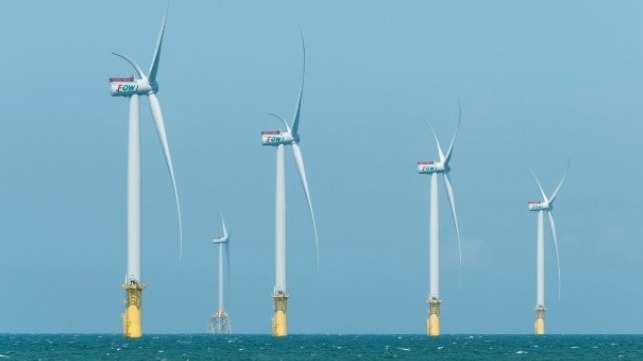
In an executive order signed on the first day of his new term, President Donald Trump used the Offshore Continental Shelf Lands Act (OCSLA) to withdraw all federal waters from future offshore wind leasing. The ban does not apply to existing leases, but it prohibits any further auctions, ending the Biden administration's plans for new lease sales off southern Oregon and the U.S. Gulf Coast.
In the order, Trump said that his decision stemmed from a desire to keep energy costs for consumers low and maintain a robust fishing industry - factors that have driven criticism of the offshore wind industry on the East and West Coast.
In response, offshore wind proponents warned that a shutdown of wind leasing could endanger thousands of U.S. jobs, put at risk $1.8 billion in Jones Act shipbuilding orders, and slow down a supply chain that brings economic benefitis to 40 states.
"Today’s actions threaten to strand $25 billion already flowing into new ports, vessels, and manufacturing centers, and curtail future investments across our country. We urge the administration to reverse this sweeping action and keep America working in offshore energy as part of its commitment to an “all-of-the-above” energy strategy," said Liz Burdock, head of the Oceantic Network (formerly Business Network for Offshore Wind).
Some offshore wind industry players expressed support for a temporary withdrawal. In a statement, the Offshore Marine Service Association (OMSA) said that the order is "a critical opportunity to reassess the industry’s direction." The trade group said that it welcomed a chance to address concerns about "over-reliance on foreign renewable energy companies, foreign vessels, and foreign mariners to build American offshore wind farms."
"We view this pause in offshore wind development as a critical moment to reset the industry’s priorities," said Aaron Smith, President of OMSA. "By addressing these systemic issues, we have an opportunity to ensure that offshore wind is delivering on its promise by creating jobs for American mariners, supporting U.S. shipyards, and reinvesting in the American economy."
While the White House called the order a temporary measure, an OCSLA lease withdrawal may be reversible only by an act of Congress (or a Supreme Court decision). When Congress wrote OCSLA in 1953, it included text to give the president broad authority to withdraw areas from future leasing, but it did not include language to let the president take back a withdrawal. The United States District Court for the District of Alaska ruled in 2019 that Congress kept that authority for itself.
In a separate executive order, Trump ordered the revocation of former President Joe Biden's OCSLA withdrawal order for offshore oil and gas leasing on the West Coast and East Coast. He also declared a national energy emergency, directing the use of the U.S. Army Corps of Engineers' emergency port and waterway permitting powers to expedite energy projects, with particular attention to projects on the West Coast and in the Northeast.
Ørsted Takes $1.7B Charge in Q4 Citing Decline in Value of US Seabed Leases
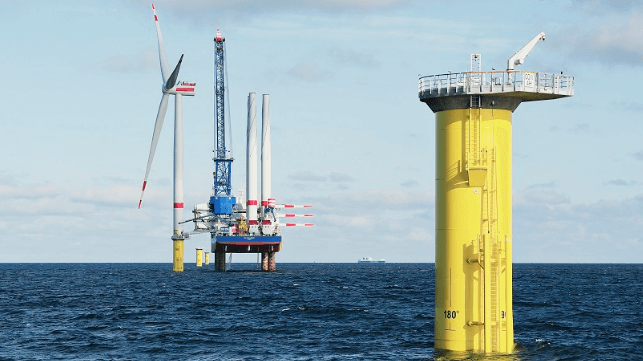
Ørsted which is focused on offshore and onshore wind farms, solar farms, energy storage facilities, renewable hydrogen and green fuels facilities, disappointed investors by announcing on Monday, January 20, an additional $1.7 billion in impairment charges. The company cited developments relating to the interest rate increases, the declining value of its U.S. seabed leases, and costs related to the construction of Sunrise Wind, a project located roughly 30 miles off the coast of New York.
“The impairments announced today, and especially the continued construction challenges, are very disappointing,” said Mads Nipper, Group President and CEO of Ørsted. He however noted, “We remain committed to the U.S. market in the long term with its potential for renewables to meet the growing electricity demand.”
The comments came on the same day as Donald Trump returned to the presidency and quickly moved to reign in future development. In an executive order, Trump moved to end future leasing of U.S. federal lands for wind farms, but experts question the administration’s ability to cancel existing leases. However, it is expected they will slow-walk future construction permits and cancel tax incentives.
Ørsted attributed $490 million of the planned charges to “market-informed valuation indications for our seabed leases located off the coasts of New Jersey, Maryland, and Delaware, which reflect prevailing market uncertainties among other factors. While this impairment substantially reduces the book value of the seabed leases, we believe the leases continue to hold strategic optionality and value, based on the long-term potential of the US offshore market.”
The company also cited U.S. interest rates which it said led to a 75-basis-point increase in the weighted average cost of capital. The increase adversely impacted the value-in-use for the U.S. portfolio, primarily the offshore wind projects, leading to a further $600 million of the total impairment charge.
Sunrise Wind, which followed Revolution Wind into construction is progressing on “a tight construction schedule and is navigating challenges related to supply chain and construction,” said Ørsted. It reported a reassessment of the Sunrise Wind project to include schedule delays and increased costs based on the experiences with Revolution Wind.
The expected commissioning of Sunrise Wind they reported has been delayed into the second half of 2027. High costs are expected for the project in part due to increases for the monopile foundations to keep fabrication and installation on track with Ørsted saying it will result in a further $600 million of the total impairment charge.
“We continue to navigate the complexities and uncertainties we face in a nascent offshore industry in the new US market,” Nipper said.
The company however emphasized that operating profits for 2024 will be in line with guidance. They reported that operational earnings from offshore and onshore were the main contributors and delivered in line with its expectations.
The company’s stock price has been under pressure due to the continued challenges in the execution of its strategy. The price of the stock is down by a third in the past six months, having lost more than 17 percent in the past month.
This marks the second major impairment charge recorded by the company. In 2023, it recognized more than $3.7 billion for impairments related in large part to the cancelation of Ocean Wind 1 which would have been built off New Jersey. It also included more than $1.3 billion in fees and costs for 2023 associated with changes in its wind farm portfolio.
Suspension Lifted at Vineyard Wind with New Plan Calling for Blade Removal
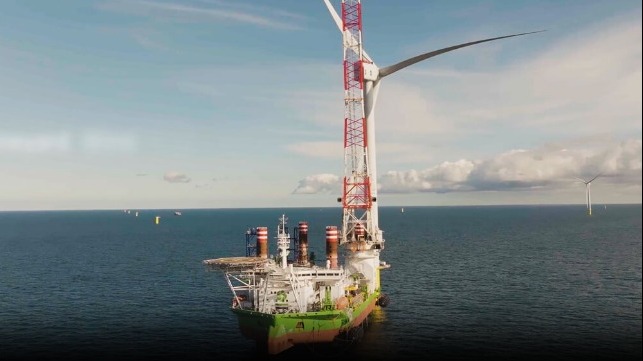
A revised Construction and Operations Plan has been approved for the troubled U.S. offshore wind farm known as Vineyard Wind approximately six months after one of its turbine blades fractured. In one of its final acts, the Biden administration’s Bureau of Ocean Energy Management and Bureau of Safety and Environmental Enforcement completed the review and approved the revised plan on January 17, including lifting the suspension orders in place for the project.
A spokesperson for Vineyard Wind confirmed to the local media in Massachusetts that a single turbine has been placed back into operation to generate power. It emphasized that safety remains the top concern while the plan addresses the blades and moving forward with the work. Previously, the company had been approved to proceed with the installation of the jackets for the monopole foundations.
The new plan cites the root cause analysis completed by GE Vernova for the July 13 failure of one of the blades. It found that there was insufficient bonding at certain locations within the blade, which should have been detected at the manufacturing plant. Reprocessing of manufacturing data reports that additional blades with insufficient bonding were identified.
GE Vernova reached a decision and it is being directed by BSE that all the blades manufactured at GE Vernova’s plan Gaspe, Canada plan be removed. This will be at up to 22 locations and pending further review by BSE potentially two additional locations with blades from other manufacturing plants. In June 2024, Vineyard Wind highlighted that it had completed the installation of blades at 21 turbines and was completing a 22nd site shortly before the failure. Blades have already been removed at two of the 22 sites. The plan calls for a total of 62 turbines. When the wind farm off Massachusetts is completed.
Vineyard Wind reports that the jack-up vessel Sea Installer, which has already been employed in the wind development area, will be working on the removal. They presented alternatives including using a second unnamed vessel to speed the removal and installation of new blades. It is estimated it could take up to seven months to remove all the blades.
The new plan calls for installing blades from the GE Vernova manufacturing plant in Cherbourg, France. Vineyard Wind will have to demonstrate that the French blades meet the original design specs. Inspections of the manufacturing process are required along with drone or rope external inspections within six months of installation.
Friday’s approval and lifting of the suspension cleared the path for the wind farm which had been billed as the U.S.’s largest operating offshore wind farm. The bureaus took these steps on the last working day of the Biden administration along with approval of the construction plan for another Vineyard wind plan.
With the change in administrations on January 20, the future of wind energy development is in doubt. Among a long list of “priorities” released by the White House shortly after the inaugural, it lists, “President Trump’s energy policies will end leasing to massive wind farms that degrade our natural landscapes and fail to serve American energy consumers.” Reports last week said the new administration would impose a moratorium for further review of offshore wind energy installations and issues ranging from whale deaths to the need for government subsidies. President Donald Trump has vowed not to build new “windmills” during his second administration
.
World’s Largest Floating Wind Turbine Hoisted for Tests
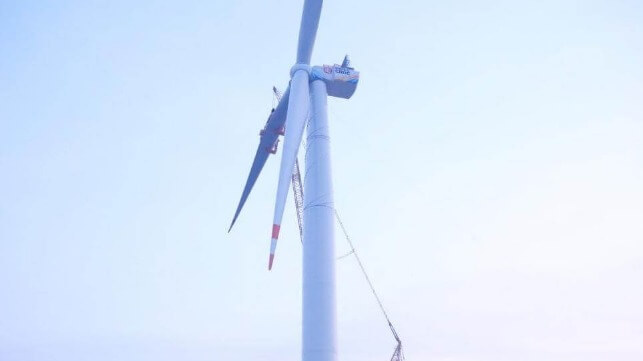
A new 20 MW wind turbine designed for floating applications was recently successfully hoisted in China ahead of the start of testing. The state-owned company CRRC is calling the new unit the world's largest power-class floating wind turbine and an important step in the exploration of ultra-large offshore wind turbines.
The "Qihang" is a 20MW floating offshore wind turbine independently developed by CRRC. The unit rolled off the production line in Sheyang, Jiangsu in October 2024, and departed from Sheyang Port to Guangli Port in Dongying in mid-December. It was transferred to the Shandong Dongying Wind Power Equipment Testing and Certification Innovation Base test site using a self-propelled modular transport unit and on January 11, was successfully hoisted into position for testing.
The company reports the design has reached 20MW, which exceeds Envision Energy’s 16.7 MW prototype and Dongfang Electric’s 18 MW prototype, which both reported began testing in June 2024. However, China’s Mingyang Wind Power is working on an even larger 22 MW unit expected to be completed this year.
China seeks to dominate the offshore wind sector and has already surpassed the UK to have the largest installed base. The companies are working to break into the international market and become a supplier to European projects.
The new unit is massive in scale. CRRC reports the diameter of the wind rotor has reached 260 meters (853 feet), which it says is equivalent to seven standard football fields. The hub height is 151 meters (495 feet). The massive blades it reports have a tip speed "in line" with the speed of high-speed rail. Each rotation of the unit it says can meet the electricity demand of a family for 2 to 4 days, saving about 25,000 tons of coal consumption and reducing carbon dioxide emissions by about 62,000 tons per year.
The "Qihang" reportedly integrates cutting-edge innovative control technologies to ensure that the floating unit maintains extreme stability and minimal swing during operation. It adopts multiple typhoon-resistant technologies and strategies. It is also designed to take into account the reusability and scalability of some components and further improves the flexibility and efficiency of the unit through the modular construction of key system interfaces and structural parts.
To assess the changeable wind, wave, and current conditions at sea, the unit is planned to have more than 200 test points, covering blades, frames, transmission chains, towers, floats, and mooring systems. It will be collecting three-dimensional wind conditions, waves, 6-DOF floating platforms, and the response curves of each test point of the unit.
After completing the relevant tests and certifications, the unit will be put into deep-sea areas for grid-connected power generation.

No comments:
Post a Comment