
The construction of Hinkley Point C and Sizewell C nuclear power plants is facing significant delays and cost overruns, jeopardizing the UK's energy security.
Sellafield Ltd's cybersecurity failings have raised concerns about the safety and security of the UK's nuclear industry.
The UK government's ambitious plans to expand nuclear power are facing criticism due to the high costs and potential impact on taxpayers.
As the U.K. government doubles down on plans to develop the country’s nuclear power industry following decades of neglect, severe delays and cost increases are hampering progress. Delays and rising costs at the Sizewell C and Hinkley C nuclear projects have drawn public criticism, while concerns over public safety have been brought into question due to cybersecurity failings by Sellafield Ltd. While public support for nuclear power is at its highest level in decades, these failings could hinder the development of a strong nuclear power industry in the U.K.
Hinkley Point C in Somerset, in the Southwest of England, is the first commercial nuclear power station to be constructed in the U.K. since the mid-1990s. The project started over a decade ago and, in that time, costs have risen over and over again, sending it over budget and causing delays. The project, being led by Électricité de France (EDF), is now expected to take several more years to complete. Around 11,000 workers are employed by EDF to get Hinkley up and running, and while operations were set to commence in 2027, EDF said in 2022, it now looks like 2030 or 2031 could be a more likely start date. This additional delay is expected to increase the cost of the plant by billions.
Sizewell C, which is being developed by EDF in Suffolk, in the East of England, has doubled in cost since initial 2020 plans, to almost $49 billion, according to claims in a recent report. This price increase is attributed to the rise in construction materials and inflation, among other factors. EDF is currently in discussions with the government about how to fund the additional project costs. A recent report from the court of auditors advises that EDF seek new investors for Hinkley C before it makes a final investment decision on Sizewell C.
The U.K. government and EDF currently plan to fund 40 percent of Sizewell C, which is expected to power as many as six million homes once operational. The government is seeking financing from private investors to fund the remaining 60 percent of the development. A final funding decision is expected to be made at the government’s review of public spending in June. At Hinkley, the agreement with the government states that EDF will only begin to earn revenue once the plant is operational, which has put greater financial constraints on the French firm. A different agreement is expected for Sizewell C to reduce this financial burden on EDF.
The Labour donor and green energy entrepreneur Dale Vince has criticised the government’s funding plan, stating, “If Hinkley Point C is anything to go by, Sizewell C really should have rigorous financial scrutiny.” Vince explained, “Originally priced at £18 billion ($22 billion), the cost of Hinkley has ballooned to £46 billion ($56 billion) and then there’s the delays. Back in 2007, the then EDF chief executive Vincent de Rivaz said that by Christmas 2017 we would be using electricity generated from atomic power at Hinkley. We’re now in Christmas 2024 and Hinkley isn’t due to be completed until 2031.”
Many are concerned about the U.K.’s lack of experience in nuclear power after decades of no new development. Nuclear power plants are extremely complex to build and due to the lack of development over the past 30 years, Britain no longer has the right skills and contractors to support construction.
Simon Taylor, a professor at the University of Cambridge’s Judge Business School believes that “The U.K. and the U.S. have, in a sense, forgotten how to build nuclear power stations.” Taylor explained, “We may rebuild that knowledge, but it will take a long time.”
The long delays faced at Hinkley are forcing four of the U.K.’s oldest nuclear power plants to continue running for over a decade longer than previously planned to help bridge the gap in delivering clean power. EDF has agreed to expand the lifespan of the reactors, once again, to “boost energy security and reduce dependence on imported gas”. The Heysham 2 nuclear reactor in Lancashire and the Torness nuclear plant in East Lothian, Scotland are now expected to continue operating for an extra two years to March 2030.
Meanwhile, Sellafield Ltd has been ordered to pay over $470,000 in criminal charges over years of cybersecurity failings at its nuclear site in Cumbria in the North of England. The company left information threatening national security exposed for four years, according to the industry regulator the Office for Nuclear Regulation (ONR). The ONR also found that 75 percent of Sellafield’s computer servers were vulnerable to cyber-attack. The company pled guilty to charges in October last year.
Despite ambitious U.K. government aims to provide abundant clean energy through the development of the country’s nuclear power sector, energy experts are concerned that the severe delays and cost increases on new nuclear projects could compromise the green transition and end up costing taxpayers billions in additional costs. Meanwhile, cybersecurity failings by Sellafield Ltd have cast a dark shadow on the industry, meaning the government must quickly reassure the public of the benefits of developing the U.K.’s nuclear power over the coming decades.
By Felicity Bradstock for Oilprice.com
Partnership to enhance UK-Canadian nuclear cooperation
The Advanced Nuclear Research Centre at the University of Strathclyde has signed a memorandum of understanding on cooperation with the Candu Owners Group and the University Network of Excellence in Nuclear Engineering.
_43068.jpg)
The Advanced Nuclear Research Centre (ANRC) undertakes research and translation for industry-led projects and acts as a hub for all nuclear activities at the University of Strathclyde. The Candu Owners Group (COG) is a Toronto-based nuclear energy not-for-profit corporation whose members are nuclear operators who invest in achieving operational excellence through collaboration. The University Network of Excellence in Nuclear Engineering (UNENE) is a network of Canadian universities, industry, government and international institutions dedicated to excellence in nuclear science, technology and engineering.
Under the MoU, with a five-year renewable term, the three organisations will cooperate on nuclear engineering, science and technology initiatives in the areas of research and development, education and training, knowledge management, and nuclear operations support.
"International collaboration is key to building the capability and capacity to deliver the ambitious growth in nuclear energy that is essential to our energy security and net-zero imperatives," said ANRC Executive Director Daryl Landeg. "Canada and the UK are also uniquely well placed to play a leading role globally in the safe and secure exploitation of nuclear energy. This agreement will enable us to build lasting productive partnerships aligned with our shared goals to advance nuclear energy."
COG President and CEO Rachna Clavero added: "We are always seeking new opportunities to create value for our members, and this agreement supports advancement of industry-led projects while expanding our international network of expertise."
"UNENE sees great opportunity for each partner in this agreement as we have very strong common interests and objectives, and a history of successful collaboration," said UNENE President Jerry Hopwood. "Working together will bring tremendous scope for synergy and innovation, bringing UNENE universities together with industrial and academic partners."
Funding aims to scale-up medical use of UK nuclear 'waste'
A project to develop the case for scaling-up the harvesting of lead-212 from reprocessed uranium for use in treating cancer has been selected for funding by UK Research and Innovation.
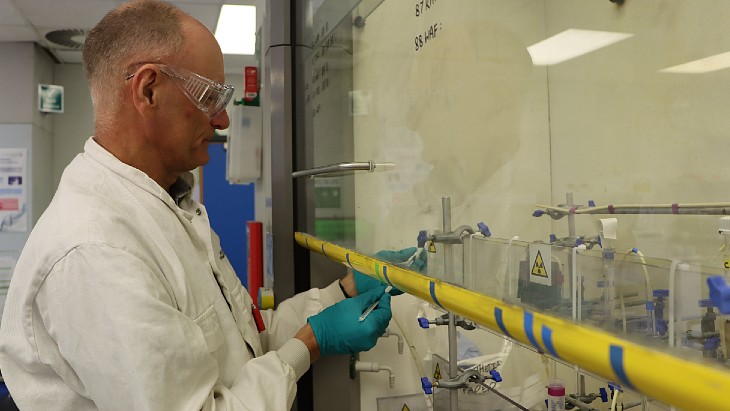
The UK's Medicines Discovery Catapult and UK National Nuclear Laboratory (UKNNL) will use the funding - they are among 15 projects sharing GBP1.3 million (USD1.6 million) - to "explore potential options for making the material available to researchers and drug development companies. The long-term aim is to enable commercial production and routine use within the NHS (National Health Service) for the benefit of patients and the development of a new community".
Targeted Alpha Therapy is an emerging form of high-precision targeted treatment which provides few side-effects, with particular interest in lead-212 which has a half-life of nearly 11 hours - as it decays its emissions can be used to target and destroy cancer cells without damaging the surrounding healthy tissue.
Professor Paul Howarth, UKNNL CEO, said: "For decades UKNNL has processed the uranium from our nuclear power plants, constantly developing new techniques and capabilities. The harvesting of lead-212 requires very specific chemistry and is the key focus of some of the scientists in our laboratory in Preston. To be able to use the skills and techniques that they have developed to save lives is an incredible legacy.
"This funding will help to clarify how lead-212 can progress to the next step, to provide life-saving therapies for cancers in patients in the UK and ensure that the next generation of scientists can continue this vital work. What is most remarkable is the fact that this uranium has already powered our homes, and it is now being reused to potentially save lives."
Professor Chris Molloy, CEO of Medicines Discovery Catapult (MDC), said: "Precision radiopharmaceuticals present a huge opportunity ... creating these new targeted treatments from toxic waste could transform patient outcomes and give the UK back its domestic radiochemical capacity to serve its patients. To do this, we must invest in the infrastructure necessary to produce the materials and run patient trials.
"Combining MDC’s specialised radiochemistry and drug discovery expertise with UKNNL’s nuclear prowess, this project will accelerate important research to secure a sustainable supply of radionuclides for medicines. Doing so will unlock the development of game-changing treatments for cancer and improve patient lives."
UKNNL has been collaborating with researchers to enable access to radionuclides for investigations into new treatments and diagnosis, including for cancer, Alzheimer's and complex heart conditions. Researchers are keen to get materials to test and develop new treatments, and scale-up treatments where trials have been successful.
There have been on-going discussions in the UK about how the valuable radioisotopes in the nuclear legacy material in the country can be recognised and influence future plans for the material.
This area of medical research and treatment is a rapidly growing area - in November Orano subsidiary Orano Med laid the foundations for its EUR250 million (USD264 million) Advanced Thorium Extraction Facility plant in western France, the world's first industrial plant dedicated to the production of thorium-228, a precursor of lead-212, for radioligand therapies. The aim is to supply all the ATLab (Alpha Therapy Laboratories) facilities set to manufacture lead-212-based drugs for patients worldwide.
You can hear more about UKNNL's work getting value from legacy nuclear material in last April's World Nuclear News podcast:

No comments:
Post a Comment