A Whole Lot of Nuclear Madness in One Week
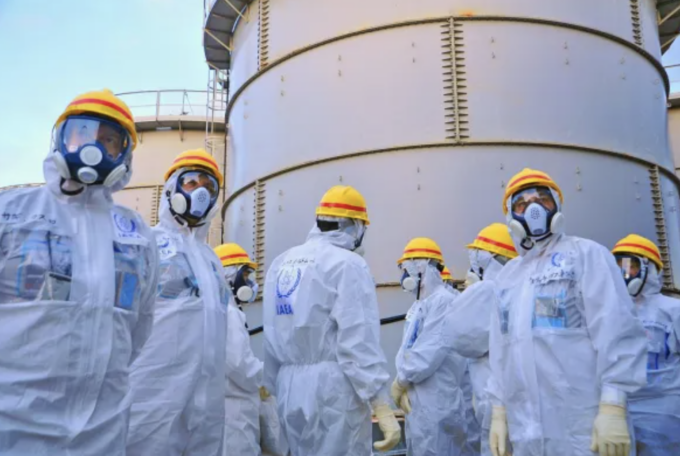
Water storage tanks at the Fukushima Daiichi nuclear site. (IAEA inspection photo.)
Remember that 1963 comedic caper movie, “It’s A Mad, Mad, Mad, Mad World”? Okay, maybe not. It was director Stanley Kramer’s escape from his more traditionally dark subject matter — Judgment at Nuremberg, The Defiant Ones, Inherit the Wind. The bridge from those more sober productions to “Mad” was his favorite and perennial lead actor, Spencer Tracy.
We’ve crossed that bridge now, into a world so mad, and decidedly not funny, that we’ll need a whole lot more “mads” in the title for the dystopian 2025 version.
In the space of just a few days, a slew of truly insane news broke — and I’m not even talking here about anything emanating from the Trump regime.
US Intelligence, if any such thing still exists, announced it foresaw an attack on Iran’s nuclear centers by Israel in the next six months. By ‘attack’, they mean ‘bomb’.
The Iranian government immediately barked back with an announcement that for every hundred such facilities destroyed they would “build a thousand other ones.”
This is no idle threat from either side. Just last October, according to US and Israeli officials, Israel reportedly destroyed a secret Iranian nuclear weapons research facility. (Iran continues to deny it is developing nuclear weapons.)
In 2010, the Stuxnet computer virus, a cyber attack likely launched by Israel and the United States, infected computers at Iran’s Bushehr nuclear power plant before spreading across other facilities including to the Natanz uranium enrichment complex. Israel has also assassinated at least five of Iran’s nuclear scientists, between 2010 and 2024.
No one really knows what if anything got destroyed by Israel (and the US) in Iran and what has been rebuilt at least once, if perhaps not one thousand times.
Iran is a signatory to the nuclear Non-Proliferation Treaty whose Article IV rashly gives the “inalienable” right to non-nuclear weapons states to develop “peaceful” nuclear energy. Iran has long-claimed that it’s doing precisely that. But because nuclear power provides a direct pathway to nuclear weapons development, Iran is at best doubted if not disbelieved by its enemies.
Also this week came the news that Japan would go for a “maximization” of nuclear power, aiming for a 20% energy share by 2040 with 30 reactors back up and running.
This is notwithstanding the fact that the country almost lost Tokyo when the Fukushima-Daiichi reactors exploded and melted down in 2011; that the destroyed reactors are still too dangerous to enter; that the prefecture and areas beyond are indefinitely contaminated with radioactive fallout; and that the reactor site has a more than one million tonne liquid radioactive waste problem that it’s currently dumping into the Pacific Ocean for the next 30 years.
Elsewhere on these “pages”, Karl Grossman writes that the U.S. could be considering a resumption of atomic testing, following the advice to do just that advocated by Robert Peters, a research fellow for nuclear deterrence and missile defense at the far-right Heritage Foundation, whose Project 2025 is the blueprint being followed by the Trump administration, never mind all their hollow denials before the election.
How many “mads” do these situations deserve? At least a couple, maybe more? But earning the full Monty of “mads” is surely a paper submitted last month by PhD student Andrew Haverly with the Rochester Institute of Technology — Nuclear Explosions for Large Scale Carbon Sequestration.
Haverly’s idea is to use a buried nuclear explosion in the seabed to accelerate carbon capture by pulverizing basalt and using Enhanced Rock Weathering, which, he says “can sequester significant quantities of atmospheric CO2 by accelerating the natural chemical breakdown of silicate rocks, such as basalt.”
But this would not just be any old nuclear explosion. It would have to be much larger than the biggest nuclear test ever — Russia’s Tsar Bomba — which, wrote Haverly, had “only a yield of 50 megatons of TNT.”
Just for context, that “only” was already 2,000 times more powerful than the 25 kiloton plutonium bomb that wiped out Nagasaki.
But Haverly’s seabed blast would be “in the gigaton range” and specifically, an 81 gigaton blast. Such a creation, should “not to be taken lightly,” he cautions. “Detonating a 81 Gt nuclear device could cause a global catastrophe if done improperly.”
Improperly? An exclamation invoking Sherlock Holmes springs to mind here. There are 1,000 kilotons in a megaton and 1,000 megatons in a gigaton. Do the math. Then multiply that by 81.
Not to worry though, insists Haverly because we already have so much radiation in our environment, what’s a little more from the most unimaginably massive nuclear explosion ever? It “should have minimal impact on the world,” he writes.
“The long-term effects of global radiation will impact humans and will cause loss of life, but this increased global radiation is ‘just a drop in the bucket’”.
Please read those words back to your readers. Out loud.
Why would anyone other than possibly a real life Dr. Strangelove, even consider this? There are plenty of faster, cheaper and way safer methods of reducing our carbon emissions, starting with using less and saving more, before we even talk about renewable technologies.
There is of course much debate about whether carbon capture itself even works or is a good use of the energy needed to achieve it. Mark Jacobson, a Stanford University-based world authority on climate change mitigation asserts that carbon capture reduces “only a small fraction of carbon emissions, and it usually increases air pollution.”
The fundamental thesis here is that because climate change is so extreme and so destructive, stopping it with something else, no matter how extreme the risks and destructive the potential outcome, pales in comparison to what we are already facing. So bombs away.
Haverly also argues that this giga-bomb would have “no strategic military value” because of its size. First, no nuclear weapon of any size has any strategic military value. They are all militarily useless. But it strains the boundaries of credulity to believe that a government that created an atomic bomb of this magnitude — if anyone ever would or could — in the name of addressing climate change, would not also threaten to use it as the ultimate way to keep the rest of the world in abeyance.
Could things get any worse. Or madder? Ignoring the White House for a moment, the answer is still “yes”, although maybe not madder, just more disastrously likely.
And so, in the early hours of last Friday morning, a missile-armed drone, launched as part of the current war initiated by Russia in Ukraine on February 24, 2022, exploded on the roof of the Chornobyl reactor dome. It was not sent as a Valentine but it does remain anonymous, with Ukraine accusing Russia of firing it and Russia in full denial.
The protective shield the drone hit, causing a subsequent fire, was built to cover the destroyed Unit 4 reactor that blew up and melted down on April 26, 1986. Ukrainian authorities insist radiation levels surrounding the plant have not increased as a result of the incident. It’s all too possible that the next Chornobyl could actually happen at Chornobyl.
This is not the first time the Chernobyl nuclear site — or other nuclear power plants in Ukraine — have come into danger because of the war there. The massive six-reactor Zaporizhzhia nuclear power plant in the southeast of the country, where the fighting has been most intense, has also suffered fires and hits from missiles. It has also been occupied by Russian forces since March 4, 2022.
Alarm bells have frequently been rung there, whether by the International Atomic Energy Agency concerned over the proximity of the fighting, or by Ukrainian operators, fearing long hours, a reduced workforce and the duress of occupation could lead to human error, in turn causing a potentially catastrophic accident.
Other reactors across Ukraine have also been put in danger and yet there too, the madness continues. (I’m finding it hard to believe that by the time this makes press Trump will have conjured a lasting peace treaty between Russia and Ukraine that both sides can live with.)
Speaking of Trump, last week also delivered an astonishing pronouncement, reported in The Guardian among other media, that the US president wants to talk to the leaders of China and Russia about nuclear disarmament.
“There’s no reason for us to be building brand-new nuclear weapons. We already have so many,” Trump said. “You could destroy the world 50 times over, 100 times over. And here we are building new nuclear weapons, and they’re building nuclear weapons.
“We’re all spending a lot of money that we could be spending on other things that are actually, hopefully, much more productive.”
This actually sounds sensible. Which is frightening in itself. Because we agree with this and would be trumpeting it and celebrating it and re-tweeting or BlueSkying it or whatever, except for the fact of its source, which makes it suspect. There’s a quid pro quo in here somewhere. We just don’t know what it is.
And in other news…
This piece first appeared in Beyond Nuclear.
Trump, Nukes and Cartoons

Wouldn’t it be nice if the war in Ukraine were entirely one side’s fault, if the U.S. had one political party that did everything perfectly, if USAID had only ever caused either benefit or harm, and if all the self-contradictory gibberish coming out of Trump’s pie hole were either lies or holy gospel? A lot of people sure seem to think so.
Here in the real world, things are ever so slightly more complex than in a cartoon. A war can develop through evil actions by two — count ’em — sides. And that’s not all. Those evil actions can be — gasp! — very different and unequal to each other. I know. I know. It makes the brain just throb, right?
An agency can both feed the hungry and help overthrow governments for imperialist thugs. It seems impossible, if only because costume designers will have no idea how to dress such an agency. And yet.
A president can demand that governments spend vastly more on wars and propose cutting war spending in half. The same skills that once made the holy Trinity both single and triple can make sense of this. The threats and demands are brilliant negotiating, or the proposed reductions are a brilliant distraction. But you cannot actually take enlarging and shrinking military spending at face value and proclaim them both right.
Of course, loyal Democrats can hear Trump back cutting military spending and decide that military spending must be maximized, but this requires ignoring the fact that Trump is also demanding vast increases to military spending around the world and through the work of his disciples in the United States Congress.
Of course, burnt out, frustrated peace activists can celebrate Trump’s cut-spending comment as a ray of glorious hope, if not the coming of the Savior, but that requires ignoring the same pieces of reality.
I suggest three simple steps.
First, accept that contradictory positions cannot both be right and that you will have to determine which, if either, you agree with based on something other than the identity of the fascist jackass who said them.
Second, once you’ve decided, for example, that reducing military spending is the way to go, feel free to indulge in only criticizing Trump, but criticize the Trump who wants more military spending, who is moving more nukes into Europe, whose DOGE charade is avoiding military spending, and whose Congressional court jesters are pushing legislation to move vast piles of what remains of non-military spending into the golden toilet of the Pentagon. Or feel free to indulge in only praising Trump, but praise the Trump who wants to get rid of nuclear weapons, make peace, end wars, and cut the Pentagon in half. Or do both the criticizing and praising as merited.
Third, demand action to back up the words you agree with. If a U.S. president who is in the midst of a mad power grab bending the federal government to his will wants to get rid of nukes, he doesn’t have to wait for other countries. He can begin a reverse arms race by halting the production of new weapons and taking a first step in reducing them, before waiting for that move to be matched in Moscow. If he wants to reduce military spending, he can send in the DOGE brownshirts to eliminate hoards of military officers as if they were hungry children in need of food. He can put a halt to efforts in the Congress to pass legislation vastly increasing military spending, and instead order the introduction of legislation to cut the beast in half.
Would such actions get more push-back from Congress Members than those targeting useful and humanitarian projects? Of course! But without any actions at all — in fact with actions to the contrary — why take the rare good Trumpism seriously at all?
Don’t want to demand action from Trump because that would involve communicating with Trump and he’s just too odious? OK. Go to Congress and tell your misrepresentatives and lords of the upper chamber to cut military spending in half, either because Trump said so or because your Congress critters themselves said so in the past (depending on your district) or because military spending deprives us of so much, impoverishes us, and is an immoral act that threatens our existence and that of all living things.

No comments:
Post a Comment