
Russia's Deputy Foreign Minister Sergei Ryabkov attends a press conference in Moscow, Russia Feb 10, 2025.
PHOTO: Reuters file
February 23, 2025
Russia wants a long-term peace deal over Ukraine that tackles what it regards as the root causes of the conflict and not a quick US-backed ceasefire followed by a swift restart of fighting, a senior Russian diplomat told the RIA news agency.
In an interview released on Monday (Feb 24), the third anniversary of tens of thousands of Russian troops crossing into Ukraine at the orders of President Vladimir Putin, Russian Deputy Foreign Minister Sergei Ryabkov said Moscow was after a Ukraine deal that stood the test of time.
"We can recognise with sufficient confidence the desire of the American side to move towards a quick ceasefire," RIA cited Ryabkov as saying.
"But... a ceasefire without a long-term settlement is the path to a swift resumption of fighting and a resumption of the conflict with even more serious consequences, including consequences for Russian-American relations. We do not want this.
"We need to find a long-term solution, which, in turn, must necessarily include an element of overcoming the root causes of what has been happening in and around Ukraine," said Ryabkov
He repeated Moscow's stance that it had no choice but to launch what it calls its "special military operation" in Ukraine — something Ukraine and the West call a brutal colonial-style war of conquest — because of what he said was the Nato alliance's "unrestrained" eastwards expansion.
He also complained about what he called the trampling of the rights of the Russian-speaking population in Ukraine, repeating an allegation which Kyiv denies
Issued on: 24/02/2025 -
Video by: Gulliver CRAGG
On the third anniversary of Russia's full-scale invasion of Ukraine, hopes for a peace plan that would be "acceptable" to Ukrainians brought about by US President Donald Trump's negotiations with Russia are "fading rapidly" says FRANCE 24's Gulliver Cragg, reporting from Kyiv.
FRANCE 24Video news
February 23, 2025
By Reuters
UNITED NATIONS —
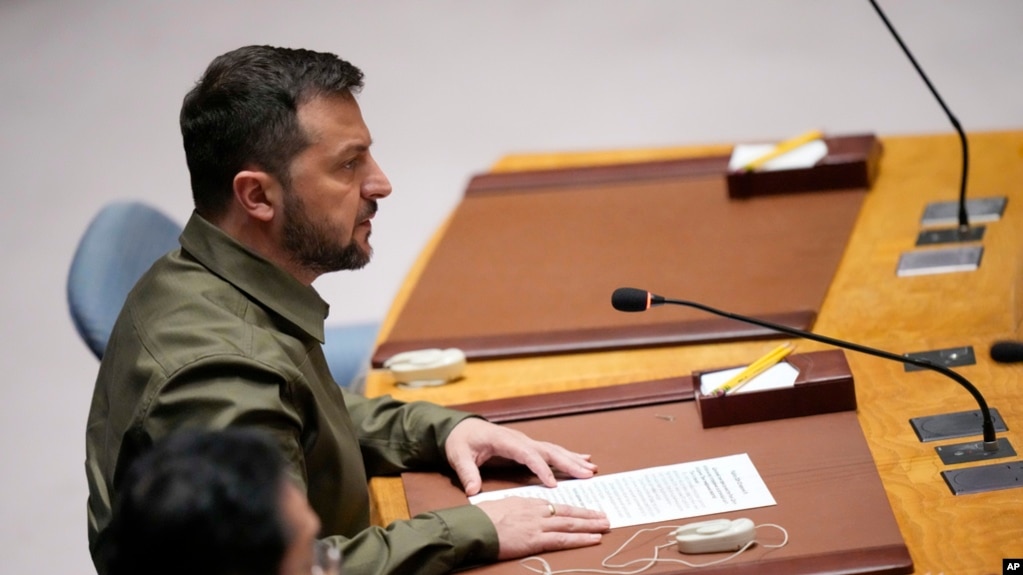
The United States is urging the United Nations General Assembly to back its resolution to mark the third anniversary of Russia's invasion of Ukraine on Monday, oppose any amendments and vote no on a rival text drafted by Ukraine and European allies.
In a diplomatic note sent on Sunday and reviewed by Reuters, the United States described its brief resolution as "a forward-looking resolution focused on one simple idea: ending the war."
"Through this resolution, Member States can build real momentum towards international peace and security, the maintenance of which is the principal purpose of the United Nations," it said, asking countries to "vote no on any other resolution or amendments presented" during Monday's meeting.
The U.S. draft resolution, put forward on Friday, pits it against Ukraine and the European Union, which have for the past month been negotiating with U.N. member states on their own resolution on the war in Ukraine, which repeats the U.N. demand that Russia withdraw its troops and halt hostilities.
The 193-member U.N. General Assembly has overwhelmingly repeatedly backed Ukraine's sovereignty and territorial integrity within its internationally recognized borders since the war began. The U.S. draft makes no reference to that.
The U.S. text mourns the loss of life during the "Russia-Ukraine conflict," reiterates that the U.N.'s main purpose is to maintain international peace and security and peacefully settle disputes. It "implores a swift end to the conflict and further urges a lasting peace between Ukraine and Russia."
Proposed amendments
The 15-member Security Council is also set to vote on the same U.S. text later on Monday, diplomats said. A council resolution needs at least nine votes in favor and no vetoes by the U.S., Russia, China, Britain or France to be adopted.
The U.S. push for U.N. action comes after President Donald Trump launched a bid to broker an end to the war, sparking a rift with Ukrainian President Volodymyr Zelenskyy and raising concerns among European allies that they could be cut out of peace talks. U.S. and Russian officials met on Tuesday.
The General Assembly is set to vote on several proposed amendments to the U.S. draft resolution.
Russia has proposed amending the U.S. draft to reference addressing the "root causes" of the war. Russia called its 2022 invasion a "special military operation" designed to "denazify" Ukraine and halt an expansion of NATO.
Britain and 24 European Union states have also proposed amendments to the U.S. draft in the General Assembly.
They want to describe the conflict as "the full-scale invasion of Ukraine by the Russian Federation," back Ukraine's sovereignty and territorial integrity and implore "just, lasting and comprehensive peace" in line with the U.N. Charter and principles of sovereign equality and territorial integrity.
General Assembly resolutions are not binding but carry political weight, reflecting a global view on the war. No country holds a veto in the assembly.
Bartholomew says Ukraine’s independence 'not up for debate' amid ongoing conflict
Aysu Biçer |24.02.2025 - TRT/AA

LONDON
Greek Orthodox Patriarch of Fener Bartholomew said on Sunday that Ukraine’s sovereignty is non-negotiable, stressing that it "cannot be debated or compromised under the guise of diplomacy."
Leading a Mass in Istanbul on the eve of the third anniversary of the Russia-Ukraine war, Bartholomew emphasized that any future peace agreement must include Ukraine as an equal participant in negotiations.
He also praised Ukrainian President Volodymyr Zelenskyy for his “tireless effort” in defending the country’s independence.
His remarks reinforced his longstanding support for Ukraine, a stance that has put him at odds with the Russian Orthodox Church and its leader, Patriarch Kirill, who has aligned himself with the Kremlin.
Most Ukrainians identify as Orthodox Christians, but the country remains divided between the independent Orthodox Church of Ukraine (OCU), recognized by Bartholomew in 2019, and the Ukrainian Orthodox Church (UOC), which historically had ties to the Moscow Patriarchate.
Since the war began in 2022, Bartholomew has consistently condemned Russia’s aggression and voiced support for Ukraine’s right to self-determination.
Kremlin’s Militarization Of Russia’s Youngest Has Far-Reaching Consequences – Analysis
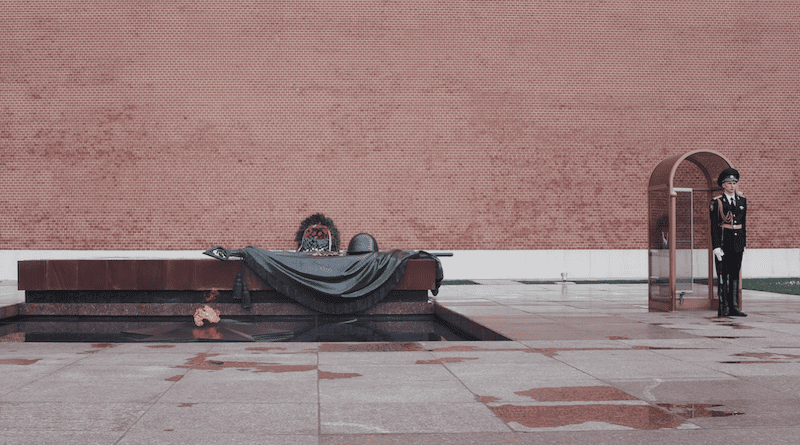
Tomb of the Unknown Soldier in Moscow, Russia. Photo Credit: Seth Weisfeld, Unsplash
By Paul Goble
Russian educational institutions, especially kindergartens and early childhood education, have been militarized since the start of Russian President Vladimir Putin’s full-scale invasion of Ukraine. The regular use of army songs, posters, and guns in the curriculum to promote military values and the employment of returning veterans as instructors now dominate the kindergartens and early grades of Russian schools (Govorit Nemoskva, February 17).
Many Russian parents and outside observers dismiss this as a passing phase. They believe that children who are now being subject to pro-war propaganda in kindergartens and the early grades will not be affected for very long and will adopt different positions when they grow older.
Aleksandra Arkhipova, an independent Russian anthropologist, however, argues that a landmark study of the impact of anti-Semitic propaganda in Nazi-era German schools suggests otherwise (Voigtländer, Nico and Hans-Joachim Voth, “Nazi indoctrination and anti-Semitic beliefs in Germany,” PNASVol. 112, No. 26 (June 2015): 7931-7036). Arkhipova believes that what is happening in Russian early childhood educational institutions now is likely to cast a dark shadow on the future. The children now passing through these schools are disposed to support militarism and aggression long into the future, serving as an important base of support for those in the Kremlin now and decades hence who want to pursue such policies (Telegram/anthro_fun, reposted at Echo fm, February 7; Telegram/anthro_fun, February 7, reposted at Echo fm, February 8).
The German study to which Arkhipova refers found through the use of surveys that Germans who were subjected to anti-Semitic messaging in schools during Nazi times were far more likely to remain anti-Semitic decades later than those born either earlier or later and not having had that experience (Voigtländer, Nico and Hans-Joachim Voth, “Nazi indoctrination and anti-Semitic beliefs in Germany,” PNAS Vol. 112, No. 26 (June 2015):7931-7036). This finding strongly suggests, Arkhipova continues, that the same pattern will hold with Russian children who are now being subjected to pro-war propaganda and are likely to remain more pro-war than those older or younger and thus form an important reservoir of support for aggressive and pro-war Kremlin policymakers long into the future.
Unsurprisingly, Arkhipova’s posts have attracted widespread attention among Russians in particular because they challenge the assumptions and hopes many in that country have about a post-Putin Russia. Additionally, unlike in the case of Germany, there is virtually no chance that Russia will suffer the overwhelming defeat and occupation that transformed German society after 1945. This transformation helped to reduce to a minimum the ideas promoted by the Nazis in kindergartens and schools. Some Russians fear, although may seldom feel free to say, that if there is no such imposed transformation in Russia, the militarist and aggressive policies Putin has implemented will continue. These policies will enjoy the support of the rising generation, in whom many placed their hopes to create a better Russia.
One Russian observer who has given particular attention to Arkhipova’s argument and the evolving state of Russian national identity is Vladimir Pastukhov, a Russian scholar now based in London. In a telegram channel post picked up by Russian internet portals, Pastukhov says that Arkhipova’s argument has prompted him to think “about the evolution that Russian society has undergone over the forty years of post-communism … from ‘new Russians’ to ‘other Russians’” (Telegram/v_pastukhov, February 8, reposted at Echo fm, February 9). Pastukhov’s argument extends the one posited by Arkhipova by expecting a very different Russia than the one others like him have lived through or hoped for since the end of the Soviet system.
Since Putin launched his full-scale invasion of Ukraine in 2022, Pastukhov says, many commentators have focused on the way in which the war has become an important part of the genesis of a new Ukrainian nation. Few, however, have focused on how it is playing an analogous function for the Russian nation (Telegram/v_pastukhov, February 8). He continues that for the reasons Arkhipova proposes as well as broader ones, it seems almost certain that “a completely different Russian society will emerge from the war than the one which entered it” (Telegram/v_pastukhov, February 8). Russia’s war against Ukraine marks “the end of the history of post-communism with its ‘new Russians’ and the beginning of a fundamentally different era … the main character of which will be ‘the other Russian’” (Telegram/v_pastukhov, February 8).
This represents, Pastukhov says, the latest round of nation-building in Russia, extending the argument of others that the tragedy of Russia is that the country became an empire before the people became a nation (Telegram/v_pastukhov, February 8). Therefore, it has little chance to become a nation-state and every chance to remain a people defined by the retention and pursuit of empire (Asia Russia Daily, January 12, 2015; Gorod 812, December 14, 2020; Svoboda, March 2, 2024).
It is a contested issue, with the opposition hoping for one kind of Russian nation and the Kremlin hoping for a very different one. This struggle has not, however, attracted as much attention as it deserves, the London-based Russian analyst says. While many in Russia and the West are more than willing to suggest that Ukraine does not exist as a nation, very few are prepared to recognize that Russia is not a nation, in the modern sense. Russia’s attachment to the state and the idea of imperial expansion reflects that reality (Telegram/v_pastukhov, February 8).
According to Pastukhov, the Kremlin has a better understanding of this reality than its opponents (Telegram/v_pastukhov, February 8). It is actively working to institutionalize itself by shaping the youngest members of society as Arkhipova suggests, anticipating to “mold golems from ‘the inhabitants’ in the hope of sitting out ‘behind the battlements’ for the time required for the golems to begin to speak” (Telegram/anthro_fun, February 7).
In the meantime, this rising generation will be far more likely to speak positively of the Kremlin than promote the formation of a democratic Russian nation at peace with itself and its neighbors. The danger of that negative outcome, again as Arkhipova indicates, is likely to remain in place far longer than Putin himself (Telegram/anthro_fun, February 7).
- This article was published at The Jamestown Foundation’s Eurasia Daily Monitor Volume: 22 Issue: 22

Paul Goble is a longtime specialist on ethnic and religious questions in Eurasia. Most recently, he was director of research and publications at the Azerbaijan Diplomatic Academy. Earlier, he served as vice dean for the social sciences and humanities at Audentes University in Tallinn and a senior research associate at the EuroCollege of the University of Tartu in Estonia. He has served in various capacities in the U.S. State Department, the Central Intelligence Agency and the International Broadcasting Bureau as well as at the Voice of America and Radio Free Europe/Radio Liberty and at the Carnegie Endowment for International Peace. Mr. Goble maintains the Window on Eurasia blog and can be contacted directly at paul.goble@gmail.com .

No comments:
Post a Comment