NYK Commissions Japan’s First Electric Battery-Driven Workboat
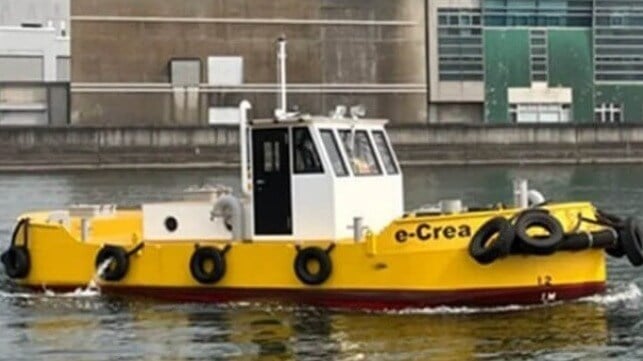
Japan’s first fully battery-driven electric workboat, named e-Crea was unveiled on May 23 by NYK Group. According to the company, fully electric vessels represent one of the most promising options for sustainable shipping and this vessel will be an important model to advance the technology.
The vessel, which is approximately 30 feet (9 meters) in length, is designed without an onboard diesel generator. It is powered solely by batteries charged from shore facilities located at the Keihin Dock’s Koyasu Shipyard in Yokohama City. The vessel has a capacity of up to 14 crew and is designed to support docking and undocking of tugboats at the Koyasu Shipyard.
In building the vessel, Keihin Dock, NYK’s sole shipbuilding subsidiary, had to overcome several key challenges. Among these, they highlight following the installation of the electric propulsion system, including the substantial battery modules, the vessel’s weight exceeded projections. To maintain balance, the team reconfigured the placement of the equipment and cabling. They were able to optimize internal space while ensuring stability.
Also, the company notes that the elevated temperature from the batteries and electric motors can increase fire risks. To effectively manage the heat, they implemented multi-layered water-cooling systems and integrated air ducts. They also enhanced fireproofing in the battery room and protection against hazardous gases along with improved ventilation.
E-Crea in addition to operating without emissions is also significantly quieter compared to conventional ships says NYK. The design features a compact hull that enables exceptional maneuverability in confined spaces. NYK says it is well suited to assisting with docking operations and vessel movement at the shipyard.
NYK reports it is committed to advancing the implementation of new technologies to realize low- and zero-carbon vessel operations. It believes this new vessel program is driving innovative solutions and accelerating the implementation of new technologies.
Introducing fully electric propulsion systems to tugs and workboats NYK says is expected to accelerate maritime decarbonization efforts. The company plans to gain data and insights from e-Crea’s construction and operation that will be incorporated into its efforts to develop an electric-propulsion tugboat scheduled for completion in December 2026. The company also says it is committed to advancing and refining electrification technologies for its application to larger vessels.
Research Vessel “NOVA” Sets Course with Torqeedo Drive for New Paths
[By: Torqeedo]
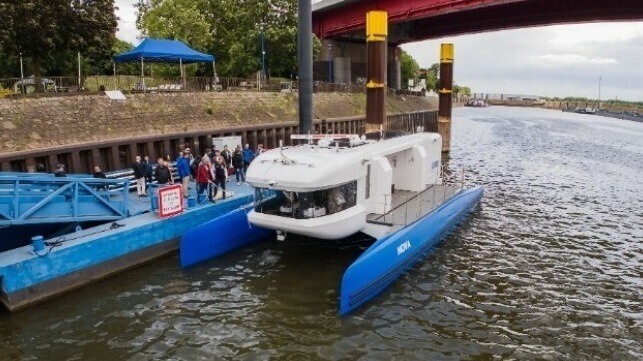
Torqeedo, the world market leader for electric propulsion systems on the water, has provided an electric propulsion system for a new research vessel, “NOVA”, operated by the University of Duisburg-Essen (UDE) and the Development Center for Ship Technology and Transport Systems (DST). Since friday, the autonomous research vessel will operate on the Rhine, exploring ways to make inland shipping more environmentally friendly and efficient.
The vessel was officially christened “NOVA” at a ceremony held on May 23 at the Port of Duisburg. Among the guests of honor was Oliver Krischer, the North Rhine-Westphalian Minister for the Environment, Nature Conservation and Transport.
A milestone for the future of inland shipping in Germany.
“The christening of NOVA marks an important step towards more sustainable inland shipping. We are proud to support this forward-looking project with our comprehensive technology portfolio. Our systems are now so powerful and reliable that they can power even complex applications such as autonomous research vessels fully electrically or in hybrid mode. We are confident that the insights gained from operating the ‘NOVA’ will provide valuable momentum for the further development and widespread adoption of alternative propulsion systems in inland shipping” says Heiko Vietmeier, CEO of Torqeedo.
The 15-meter-long “NOVA” is an inland vessel with a twin-hull design. It will be capable of transporting both cargo and passengers. Its development and construction took approximately two years and it is powered by Torqeedo’s electric propulsion system. Four Deep Blue Batteries 80 supply energy to the two 50kW Deep Blue motors and all onboard systems. Torqeedo has provided a complete power management system with a dedicated low voltage power circuit for consumers like the autonomous navigation system, instruments and lighting, supplied by the high voltage system for propulsion. In addition two coupled Torqeedo System Management Units in combination with the OEM-Display Interface provide access to all relevant system data for various scientific analyses and monitoring of the power train. This way the scientists of UDE and DST can simply focus on their research into making the autonomous navigation software work.
Low-emission inland shipping is picking up speed
The planned research trips will take place in the Port of Duisburg on the Rhine and in canals throughout the Ruhr region. Researchers at the University of Duisburg-Essen anticipate that fully automated — and thus partially autonomous — inland vessels could be in regular operation within the next eight to ten years.
The products and services herein described in this press release are not endorsed by The Maritime Executive.

No comments:
Post a Comment