It’s possible that I shall make an ass of myself. But in that case one can always get out of it with a little dialectic. I have, of course, so worded my proposition as to be right either way (K.Marx, Letter to F.Engels on the Indian Mutiny)
Wednesday, June 18, 2025
SPACE/COSMOS
Queer astronaut documentary takes on new meaning in Trump’s US
Sally Ride became the first US women in space on June 24, 1983
- Copyright AFP Armend NIMANI
Bénédicte Rey
When director Cristina Costantini started making a documentary about the first US woman in space, she thought it would be looking back on the “sexism and homophobia of yesteryear”.
But the story of astronaut Sally Ride, whose queer identity was a secret when she blasted off more than four decades ago, took on a “completely different meaning” after the re-election of President Donald Trump, Costantini told AFP.
“When we started making the film, it didn’t seem all that political to celebrate queer love or women astronauts,” said the director of “Sally”, which started streaming on Disney+ in many countries on Tuesday.
“Just a few years ago, there was a pride flag that flew in space, and (NASA) had vowed the next person on the Moon would be a woman.”
But that vow has now been removed from NASA’s website, just one of many changes at the US space agency since Trump returned to the White House in January.
“Employees have been asked to remove symbols of gay pride, pride flags, trans visibility flags,” Costantini said.
Now, the director hopes the documentary “serves as a reminder that these rights are not guaranteed, that they were hard fought and they were won by people like Sally” and her partner Tam.
“It’s our responsibility to carry the torch and continue the fight for equality.”
– ‘It was hard on her’ –
After boarding the Challenger space shuttle on June 18, 1983, Ride became the first US woman to fly to space. It was two decades after Soviet cosmonaut Valentina Tereshkova made the voyage.
NASA only started allowing women to apply as astronaut recruits in 1977.
Ride, who had a PhD in astrophysics from Stanford University and was an accomplished tennis player, was one of six women selected out of more than 8,000 applicants in the class of 1978.
Ride received the same training as male astronauts, but was treated quite differently.
Journalists asked whether she cried when facing difficulty. NASA engineers asked about what make-up she would need in space. They even worried whether 100 tampons would be enough for her six-day journey into space.
“I felt the women hadn’t paid their dues like we had,” Mike Mullane, another astronaut in the class of 1978, said in the documentary.
When Ride returned to Earth, the image of the 32-year-old in her blue jumpsuit, curly chestnut hair, piercing blue eyes and confident smile was seen around the world.
But Ride struggled to come to terms with her new status as icon.
“It was too much for her,” Tam O’Shaughnessy, who was Ride’s partner for 27 years, told AFP. “She was an introvert and it was hard on her.”
The two women founded a nonprofit dedicated to teaching girls science.
But the world would only learn they were in a relationship until after Ride’s death from pancreatic cancer at the age of 61 in 2012.
“Sally did not like labels,” O’Shaughnessy said.
“She was a queer woman. And so I think it’s great that she’s sort of become a part of the (LGBTQ+) community after death.”
O’Shaughnessy expressed concern at reports that US Defense Secretary Pete Hegseth wants to change the name of a Navy ship currently named after famous gay activist Harvey Milk.
“There’s a research vessel called ‘Sally Ride’ and it crossed my mind that might change, too” she said.
“It’s just shocking. All of this is hard to swallow.”
Lunar dust less toxic than city pollution, study finds
As NASA prepares to send astronauts back to the moon for the first time in over 50 years, new research from the University of Technology, Sydney (UTS) has found that lunar dust is less harmful to human lung cells than previously feared, and significantly less toxic than common Earth-based air pollution.
The UTS-led study, published in the journal Life Sciences in Space Research, provides reassuring data for the upcoming Artemis missions, which aim to establish a long-term human presence and a base on the moon.
Lead researcher and UTS PhD candidate Michaela B. Smith investigated the impact of the most accurate, new-generation lunar dust simulants on human lung cells in the lab. She compared the effects to those of airborne particulate matter collected from a busy street in Sydney.
Smith said the health of astronauts was a concern after the Apollo missions, where crew members experienced respiratory issues.
The study found that while the sharp, abrasive lunar dust can act as a physical irritant, it did not cause the severe cellular damage or inflammation seen from the urban Earth dust. “It's important to distinguish between a physical irritant and a highly toxic substance,” Smith said.
“Our findings suggest that while lunar dust may cause some immediate irritation to the airways, it does not appear to pose a risk for chronic, long-term diseases like silicosis, which is caused by materials like silica dust.”
In Apollo, the primary route of exposure occurred after extravehicular activity. “When astronauts re-entered their landing module, fine dust that had clung to their spacesuits became airborne in the confined cabin and was subsequently inhaled, leading to respiratory issues, sneezing, and eye irritation,” said Smith.
“Any dust, if you inhale it, you'll sneeze, cough, and have some physical irritation. But it's not highly toxic like silica, where you end up with silicosis from being on a construction site for 10 years. It’s not going to be something like that,” said Smith.
The research focused on fine dust particles (≤2.5 micrometres), which are small enough to bypass the body's natural defences and penetrate deep into the lower airways of the lungs. The study used two different types of lung cells, representing the upper (bronchial) and lower (alveolar) regions of the lung.
Results showed that Earth dust induced a greater inflammatory response and was more toxic to the cells than the lunar dust simulants. The paper suggests the primary mechanism of toxicity from lunar dust is mechanical damage caused by the particles' irregular shape and rough edges as they are internalised by cells. Crucially, the lunar simulants did not trigger significant oxidative stress—a key chemical damage pathway often associated with fine particle toxicity.
“This likely means that if exposure occurs at levels typically found in air pollution on Earth, health effects would be minimal,” the authors conclude in the paper.
While the findings reduce a critical risk factor, NASA is still taking the threat of dust exposure seriously. Smith, who recently visited the NASA Johnson Space Center in Houston, saw new engineering solutions firsthand.
“What they've done now is designed it so that the suits are actually attached to the outside of the rover,” she said. “The astronaut will climb in and out from inside, and the suit never goes inside, which prevents the dusty suit from ever contaminating the internal cabin environment.”
“While this research helps to reduce concerns about one critical risk factor, it’s important to note that NASA continues to treat dust exposure seriously and is developing robust mitigation strategies,” said Smith.
The research has paved the way for Smith’s current PhD work, which investigates the next frontier of space health: the effect of microgravity on lung function.
In the lab, she uses a specialised rotating device to simulate the weightlessness experienced on the International Space Station, studying how it impacts the cellular structure and function of the lungs over time.
Smith’s PhD supervisor and study co-author Distinguished Professor Brian Oliver, from UTS and the Woolcock Institute of Medical Research, said this foundational work on lunar dust provides greater confidence for humanity’s next giant leap.
“The results contribute to the safety case for returning humans to the moon.”
“This research places our research group at UTS at the forefront of the space life sciences field, establishing us as key contributors to this vital area of research, particularly within Australia,” Oliver said.
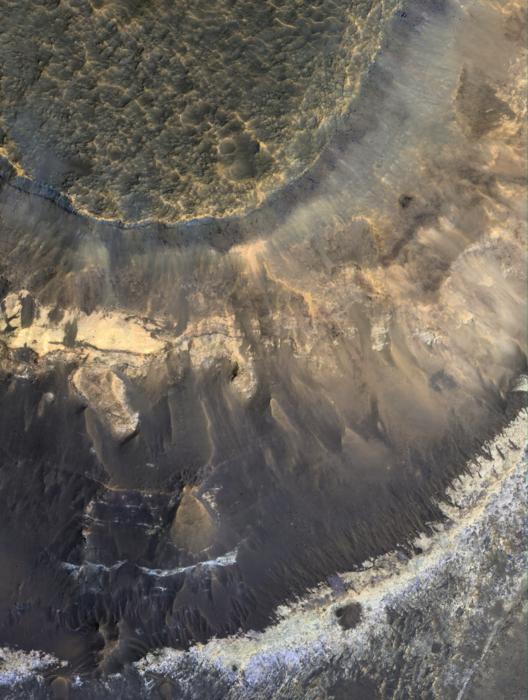
A clay-rich mesa in the Hellas basin of Mars. The blue color near the rim is aluminum bearing clays. The red-orange color below that is iron and magnesium bearing clays. The image captures an area that’s 1 kilometer across.
The planet Mars is home to thick layers of clay that can span hundreds of feet. Since they need water to form, these outcrops have long been of interest to scientists looking for signs of past life on the Red Planet.
In a new study in Nature Astronomy, scientists from The University of Texas at Austin and collaborators took a closer at these clay terrains and found that most formed near standing bodies of surface water, which were common on Mars billions of years ago. This environment would help foster the chemical weathering needed to create thick, mineral-rich layers of clay and could have provided the right mix of water, minerals and a calm environment for life to develop.
“These areas have a lot of water but not a lot of topographic uplift, so they’re very stable,” said the study’s lead author Rhianna Moore, who conducted the research as a postdoctoral fellow at the UT Jackson School of Geosciences. “If you have stable terrain, you’re not messing up your potentially habitable environments. Favorable conditions might be able to be sustained for longer periods of time.”
The study was conducted as part of UT’s Center for Planetary Systems Habitability, which investigates the origins and requirements for life on Earth and other planetary bodies. Moore is now with NASA as part of a team supporting the Artemis mission to Earth’s Moon.
The researchers noted that the thick clays could also be a sign of an imbalanced water and carbon cycle on ancient Mars, which could explain why Mars appears to be missing carbonate rocks in environments where they would be expected on Earth.
Billions of years ago, Mars was a wet world. It had lakes and rivers, which created geological formations that are carved on the surface of the planet today. The thick clay layers formed during this wet period. However, before this study, little was known about the environments in which they formed, and how the surrounding terrain influenced their evolution.
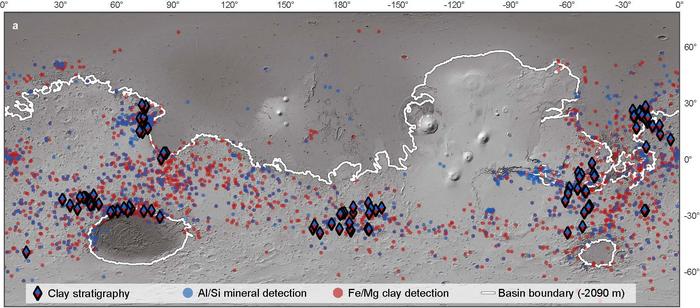
Moore analyzed images and data from 150 clay deposits that had been previously identified in a global survey conducted by NASA’s Mars Reconnaissance Orbiter. She investigated trends in their topographical characteristics and how close they were to other geological features, such as former bodies of water.
She found that the clays were mostly found at low elevations near lake deposits but away from valley networks, where water is thought to have flowed more vigorously across the terrain. This balance between chemical and physical weathering led to their preservation through time. Co-author Tim Goudge, an assistant professor at the Jackson School’s Department of Earth and Planetary Sciences, said that the Mars clay environment is similar to the tropical places where thick clay layers are found on Earth.
“On Earth, the places where we tend to see the thickest clay mineral sequences are in humid environments, and those with minimal physical erosion that can strip away newly created weathering products,” he said. “These results suggest that the latter element is true also on Mars, while there are hints at the former as well.”
However, the clays also reflect an ancient Martian world that was very different from the Earth of today.
On Earth, shifting tectonic plates are constantly exposing fresh rock that can readily react with water and CO2 in the atmosphere, which helps regulate the climate. However, Mars lacks tectonic activity. When Martian volcanoes released CO2 into the atmosphere, the lack of a source for new reactive rock would have led the greenhouse gas to linger — causing the planet to become warmer and wetter. The researchers suggest that these conditions may have contributed to the formation of the clays.
What’s more, the lack of new rock on the surface may have impeded the chemical reactions needed to form carbonate rock — which would normally form from volcanic rock that underlies most Martian geology given CO2, water and time. Ongoing clay formation may have contributed to the dearth of carbonates by sucking up water and sequestering chemical byproducts in the clay, rather than having them leach out into the wider environment, where they could react with the surrounding geology.
“It’s probably one of many factors that’s contributing to this weird lack of predicted carbonates on Mars,” said Moore.
The research was funded by NASA and the Canadian Institute for Advanced Research.
A map from the study showing the location the clay deposits on Mars, along with other geological features that the researchers examined.
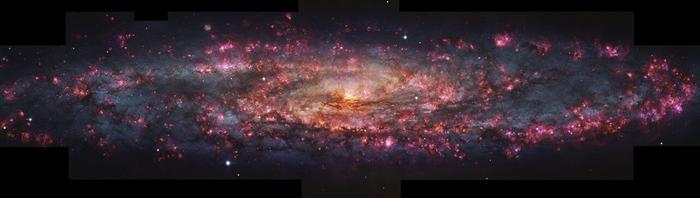
This image shows a detailed, thousand-colour image of the Sculptor Galaxy captured with the MUSE instrument at ESO’s Very Large Telescope (VLT). Regions of pink light are spread throughout this whole galactic snapshot, which come from ionised hydrogen in star-forming regions. These areas have been overlaid on a map of already formed stars in Sculptor to create the mix of pinks and blues seen here.
Astronomers have created a galactic masterpiece: an ultra-detailed image that reveals previously unseen features in the Sculptor Galaxy. Using the European Southern Observatory’s Very Large Telescope (ESO’s VLT), they observed this nearby galaxy in thousands of colours simultaneously. By capturing vast amounts of data at every single location, they created a galaxy-wide snapshot of the lives of stars within Sculptor.
"Galaxies are incredibly complex systems that we are still struggling to understand," says ESO researcher Enrico Congiu, who led a new Astronomy & Astrophysics study on Sculptor. Reaching hundreds of thousands of light-years across, galaxies are extremely large, but their evolution depends on what’s happening at much smaller scales. “The Sculptor Galaxy is in a sweet spot,” says Congiu. “It is close enough that we can resolve its internal structure and study its building blocks with incredible detail, but at the same time, big enough that we can still see it as a whole system.”
A galaxy’s building blocks — stars, gas and dust — emit light at different colours. Therefore, the more shades of colour there are in an image of a galaxy, the more we can learn about its inner workings. While conventional images contain only a handful of colours, this new Sculptor map comprises thousands. This tells astronomers everything they need to know about the stars, gas and dust within, such as their age, composition, and motion.
To create this map of the Sculptor Galaxy, which is 11 million light-years away and is also known as NGC 253, the researchers observed it for over 50 hours with the Multi Unit Spectroscopic Explorer (MUSE) instrument on ESO’s VLT. The team had to stitch together over 100 exposures to cover an area of the galaxy about 65 000 light-years wide.
According to co-author Kathryn Kreckel from Heidelberg University, Germany, this makes the map a potent tool: “We can zoom in to study individual regions where stars form at nearly the scale of individual stars, but we can also zoom out to study the galaxy as a whole.”
In their first analysis of the data, the team uncovered around 500 planetary nebulae, regions of gas and dust cast off from dying Sun-like stars, in the Sculptor Galaxy. Co-author Fabian Scheuermann, a doctoral student at Heidelberg University, puts this number into context: “Beyond our galactic neighbourhood, we usually deal with fewer than 100 detections per galaxy.”
Because of the properties of planetary nebulae, they can be used as distance markers to their host galaxies. “Finding the planetary nebulae allows us to verify the distance to the galaxy — a critical piece of information on which the rest of the studies of the galaxy depend,” says Adam Leroy, a professor at The Ohio State University, USA, and study co-author.
Future projects using the map will explore how gas flows, changes its composition, and forms stars all across this galaxy. “How such small processes can have such a big impact on a galaxy whose entire size is thousands of times bigger is still a mystery,” says Congiu.
More information
This research was presented in a paper accepted for publication in Astronomy & Astrophysics.
The team is composed of E. Congiu (European Southern Observatory, Chile [ESO Chile]), F. Scheuermann (Astronomisches Rechen-Institut, Zentrum für Astronomie der Universität Heidelberg, Germany [ARI-ZAH]), K. Kreckel (ARI-ZAH), A. Leroy (Department of Astronomy and Center for Cosmology and Astroparticle Physics, The Ohio State University [OSU], USA), E. Emsellem (European Southern Observatory, Germany [ESO Garching] and Univ. Lyon, Univ. Lyon1, ENS de Lyon, CNRS, Centre de Recherche Astrophysique de Lyon, France), F. Belfiore (INAF – Osservatorio Astrofisico di Arcetri, Italy), J. Hartke (Finnish Centre for Astronomy with ESO [FINCA] and Tuorla Observatory, Department of Physics and Astronomy [Tuorla], University of Turku, Finland), G. Anand (Space Telescope Science Institute, USA), O. V. Egorov (ARI-ZAH), B. Groves (International Centre for Radio Astronomy Research, University of Western Australia, Australia), T. Kravtsov (Tuorla and FINCA), D. Thilker (Department of Physics and Astronomy, The Johns Hopkins University, USA), C. Tovo (Dipartimento di Fisica e Astronomia ‘G. Galilei’, Universit‘a di Padova, Italy), F. Bigiel (Argelander-Institut für Astronomie, Universität Bonn, Germany), G. A. Blanc (Observatories of the Carnegie Institution for Science, USA, and Departamento de Astronomía, Universidad de Chile, Chile), A. D. Bolatto and S. A. Cronin (Department of Astronomy, University of Maryland, USA), D. A. Dale (Department of Physics and Astronomy, University of Wyoming, USA), R. McClain (OSU), J. E. Méndez-Delgado (Instituto de Astronomía, Universidad Nacional Autónoma de México, Mexico), E. K. Oakes (Department of Physics, University of Connecticut, USA), R. S. Klessen (Universität Heidelberg, Zentrum für Astronomie, Institut für Theoretische Astrophysik and Interdisziplinäres Zentrum für Wissenschaftliches Rechnen, Germany, Center for Astrophysics Harvard & Smithsonian, USA, and Elizabeth S. and Richard M. Cashin Fellow at the Radcliffe Institute for Advanced Studies at Harvard University, USA) E. Schinnerer (Max-Planck-Institut für Astronomie, Germany), T. G. Williams (Sub-department of Astrophysics, Department of Physics, University of Oxford, UK).
The European Southern Observatory (ESO) enables scientists worldwide to discover the secrets of the Universe for the benefit of all. We design, build and operate world-class observatories on the ground — which astronomers use to tackle exciting questions and spread the fascination of astronomy — and promote international collaboration for astronomy. Established as an intergovernmental organisation in 1962, today ESO is supported by 16 Member States (Austria, Belgium, Czechia, Denmark, France, Finland, Germany, Ireland, Italy, the Netherlands, Poland, Portugal, Spain, Sweden, Switzerland and the United Kingdom), along with the host state of Chile and with Australia as a Strategic Partner. ESO’s headquarters and its visitor centre and planetarium, the ESO Supernova, are located close to Munich in Germany, while the Chilean Atacama Desert, a marvellous place with unique conditions to observe the sky, hosts our telescopes. ESO operates three observing sites: La Silla, Paranal and Chajnantor. At Paranal, ESO operates the Very Large Telescope and its Very Large Telescope Interferometer, as well as survey telescopes such as VISTA. Also at Paranal ESO will host and operate the Cherenkov Telescope Array South, the world’s largest and most sensitive gamma-ray observatory. Together with international partners, ESO operates ALMA on Chajnantor, a facility that observes the skies in the millimetre and submillimetre range. At Cerro Armazones, near Paranal, we are building “the world’s biggest eye on the sky” — ESO’s Extremely Large Telescope. From our offices in Santiago, Chile we support our operations in the country and engage with Chilean partners and society.
USC-led team sheds light on dark matter by simulating twins of our Milky Way galaxy
Until now, scientists could not study how galaxies are born and evolve in a universe where dark and normal matter interact. The supercomputer-based COZMIC simulator developed by a USC-led team has made that possible
A USC-led research team has created a series of supercomputer-simulated twins of our Milky Way galaxy—which could help scientists unlock new answers about one of the biggest mysteries in the universe: dark matter, the invisible substance that makes up about 85% of all matter in existence.
The research was led by cosmologist Vera Gluscevic, who is an associate professor at the USC Dornsife College of Letters, Arts, and Sciences; as well as Ethan Nadler, formerly a postdoc at USC and Carnegie Observatories who is now an assistant professor at University of California, San Diego; and Andrew Benson, a staff scientist at Carnegie Observatories.
They called their simulation project “COZMIC” —short for “Cosmological Zoom-in Simulations with Initial Conditions beyond Cold Dark Matter.”
Scientists have known for decades that dark matter exists—but until now, they could not study how galaxies are born and evolve in a universe where dark and normal matter interact. COZMIC has made that possible, the team said.
The development of COZMIC and the team’s results are described in a trio of studies published today (Monday, June 16) in The Astrophysical Journal, a publication of the American Astronomical Society. (See COZMIC I, COZMIC II and COZMIC III)
The heart of dark matter Scientists know that dark matter is real because it affects how galaxies move and stick together. For example, galaxies spin so fast that they should fly apart, but they don’t. Something invisible holds them together; many scientists believe that dark matter is at the heart of this— an idea first suggested in 1933 by a Swiss researcher, Fritz Zwicky. Research on dark matter has evolved ever since.
Dark matter is tricky to study because it doesn’t emit any light or energy that can be easily detected. Scientists study dark matter by watching how it affects motions and structures like galaxies. However, that is somewhat like studying someone’s shadow without being able to examine in detail the actual person who cast the shadow.
For the suite of studies, the research team took the step of deploying new physics —not just standard particle physics and relativity— and programmed a supercomputer to create very detailed cosmological simulations through COZMIC to test different ideas about what dark matter might be doing.
“We want to measure the masses and other quantum properties of these particles, and we want to measure how they interact with everything else,” Gluscevic said. “With COZMIC, for the first time, we’re able to simulate galaxies like our own under radically different physical laws—and test those laws against real astronomical observations.”
In addition to Glusevic, Nadler and Benson, the team behind COZMIC includes Hai-Bo Yu of UC Riverside; Daneng Yang, formerly of UC Riverside and now at Purple Mountain Observatory CAS; Xiaolong Du of UCLA; and Rui An, formerly of USC.
Several dark matter scenarios “Our simulations reveal that observations of the smallest galaxies can be used to distinguish dark matter models,” said Nadler.
For the studies with COZMIC, the scientists accounted for the following dark matter behavior scenarios:
Billiard-ball model: In this first study, every dark matter particle collides with protons early in the universe, much like billiard balls when they are first set in motion. This interaction smooths out small-scale structures and eliminates satellite galaxies in the Milky Way. The study also includes scenarios where dark matter moves at high speeds, and others in which it is composed of extremely low-mass particles.
Mixed-sector model: This second study is a hybrid scenario in which some dark matter particles interact with normal matter, but others pass through it.
Self-interacting model: For this third study, the scientists simulated a scenario in which dark matter interacts with itself both at the dawn of time and today, modifying galaxy formation across cosmic history.
While running these simulations, the scientists input new physics into the supercomputer to produce a galaxy whose structure bears the signatures of those interactions between normal and dark matter, said Benson.
Gluscevic added: “While many previous simulation suites have explored the effects of dark matter mass or self-interactions, until now, none have simulated dark matter interactions with normal matter. Such interactions are not exotic or implausible. They are, in fact, likely to exist.”
A new day for dark matter
The team says it is a big step forward in figuring out what dark matter really is. They hope that by comparing their twin galaxies to real telescope images, they can get even closer to solving one of space’s biggest mysteries.
“We’re finally able to ask, ‘Which version of the universe looks most like ours?’” Gluscevic said.
The COZMIC team plans to expand their work by directly testing the predictions from their simulations with telescope data so they may discover signatures of dark matter behavior in real galaxies.
This next stage could bring scientists closer than ever to understanding what dark matter is, and how it shapes the cosmos.
###
Journal
The Astrophysical Journal
Method of Research
Computational simulation/modeling
Subject of Research
Not applicable
Article Publication Date
16-Jun-2025
Space conditions can cause gum inflammation and bone loss, say scientists
Micro-CT analysis and 3D reconstructions of the left maxillary bone with ligature-induced periodontitis between the first and second molars in ground control and hindlimb unloaded (HLU) ligature-induced periodontitis mice.
Credit: Journal of Periodontal Research. DOI: https://doi.org/10.1111/jre.70000
Living in zero gravity can lead to periodontitis, a common and serious condition where the gums become inflamed and the bone that supports teeth starts to break down, eventually leading to tooth loss, scientists reveal in a new study.
The scientists confirm their findings in the study published in the Journal of Periodontal Research, in which they try to understand how simulated microgravity—the near-weightless environment astronauts experience in space—might influence the development and severity of periodontitis.
The researchers carried out their experiment in a lab in which mice were used to test the impact of periodontitis in microgravity conditions and on Earth. To simulate this, they use a special model where mice were placed in a position that mimics the effects of microgravity, and then gum disease was induced.
The write, “Six male C57BL/6J mice (3–4 months, ~30 g) were randomly divided into two groups (n=3 each): (a) ground control with ligature-induced periodontitis and (b) hindlimb unloaded with ligature-induced periodontitis.
“All procedures followed ethical approval (ACUC-02-02-2023). Mice were anesthetized (100mg/ kg ketamine/5–10mg/kg xylazine, intraperitoneally) prior to ligature placement between the first and second left maxillary molars.”
The study, according to lead author Zahi Badran, University of Sharjah’s professor of periodontology, has “found that mice exposed to simulated microgravity showed much worse gum inflammation and bone loss compared to mice with induced periodontitis on the ground. They had higher levels of disease markers, more severe tissue damage, and more immune cells in the affected areas.”
The group of mice on the ground “showed minimal bone loss,” while the group in simulated space conditions “exhibited a marked increase in CEJ-ABC distance, indicating significant bone resorption.”
Similarly, the group of mice in simulated space fight “displayed a significant increase in ALP activity compared to the control group, indicating increased bone resorption and inflammation associated with periodontitis due to the change in gravity,” the researchers find.
The researchers use ALP, or Alkaline Phosphatase activity, as a marker for several biological processes, most notably bone growth and liver function.
The research indicates that microgravity can exacerbate induced gum disease in animals, underscoring the importance of developing tailored dental prophylaxis and care strategies for future space explorers. “It also opens the door to better understanding how inflammation works in the body, both in space and on Earth,” adds Prof. Badran.
As space travel becomes a real possibility for longer missions, including journeys to Mars, scientists are looking more closely at how space conditions affect human health. However, the authors maintain that one area that’s been less studied is oral health and diseases in microgravity, especially gum disease, also known as periodontitis.
The authors stress the fact that there has been “an increased interest in astronauts or future space health, especially the effects of microgravity on various body systems.”
However, they note that “to the best of our knowledge, this is the first in vivo pilot study to investigate microgravity's effects on periodontitis progression using the combination of the hindlimb unloading.”
Asked about the significance of the research findings for space agencies, Prof. said the study “calls for the integration of dental medicine, particularly periodontology, into astronaut/future space colonies' inhabitants' health protocols.
“Specialized prevention and treatment strategies, along with in-mission monitoring tools, most probably will be essential in case of prolonged space stays. Simultaneously, the model offers terrestrial benefits, providing insights into the periodontal status of immobilized bed patients, who experience similar effects of microgravity.
“This model will be extensively studied to better understand the biological pathways underlying these outcomes and to explore how periodontitis may influence other systemic diseases under microgravity.”
The authors see their study as a harbinger of “a new line of multidisciplinary research on oral health and disease in microgravity” that will shed more light on space medicine in general.
They say they are determined to replicate their model “to assess additional microbiological and immunological parameters to investigate the connection between gum diseases and other systemic diseases in microgravity.”
The authors are aware of the limitations of their study, as its findings are based on a relatively small sample size. However, they emphasize its robustness due to the use of “the HLU model to simulate microgravity, which offers valuable insights into disease progression under space-like conditions.”



No comments:
Post a Comment