Offshore Power Agreements Delayed Citing Uncertainties in US Policy
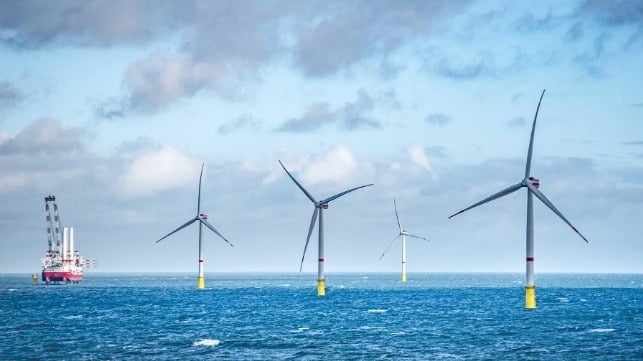
For the fourth time in a year, power purchase agreements that were due to be signed for offshore wind farms to serve Massachusetts and Rhode Island have been postponed. While the states remain anxious to pursue clean energy, the developers cite the continuing uncertainties in U.S. policy and, for the first time, raised the possibility of canceling agreements in their most recent filing.
Massachusetts selected nearly 2.7 GW of offshore power in the 2024 solicitation across three projects. A first-of-its-kind agreement called for Rhode Island to take 200 MW sharing the South Coast Wind project between the two states.
Originally, it was anticipated that the power purchase agreements between the wind farm developers and the state’s utilities would be completed in August 2024 and then submitted to the state’s public utility regulators for final approval. Citing uncertainties and market conditions, the deadline was pushed to November, and after the election of Donald Trump again delayed till January. In March, the two states agreed that the deadline would be moved to June 30.
Creating much of the uncertainty is an Executive Order signed by Donald Trump on January 20, putting leasing under review and pausing further activities. Five months later, there is no progress or word on when the ordered review might be concluded. The administration also briefly this spring stopped work on the Empire Wind project in New York and withdrew an EPA approval related to the construction of a proposed New Jersey offshore wind farm.
Trump has continued to speak out against what he calls “windmills,” contending incorrectly in a recent interview that they are all built in China. While Chinese companies have developed wind turbines, no American or European project has so far agreed to use them for their power generation. The new “big beautiful bill” for funding the U.S. government also contains provisions that, if passed, would impact tax credits for renewable energy.
“Without clarity on when or how issues arising under the Presidential Memorandum will be resolved, it may be impossible for parties to execute the PPAs,” Michael Brown, CEO of Ocean Winds, warned in the most recent filing.
Ocean Winds is the developer for South Coast Wind, a project which would be located over 30 miles south of Martha’s Vineyard and 20 miles south of Nantucket, and providing a total of 1,287 MW between Massachusetts and Rhode Island. While it has gained state approvals, it needs three additional federal approvals before construction can begin.
New England Wind, which is to be developed by Iberdrola’s Avangrid, however, is fully permitted at the state and federal levels. It would be located roughly 30 miles south of Barnstable, Massachusetts, and have a capacity for 791 MW.
Massachusetts had pushed back the deadline for the power agreements now targeting December 31 to finish negotiations. They would then be required to file with the state’s regulator by February 25, 2026.
Similarly, Rhode Island has set a new deadline of November 1 for the negotiations to be completed. This came less than a month before hearings were scheduled for the cable routing for the power supply.
South Coast Wind highlights that it has invested more than $600 million during the past seven years. This was for the permitting, engineering, and other preparations, but it and Rhode Island’s power utility warn if the uncertainties can not be resolved and agreements reached, Ocean Winds is prepared to delay indefinitely or walk away from its selection by Massachusetts and Rhode Island.
In the spring, 17 states and jurisdictions filed a lawsuit against the Trump administration regarding the indefinite pause in permitting for offshore wind projects. A District Court in Massachusetts has scheduled a September hearing on the suit.
In the interim, Vineyard Wind, which has been badly delayed by problems with its turbine blades, continues its construction process, which also involves surveying and replacing problems on the approximately 20 turbines installed before a blade broke last year. It will provide power to Massachusetts. In addition, Ørsted’s Revolution Wind is quietly progressing with its construction. This project will be shared between Rhode Island and Connecticut.
Plans for additional renewable energy solicitations by the states asl remain stalled waiting for resolution from the federal government. One proposal said they could continue to review projects quarterly or else wait till 2029 when Donald Trump is due to leave office.
Australia’s Offshore Wind Plans in Limbo as Equinor Leaves Project

Norwegian energy major Equinor has walked away from a third offshore wind development project in Australia in another blow to the federal government’s plan to build an offshore wind industry.
Earlier this year, Equinor quietly walked away from the Bass Offshore Wind Energy project near the coast of Tasmania, as the oil and gas giant reduced its investments in renewables to boost returns for shareholders and adapt to an “uneven energy transition.”
In a short statement to Australia’s Financial Review, Equinor and its partner in BOWE, Australian firm Nexsphere, confirmed on Wednesday the end of their collaboration on the project.
“Equinor and Nexsphere have made the decision not to proceed together with the Bass Offshore Wind Energy project (BOWE) in Tasmania,” the companies said.
Nexsphere continues to pursue the project, which aims to have between 70 and 100 offshore wind turbines installed, capable of generating up to 1,500 megawatts (MW) of renewable energy, which would be enough to power 325,000 homes in the area.
Nexsphere said in a separate statement to the Financial Review that the project is now “100 per cent Australian-owned” and that the company would “work with major international offshore wind partners make the proposal a reality.”
In the latest window in April, BOWE did not obtain a feasibility license—the first required permit for offshore infrastructure in Australia in which the holder has to assess the feasibility of a potential commercial offshore renewable energy project. But Nexsphere is “progressing” an application with the federal government, the company told the Financial Review.
Setbacks in the offshore wind sector are not unique to Australia.
The global offshore wind industry continues to face significant headwinds relating to supply chain, regulatory, and macroeconomic developments.
Orsted, the world’s biggest offshore wind project developer, in May warned of a continued challenging environment for the industry.
Due to higher costs and interest rates, the company announced it had decided to discontinue the development of the Hornsea 4 offshore wind project in the UK.
By Tsvetana Paraskova for Oilprice.com

No comments:
Post a Comment