CMB.TECH Completes Merger of Golden Ocean, Creating 250 Ship Fleet
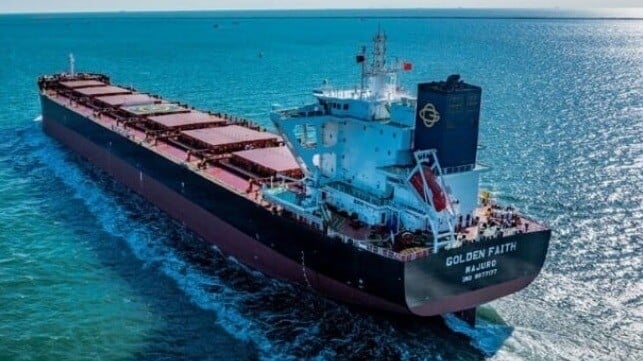
After the shareholders of Golden Ocean Group officially ratified the proposed merger, CMB.TECH completed the merger, assuming the operations of the dry bulk carrier into its fleet. The resulting company is an industry giant that further diversifies CMB.TECH’s overall fleet and setting the stage as it continues to push forward with a strategy tied to the energy transformation of the shipping industry.
Golden Ocean confirmed that August 19 was the last day of trading for its stock in the United States on NASDAQ and the Euronext Oslo Børs. Under the terms of the merger agreement, each outstanding common share of Golden Ocean was exchanged for nearly 96 million newly issued CMB.TECH ordinary shares at an exchange ratio of 0.95 ordinary shares of CMB.TECH for each common share of Golden Ocean. CMB.TECH also launched a listing on the Euronext Oslo Børs, as well as continuing to trade on the New York Stock Exchange and Euronext Brussels.
“Today, we are delighted to close the merger between CMB.TECH and Golden Ocean,” said Alexander Saverys, CEO of CMB.TECH. “In less than 18 months, we have transformed a pure play crude oil tanker company into a large and leading diversified and future-proof maritime group.”
Plans for the merger were announced in April with Saverys calling the transaction “another great step forward” in building a diversified maritime group. CMB.TECH, which was formed by the 2024 takeover of Euronav, owns and operates more than 160 seagoing vessels in the crude oil tankers, dry bulk, containership, chemical tanker, offshore wind, and workboat sectors. CMB.TECH’s dry bulk fleet before the merger included 28 Newcastlemax vessels as well as two smaller coasters operating under the Bocimar brand.
Saverys said in April, explaining the rationale for the merger, “The value of our fleet would reach more than $11 billion and, combined with our public listings and enhanced liquidity in our shares, we will have all the necessary firepower to continue to invest in our fleet and seize opportunities. Our focus on decarbonization is starting to generate meaningful long-term contracts, and the recent IMO decisions on limiting greenhouse gas emissions from shipping give us even more wind (and ammonia) in our sails.”
The combined fleet numbers approximately 250 vessels with Saverys an average age of vessel of just over six years. Dry bulk becomes the largest portion of the group’s operations.
The transaction in effect brings Golden Ocean and the bulker fleet full circle 20 years after the company emerged as an independent operator. Originally part of Frontline, Golden Ocean was spun off in 2005 to create a pureplay bulker company separate from Frontline’s tanker operations. The company grew to a leading position in the dry bulk.
The Golden Ocean fleet consisted of 89 dry bulk vessels, with an aggregate capacity of approximately 13.5 million deadweight tonnes. The ships are now being reflected as part of CMB.TECH’s Bocimar brand with a combined fleet of 119 ships. Analysts have speculated that a portion of the dry bulk fleet might be sold now that the merger is completed.
HD Hyundai Buys Manufacturer as it Seeks Expansion in Vietnam Shipbuilding
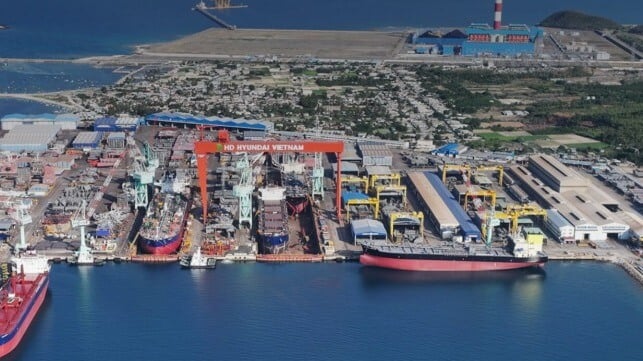
South Korea’s HD Hyundai is continuing to pursue opportunities to grow its shipbuilding business and increase its competitive position against the Chinese. It is acquiring a Vietnamese manufacturing business for components, including tanks and cranes, while also moving to expand its Vietnamese shipbuilding and being linked to other international deals.
HD Korea Shipbuilding and Offshore Engineering has agreed to acquire Doosan Vina from Doosan Enerbility, a Vietnamese offshoot of the Korean industrial company Doosan. HD KSOE will pay $207 million for full ownership of the Doosan Vina business, which was established in 2006. The industrial manufacturer is located south of Da Nang in central Vietnam.
Doosan Vina is a manufacturer of tanks and other components for LNG plants as well as port cranes, thermal power plant boilers, and other industrial components. HD KSOE highlights the growing need for tanks that can be used with LNG and other gas carriers, as well as the next generation of eco-friendly shipping.
The acquisition comes as the company is also expanding its shipbuilding capacity in Vietnam. Its Vietnamese operations were launched as a joint venture in 1996, focused on ship repair and conversion. It completed work on over 900 ships and, starting in 2008, entered into shipbuilding. Since 2011, the operations have been totally focused on shipbuilding, with the yard mostly delivering product/chemical tankers and bulkers.
Last year, HD Hyundai announced plans to expand its shipbuilding operations in Vietnam. It has a capacity to build 12 vessels a year, which it said would be increased to 15 ships per year. It is working to improve the efficiency of the shipbuilding operation. It also said it would review the possibility of expanding the capacity in Vietnam to 23 ships per year by 2030.
Elsewhere in its international operations, HD Hyundai is in the process of restarting the former Hanjin shipbuilding operation at Subic Bay in the Philippines. Product work will resume by the start of next year, with the Philippine yard ramping up to a capacity of 10 ships per year. The company has also been linked to a bid for a developmental shipyard in Morocco, and it recently signed partnership agreements in the United States and India.
Already the largest shipbuilder in South Korea, HD Hyundai’s shipbuilding group is focused on eco-friendly future ships and is also looking to develop new capacity and capabilities to keep up with demand and competition. The Korean shipyards have lost business in recent years to the Chinese shipbuilders, who pose strong price competition.

No comments:
Post a Comment