Hanwha Shipping Details Largest U.S. Commercial Vessel Order in 20 Years
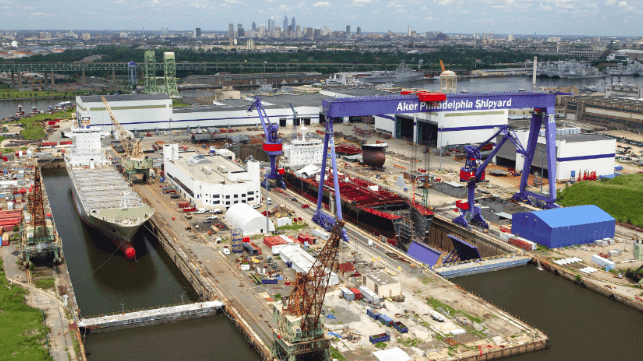
Hanwha Shipping, the newly-launched U.S. shipping subsidiary of South Korea’s Hanwha Ocean, provided additional details on its shipbuilding plans, which it is calling the largest U.S. commercial vessel order in more than 20 years. The company looks to build out the U.S. Jones Act tanker fleet and launch the first modern U.S. LNG carriers for the international export market.
“We are able to order these U.S.-made MR tankers because of Hanwha’s investment in building a world-class shipyard in Philadelphia,” said Ryan Lynch, President & CEO of Houston-based Hanwha Shipping. “Hanwha has made a long-term commitment to bringing cutting-edge technology from Korea to the Hanwha Philly Shipyard that will create thousands of good, advanced manufacturing jobs in the United States and spearhead the revitalization of America’s maritime industrial base.”
The hallmark of the initiative is an order for 10 medium-range (MR) oil and chemical tankers to be built in Philadelphia. The first tanker is expected to be delivered by early 2029, in what Hanwha Shipping terms “the highest-value commercial order seen at U.S. shipyards.”
The MR vessels will be fitted to transport crude oil, refined petroleum, and chemical products, and will significantly expand the U.S. Jones Act fleet of U.S.-built, U.S.-owned, and U.S.-crewed vessels operating between U.S. ports.
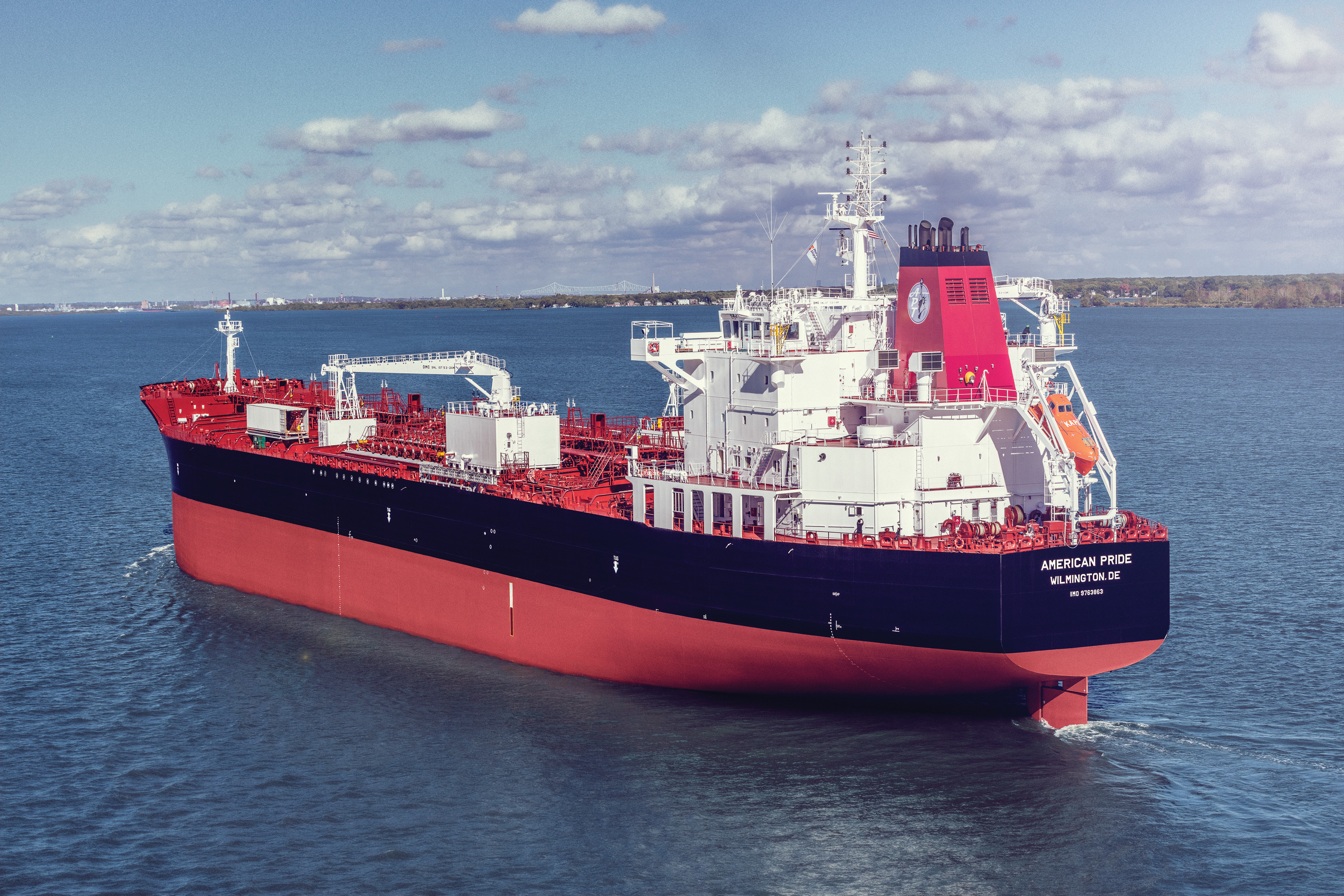
Delivered in 2017, American Pride was the 28th ship built by the yard since it started commercial operations in 2000 (Philly Shipyard)
The ships return the yard now known as Hanwha Philly Shipyard to its roots. Started in 2000 at the site of the former Philadelphia Navy Yard, the company, known as Aker Philadelphia Shipyard, started with contracts to build 46,000 to 50,000 dwt tankers. This included a dozen 600-foot MT46 Veteran-class tankers for Overseas Shipping Group and concluded in 2017 when it delivered American Pride, the fourth 50,000 dwt product tanker built for American Petroleum Tankers (APT), a subsidiary of Kinder Morgan. The yard delivered 24 tankers in addition to its six containership builds for Matson.
As the only company in the world with significant shipbuilding operations in both Korea and the U.S., Hanwha reports it plans to build new MR tankers in the U.S. by transferring its advanced shipbuilding technologies, processes, and supply chains to Hanwha Philly Shipyard.
At the same time, Hanwha Shipping also exercised an option to order a second liquefied natural gas (LNG) carrier, following its first order announced a month ago. They will be the first U.S.-ordered LNG carriers for the export market in almost 50 years and respond to the Trump plan that calls for requiring a portion of U.S. LNG exports to be transported on U.S. ships. The ships will be built via a joint construction model between Hanwha Ocean and Hanwha Philly Shipyard as part of the U.S.-Korea partnership.
The orders are an element of a $5 billion infrastructure plan announced yesterday for Hanwha Philly Shipyard as part of South Korea’s commitment to supporting the growth of U.S. shipbuilding. After acquiring the shipyard at the end of 2024, the company plans to install two additional docks and three quays to increase annual capacity from less than two vessels to up to 20. Hanwha is also reviewing the build-out of a new block assembly facility as it targets work for LNG carriers, naval modules and blocks, and, in the long-term, naval vessels built at the U.S. shipyard.
The Hanwha group quietly launched Hanwha Shipping, based in Texas, in April 2024. According to the company, it aims to take a leading position in the American shipping ecosystem by deploying next-generation digital technologies and advancing the resilience and robustness of America’s energy security and maritime industrial base.
HD Hyundai to Merge Ulsan Shipyards to Expand Defense and Commercial Work
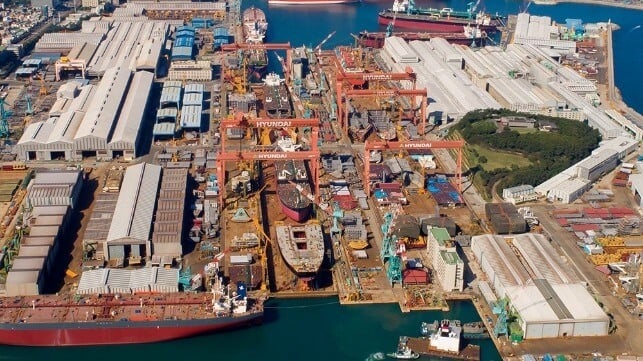
HD Hyundai, which is already South Korea’s largest shipbuilder, announced plans to reorganize by merging its shipbuilding operations in Ulsan to realize opportunities both in naval shipbuilding and repair, and the South Korean MASGA (Make America Shipbuilding Great Again) initiative.
The company said that it looks to take a leadership role in the South Korean program following the meeting earlier this week between the country’s president, Lee Jae Myung, and Donald Trump, in which South Korea committed to investing at least $150 billion into U.S. shipbuilding and other key industries. As part of the agreement, the company announced a new partnership with U.S. private equity giant Cerberus Capital Management and the Korea Development Bank to pursue a maritime investment strategy.
Under the terms of the proposed merger, HD Hyundai Heavy Industries will acquire the mid-sized operation HD Hyundai Mipo with HHI as the surviving company. HD Hyundai’s shipbuilding holding company, HD Korea Shipbuilding & Offshore Engineering, owns 74 percent of HHI and 42 percent of Mipo, and after the merger will have a 69 percent position in the combined company.
HHI says the merger is an effective response to future changes in the shipbuilding industry and points to the opportunities to reduce unnecessary costs and structure by integrating its systems. Media reports are highlighting that China recently consolidated its two large shipbuilding companies and that Japan’s two largest shipbuilders have also reorganized.
In the first seven months of 2025, HD KSOE reported that it booked orders for a total of 82 ships worth $11.22 billion. It has achieved 62 percent of the annual order target of $18.05 billion for 2025. HHI specializes in larger vessels, including LNG carriers and containerships, while Mipo is considered a medium-sized operation building containerships, chemical tankers, and vehicle carriers.
One of the key markets the combined company will be targeting is defense shipbuilding, which HD Hyundai highlighted to investors as a rapidly growing segment as countries expand their investments. HHI reports it has built 106 naval vessels, more than any other domestic shipbuilder. It has experience with destroyers, frigates, submarines, and patrol boats, and looks to expand both internationally and specifically with the United States as part of the MASGA program.
“We will increase our competitiveness in the K shipbuilding and defense sectors by reorganizing the shipbuilding business,” the company told investors. It said the target is to grow defense revenues to $7.2 billion annually by 2035.
It also looks to expand its entry into the repair business. The company recently won its first MRO contract from the U.S. for the overhaul of a U.S. Military Sealift vessel, USNS Alan Shepard, a 41,000-ton displacement Lewis and Clark class dry cargo and ammunition vessel. As part of MASGA, they believe this business segment will grow rapidly.
They also look to expand their expertise in specialty ships, pointing to the opportunity for icebreakers due to the rise in Arctic development. South Korea previously announced that it plans to launch an Arctic shipping initiative and recently ordered a new Arctic research vessel.
The combined company will also accelerate its focus on green shipping. They will consolidate the R&D and design capabilities of the two shipbuilders. Mipo will also provide additional capacity to the combined company, as reports are that it is currently operating at a rate of 45 ships but has a capacity to reach 70 ships annually.
The combined company plans to launch by December a new overseas investment holding company to be based in Singapore. It will manage the operations of the shipyards in Vietnam and the newly launching yard in the Philippines, as well a the recently acquired tank and crane manufacturer in Vietnam that it has agreed to acquire from Doosan. HD Hyundai has also been exploring additional overseas operations, including possibly a shipyard in Morocco and Egypt, and has formed new relationships in the United States.

No comments:
Post a Comment