Why Trump’s Desperate Chase For Bagram Airbase Could Reshape Afghanistan’s Future Forever – Analysis
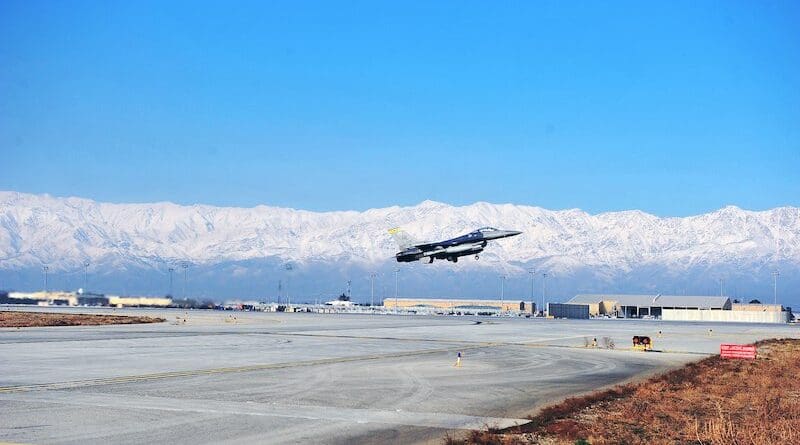
File photo of an F-16 Fighting Falcon assigned to the 4th Expeditionary Fighter Squadron from Hill Air Force Base, Utah, takes off at Bagram Air Field, Afghanistan, Jan. 23, 2015. Photo Credit: Staff Sgt. Whitney Amstutz, Wikipedia Common
The return of Donald Trump to the White House has brought back one of his most persistent fixations – the Bagram Airbase in Afghanistan. His recent threats to punish Afghanistan if they don’t return the strategic military facility reveal a deeper game of global power politics that could have far-reaching consequences for the war-torn nation.
Trump’s obsession with Bagram is not just about military pride or correcting what he sees as Biden’s withdrawal mistakes. The 79-year-old President’s determination to reclaim this airbase stems from three critical strategic calculations that go far beyond Afghanistan’s borders.
The China Factor: A New Cold War Battleground
The most compelling reason behind Trump’s Bagram fixation is its proximity to China. Located just 800 kilometres from the Chinese border, Bagram offers an unmatched strategic advantage in America’s growing rivalry with Beijing. Trump has repeatedly mentioned China’s increasing influence in Afghanistan, and he sees Bagram as the perfect counter-move in this chess game.
China has been quietly expanding its presence in Afghanistan since the Taliban’s return to power. Through infrastructure projects and mining deals, Beijing is slowly but steadily gaining a foothold in the region. For Trump, losing Bagram means giving China a free pass to dominate Central Asia without American oversight. Reclaiming the base would allow the US to monitor Chinese activities closely and maintain a strategic presence in this crucial region.
The Geopolitical Chessboard: More Than Just Afghanistan
Bagram’s value extends far beyond its role in Afghan affairs. The airbase sits at the crossroads of South Asia, Central Asia, and the Middle East. Control over Bagram means having a launching pad for operations across this volatile region. It provides easy access to Pakistan, Iran, and the Central Asian republics – all areas where American influence has been declining.
For a president who believes in projecting American strength globally, Bagram represents the ultimate power projection tool. It’s not just about Afghanistan; it’s about maintaining American dominance in a region that’s becoming increasingly important for global trade and security.
Economic and Resource Considerations
Afghanistan sits on an estimated one trillion dollars worth of untapped mineral resources, including rare earth elements crucial for modern technology. China has already shown interest in these resources, signing preliminary agreements with the Taliban government. Trump’s push for Bagram could be part of a broader strategy to ensure American companies get their share of Afghanistan’s mineral wealth.
The airbase would provide the security and logistical support needed for American businesses to operate safely in Afghanistan. Without a military presence, the US risks being completely shut out of Afghanistan’s economic opportunities while China reaps the benefits.
The Devastating Impact on Afghanistan
For Afghanistan, Trump’s Bagram demands create an impossible situation. The Taliban government, which has struggled to gain international recognition and desperately needs foreign aid, now faces threats from the world’s most powerful military. Returning Bagram would mean allowing foreign troops back on Afghan soil – something that goes against everything the Taliban fought for during their 20-year insurgency.
The timing couldn’t be worse for Afghanistan’s people. The country is facing a severe humanitarian crisis, with millions needing food aid and basic services. International sanctions have crippled the economy, and most foreign aid has dried up. Trump’s threats add another layer of uncertainty to an already unstable situation.
If Afghanistan refuses to return Bagram, Trump’s promised “consequences” could include harsher economic sanctions, military action, or support for anti-Taliban groups. Any of these options would further destabilise the country and cause more suffering for ordinary Afghans who have already endured decades of war.
A Dangerous Game with Global Consequences
Trump’s Bagram strategy reflects his broader approach to international relations – using American military and economic power to force other nations to comply with US demands. While this might appeal to his domestic supporters who want to see America “winning” again, it risks creating new conflicts and undermining global stability.
The international community is watching closely to see how this unfolds. If Trump successfully pressures Afghanistan into returning Bagram, it could set a precedent for other powerful nations to make similar demands on weaker countries. This could lead to a more chaotic and unpredictable world where might makes right.
The Road Ahead: Limited Options for All
As this standoff continues, both sides have limited good options. Trump cannot easily invade Afghanistan again without significant domestic and international backlash. The American public has little appetite for another long war in Afghanistan, and allies would be reluctant to support such action.
For Afghanistan, the choices are equally difficult. Giving up Bagram would undermine the Taliban’s legitimacy and invite more foreign interference. Refusing could bring devastating consequences from the world’s most powerful military.
Conclusion: A Test of Wills with Global Stakes
Trump’s desperate pursuit of Bagram Airbase is about much more than correcting past mistakes or showing strength. It’s a calculated move in America’s competition with China and an attempt to maintain global dominance in a changing world order.
For Afghanistan’s long-suffering people, this great power competition means more uncertainty and potential conflict. The country that just wanted peace after decades of war now finds itself at the centre of a new geopolitical storm.
The coming months will reveal whether Trump’s threats are serious or just political posturing. Either way, his Bagram obsession has already changed the dynamics in Afghanistan and reminded the world that the Great Game in Central Asia is far from over. The stakes couldn’t be higher – for Afghanistan, for regional stability, and for the future of global power politics.

Girish Linganna
Girish Linganna is a Defence, Aerospace & Political Analyst based in Bengaluru. He is also Director of ADD Engineering Components, India, Pvt. Ltd, a subsidiary of ADD Engineering GmbH, Germany. You can reach him at: girishlinganna@gmail.com

No comments:
Post a Comment