Jellyfish Force another French Nuclear Reactor to Shut Down

For a second time in three weeks, a swarm of jellyfish has forced the closure of a nuclear reactor in France in another curious incident in which jellyfish entered the filters of the water cooling systems.
The Paluel nuclear power plant in Normandy, northern France, saw its electricity generation nearly halve by 2.4 gigawatts (GW) out of a total 5.2-GW capacity, due to the presence of jellyfish that have entered the filtering system, French operator EDF said on Thursday, as carried by Reuters.
One of four reactors at Paluel was shut down while power output at another reactor was curtailed to prevent further disruption due to the jellyfish swarm.
Today’s incident at Paluel occurred just over three weeks after a jellyfish swarm clogged the cooling system of the Gravelines nuclear power plant near Dunkerque and Calais. As a result, four of six units at one of France’s largest nuclear power plants automatically switched off, while the remaining two units were already shut down for planned maintenance. Gravelines has six reactors, each with a capacity of 900 megawatts (MW).
At the time, France’s EDF said there was “no impact on the safety of the facilities, the safety of personnel, or the environment.”
Reactors at the Gravelines power plant are cooled from a canal linked to the North Sea, where jellyfish are swarming near the coast during hot weather and warm waters.
Global warming can worsen the jellyfish problem in waters cooling reactors close to seas, scientists have warned.
In recent years, heatwaves and too hot waters in rivers have disrupted France’s nuclear power generation, too.
France’s nuclear power generation accounts for around 70% of its electricity mix, and when its reactors are fully operational, it is a net exporter of electricity to other European countries.
But in 2022 and 2023, EDF was forced to curb power generation at some nuclear plants as heatwaves raised the temperatures of rivers. The power plant operator had to limit electricity output because of environmental regulations for using river water for cooling nuclear reactors.
By Charles Kennedy for Oilprice.com
UK committed to nuclear expansion, conference told
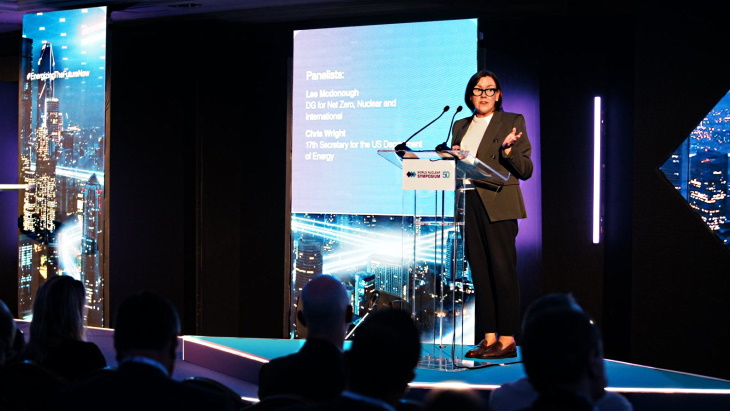
"Here in the UK, the Department for Energy and Security Net Zero (DESNZ) is focused on delivering two key missions: kick-starting economic growth, and making Britain a clean energy superpower, rebuilding Britain, bringing bills down and accelerating towards net-zero. And nuclear is uniquely placed to deliver for both of those missions," she said.
McDonough noted that over the past few months, the government took important decisions, "which the Secretary of State for Energy Security and Net Zero has hailed as decisive steps to usher in a new golden age of nuclear".
She said the UK's new nuclear energy programme includes signing a multi-billion-pound commercial deal for the Sizewell C power plant, "securing our home-grown nuclear supply far beyond our clean energy target of 2030".
McDonough added: "And for the first time, we have created a new funding model to successfully track world-class investments to run the project alongside us. This deal, which was agreed in July, will deliver clean power to consumers for decades to come and will open up new possibilities for the financing of future nuclear projects."
The government has also announced GBP2.5 billion (USD3.6 billion) for small modular reactors (SMRs) and in June selected Rolls-Royce SMR as the bidder to partner with Great British Energy - Nuclear to deliver SMRs at home and "to help realise our long-term ambition of delivering one of Europe's first small modular reactors".
In addition, it also committed GBP2.5 billion for nuclear fusion.
"These are plans for the future," McDonough said. "These are real significant amounts of investment over the course of this Parliament and beyond."
However, she added: "It's not just about announcing a big nuclear power station. That's great. We need to create the context for these projects to succeed and to be able to move rapidly. And so we've also taken significant steps to unlock the planning process. for all kinds of infrastructure, actually not just nuclear. So this will apply across the country and hopefully be vital to securing pace.
"The other thing we've done is create a context where nuclear can be deployed more broadly in different places across the country on top of the existing nuclear licence sites that we have. And that's really looking to the future to think about how we can enable both gigawatts but also advanced nuclear technologies that are coming down the line, whilst of course maintaining the highest standards of safety, security and environmental protection."
The government has also set up a nuclear regulatory task force. "This is really to look at how we can enable innovation, streamline regulatory processes and unlock the UK's full nuclear potential," McDonough said.
"Our government is totally clear. If we're going to kick-start the economy, if we're going to achieve clean power by 2030 and deliver on net-zero, then nuclear must play a central role. However, the golden age that the Secretary of State spoke of is not specific to the UK, as we have heard. Indeed, our achievements must be part of a wider global success story which depends entirely on effective collaboration with our like-minded partner governments and industries."
'Difficult to overstate demand from institutional investors' for nuclear
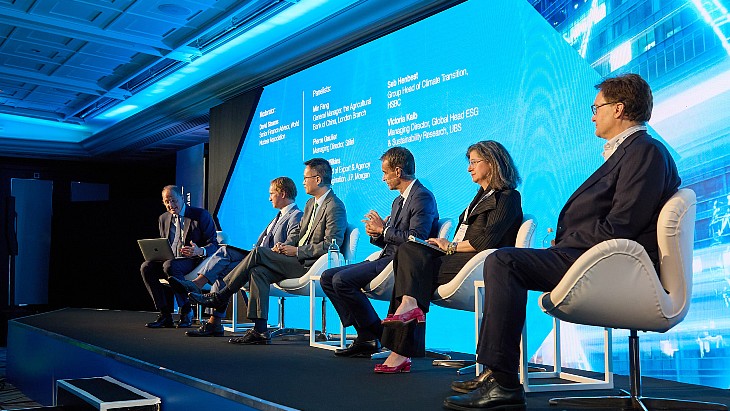
Victoria Kalb, Managing Director, Global Head ESG & Sustainability Research, for UBS, said "the demand from the institutional investors that we speak to on nuclear - it's difficult to overstate how strong that is. We spend hours and hours and hours speaking to people, listed equity investors, infrastructure funds, looking for a way to be involved".
She said that "interest level is increasing as we get more and more noise around" the industry on the predicted future electricity demand growth, led by AI in particular, as well as energy security issues.
However, along with other speakers, she said that there was a complex choice to be made to make the investments, with issues cited being the high capital expenditure, the long-term nature of investments, uncertainty over project costs and timelines, and the associated allocation of risks.
Seb Henbest, Group Head of Climate Transition at HSBC, said that investing in nuclear aligned with environmental missions but cautioned against the energy industry and finance industry "talking past each other" and said that large-scale nuclear was essentially like any other large-scale infrastructure project and should not be proposed as if it was a science project - "the industry's got to present the proposition to commercial financial institutions as something that looks really, really attractive".
The risks to be managed included whether there was offtake, the technology design risk, the construction risk and the reputational risk - "these are the same with any other project", he said. But given the long-term nature of returns from investing in new nuclear capacity - compared with renewables - the role of government becomes more important. And he cited HSBC's role at Sizewell C, where risks on design were reduced by it echoing the Hinkley Point C units on the technology design side, and also the Regulated Asset Base financing model which mitigates the risk of cost overruns.
Mark Muldowney, Managing Director, Energy, Resources and Infrastructure, at BNP Paribas, said they wanted to deploy "very large amounts of our capital to the energy transition, and to us, nuclear is a key part of that". He said that new GW-scale projects were "so large and so significant, they are inherently political projects" and he said that, with the uncertainty over the cost and time to build new nuclear, "the risks in building new large-scale nuclear are not going to be taken by the private sector".
He said the risks could also not be taken on by contractors, so the answer would be governments or the electricity consumers in a country, with utilities maybe involved in some places, or some combination of those parties. A key role of government was to take measures to drive down the cost of capital by taking on the "appropriate level of risks".
Jake Jurewicz, CEO and Co-Founder, Blue Energy, said the demand was now greater than it had been for 70 years and said the issue was to create a new financiable product for new nuclear capacity. He said that looking at the data on cost overruns, it was not from the reactor, but rather from the construction, where a new workforce has to be trained and infrastructure built in new areas. He said the experience of offshore oil and gas and offshore wind showed the benefits of modular construction - mass production at a site and moving it to the project, rather than having to move 10,000 workers from site to site.
In her closing remarks to the day-long summit, which came at the start of World Nuclear Symposium, World Nuclear Association Director General Sama Bilbao y León said that the key messages were that financing needs to be thought about from the start of a project "and not be an afterthought". She said there needed to be further conversations "about sharing benefits, costs and risks in all these projects". She said that there was a "massive appetite for nuclear investment" in the banking and finance industry alongside government support, and there was work ahead to develop financing frameworks.
She stressed that opportunities exist throughout the nuclear value chain, and added "there is nothing inherently unique about nuclear projects ... so let's demystify them", adding that World Nuclear Association was planning to launch a Nuclear Investment Guide which would "take many of the themes we discussed today and boil them together into something that is digestible and actionable to move forward".
Consumers cluster around nuclear energy
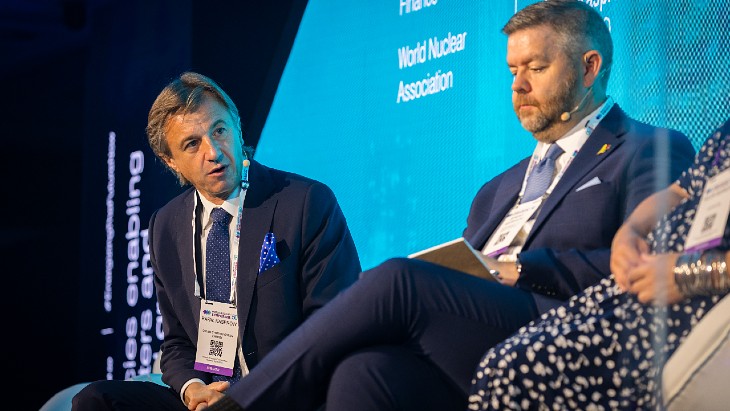
The energy cluster model would see large consumers take their electricity or heat directly from one or more co-located reactors, large or small. While the consumers benefit from energy that is more reliable, resilient, secure and clean than grid supply, the nuclear developer would benefit from the simplified project finance that comes with having such committed partners.
It would also be a benefit for both the consumers and the nuclear developer to avoid long transmission lines and to reduce the burden the cluster's grid connection would place on grid resources, which are at a premium in most markets.
Surging demand from data centres to meet the needs of artificial intelligence and other cloud services are one main driver of the trend. Co-location is already happening in some places, notably where data centres have been built alongside existing nuclear power plants at Susquehanna in the US and in recent years at Kalinin in Russia. Looking ahead, several small reactor companies are vying for data centre supply contracts and X-energy’s Ben Reinke noted that the surety of its 1 GWe contract with Amazon gave its supply chain the confidence to make necessary capital investments.
In Poland, five of the six locations identified by Orlen Synthos Green Energy would be based on clustering, said company CEO Rafał Kasprów. He noted that Poland also consumes some 55 GWt of district heating nationally, including 4.6 GWt in Warsaw. “It is not feasible to build cables and electrify,” he said, “Easier to replace the source of energy and that’s why we focus on SMRs for heat production.”
In the Netherlands a study by developer ULC looked at the co-location of two Rolls-Royce SMRs with a hydrogen production facility using high temperature electrolysis. Company CEO Dirk Rabelink said it found this to be feasible, especially when compared with strategies based on enormous overbuilding of variable renewables.
As well as producing hydrogen towards the European Union’s targets, the facility could provide other services, said Rabelink. By keeping the electrolyser in a hot standby using nuclear heat in the form of steam, the system could respond to grid fluctuations “in milliseconds”, said Rabelink, thereby supporting grid stability.
Given that the Netherlands' grid will probably be dominated by offshore wind in decades to come, Rabelink said the nuclear hydrogen facility could also generate revenue by switching to put some of its electricity onto the grid when market conditions are favourable.
One very serious advantage of energy clusters to those countries that develop them is energy security, said Kasprów. The potential to give key industries the most resilient and secure energy supply possible, which is free from the influence of fossil fuel markets, is strategically attractive.
Open Group
Separately, the conversation around energy clusters expanded on 2 September with the formation of the Industrial Advanced Nuclear Consortium. Under the banner of The Open Group, founder members Chevron, ConocoPhillips, ExxonMobil, Freeport-McMoRan, Nucor, Rio Tinto, and Shell said they would "leverage their integration and project delivery expertise to define the requirements for the application of nuclear technology to provide process heat and power for their respective industries". They plan to engage with the US Nuclear Regulatory Commission.
"There is an urgent need to better leverage nuclear energy to address the application of heat and power solutions. We believe that an open architecture approach can enable cost effective solutions that can be replicated to drive this adoption," said Steve Nunn, President and CEO of The Open Group. "By bringing together large industrial end users and the supplier community, we can draw on the huge amount of industry expertise in project delivery, reduce cost and schedule uncertainty, and effectively deliver nuclear projects that serve the needs of the industry."
EBRD's 'evolving view' on new nuclear projects
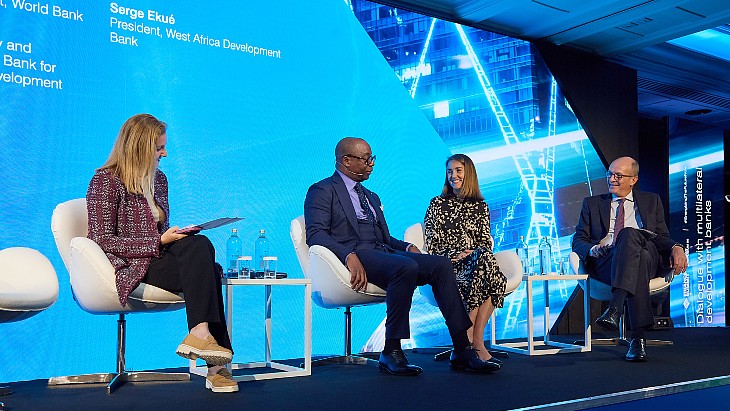
Mark Bowman, vice president for policy and partnerships at the European Bank for Reconstruction and Development (EBRD), told World Nuclear Association's Finance Summit in London, that across its 35-year history the bank had been involved in donor and loan funding in the field of nuclear safety, decommissioning and environmental remediation.
This work included long-running involvement with the Chernobyl site, with the giant New Safe Confinement probably the best known EBRD nuclear safety-related project. That work continues, including to repair the damage caused to its roof by a drone in February.
Speaking at the event, alongside fellow multinational development banks, he said that with nuclear emerging as a "key contribution to the transition to low carbon economies" and to energy security, the bank "can add significant value with our long experience in nuclear safety to ensure safety and sustainability remain top priorities".
"As a bank with a private sector mandate, we have limited capacity to support large sovereign projects, but we are very keen to engage with private companies throughout the sector and through supply chains," he said.
"There is nothing in our mandate that prevents us investing in nuclear energy. Historically, though, traditionally our board has taken a cautious approach and restricted our activities to the nuclear safety space. But I think it is important to note that views are evolving. There is a change in the balance of views in our board amongst our shareholders. And I think it's very likely in the not-too-distant future we will be bringing projects to our board," he said.
These would not be just the traditional type of areas EBRD has supported but could include long-term operation, supporting safety uprates and also looking at small modular reactors (SMRs) and advanced modular reactors "where we're engaging early with developers and regulators, very much monitoring developments and assessing where and whether investments could be made".
There would also be involvement with reconstruction in Ukraine as well as considering investment in helping countries diversify nuclear fuel supplies and supply chains and supporting newcomer countries with areas such as regulatory frameworks and helping with decommissioning planning and waste management to help ensure sustainability.
He said the EBRD was developing its coordination with organisations such as the International Atomic Energy Agency and with other multinational lenders such as the World Bank, which earlier this year ended its long-standing ban on investing in nuclear projects.
Lauren Culver, Senior Energy Specialist at the World Bank, outlined the ways in which it could develop its financing policies for nuclear projects in the coming years. But she stressed that in the near term the bank would likely focus on helping countries with financing for the infrastructure required to support a future nuclear power project - including grids - and the institutions required to manage all aspects, from the nuclear fuel cycle supply chain onwards.
Serge Ekué, President, West Africa Development Bank, said that energy should be treated as an enabler rather than as a "sector" and nuclear energy could be a key part of the solution to provide the energy Africa requires. But he said that innovative financing and working with the World Bank would be needed. He added that SMRs were a possible solution because of their agility and their ability to be implemented more quickly.
TVA, ENTRA1 Energy team up for SMR deployment
_83269.jpg)
The six ENTRA1 Energy Plants, each powered by multiple NuScale Power Modules, could provide enough energy to power the equivalent of some 4.5 million homes or 60 new data centres, TVA said.
ENTRA1 is NuScale Power Corporation's strategic partner and has exclusive global rights to the commercialisation, distribution, and deployment of NuScale’s products and services, acting as a one-stop-shop and hub for the deployment, financing, investment, development, execution, and management of ENTRA1 Energy Plants. The plants - containing NuScale’s small modular reactors (SMR) -would be owned and financed by ENTRA1.
NuScale's small pressurised water reactor is the first - and, so far, only - small modular reactor (SMR) design to receive certification by the US Nuclear Regulatory Commission.
NuScale President and CEO John Hopkins described the agreement as "historic", and added that ENTRA1's combined energy and finance sector experience will support the next phase of commercialising and deploying the technology. "Together, we are ready as partners to meet America’s surging demand for reliable, carbon-free baseload power - powering AI data centres, critical mining, semiconductor manufacturing, and the energy-intensive industries that are driving our nation’s economic future," he said.
TVA - the Tennessee Valley Authority - is the largest public power supplier in the USA, providing electricity across seven southeastern states from a diverse portfolio including nuclear, hydro, coal, gas, solar and advanced technologies. Earlier this year, it submitted an application for a permit to construct an SMR at Clinch River, near Oak Ridge in Tennessee, using GE Vernova Hitachi Nuclear Energy's BWRX-300 technology. Recently, it signed a power purchase agreement with Kairos Power for up to 50 MW of electricity from Kairos Power's Hermes 2 demonstration reactor, which is to be built alongside the Hermes low-power demonstration plant currently under construction at Oak Ridge.
In February, the authority signed a cooperative agreement with US fusion energy developer Type One Energy to jointly develop plans for a potential fusion power plant project.
"TVA is leading the nation in pursuing new nuclear technologies, and no utility in the US is working harder or faster than TVA," TVA President and CEO Don Moul said. "This agreement with ENTRA1 Energy highlights the vital role public-private partnerships play in advancing next-generation nuclear technologies that are essential to providing energy security - reliable, abundant American energy - and creating jobs and investment across the nation."
Kairos, BWXT team up for commercial TRISO fuel production

The joint team will explore opportunities to use the TRISO Development Lab at Kairos Power's Albuquerque campus, the BWXT Innovation Campus in Lynchburg, Virginia, and BWXT's existing TRISO production line, to optimise TRISO fuel manufacturing and process automation. The companies have also agreed to explore opportunities to jointly develop a TRISO fuel fabrication facility with newly developed technology for commercial fuel production.
TRISO - for tri-structural isotropic - fuel particles are made up of a uranium, carbon, and oxygen fuel kernel encapsulated by three layers of carbon- and ceramic-based materials that prevent the release of radioactive fission products. These extremely robust particles can then be fabricated into "pebbles" of reactor fuel. Kairos is combining TRISO fuel with molten fluoride salt coolant in its fluoride salt-cooled, high-temperature reactor known as the KP-FHR. A low-power demonstration reactor called Hermes is currently under construction in Oak Ridge, Tennessee. Hermes is to be followed by Hermes 2 - a 50 MWe power-producing demonstration plant - for which the US Nuclear Regulatory Commission issued a construction permit last year.
The collaboration agreement brings together Kairos Power's capabilities in annular graphite pebble production with BWXT's more than 20 years of experience in TRISO fuel manufacturing, Kairos said, and will consider possible paths to deliver fuel for Hermes 2 and subsequent Kairos Power reactor deployments.
Kairos Power Chief Technology Officer and co-founder Ed Blandford said the collaboration is an opportunity to develop a secure pathway to commercial TRISO fuel production, which is the next step in the development of Kairos Power's fuel supply chain. "With BWXT as a trusted strategic partner, we have a clear path to produce the high-quality fuel products that will unlock advanced nuclear energy's potential," he said.
Josh Parker, Senior Director, BWXT Advanced Fuels, said the collaboration creates an "industry-leading" TRISO development and manufacturing team. "Together, we believe we have the opportunity and skills to speed up the development process and provide more economical TRISO fuel that ensures supply for Kairos, BWXT, and the wider advanced reactor community," he added.
BWXT Advanced Fuels was launched as a subsidiary of BWXT in August, to leverage the company's experience manufacturing TRISO fuel at its Lynchburg facility for the commercialisation of advanced nuclear fuel.
The announcement coincided with World Nuclear Association’s Energy Users Summit in London, where Jeffrey Olson, Vice President of Business Development & Finance for Kairos Power, took part in a panel session called Partnerships for progress: In conversation with technology developers and energy partners.
Open Group focuses on nuclear for industrial applications
_95077.jpg)
The consortium founding members - Chevron, ConocoPhillips, ExxonMobil, Freeport-McMoRan, Nucor, Rio Tinto, and Shell - represent large industrial users of power and heat. These members will leverage their integration and project delivery expertise to define the requirements for the application of nuclear technology to provide process heat and power for their respective industries.
The primary objectives of the Industrial Advanced Nuclear Consortium (IANC) include: standardising interfaces and sourcing terminology; adopting risk-appropriate design practices; and developing open frameworks and business guidelines.
"These efforts are designed to encourage competition, lower costs, reduce regulatory and scheduling risks, and ultimately deliver diversified, dependable, and decarbonised heat and power solutions for industry," The Open Group said.
Working together with technology providers, Engineering, Procurement, Construction (EPC) companies, and the wider industry, the consortium plans to advocate for aligning and streamlining nuclear regulatory approval and permitting processes with industrial facility project timelines, collaborate across the nuclear ecosystem to standardise interfaces between nuclear and industrial facilities, and promote business models for the delivery of nuclear generated heat and power to reduce costs and improve schedules.
"There is an urgent need to better leverage nuclear energy to address the application of heat and power solutions," said Steve Nunn, President and CEO of The Open Group. "We believe that an open architecture approach can enable cost effective solutions that can be replicated to drive this adoption.
"By bringing together large industrial end users and the supplier community, we can draw on the huge amount of industry expertise in project delivery, reduce cost and schedule uncertainty, and effectively deliver nuclear projects that serve the needs of the industry."
The IANC said it is "welcoming new members from across the ecosystem including technology providers, academia, EPCs, and government agencies".
The Open Group, is a global consortium with over 900 members that enables the achievement of business objectives through technology standards and open source initiatives by fostering a culture of collaboration, inclusivity, and mutual respect among its members. Its membership includes customers, systems and solutions suppliers, tool vendors, integrators, academics, and consultants across multiple industries.

No comments:
Post a Comment