NUKE NEWZ
Cameco soars on $80 billion US nuclear pact
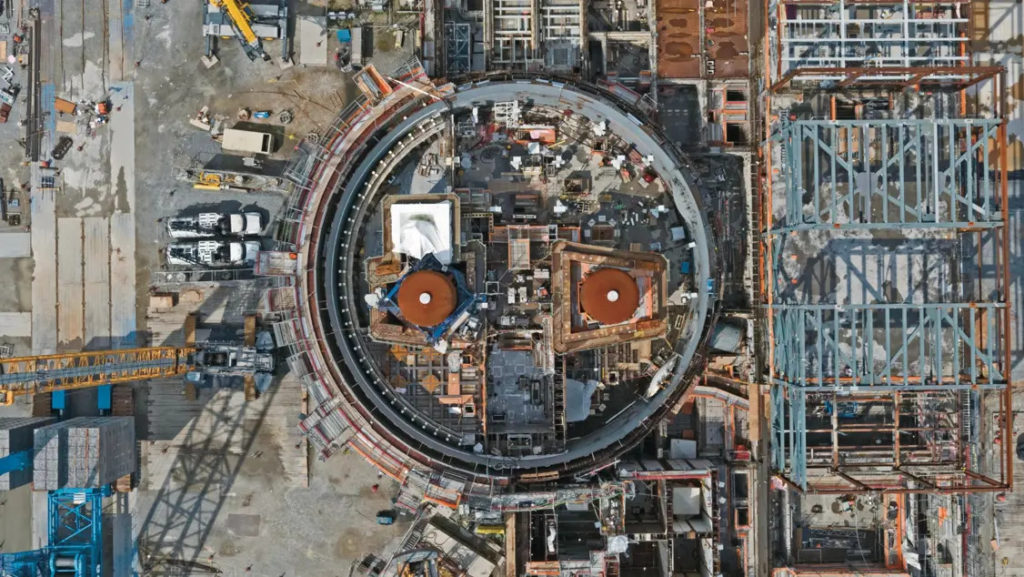
Cameco (TSX: CCO) (NYSE: CCJ) surged on Tuesday after the US government announced a strategic partnership with Westinghouse Electric Company, which it co-owns with Brookfield Asset Management, to accelerate the development of America’s nuclear power.

Washington envisions that at least $80 billion of new nuclear reactors will be constructed across the country, using Westinghouse nuclear reactor technology. Once constructed, the reactors are expected to generate reliable and secure power, including for significant data center and compute capacity that will drive America’s growth in artificial intelligence.
The move, the companies say, aligns with US President Donald Trump’s executive order signed in May aimed at advancing the nation’s nuclear technology development, which he sees as vital to its energy security and AI ambitions.
Cameco’s US-listed shares jumped more than 20% to an all-time high of $104.75 apiece on the news, taking the Canadian uranium producer’s market capitalization to $45.3 billion. Brookfield Asset Management also inched higher, rising 2.2% with a market capitalization of $91.2 billion.
Nuclear renaissance
BloombergNEF estimates that power consumption from US data centers is expected to double by 2035, reaching almost 9% of total demand. The anticipated demand has created a nationwide rush to build new infrastructure, with nuclear reactors being at the forefront of this energy revolution.
Secretary of Commerce Howard Lutnick said the $80 billion pact with Westinghouse “embodies the bold vision of President Trump – to rebuild our energy sovereignty, create high-paying jobs and drive America to the forefront of the nuclear renaissance.”
“Our administration is focused on ensuring the rapid development, deployment and use of advanced nuclear technologies,” he stressed.
The agreement comes against the backdrop of a sluggish nuclear buildout in the US — only three reactors have been completed this century.
AP1000 reactors
Under the partnership, Westinghouse will deploy its AP1000 reactor, which it hails as the most advanced commercially available, with fully passive safety systems, modular construction design and the smallest footprint per MWe on the market.
Each two-unit AP1000 site would create or sustain 45,000 manufacturing and engineering jobs in 43 states, and a national deployment will create more than 100,000 construction jobs, the companies said.
Currently, there are six AP1000 reactors setting operational performance and availability records worldwide with 14 additional reactors under construction and five more under contract, they added. To date, the AP1000 technology has been selected for nuclear energy programs in Poland, Ukraine and Bulgaria.
BMO Capital Markets, in a note, said the $80 billion investment could support 6-10 new AP1000s (depending on costs), “which could add significantly to Westinghouse’s project pipeline through the 2030s.”
“This partnership with the US government will help unlock the potential that Westinghouse and nuclear energy can play to accelerate the growth of artificial intelligence in the United States, while meeting growing electricity demand and energy security needs at scale,” Connor Teskey, president of Brookfield Asset Management, stated in a press release.
“We expect this new partnership to support the global growth opportunities for both Westinghouse’s and Cameco’s nuclear products, services and technologies, adding significant long-term value for our stakeholders and enhancing energy, national and climate security around the world,” added Cameco CEO Tim Gitzel.
Cameco and Brookfield formed a strategic partnership to acquire Westinghouse in October 2022. The partnership brought together Cameco’s expertise in the nuclear industry with Brookfield’s recognized position as one of the world’s largest investors in energy generation technologies.
Cameco, Brookfield Partner With U.S. Government to Accelerate $80B Nuclear Build

Cameco Corporation (TSX: CCO; NYSE: CCJ) and Brookfield Asset Management have signed a binding term sheet with the U.S. Department of Commerce to establish a strategic partnership that will accelerate the deployment of Westinghouse Electric Company’s nuclear reactor technologies, backed by at least $80 billion in planned U.S. government-facilitated investment.
The agreement positions the U.S. government as a key financial and regulatory partner to fast-track the permitting, financing, and construction of new Westinghouse reactors across the country—expected to generate reliable, carbon-free power for the grid and help meet the soaring energy demands of AI and data centers.
Under the terms of the partnership, the U.S. government will help mobilize at least $80 billion for new nuclear projects, including near-term financing for long-lead equipment. Once operational, the reactors will provide firm, emission-free electricity and reinforce the domestic nuclear supply chain.
The deal also grants the U.S. government a 20% participation interest in future Westinghouse cash distributions exceeding $17.5 billion, contingent on final investment and construction commitments. Should Westinghouse pursue an IPO valued at $30 billion or more by 2029, the government would receive a warrant to purchase up to 20% of the IPO entity’s equity value.
Cameco CEO Tim Gitzel said the partnership builds on the “highly successful” collaboration with Brookfield, which jointly acquired Westinghouse in 2023. He noted that the agreement “creates the right incentives” for the U.S. government to use its financial, regulatory, and diplomatic tools to advance nuclear deployment and bolster national energy and climate security.
The initiative is expected to reinvigorate the U.S. nuclear industrial base and expand Westinghouse’s footprint, especially its energy systems, fuel fabrication, and reactor services segments. The supply chain developed for Georgia Power’s Vogtle Units 3 and 4 will serve as a model for scaling future projects.
The partnership aligns with the Biden administration’s May 2025 executive orders to rebuild America’s clean energy manufacturing base and expand nuclear energy capacity to meet climate goals and AI-driven electricity demand. It also underscores the U.S. government’s intent to reduce dependence on foreign nuclear supply chains—particularly amid intensifying global competition for uranium and reactor technologies.
For Cameco, one of the world’s largest uranium and nuclear fuel suppliers, the deal represents a major demand catalyst. As nuclear deployment accelerates, the company expects “tremendous upside optionality” in fueling new reactors in both domestic and international markets.
Cameco, Brookfield, and the U.S. government plan to finalize definitive agreements to replace the binding term sheet, pending regulatory approvals and customary conditions.
By Charles Kennedy for Oilprice.com
Brookfield, Cameco team with US government for AP1000 deployment
The US Government, Cameco Corporation and Brookfield Asset Management have announced a 'transformational' strategic partnership centred on the construction of at least USD80 billion of new reactors across the USA using Westinghouse nuclear reactor technology.
_15447.jpg)
The companies have entered into a binding term sheet with the US Department of Commerce to establish the partnership, which they say is expected to accelerate the global deployment of Westinghouse's nuclear reactor technologies and reinvigorate supply chains and the nuclear power industrial base in the USA and abroad. Brookfield and Cameco acquired Westinghouse in November 2023.
Howard Lutnick, Secretary for the US Department of Commerce, said the partnership supports US national security objectives and enhances its critical infrastructure. "Together with Westinghouse we will unleash American energy. This partnership embodies the bold vision of President Trump - to rebuild our energy sovereignty, create high-paying jobs, and drive America to the forefront of the nuclear renaissance," he said.
US Energy Secretary Chris Wright said the "historic partnership with America’s leading nuclear company" would "help unleash President Trump’s grand vision to fully energize America and win the global AI race. President Trump promised a renaissance of nuclear power, and now he is delivering."
Connor Teskey, President of Brookfield Asset Management, said Brookfield currently has more than half a trillion dollars invested in the critical infrastructure that underpins the US economy, and expect to double that investment in the next decade as the "infrastructure backbone of artificial intelligence" is built. "This partnership with the US Government will help unlock the potential that Westinghouse and nuclear energy can play to accelerate the growth of artificial intelligence in the United States, while meeting growing electricity demand and energy security needs at scale," he said.
The agreement provides for the US Government to arrange financing and facilitate the permitting and approvals for new Westinghouse nuclear reactors to be built in the USA, with an aggregate investment value of at least USD80 billion, including near-term financing of long lead time items. Upon closing of the transaction, and with financing facilitated by the US Government, Westinghouse "plans to commence project execution and initiate orders for critical equipment with long lead times, which is expected to leverage the nuclear industry supply chains that were established during the construction of Vogtle units 3 and 4," Cameco and Brookfield said.
Under the partnership agreement, the US Government will be entitled to receive 20% of any cash distributions in excess of USD17.5 billion made by Westinghouse - once the government has made a final investment decision and entered into definitive agreements to complete the construction of new Westinghouse nuclear reactors in the USA with an aggregate value of at least USD80 billion.
"We are pleased to see the US government make this commitment to expanding nuclear power capacity using Westinghouse's proven technology. We expect that our highly successful partnership with Brookfield as owners of Westinghouse will be further strengthened through this strategic collaboration with the US Government," Cameco CEO Tim Gitzel said.
"At the centre of this new partnership is value creation. When coupled with the 23 May 2025 Executive Orders, we believe the US Government's participation in the partnership creates the right incentives to deploy its full suite of tools behind the construction of Westinghouse reactors, including financial, regulatory, policy and diplomatic support. That support is expected to drive additional value for the partnership and the many stakeholders who are expected to benefit from enhanced energy, national and climate security around the world.
“We expect that the new build commitments from the US will bolster broader confidence in the durable growth profile for nuclear power, and support increased demand for Westinghouse’s and Cameco’s products, services and technologies."
Westinghouse Interim CEO Dan Summer said the company is "honoured" to partner with the US Government in what he described as a once-in-a-generation opportunity. "The AP1000 is ready to meet this mission, with a commercialised design, ready US supply chain, highest capacity factor of any new reactor globally, and backed by cutting-edge AI tools that will transform construction into an efficient, repeatable process," he said.
Washington’s $80-Billion Nuclear Play Targets AI’s Energy Hunger
- The Trump administration has launched an $80 billion strategic partnership with Westinghouse, Cameco, and Brookfield to build large-scale nuclear reactors.
- Each two-unit Westinghouse AP1000 project could create 45,000 jobs across 43 states, while national deployment may exceed 100,000 construction jobs.
- The deal follows a wave of tech–nuclear power purchase agreements.
The Trump Administration is following through on its pledge to revive America’s nuclear energy with a strategic partnership with Westinghouse and Cameco to help build large-scale nuclear power plants in the U.S. with a total investment of at least $80 billion.
In the landmark agreement, Cameco Corporation, Brookfield Asset Management, and Westinghouse Electric Company have entered into a binding term sheet with the United States Department of Commerce to establish a strategic partnership, which is expected to accelerate the global deployment of Westinghouse’s nuclear reactor technologies. The partnership is also aimed at reinvigorating supply chains and the nuclear power industrial base in the U.S. and abroad.
Brookfield and Cameco acquired Westinghouse in November 2023.
Under the new strategic partnership, the U.S. Government will be granted a participation interest, which, once vested, will entitle it to receive 20% of any cash distributions in excess of US$17.5 billion made by Westinghouse. For the Participation Interest to vest, the U.S. Government must make a final investment decision and enter into definitive agreements to complete the construction of new Westinghouse nuclear reactors in the U.S. with an aggregate value of at least $80 billion.
Each two-unit Westinghouse AP1000 project creates or sustains 45,000 manufacturing and engineering jobs in 43 states, and a national deployment will create more than 100,000 construction jobs, Westinghouse says.
“The program will cement the United States as one of the world’s nuclear energy powerhouses and increase exports of Westinghouse’s nuclear power generation technology globally,” the reactor manufacturer said.
Connor Teskey, President of Brookfield Asset Management, commented, “This partnership with the U.S. Government will help unlock the potential that Westinghouse and nuclear energy can play to accelerate the growth of artificial intelligence in the United States, while meeting growing electricity demand and energy security needs at scale.”
The strategic partnership follows a May 2025 executive order in which U.S. President Donald Trump said that “In conjunction with domestic fossil fuel production, nuclear energy can liberate America from dependence on geopolitical rivals,” in a clear message which energy sources the Administration prefers to power America’s soaring electricity demand.
The Trump Administration gave an additional boost to an already revitalizing nuclear power industry.
Last year, Constellation Energy signed its largest-ever power purchase agreement with Microsoft, which paved the way for the restart of the Three Mile Island Unit 1 nuclear plant.
This year, Constellation, the biggest nuclear power operator in the U.S., signed a 20-year power purchase agreement with Meta for the output of the Clinton Clean Energy Center in Illinois.
Talen Energy signed a deal with Amazon to provide carbon-free energy from Talen’s Susquehanna nuclear power plant in Pennsylvania to Amazon Web Services data centers in the region.
And just this week, NextEra Energy and Google announced an agreement to restart the Duane Arnold Energy Center in Iowa—the state’s only nuclear facility—to help meet soaring U.S. electricity demand driven by AI and data center growth.
The biggest hyperscalers are signing PPAs from operational and restarted nuclear power plants, but they are also betting on the next-generation of nuclear technology—the small modular reactors (SMR) believed to be simpler and cheaper to build and install.
The new nuclear age is upon us, experts at the Goldman Sachs Global Institute wrote in an analysis last month.
Globally, data center power demand is projected to surge by 165% by 2030, bringing total data center capacity to about 137 GW—about 60% of which will need to be met with new generation capacity, according to Goldman Sachs Research.
Nuclear can play a major role in this, as hyperscalers, while largely turning to natural gas, are also looking to use sustainable power sources, while avoiding the intermittency issues of wind and solar, Goldman Sachs said.
In recent decades, the U.S. has allowed its domestic nuclear industry and supply chains to erode, while China and Russia have taken the lead in global nuclear reactor investment and installation, Goldman Sachs Global Institute noted.
In the United States, the last two domestic reactors built at Georgia’s Plant Vogtle took about 15 years to complete and cost more than $35 billion. That’s more than double the initial projections of $14 billion.
The U.S. still leads the world in terms of installed nuclear capacity, but the current operating licenses of most U.S. reactors are set to expire in the 2030s.
The $80-billion strategic partnership could go a long way toward helping the U.S. meet part of the AI demand with new nuclear power generation.
As Goldman Sachs Global Institute said, “success will depend on whether nations can build the infrastructure and partnerships necessary, with the right capital solutions in place, to support a robust nuclear industry.”
By Tsvetana Paraskova for Oilprice.com
U.S. Nuclear Output Forecast to Surge 27% After 2035

U.S. nuclear generation is projected to rise by 27% between 2035 and 2060, according to new analysis from Wood Mackenzie, as the rapid build-out of artificial-intelligence and cloud-computing infrastructure reshapes national electricity demand. The findings, cited by Reuters, suggest that a long-stagnant sector could enter a second expansion phase once legacy plants are extended and modular technologies reach commercial scale.
The firm said U.S. nuclear power’s share of total electricity generation could stabilize near 20% through 2040 before beginning to rise as post-2035 reactors come online, reversing a decades-long decline in output share. Wood Mackenzie estimates that total U.S. nuclear capacity could reach levels about one-quarter higher than today’s roughly 95 GW.
Growth after 2035 is expected to come largely from small modular reactors (SMRs) and advanced-fission units designed for load-following to support intermittent renewables. The renewed outlook stems from surging industrial power requirements from hyperscale data-center clusters tied to AI development, cloud storage, and electrified manufacturing.
The forecast aligns with recent U.S. government and private-sector initiatives aimed at rebuilding the domestic nuclear supply chain.
In October, Cameco and Brookfield Renewable Partners announced a strategic collaboration with Washington to accelerate an $80-billion reactor-deployment program, focused on next-generation designs, enriched-uranium availability, and workforce expansion. The partnership positions nuclear energy as a stable power option for the growing data-center sector and a practical route for lowering U.S. dependence on fossil fuels.
The Wood Mackenzie projections point to a move from limited policy support toward expectations of large-scale reinvestment.
With data-center consumption forecast to triple over the next decade, nuclear energy is re-emerging as the only carbon-free source capable of sustaining round-the-clock generation at scale, and this development is expected to redefine U.S. grid planning after 2035.
By Charles Kennedy for Oilprice.com
Nova Scotia, Ontario sign SMR MoU
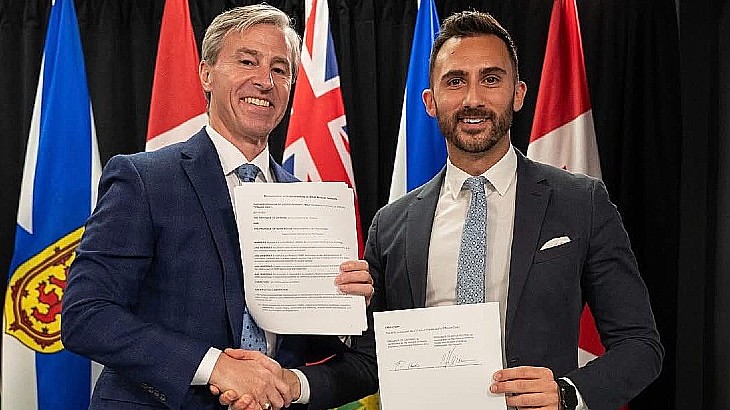
According to a Memorandum of Understanding (MoU) signed on 23 October by Nova Scotia Premier Tim Houston, who is also Minister of Energy, and Ontario Minister of Energy and Mines Stephen Lecce, the two provinces will: share knowledge and expertise on small modular reactor (SMR) development, including new technologies, regulatory frameworks, supply chain capacity, economic and financial modelling, nuclear waste management, and public and Indigenous engagement; raise public awareness about the economic and environmental benefits of nuclear energy from SMRs; collaborate with other provinces and territories to accelerate SMR adoption nationwide; and advocate to the federal government for stronger support and streamlined regulatory processes to enable the fast, cost-effective deployment of SMRs across Canada.
Nova Scotia has said SMR technology will not be established in the province "soon", but a statement from Ontario's Ministry of Energy and Mines said Nova Scotia’s involvement marks a "pivotal moment" for Atlantic Canada’s energy strategy.
Nova Scotia is "open to exploring the full range of clean energy options" that can help it meet its future energy needs and build grid resilience, Houston said: "We have an opportunity to learn from Ontario's experience deploying nuclear technology and I see great value in this partnership to inform system planning and best practices for Nova Scotia."
“The world is watching Ontario as we lead the largest expansion of nuclear energy on the continent and build the G7’s first small modular reactor,” said Lecce. “Through this important clean energy partnership with Nova Scotia, we are helping to advance small modular reactor technology to create good-paying jobs across the country."
The construction of four SMRs at the Darlington New Nuclear Project in Ontario - for which the provincial government issued a Final Investment Decision in May - is expected to create up to 18,000 jobs in Canada and sustain some 3,700 jobs over 65 years when the units are in operation. The project is expected to add more than CAD38 billion (USD27.3 billion) to the Canadian GDP through the plant's lifetime. Earlier in October, the Canada Growth Fund Inc - a federal investment vehicle designed to attract private capital to build Canada's clean economy - committed to invest up to CAD2 billion in the project, with the Building Ontario Fund - a Crown agency with a mandate to catalyse investment in revenue-generating infrastructure projects across Ontario - to invest CAD1 billion in the project.
KAERI, Mizzou expand cooperation
_18492.jpg)
The agreement was signed on 27 October by Korea Atomic Energy Research Institute (KAERI) President Han Gyu Joo and University of Missouri (Mizzou) President Mun Choi at KAERI's headquarters in Daejeon, South Korea.
Through this agreement, KAERI and the University of Missouri have established a framework for joint research and personnel exchanges across six key areas, including technology development for nuclear reactors, instrumentation for advanced nuclear reactors, radioisotope applications, neutron beam utilisation, materials research, and advanced computing R&D. The two organisations plan to expand practical cooperation by leveraging their respective expertise, research reactor design and operation experience, and infrastructure.
"The agreement is expected to open interdisciplinary opportunities across Mizzou's 13 schools and colleges - and directly support the launch of the Energy Innovation Center, which will drive research into new energy solutions, including nuclear energy," the university said.
Hyuk Chae Koo, Korea's First Vice Minister of the Ministry of Science and ICT, emphasised that this agreement represents "a major turning point that elevates Korea-US nuclear research and development to a new, future-oriented phase". He added that he looks forward to both countries achieving "joint innovation in science and technology and the peaceful use of nuclear energy".
KAERI President Han Gyu Joo stated that the visit by the University of Missouri delegation "goes beyond a simple visiting exchange", describing it as "a foundation for sustainable technological cooperation based on the existing collaboration between two institutions". He added that KAERI will "continue to strengthen collaboration in the research reactor field and broaden the scope of Korea-US cooperation in nuclear R&D based on mutual trust."
Mizzou President Mun Choi praised KAERI as "an institution with world-class capabilities in research reactor design and research". He expressed excitement that "through the signing of this General Agreement, the two institutions will expand cooperation in future nuclear technologies that will benefit humankind not only in Korea and the United States but across the world."
In April this year, a consortium led by the KAERI was awarded a USD10 million contract by the University of Missouri for the design and licensing of its planned new research reactor. The Korea-US University of Missouri Research Reactor Consortium - comprising KAERI, Hyundai Engineering Company, Hyundai Engineering America and US-based engineering firm MPR Associates - has been contracted for the design studies phase to develop the 'roadmap' for the new reactor.
The university's existing MU Research Reactor (MURR) - originally constructed as a 5 MWt reactor which began operations in 1966 - is the highest-powered university research reactor in the USA and is currently the country's only producer of certain medical radioisotopes.
The new 20+ MW NextGen MURR research reactor will expand the current capabilities of MURR and address new innovative demands such as cancer treatment. The university said the new reactor and supporting infrastructure will be the largest capital investment in its history and will "position Missouri as a national hub for innovation, investment and manufacturing in nuclear health technologies". The conceptual design of the reactor is expected to be completed by the end of 2026. The total initiative is expected to take 8-10 years.
Second steam generator installed at Lianjiang 1
_22033.jpg)
Steam generators are heat exchangers which convert heat generated by the reactor core into steam, which is transported to the conventional island via the main steam pipeline. The steam generator drives the steam turbine, which then drives the generator to generate electricity.
The construction of the first two 1250 MWe CAP1000 reactors - the Chinese version of the Westinghouse AP1000 - at the Lianjiang site was approved by China's State Council in September 2022. Excavation works for the units began in the same month, with the pouring of first concrete for the foundation of unit 1 starting in September 2023 and that of unit 2 in April last year. Unit 1 is expected to be completed and put into operation in 2028.
The reactor pressure vessel was installed at Lianjiang unit 1 in February this year.
The installation of the second steam generator "completes the installation of key equipment, including the pressure vessel, steam generators, and pressuriser, for unit 1, laying a solid foundation for the completion of the primary circuit connection of the nuclear island reactor and the capping of the reactor building," Lianjiang Nuclear Power Company said.
Once all six CAP1000 units planned at the site are completed, the annual power generation will be about 70.2 TWh, which will reduce standard coal consumption by more than 20 million tonnes, and reduce carbon dioxide emissions by more than 52 million tonnes, sulphur dioxide by about 171,000 tonnes and nitrogen oxides by about 149,000 tonnes.
State Power Investment Corp says the Lianjiang plant will be the first nuclear power project in China to adopt seawater secondary circulation cooling technology as well as the first to use a super-large cooling tower.
TerraPower submits Natrium for UK regulatory assessment
_52761.jpg)
The Generic Design Assessment - or GDA - process allows UK regulators to assess the safety, security and environmental implications of new reactor designs, separately from applications to build them at specific sites. The three-step process - which is voluntary - is carried out by the UK's regulators: the Office for Nuclear Regulation (ONR), the Environment Agency (EA) and Natural Resources Wales (NRW). Successful completion of the process culminates in the issue of a Design Acceptance Confirmation from the ONR and a Statement of Design Acceptability from the EA.
TerraPower formally notified UK regulators of its plans to begin the GDA approval process for its Natrium sodium-cooled fast reactor in May, and in September, it announced plans to evaluate potential UK sites for the Natrium reactor in partnership with KBR Inc.
Submission of the Natrium technology into the GDA process is a substantial step towards bringing the reactor and energy storage system to the UK, TerraPower President and CEO Chris Levesque said. "TerraPower is committed to delivering Natrium units across the globe, and our industry-leading regulatory team is setting the standard on how to license and deploy advanced nuclear technologies. We look forward to working with the UK government as we work through the review process," he added.
The first-of-a-kind Natrium sodium-cooled fast reactor plant is to be built in the USA at Kemmerer, Wyoming. TerraPower submitted an application to the US regulator in March 2024 for a construction permit for Kemmerer Unit 1. The US Nuclear Regulatory Commission recently completed its Environmental Impact Statement for the project and recommended that a construction permit be issued. Construction of the non-nuclear portions of the site are already underway.
The UK's GDA process will build on the company's experience and efforts in the USA, and will allow for TerraPower to establish deployment timelines for Natrium sites in the country, the company said.
In September, UK and US nuclear regulators announced a new initiative to streamline regulation and accelerate the deployment of advanced nuclear reactors across UK and US markets. The Atlantic Partnership for Advanced Nuclear Energy includes commitments from the regulators to significantly accelerate timeframes for decisions, by working much closer together on specific technologies where timeframes align.
UKAEA opens tritium fuel cycle facility training simulator
_27746.jpg)
Tritium recovery and re-use will play a fundamental role in the supply and generation of the fuel in future fusion power plants and will be crucial in making the technology increasingly efficient.
In March this year, the UK Atomic Energy Authority (UKAEA) and Italian multinational energy company Eni SpA entered into a collaboration agreement to jointly conduct research and development activities in the field of fusion energy. The collaboration primarily starts with the construction of the world's largest and most advanced tritium fuel cycle facility. The UKAEA-Eni H3AT Tritium Loop Facility, located at its Culham Campus in Oxfordshire, England, will be completed in 2028. It is designed to serve as a world-class facility providing industry and academia with the opportunity to study how to process, store and recycle tritium.
The H3AT facilities will comprise: advanced tritium infrastructure, to feed, recover, store and recycle tritium; a flexible suite of enclosures designed to enable a wide variety of experimental work, including pure tritium science, process development, component testing and waste detritiation; computational simulations and model validation; training facilities; and materials detritiation processes and facilities. H3AT will include a prototype-scale process plant and experimental platform, which is a scaled version of the design for the International Thermonuclear Experimental Reactor.
International industrial services provider Bilfinger was appointed by UKAEA as a Tier-One contractor and created a virtual control room for its tritium fuel cycle facility. In addition to providing the control system, as a Tier One contractor Bilfinger UK facilitated and co-ordinated the sub-contracting process, including to Schneider Electric, AVEVA and Siemens.

(Image: UKAEA)
This new virtual control room allows staff at the facility to undergo computer-based simulated training exercises. This enables engineers to train for a range of situations that they wouldn't be able to practice in the real world, which in turn provides UKAEA the ability to build a digital library of training scenarios. The digital system also allows UKAEA to simulate potential changes to the plant's operating parameters and the possible knock-on effects, allowing it to optimise processes. Furthermore, alongside the ability to demonstrate H3AT's capabilities to visiting stakeholders, the virtual control room could be made available in the future for third parties to test their own fuel cycle management systems.
"By creating this digital control room with the support of Bilfinger, we're increasing technical capability and supporting industry to deliver the mechanisms that will serve fusion in the future," said Stephen Wheeler, Executive Director for Fusion Technology and Tritium Fuel Cycle at UKAEA. "The development provides an unprecedented opportunity to train the next generation of fusion engineers through cutting-edge virtual simulation technology. Using digital technology to train operators is business-as-usual across several divisions at UKAEA, so it is really pleasing that we are able to employ the same principles within the UKAEA-Eni H3AT Tritium Loop Facility. We are also delighted to have been able to support a broad supply chain through this investment."
Darren Clement, Vice President EAP, Bilfinger Engineering and Maintenance UK, added: "The exciting research at Culham has the potential to dramatically change the world's future energy mix - realising the potential for safe, clean and virtually limitless energy. This virtual control room gives UKAEA the ability to further improve its processes while also ensuring staff are able to learn the important skills needed to help make sure operations run smoothly and safely. We've supported the nuclear industry for 60 years, supporting pioneers and major operators as they safely deliver clean energy in abundance."
The UKAEA carries out fusion energy research on behalf of the UK government, overseeing the country's fusion programme, including the MAST Upgrade (Mega Amp Spherical Tokamak) experiment as well as hosting the recently closed Joint European Torus (JET) at Culham, which operated for scientists from around Europe. It is also developing its own fusion power plant design with plans to build a prototype known as STEP (Spherical Tokamak for Energy Production) at West Burton in Nottinghamshire, which is due to begin operating by 2040.
BWXT to design steam generators for Rolls-Royce SMR
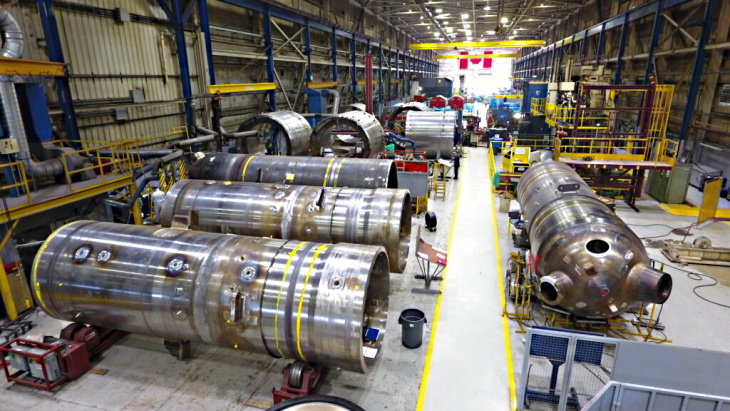
Under the detailed design contract, BWX Technologies (BWXT) will design the nuclear steam generators to be used in the Rolls-Royce SMR, a 470 MWe design based on a small pressurised water reactor that will provide consistent baseload generation for at least 60 years. 90% of the small modular reactor (SMR) - measuring about 16 metres by 4 metres - will be built in factory conditions, limiting on-site activity primarily to assembly of pre-fabricated, pre-tested, modules which significantly reduces project risk and has the potential to drastically shorten build schedules. Each reactor features three steam generators.
BWXT subsidiary BWXT Canada Ltd, based in Ontario, has been producing high-quality steam generators for the nuclear energy industry for more than 60 years and has supplied more than 315 steam generators to plants around the world.
Key elements of the MoU are Rolls-Royce SMR's readiness to procure steam generators for multiple reactor units from BWXT and the development of a localisation plan for future manufacturing work and other activities, if necessary, to support the Rolls-Royce SMR deployment in the global market.
"The agreement with BWXT for the design of the nuclear steam generators - reinforced by an MoU to support the first units in a global fleet of Rolls-Royce SMRs - is another major stride forward for our organisation," said Ruth Todd, Rolls-Royce SMR's Operations and Supply Chain Director. "Sourcing these critical components from world-leading suppliers is part of our 'designed for delivery' approach - combining modularisation and proven nuclear technology - significantly reducing cost, construction time and removing project risk. This is undoubtedly an important milestone, and there remain a huge range of opportunities for the supply chain to become involved and contribute to this transformational programme."
John MacQuarrie, president of BWXT Commercial Operations, added: "This agreement is a strong example of how BWXT is positioned to enable nuclear reactor developers around the world to meet the growing demand for clean, reliable energy. We look forward to further developing this collaboration with the team at Rolls-Royce SMR and continuing to build out this robust nuclear manufacturing chain."
Rolls-Royce SMR noted it is "the only company with multiple SMR commitments in Europe". In June this year Rolls-Royce SMR was selected as the UK government's preferred technology for the country's first SMR project with the goal of signing contracts later this year and forming a development company. Great British Energy - Nuclear, which ran the selection, will also aim to allocate a site later this year and connect projects to the grid in the mid-2030s. A final investment decision is expected to be taken in 2029. The Czech Republic selected Rolls-Royce SMR as its partner for up to 3 GW of new nuclear capacity last year and Czech utility CEZ has taken a 20% shareholding in the UK-based company.

No comments:
Post a Comment