OPG opens outreach hub at proposed plant site
The new Port Hope Nuclear Discovery Centre will give visitors the opportunity to learn about nuclear power and energy demand, as well as Ontario Power Generation's proposed Wesleyville nuclear power project.
_98657.jpg)
In January, the Ontario government formally asked Ontario Power Generation (OPG) to explore opportunities for new nuclear energy generation at the Wesleyville site, near Port Hope, following expressions of interest from the Municipality of Port Hope and the Williams Treaties First Nations.
The Discovery Centre, described by OPG as a new hub for learning, exploration, and community engagement related to potential new nuclear generation at the Wesleyville site, will serve as a venue for community members and Indigenous Nations to access up-to-date information, participate in activities, and share their feedback, the company said.
At an opening ceremony held on 10 October, Ontario Minister of Energy and Mines Stephen Lecce described the centre as a "significant step forward" for Ontario's clean energy future. "This nation-building project represents our sense of ambition and plan for self-reliance by creating 10,500 jobs and adding CAD235 billion to the Canadian economy. This project and new Centre will be the frontline for learning, jobs, and economic growth as we lead the largest nuclear expansion on the continent," he said.
New nuclear capacity - both small modular reactors and large-capacity plants - is a key part of the Energy for Generations strategy launched by Lecce in June, which aims to ensure Ontario - which already gets more than half of its electricity from nuclear plants - has the affordable, secure, reliable and clean energy it needs. The province is supporting the development and deployment of small modular reactor units at OPG's Darlington site, and pre-development work has already begun to site the first large-scale nuclear build in the province since 1993 at the existing Bruce nuclear site. This is in addition to the ongoing refurbishments of Ontario's existing nuclear power plants, extending their operating periods by a further 30-35 years each.
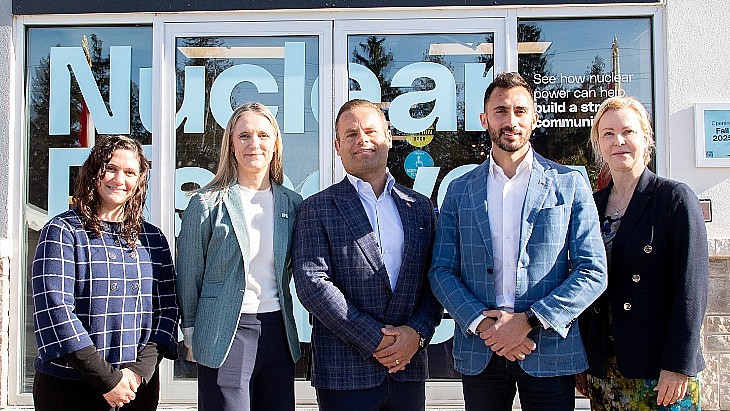
Lauritsen (second from left) and Lecce (second from right) pictured at the opening of the new centre (Image: Stephen Lecce)
The 1,300 acres (more than 5 square kilometres) Wesleyville site covers is located near existing transmission, road, and railway infrastructure, and is already zoned for new electricity generation. Early assessments by OPG have suggested the site could host up to 10,000 MW of new nuclear generation - which the company says would make it the largest nuclear generating station in the world. The site has been maintained by OPG for more than 50 years, specifically for the purpose of hosting new electricity generation.
According to information from OPG, Wesleyville was prioritised for site work over two other potential locations at Lambton and Nanticoke because the First Nations and the municipality have expressed interest in exploring nuclear generation development there, although discussions with the two other communities are still continuing.
Several years of work by OPG, in collaboration with the host community and Indigenous Nations, will be needed before it can be determined whether the Wesleyville site can proceed to support new power generation. Regulatory and licensing actions would then need to be completed before site preparations could begin. According to OPG, it could take around 15 years before the first generating unit is connected to the grid: a potential development roadmap shared by the company envisages units entering service in the early to mid 2040s.
"OPG is committed to building strong, collaborative partnerships with both the local community and the Michi Saagiig First Nations," said Kim Lauritsen, SVP Enterprise Strategy & Growth. "The Nuclear Discovery Centre will act as a welcoming space for information-sharing, meaningful participation, and open dialogue that guides the project's progress."
Contracts awarded for Sellafield infrastructure work
_65986.jpg)
The three companies will be part of a long-term arrangement called the Infrastructure Delivery Partnership (IDP), which is a key element of Sellafield Ltd's Overarching Acquisition Strategy and replaces the existing Infrastructure Strategic Alliance. The IDP will deliver projects and tasks to support essential services at Sellafield like electricity distribution, water, road and rail networks, bridges, foundations and security installations.
The contracts will be for an initial nine years with an option for a further six years, through to 2040. The work is split into three lots: electrical distribution partner; utilities partner; and civils partner. Under the contracts, the companies will complete detailed design plus all procurement, installation, construction, commissioning, and handover activities that form part of project delivery. The companies will also develop a joint sustainability plan to ensure a joined-up approach which is aligned to local priorities and delivers maximum impact and return on investment.
As the Electrical Distribution Partner, Morgan Sindall Infrastructure will lead on maintaining and upgrading the Sellafield site's electrical network. It will be supported in this by its design partners Baker Hicks and GHD.
Costain has been confirmed as Utilities Delivery Partner, worth up to GBP1 billion to the company. Costain’s responsibilities will involve refurbishing and replacing a variety of on-site and off-site utility distribution systems and services, including steam, water supply, water treatment, compressed gas and other essential utilities serving Sellafield.
HOCHTIEF (UK) Construction will deliver a major nuclear and civil works framework contract worth up to GBP595 million as part of the IDP. The contract involves design, engineering, and delivery of civil infrastructure works in support of nuclear operations and decommissioning in collaboration with Sellafield and its partners.
The Sellafield site - which houses more than 1000 buildings - is the largest nuclear complex in Western Europe. Sellafield's nuclear facilities include those connected with the Magnox reprocessing programme, the Sellafield mixed-oxide fuel plant, the Thermal Oxide Reprocessing Plant, and nuclear waste treatment plants. It is also home to redundant facilities from defence work in the 1950s, which included making plutonium for nuclear weapons.
"Our job at Sellafield is to create a clean and safe environment for future generations," said James Riddick, Sellafield Ltd chief supply chain officer. "That means safely, securely, and cost-effectively dealing with the legacy of historic operations on our site. To deliver this we need robust and reliable infrastructure to support our nuclear decommissioning and waste management activities. IDP is a long-term strategic partnership designed to provide that support while unlocking investment and opportunities for our local community and delivering sustainable value for money to the taxpayer."
Costain CEO Alex Vaughan added: "This new contract award with Sellafield, with whom we have been working with since 2005, is testament to our strategy of developing long-term relationships with tier 1 customers, building strong and collaborative partnerships, broadening our service offering, and maintaining consistency and continuity of workflows. This long-term award further demonstrates our integral position in the UK's civil nuclear energy market. The government is clear that the safe and responsible decommissioning of the UK's nuclear legacy is a critical part of creating a sustainable future and delivering local and national economic prosperity. As one of Sellafield's trusted partners we will deliver safe, high-quality utilities upgrades in a complex working environment."
"We have been delivering in West Cumbria for over 15 years, and we are delighted to build on this further with the award of the Infrastructure Delivery Partnership," said Morgan Sindall Infrastructure Managing Director Simon Smith. "This long-term programme is not only nationally significant for Sellafield and its decommissioning programme, but we know first-hand the benefits to local communities and the region from an award of this nature. This award reflects the brilliant work our teams have delivered and continue to deliver."
Juan Santamaría Cases, CEO of HOCHTIEF said: "HOCHTIEF has an unbroken legacy in the nuclear sector since the 1950s and is a trusted partner in engineering and construction for some of the world's most critical nuclear programmes. Together with Sellafield and its delivery partners, we have secured this strategic, long-term partnership. The award builds on HOCHTIEF's expanding portfolio of long-term delivery contracts with globally significant clients across the nuclear and infrastructure sectors."
Romania’s Feldioara to deliver uranium dioxide to Argentina
_25129.jpg)
Cosmin Ghita, General Manager of Nuclearelectrica, said: "The fact that we are delivering nuclear raw materials for the first time to another country that owns and operates pressurised heavy water reactors is a source of pride and achievement for Nuclearelectrica and its subsidiary, FPCU Feldioara, but also for the development of the Romanian fuel cycle, given that Nuclearelectrica took over the processing assets in December 2022, operationalised Feldioara in 2023 and continues to modernise. Such an agreement is a confirmation of the quality of the raw material processed at Feldioara."
Gelu Agafiel Maracineanu, General Manager of FPCU Feldioara, said that as well as supplying the raw material needed to manufacture fuel assemblies at Pitesti for units 1 and 2 at Cernavoda Nuclear Power plant, "we have set out to develop, expand our supply network and offer the nuclear fuel cycle in Romania a new dimension: the international one".
Background
In 2021 Romania's competition commission cleared Nuclearelectrica's purchase of the uranium processing line assets of Compania Nationala a Uraniului (CNU) at Feldioara - a state company that manages Romania's uranium resources and reserves, historically mining uranium at Crucea-Botusana and refining it at Feldioara before supplying it to the Pitesti facility where it was used in the manufacture of fuel bundles for Nuclearelectrica's CANDU reactors at the Cernavoda power plant.
Nuclearelectrica said that its aim was to "preserve and develop the integrated Romanian nuclear fuel cycle, the integrated production capacities … ensuring the production of fuel assemblies and the optimal operation of FCN Pitești and CNE Cernavodă, at an advantageous transaction cost".
It says that two years after work undertaken to become operational "Nuclearelectrica, through its subsidiary FPCU Feldioara, will deliver uranium dioxide internationally, a variable of development and diversification that will add value and financial benefits".
Cernavoda is the only nuclear power plant in Romania and consists of two 650 MWe Candu reactors. Unit 1 went into commercial operation in 1996 and unit 2 in 2007. Candu units are pressurised heavy water reactors designed to operate for 30 years, with a further 30 years available subject to refurbishment. Argentina has three operable nuclear power reactors, all pressurised
Fuel loading under way at second Zhangzhou unit
(1)_18573.jpg)
China's Ministry of Ecology and Environment issued an operating licence for Zhangzhou Nuclear Power Unit 2 on 11 October. Dong Baotong, Vice Minister of Ecology and Environment and Director of the National Nuclear Safety Administration, issued a licence to Zhangzhou Energy, and Zhang Kai, member of the Party Group and Deputy General Manager of China National Nuclear Corporation (CNNC), attended the event. At 16:13 on the same day, workers began to load the first reactor nuclear fuel into Zhangzhou 2.
CNNC said the milestone marked "that the unit has entered the stage of commissioning the main system with nuclear power, laying a solid foundation for the subsequent unit criticality and grid-connected power generation". It noted the unit was scheduled to be put into operation in the fourth quarter of 2025.
China's Ministry of Ecology and Environment issued construction licences for Zhangzhou units 1 and 2 on 9 October 2019 to CNNC-Guodian Zhangzhou Energy Company, the owner of the Zhangzhou nuclear power project, which was created by CNNC (51%) and China Guodian Corporation (49%) in 2011. Construction of unit 1 began one week after the issuance of the construction licence, with that of unit 2 starting in September 2020.
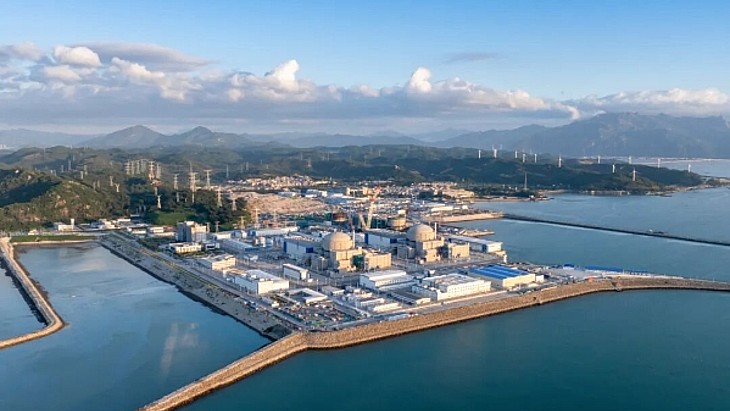
Zhangzhou units 1 and 2 (Image: CNNC)
In September 2022, China's State Council approved the construction of two further Hualong One units as Phase II of the Zhangzhou plant. First concrete for the nuclear island of unit 3 was poured in February last year, with that for unit 4 following in September.
Six Hualong One units are planned for the Zhangzhou site, in China's Fujian province.heavy water reactors, including a CANDU unit at Embalse.
South Korea’s embrace of SMRs as a pillar of nuclear policy

South Korea’s nuclear energy strategy is undergoing a transformative shift, with small modular reactors (SMRs) at the forefront. Spearheaded by Korea Hydro & Nuclear Power (KHNP), these compact reactors are increasingly being seen as central to the nation's energy policy, offering flexibility, scalability, and ultimately a pathway to carbon neutrality.
KHNP’s SMR vision
KHNP's commitment to SMRs is exemplified by the development of the SMART100 (System-integrated Modular Advanced Reactor 100), which received standard design approval as was reported by World Nuclear News in September 2024, from the Nuclear Safety and Security Commission. This advanced version of the original SMART design is a 330 MWt pressurised water reactor capable of generating up to 100 MWe and is designed for both electricity generation and thermal applications such as seawater desalination.
The SMART100's design integrates advanced safety features and modular construction techniques, enabling rapid deployment and reduced capital costs – key in aiding many of the multi-island nations across Asia where a number of hitherto nuclear free nations are known to be considering the future deployment of SMRs.
The i-SMR meanwhile, another KHNP initiative, is tailored to replace ageing coal-fired power plants, aligning with South Korea's carbon neutrality goals. It is designed to be economically competitive with even the largest of nuclear power plants while offering operational flexibility. Essentially a compact nuclear power plant designed to generate up to 300 MW of electricity per unit, unlike traditional large-scale reactors, SMRs are built using modular, factory-fabricated components, allowing for much faster construction, lower upfront costs, and a greater degree of flexibility in deployment. The i-SMR's modular design - with the ‘i’ standing for intelligent – also allows for incremental deployment, making it adaptable to varying energy demands and facilitating integration with renewable energy sources, KHNP says.
Domestic policy alignment
In 2022, the South Korean government unveiled a new energy policy aiming to maintain nuclear energy's share in the national energy mix at a minimum of 30% by 2030. This policy, subsequent political shifts in South Korea notwithstanding, also set the ambitious goal of exporting 10 nuclear power plants by 2030, underscoring the strategic importance of nuclear energy in national policy. KHNP's SMR initiatives to date have seemingly fallen in line with this policy, positioning the company as a key player in both domestic energy security and international nuclear energy markets, NUCNET has said - and as was evident at the late-August Korea Energy Show in Busan, South Korea with KHNP establishing a commanding presence in the form of one of the most prominent booths at the event.
Scalability
One of the most compelling features of SMRs is their flexibility. Unlike traditional large-scale reactors, SMRs – as the i-SMR demonstrates - can be deployed incrementally, allowing for a modular approach to energy generation. This scalability means that power plants can be expanded as demand grows, reducing the risk of overcapacity and enabling more precise alignment with energy needs.
Moreover, SMRs can operate in tandem with renewable energy sources, providing a more stable and reliable power supply that complements the intermittent nature of solar at nighttime, and wind energy whenever a region is becalmed. This synergy is crucial for successfully achieving carbon neutrality and enhancing energy resilience.
KHNP's SMR expertise is thus gaining international recognition, and earlier in 2025, KHNP and Oklo, a US-based nuclear technology company, announced plans to collaborate on the standard design development and licensing strategy for Oklo's planned Aurora powerhouse. This partnership aims to advance the deployment of advanced nuclear technologies in the United States at a time significant moves in nuclear power proliferation are being seen.
KHNP is also exploring SMR options with Thailand's EGAT, focusing at present, sources indicate, on technical information exchange and personnel training to one day facilitate the introduction of SMRs in Thailand; one of multiple Southeast Asian nations looking to move into SMR use in the years ahead.
These collaborations not only bolster South Korea's position in the global nuclear energy tech market but also contribute to the international proliferation of safe and sustainable nuclear technologies with Korea seen as a figurehead in that regard.
Other domestic applications
KHNP's vision, however, extends beyond traditional power generation. The company is already understood to be developing the Smart Net Zero City (SSNC) concept according to its own site, in the process integrating SMRs with renewable energy sources to create self-sustaining, carbon-neutral urban environments. The SSNC model when up and running aims to reduce energy production costs by up to 30% compared to conventional cities, offering a blueprint for future urban development in line with sustainability goals.
Challenges ahead
Despite the promising deals made and concepts in place, the deployment of SMRs still faces a number of challenges. Regulatory hurdles in some areas, public acceptance, and the need for skilled workforce development are critical factors that could – and will – in the end influence the pace of SMR adoption. As such, addressing these challenges requires transparent and effective communication, more than adequate safety protocols, and comprehensive training programs to ensure the successful integration of SMRs into societies across Korea and Asia.
To this end, KHNP's focus on SMRs represents an alignment of technological innovation with national energy policy objectives that can be put in place anywhere across Asia, and by embracing SMRs in South Korea, the nation is not only enhancing its own domestic energy security but is also positioning itself as a leader in the regional and global nuclear energy market to allow others to follow suit.

No comments:
Post a Comment