Beware the Big Tech Oligarchs:
Their AI-Crypto Bubble Is Bound to Burst
And when the artificial intelligence and cryptocurrency bubbles do burst, we’ll likely see what damage the wrecking ball of Trump and his fellow oligarchs have done.
Robert Reich
October 14, 2025
RAW STORY
A street sign for Wall Street is seen in the financial district in New York.
REUTERS/Brendan McDermid
What happens when huge amounts of money pour into poorly understood and unregulated industries that promise spectacular profits for a few winners?
At best, some investors lose their shirts while the lucky ones make fortunes. At worst, the bubble bursts and takes everyone down with it — not just its investors, but the entire economy.
My purpose today isn’t to worry you but to give you some economic information that may help you. I’m deeply concerned that two opaque industries are creating giant bubbles on the verge of bursting.
One is AI.
AI is worrisome enough as is — its insatiable thirst for energy and water, its capacities to override the wishes of human beings, its potential to destroy the planet.
My immediate concern is that AI is becoming a financial bubble whose bursting will harm lots of innocent people.
Anyone remember the dot-com bubble of the late 1990s? The housing bubble of 2006? The tulip-mania bubble of the 1630s? The South Sea bubble of 1720?
They all followed a well-worn pattern.
An asset generates excitement among investors because its value starts rising — mainly because other investors are also becoming excited and investing in it. Investors borrow piles of money to get in on the action.
The bubble bursts when it becomes evident that way too much has been invested relative to the potential for real-world profits. Smart investors cash out first. Everyone else is left with worthless pieces of paper. Borrowers go broke. Those insuring the borrowers disappear. If bad enough, governments have to bail out the biggest borrowers.
The Bank of England recently warned that AI stock market valuations appeared “stretched” — risking a “sudden correction” in global markets. Translated: The bubble will burst.
AI has many of the characteristics of a bubble.
Market valuations of its major players — OpenAI, Anthropic, Nvidia, Microsoft, Google, Oracle, Amazon, Meta, and Elon Musk’s xAI — have soared. Most of this is on the basis of hope and hype.
Shares of stock surrounding AI and its data centers account for an estimated 75 percent of the returns to America’s biggest corporations, 80 percent of earnings growth, and 90 percent of the growth in capital expenditures.
Yet, according to an MIT report, 95 percent of companies that try AI aren’t making any money from it.
Taxpayers are footing some of this bill. Thirty-seven states have passed legislation granting hundreds of millions of dollars of tax exemptions for the building of data centers.
Meanwhile, factory construction and manufacturing investments in the rest of the American economy have slowed. Manufacturing has lost 38,000 jobs since the start of the year, according to the Bureau of Labor Statistics.
Amazon’s Jeff Bezos recently admitted that AI is likely a bubble but that some investments will eventually pay off.
“When people get very excited, as they are today, about artificial intelligence, for example ... every experiment gets funded, every company gets funded. The good ideas and the bad ideas. And investors have a hard time in the middle of this excitement, distinguishing between the good ideas and bad ideas.”
The flood of money into AI has made America’s billionaire oligarchs far richer.
By Forbes’ count, 20 of the most notable billionaires tied to the explosive growth in AI infrastructure have already added more than $450 billion to their fortunes since January 1.
Oracle cofounder and chief technology officer Larry Ellison’s wealth has increased $140 billion in the past year, as Oracle’s shares jumped 73 percent (compared to 15 percent for the entire stock market). This was due to projected revenue from Oracle’s cloud infrastructure to power AI.
This has made Larry Ellison the second-richest person in America (just behind Elon Musk). The Ellison family is pouring some of this wealth into a media empire aligned with Trump.
The wealth of Nvidia cofounder and CEO Jensen Huang has increased $47 billion this year as shares of his chipmaking giant have risen 40 percent.
Wait for the burst.
Oracle is carrying more debt than ever, issuing another $18 billion of debt in September. The S&P’s credit rating bureau downgraded its outlook for the company to “negative” in July, citing concerns about free cash flow.
Other major players are also deep into debt.
Frankly, I don’t care which giant corporations or ultra-wealthy investors strike it big and which lose their shirts.
I worry about the economy as a whole, about working families who could lose their jobs and savings. The losses when the AI bubble bursts could ricochet across America.
Trump has put David Sacks, co-founder of an AI company and, of course, a fierce Trump loyalist, in charge of AI and cryptocurrencies. So far, Sacks has killed any restrictions and regulations that might stand in the way of either.
The Trump regime has been opening the doors for trillions of dollars in pension funds to be invested in crypto, AI, venture capital, and private equity. Even 401(k) plans have joined the flood.
Crypto is my second bubble concern. It’s a classic Ponzi scheme. It’s growing because investors believe other investors will keep buying it. And like AI, crypto’s meteoric growth has also been powered largely by the ultra-wealthy. (Trump and his family are said to have made $5 billion off it so far.)
Also like AI, crypto uses up massive amounts of energy but doesn’t actually create anything. Gertrude Stein’s famed description of Oakland, California, seems apt: There’s no there there.
Consider the online brokerage firm Robinhood, whose stock rose 284 percent in the year through September. What fueled this extraordinary increase in value? Trading in cryptocurrency and in betting on sports games.
Last month, Robinhood joined the S&P 500 — the index of America’s biggest corporations. As Jeff Sommer noted in The New York Times, had Robinhood been a member of the S&P 500 for the entire year, its meteoric rise would have been enough for it to lead the index.
Crypto tokens are even being sold as ways to get pieces of private firms like SpaceX and OpenAI. Watch your wallets.
When will the crypto bubble burst? Maybe it’s already started.
Friday’s cryptocurrency selloff — apparently triggered by Trump’s talk of a 100 percent tariff on China — wiped out more than $19 billion in crypto assets. Bitcoin dropped 12 percent, forcing liquidations that triggered more selling, pushing prices even lower. The token for World Liberty Financial, a crypto project backed by Trump and his sons, fell by more than 30 percent.
The sharp downturn exposed the huge amount of borrowing behind crypto’s nine-month rally, which began after the election of an administration seen as friendly to the industry.
The flood of money into these two opaque industries — AI and crypto — has propped up the U.S. stock market and, indirectly, the U.S. economy.
AI and crypto have created the illusion that all is well with the economy — even as Trump has taken a wrecking ball to it: raising tariffs everywhere, threatening China with a 100 percent tariff, sending federal troops into American cities, imprisoning or deporting thousands of immigrants, firing thousands of federal workers, and presiding over the closure of the U.S. government.
When the AI and crypto bubbles burst, we’ll likely see the damage Trump’s wrecking ball has done.
I fear millions of average Americans will feel the consequences — losing their savings and jobs.
Again, I’m not writing this to alarm you. You already have more than enough reason to be alarmed by what’s happening to America.
I want you to take reasonable precaution.
This isn’t an investment letter, but if you have savings, please make sure some are in low-risk assets such as money-market funds. As to your job, hold on.Robert Reich is a professor of public policy at Berkeley and former secretary of labor. His writings can be found at https://robertreich.substack.com/
What happens when huge amounts of money pour into poorly understood and unregulated industries that promise spectacular profits for a few winners?
At best, some investors lose their shirts while the lucky ones make fortunes. At worst, the bubble bursts and takes everyone down with it — not just its investors, but the entire economy.
My purpose today isn’t to worry you but to give you some economic information that may help you. I’m deeply concerned that two opaque industries are creating giant bubbles on the verge of bursting.
One is AI.
AI is worrisome enough as is — its insatiable thirst for energy and water, its capacities to override the wishes of human beings, its potential to destroy the planet.
My immediate concern is that AI is becoming a financial bubble whose bursting will harm lots of innocent people.
Anyone remember the dot-com bubble of the late 1990s? The housing bubble of 2006? The tulip-mania bubble of the 1630s? The South Sea bubble of 1720?
They all followed a well-worn pattern.
An asset generates excitement among investors because its value starts rising — mainly because other investors are also becoming excited and investing in it. Investors borrow piles of money to get in on the action.
The bubble bursts when it becomes evident that way too much has been invested relative to the potential for real-world profits. Smart investors cash out first. Everyone else is left with worthless pieces of paper. Borrowers go broke. Those insuring the borrowers disappear. If bad enough, governments have to bail out the biggest borrowers.
The Bank of England recently warned that AI stock market valuations appeared “stretched” — risking a “sudden correction” in global markets. Translated: The bubble will burst.
AI has many of the characteristics of a bubble.
Market valuations of its major players — OpenAI, Anthropic, Nvidia, Microsoft, Google, Oracle, Amazon, Meta, and Elon Musk’s xAI — have soared. Most of this is on the basis of hope and hype.
Shares of stock surrounding AI and its data centers account for an estimated 75 percent of the returns to America’s biggest corporations, 80 percent of earnings growth, and 90 percent of the growth in capital expenditures.
Yet, according to an MIT report, 95 percent of companies that try AI aren’t making any money from it.
Taxpayers are footing some of this bill. Thirty-seven states have passed legislation granting hundreds of millions of dollars of tax exemptions for the building of data centers.
Meanwhile, factory construction and manufacturing investments in the rest of the American economy have slowed. Manufacturing has lost 38,000 jobs since the start of the year, according to the Bureau of Labor Statistics.
Amazon’s Jeff Bezos recently admitted that AI is likely a bubble but that some investments will eventually pay off.
“When people get very excited, as they are today, about artificial intelligence, for example ... every experiment gets funded, every company gets funded. The good ideas and the bad ideas. And investors have a hard time in the middle of this excitement, distinguishing between the good ideas and bad ideas.”
The flood of money into AI has made America’s billionaire oligarchs far richer.
By Forbes’ count, 20 of the most notable billionaires tied to the explosive growth in AI infrastructure have already added more than $450 billion to their fortunes since January 1.
Oracle cofounder and chief technology officer Larry Ellison’s wealth has increased $140 billion in the past year, as Oracle’s shares jumped 73 percent (compared to 15 percent for the entire stock market). This was due to projected revenue from Oracle’s cloud infrastructure to power AI.
This has made Larry Ellison the second-richest person in America (just behind Elon Musk). The Ellison family is pouring some of this wealth into a media empire aligned with Trump.
The wealth of Nvidia cofounder and CEO Jensen Huang has increased $47 billion this year as shares of his chipmaking giant have risen 40 percent.
Wait for the burst.
Oracle is carrying more debt than ever, issuing another $18 billion of debt in September. The S&P’s credit rating bureau downgraded its outlook for the company to “negative” in July, citing concerns about free cash flow.
Other major players are also deep into debt.
Frankly, I don’t care which giant corporations or ultra-wealthy investors strike it big and which lose their shirts.
I worry about the economy as a whole, about working families who could lose their jobs and savings. The losses when the AI bubble bursts could ricochet across America.
Trump has put David Sacks, co-founder of an AI company and, of course, a fierce Trump loyalist, in charge of AI and cryptocurrencies. So far, Sacks has killed any restrictions and regulations that might stand in the way of either.
The Trump regime has been opening the doors for trillions of dollars in pension funds to be invested in crypto, AI, venture capital, and private equity. Even 401(k) plans have joined the flood.
Crypto is my second bubble concern. It’s a classic Ponzi scheme. It’s growing because investors believe other investors will keep buying it. And like AI, crypto’s meteoric growth has also been powered largely by the ultra-wealthy. (Trump and his family are said to have made $5 billion off it so far.)
Also like AI, crypto uses up massive amounts of energy but doesn’t actually create anything. Gertrude Stein’s famed description of Oakland, California, seems apt: There’s no there there.
Consider the online brokerage firm Robinhood, whose stock rose 284 percent in the year through September. What fueled this extraordinary increase in value? Trading in cryptocurrency and in betting on sports games.
Last month, Robinhood joined the S&P 500 — the index of America’s biggest corporations. As Jeff Sommer noted in The New York Times, had Robinhood been a member of the S&P 500 for the entire year, its meteoric rise would have been enough for it to lead the index.
Crypto tokens are even being sold as ways to get pieces of private firms like SpaceX and OpenAI. Watch your wallets.
When will the crypto bubble burst? Maybe it’s already started.
Friday’s cryptocurrency selloff — apparently triggered by Trump’s talk of a 100 percent tariff on China — wiped out more than $19 billion in crypto assets. Bitcoin dropped 12 percent, forcing liquidations that triggered more selling, pushing prices even lower. The token for World Liberty Financial, a crypto project backed by Trump and his sons, fell by more than 30 percent.
The sharp downturn exposed the huge amount of borrowing behind crypto’s nine-month rally, which began after the election of an administration seen as friendly to the industry.
The flood of money into these two opaque industries — AI and crypto — has propped up the U.S. stock market and, indirectly, the U.S. economy.
AI and crypto have created the illusion that all is well with the economy — even as Trump has taken a wrecking ball to it: raising tariffs everywhere, threatening China with a 100 percent tariff, sending federal troops into American cities, imprisoning or deporting thousands of immigrants, firing thousands of federal workers, and presiding over the closure of the U.S. government.
When the AI and crypto bubbles burst, we’ll likely see the damage Trump’s wrecking ball has done.
I fear millions of average Americans will feel the consequences — losing their savings and jobs.
Again, I’m not writing this to alarm you. You already have more than enough reason to be alarmed by what’s happening to America.
I want you to take reasonable precaution.
This isn’t an investment letter, but if you have savings, please make sure some are in low-risk assets such as money-market funds. As to your job, hold on.Robert Reich is a professor of public policy at Berkeley and former secretary of labor. His writings can be found at https://robertreich.substack.com/
Robert Reich's new memoir, Coming Up Short, can be found wherever you buy books. You can also support local bookstores nationally by ordering the book at bookshop.org
US Consumers Paying the Most for Tariffs: Wall Street Giant’s Report Exposes Trump Lies
The report from investment bank Goldman Sachs comes as President Donald Trump is piling up even more tariffs on imported goods.
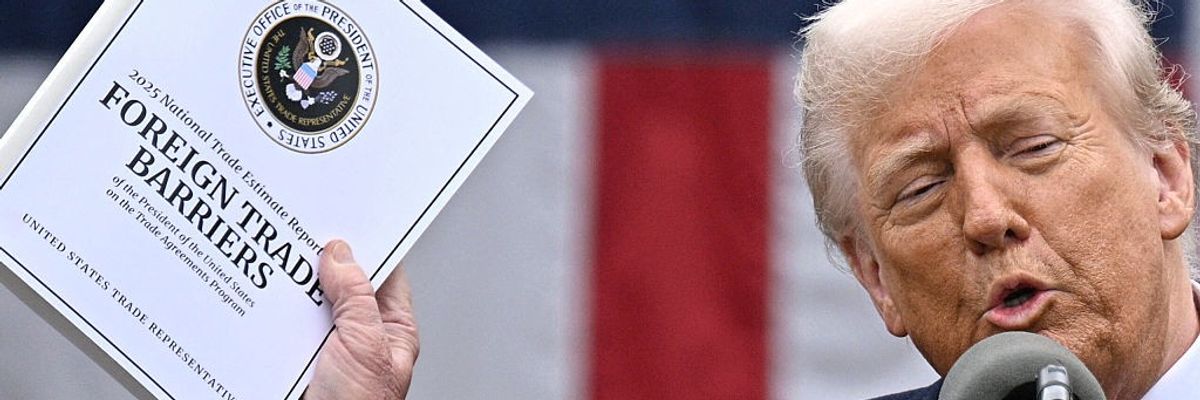
US President Donald Trump delivers remarks on reciprocal tariffs during an event in the Rose Garden entitled “Make America Wealthy Again” at the White House in Washington, DC, on April 2, 2025.
(Photo by Brendan Smialowski/AFP via Getty Images)
Brad Reed
Oct 14, 2025
COMMON DREAMS
New research from investment bank Goldman Sachs affirms, as progressive advocates and economists warned, that US consumers are bearing the brunt of President Donald Trump’s trade wars.
As reported by Bloomberg on Monday, economists at Goldman released an analysis this week estimating that US consumers are shouldering up to 55% of the costs stemming from Trump’s tariffs, even though the president has repeatedly made false claims that the tariffs on imports exclusively tax foreigners.
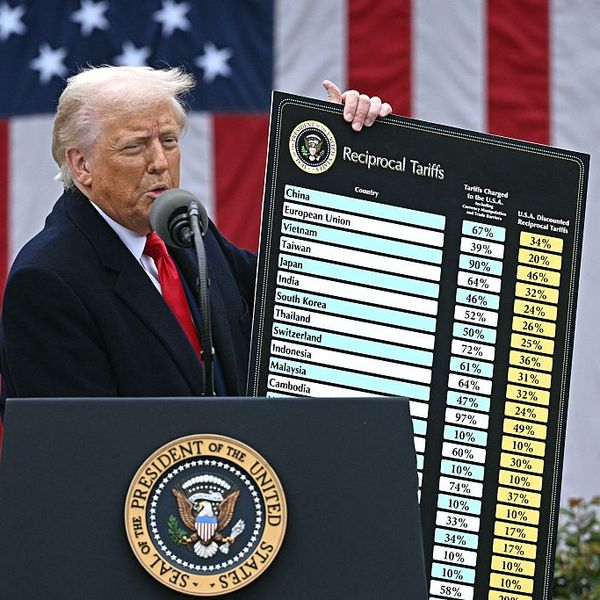
Trump Announces New 100% Tariff on China Over Rare Earth Minerals Restrictions
‘Business Continues to Be Severely Depressed’: New Reports Paint Dark Picture of Trump Economy
Goldman’s research also found that US businesses will pay 22% of the cost of the tariffs, while foreign exporters will pay just 18% of the cost. Additionally, Goldman economists estimate that Trump’s tariffs “have raised core personal consumption expenditure prices by 0.44% so far this year, and will push up the closely watched inflation reading to 3% by December,” according to Bloomberg.
Despite all evidence that US consumers are shouldering the costs of the tariffs, the Trump administration has continued to insist that they are exclusively being paid by foreign countries.
During a segment on NBC‘s “Meet the Press” last month, host Kristen Welker cited an earlier Goldman estimate that 86% of the president’s tariffs were being paid by US businesses and consumers, and then asked US Treasury Secretary Scott Bessent if he accepted that the tariffs were taxes on Americans.
“No, I don’t,” Bessent replied.
As Common Dreams reported in August, executives such as Walmart CEO Doug McMillon have explicitly told shareholders that while they are able to absorb the cost of tariffs, Trump’s policy would still “result in higher prices” for customers.
Goldman’s report comes as Trump is piling up even more tariffs on imported goods that will ultimately be paid by US consumers as companies raise prices.
According to The New York Times, tariffs on a wide range of products including lumber, furniture, and kitchen cabinets went into effect on Tuesday, and the Trump administration has also “started imposing fees on Chinese-owned ships docking in American ports.”
The administration has claimed that the tariffs on lumber are necessary for national security purposes, although some experts are scoffing at this rationale.
Scott Lincicome, vice president of general economics at libertarian think tank the Cato Institute, told the Times that the administration’s justification for the lumber tariffs are “absurd.”
“If war broke out tomorrow, there would be zero concern about American ’dependence’ on foreign lumber or furniture, and domestic sources would be quickly and easily acquired,” he said.

No comments:
Post a Comment