Trump touts Canada-U.S. ‘merger’ at White House, Carney leaves Washington without a deal

By Spencer Van Dyk
Updated: October 07, 2025

‘We want Canada to do great’: Trump says Canada-U.S. competing for same business

‘I want to be a great man, too’: Trump jokes on trade holdup with Carney

Trump says U.S. is the ‘hottest country in the world’, and ‘maybe Canada’

Watch in full: Carey and Trump take questions at the White House
Prime Minister Mark Carney and U.S. President Donald Trump have wrapped up a two-and-a-half-hour meeting at the White House, with the latter once again hinting at his threats to annex Canada.
It was the second high-stakes, in-person meeting at the Oval Office between Carney and Trump since May, though the two have been in frequent contact as they work to hash out a new economic and security deal.
Speaking to reporters following the meeting, Canada-U.S. Trade Minister Dominic LeBlanc did not offer up any tangible outcomes from the meeting, but categorized it as “successful,” “positive,” and “effective.”
Ahead of the meeting, however, Trump signalled he was optimistic there would be progress.
“I think they’re going to be very happy,” Trump told reporters ahead of the meeting, when asked whether Carney will be leaving Washington with a deal.
“They talk about competitiveness, he’s a very competitive person,” he added, referring to Carney. “And they talk about things that we don’t necessarily agree on, but I think they’re going to walk away very happy.”

Asked about the president’s comments, LeBlanc said the Canadian delegation is leaving Washington “very much with the sense” that the Trump administration is ready to “structure something” on steel and aluminum that “would be in the economic and security interests of both countries.”
“I’m sort of an optimistic guy,” LeBlanc said, when asked specifically about the timing of a deal. “I said at parliamentary committees last week that I remain optimistic, and I’m more optimistic today after those discussions at the White House than I was when we arrived in Washington yesterday.”
Joining Carney is a handful of cabinet ministers, including LeBlanc, Foreign Affairs Minister Anita Anand, Industry Minister Melanie Joly, and Natural Resources Minister Tim Hodgson.
Canada’s Ambassador to the U.S. Kirsten Hillman is also in the meeting.
Trump touts Canada-U.S. ‘merger’
“From the beginning, I’ve liked him, and we’ve had a good relationship,” Trump also said of Carney. “We have some natural conflict, but we will probably work that out. But we’ve had a very strong relationship.”
“We’re going to be talking about trade. We’re going to be talking about a lot of different things. We’ll certainly be talking about Gaza,” he also said.
Speaking to reporters in the Oval Office, Carney once again called Trump a “transformative president,” listing his accomplishments during his second term, during which Trump added: “and the merger of Canada and the United States.”
Trump’s comments about Canada becoming the 51st state have dominated the headlines for months, with the president often threatening to use “economic force” to accomplish the annexation.

Meeting comes amid protracted trade war
A source speaking on background told CTV News late last week that Canadian officials were “cautiously optimistic” there could be potential movement on steel or aluminum tariffs following Tuesday’s meeting.
When asked by reporters in the Oval Office on Tuesday on what it would take for the U.S. to reduce or withdraw tariffs on steel and aluminum, Trump said “We’re going to be talking about that with the prime minister.”
LeBlanc, however, when pressed by reporters about the absence of any relief on steel and aluminum tariffs, said he didn’t “have an expectation of a detailed deal today.”
“So, because some unnamed sources speculated, doesn’t change our state of mind when we got here,” he said. “We hope to make progress.”
“People understandably want to see the results, and believe me, so do we,” he also said. “And we’re going to continue that work, and we hope to have meetings, perhaps as soon as later this evening and tomorrow in that regard.”
Canada and the U.S. have been in an ongoing trade war since February, when Trump imposed sweeping tariffs on Canadian goods, claiming they were related to border security. Those were later scaled back to apply only to goods not covered by the Canada-U.S.-Mexico Agreement (CUSMA).

But, in the months since, the U.S. president has stacked additional sectoral tariffs on steel and aluminum, copper and autos.
Trump has also announced tariffs on lumber and medium- and heavy-duty trucks are on the way.
In late August, Carney announced Canada would be dropping many of its counter-tariffs by exempting goods covered by CUSMA.
In addition to the counter-tariff carveout, Canada has made other concessions, for example scrapping the controversial digital services tax to which Trump was vehemently opposed.
Canada has also made policy decisions in response to Trump’s concerns, namely by introducing a $1.3-billion border plan and naming a “fentanyl czar,” and by speeding up the date by which it’ll meet its defence-spending commitments to NATO.
“It’s a complicated agreement,” Trump told reporters alongside Carney, when asked why the two countries have failed to reach a new deal. “More complicated maybe than any other agreement we have on trade, because, you know, we have natural conflict. We also have mutual love.”
‘A nice man but he can be nasty’: Trump on Carney
Asked on Tuesday if Carney has done anything to make it easier or more difficult to reach a deal, Trump said “no.”
“I think he’s a great prime minister,” Trump said. “I mean, he could represent me.”
“He’s a nice man, but he can be nasty,” he added. “I think I can tell you this because I deal with lots of leaders all over the world: He is a world-class leader.”
When asked why he hasn’t yet made a deal with Canada if he believes Carney to be a “great man,” Trump said: “Because I want to be a great man, too.”

Poilievre, Ford call on Carney to come away with a deal
In a public letter addressed to Carney on Monday, Conservative Leader Pierre Poilievre called on the prime minister to “negotiate a win” in Washington.
He pointed to the missed mid-summer deadline to reach a new deal, and to the tariffs that are still in place as examples of Carney’s unmet promises.
“We only expect you to keep your promises,” Poilievre wrote. “If you only return with excuses, broken promises and photo ops, you will have failed our workers, our businesses and our country.”
In an interview with CNN on Tuesday, Ontario Premier Doug Ford said it’s a “shame” Trump has implemented such sweeping tariffs.
“What are the American population going to do? You rely on the aluminum coming from Canada to build military and aerospace and manufacturing,” he said. “You rely on steel as well coming from Canada. And 30 per cent of the lumber to build homes is coming from Canada.”
“The way to create more jobs is make a deal with Canada,” he added. “The way to reduce inflation is make a deal with Canada, and increase the economy is make a deal with Canada, your number one export country in the entire world.”
Speaking to reporters at Queen’s Park on Tuesday, Ford compared the protracted trade dispute and absence of a deal to “a kid going in the school yard and getting punched in the face every day.”
“It’s time to hit back if he can’t get a deal,” Ford said. “Maybe, maybe Prime Minister Carney knows something I don’t know. And if that’s the case, he should sit down with the premiers and explain that.”
Both countries have launched CUSMA consultations. The trade agreement was already set for review next year.
Spencer Van Dyk
Writer & Producer, Ottawa News Bureau, CTV News
Trump says there is 'natural conflict' with Canada as he hosts PM Mark Carney at the Oval Office
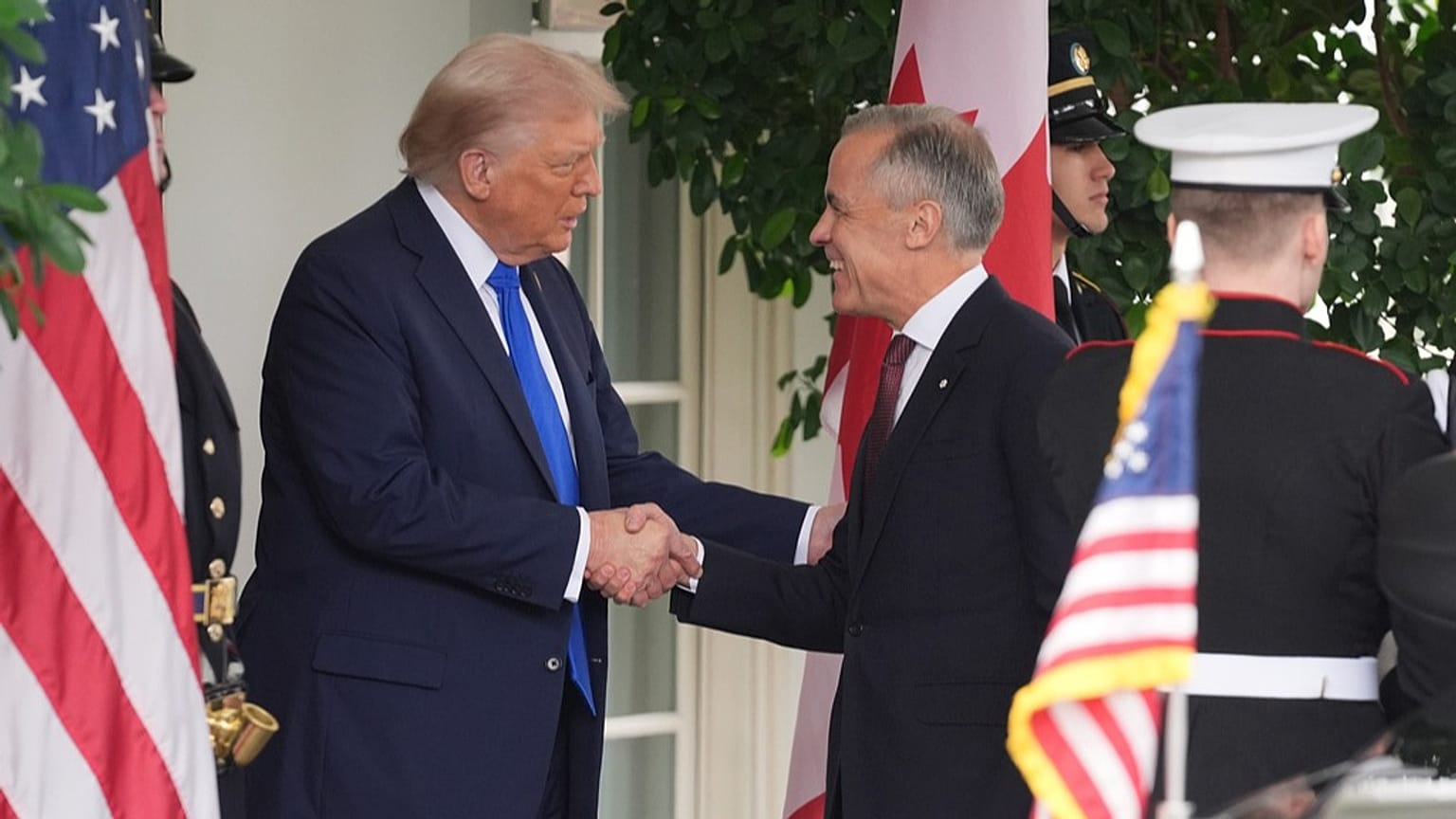
US President Donald Trump says his country has a “natural conflict” over the same business with Canada, making striking a trade deal between the two neighbours a “complicated situation”.
The comments came as he met with Canada’s Prime Minister Mark Carney at the Oval Office on Tuesday to discuss trade after Trump slapped one of the US’ closest trading partners with 35% tariffs on most of its goods.
While other countries, including the UK, the EU, South Korea and Japan were able to strike deals to decrease the tariffs imposed on them, Canada is not part of that list and still faces one of the higher rates imposed by the Trump administration.
Tariffs started after Trump accused Canada, under former Prime Minister Justin Trudeau, of enabling the flow of illegal immigrants and drugs, namely fentanyl, into the US through a lack of diligent policing.
Mexico was also victim to the same accusation, and it too was slapped by the Trump cabinet with a heavy tariff for its part in that.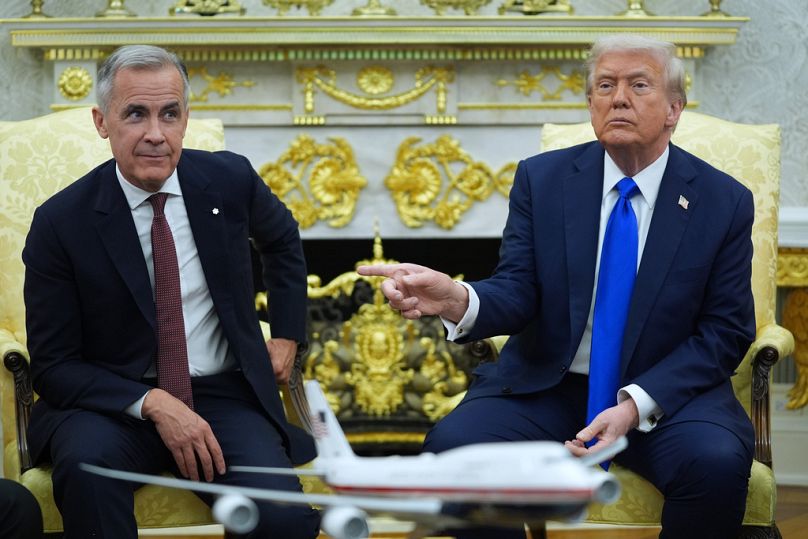
President Donald Trump and Canadian Prime Minister Mark Carney meet in the Oval Office of the White House, Tuesday, Oct. 7, 2025, in Washington Evan Vucci/Copyright 2025 The AP. All rights reserved
Carney’s second visit to the Oval Office since succeeding Trudeau in March came ahead of next year’s review of the United States-Mexico-Canada Agreement and as one of the world’s most durable and amicable alliances has been fractured by Trump’s trade war and annexation threats.
Trump said he was open to extending the free trade agreement with Mexico and Canada through a renegotiation or seeking “different deals.”
The agreement was enacted during Trump’s first term and it allows the majority of Canadian and Mexican goods to be shipped to the US without tariffs.
Trump has made it clear however since returning to office that he wants to reshape that relationship, and expressed mixed feelings over the process as long as he feels like he’s able to improve Washington’s position.
“We could renegotiate it, and that would be good, or we can just do different deals,” he said. “We’re allowed to do different deals if we want. We might make deals that are better for the individual countries.”
Carney entered the visit hoping to find some relief on sector-specific tariffs. Trump has some sector-specific tariffs on Canada – known as Section 232 tariffs – that are having an impact. There are 50% tariffs on steel and aluminium imports, for example.
There is fear in Canada over what will happen to the US-Mexico-Canada Agreement, which is critical to Canada’s economy. More than three-quarters of Canada’s exports go to the US.
Trump, who showed a fondness for Carney, something he didn't have towards his predecessor, noted there was a “natural conflict” between the two countries, a point to which the Canadian premier politely disagreed.
“We have natural conflict,” he said. “We also have mutual love.” Carney said he wouldn't use the word “conflict.”
“There are areas where we compete, and it’s in those areas where we have to come to an agreement that works. But there are more areas where we are stronger together, and that’s what we’re focused on,” stressed Carney.
This is a low point in US-Canada relations, a situation largely exacerbated by Trump’s hostility and repeated remarks expressing interest in “taking ownership” of his northern neighbour and making them the 51st US state.
The US president even made a joking reference to a “merger” between the two countries at the top of his remarks on Tuesday.
The comments have infuriated many Canadians, who have avoided travel to the US, as data from Canada’s national statistical office indicates a 23% decline in Canadians dropping south of the border in the first seven months of this year, compared to last year.
Trump dismissed the issue, saying that Canadians still “love” the US, and asserting that relations will be “better than they ever were” once the two countries reach a trade deal.
Market Outlook: Carney’s Washington visit
signals early test for Canada-U.S. trade
relations
By BNN Bloomberg
Published: October 07, 2025
Diamond Isinger, former special advisor on Canada-U.S. relations in the Prime Minister's office, joins BNN Bloomberg to discuss importance of meeting for CA-US.
Prime Minister Mark Carney’s first official visit to Washington marks an early test of his government’s approach to managing Canada-U.S. trade tensions. With CUSMA negotiations expected to restart in the coming year, both sides are seeking common ground on tariffs, defence and economic co-operation.
BNN Bloomberg spoke with Diamond Isinger, former special advisor on Canada-U.S. relations in the Prime Minister’s Office under Justin Trudeau, about the tone of the meeting and what it signals for future trade talks and the broader market outlook.
Key TakeawaysCarney’s first Washington visit marks a key moment before the CUSMA review process begins.
The meeting focuses on rebuilding trust and rapport between Carney and Trump.
Tariff relief is possible but likely limited to targeted sectoral changes.
Canada should prioritize a strong, fair deal over a quick agreement to avoid long-term drawbacks.

Pressure from U.S. businesses facing higher costs could push the White House toward compromise.Diamond Isinger, former special advisor on Canada-U.S. relations in the Prime Minister’s Office
Read the full transcript below:
MERELLA: Prime Minister Mark Carney is now in Washington. We heard from the prime minister and the American president a short time ago. They will talk about trade, of course, and defence. Let’s discuss this with Diamond Isinger, former special advisor on Canada-U.S. relations in the Prime Minister’s Office under Justin Trudeau. Thanks for joining us today.
DIAMOND: Thanks for having me.
MERELLA: You heard the American president talk about the tariff situation in particular as being complicated. How do you interpret that?
DIAMOND: Complicated, to say the least. We obviously have a very complex trading relationship with the United States — not only in terms of the flow of goods and services back and forth across the border, but also the complexity of the relationship right now. Today’s meetings are an important opportunity for the two leaders — Carney being a new leader for Canada — to have some face time together and hopefully clarify each other’s intentions as we head into more trade talks.
MERELLA: Do you think the relationship now between Canada and the U.S., and between the leaders in particular, is one of the most complicated we’ve seen?
DIAMOND: Perhaps. Early signals out of today’s meetings show a bit of a balance between fun and light-hearted, but also serious and focused on getting to a deal. We’re heading into a CUSMA renegotiation and review process over the coming year, and it’s only going to get more complex. One item that hasn’t yet been clarified by the U.S. government, to my knowledge, is what the scope and scale of that process will look like and what businesses and Canadians can expect.
MERELLA: Negotiators often talk about managing expectations. Why is that key in discussions like today’s?
DIAMOND: A win out of today would be, at its simplest, a stronger and better relationship between the two leaders — a better sense of each other and a stronger rapport. But, of course, Canadian officials are managing expectations, because until something is in writing or announced formally by the two leaders — whether small or large — we know with this president that we can’t take anything for granted until it’s solidified. It’s important for Canadians to hold out for the right deal rather than the quickest deal. While there may be short-term pain for businesses, the worst outcome would be years of pain from a poor agreement.
MERELLA: So based on what you’ve said, we shouldn’t expect any tariff relief or movement on tariffs?
DIAMOND: There may be. It’s up to the two leaders to announce today. There were some positive signals in their brief joint media appearance before the Oval Office meeting. There could be some incremental shifts on specific sectoral tariffs — steel, aluminum or otherwise. But more broadly, this is about laying the groundwork for what will be a lengthy and complex CUSMA review process, and addressing concerns from many sectors across Canada about the potential impact on their businesses.
MERELLA: What do you think Washington really wants from Ottawa, in a broader sense?
DIAMOND: That’s a tricky one. In recent months, there’s been a mix of rhetoric from the U.S., including talk about reshoring and bringing jobs back that the president feels have been lost to other countries like Canada. But ultimately, the pressure is coming from Americans themselves — rising costs for consumers and businesses. I can’t imagine key business leaders in the U.S. aren’t in the president’s ear, suggesting that change needs to happen. The current situation is painful for Americans just as much as it’s challenging for Canadians.
MERELLA: Could we end up with bilateral agreements instead of the trilateral trade deal we have now? Would that be better or worse for Canada?
DIAMOND: It’s hard to say. The devil’s in the details — the reality is in the text. There have been discussions over the years about whether Mexico or Canada has the better standing with the U.S. to broker a one-on-one agreement. But ultimately, I believe we’re strongest as a North American trading bloc. Given the deeply integrated nature of our jobs and supply chains, especially in the automotive sector, trying to carve out Mexico and focus solely on Canada-U.S. trade would ignore those fundamental business realities.
MERELLA: Are you seeing any signs the U.S. has been negatively affected by tariffs? You mentioned Americans are feeling similar pain. What might pressure the president to give a little in these trade talks?
DIAMOND: The president has always had many voices in his ear. He’s out across the U.S. talking to business leaders and stakeholders — that was a major focus of our outreach during the first NAFTA renegotiation back in 2017-18. The idea was to reach unlikely voices who could influence the president.
We saw just yesterday that some American governors were in Canada for a conference with Premier Doug Ford and Quebec’s premier. They said their own constituents are feeling the impact of rising costs and job pressures — all linked to tariffs and supply chain issues. It’s short-sighted to place new tariffs on Canada when those inputs are required for goods made in the U.S. as well.
MERELLA: Got it. Diamond, I have to leave it there. Appreciate you joining us today. Diamond Isinger is a former special advisor on Canada-U.S. relations in the Prime Minister’s Office under Justin Trudeau.
---
This BNN Bloomberg summary and transcript of the Oct. 7, 2025 interview with Diamond Isinger are published with the assistance of AI. Original research, interview questions and added context was created by BNN Bloomberg journalists. An editor also reviewed this material before it was published to ensure its accuracy and adherence with BNN Bloomberg editorial policies and standards.
By Spencer Van Dyk
Published: October 07, 2025
Former U.S. ambassador to Canada Kelly Craft has a message for Prime Minister Mark Carney ahead of his highly anticipated meeting with the U.S. president: it’s no use trying to compete with Donald Trump.
Carney is set to meet with Trump in Washington on Tuesday amid a protracted trade war and an unmet, self-imposed deadline to reach a security and economic deal.
“Prime Minister Carney, I am certain, understands that he has to come prepared, and he understands that retaliatory tariffs are not the way,” Craft said on Monday during a panel discussion on CTV Power Play with Vassy Kapelos. “You certainly cannot try to compete with President Trump, because you’ll lose.”
During Trump’s first term, Craft was the U.S. ambassador to Canada from 2017 to 2019, and also served as the U.S. ambassador to the United Nations under Trump from 2019 to 2021.
Canada and the U.S. have been in an ongoing trade war since February, when Trump imposed sweeping tariffs on Canadian goods, claiming they were related to border security. Those were later scaled back to apply only to goods not covered by the Canada-U.S.-Mexico Agreement (CUSMA).
But in the months since, the U.S. president has stacked additional sectoral tariffs on steel and aluminum, copper and autos.
In late August, Carney announced Canada would be dropping many of its counter-tariffs by exempting goods covered by CUSMA.
“You look at the world, I mean, they set their hair on fire when we started initiating these tariffs, and you know, the sky didn’t fall,” Craft insisted to Kapelos. “Actually, what happened were countries were like NATO. Defence spending increased.”
The former diplomat pointed to other countries that have made deals with Trump in the months since the president began rolling out his tariff regime.
“I think that’s important to see that nothing happened negative to these countries,” Craft said. “Actually, it has encouraged them, it has strengthened them, and that it has given them respect with the president, and I think that’s really important.”

Craft also said it’s “absolutely” true that other politicians have said that face-to-face meetings with the president tend to yield more results than over the phone or otherwise.
“I think that’s very important to always be prepared and to come with a package and to be open minded,” she said as a message to Carney ahead of Tuesday’s meeting.
She said in this case “the burden is on Carney” to look at previous deals Trump has made with other countries, and to ask himself: “what concessions have they made?”
“And how has this been a successful outcome for them, and, of course, for the United States?” she added.
Craft made the comments during a panel discussion with David MacNaughton, a former Canadian ambassador to the U.S. who was also in the role during Trump’s first term.
Asked by Kapelos about the stakes for Tuesday’s meeting, MacNaughton urged caution, but said “it’s always useful and important for the prime minister to get together with the president.”

“I think we should be realistic about what the outcome is going to be, although you never know,” MacNaughton said. “The president, he can come up with ideas about deals faster than almost anybody, so you never know.”
He added Carney should push to have steel and aluminum tariffs imposed under Section 232 “either removed or substantially reduced,” arguing Canada is not a national security threat to the United States.
MacNaughton also said that when it comes to tariffs, it’s “important to realise” that a trade deal between Canada and the U.S. is already in place, one that was negotiated and signed during Trump’s first term.
A source speaking on background has told CTV News Canadian officials are “cautiously optimistic” there could be potential movement on steel or aluminum tariffs following Tuesday’s meeting.
Speaking to reporters from the Oval Office on Monday, Trump said he expects Carney to “ask about tariffs” but reiterated that “tariffs are very important for the U.S.”
“Not only do we make hundreds of billions of dollars, we are a peacekeeper because of tariffs,” Trump said.
You can watch former U.S. ambassador to Canada Kelly Craft and former Canadian ambassador to the U.S. David MacNaughton’s full panel discussion in the video player at the top of this article.
Spencer Van Dyk
Writer & Producer, Ottawa News Bureau, CTV News
.jpg)


No comments:
Post a Comment