EU Says Going After Russia’s Shadow Fleet Remains a Priority
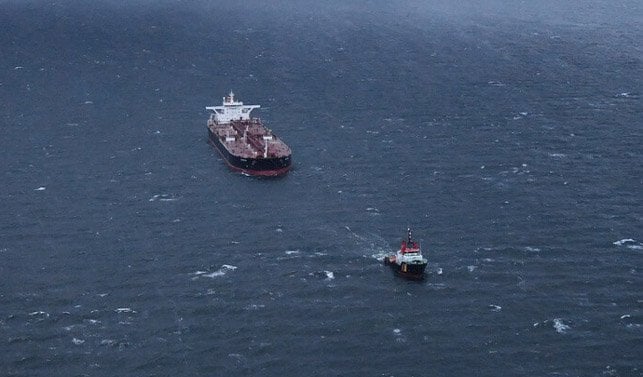
European leaders continue to work to increase the pressure on Russia with the shadow fleet and cutting Russia’s revenues from oil remaining a high priority. The EU High Representative for Foreign Affairs and Security Policy, Kaja Kallas, told reporters the EU’s plan is to continue to weaken Russia, saying the sanctions are working.
Speaking to reporters are the end of the monthly Foreign Affairs Council session, Kallas said the next steps the EU is exploring include pre-boarding agreements with the flag states that register vessels. She reported that there have been “extensive diplomatic talks” to establish the inspection rights targeting the shadow tankers.
Kallas asserted that “slowing down the shadow fleet costs Russia revenues.” French President Emmanuel Macron advocated for this stance after France detained a shadow fleet tanker for a few days in September. Estonia has also taken aggressive actions to challenge some of the tankers to confirm their flags and valid insurance.
“The export of Russian crude oil is the lowest it has been in months,” Kallas told reporters. “Russian tax revenues from oil are the lowest since the war started.”
When the EU started the sanction efforts targeting the shadow fleet, Kallas reported revenues from oil shipped via the Baltic and Black Sea dropped by 30 percent. She contends the impact has increased further, saying the ministers want to work with the European Commission to be “more agile” and to do it faster. She said they do not want to wait for the next sanctions package to take further steps against the tankers.
“Sanctions are hitting Russia hard, and more are coming,” warned Kallas.
She noted that the EU has already listed more than 550 ships. It has also authorized member states to challenge tankers transiting local waters to demand proof of insurance. The EU and NATO also supported the Baltic countries in increasing monitoring efforts and in the efforts to protect the undersea infrastructure.
“Russia has repeatedly paid lip service for peace talks, and previous talks fell apart because Russia never made any real commitments,” Kallas said during the briefing. She said if Russia really wanted peace, it would have accepted the unconditional ceasefire offer made in March.
The comments came as news of a proposed new peace plan developed by the United States in consultation with Russia was announced. Critics were quick to say the plan contains large concessions from Ukraine, and it was unclear, other than a promise not to attack again, what concessions Russia might be proposing in the plan. Ukraine acknowledged the receipt of the plan and said it would be talking with the United States in the coming days about the opportunities for peace.
Danwatch: Uniformed Overseers Appear on "Shadow Fleet" Tankers in Baltic
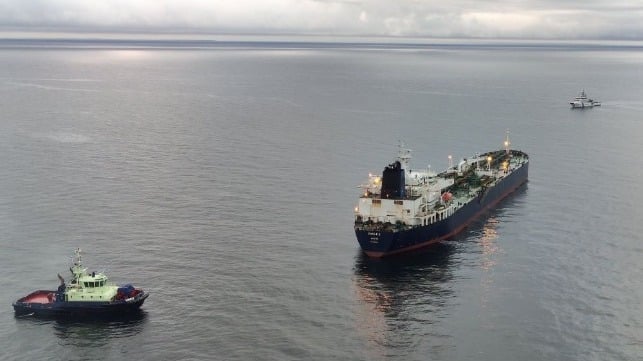
The steady flow of Russian "shadow fleet" tankers through the Baltic has unnerved authorities in Denmark for years, since the aging vessels transit through the Danish Straits en route to Primorsk and Ust-Luga. The straits are pilotage waters, narrow, congested and close to populated areas, and a grounding or collision could cause a billion-dollar spill. The concerns grew when a shadow fleet tanker was implicated in the launch of the drone attack on Copenhagen airport on September 22. Now, investigative outlet Danwatch has obtained unusual reports of Russian men in military uniforms aboard "shadow fleet" vessels, exercising authority and rebuffing ordinary requests from Danish pilots - a hint that the Russian government may be installing its own personnel aboard outlaw merchant tankers, which have become vital to Moscow's finances.
Danwatch received the tip from an accomplished maritime professional, Bjarne Caesar, who is an admiralty court judge in addition to his active role as a licensed marine pilot. Caesar told the outlet that shadow fleet vessels have men in uniform on deck; that pilots are treated with disdain on board, and the crews are uncooperative - an inversion of the deference and respect that pilots can normally expect; and that there is an overall atmosphere of intimidation in the wheelhouse, seemingly aimed at keeping the foreign crew in check.
Denmark's state pilotage agency, foreign minister, ministry of foreign affairs and ministry of public security all declined to comment on the matter when asked by Danwatch.
Other NATO member states have been reluctant to directly confront Russian interests in the shadow fleet. The head of Estonia's navy, Commodore Ivo Vark, told BBC that dozens of questionably-registered shadow fleet vessels pass by Estonia's waters each year - but rarely are they pursued for a flag state verification boarding.
"With the Russian presence next to our borders, the risk of escalation is too high to do it on a regular basis," Commodore Vark told BBC.
UK Accuses Russian Spy Ship of Aiming Laser at Surveillance Aircraft
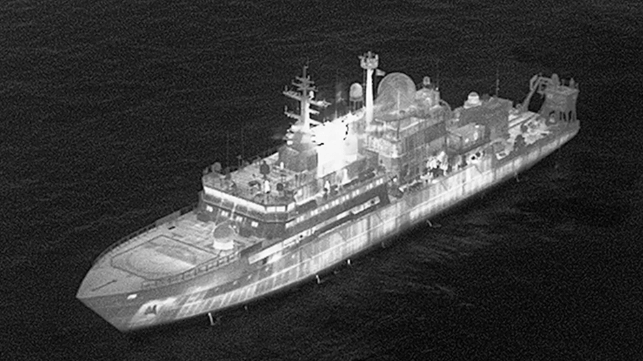
The Russian spy ship Yantar has had run-ins with British forces before, but this time it has gone too far, according to the UK Ministry of Defence. The ship allegedly directed lasers at Royal Air Force pilots off the coast of northern Scotland, creating a real hazard to health and safety - and prompting a strong reaction from the British government.
At some point in the past few weeks, the Royal Navy dispatched a Type 23 frigate and a P-8A Poseidon maritime surveillance aircraft to monitor the activities of the Yantar, a subsea espionage vessel belonging to the Russian Ministry of Defense's Main Directorate of Deep-Sea Research (GUGI). The directorate operates Russia's top-secret minisubs, which are designed to dive deep for special missions - like emplacing subsea sensors and tampering with critical infrastructure. Yantar is a platform for deploying a manned submersible, the Project 16810 Rus-class, which is titanium-hulled and capable of reaching 20,000 feet of water depth.
The Russian threat to subsea cables and pipelines is a top concern for British defense planners, and Yantar is emblematic of that threat. While British forces were tracking the vessel off Scotland, Yantar's crew aimed a laser at a British aircraft in a "deeply dangerous" manner, according to Defence Secretary John Healey.
"We have military options ready should the Yantar change course. I am not going to reveal those because that only makes President Putin wiser," Healy said. "My message to Russia and to Putin is this: we see you. We know what you're doing. And if the Yantar travels south this week, we are ready."
The Russian Embassy in London denied any improper behavior and accused the British government of "Russophobia" and "militaristic hysteria." The embassy asked the UK to "hold off taking any destructive steps which might aggravate the crisis situation on the European continent."
Earlier this week, Russian-funded saboteurs blew up tracks on a strategic rail line in eastern Poland, according to Polish Prime Minister Donald Tusk. Loss of civilian lives was prevented by early detection of gaps in the rail line, authorities said. In response, the Polish government has closed the last Russian consulate in the country, accused Russia of state terrorism, and arrested four suspects. Pursuit of additional suspects is under way.

No comments:
Post a Comment