Some LGBTQ Ugandans forced into hiding are finding ways to build faith communities

Activists hold placards during their picket against Uganda’s anti-homosexuality bill at the Uganda High Commission in Pretoria, South Africa, on April 4, 2023. (AP Photo/Themba Hadebe, File)
Ugonna-Ora OwohDecember 9, 2025
LAGOS, Nigeria (RNS) — For Agy, a transgender woman pastor in Uganda, the connection between her faith, identity and resilience is always on her mind. She serves as a pastor with the Young Prophets Collective, a queer-affirming online church community, two years after her country enacted one of the harshest anti-homosexuality laws in the world.
Since the law passed, Agy said she has dealt with fear of discrimination daily. However, none of it has shaken her belief in God, and instead it has deepened her resolve to serve her congregation, she said.
“It’s made me even more committed to showing that God’s love includes queer and trans people, and to creating spiritual spaces where they can feel safe, valued and fully seen,” said Agy, who is being identified by her first name only due to safety concerns.
Agy is among several religious LGBTQ Ugandans who spoke with Religion News Service about how their faith has changed since the law was approved. In a country where about 88% of the population identifies as Christian and 11% as Muslim, she and others are also attempting to find ways to ensure queer Ugandans are still able to practice their religions safely.
In May 2023, Ugandan President Yoweri Museveni signed a sweeping anti-homosexuality bill into law after years of political and religious campaigns. The Parliament of Uganda positioned the bill as protecting traditional values. After debate, it passed with overwhelming support — 389 legislators in favor, with only two opposed.
The law punishes consensual same-sex intimacy with penalties as severe as life imprisonment, while those charged with “aggravated homosexuality” — applied in cases such as those involving minors, people living with HIV or serial offenders — could face the death penalty.
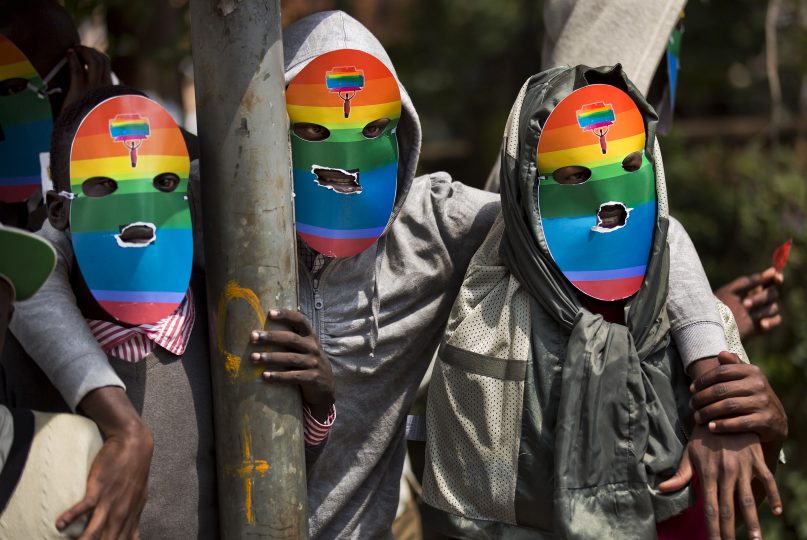
FILE – LGBT members and advocates wear masks for anonymity
as they stage a rare protest, opposing many African nations’ tough
stances against homosexuality, in Nairobi, Kenya, on Feb. 10, 2014.
(AP Photo/Ben Curtis)
The law also criminalizes promoting homosexuality, which includes distributing LGBTQ-affirming material, running support groups or offering medical care, punishable by up to 20 years in prison. Landlords who rent to LGBTQ+ tenants and service providers seen as facilitating same-sex relationships also face prosecution. Citizens can also be jailed for failing to report suspected homosexual activity to authorities.
International human rights groups have condemned the law, and Western governments, including the United States, United Kingdom and the European Union, warned of aid cuts and sanctions.
In August 2023, a 20-year-old man was the first hit with a charge punishable by death. A report from July found that over the past two years, the Ugandan legal aid network Human Rights Awareness and Promotion Forum has represented 1,743 cases targeting LGBTQ+ people over their sexuality.
For these reasons, Agy’s congregation gathers via Facebook livestreams, often with 10 to 25 participants, though some can only join briefly due to data or Wi-Fi limitations. Services have been online-only since inception due to dangers associated with creating a physical location. With limited resources, the community does what it can to support members’ participation, reminding everyone that belonging doesn’t depend on perfect connectivity but on the shared commitment to show up for one another, Agy said.
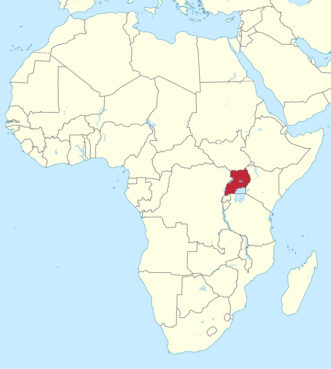
Uganda, red, in eastern Africa. (Map courtesy of Wikimedia/Creative Commons)
Human rights violations and public prejudice against LGBTQ people also have been increasingly documented leading up to and after the law passed.
“Honestly, it didn’t change anything inside me because this is how Uganda has been,” said LGBTQ+ activist Hans Senfuma, who is Muslim. “Even before the law was passed, violations of human rights were happening in broad daylight. The law simply gave a green light to more hatred and more criminalization. So, when it passed, I wasn’t shocked.”
But Senfuma said he was especially afraid of how almost every lawmaker rallied behind the bill and said it was sad seeing others label queer people as “demons.” He said that today, homophobic people will lure LGBTQ people on dating apps to kidnap and/or extort them. And employers often don’t want to risk hiring queer people because they can face jail time if authorities find out.
“I’ve had to move many times,” he said. “Landlords evict me once they see my activism online. Some fear being jailed just for renting to me. Right now, I’ve been in a new place for six months, but I know it’s temporary. I’m unemployed, surviving on small donations.”
Leaving the country has also not been easy for Senfuma. Last year, he said, he applied for a visa to attend a human-rights conference in Canada but was denied.
But Senfuma also said the law has changed his Muslim faith because of how religion has been used to fuel much of the hate directed toward LGBTQ people. Religious leaders use schools, courts and public spaces to spread false conspiracies that queer people recruit children, make pornography and corrupt society, he said.
Diane Sydney Bakuraira co-founded the organization Women of Faith in Action in 2019 to empower women spiritually in Uganda, after noticing mainstream ministry experiences sidelined women — especially queer ones. In addition to advocating for and researching and documenting experiences of marginalized women, the organization works with those struggling to reconcile their sexuality with their spiritual beliefs.
“As someone who once aspired to be a reverend, I wanted to create a platform that pushed liberation and inclusion,” said Bakuraira, who is Christian and founded the group with a Muslim friend.
At the forefront of queer advocacy in Uganda since the 2000s, Bakuraira said the community has religious allies, such as the Rev. Christopher Senyonjo, retired Church of Uganda bishop of West Buganda, and the Rev. Canon Gideon Byamugisha, a Ugandan Anglican priest. While she said she’s seen anti-queer legislation proposed throughout her career, she said she’s learned to “trust that the God we serve has justice and protection for us, even when society turns against us.”
The Fellowship of Affirming Ministries, an inclusive Christian ministry that began in the United States in 2001, established a branch in Uganda in 2017 to include queer people who have been excluded from mainstream churches. But after the law passed, the ministry has had to be discreet. Bakuraira, who is also a leader of that group, said the leader pastor, who is bisexual, was attacked, forcing them to hold off on hosting large gatherings.
“We do small house fellowships and online meetings,” she said. “It’s about reducing risks because members face threats of arrest, blackmail and intimidation. So, the peer-to-peer approach works best now.”
When the law was passed in 2023, Bakuraira said she was “terrified” because she had a court case filed against her as a religious leader and queer advocate, and her landlord refused to renew her agreement. The court case was eventually dismissed, though, and she said her faith has grown stronger as a result of overcoming such challenges.
“As someone who has survived many violations, my faith is what I hold onto,” she said. “When the law passed, I leaned on my foundation.”
In addition to Young Prophets Collective, Agy also co-leads the Talented Youth Community Fellowship Uganda, a faith-based organization that supports rural trans and queer communities through advocacy, HIV awareness and storytelling.
“For me, it’s about living authentically, advocating for inclusion and creating spiritual spaces where queer people can thrive without having to separate their faith from their identity,” she said.


No comments:
Post a Comment