It’s possible that I shall make an ass of myself. But in that case one can always get out of it with a little dialectic. I have, of course, so worded my proposition as to be right either way (K.Marx, Letter to F.Engels on the Indian Mutiny)
Wednesday, December 10, 2025
Surprising nanoscopic heat traps found in diamonds
Hot-Phonon-Induced Distortion of Diamond Defects on
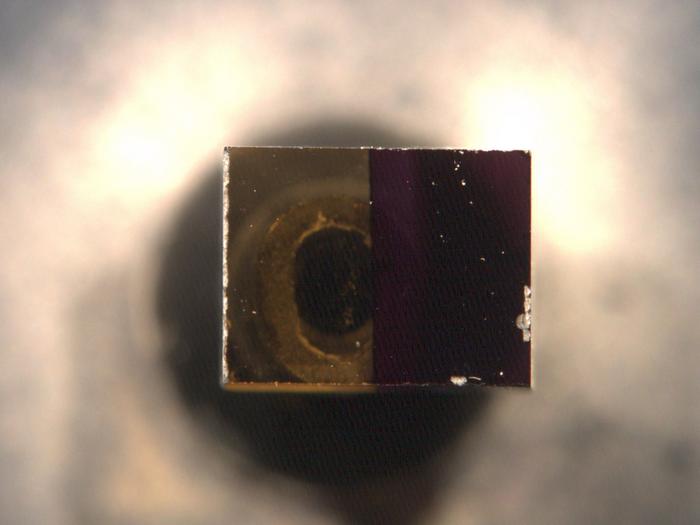
A diamond sample containing the NsH-C0 defect, with regions of different coloration which indicates varying defect content. Credit: Junn Keat/University of Warwick
Scientists discover “hot spots” around atomic defects in diamonds – challenging assumptions about the world’s best heat conductor.
Diamond, famous in material science for being the best natural heat conductor on Earth – but new research reveals that, at the atomic scale, it can briefly trap heat in unexpected ways. The findings could influence how scientists design diamond-based quantum technologies, including ultra-precise sensors and future quantum computers.
In a study published in Physical Review Letters, researchers from University of Warwick and collaborators showed that when certain molecular-scale defects in diamond are excited with light, they create tiny, short-lived “hot spots” that momentarily distort the surrounding crystal. These distortions last only a few trillionths of a second but are long enough to affect the behaviour of quantum-relevant defects.
“Finding a hot ground state for a molecular-scale defect in diamond was extremely surprising for us”, explained Professor James Lloyd-Hughes, Department of Physics, University of Warwick. “Diamond is the best thermal conductor, so one would expect energy transport to prevent any such effect. However, at the nanoscale some phonons – packets of vibrational energy – hang around near defect, creating a miniature hot environment that pushes on the defect itself.”
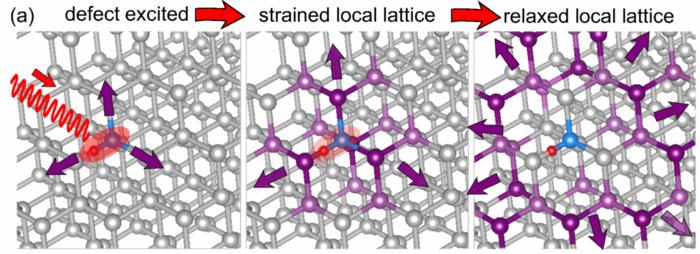
The team studied a specific atomic defect in diamond where a nitrogen atom sits in place of a carbon atom and bonds to hydrogen – known as the Ns:H-C0 defect. When the researchers excited the defect’s C–H bond with ultrafast infrared laser pulses, they expected the heat to dissipate immediately into the diamond lattice.
Instead, advanced spectroscopy revealed a curious effect: the defect briefly entered what scientists call a ‘hot ground state’ – meaning the surrounding crystal was still hot, and the defect was altered. The presence of built-up vibrational energy nearby shifted the defect’s infrared signature to a higher energy, taking a few picoseconds to peak and then decay.
Dr. Junn Keat, PDRA, Department of Physics, University of Oxford and former PhD student at Warwick said: “For this study we used multidimensional coherent spectroscopy (2DIR) to study the defect, which allows us to separate the response of the defect produced by light with different energies.
“This is the first time we’ve applied this technique to the study of diamond defects, and the direct observation of hot ground state formation was beyond our expectations. We are very pleased with the results of this novel approach and are excited to see what else we can study with this technique.”
The team also explained why diamond fails to remove this energy instantly. The defect releases its energy by generating particular phonons with large energy – the kinds of vibrations that do not travel far. These phonons move slowly and scatter quickly, creating a tiny bubble of heat around the defect before they eventually decay into faster-moving, heat-carrying vibrations.
Dr. Jiahui Zhao, Department of Physics, University of Warwick added: “Momentary local heating matters because defects are tiny, sensitive quantum systems, and even fleeting changes in their environment can affect their stability, precision, and usefulness in quantum technologies.”
Defects like the nitrogen-vacancy (NV) and silicon-vacancy (SiV) centres in diamond serve as sensitive sensors and building blocks for quantum information processing. Their performance depends on keeping their spin states stable—and these spin states are strongly influenced by vibrations in the surrounding lattice.
The new findings indicate that optical techniques used to control defects may unintentionally generate small, short-lived pockets of heat. These local temperature spikes can subtly disturb the spin states, potentially affecting coherence times and the overall performance of diamond-based quantum devices.
ENDS
‘Hot-Phonon-Induced Distortion of Diamond Defects on Ultrafast Timescales’ is published in Physical Review Letters. DOI: https://doi.org/10.1103/mvdf-bdrx
Notes to Editors
For more information please contact:
Matt Higgs, PhD | Media & Communications Officer (Warwick Press Office)
This project was a collaborative effort between universities, national research facilities, and industry. The 2DIR measurements were only made possible due to the support and 2DIR setup provided by the ULTRA team at the Central Laser Facility. The facilities and expertise locally available at the Spectroscopy RTP and the Warwick Centre for Ultrafast Spectroscopy RTP were crucial. The samples used in this study was provided by the De Beers Group. Meanwhile, theoretical calculations presented in the work were done by collaborators in Newcastle University.
About the University of Warwick
Founded in 1965, the University of Warwick is a world-leading institution known for its commitment to era-defining innovation across research and education. A connected ecosystem of staff, students and alumni, the University fosters transformative learning, interdisciplinary collaboration and bold industry partnerships across state-of-the-art facilities in the UK and global satellite hubs. Here, spirited thinkers push boundaries, experiment and challenge conventions to create a better world.
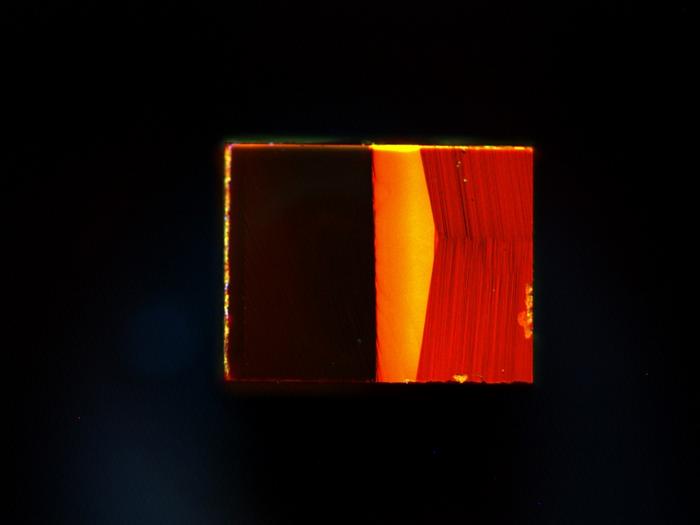
A diamond sample containing the NsH-C0 defect under UV illumination. Credit. Junn Keat/University of Warwick
Credit
Junn Keat/University of Warwick
Excitation and relaxation of the Ns:H-C0 defect in a diamond crystal. Gray, blue, and red spheres represent carbon, nitrogen, and hydrogen atoms, respectively. Purple arrows show the transfer of energy away from the defect. Credit: Keat, T. J., Zhao, J., Woolley, J. M., Malakar, P., Greetham, G. M., Wu, X., ... & Lloyd-Hughes, J. (2025). Hot-Phonon-Induced Distortion of Diamond Defects on Ultrafast Timescales. Physical Review Letters, 135(21), 216902.
Credit
Keat, T. J., Zhao, J., Woolley, J. M., Malakar, P., Greetham, G. M., Wu, X., ... & Lloyd-Hughes, J. (2025). Hot-Phonon-Induced Distortion of Diamond Defects on Ultrafast Timescales. Physical Review Letters, 135(21), 216902.

No comments:
Post a Comment