Wednesday, April 15, 2020

Canadian hospitals prepare to sterilize, re-use N95 masks if supplies dwindle

By Steve Scherer and Allison Martell, Reuters•April 15, 2020
FILE PHOTO: Boxes of N95 protective masks for use by medical field personnel are seen at a New York State emergency operations incident command center during the coronavirus outbreak in New Rochelle

OTTAWA/TORONTO (Reuters) - Some Canadian hospitals are collecting used N95 masks so that they can be decontaminated and worn again should new ones become impossible to find amid a global scramble for personal protective equipment caused by the coronavirus pandemic.

The issue has become more pressing in Canada after the United States blocked some exports of protective gear. On April 5, Canada's chief medical officer, Theresa Tam, said hospitals should not throw away medical masks, including N95 respirators, because it may be possible to disinfect and re-use them.

The CHEO Research Institute in Ottawa is preparing to sterilize the masks with ultraviolet light for the CHEO pediatric health center.

"That transition from having masks to having no masks can happen very quickly, so having something in place now so we're ready is really important," said Katie O'Hearn, research coordinator at the institute.

So far the institute has looked into ultraviolet germicidal irradiation, and microwave and heat decontamination methods, but it is also studying chemical disinfectants, including vaporized hydrogen peroxide.

"We found that UV light could successfully remove viral pathogens from the mask," she said, while ensuring that they still fit properly on the face. If used masks are needed, the hospital could do UV decontamination in the microbiology labs, O'Hearn said.

CHEO, which is using about 250 N95 masks per day, currently has a sufficient supply of new masks, said its medical chief of staff, Lindy Samson.

U.S. President Donald Trump has directed federal agencies to use any authority necessary to keep highly sought-after medical supplies in the country, kicking off a diplomatic spat with Canada over N95 masks produced by 3M Co.

Canada's deputy prime minister, Chrystia Freeland, has characterized the market for medical equipment as "a Wild West," and the government is encouraging more domestic production of medical supplies.


Hospitals in New Brunswick, Newfoundland, Ontario and Saskatchewan are all collecting used masks and making plans to sterilize them should they run out of new ones. British Columbia's health authority is evaluating whether to do the same, Chief Health Officer Bonnie Henry has said.

Horizon Health Network in New Brunswick is in "the very early stages of examining the feasibility of decontaminating and reusing N95 respirators during the COVID-19 pandemic," said Margaret Melanson, a vice president.

Newfoundland's Eastern Health is developing a procedure to re-use N95 respirators. Saskatchewan's provincial health authority said it would partner with the University of Saskatchewan's Vaccine and Infectious Disease Centre to use vaporized hydrogen peroxide to decontaminate respirator masks.

In Ontario, Toronto's Sunnybrook Health Sciences Centre is also collecting used masks and has done its own testing but not used them yet, a hospital spokesman said.

Toronto's Michael Garron Hospital is collecting goggles at the end of shifts and is looking at possible decontamination methods, while the city's University Health Network said it is saving personal protective equipment while it awaits the results of research.

All the health authorities and hospitals said they would need approval either from the province or the federal regulator to start using sterilized masks.


THE GUARDIAN

Denial didn't get America past the Depression and it won't work for Trump on coronavirus

It's terribly risky in a pandemic to have a president who is anti-fact, anti-science and without empathy. 

Bad leaders who ignore crises make them much worse.

David Rothkopf Opinion contributor

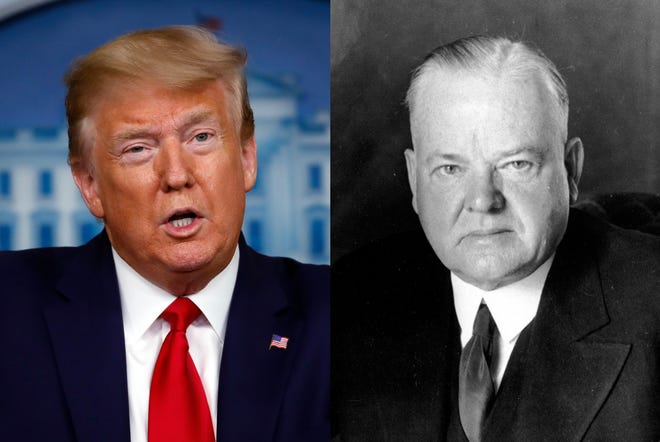
In March, the president, said the worst would be over in 60 days. Weeks later, he predicted that the economy would be back to normal soon. Later, he said “the fundamental strength of the economy is unimpaired.” While these remarks sound familiar, they didn’t come from Donald Trump. The president offering them up was Herbert Hoover during the first years of the Great Depression.

The quotes come from Robert Caro’s magnificent “The Path to Power.” He observes that when asked about all the men selling apples on the sidewalk, Hoover responded, “Many people have left their jobs for the more profitable one of selling apples.” He was determinedly oblivious, in Caro's telling: “He couldn’t bear to watch suffering, so he never visited a breadline or a relief station; as his limousine swept past men selling apples on street corners, he never turned his head to look at the them."

Caro finished off his devastating summary with this quote from Hoover: "Nobody is actually starving. The hoboes, for example, are better fed than they’ve have ever been. One hobo in New York got ten meals in one day.”
Spreading lies, ignoring warnings

Eerily familiar, no? Trump has been in denial about the coronavirus crisis since day one. We know his quotes and tweets. It was nothing, it would magically disappear, it was under control, the economy was in great shape, the economy would come roaring back any minute. On Thursday, economic adviser Larry Kudlow implied working had gone out of fashion and said it has become cool again. On Friday, Trump touted the stock market rally as the biggest since 1974. That was the day after we had learned close to 17 million people were unemployed in the last three weeks alone and knowing full well that the St. Louis Fed has predicted nearly 50 million people would be out of work before this was over.

To paraphrase the old joke, denial seems to be a river that runs through Washington. Bad leaders who refuse to see what doesn’t suit their ideology or political fortunes ignore crises and make bad times much, much worse.

Step one to solving a problem is acknowledging it. But in this case, not only is the president in denial, not only is his staff in denial, but he is hiring new aides who made their reputation with him by saying things like incoming White House Press Secretary Kayleigh McEnany’s line that under Trump, we don’t get epidemics like coronavirus. He has fired truth-tellers from Navy Capt. Brett Crozier, who warned of rapidly spreading COVID-19 on his ship, to the inspector general named to oversee relief funds for the pandemic.

The president's men and women — Mike Pence and Larry Kudlow and Kellyanne Conway and Jared Kushner and Bill Barr — have spread the lies further. And of course, the centerpiece of his policy has been suppression of the truth about the crisis by slow-walking and then unfunding and then denying the need for testing … which is the only way we can ever know how deep the crisis is.

Take it from a doctor:Fake news about the coronavirus is hazardous to your health. Don't fall for it.

Less than 1% of Americans have been tested, and there's widespread agreement among experts that official counts underestimate the deaths caused by the pandemic. The number of people dying at home in New York City without a diagnosis is 10 times normal levels. It is not a coincidence that this surge is happening at this time of public health crisis.

Ignoring warnings from the Obama team, from the intelligence community, from the Army, from his own economic adviser, are also a form of this denial. So are the Trump-led attempts right now to sell the line that we are ready to open for business. The facts show otherwise. 

On our own at a perilous moment

Experts including the president’s own advisers, like Dr. Anthony Fauci, emphasize that we risk triggering another wave of the disease if we prematurely lift the lockdown that currently has more than 9 out of 10 Americans sheltering in place. Indeed, a second wave seems likely in any case and were it to hit a society that has unlearned the lessons of the past three months, the toll would be catastrophic.

That is why Trump ignoring the constant drumbeat of warnings since he entered the White House is not simply a frustrating story of our recent past. It is one about a looming risk to our future on a par with that caused by the virus itself.

Ex-Republican on Trump coronavirus failures: Our lives depend on electing Joe Biden

The United States did not begin to turn the tide against the Great Depression until it elected a man who acknowledged and truly understood the depth of the problem, Franklin Delano Roosevelt. He acted from his first 100 days onward with the sense of urgency and the scope of initiative that the crisis called for. And when programs faltered or failed, he admitted it and found new ones.

You can’t be anti-fact or anti-science or anti-math or, for that matter, without empathy, and be a good leader. Closing your eyes to a disease that doesn’t care whether you believe in it or not won’t make it go away. On the contrary, it will only demonstrate that viruses like this one, like economic disasters, actively thrive on denial. As a consequence, today we face not one but three grave risks — from the pandemic, from the shattered economy, and from being leaderless at a moment of great peril.

David Rothkopf is CEO of the Rothkopf Group and host of "Deep State Radio." His latest book, "Traitor: A History of Betraying America from Benedict Arnold to Donald Trump," will be published in October. Follow him on Twitter: @djrothkopf


WHO director calls for unity to fight coronavirus after Trump orders halt to U.S. funding

Dylan Stableford Senior Writer,Yahoo News•April 15, 2020

WHO regrets U.S. hold on funding but says focus is on stopping coronavirus

The head of the World Health Organization on Wednesday defended its mission in fighting the coronavirus after President Trump halted U.S. funding to the global health agency.

“The enjoyment of the highest standard of health is one of the fundamental rights of every human being without distinction of race, religion, political belief, economic or social condition,” Dr. Tedros Adhanom Ghebreyesus, the WHO’s director-general, said at a press briefing in Geneva, reciting the 75-year-old organization’s mission statement. “That creed remains our vision today.”


His comments came a day after Trump announced that he planned to withhold funding to the WHO for what he claimed were missteps in handling the coronavirus outbreak, which has infected more than 2 million people worldwide and killed at least 129,000, including more than 26,000 in the United States.

“With the outbreak of the COVID-19 pandemic, we have deep concerns whether America’s generosity has been put to the best use possible,” Trump said at a Rose Garden briefing late Tuesday afternoon. “The reality is that the WHO failed to adequately obtain and share information in a timely and transparent fashion.”

Trump has expressed annoyance that the WHO gets much more money from the U.S. — $893 million over the past two years, roughly 10 percent of the organization’s budget — than from China, while it was allegedly complicit in China’s early attempts to hide the coronavirus outbreak.

Trump himself, however, initially praised China for its “transparency” about the disease, before more recently blaming the nation for allowing the pandemic to spread.


U.S. funding to the WHO is appropriated by Congress. Presidents can put holds on funds, and Trump suggested that his administration would indeed withhold some portion of the money while investigating the organization. But the president provided few specifics of that investigation, saying only that WHO funding would be withheld — before eventually being released — for up to three months.

“The United States of America has been a longstanding and generous friend to WHO, and we hope it will continue to be so,” Tedros said. “We regret the decision by the president of the United States to order a hold in funding to the World Health Organization.”

Tedros was named WHO director-general in 2017 after serving as Ethiopia’s health minister.
 
President Trump and Dr. Tedros Adhanom Ghebreyesus.
 (Alex Brandon/AP, Salvatore Di Nolfi/Keystone via AP)

He said the WHO would work with partners to “fill any financial gaps we face, and to ensure our work continues uninterrupted.” And he called for unity in the face of the pandemic.

“COVID-19 does not discriminate between rich nations and poor, large nations and small,” Tedros continued. “It does not discriminate between nationalities, ethnicities or ideologies. Neither do we.”

“This is a time for all of us to be united,” he added. “When we are divided, the virus exposes the cracks between us.”

Trump’s decision to halt funding to the WHO was widely condemned by lawmakers, global health officials and philanthropists, including Microsoft founder Bill Gates, who has made international health his signature philanthropy.

“Halting funding for the World Health Organization during a world health crisis is as dangerous as it sounds,” Gates tweeted. “Their work is slowing the spread of COVID-19 and if that work is stopped no other organization can replace them. The world needs @WHO now more than ever.”

“Withholding funds for WHO in the midst of the worst pandemic in a century makes as much sense as cutting off ammunition to an ally as the enemy closes in,” Sen. Patrick Leahy, D-Vt., said in a statement. “WHO could have been more forceful with China and declared a global health emergency sooner, but it is performing an essential function and needs our strong support.”

Tedros said the WHO will conduct a thorough review of its response to the pandemic “in due course.”

“No doubt areas of improvement will be identified and there will be lessons for all of us,” the director-general said. “But for now, our focus, my focus, is on saving lives.”

Alexander Nazaryan contributed reporting to this story.

Nancy Pelosi Pledges To Challenge Trump's 'Illegal' WHO Funding Freeze

Igor Bobic,HuffPost•April 15, 2020

House Speaker Nancy Pelosi (D-Calif.) says President Donald Trump’s decision to withhold funding to the World Health Organization is “illegal” and will be “swiftly challenged” by Democrats.

Trump announced Tuesday he intended to at least temporarily halt U.S. funding to the United Nations public health agency over its handling of the coronavirus pandemic. The president claimed the WHO promoted China’s “disinformation” about the severity of the outbreak, which originated in the Chinese city of Wuhan late last year.

“The WHO failed in this basic duty and must be held accountable,” Trump said.

The U.S. is the biggest overall donor to the Geneva-based global world health agency, contributing more than $400 million in 2019 ― about 15% of its budget ― according to Reuters. The money goes to public health programs throughout the world, from war-torn countries like Yemen to those dedicated to fighting Ebola.

Pelosi slammed Trump’s decision on Wednesday. She and other House Democratic leaders maintain Trump does not have unilateral authority to freeze congressionally appropriated funding to the WHO over a policy disagreement. They’re pointing to a similar decision from a federal watchdog that found that the Trump administration broke the law when it withheld assistance to Ukraine, which led to the president’s impeachment.

Trump’s targeting of the WHO, Pelosi charged, is an effort by him to shift blame for the rise of the deadly epidemic in the U.S., which has cost more than 25,000 lives so far.

“Sadly, as he has since Day One, the president is ignoring global health experts, disregarding science and undermining the heroes fighting on the frontline, at great risk to the lives and livelihoods of Americans and people around the world,” the speaker said in a statement. “This is another case, as I have said, of the President’s ineffective response, that ‘a weak person, a poor leader, takes no responsibility. A weak person blames others.’”

Beijing has been accused of understating the coronavirus epidemic by censoring and vastly undercounting its official death toll. The nation’s public figures alarmed the CIA in early February, which at that time warned the White House about understated infection numbers from China.

Republicans are demanding information from the WHO about its communications with Chinese officials, and they’re pushing to grill its leaders at a future congressional hearing.

Some Democrats acknowledge that the WHO could have handled the coronavirus outbreak better, but they maintain now is not the time to cripple the only agency in charge of public health on a global scale.

“It needs to be reformed. There are problems. It was too soft on China here,” Ron Klain, who oversaw the Obama administration’s response to the Ebola outbreak, said Wednesday in a Twitter conversation with Sen. Chris Murphy (D-Conn.). “But let’s be clear, the mess we have in America right now is not because of the WHO, it’s because of what Trump did with the information he was getting.

Rep. Tim Ryan: Halting WHO funding 'one of the most irresponsible decisions in the history of the presidency'

Jessica Smith Reporter,Yahoo Finance•April 15, 2020

Rep. Tim Ryan (D-OH) slammed President Trump for halting funding for the World Health Organization — calling the decision the “height of irresponsibility” in an interview with Yahoo Finance.

“This is one of the most irresponsible decisions in the history of the presidency — in the middle of a global pandemic to defund the World Health Organization,” Ryan said in an interview with Yahoo Finance.

On Tuesday, Trump announced he was cutting off U.S. funding for the WHO pending a review of the organization’s handling of the coronavirus pandemic. House Speaker Nancy Pelosi (D-CA) called the move “dangerous and illegal” — while noting it would be “swiftly challenged.”

In a statement on Wednesday, the White House said the WHO’s response “has been filled with one misstep and cover-up after another” and the organization has “longstanding structural issues that must be addressed before the organization can be trusted again.”

‘Negligent to the nth degree’

Ryan and other Democratic lawmakers have suggested Trump is trying to deflect blame from his administration.

“He put us in this position and then he wants to blame the World Health Organization, blame Andrew Cuomo,” said Ryan. “I played a lot of sports growing up. No coach worth their salt would ever try to blame somebody else. You get better, you improve, you take responsibility as a leader and that's your job — and he is negligent to the nth degree.”

Ryan, a former 2020 presidential candidate, told Yahoo Finance the Trump administration’s response to the pandemic will hurt the president at the polls in November.

“In the conversations I'm having here in Ohio, everyone is seeing the president for what he is. He's not taking any responsibility. He's encouraging fights between governors, bidding up products that are essential,” said Ryan. “I don't know if you'll be able to find a healthcare worker that will vote for President Trump.”

The president has also come under fire for reportedly ordering his name to be printed on the stimulus checks being sent to Americans — which some worry could slow down the process of getting checks out to people in need.

“Are you freaking kidding me? Really? This is happening in America. A president's more worried about his political standing — his ego getting stroked — as opposed to getting this money,” said Ryan. “I just think that the average person where I grew up, where we come from in Ohio, is just appalled by something so obnoxious as trying to get your name on the check for your own political gain.”

The Treasury Department denies the decision will cause any delays.

Economic anxiety

Lawmakers are trying to come to a deal before the Paycheck Protection Program runs out of money this week. Republicans want to solely focus on boosting money to the small-business loan program, while Democratic lawmakers want to include help for hospitals, state and local governments and rapid testing.

“We just are not getting the presidential leadership that we need on some of these issues. That's the reality of the situation. So we're all trying to figure this out without, you know, the top dog helping us make this happen,” said Ryan.

Ryan argues individual Americans need more help than the $1,200 payment included in the CARES Act. On Tuesday, Ryan and Rep. Ro Khanna introduced a bill that would give most Americans $2,000 a month until the economy recovers.

“I just believe that these direct cash payments to people who are really suffering on the ground out here — it's going to be very, very helpful. There's a lot of anxiety in the country today that's obviously around the coronavirus, but for most people it's around the economic anxiety,” said Ryan.


Jessica Smith is a reporter for Yahoo Finance based in Washington, D.C. Follow her on Twitter at @JessicaASmith8

Global backlash after Trump orders funding freeze on WHO

Nina LARSON and AFP bureaus AFP•April 15, 2020


A full-scale return to normality still appears a long way off in countries including Italy (AFP Photo/Miguel MEDINA)

Geneva (AFP) - Criticism was heaped on US President Donald Trump on Wednesday after he ordered a freeze on funding for the World Health Organization, with friends and foes of the United States calling for global solidarity in the fight against the coronavirus and its economic devastation.

The pandemic is entering a new and uncertain phase as governments debate how to reboot commerce without triggering new infection waves of a virus that has killed more than 125,000 people.

In hard-hit Europe, a patchwork of countries are easing lockdown measures, with Denmark the first on the continent to send some children back to school and Germany announcing it would allow most shops to open with "plans to maintain hygiene".

Yet in poorer and more densely populated parts of the world, many governments are still struggling to enforce restrictions on movement that are piling misery on the needy and spreading hunger.

On the horizon looms the worst economic downturn in a century, which the International Monetary Fund has said could see $9 trillion wiped from the global economy.

Offering a lifeline for the world's poorest countries, the G20 -- a group of the world's leading economies -- said it would temporarily suspend debt repayments from the most impoverished nations.

The reprieve will free up more than $20 billion for those countries to focus on the pandemic and will last at least a year, according to Saudi Finance Minister Mohammed Al-Jadaan.

But the global economic outlook remains gloomy, with Europe's powerhouse Germany already in recession and US industrial output declining by 6.3 percent -- its biggest fall in seven decades.

More than a third of French workers are on temporary unemployment, the government said Wednesday, as the virus toll topped 17,000 while hospital numbers went down for the first time.

- Trump's blame-game -\

As the world tries to chart a way out of the crisis, Trump ramped up his blame-game with the WHO, the UN's health agency.

Accusing the WHO of "severely mismanaging and covering up the spread of the coronavirus", Trump ordered a freeze on payments -- the US was its top individual donor last year giving $400 million.

The outbreak could have been contained "with very little death" if the WHO had accurately assessed the situation when the disease broke out late last year in China, Trump alleged.

Allies and enemies of the US fired back at the American leader, who played down the dangers of the virus until it arrived in full force in the US, where it has now chalked up its highest death tolls.

"No doubt, areas for improvement will be identified and there will be lessons for all of us to learn," said WHO chief Tedros Adhanom Ghebreyesus, adding that he would work to cover any funding gaps.

UN chief Antonio Guterres also condemned Trump's move while billionaire Bill Gates, a major WHO contributor, tweeted that cutting funding was "as dangerous as it sounds".

European allies were similarly disapproving and Washington's rivals also took aim -- Russia condemning the "selfish approach" of the US, and China and Iran blasting the move as dangerous.


- Normality a long way off -

With tentative hope the death tolls and infection rates could be plateauing in some European hotspots, a handful of countries are experimenting with phasing out restrictions.

Germany said most shops would be allowed to reopen but measures such as bans on large events would remain in place and schools would stay closed until at least May 4.

While children started returning to nurseries and primary schools in parts of Denmark, Lithuania said it would allow smaller shops to reopen from Thursday.

A travel ban around the Helsinki region was also scrapped, though Finland's Prime Minister urged residents to continue avoiding unnecessary movement, saying "now is not the right time to go to the summer cottage".

In Brussels, the EU unveiled a proposed roadmap for loosening controls across the bloc with the help of smartphone tracking apps that could detect local flare-ups of the virus.

Other countries are also tweaking confinement rules, with Iran set to let some small businesses reopen and India allowing millions of rural people to return to work -- officials saying it was too painful to shut the farming sector.

Yet a full-scale return to normality still appears a long way off.

Harvard scientists have warned that repeated periods of social distancing could be needed as far ahead as 2022 to avoid overwhelming hospitals.

Spanish Prime Minister Pedro Sanchez, who has allowed work to restart in some factories and building sites, nevertheless warned that "nothing will be the same until a vaccine is found".

- 'Police come with a whip' -

Food banks are swarming with newcomers even the world's wealthier capitals.

But fears over hunger and possible social unrest are especially acute in parts of Africa and Latin America.

In Cape Town, clashes erupted Tuesday as police fired rubber bullets and tear gas at residents protesting access to food aid.

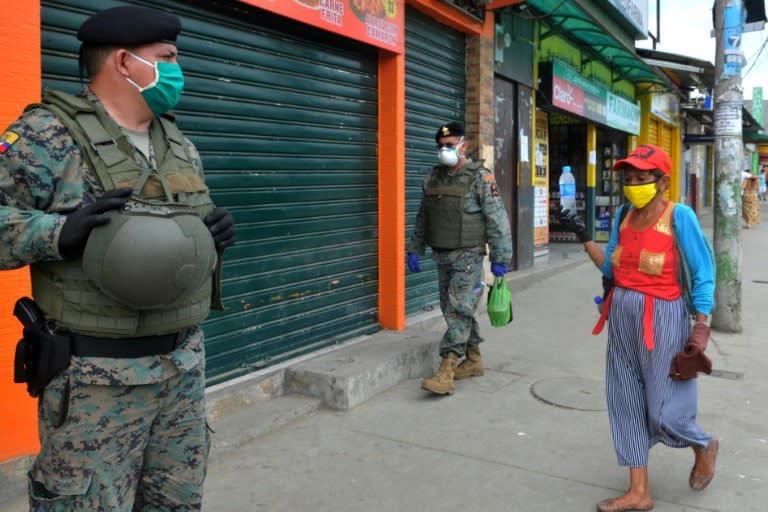
A similar crisis is taking hold in Ecuador, where hunger trumps fear of the virus for residents in rundown areas of the badly affected city of Guayaquil.

"The police come with a whip to send people running, but how do you say to a poor person 'Stay home' if you don't have enough to eat?" said Carlos Valencia, a 35-year-old teacher.

The city's mayor has warned that overstretched medical facilities have left many to die before they could be tested -- a reality that could be hiding the true extent of the carnage in many poorer places.

However, in parts of the world that saw early outbreaks, there were some hopeful examples of life carrying on.

Wearing compulsory face masks and gloves, South Koreans went to the polls on Wednesday and delivered a strong show of support for President Moon Jae-in, commending his handling of the epidemic.

Once home to the world's second-largest outbreak, South Korea has largely brought the virus under control through widespread testing, contact-tracing and social distancing.

burs-ssm-nl
ER doctor and Ebola survivor to Trump: Build World Health Organization, don't tear it down

Dr. Craig Spencer, Opinion contributor, USA TODAY Opinion•April 15, 

President Donald Trump has halted U.S. funding for the World Health Organization and is reviewing how it has handled the coronavirus. As an emergency room doctor in New York City, a global health expert and an Ebola survivor, I welcome the chance to weigh in.

The president may remember me from 2014. He was still a private citizen, and I was recently returned from Guinea, where I contracted Ebola while treating sick patients with Doctors Without Borders. Thanks to the world-class care I received from my medical team, I recovered from the deadly disease and have spent the past six years advocating for greater investment in global health infrastructure.

I am no stranger to the consequences of the WHO's inefficiencies, having personally witnessed its slow response to the Ebola epidemic in West Africa. Saddled by an ambiguous mandate and the competing demands of its donor countries, the organization is forced into a near-constant state of reaction rather than preparation. Limited funding leads to limited capacity, which leads to suboptimal operations; in this case, suboptimal is often the difference between life and death.

But to doubt the importance of the World Health Organization is to misunderstand the nature of our international health system and its connection to global stability.

10 ventilators for an entire nation

Today, America — the most powerful country in the world — finds itself woefully underprepared to fight a disease that we have known about for four months. I have personally witnessed the devastating impact this virus has had on the most expensive health care system in the world.

Critical missteps in testing allowed the disease to spread quickly. Our supply of essential supplies, like personal protective equipment and ventilators, are dangerously strained. Our emergency rooms have become intensive care units.

World Health Organization headquarters in Geneva.

What happens when COVID-19 reaches countries with health systems less advanced than ours?

The spread of coronavirus will undoubtedly accelerate as it hits developing nations, where handwashing and physical distancing are luxuries affordable by few. In Burundi, a nation of nearly 11 million people, health care workers and communities are bracing for the first wave of coronavirus. A close friend working there estimated they have 10 ventilators. That’s for the entire country.

Sidelined in an emergency: I'm a physician assistant on furlough when I could be helping coronavirus patients

In the meantime, export restrictions in Europe are preventing medical aid organizations like Doctors Without Borders from shipping personal protective equipment and other vital supplies to countries in need.

In those places where contagion will be rampant and resources are most scarce, it is the World Health Organization that has boots on the ground and will be a vital partner in saving lives. Its teams will work to flatten the curve from Burundi to Bolivia, and in so doing, help prevent the continued transmission of the novel coronavirus across borders. They will stymie the progression of second waves like those we are actively suppressing in Asia. And they will keep the disease from coming back to America’s shores, where we have already sacrificed so much to defeat it.

Build up WHO, don't tear it down

On a good day, the World Health Organization manages to support national health plans and emergency responses in more than 150 countries with an annual global budget smaller than that of one New York City hospital system. It is also the only organization in the world with the infrastructure and ability to identify emerging diseases, as it did with COVID-19 and every major health threat in modern history. They are our eyes and ears around the world.

So I’m ready to follow President Trump’s lead, albeit from a different angle. Let’s really look at the World Health Organization and what it does for us.

Let’s talk about strengthening — not diminishing — our collective ability to shorten this pandemic and prevent the next.

Let’s clarify the World Health Organization’s mandate as an international network for disease surveillance and an operational partner for pandemic response.

And let’s agree that we must align our expectations with our investment. If we truly want to anticipate public health threats and save lives, we must build up in the World Health Organization, not tear it down.

Craig Spencer, MD MPH, is the director of global health in emergency medicine at New York-Presbyterian/Columbia University Medical Center and an assistant professor of emergency medicine and population and family health at the Columbia University Mailman School of Public Health. He serves on the board of directors of Doctors Without Borders/Médecins Sans Frontières USA. Follow him on Twitter: @Craig_A_Spencer

You can read diverse opinions from our Board of Contributors and other writers on the Opinion front page, on Twitter @usatodayopinion and in our daily Opinion newsletter. To respond to a column, submit a comment to letters@usatoday.com.

This article originally appeared on USA TODAY: Coronavirus highlights why we need World Health Organization: ER doctor
Coronavirus: Trump's WHO de-funding 'as dangerous as it sounds'

BBC•April 15, 2020


US President Donald Trump has been heavily criticised for halting funding for the World Health Organization (WHO) amid the global coronavirus pandemic.

Philanthropist Bill Gates, a major funder of the WHO, said it was "as dangerous as it sounds".

President Trump said on Tuesday that the body had "failed in its basic duty" in its response to coronavirus.

The head of the WHO said it was reviewing the cuts' impact "to ensure our work continues uninterrupted".

"We regret the decision of the President of the United States to order a halt in the funding to the WHO," Director-General Tedros Adhanom Ghebreyesus said at a press conference, adding that the US has been "a long-standing and generous friend... and we hope it will continue to be so".

Earlier on Twitter he said it was the agency's "singular focus" was to stop the outbreak.

UN Secretary General António Guterres said it was "not the time" to cut funds to the WHO, which "is absolutely critical to the world's efforts to win the war against Covid-19".


Follow live coronavirus updates


Is President Trump right to criticise the WHO?


The WHO row, explained

Mr Trump has accused the WHO of making deadly mistakes and overly trusting China.

"I am directing my administration to halt funding while a review is conducted to assess the World Health Organization's role in severely mismanaging and covering up the spread of the coronavirus," Mr Trump told reporters on Tuesday.

A White House statement on Wednesday said the agency had "failed" the US people.

"The American people deserve better from the WHO, and no more funding will be provided until its mismanagement, cover-ups and failures can be investigated," it read.
WHO funding

Mr Trump has been under fire for his own handling of the pandemic. He has sought to deflect persistent criticism that he acted too slowly to stop the virus's spread by pointing to his decision in late January to place restrictions on travel from China.

He has accused the WHO of having "criticised" that decision, an apparent reference to general advice from the agency against travel restrictions.

The US is the global health body's largest single funder and gave it more than $400m in 2019. The Bill and Melinda Gates Foundation, which is funding Covid-19 treatment and vaccine research, is the second-largest funder.

Halting funding for the World Health Organization during a world health crisis is as dangerous as it sounds. Their work is slowing the spread of COVID-19 and if that work is stopped no other organization can replace them. The world needs @WHO now more than ever.
— Bill Gates (@BillGates) April 15, 2020

A decision on whether the US resumes funding will be made after the review, which Mr Trump said would last 60 to 90 days.

In other reaction:

A spokesman for UK Prime Minister Boris Johnson said there were "no plans" to halt funding and said the WHO had "an important role to play in leading the global health response". The UK gives most of any country apart from the US

Germany's foreign minister Heiko Mass tweeted that strengthening the "under-funded" WHO was one of the best investments that could be made at this time

Chinese foreign ministry spokesman Zhao Lijian said that the decision would "undermine international co-operation" in fighting the virus

The American Medical Association said it was a "dangerous step in the wrong direction"

There was no justification for the move at a time when the WHO was "needed more than ever", said the EU's foreign policy chief Josep Borrell

Australian PM Scott Morrison said he sympathised with Mr Trump's criticisms but that the WHO also does "a lot of important work"

New Zealand leader Jacinda Ardern said the WHO had provided "advice we can rely on"

The president was doing "whatever it takes to deflect from the fact that his administration mismanaged this crisis", said Democratic representative Eliot Engel

The decision was "exactly right", said US Senator Josh Hawley, among many Republicans who share Mr Trump's views on the WHO
What is Donald Trump's argument?

The US has by far the highest number of coronavirus cases and deaths worldwide - with more than 600,000 cases and 26,000 deaths.

Mr Trump accused the WHO of having failed to adequately assess the outbreak when it first emerged in the city of Wuhan, losing precious time.

"Had the WHO done its job to get medical experts into China to objectively assess the situation on the ground and to call out China's lack of transparency, the outbreak could have been contained at its source with very little death," he told reporters.

"This would have saved thousands of lives and avoided worldwide economic damage. Instead, the WHO willingly took China's assurances to face value... and defended the actions of the Chinese government."
What is the WHO - and who funds it?

Founded in 1948 and based in Geneva, Switzerland, it is the UN agency responsible for global public health

Has 194 member states, and aims to "promote health, keep the world safe and serve the vulnerable"

Involved in vaccination campaigns, health emergencies and supporting countries in primary care

Funded by a combination of members' fees based on wealth and population, and voluntary contributions

US provided 15% of its 2018-19 budget - with more than $400m

China gave about $86m in 2018-19

Chinese officials initially covered up the outbreak of the virus in Wuhan, and punished whistleblowers who tried to raise the alarm. Beijing later imposed draconian restrictions, including quarantine zones on an unprecedented scale, drawing effusive praise from the WHO and Mr Tedros.

But WHO experts were only allowed to visit China and investigate the outbreak on 10 February, by which time the country had more than 40,000 cases.

White House reporters pointed out, however, that Mr Trump himself had praised China's response to the outbreak and downplayed the danger of the virus at home long after the WHO had declared a "public health emergency of international concern".

China has been working very hard to contain the Coronavirus. The United States greatly appreciates their efforts and transparency. It will all work out well. In particular, on behalf of the American People, I want to thank President Xi!
— Donald J. Trump (@realDonaldTrump) January 24, 2020

Why has the WHO faced criticism?

It is not the first time the WHO's response to the outbreak has come under scrutiny.

On 14 January, the organisation tweeted that preliminary Chinese investigations had found "no clear evidence of human-to-human transmission" of the new virus.

Mr Trump and others have used the tweet to attack the WHO for simply believing China, despite evidence to the contrary. But about a week after that tweet, on 22 January, the agency released a public statement saying that human-to-human transmission did appear to be taking place in Wuhan.

At the end of January, on the same day it declared a public health emergency, the WHO said that travel restrictions were not needed to stop the spread of Covid-19 - advice that was eventually ignored by most countries, including by the Trump administration the next day.

The man leading the fight against the coronavirus

In March, the UN agency was also accused of being unduly influenced by China after a senior official refused to discuss Taiwan's response to the outbreak.

Meanwhile, some health experts also say that the WHO's guidance on face masks has led to public confusion.

Other frequently-made criticisms of the WHO more generally are that it is constrained by politics and a sprawling bureaucracy. It came under particular fire for its response to the 2014-16 Ebola outbreak in West Africa and how long it took to declare a public health emergency, leading the organisation to announce reforms in response.


As virus hits South America, Brazil's president mocks threat


CBS News•April 15, 2020


South America is struggling to stop the coronavirus from spreading, and cases in countries like Brazil and Ecuador are likely being underreported, researchers say. Brazil has reported more than 25,000 cases, but researchers believe the real number could be 10 times higher.

Protecting Brazil's poorest neighborhoods is often a do-it-yourself project. Locals were seen fumigating on their own and makers of Carnaval costumes are sewing medical scrubs.

Even as cases spike, the country's autocratic president, Jair Bolsonaro, continues to mock the virus' threat, posting on YouTube cheery appearances at doughnut shops and glad-handing with supporters.

Just two countries over, in Ecuador's largest city, Guayaquil, nearly 2,000 bodies have reportedly been collected for burial, some in cardboard caskets. Many were left in the streets for days.

"This is a generational event," Dr. Luis Yepez told CBS News correspondent Manuel Bojorquez from Guayaquil's largest hospital. "We've never lived through an emergency like this."

The biggest problem, he said, "is that when social distancing was requested, people didn't take it as seriously as they should have."

Many found social distancing impossible, said Alexandra Moncada, the director of the organization Care in Ecuador.

"People cannot afford to stay in their houses if they have no income," she said.

Moncada said Latin America's severe inequalities, poor social safety net and fragile infrastructure were all laid bare in Guayaquil, a warning for the region as the virus spreads.

"If our governors don't provide examples and have clear messages that the population should stick to … it's more difficult to ensure a rapid overcome of the situation," she said.

Coronavirus could 'decimate' Latino wealth, hammered by the Great Recession

Suzanne Gamboa and Nicole Acevedo, NBC News•April 12, 2020
Octavia Nieto worked for over 10 years as a pastry chef at a bakery in Princeton, New Jersey. Now with the business closed indefinitely, she relies on a part-time job with a cleaning company.

“I’m making about $170 a week. What can I do with that? Not much. The other day I went to the store to get some essential things and it was like $30,” Nieto said, adding she only has enough savings for two months.

“When I think about what the future will bring us, I don’t even know what that looks like,” Nieto said.

The economic fallout from the coronavirus pandemic is dealing a hard-hitting blow to Latinos who barely recovered from the hammering they took in the Great Recession, raising the possibility of a setback from which many may not recover.

Millions of Latino families were just bouncing back from losing 66 percent of their household wealth, lagging far behind their white peers. During the Great Recession, Latino median household wealth plummeted from $18,359 in 2005 to $6,325 in 2009, the largest of any racial or ethnic group, according to Pew Research Center.

But the pandemic has left many out of work and pushed Latino business owners to the brink of shutting down. The crisis has either erased or is threatening to erase Latinos’ decade-long climb back to financial stability.

“Our communities will be decimated" economically by the coronavirus, said Nancy Santiago Negrón, a former Obama administration official and a founding team member of Ureeka, a platform that seeks to help entrepreneurs boost their small to medium businesses.

“After the smoke clears up, we will see a zap of our small businesses. We will see families without income. It would be entire communities having lost all their wealth and all their assets," she said.

While the pain from the pandemic crosses all races and ethnicities, experts say Latinos stand to endure a deep economic blow due to persistent income inequality, disparities in wealth, the fragility of Latino small businesses and the large number of Latinos employed in service industries such as hotels, restaurants and retail stores — many of which have been forced to shut down.

"Eighty-four percent of Hispanics in the United States don’t have jobs that allow them to stay home," said Rep. Joaquin Castro, D-Texas, chair of the Congressional Hispanic Caucus.
A crisis away from financial disaster

Tasha Mora, 43, and her husband, Angel, 45, have owned an automotive service and a towing business in Austin, Texas, for about the past two decades. They weathered the downturns that came after the Sept. 11, 2001, terrorist attack and the Great Recession. During that time, their businesses grew to include 24 employees, many of them Latino, Tasha said.

But they now find themselves filling out the forms required to get a payroll protection loan that Congress made available in one of the coronavirus relief packages. Even though their towing business is considered an essential service, they’re struggling to stay afloat as reduced traffic, waived parking and other regulations have cut the need for their services, according to Mora.

“There is no revenue to cover pay, so we are tapping into a reserve that we had. That reserve is very, very quickly depleting,” she said, adding that they’re trying their best to keep the business open and maintain their workers’ health coverage, without laying anyone off.
Image: Angel Mora, Tasha Mora (Tasha Mora)

More than half of Latino families live one crisis away from financial disaster and wouldn't be able to cover basic expenses for three months in the event of an economic burden, according to the National Community Reinvestment Coalition, a nonprofit targeting discrimination in lending, housing and business practices.

“This pandemic has come at a time when it is likely to put more Latinos who are working in service industries either out of work or in tougher positions than they were prior,” Mark Hugo Lopez, director of global migration and demography research at Pew Research Center, told NBC News.

Latinos recently surveyed by Pew Research were more likely to say they’ve had to take a pay cut or had lost a job as a result of the coronavirus pandemic and downturn. They also were more likely to say they are worried about their financial health and personal health than the general public.

In addition, millions of Latinos and their families were left out of the assistance packages that Congress passed because those who apply must have a Social Security number. People who pay taxes with an Individual Tax Identification Number (ITIN) or those who live with someone who uses an ITIN to pay federal taxes also are excluded, which affects many Latino families whose members have a mix of citizenship and immigration status.

“The virus doesn’t check immigration papers before spreading into a community,” said Frankie Miranda, president of the Hispanic Federation, a Latino advocacy group.
The Latino wealth gap and the fate of small businesses

Latino median incomes rebounded to about $30,000 by 2017, about 5 percent higher than in 2007, and this February unemployment was at 4.4 percent.

While the wealth gap had narrowed in the past decade, it grew for middle-income Latino families, Pew Research reported.

Latino small businesses had begun to emerge from the recession. In 2012, the latest year for which census information is available, Latino-owned businesses were one in four new businesses and were estimated to have 2.3 million employees on payroll, according to a 2018 study by Stanford.

Because so many new Latino businesses were starting, contributing about $700 billion to the economy, they had been hailed for driving small business growth.

But the coronavirus, like the Great Recession, is exposing businesses’ precarious positions.

“Many of our small businesses are small and they are fragile. They have 27 days of working capital, on average, and many of them employ Latinos,” Ramiro Cavazos, president and CEO of the U.S. Hispanic Chamber of Commerce, said Wednesday in a virtual town hall hosted by the League of United Latin American Citizens.

Of the 30 million U.S.-owned businesses, 4.5 million are Latino owned, but only half have a relationship with a bank, meaning half are “in trouble” trying to figure out how to make rent or pay employees, Cavazos said. Most information on getting help from the federal government is not in Spanish and the chamber is trying to translate and provide information.

“We need liquidity now for our businesses," he said, "for many of them they don’t have the ability to get the lending they need."
Seeking help amid the urgency

Latino families' economic recovery depends heavily on the well being of Latino-owned small businesses that are often in their communities and employ Hispanics, Santiago Negrón said.

Congress expanded an existing small business loan program and created the Paycheck Protection Program in one of the coronavirus relief bills. But demand is quickly outstripping available funding.

Latino businesses often bank with smaller financial institutions that have fewer amounts to dole out for loans. Larger banks have more restrictions and are prioritizing businesses that already bank with them.

The U.S. Hispanic Chamber of Commerce has created a technical assistance guide and webinar to guide businesses on where to find money and how to apply for it. Local Hispanic chambers also are providing information.

In addition, the New York Federal Reserve Bank has created a resource center where individuals, businesses and nonprofits can get information on what's available at the federal, state and city level.

Santiago Negrón's organization partnered with 1863 Ventures, a nonprofit focused on empowering entrepreneurs of color, to provide free webinars and virtual mentorship opportunities to help them access resources such as loans or grants for businesses and nonprofits. Ureeka recently partnered with Facebook, which is giving $40 million in grants to help 10,000 American small businesses survive the economic impacts of the coronavirus.

Meanwhile, small-business owners like the Moras are holding on as they try to keep other families afloat.

“We are going to pull through this because we’ve learned to navigate through hardship and very limited means," Mora said. "But it may cost us now because our heartstrings are involved, and we are trying to do the best for our team."

Suzanne Gamboa reported from Austin, and Nicole Acevedo from New York.
Virus hit 'like a bomb' as toll rises in Ecuador's business capitalSantiago PIEDRA SILVA à Quito, AFP•April 14, 2020


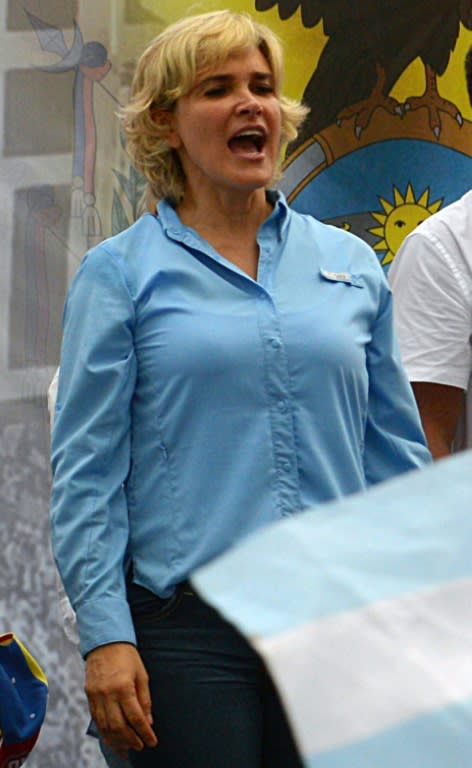
Guayaquil (Ecuador) (AFP) - Ecuador's economic capital Guayaquil is reeling from the most aggressive outbreak of COVID-19 in Latin America after the pandemic hit the city "like a bomb," its mayor said.

Cynthia Viteri has emerged from her own bout with the virus to battle the worst crisis the port city of nearly 3 million people has known in modern times.

"There is no space for either the living or the dead. That's how severe the pandemic is in Guayaquil," Viteri told AFP in a phone interview Monday.

Mortuaries, funeral homes and hospital services are overwhelmed, and Viteri said the actual death toll from the virus is likely much higher than the official national figure of 369.

Guayaquil accounts for more than 70 percent of Ecuador's 7,600 infections since February 29.

- 'Unprepared' -


The 54-year-old mayor admitted the city was "unprepared" for the onslaught: "Nobody believed that what we saw in Wuhan, people falling dead in the streets, would ever happen here."

Now authorities are forecasting a death toll of more than 3,500 in the city and its hinterland in the coming months.

Guayaquil proved especially vulnerable to the virus because of its air links to Europe, Viteri said.

The first case of infection -- Ecuador's "patient zero" -- was of an elderly Ecuadoran woman who arrived from Spain.

"This is where the bomb exploded, this is where patient zero arrived, and since it was vacation time, people traveled abroad, some to Europe or the United States, and our people who lived in Europe came here," Viteri said.

"And when they arrived there were no controls like they should have been if we had known that this was already coming by air. And the city of Guayaquil simply convulsed. "

Too late, the city went into lockdown as authorities imposed a 15-hour curfew and bodies began to accumulate in homes, and even on the streets.

"The health system was obviously overwhelmed, the morgues overflowed, the funeral homes overflowed."

Guayaquil's authorities "are not the villains of the world," Viteri insisted.

"We are the victims of a virus that came by air" that she said echoed the yellow fever that devastated the city when it came over the sea from Panama in 1842.

"A bomb exploded here. Other places received only the shock waves. But the crater remained here in Guayaquil."

- Counting the dead -

Coffins are seen stacked high on a pick-up truck and trailer as it passes a hospital in Guayaquil, Ecuador (AFP Photo/Jose Sánchez)


Viteri said the number of coronavirus deaths in the city is likely far higher than the official figure "for a single reason -- because there are no tests to determine how many people are actually infected in the city and in the country."

She continued: "Patients are dying without ever having had a test. And there is no space, time or resources to be able to carry out subsequent examinations and to know whether or not they died from the coronavirus.

"In the month of March alone, there were 1,500 more deaths than in the month of March last year.


The true number will be known once this tragedy, this nightmare, ends."

People are continuing to "collapse in their houses, in the hospitals, all over the place," she said, because the normal medical services are overwhelmed.

"There are still women who need to give birth, people are still being run over, people still have diabetes and hypertension."

She said just last month alone "100 people" had died because they were unable to get dialysis treatment.

"Why? Because there is no space. Because we are stretched to breaking point, our doctors have fallen sick too."

Around 50 people from her own municipal staff had died, she said.

Viteri said her task now was to bring all the city's financial resources to bear on buying test kits, with $12 million already earmarked, to be able to detect, isolate and monitor positive cases.

"For me there is no other way," she said.

"We have to look after the living, and provide a decent burial for the dead. We are living in a war.

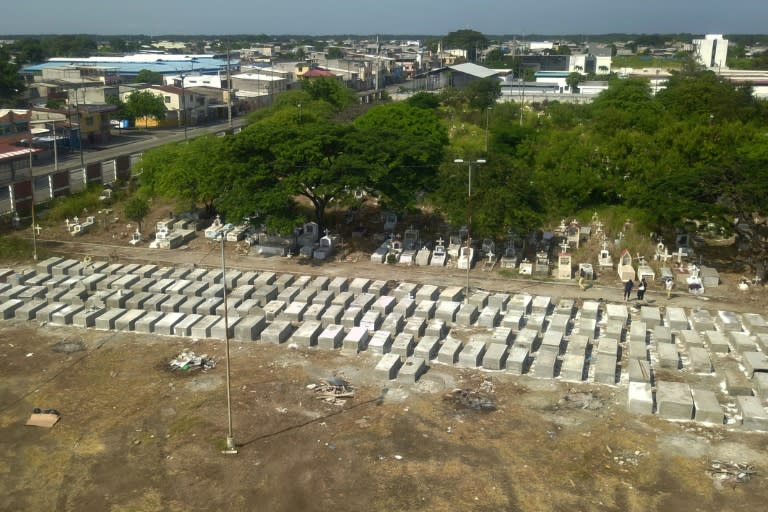
Responding to a spate of nightmarish media stories about bodies accumulating in hospitals, homes and streets, the city was making two new cemeteries available to bury the dead and relieve pressure on city morgues.

"The bodies are being collected daily," Viteri said.

"But this is very hard because it means there is mourning every day in Guayaquil."

Guayaquil barrio where hunger is more feared than COVID-19


Xavier LETAMENDI,AFP•April 14, 2020

A child remains inside his home as his relatives sit out the COVID-19 epidemic in Guayaquil, Ecuador's Nigeria neighborhood (AFP Photo/Jose Sanchez LINDAO)


Guayaquil (Ecuador) (AFP) - When the curfew falls, a cat and mouse game begins between police and residents in a rundown barrio in Guayaquil, the city at the heart of Ecuador's coronavirus crisis.

Contagion is seen as the lesser of two evils. People here say confinement is worse than depriving them of food. They know hunger and fear it more than COVID-19.

"The authorities are saying to families: stay inside your house, but they don't see beyond that -- the need before we had this, as well as right now, is worse!" says Washington Angulo, 48, a community leader in the Afro-Ecuadoran neighborhood of Barrio Nigeria.

Tensions fray here around 2:00 pm every day when the 15-hour curfew imposed by the government against the spread of the coronavirus begins. That's when a peculiar game of hide-and-seek begins.

"The police come with a whip to send people running, but how do you say to a poor person: 'Stay home,' if you don't have enough to eat?" said Carlos Valencia, a 35-year-old teacher.

Reports have flared on social media of the police using excessive force. But Valencia acknowledges that as soon as the officers leave, local people are out on the streets again. Until the police return to chase them home again.


- No protection -

Some 8,000 families live in Barrio Nigeria on the Mogollon estuary, on a finger of the Pacific that stretches inland.

Guayaquil is one of the worst hit cities in Latin America, but there are no confirmed cases so far in Barrio Nigeria. Locals seem barely aware of the tragedy unfolding across the city, where many families have had to wait days for overwhelmed authorities to collect the bodies of their relatives, after local health and mortuary service systems collapsed under the weight of the pandemic.

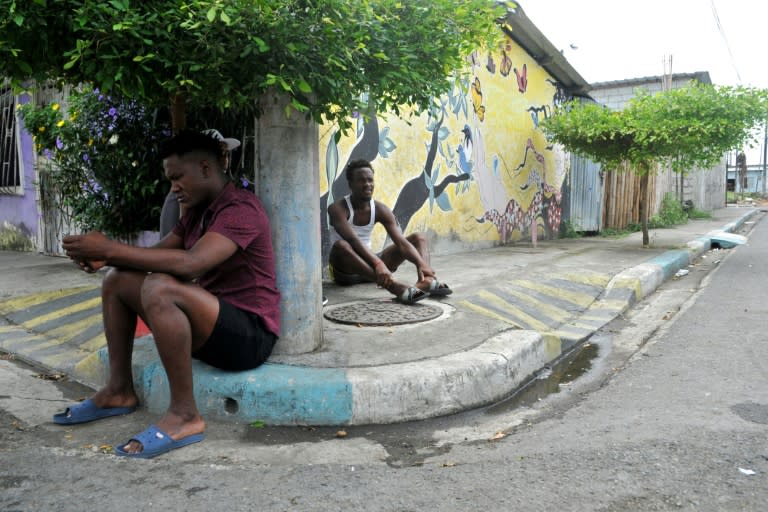
Men hang around street corners to chat, the younger ones playing impromptu soccer matches on the narrow streets. The women gather by the estuary and children play marbles on the street.

Nobody wears a mask, or gloves. Social distancing is non-existent here, handshakes are still exchanged in greeting.


Many families share the same small houses under a tin roof where temperatures can reach 32 degrees Celsius (90 degrees Fahrenheit) in this Pacific coast city.

There is no air conditioning or ventilators, just a television to combat the boredom.

- Empty fridges -

Many of the residents of Barrio Nigeria come from the Esmeraldas province, on the border with Colombia.

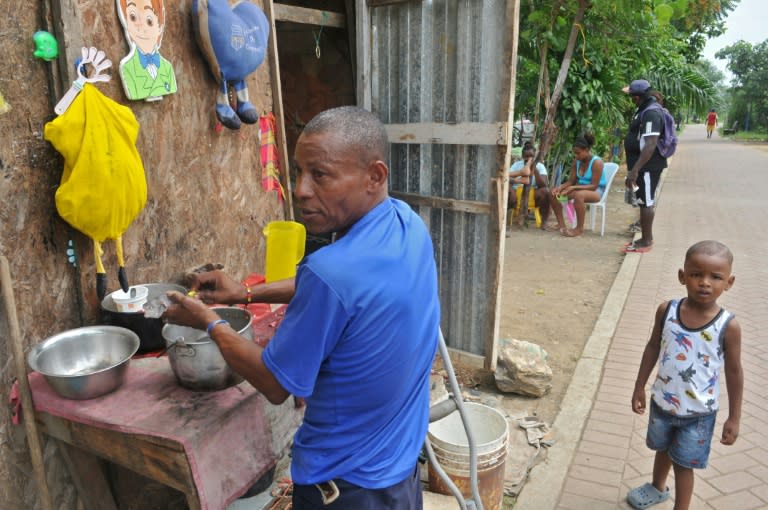
The pandemic has left most of the locals, who make their living as informal vendors, recyclers, cooks or car park attendants, unemployed.

The authorities, through donations from private companies, have been trying to alleviate the worst of the crisis with grocery handouts.

"Some tuna, noodles, that's not enough. There isn't even a piece of meat or cheese. Fresh produce doesn't reach here. We are living a difficult life," said Angulo.

Others have received nothing at all. Marcial Vernaza, 61, is furious as he stands at his front door.

"Open the fridge and there's nothing to see but ice in there. I have nothing. My son is asking me for food."

Even fried rice, the most common dish in Barrio Nigeria, is in now a rare treat, after the price of eggs doubled, according to Vernaza, who hasn't worked in a year.

In the midst of the economic crisis paralyzing the country, the government is providing a $60 subsidy to the poorest families.

Fulton Ordonez, a 52-year-old left lame by polio as a child, hopes someone will eventually come to help him at his small wood cabin by the estuary.

"I'm afraid they'll kick me out of here," he said, the virus playing no part in his fears.


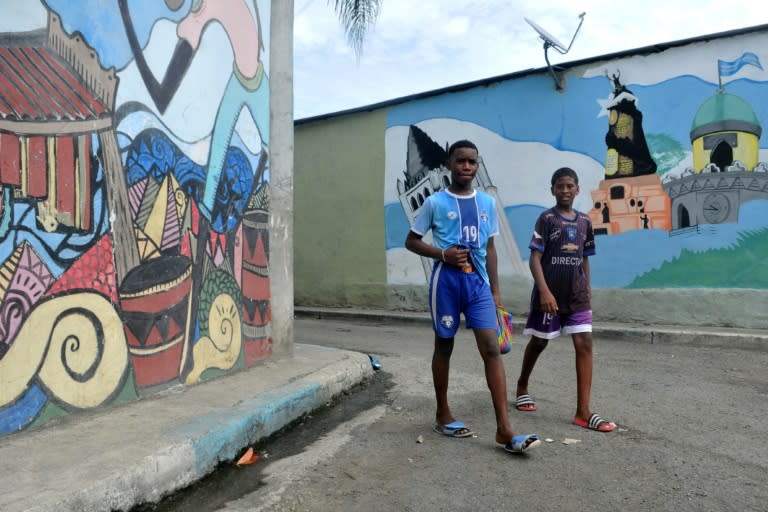
Children walk along a street of the Nigeria neighborhood in Guayaquil, Ecuador, a port city where hundreds of people have died of COVID-19 (AFP Photo/Jose Sanchez LINDAO)
THE MOST VALUED ENDORSEMENT
Elizabeth Warren endorses Joe Biden for president
Announcement follows endorsements this week by former President Barack Obama and Senator Bernie Sanders


Oliver O'Connell THE INDEPENDENT New York Wednesday 15 April 2020 


Elizabeth Warren has endorsed Joe Biden for president.

The Massachusetts senator made the announcement on Wednesday morning, following endorsements by former President Barack Obama on Tuesday, and Senator Bernie Sanders on Monday.

“In this moment of crisis, it’s more important than ever that the next president restores Americans’ faith in good, effective government — and I’ve seen Joe Biden help our nation rebuild. Today, I’m proud to endorse Joe Biden as President of the United States,” she said on Twitter.

In an accompanying video, Senator Warren speaks about Mr Biden’s life story and how his experiences “animate the empathy he extends to Americans who are struggling no matter what their story.”


Speaking of the task facing Mr Biden should he win November’s election, Ms Warren refers to his experience in rebuilding the nation after the global financial crisis through the implementation of the Recovery Act in 2009.


“I saw him up close, doing the work, getting in the weeds, never forgetting who we were all there to serve,” she said.


Senator Warren ended her own campaign for president in March, and since then has spoken multiple times to Mr Biden about policy issues, according to Reuters.

Following the departure of both Ms Warren and Mr Sanders from the race, the Biden campaign has moved left in an effort to attract their supporters.

In terms of policy, this has meant a shift in approach towards student debt and Medicare, as well as adopting Senator Warren’s plan on bankruptcy — surprising since the two had previously clashed over the issue.

In her endorsement video, she praised Mr Biden’s ability to adapt.

“One thing I appreciate about Joe Biden is he will always tell you where he stands,” she said.

“When you disagree – he’ll listen ... And he’s shown throughout this campaign that when you come up with new facts or a good argument, he’s not too afraid — or too proud — to be persuaded.”


WHEN BIDEN ADOPTS MEDICARE FOR ALL, EVEN AS ASPIRATIONAL,  I WILL BELIEVE HE IS THE BEST CANDIDATE TO REPRESENT THE DEMOCRATIC MAJORITY IN THE USA