Monday, June 23, 2025


The Key Nuclear Allegation That Started The War Was Coaxed From A Palantir Counter-Intelligence Algorithm – OpEd
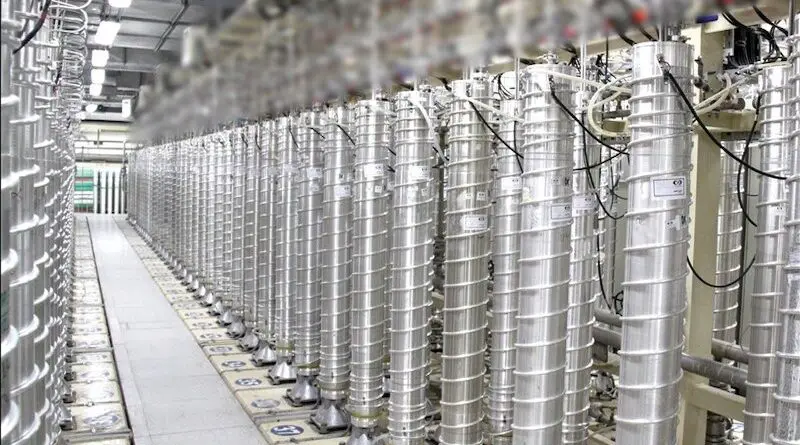
Centrifuges in Iran's Fordow Nuclear Facility. Photo Credit: Tasnim News Agency


By 

The IAEA Board’s ‘Non-Compliance’ Resolution on 12 June 2025 was the planned precursor for Israel’s ‘bolt from the blue’ strike on Iran the next day. Israelis say the plan to go to war with Iran was grounded in ‘the opportunity’ to strike, and not the intelligence that Iran was speeding towards a bomb (that was the peg for war). 


The sudden claim of Iran being very close to a bomb (that seemingly jumped out of ‘nowhere’ to leave Americans puzzling how could it happen that – in the blink of eye, we are going to war – was subsequently refuted by IAEA Chief Grossi to CNN on 17 June (but only after the abrupt attack on Iran already had taken place):

We did not have any evidence of a systematic effort [by Iran] to move to a nuclear weapon”, Grossi confirmed on CNN.

This statement drew the following riposte from Iran by its Foreign Ministry Spokesman, Esmaeil Baqaei on 19 June

“This is too late, Mr. Grossi – you obscured this truth in your absolutely biased report that was instrumentalized by E3/U.S. to craft a resolution with baseless allegation of [Iranian] ‘non-compliance’; the same resolution was then utilized, as a final pretext, by a genocidal warmongering regime to wage a war of aggression on Iran and to launch an unlawful attack on our peaceful nuclear facilities. Do you know how many innocent Iranians have been killed/maimed as a result of this criminal war? You turned IAEA into a tool of convenience for non-NPT members to deprive NPT members of their basic right under Article 4. Any clear conscience?!”.

To which Dr Ali Larijani, Advisor to the Supreme Leader, added:


“When the war ends, we will hold the director of the IAEA, Rafael Grossi, accountable”.

What they are saying: 

The Russian Foreign Ministry’s Statement, in relation to the escalation of the Iranian-Israeli conflict –

“It was precisely these “sympathisers” [EU3] who exerted pressure on the leadership of the [IAEA] Agency to prepare a controversial “comprehensive assessment” of Iran’s nuclear programme, the flaws of which were subsequently exploited to push through a biased anti-Iran resolution at the IAEA Board of Governors on 12 June [2025]. This resolution effectively provided a green light to actions by West Jerusalem, leading to tragedy” [i.e. to the sneak attack on the immediate day after, 13 June].

Behind the scenes: 

The underpinnings to the 12 June 2025 IAEA Resolution – giving pretext for Israel to strike Iran (and crafted to sway President Trump to dismiss his own Director of National Intelligence’s warnings that there was no evidence of Iran moving towards weaponisation) – reportedly were drawn not from Mossad or other western intelligence services, but from IAEA software. As DD Geo-politics outlines, since 2015, the IAEA has relied on Palantir’s Mosaic platform, a $50-million AI system that sifts through millions of data points – satellite imagery, social media, personnel logs – to predict nuclear threats:

Iran’s stockpile [of enriched uranium] had been growing steadily for months—yet the narrative of an imminent breakthrough surged only after the IAEA’s censure on June 6, 2025. That resolution, adopted 19–3, provided Israel the diplomatic cover it needed. Palantir’s Mosaic platform played a critical role in this pivot. Its data shaped the May 31 report, flagging anomalies at Fordow and Lavisan-Shian, and recycling prior allegations from Turquzabad—despite years-old Iranian denials and sabotage … Mosaic was conceived originally to identify insurgent activity in Iraq and Afghanistan”.

Its algorithm looks to identify and infer ‘hostile intent’ from indirect indicators – metadata, behavioral patterns, signal traffic – not from confirmed evidence. In other words, it postulates what suspects may be thinking, or planning. On 12 June, Iran leaked documents, which it claimed showed IAEA chief Rafael Grossi sharing Mosaic outputs with Israel. By 2018, Mosaic had processed more than 400 million discrete data objects and had helped impute suspicion to over 60 Iranian sites such as to justify unannounced IAEA inspections of those sites, under the JCPOA. These outputs, though dependent largely on the algorithmic equations, were incorporated into formal IAEA safeguard reports and were widely accepted by UN member states and non-proliferation regimes as credible, evidence-based assessments. Mosaic however is not a passive system. It is trained to infer from its algorithm hostile intent, but when repurposed for nuclear oversight, its equations risk translating simple correlation into malicious intent.

What leading Israeli commentators are saying:

Leading Israeli centre-right commentator, Ben Caspit (Ma’ariv):

“Was Iran’s ‘breakthrough’ to the nuclear weapon actually detected? Probably not. Was the [Supreme] Leader’s “order” to achieve a military nuclear weapon actually given? Probably not. So why did we go to war? Because there was no choice. They were promoting an Israeli annihilation plan and we had no choice… October 7: A cold shower woke up an entire country. All those involved need to understand that anyone who contemplates our destruction will be destroyed. Eyes on the ball and a bullet between the eyes … From now on, every move one of our enemies makes somewhere must be followed by action. Every snake’s head that rises must be beheaded … And there is something else: the rare and one-time historical window of opportunity that suddenly opened before us … All of this made the decision to go to this war the right one … Netanyahu is currently in euphoria”.

Israeli commentator, Nahum Barnea (Yedioth Ahoronot):

“The decision to start a war was all Netanyahu’s. And here he is, deciding and responsible: all the credit is his. Trump gave Israel the green light to start a war, provided that it does not present America as a partner and responsible. The Trump method does not distinguish between Zelensky’s Ukraine and Khamenei’s Iran: humiliation along the way is the guarantee of an agreement in the end”.

Israeli & NY Times commentator, Ronan Bergman (Yedioth Ahoronot):

“The need for the series of assassinations last week first emerged as a thought last September, among senior officials in Unit 8200, the research division in the Intelligence Directorate, the Mossad, and other parts of the system. The trigger was the defeat inflicted by the IDF on Hezbollah, followed by the successful attack on Iran and the destruction of its air defence system in October, followed in December by the collapse of the Assad regime in Damascus and the destruction of its air defence system by the IDF. The sequence of events led many senior Israeli officials to believe that an unprecedented opportunity had arisen, a window of a lifetime, to attack Iran… And so the beheading forum, which decided the fates of scientists thousands of miles away, sat down and decided who would be ranked at level A – the highest importance – and who at levels B, C or D – the lowest”.

Big Picture:

Seemingly, Trump had been convinced by Netanyahu, Ron Dermer and CENTOM’s General Kurilla (Politico reports that Kurilla was instrumental in persuading Trump that DNI Tulsi Gabbard was wrong in her assessment that Iran had ‘no bomb’). Trump sided with the Israelis, asserting that Iran was “very close” to having a bomb, and added that he ‘didn’t care what she [Gabbard] thinks’. Trump did speculate out loud – the day before the sneak 13 June – that an Israeli attack (on Iran) “could speed [up] a deal”. There is little doubt that Syria’s unexpectedly sudden ‘fall’ galvanized the neo-cons to imagine they might quickly repeat the exercise in Iran. This is why, too, so much emphasis is beinglaid on assassinating the Supreme Leader. When Iran did not collapse; when the Iranian system rebooted itself unexpectedly swiftly; and when Iran’s retaliatory strikes on Israel began, the pro-Israeli bloc panicked and exerted tremendous pressure on Trump for the U.S. to enter the war on Israel’s behalf.

This left Trump facing a terrible dilemma – having to choose between the sirens, Scylla and Charybdis – either to alienate his MAGA support base (who voted for him precisely to prevent the U.S. joining another forever war (thus likely causing a GOP loss at the next midterms)), or to alienate his ultra-rich Jewish donors (such as Miriam Adelson, whose money holds sway over Congress, and whose resources are harnessed by the Deep State to pursue mutual interests with the Israeli-Firsters), who would turn against him.

Shades of Iraq and the Colin Powell role…


Alastair Crooke

Alastair Crooke is a former British diplomat, founder and director of the Beirut-based Conflicts Forum.


Deciphering starfish communication may help protect coral reefs


By mimicking one of their own scents, researchers have found an efficient method of a controlling the highly destructive Crown-of-Thorns Starfish.


Okinawa Institute of Science and Technology (OIST) Graduate University

Toxicity and behavioral assays of CoTS synthetic peptides 

image: 

The main findings from experiments with the synthetic peptide mixture (SPM). A) shows a toxicity assay in which brine shrimp (Artemia salinia) are subjected to various concentrations of the SPM, showing a very high survival rate. The dips in survival rate at the end of the experiment are most likely caused by natural factors.

B) shows cumulative heatmaps with the location of the CoTS in two separate flume assay tanks (left and right). Each tank contains two parallel, non-mixing water flows maintained under highly controlled conditions, with no turbulence or blending between the streams inside the tank. One flow – the “cue arm” – contains a steady concentration of the SPM, added to the flow at the white dot. CoTS were released at the boundary between the two flows in the tank, with warmer colors indicating areas where the starfish spend more time during the experiments.

C) and D) indicate the duration spent in each ‘arm’ of the tanks and the amount of meandering (a type of foraging or searching movement by the CoTS to infer the source of a chemical cue) respectively.

view more 

Credit: Harris et al., 2025


The Crown-of-Thorns Starfish (Acanthaster; CoTS) is native to reefs of the Indo-Pacific and plays a key role in maintaining ecosystem health. A single CoTS can consume up to 240 cm2 of coral tissue per day, roughly 10 m2 per year. On its own, this may not seem catastrophic. But during outbreaks, swarms counting thousands of starfish can strip hectares of coral tissue in just a few months. This overconsumption doesn’t just degrade reef health and stability by depleting hard-bodied, reef-building corals. It also damages long-term resilience, preventing reefs from adapting to their greatest threat: climate change. 

Currently, the main method of combatting CoTS outbreaks is by manually culling each starfish one-by-one, which is highly inefficient, labor-intensive, and costly. But now, a team of researchers from the Australian Institute of Marine Science (AIMS), the University of the Sunshine Coast in Australia, and the Okinawa Institute of Science and Technology (OIST) in Japan have discovered that CoTS use their characteristic spines to ‘smell’ peptides and communicate with one another, even outside mating seasons. Building on this finding, the team has created a synthetic peptide that consistently attracts CoTS at very low concentrations and with no toxicity. The results are published in iScience. Their discovery could lead to the further development of potent pest-management peptides – dubbed Acanthaster attractins – that prompts the starfish to congregate at one spot, enabling the efficient removal of many CoTS in one sweep.

“Through genomic and proteomic analysis, we found that the CoTS spines are used to both sense and secrete a wide range of peptides – not just defensive toxins,” explains Professor Noriyuki Satoh, head of the Marine Genomics Unit at OIST. “These may promote swarming, and so we synthesized the peptides that we suspected function like pheromones for communication and found that they consistently affect the trajectories of the starfish. With these attractins, we hope to contribute to the development of an efficient and safe measure against CoTS outbreaks.”


New method may transform yoghurt production


Researchers have developed a simple yet powerful method that has the potential to reduce the use of expensive bacterial cultures in dairy production by up to 80%, while also extending shelf life


Technical University of Denmark

Solem in the lab. 

image: 

Associate Professor Christian Solem with a test tube with yoghurt in the laboratory at the DTU National Food Institute. Photo: Lene Koss.

view more 

Credit: Lene Koss.


New research from DTU in Denmark could change the way the food industry manufactures dairy based yoghurt—making it both more cost-effective and more sustainable. Researchers have developed a simple yet powerful method that has the potential to reduce the use of expensive bacterial cultures by up to 80%, while also extending shelf life.

A new method for producing yoghurt has been developed by a research team at the DTU National Food Institute, and it all began with a straightforward question.

“We’ve studied lactic acid bacteria and their energy metabolism for years, but one day it struck us: what if we let the bacteria acidify without allowing them to grow? It was something of a eureka moment,” says Associate Professor Christian Solem, who has researched lactic acid bacteria for more than 25 years and co-author of a new paper in Food Bioscience describing their findings.

The method has been tested on a smaller scale in the laboratory at the DTU National Food Institute, and the researchers see no reason why it cannot be immediately implemented by dairies. It requires no new technology—only an adjustment of the temperature control during production.

“In principle, dairies could adopt the method as early as tomorrow. We have not observed any drawbacks, apart from the process taking an hour or two longer – and you will have a more stable and sustainable product,” says Christian Solem.

The research holds great potential, as it is estimated that, on average, each person globally consumes nearly 12 kilograms of yoghurt annually.

A two-step fermentation technique

Traditional yoghurt production involves adding a relatively large amount of yoghurt starter culture to milk, which is then fermented at 42°C for 4–6 hours. The desired acidity is then reached, and the yoghurt is cooled. However, the process is known to present several challenges:

  • High costs for starter culture.
  • Limited shelf life.
  • So-called “post-acidification”, where the yoghurt continues to acidify during storage, affecting both quality and longevity.

With the new method, researchers use just 20% of the usual amount of starter culture. The milk is first fermented at 42°C, as per standard procedure, and then the temperature is raised to 51°C for a few hours. At this elevated temperature, the bacteria cease to divide, but continue to produce lactic acid.

“It’s like putting the bacteria on a treadmill—they’re not going anywhere, but they’re still working. This allows us to control the acidification while avoiding undesirable post-acidification,” explains Christian Solem.

The 51°C step also acts almost as a mild pasteurisation phase.

“We eliminate up to 99.9% of yeast cells and mould spores, which would otherwise significantly shorten the yoghurt’s shelf life,” says Christian Solem.

Goodbye to post-acidification – hello to extended shelf life

Post-acidification is among the most serious quality concerns in yoghurt production. It causes the product to become overly sour, bitter, and prone to phase separation—characteristics often associated with spoiled yoghurt.

“We’ve tested the method on three different starter cultures, including some particularly prone to post-acidification. In all cases, the issue was resolved,” says Postdoctoral Researcher Shuangqing Zhao, corresponding author of the study.

The exact extension of shelf life has not yet been determined, but according to the researchers, it is expected to far exceed the current 3–4 weeks. This could have significant implications for both long-distance transport and food waste reduction.

Substantial benefits for dairies

At present, dairies use up to 0.18 grams of starter culture per litre of milk. Given the scale of production, the cost of bacterial cultures can be considerable.

“We reduce the use of starter culture by a factor of five. That’s a substantial saving, and it matters in an industry where profit margins are tight,” says Christian Solem.

Moreover, the extended shelf life improves planning and logistics:

“Yoghurt is typically produced in large batches, and each production run requires cleaning and reconfiguration. With longer shelf life, larger and perhaps even more continuous production becomes feasible,” he adds.

About the paper

The article is available online in the scientific journal Food Bioscience: “Smoking hot – Heat-induced uncoupling of growth & acidification in yoghurt production helps save costs and results in reduced post-acidification and improved shelf life”.

Authors: Postdoctoral Researchers Liuyan Gu, Belay Tilahun Tadesse, and Shuangqing Zhao, as well as Associate Professor Christian Solem—all from the DTU National Food Institute.

Test tube with yoghurt in the laboratory at the DTU National Food Institute. Photo: Lene Koss

Credit

Lene Koss.