Wednesday, September 10, 2025

AI’s Ballooning Energy Consumption Puts Spotlight on Data Center Efficiency

September 10, 2025

Photograph Source: IMarcoHerrera – CC BY-SA 4.0

Artificial intelligence is growing fast, and so are the number of computers that power it. Behind the scenes, this rapid growth is putting a huge strain on the data centers that run AI models. These facilities are using more energy than ever.

AI models are getting larger and more complex. Today’s most advanced systems have billions of parameters, the numerical values derived from training data, and run across thousands of computer chips. To keep up, companies have responded by adding more hardware, more chips, more memory and more powerful networks. This brute force approach has helped AI make big leaps, but it’s also created a new challenge: Data centers are becoming energy-hungry giants.

Some tech companies are responding by looking to power data centers on their own with fossil fuel and nuclear power plants. AI energy demand has also spurred efforts to make more efficient computer chips.

I’m a computer engineer and a professor at Georgia Tech who specializes in high-performance computing. I see another path to curbing AI’s energy appetite: Make data centers more resource aware and efficient.

Energy and heat

Modern AI data centers can use as much electricity as a small city. And it’s not just the computing that eats up power. Memory and cooling systems are major contributors, too. As AI models grow, they need more storage and faster access to data, which generates more heat. Also, as the chips become more powerful, removing heat becomes a central challenge.

Cooling isn’t just a technical detail; it’s a major part of the energy bill. Traditional cooling is done with specialized air conditioning systems that remove heat from server racks. New methods like liquid cooling are helping, but they also require careful planning and water management. Without smarter solutions, the energy requirements and costs of AI could become unsustainable.

Even with all this advanced equipment, many data centers aren’t running efficiently. That’s because different parts of the system don’t always talk to each other. For example, scheduling software might not know that a chip is overheating or that a network connection is clogged. As a result, some servers sit idle while others struggle to keep up. This lack of coordination can lead to wasted energy and underused resources.

A smarter way forward

Addressing this challenge requires rethinking how to design and manage the systems that support AI. That means moving away from brute-force scaling and toward smarter, more specialized infrastructure.

Here are three key ideas:

Address variability in hardware. Not all chips are the same. Even within the same generation, chips vary in how fast they operate and how much heat they can tolerate, leading to heterogeneity in both performance and energy efficiency. Computer systems in data centers should recognize differences among chips in performance, heat tolerance and energy use, and adjust accordingly.

Adapt to changing conditions. AI workloads vary over time. For instance, thermal hotspots on chips can trigger the chips to slow down, fluctuating grid supply can cap the peak power that centers can draw, and bursts of data between chips can create congestion in the network that connects them. Systems should be designed to respond in real time to things like temperature, power availability and data traffic.

How data center cooling works.

Break down silos. Engineers who design chips, software and data centers should work together. When these teams collaborate, they can find new ways to save energy and improve performance. To that end, my colleagues, students and I at Georgia Tech’s AI Makerspace, a high-performance AI data center, are exploring these challenges hands-on. We’re working across disciplines, from hardware to software to energy systems, to build and test AI systems that are efficient, scalable and sustainable.

Scaling with intelligence

AI has the potential to transform science, medicine, education and more, but risks hitting limits on performance, energy and cost. The future of AI depends not only on better models, but also on better infrastructure.

To keep AI growing in a way that benefits society, I believe it’s important to shift from scaling by force to scaling with intelligence.The Conversation

This article is republished from The Conversation under a Creative Commons license. Read the original article.

Côte d’Ivoire: Exclusion of main opponents in presidential election

Wednesday 10 September 2025, by Paul Martial


The exclusion of the main opposition candidates from the presidential election in Côte d’Ivoire on 25 October 2025 casts a shadow over the vote and fuels the risk of political violence in a country marked by a long history of electoral crises.

For the past thirty years, presidential elections in Côte d’Ivoire have been the source of serious political tensions that have led to violence, such as during the 2020 election when more than 85 people were killed, not to mention the hundreds injured. The elections of 25 October do not seem, alas, to be an exception to the rule.
The opposition out of the game

The major element of the crisis is the exclusion from the electoral list, for various reasons, of candidates such as Charles Blé Goudé, former youth minister, Guillaume Soro, former prime minister, and above all the two main opponents: the businessman Tidjane Thiam, of the Democratic Party of Côte d’Ivoire (PDCI), and the former president Laurent Gbagbo, leader of the African Peoples’ Party (PPA-CI). These bans on running remove all credibility from the election and could generate political tensions, aggravated by the community dimensions linked to the establishment of these leaders in their regional strongholds.

This fragility of the electoral process can also be explained by other grievances: the fourth term of the current president, Alassane Ouattara, made possible by the constitutional change of 30 October 2016 that he initiated to circumvent the ban on more than two successive terms; an electoral list of eight million people out of a total of more than twelve million potential voters; a discredited independent electoral commission; a justice system considered to be at the orders of the government.
Mobilization for voter inclusion

The first protests took place on 9 August in Abidjan, the capital, where thousands of demonstrators, mainly from the PDCI and the PPA-CI, took to the streets. This success will probably encourage opponents to keep up the pressure. Especially since an organization like the PDCI, founded by Houphouët-Boigny, who ruled Côte d’Ivoire for more than three decades, has strong roots throughout the country. On the other hand, the government, as usual, will override it and will not take the risk of a political opening leading to an inclusive electoral framework.

On the strength of his economic success, which is certainly real but very unequal, with persistent inflation, unemployment and weak health infrastructure, Alassane Ouattara has opted for a forced passage. For these elections, the state’s resources will be mobilized for its campaign. Already, a wave of repression is falling on opponents, especially those of the PPA-CI, who are particularly targeted. Thus, executives of this party such as former defence minister Moïse Lida Kouassi or ex-ambassador Boubacar Koné are in police custody. In Côte d’Ivoire, as in most African countries, elections have only one purpose: the preservation of authoritarian power under a democratic veneer.

4 September 2025

Translated by International Viewpoint from l’Anticapitaliste.

Attached documentscote-d-ivoire-exclusion-of-main-opponents-in-presidential_a9164.pdf (PDF - 905.3 KiB)
Extraction PDF [->article9164]


Paul Martial is a correspondent for International Viewpoint. He is editor of Afriques en Lutte and a member of the Fourth International in France.

International Viewpoint is published under the responsibility of the Bureau of the Fourth International. Signed articles do not necessarily reflect editorial policy. Articles can be reprinted with acknowledgement, and a live link if possible.

CPI(ML) Liberation on Nepal’s Gen Z Uprising

The Gen Z upsurge in Nepal has led to the collapse of the Nepal government led by PM K P Oli. Following the state violence on September 8, which caused several deaths and left many more protesters injured, Nepal was subsequently rocked by massive crowd violence and acts of arson, including the setting of the parliament building on fire and attacks targeting leaders and their families across party lines. Sections of protestors continue to insist that the movement is aimed at securing peaceful change, blaming 'external agitators' for the violence and appealing to the army to enforce curfews to maintain peace and protect public property.

While respecting the Nepali youth and people's right to fight against corruption and determine the future of Nepal, we are deeply concerned by the escalating violence and continuing loss of lives. We hope the people of Nepal succeed in restoring peace and work out a negotiated transition that does not undermine republican secular democracy in Nepal.

Nepal had succeeded in abolishing the monarchy and making a transition to parliamentary democracy largely under the leadership of communists, but ironically today communists seem to be the immediate target of the youth unrest against corruption, nepotism and autocracy. We hope the people of Nepal will guard against any attempt to restore the monarchy and undermine the sovereignty of this Himalayan republic and communists of Nepal will succeed in overcoming this juncture and renewing their role as the most credible force of democracy, progress and people's welfare.

September 9, 2025


CPI(ML) Liberation on protests and repression in Nepal

We are outraged and deeply saddened by the horrific killing of at least 19 young protesters and the brutal state repression in Nepal on September 8 during protests against the blanket ban on social media platforms. These killings mark one of the darkest days in Nepal’s recent democratic journey.

The government’s move to ban 26 social media sites including WhatsApp, YouTube, and X is an assault on the people’s fundamental right to free expression. The ban on social media, in the name of curbing fake news and misinformation, marks a deeply flawed path that only weakens democratic institutions instead of strengthening them. The youth of Nepal have also mobilised on the issue of corruption, which has corroded the country’s institutions and deepened public distrust.

Nepal has walked a long road from monarchy to republican democracy, but such repressive actions threaten the democratic spirit that brought down kings and autocrats. Respecting and expanding the democratic rights of the people is the only way to strengthen Nepal’s democracy and honour the sacrifices made in the country’s long struggle for democracy.

We stand with progressive and democratic forces across the region in rejecting all moves that erode democratic rights and civil liberties. We call for an immediate end to repression, and all necessary actions by the government to ensure justice for the victims and accountability for those responsible.

September 8, 2025


Nepal’s Gen-Z Uprising is About Jobs, Dignity—and a Broken Development Model


 September 10, 2025

Photograph Source: हिमाल सुवेदी – CC0

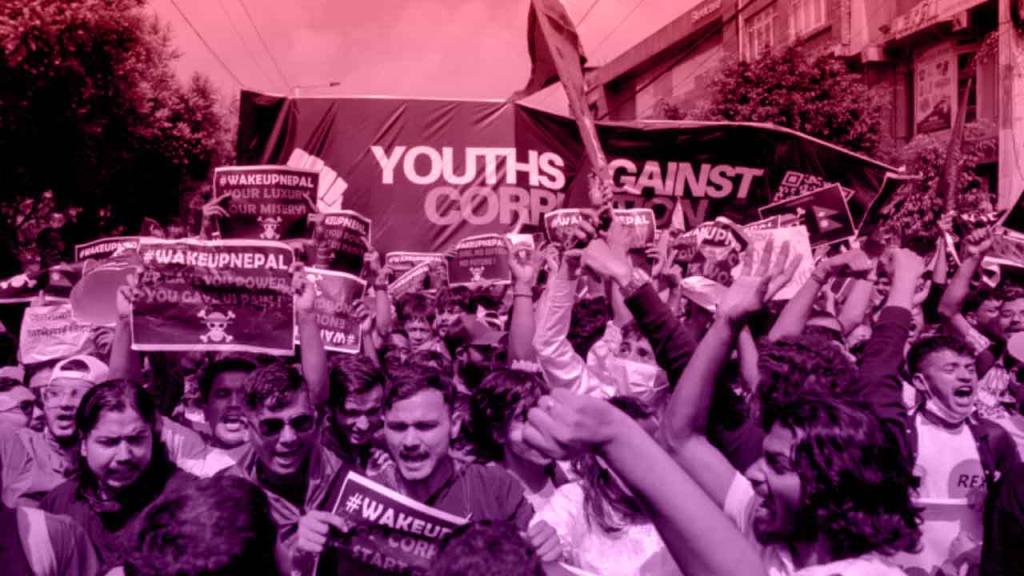
Kathmandu is on edge not because of “apps,” but because a generation raised on the promise of democracy and mobility has collided with an economy and political order that keep shutting every door. The proximate trigger was regulatory: the government ordered 26 major social-media platforms to register locally and began blocking those deemed non-compliant, including Facebook, YouTube, Instagram, WhatsApp, X and others. Crowds surged toward Parliament; police deployed tear gas, rubber bullets and, in several places, live fire. By late 9 September, at least 19 people were killed and well over 300 injured. Under pressure, the government lifted the social-media banand Prime Minister K. P. Sharma Oli resigned.

The Spark Was the Ban. The Fuel Was Political Economy

It is tempting—especially from afar—to narrate this as a clash over digital freedoms. That would be analytically thin. For Gen-Z Nepalis, platforms are not just entertainment; they are job boards, news wires, organizing tools, and social lifelines. Shutting them off—after years of economic drift—felt like collective punishment. But the deeper story is structural: Nepal’s growth has been stabilized by remittances rather than transformed by domestic investment capable of producing dignified work. In FY 2024/25, the Department of Foreign Employment issued 839,266 labor permits—staggering out-migration for a country of ~30 million. Remittances hovered around 33 percent of GDP in 2024, among the highest ratios worldwide. These numbers speak to survival, not social progress; they are a referendum on a model that exports its youth to low-wage contracts while importing basics, and that depends on patronage rather than productivity.

That is why the ban detonated so quickly. With youth under- and unemployment already high at 20.82 percent as seen in 2024, ministerial churn the norm, and corruption scandals ambient, attempts to police the digital commons looked less like “order” and more like humiliation. The movement’s form—fast, horizontal, cross-class—echoed Bangladesh’s student-led mobilizations and Sri Lanka’s Aragalaya: school and college students in uniform, unemployed graduates, gig and informal workers, and a broader, disillusioned public converged around a shared verdict on misrule.

Facts on the Ground: Casualties, Curfews, and Climb-Down

The event’s sequence is unambiguous. An expansive registration order and blocking decision ignited protests; security forces responded with escalating force; by Monday night 19 were dead and hundreds injured; curfews and assembly bans spread; the Home Minister quit; an emergency cabinet huddle withdrew the ban; by Tuesday, Oli resigned.
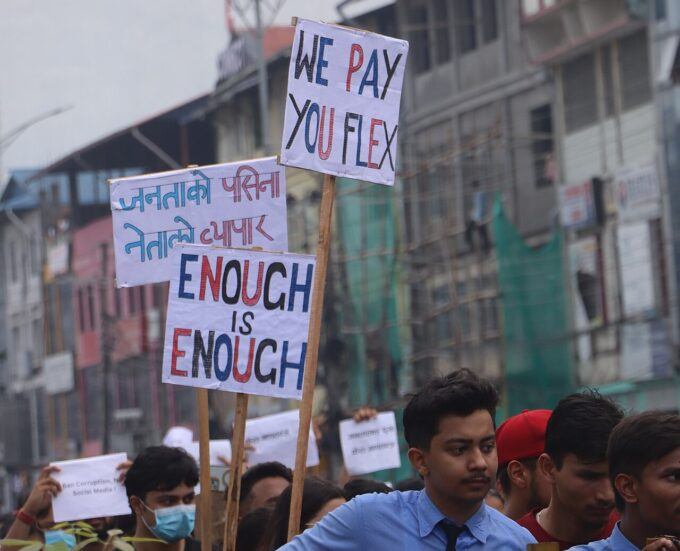
Importantly, the grievance was never only digital. Protest signs and chants centered on corruption, elite impunity, and the absence of a credible development horizon. Amnesty International demanded an independent probe into possible unlawful use of lethal force—another reason the uprising hardened from a platform quarrel into a legitimacy crisis.

Migration as the Silent Plebiscite

If one metric explains the generational mood, it is Exits. The 839,266 labor permits issued in FY 2024/25 (up sharply from the previous year) translate into thousands leaving every day at the peak. These are not tourists; they are the very cohort now on the streets. Their remittances—~33 percent of GDP—keep households afloat and the import bill paid, but they also mask a lack of structural transformation in the domestic economy. In a system that cannot absorb its educated youth into stable, value-adding work, the public square—online and offline—becomes the one place where dignity can be asserted. Trying to close that square amid scarcity was bound to provoke an explosion.

A Self-Inflicted Wound for Nepal’s Left

Following Nepal’s four-year IMF Extended Credit Facility (ECF) program, the government faced pressure to boost domestic revenue. This led to a new Digital Services Tax and stricter VAT rules for foreign e-service providers, but when major platforms refused to register, the state escalated by blocking them. This move, which began as a tax enforcement effort, quickly became a tool of digital control, and it occurred as the public was already dealing with rising fuel costs and economic hardships driven by the program’s push for fiscal consolidation. The government’s platform ban became the final trigger for widespread protests against corruption, joblessness, and a lack of opportunities, highlighting that the unrest was less about a “color revolution” and more about material grievances fueled by austerity measures.

That the crackdown and its political denouement unfolded under a CPN (UML) prime minister makes this a strategic calamity for Nepal’s left. Years of factional splits, opportunistic coalitions, and policy drift had already eroded credibility among the young. When a left-branded government narrows civic space instead of widening material opportunity, it cedes the moral terrain to actors who thrive on anti-party cynicism—individual-cult politics and a resurgent monarchist right. The latter has mobilized visibly this year; with Oli’s resignation, it will seek to portray itself as the guarantor of “order,” even as its economic vision remains thin and regressive. This is the danger: the very forces most hostile to egalitarian transformation can capitalize on left misgovernance to expand their footprint.

From an anti-imperialist vantage—one that opposes Northern privilege yet insists on unsentimental analysis—the crisis is textbook dependency without development. Remittances smooth consumption but entrench external dependence; donor-driven governance tweaks rarely become employment-first industrial policy; and procurement-heavy public spending feeds rent circuits more than productive capacity. In such an order, the state is tempted to police visibility rather than transform conditions. That is why an attempt to regulate platforms by switching them off—rather than by ensuring due process and narrow tailoring—was read as an effort to manage dissent, not to solve problems.

What Opposition Signals Tell Us (and What They Don’t) 

Opposition statements recognized the larger canvas sooner than the government did. Pushpa Kamal Dahal (Prachanda) expressed condolences, urged action on anti-corruption demands, and called for removing “sanctions on social networks.” The CPN (Unified Socialist) and CPN (Maoist Centre) statements condemned the repression, demanded an impartial investigation, and linked digital curbs to failures on jobs and governance. These reactions matter analytically because they show that even within mainstream politics there is acknowledgment that the crisis is about livelihoods and legitimacy, not merely law-and-order.

But these signals also reveal the predicament of the left: if its leading figures can only react to a youth uprising rather than prefigure the development horizon that would have prevented it, then the arena will be dominated by anti-establishment and royalist currents claiming to deliver order faster—even at the cost of democratic space.

The bottom line

These protests in Nepal began because a government tried to regulate by switching off the public square. They exploded because that square is where a precarious generation looks for work, community and voice in the absence of opportunity at home. A complete accounting must therefore record both the human toll—19 dead and hundreds injured—and the structural toll: hundreds of thousands compelled to leave each year and remittances that prop up consumption while postponing transformation. With Oli’s resignation and the ban withdrawn, the immediate confrontation may ebb, but the verdict delivered by Gen-Z will not. Until Nepal replaces remittance complacency and coalition arithmetic with an employment-first development model, the streets will remain the most credible arena of accountability.

This article was produced by Globetrotter.

Atul Chandra is a researcher at Tricontinental: Institute for Social Research. His areas of interest include geopolitics in Asia, left and progressive movements in the region, and struggles in the Global South.  Pramesh Pokharel is a political analyst and part time lecturer of Anthropology at Tribhuvan University. He is a Central Committee Member of CPN (Unified Socialist) and General Secretary of All Nepal Peasants Federation.