Wednesday, November 26, 2025

UN Warns Of Rising Heat Risks In Asia And The Pacific


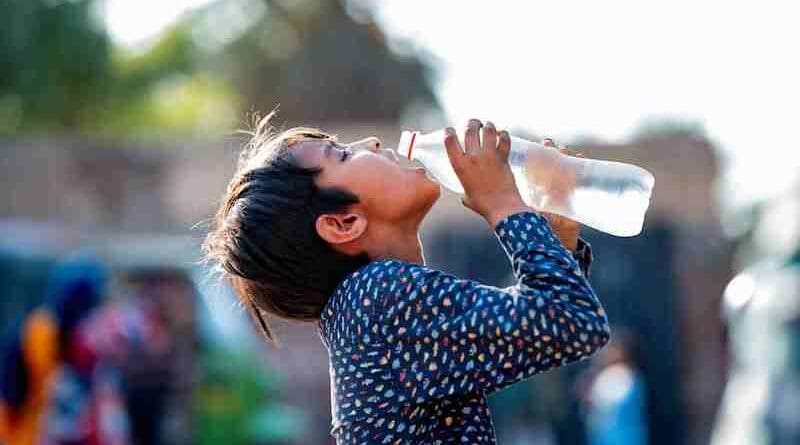
A boy drinking water. Photo credit: UNICEF/Fahad Ahmed

November 26, 2025 
By Eurasia Review


Extreme heat is reshaping the region’s disaster landscape and driving the fastest growing climate-related hazards, according to the Asia-Pacific Disaster Report 2025: Rising Heat, Rising Risk.

Launched today by the United Nations Economic and Social Commission for Asia and the Pacific (ESCAP), the report shows that rising temperatures are “impacting all, everywhere,” with expanding and intensifying risks to food systems, public health, urban living, rural livelihoods, infrastructure and ecosystems. In 2024, the hottest year on record globally, countries across Asia and the Pacific experienced severe heat episodes, including the heatwave in Bangladesh that affected around 33 million people and another in India that caused around 700 fatalities.

New projections in the 2025 report highlight the scale of the threat. By 2100, regional disaster losses could increase from US$418 billion under the current scenario to US$498 billion under a worst-case climate scenario. The frequency of days above critical heat thresholds is set to increase sharply, with South and South-West Asia, parts of South-East Asia and northern and eastern Australia trending toward chronic heat exposure.

Urban centres are particularly vulnerable: densely built cities such as Seoul, Tokyo, Beijing, Delhi, Karachi, Dhaka, Manila, Jakarta and Phnom Penh are projected to become significantly hotter, with the urban heat island effect adding an extra 2°C to 7°C on top of global warming. Vulnerable communities, including children, older persons and outdoor low-wage earners in densely populated areas, face the greatest risks.

“Heat knows no borders; therefore, policy responses must anticipate impacts, reduce exposure and vulnerability at scale and safeguard those most at risk. With urgency, clarity and cooperation, lives and livelihoods across the region can be protected,” said United Nations Under-Secretary-General and Executive Secretary of ESCAP Armida Salsiah Alisjahbana.

The report calls for strategic, long-term action grounded in science, innovation and regional cooperation. It emphasizes the need to place heat at the centre of multi-hazard planning, supported by heat-ready early warning systems that use interoperable alerting, agreed metrics and trusted last-mile communication. With only 54 per cent of global meteorological services issuing warnings for extreme temperatures, expanding heat-health warning systems in just 57 countries could save approximately 100,000 lives each year, the report notes.

To help countries deal with extreme heat, ESCAP is planning three new regional initiatives: scaling up climate-resilient and inclusive social protection schemes; establishing cross-border green cooling corridors; and using innovative space-based solutions to strengthen heat preparedness and early warning systems.

The report was launched at the Ninth Session of the Committee on Disaster Risk Reduction, which is meeting through 28 November 2025 in Bangkok and serves as the intergovernmental forum for reviewing the expanding disaster risk landscape and exploring forward-looking solutions to strengthen regional resilience.

Tehran tops world pollution rankings as air quality reaches hazardous levels

Tehran tops world pollution rankings as air quality reaches hazardous levels
Uptown Tehran suffocating under blanket of smog. / CC: Jamaran
By bnm Tehran bureau November 26, 2025

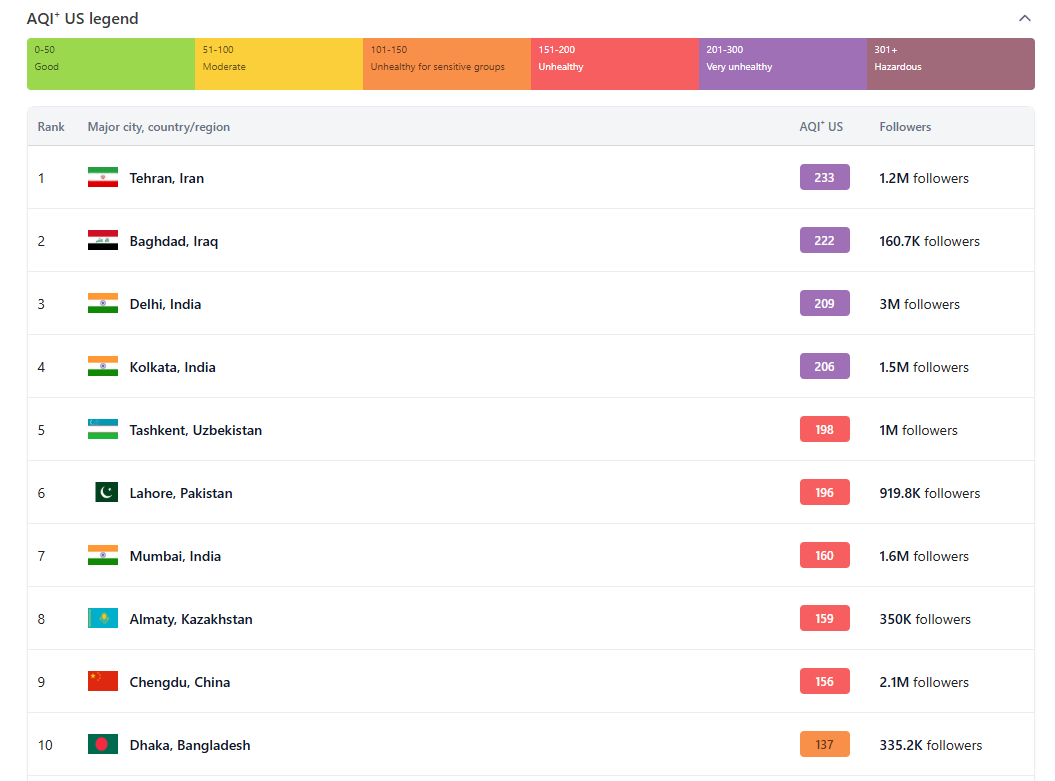
Tehran has been ranked the world's most polluted city with an Air Quality Index of 233, according to Swiss-based air quality monitor IQAir, as critical pollution levels affect all monitoring stations across the Iranian capital.

Pollution has been lingering for days over the Iranian capital as autumnal rains have failed to arrive, only worsening the issue of airborne particles hovering close to the ground due to the so-called "inversion effect", which, due to cool temperatures and a lack of wind, traps pollution close to the ground. 

The Tehran Air Quality Control Company reported that 25 stations registered critical "red" conditions on November 25, with the capital's average Air Quality Index reaching 171 and no areas recording acceptable air quality levels, ISNA reported on November 25.

IQAir's real-time rankings place Tehran ahead of Baghdad (AQI 222), Delhi (209), and Kolkata (206) in the "very unhealthy" category, indicating severe health risks for all residents. The primary pollutant affecting most stations was particulate matter smaller than 2.5 microns (PM2.5).

Fatah Square station in District 9 recorded the highest pollution level with an AQI of 195, marking it as the most polluted monitoring point in the capital. One station registered "very unhealthy" purple-level conditions on November 24, when the citywide average stood at 169 with 21 stations in red status.

Stations recording unhealthy conditions for all groups included Aghdasiyeh, Sharif, Poonak, Tarbiat Modares, Tehran University, Crisis Headquarters, Golbarg and Fatah Square. Critical red-level readings were reported at stations across Districts 11, 13, 15, 17, 18, 19, 20, 21 and 22.

The pollution stems from multiple sources, including vehicular emissions, heavy fuel oil and mazut burning in power plants, and temperature inversion that traps pollutants close to the ground. Vehicle emissions account for approximately 80% of Tehran's air pollution.

Tehran's chronic air pollution stems from a combination of geographic and industrial factors, with the city's location in a valley surrounded by mountains creating an atmospheric inversion effect that traps pollutants close to ground level due to cold weather. 

The Air Quality Index is divided into six categories: zero to 50 indicates clean air, 51 to 100 is acceptable, 101 to 150 is unhealthy for sensitive groups, 151 to 200 is unhealthy for all groups, 201 to 300 is very unhealthy, and 301 to 500 indicates hazardous conditions.

Online social media across Iran has become increasingly critical of government pollution readings, fearing that monitoring stations have been either switched off or producing metered-down readings in recent days, according top previous reports.

Further west, schools and government offices in Tabriz will close on November 26 and 27 after the city's Air Quality Index reached 182, entering the "unhealthy for all groups" red category.

The Emergency Working Group announced the closures due to continuing pollution levels in Iran's fifth-largest city. The AQI reading of 182 places Tabriz firmly in the unhealthy range, which extends from 151 to 200 on the Air Quality Index scale.

The closures affect all educational institutions and government offices across the city for the two-day period, as authorities respond to the sustained deterioration in air quality.

  Other cities across Asia are also suffering under a blanket of smog, including more northernly Tashkent in Uzbekistan, which also reported high readings of airbourne particles. The Uzbek capital, similar in layout to Tehran near mountains is currently suffering with a PM 2.5 level of 198, accordign to the latest readings. 

 Uzbekistan

Tashkent blanketed by haze as Uzbek capital chokes on world's worst air pollution

Tashkent blanketed by haze as Uzbek capital chokes on world's worst air pollution
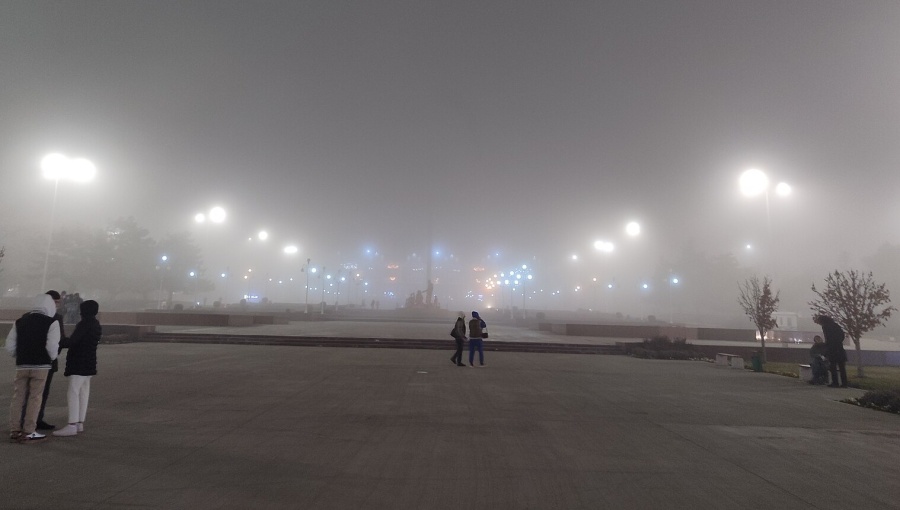
Smog descends on Peoples' Friendship Square (aka Bunyodkor Square), Tashkent. The city on November 20 had the unwanted distinction of being the world's most air-polluted. / Muzaffar Murodovich, cc-by-sa 4.0
By Mokhi Sultanova in Tashkent November 25, 2025

In recent days, Tashkent has been engulfed by a dense haze. The sharp smell of burning permeates neighbourhoods of the Uzbek capital and air-quality readings taken in the city confirm what residents sense first-hand: residents are once again choking on dangerously high levels of pollution.

The situation has prompted urgent government action with international comparisons showing Tashkent is faring so badly with smog that, on November 20, it was ranked first among the world’s 10 most polluted cities by the International Air Quality Index (IQAir), with an air quality index of 250 units classified as “very harmful.”

After several days of near-normal air quality, the situation began to worsen again on the afternoon of November 23. 

Uzhydromet reported that by 8:00 pm local time that day, the concentration of fine particulate matter PM10 in the air had reached 373 micrograms (μg) per cubic metre, 20% above the maximum permissible concentration of 300 μg/m³. 

Even more concerning, PM2.5 levels surged to 202 μg/m³, more than three times the daily safe limit of 60 μg/m³.

Authorities reminded city dwellers that it is sudden temperature fluctuations that cause an atmospheric inversion, trapping fine particles close to the ground and exacerbating pollution levels. 

"These weather conditions will persist throughout our republic for several more days," Uzhydromet said, urging residents to limit outdoor activities and wear protective masks. 

In response to the crisis, President Shavkat Mirziyoyev signed a decree on November 25 introducing urgent measures to improve Tashkent’s ecological status. 

A special commission, headed by the chairperson of the National Ecology Committee and the president’s environmental advisor, Aziz Abduhakimov, has been established to monitor the situation, forecast trends and implement immediate interventions when air quality reaches dangerous levels.

The commission is empowered to:

  • Restrict operations at industrial enterprises, transport and other sources of pollution.
  • Impose vehicle restrictions based on licence plate numbers, excluding electric vehicles (EVs).
  • Temporarily close facilities that burn polluting substances, including certain greenhouses.
  • Identify industrial zones for potential relocation outside the city.
  • Enforce limits on industrial discharges and suspend non-compliant enterprises.
  • Introduce construction regulations to reduce dust emissions and ensure green zones.

Construction sites in Tashkent are to undergo immediate inspections to ensure compliance with environmental measures. Developers must allocate 25% of their territory to green zones, install water sprayers and provide wheel-washing facilities for construction vehicles. Air quality monitoring stations will be installed across all major sites.

The city administration will also increase watering of trees and bushes. 

Over the next three months, 12 artificial lakes are set to open and the number of fountains in the city will be doubled to improve urban air humidity.

The government has also ordered the accelerated gasification of greenhouses in and around Tashkent, reversing a previous push to use coal. Facilities burning waste or pollutants may face fines or confiscation, while all greenhouses will be required to install proper air and gas filtering systems.

Additionally, an expanded “Air Monitoring Uzbekistan” network is being launched, incorporating Tashkent stations and new monitoring laboratories. Household air purifiers will now be duty-free and by December 1, colour-coded national air quality indicators and corresponding health safety guidelines will be introduced.

As conditions worsened, Saida Mirziyoyeva, head of the Presidential Administration, convened an emergency meeting on November 24 with top officials. The discussion centred on citizen complaints, updated air-quality data and the main factors driving the pollution surge.

Mirziyoyeva stressed that polluters, state-owned or private, must face uncompromising consequences for violating environmental standards. She emphasised that public health must be fully protected, calling for coordinated short, medium and long-term measures.

Uzbekistan has also instructed major industrial enterprises to cut harmful emissions by 50% by December 1, particularly given the ongoing temperature inversions. 

Category I and II enterprises must comply with environmental regulations or face severe penalties, including temporary shutdowns, fines, or criminal liability. Construction companies have also been reminded of air protection obligations.

Amid public concern, the Muslim Office of Uzbekistan announced that on November 28, istisqa prayers, traditionally performed to pray for rain, will be held after Friday prayers across the country. The initiative, led by Mufti Sheikh Nuriddin Khaliqnazar, seeks divine intervention amid the dry autumn and worsening air quality.

As of 8:00 pm local time on November 25, Tashkent’s air quality index reached 251 US AQI – very unhealthy, with PM2.5 at 175.9 µg/m³, signalling a severe spike in pollution that was blanketing the city in thick haze.


Panama Canal presses forward with port tenders despite US unease over Chinese bidders

Panama Canal presses forward with port tenders despite US unease over Chinese bidders
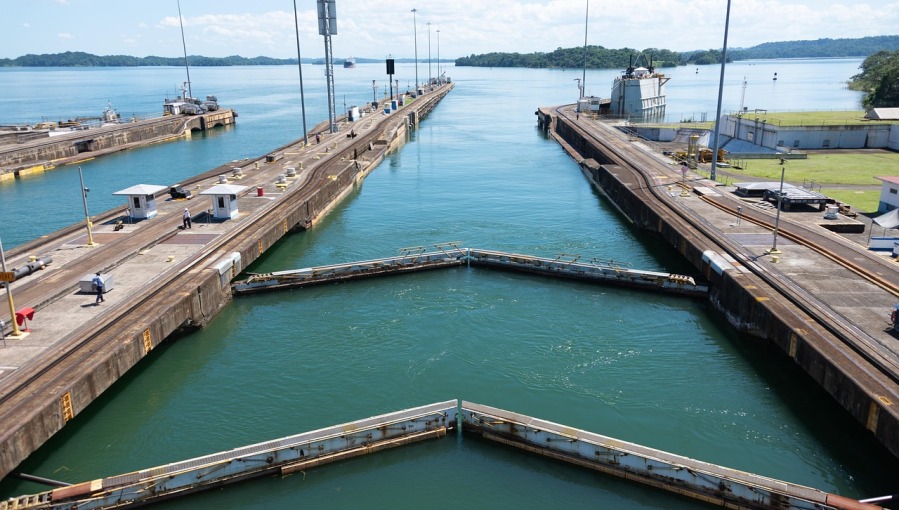
The authority is proceeding without exclusions despite pressure from the United States, which has strongly objected to Chinese activity in the corridor. / pixabay
By Alek Buttermann November 26, 2025

Panama’s canal authority has confirmed that preparations for two port concessions and a cross-isthmus gas pipeline are entering defined stages, with technical and investor-specific meetings set to take place before the end of the year.

Administrator Ricaurte Vásquez stated that individual discussions with the seventeen companies expressing preliminary interest in the gas pipeline are scheduled to finish this week. The initiative, evaluated under the Canal’s concessions framework following an unsolicited proposal, was declared of institutional relevance and subsequently opened to competitive procedures. Vásquez indicated that financing will not place Canal assets at risk, specifying that capital participation would be limited and that the project must be structured to protect the authority’s balance sheet.

While the gas infrastructure moves to its next phase, the most immediate activity concerns the launch of port-related negotiations. Beginning next week, the Panama Canal Authority will meet firms interested in developing terminals at Corozal on the Pacific side and Isla Telfers on the Atlantic side. The prequalification documents are expected between late December and January 2026. The call for interest was issued publicly in October and generated responses from companies in Asia, Europe and other regions.

The participation framework is governed by the Neutrality Treaty, which requires non-discriminatory access for all bidders. Vásquez reiterated this principle when questioned about the potential involvement of Chinese operators, noting that companies including state-owned Cosco Shipping participated in the October presentation. He added that any geopolitical implications will be addressed only if they materialise.

The authority is proceeding without exclusions despite pressure from the United States, which has strongly objected to Chinese activity in the corridor. Washington’s concerns stem from historical control of terminals and the sale of Balboa and Cristóbal facilities by Hutchison Holdings to a consortium led by the United States-based BlackRock, a transaction that sparked apprehension in Beijing. 

Meetings next week will include consortia such as Cosco Shipping Ports, Orient Overseas Container Line, PSA International, Evergreen, Hapag-Lloyd, Maersk and CMA Terminals. Broader investment plans cited by AFP total $8,500mn over ten years, covering the gas pipeline, a reservoir and additional assets, with adjudications anticipated for 2026 and operations commencing in 2029. 

The key waterway currently carries 5% of global maritime trade and remains heavily dependent on United States and Chinese traffic, which continues to heighten strategic sensitivity over upcoming concessions.

Denmark

The Unity List remains Copenhagen’s largest party

Wednesday 26 November 2025, by Jonathan Simmel


Local and regional elections have been held in Denmark, and the Unity List [known internationally as the Red Green Alliance] has once again become Copenhagen’s largest party. The Social Democrats lost the mayoralty to the Socialist People’s Party and lost ground in 86 of 98 municipalities. The results clearly reflect the national political scene, where the Social Democrats chose to form a majority government with two bourgeois parties in 2022.

On Tuesday, 18 November, elections were held for municipal and regional councils in Denmark. International media have already described the ‘battle for Copenhagen,’ where the Social Democrats lost the mayoralty for the first time in 123 years.

In the last election in 2021, the Unity List became the capital’s largest party with 24.6% of the vote. This contrasted with the historically large Social Democratic Party, which had fallen to 17.2%. At that time, the Social Democrats got away with just a scare and were still able to take the mayor’s office with support from the left.

In August 2024, the Prime Minister announced a government reshuffle and appointed the former Social Democratic mayor of Copenhagen as a new minister. Instead, Pernille Rosenkrantz-Theil (former Member of Parliament for the Unity List) resigned as minister to become the Social Democrats’ new top candidate in Copenhagen. The hope for the Social Democrats and the Prime Minister was that a more well-known Social Democrat would be able to revive the party in Copenhagen.

Meanwhile, opinion polls were moving in the opposite direction, and a clear picture was once again emerging with the Unity List as Copenhagen’s largest party. And with the support of the Alternative (Green Party) and the Socialist People’s Party (reformist socialist party), we were close to achieving an absolute majority together.

The Unity List clearly stated that if we became the largest party and the ‘red bloc’ could form a majority, we would field a candidate for mayor of Copenhagen. The Socialist People’s Party then made the same statement. Several opinion polls showed a very close race, and the longer the election campaign went on, the more panicked the Social Democrats’ rhetoric became. For example, they sent a letter to all Copenhagen residents with a brief presentation of their own candidate and clear warnings against the policies of the Socialist People’s Party and the Unity List.

The Unity List has also been treated harshly in the conservative media, a clear sign that certain groups felt threatened by our successes. Denmark’s second largest tabloid newspaper, BT, published articles against the Unity List almost daily. Everything from our leading candidate Line Barfod’s participation in the Moscow Festival in 1985 to previous cases of support for Palestine, Line Barfod’s private housing situation and, three days before election day, an article about the Unity List wanting to introduce ‘Marxist training’ in the party, which was interpreted as anti-democratic with references to the Soviet Union. A good example of the attitude of the media and the Social Democrats when the left threatens their power.

Unfortunately, it did not quite work out, as the left to the left of the Social Democrats only won 26 seats, two seats short of a majority. However, the Unity List remained the largest party with 13 seats, followed by the Socialist People’s Party with 10 seats.

Since the Social Democrats have refused to nominate anyone other than themselves, the parties ‘around’ them have formed a coalition across the right and left wings, with SF as the new mayor, thus pushing the Social Democrats out in the cold after 123 years as mayor of the country’s capital.

But the really big news is actually in the rest of the country and at the national level. Here, Copenhagen is just one example of the Social Democrats’ decline.

The Social Democrats are losing ground in 86 of 98 municipalities, with a total of 5.2%, but they are still the country’s largest party with a total of 23.2%. However, the message is clear, and they are losing the mayoralty in a number of Denmark’s larger cities, including ‘classic Social Democratic cities’. Part of this is, of course, due to local politics, but the results clearly reflect the national political scene, where the Social Democrats chose to form a majority government with two bourgeois parties in 2022. All three of these parties are experiencing a sharp decline. Unfortunately, it seems that voters are largely turning to right-wing parties. There has thus been an overall shift to the right on the political scene.

The Unity List largely maintained the status quo, with a few new municipalities and a few lost municipalities, a total decline of 0.2% to a total of 7.1% of the votes.

20 November 2025

Translated by International Viewpoint from Internationalen.se.


Attached documentsthe-unity-list-remains-copenhagen-s-largest-party_a9279.pdf (PDF - 907.3 KiB)
Extraction PDF [->article9279]

Denmark
Return from Ukraine
Visiting a secret anarchist warehouse in Ukraine
Enhedslisten: Support for more defence - but which defence?
For a free and demilitarized Arctic – Defend Greenland’s independence – Defend the Greenlandic people and nature
Trump’s Greenland bid is really about control of the Arctic and the coming battle with China


Jonathan Simmell is a leading member of the SAP, Danish section of the Fourth International.


International Viewpoint is published under the responsibility of the Bureau of the Fourth International. Signed articles do not necessarily reflect editorial policy. Articles can be reprinted with acknowledgement, and a live link if possible.

Canada Exploits the US Loophole to Send Weapons to Israel

How CRA audits suppress Palestine solidarity


loophole_conference.png

On Tuesday, the Arms Embargo Now campaign launched a damning new report, co-authored by CJPME, which exposes the weapons pipeline running from Canadian factories and ports to Israel through the United States to send weapons. In direct contradiction to our government’s many claims that Canadian military exports are not being used in this genocide, this new report exposes shipments of vital components of both Israel’s fighter jets and the bombs they are still dropping on Gaza. Click here to read the report.

But despite the ever-growing body of evidence, the Canadian government continues to pretend that there isn’t a problem. Instead, the Liberals have indicated that they will not support MP Kwan’s Bill to close the US loophole, claiming that the initiative is based on a “false premise.” This government simply refuses to look at the evidence of Canadian complicity in genocide, prioritizing corporate profits over human rights.

How CRA audits suppress Palestine solidarity

CRA_audits.png

The Anti-Racism Program of the CJPME Foundation has issued a policy brief on systemic discrimination and bias in the Canada Revenue Agency (CRA)’s audits of charities. A recent government review identified patterns of religious discrimination in how the CRA selected charities for terrorism-related audits, disproportionately targeting Muslim and Sikh organizations. However, the Foundation’s brief argues that CRA audits are not only about religious profiling, but also about suppressing political solidarity with oppressed groups abroad. Click here to read the full brief.

CJPME’s mission is to enable Canadians of all backgrounds to promote justice, development and peace in the Middle East, and here at home in Canada. Read other articles by Canadians for Justice and Peace in the Middle East, or visit Canadians for Justice and Peace in the Middle East's website.

It’s Not Only about Venezuela: Trump Intends a Wider Domino Effect


It’s increasingly obvious that the US military threats against Venezuela have a wider agenda. Their game plan is regime change, but not only in Venezuela. This is the objective – on a longer timescale in some cases – across several of the countries in the Caribbean Basin, aiming to cleanse the region of governments deemed undesirable to Washington.

As international relations professor at the University of Chicago, John Mearsheimer reminds us, the US “does not tolerate left-leaning governments… and as soon as they see a government that is considered to be left-of-center they move to replace that government.”

In the Financial Times, Ryan Berg, head of the Americas programme at the Washington think-tank CSIS, which is heavily funded by Pentagon contractors, said that Trump’s vision is for the US to be the “undisputable, pre-eminent power in the western hemisphere.” The New York Times dubbed Trump’s ambitions the “Donroe Doctrine.”

After Venezuela, in the current US line of fire, is Honduras. This Central American country faces an election on November 30 which will determine whether the leftist Libre Party stays in power or whether the country reverts to neoliberalism.

The crisis in the Caribbean engineered by the Trump administration is being actively instrumentalized to distract Hondurans from domestic issues when deciding how to vote. Honduras’s mainstream media repeatedly draw attention to the likelihood that Washington will threaten Honduras militarily if it votes the “wrong way” on November 30.

Interviewed on television, opposition candidate Salvador Nasralla was asked what would happen if the Libre Party won. He replied: “Those ships that are soon going to take over Venezuela are going to come and target Honduras.” Amplifying the supposed threat, opposition candidates have posted street signs labelling themselves “anti-communist,” as if communism were actually on offer in the election.

In a bizarre article, the Wall Street Journal alleges that Venezuela aims to “gobble up Honduras.” Turning on its head recent alarming evidence of a plot by Libre’s opponents to steal the election, the article claims that Venezuela is schooling Libre in defrauding the Honduran people.

This argument is also being repeated enthusiastically in the US Congress by María Elvira Salazar and others. On November 12, Deputy Secretary of State Christopher Landau said the US government “will respond rapidly and firmly to any attack on the integrity of the electoral process in Honduras.” In fact, the US is working with the opposition to undermine the popular mandate.

There is acute irony here. Washington’s justification for its military build-up is supposedly to tackle “narcoterrorism,” yet a Libre defeat would risk returning Honduras to the “narcostate” it had become in the decade under US patronage before the previous election in 2021.

Also lined up for regime change is, inevitably, Cuba. The UK’s Daily Telegraph, not normally known for its Latin America coverage, argues that Cuba is the “real target” of Trump’s campaign in Venezuela.

Having failed to dislodge the Cuban revolution after more than six decades of blockade, driving its citizens into acute hardship and pushing a tenth of them to migrate, Secretary of State Marco Rubio evidently sees the “real prize” of the US military build-up as dealing the fatal blow to its revolution.

Installing a US-friendly government in Caracas would aid the counter-revolution by cutting off gasoline and other supplies it currently sends to Cuba. Or supplies might be stopped by the US navy itself, further tightening the screws on Havana. In addition, if the Bolivarian Revolution in Venezuela collapsed, it would embolden the US-sponsored dissidents in Cuba, who feed on the discontent rained upon their country by US sanctions.

Yet even the gung-ho Telegraph doubts whether Rubio’s goal will be achieved, given Cuba’s remarkable resilience.

Another country in Washington’s crosshairs is Nicaragua. Here too, Rubio is leading the charge. But he has plenty of confederates on both sides of the congressional isles.

Although not directly threatened militarily (at least, so far) by the US, it has imposed new sanctions on Nicaraguan businesses, threatens to impose 100% tariffs on the country’s exports to the US, and may try to exclude it from the regional trade agreement, CAFTA.

At the same time, Nicaragua’s opposition figures enthusiastically identify with their peers in Venezuela, hoping that regime-change in Caracas would encourage Washington to further attack Nicaragua’s Sandinista government.

Two other left-leaning administrations in the Caribbean Basin, Colombia and Mexico, have been subject to Trump’s threats of military strikes. Colombian President Gustavo Petro has been sanctioned by Washington as “a hostile foreign leader.” He has responded by condemning the US attacks on boats in the Caribbean as “murder.”

Trump has recently repeated earlier threats to attack Mexican drug cartels, saying he would be “proud” to do so. Asked whether he would only take military action in Mexico if he had the country’s permission, he refused to answer the question. Mexican President Claudia Sheinbaum had earlier dismissed Trump’s threat of military action against drug cartels inside her country, telling reporters: “It’s not going to happen.”

However, despite Sheinbaum’s ongoing popularity, on November 15 she faced so-called Gen Z demonstrations which erupted in over 50 cities. According to The Grayzone, these were not what they seemed: they were financed and coordinated by an international right-wing network and amplified by bot networks. Their timing in relation to the Caribbean military build-up may have been intentional.

In the context of these protests, Trump said: “I am not happy with Mexico. Would I launch strikes in Mexico to stop drugs? It’s OK with me.” Elements in the MAGA movement are urging him to go further, launching a US military incursion to ensure “a transitional government.”

Washington successfully interfered in recent elections in Argentina. US endorsement of the right-wing victory in Ecuador in April was critical after a disputed election. Next month is the second round of Chile’s elections. Trump hopes for a rightward shift – with a little help from the hegemon – in that election as well as those in Colombia next year and in 2030 in Mexico.

Former Bush and Trump official Marshall Billingslea says the ultimate target of a US regime change assault is the entire Latin American left, “from Cuba to Brazil to Mexico to Nicaragua.” Military intervention leading to the end of the Maduro government would halt what he alleges (without evidence) is the flow of money from Caracas that has led to the “socialist plague that has spread across Latin America.”

US-imposed regime-change in Venezuela, Cuba, and Nicaragua – where the “socialist plague” has taken deep root – is a bipartisan project. For other progressive and left-leaning Latin American states – Mexico, Honduras, Colombia, and even Chile – the pax americana prescription stops short of outright deep regime change; infiltration, intimidation and co-optation are employed to keep them subordinate.

For Democrats and Republicans alike, the US imperial projection on the region is a given. Trump and his comrade-in-arms Rubio are leading the charge. But the so-called US opposition party is offering weak constraints.

To these ends, the US empire, with Trump at its titular head, is weighing the opportunity costs of deploying the full force of the military might assembled in the Caribbean, one-fifth of its navy’s global firepower. But Trump’s neocon advisers appear to want to seize the moment and embark on hemispheric political change, bringing a Trumpian “Donroe Doctrine” to fulfilment.

Will caution prevail, or will the US continue to bring lawlessness and chaos – as it has to Haiti, Libya, Syria, Afghanistan and elsewhere – not just to Venezuela but possibly to other countries in the region?
John Perry, based in Nicaragua, is with the Nicaragua Solidarity Coalition and writes for the London Review of Books, FAIR, and CovertActionRoger D. Harris is with the Task Force on the Americas, the US Peace Council, and the Venezuela Solidarity NetworkRead other articles by John Perry and Roger D. Harris.