Sunday, November 30, 2025

TRUMPISM
Netanyahu requests a pardon to end his ongoing corruption trial in Israel

SAM MEDNICK
Sun, November 30, 2025 


Israel's Prime Minister Benjamin Netanyahu addresses lawmakers in the Knesset, Israel's parliament, in Jerusalem, Monday, Nov. 10 2025. (AP Photo/Ohad Zwigenberg)


TEL AVIV (AP) — Israeli Prime Minister Benjamin Netanyahu on Sunday asked the country’s president to grant him a pardon from corruption charges, seeking to end a long-running trial that has bitterly divided the nation.

Netanyahu, who has been at war against Israel’s legal system over the charges, said the request would help unify the country at a time of momentous change in the region. But it immediately triggered denunciations from opponents, who said a pardon would weaken democratic institutions and send a dangerous message that he's above the rule of law.

Netanyahu had submitted a request for a pardon to the legal department of the Office of the President, the prime minister’s office said in a statement. The president's office called it an “extraordinary request,” carrying with it “significant implications.”

Netanyahu is the only sitting prime minister in Israeli history to stand trial, after being charged with fraud, breach of trust and accepting bribes in three separate cases accusing him of exchanging favors with wealthy political supporters. He hasn't been convicted of anything.

Netanyahu rejects the allegations and has described the case as a witch hunt orchestrated by the media, police and judiciary.

Trump's request

His request comes weeks after U.S. President Donald Trump publicly urged Israel to pardon Netanyahu, turning to President Isaac Herzog during his speech to Israel's parliament last month. Earlier this month, Trump also sent a letter to Herzog calling the corruption case "political, unjustified prosecution.”

Herzog is a former political rival of Netanyahu, but the men have a good working relationship. Later Sunday, Israeli media reported a small protest outside Herzog’s home, including a pile of bananas with a sign saying a pardon equals a banana republic.

In a videotaped statement, Netanyahu said the trial has divided the country. He also said the requirement that he appear in court three times a week is a distraction that makes it difficult for him to lead.

“The continuation of the trial tears us apart from within, stirs up this division, and deepens rifts. I am sure, like many others in the nation, that an immediate conclusion of the trial would greatly help to lower the flames and promote the broad reconciliation that our country so desperately needs," he said.

Case delays

Netanyahu has taken the stand multiple times over the past year. But the case has been repeatedly delayed as he has dealt with wars and unrest stemming from the Hamas-led militant attacks on southern Israel on Oct. 7, 2023.

Netanyahu's pardon request consisted of two documents: a detailed letter signed by his lawyer and a letter signed by Netanyahu. They'll be sent to the Justice Ministry for opinions and will then be transferred to the legal adviser at the president's office, which will formulate additional opinions for the president.

Legal experts say the pardon request isn't able to stop the trial.

“It’s impossible,” said Emi Palmor, former director-general of the Justice Ministry.

“You cannot claim that you’re innocent while the trial is going on and come to the president and ask him to intervene,” she said. The only way to stop the trial is to ask the attorney general to withhold the proceedings, she said.

In rare cases, the system could pardon Netanyahu. Experts say the president has broad discretion to grant one, and oversight is limited.

However, "as a rule, the president reviews a pardon request only after all legal proceedings have ended. The possibility of a preconviction pardon ... is extremely rare,” the Israel Democracy Institute wrote earlier this month. “A pardon before conviction, while legal proceedings are ongoing, threatens the rule of law and seriously undermines the principle of equality before the law.”

Netanyahu portrays himself as victim


In 2008, as opposition leader, Netanyahu called on then Prime Minister Ehud Olmert to step down as he faced a growing corruption scandal. At the time, Netanyahu said that a prime minister “up to his neck” in scandal did not have a mandate to lead the country, and there was a risk that Olmert would make decisions that served his personal interests and not those of the nation.

Olmert resigned even before he was indicted that year and would later serve 16 months in prison.

Netanyahu has struck a different, defiant tone since his own legal problems began. He has portrayed himself as the victim of a “deep state” conspiracy trying to oust him from office.

Shortly after forming his current government in late 2022, Netanyahu launched a plan to overhaul Israel’s justice system.

Netanyahu presented the plan as a much-needed reform. But his opponents accused him of trying to weaken the justice system, damaging the country’s system of checks and balances and having a conflict of interest at a time when he was on trial.

The plan triggered large street protests against the government, and critics have said the deep divisions sent a message of weakness to Israel’s enemies that encouraged Hamas to launch its 2023 attacks.

Netanyahu's request also sparked backlash on Sunday, with an immediate response from the opposition and advocacy groups urging the president not to give in to his request.

“You cannot grant him a pardon without an admission of guilt, an expression of remorse and an immediate retirement from political life," opposition leader Yair Lapid said.

The Movement for Quality Government in Israel said that granting a pardon to a prime minister accused of serious offenses of fraud and breach of trust would send a clear message that there are citizens who are above the law.

But some Israelis expressed support for Netanyahu's request.

“Bibi Netanyahu did totally the right thing requesting the pardon," said Lior Gal, a Jerusalem resident, referring to the prime minister by his nickname. "He deserves to be pardoned. This chapter should be over and to remain united people and carry on.”

___

Josef Federman contributed to this report from Jerusalem.

Jim Acosta Says Trump’s ‘Media Offender’ Site Has ‘Cracked the Code on How to Hurt the Press’ | Video

"What they're basically trying to do is just sort of feed red meat to the base," he insists on MS NOW

Stephanie Kaloi
Sat, November 29, 2025 
TheWrap.


Jim Acosta and April Ryan (Credit: MS NOW)


The Trump administration’s new “Media Offender of the Week” website has “cracked the code on how to hurt the press in this country,” Jim Acosta told Charles F. Coleman, Jr. on MS NOW’s “Velshi” Saturday, adding that the administration is essentially trying to “feed red meat to the base.”

Trump announced the new website Friday. The page currently accuses CBS News, along with The Boston Globe and The Independent of misrepresenting Trump’s response to Sen. Mark Kelly telling service members they can refuse illegal orders.

“The media misrepresented President Trump’s call for Members of Congress to be held accountable for inciting sedition by saying that he called for their ‘execution,’” the site stated.

“I think Donald Trump has cracked the code on how to hurt the press in this country with these lawsuits that have been settled,” the former CNN anchor said on MS NOW. “It’s done terrible damage to the industry, I think, by and large when he puts that kind of stuff up on the White House website.”

“What they’re basically trying to do is just sort of feed red meat to the base,” he continued. “If you look at his poll numbers, he is down in what the mid-30s right now according to the latest public approval polls.

He added: “The rest of the country has sort of written him off. And the other thing that I think he does when he’s lashing out in this fashion, I will say I think it’s gotten worse. This is worse than what I saw during the first administration in terms of the way he’s ramping up these attacks. And it may have something to do with just a state of decline on his part. It seems to me to be kind of a symptom of the cognitive decline.”

The solution to this website and Trump’s frequent habit of attacking the press and specifically targeting female reporters is “collective action,” Acosta said.

“Imagine, you know, the boss in your office talking to a female reporter in that way,” he said of Trump’s continued verbal assaults on female journalists. “It wouldn’t be tolerated, [and] that boss would be fired at any company.”

“Imagine if this were your daughter or your sister or your mother being spoken to in this fashion,” Acosta added. “That’s why, you know, I strongly believe, and there are people who disagree with me on this, that other folks in the press in the room should speak up in that moment and say, ‘Mr. President, that is not appropriate.'”

“I think the only solution to all of this is collective action,” he continued. “We need to see the networks get together, perhaps with some of the major newspapers, [and] send a letter to the White House, send it to Karoline Leavitt and say, ‘Listen, if the president does not stop these attacks, we’re not coming into your Oval Office sprays, we’re not going to ride with you on Air Force One, you can have Fox and all these other sycophantic outlets covering you, but we’re just not going to do it.”

Watch the full interview with Jim Acosta and April Ryan in the video

NORDSTREAM BOMBING

Opinion - A German court may have just shattered one of the Biden era’s biggest lies


Jonathan Turley,
FOX NEWS  opinion contributor
Sat, November 29, 2025


It is often said that “the first casualty when war comes is truth.” A criminal warrant just issued in Germany shows that war continues to claim its victims. However, this warrant could prove to be as great an indictment not just of the government of Volodymyr Zelensky, but also of former President Joe Biden.

This week, a German court issued an arrest warrant for Ukrainian Serhii Kuznietsov, which may finally confirm what was long suspected: that Ukraine was responsible for the 2022 sabotage of the Nord Stream pipelines in the waters near Denmark and Sweden.

The Biden administration may have been given prior warning. It was allegedly told years ago by a Ukrainian whistleblower that a six-person team of Ukrainian special forces was planning to rent a boat, dive to the sea floor and blow up the Nord Stream project. The operation was reportedly led by Gen. Valerii Zaluzhnyi, commander-in-chief of Ukraine’s armed forces.

Nevertheless, after the attack, the Biden administration and many in the media fueled speculation that Russia had destroyed its own pipeline, despite evidence and logic to the contrary. It was another convenient claim of a Russian false-flag operation that allowed the Biden administration to ignore the possibility that Ukraine had not only engaged in environmental crimes but had also knowingly lied to its allies.

For years, some of us have questioned the official account from the Biden administration about the available evidence of those responsible.

The suggestion of a Russian attack on a Russian pipeline never seemed logical. However, the administration was funneling billions in support for Ukraine, funding that has now exceeds an estimated $180 billion. Having Ukraine sabotage pipelines to our allies would hardly be opportune when many were questioning the costs to U.S. citizens.

The Biden administration was not alone in running interference for Ukraine, as Zelensky denied responsibility despite mounting evidence to the contrary. When another alleged Ukrainian saboteur was found in Poland, a Polish court blocked the extradition to Germany and ordered his release. The reason? The judge did base the decision on Ukrainian denials. Instead, he declared that the act had been committed in the name of a just war. (Poland remains the frontline against Russian aggression in Europe).

An Italian court did not engage in such rationalization. It ordered the extradition of Kuznietsov, believed to be a key figure in the conspiracy. The attack involved leasing a yacht in the German port of Rostock, using forged IDs and a screen of intermediaries. Kuznietsov insists that he was an army captain serving in Ukraine at the time.

If the investigators are correct, it was not just the Ukrainian government that was lying to us. Biden was also presumably informed by the intelligence agencies of this evidence. Yet Biden kept suggesting anyway that the Russians were covering up the truth. He told the public, “The Russians are pumping out disinformation and lies. We will work with our allies to get to the bottom [of) precisely what happened] Just don’t listen to what Putin’s saying. What he’s saying we know is not true.”

Ironically, even if we were told about this evidence, the public might still have supported the commitment to Ukraine. After all, Ukraine is the victim of a horrendous invasion that has involved repeated charges of war crimes against the Russian forces. However, the public has a legitimate expectation that a country that is receiving billions in support will not engage in environmental attacks on our allies. These pipelines were in the economic zone of two NATO countries.

As the Germans work to find the truth, the question is whether the American public will ever be given transparency on our own government’s complicity or knowledge. The public was asked to pump billions into a war while the administration allegedly covered up an attack by Ukraine on a Western pipeline — and then may have misled the public.

The public also has a right to know if the CIA was told in advance that this attack was coming and either gave tacit approval or said nothing to our allies.

While Johnson is often quoted on his 1929 line about truth in war, the line following was equally poignant: “this mode of propaganda whereby … people become war hungry in their patriotism and are lied into a desire to fight. We have seen it in the past; it will happen again in the future.”

It may have happened in the U.S., and truth was not the only casualty. The American people were treated as chumps who could not handle the truth.

Jonathan Turley is the Shapiro professor of public interest law at George Washington University and the author of the best-selling book “The Indispensable Right: Free Speech in an Age of Rage.

This African nation built its development on diamonds. Now it's crashing down


SELLO MOTSETA and FARAI MUTSAKA
Fri, November 28, 2025
AP


A raw diamond is displayed during a media tour of the Diamond Trading Company in Gaborone, Botswana, Sept. 16, 2025. (AP Photo/Sello Motseta)(ASSOCIATED PRESS)

A truck carries rough stones from the Orapa open cast mine in Lethakane, Botswana, Sept. 14, 2025. (AP Photo/Sello Motseta)(ASSOCIATED PRESS)

Dust rises from the processing plant at the Orapa open cast mine in Lethakane, Botswana, Sept. 14, 2025. (AP Photo/Sello Motseta)(ASSOCIATED PRESS)

Ian Furman, a jewellery consultant, points out the difference between real, at right, and synthetic diamond used on engagement and wedding rings, in Johannesburg, South Africa, Thursday, Nov. 13, 2025. (AP Photo/Themba Hadebe)(ASSOCIATED PRESS)

GABORONE, Botswana (AP) — In a village outside Botswana ’s capital, Keorapetse Koko sat on an aging couch in her sparsely furnished home, stunned that a career — and an entire nation’s economy — built on diamonds had fallen so far, so fast.

For 17 years, she had earned a living cutting and polishing the gems that helped transform Botswana from one of the world’s poorest nations into one of Africa’s success stories. Diamonds were discovered in 1967, a year after independence, an abrupt change of fortune for the landlocked country.

Botswana became the world’s top diamond producer by value, and second-largest by volume after Russia. Diamonds are woven into the national identity, with local Olympic champion runner Letsile Tebogo heading a De Beers campaign celebrating how the industry funds schools and stadiums.

The stones that Koko and thousands of others dug and polished over the decades have funded Botswana’s health, education, infrastructure and more. The country risked the “resource curse” of building its economy on a single natural asset — and unlike many African nations, it was a success.

But Koko lost her job a year ago, joining many others left adrift as Africa’s trade in natural diamonds buckles under growing pressure from cheaper lab-grown diamonds mass-produced mainly in China and India.

“I have debts and I don’t know how I am going to pay them,” said the mother of two, who had survived on about $300 a month and relied on her employer for medical insurance. It had been a decent situation for a semi-skilled worker in a country where the average monthly salary is about $500. “Every month they call me asking for money. But where do I get it?”

‘Diamonds built our country’

Botswana, which has unearthed some of the world’s biggest stones, has prided itself on prudently managing its natural wealth, avoiding the corruption and fighting that have plagued many African peers. Its marketing message has been simple: Its stones are conflict-free and help fund development.

“Diamonds built our country,” said Joseph Tsimako, president of the Botswana Mine Workers Union, which represents about 10,000 workers in the nation of 2.5 million people. “Now, as the world changes, we must find a way to make sure they don’t destroy the lives of the people who helped build it.”

He warned that new U.S. tariffs under the Trump administration could worsen Botswana’s downturn, triggering staffing freezes, unpaid leave and more layoffs. The U.S. has imposed a 15% tariff on diamonds that are mined, cut and polished there.

Diamond exports, roughly 80% of Botswana’s foreign earnings and a third of government revenue, have tumbled.

Debswana, the largest local diamond producer and a joint venture between the government and mining giant De Beers, saw revenues halve last year. It has paused operations at some mines as Botswana and Angola enter talks to take over controlling stakes in De Beers’ diamond mining unit.

In September, Botswana’s national statistics agency reported a 43% drop in diamond output in the second quarter, the steepest fall in the country’s modern mining history. The World Bank expects the economy to shrink 3% this year, the second consecutive contraction.

The rise of synthetic diamonds

The global rise of synthetic diamonds has been swift. They have “given stiff competition, especially in lower-quality stones,” said Siddarth Gothi, chairman of the Botswana Diamond Manufacturers Association.

The gems emerged in the 1950s for industrial use. By the 1970s they had reached jewelry quality. Lab-grown stones now sell for up to 80% less than natural diamonds. Once making up just 1% of global sales in 2015, they have surged to nearly 20%.

Glitzy social media videos have fueled the appeal of synthetic gems made in weeks under intense heat and pressure and marketed as cheaper, conflict-free and eco-friendly alternatives to stones formed over billions of years.

Environmental groups have said natural diamond mining can drive deforestation, destroy habitats, degrade the soil and pollute the water. But environmental claims about the synthetic gems also face scrutiny, with critics noting that production remains energy-intensive, often powered by fossil fuels.

From “a marginal phenomenon,” an “unprecedented flood” of synthetics now threatens the natural diamond’s value and future, World Federation of Diamond Bourses president Yoram Dvash warned in July.

Lab-grown stones now account for most new U.S. engagement rings, he said. Natural diamond prices have fallen roughly 30% since 2022, leaving the industry at what Dvash called “a critical juncture.”

Hollywood stars, including Billie Eilish and Pamela Anderson, and Bollywood celebrities have boosted synthetic diamonds’ allure, along with Gen Z influencers.


“The new generation of youngsters getting engaged, they’ve got far more important things to spend their money on than a diamond,” said Ian Furman, founder of Naturally Diamonds, which sells natural and synthetic diamonds in neighboring South Africa. “So, it’s become so attractive to them to buy lab diamonds."

Furman said that for every 100 diamonds his company sells, around 95 are synthetic when just five or six years ago it was overwhelmingly natural diamonds.

African producers feel the pain


The shift is felt beyond Botswana. Across southern Africa, falling production of natural diamonds and revenue have led to job cuts and financial strain.

To counter the trend, Botswana, Angola, Namibia, South Africa and Congo in June agreed to pool 1% of annual diamond revenues, translating into millions of dollars, into a global marketing push led by the Natural Diamond Council to promote natural stones. The nonprofit’s members include major mining companies such as De Beers Group and Rio Tinto, which have invested heavily in natural diamonds.

Last year, the council launched a “Real. Rare. Responsible” campaign starring actor Lily James in a bid to recast natural diamonds as unique and ethically sourced.

Kristina Buckley Kayel, the council’s managing director for North America, said restoring natural diamonds’ “desirability” is essential to protect producer economies, particularly in southern Africa.

With its diamond income no longer assured, Botswana’s government in September created a sovereign wealth fund focused on investment and diversification beyond mining, although details about its value and investors sketchy. Suddenly, the country’s elephant-heavy tourism industry and other mining options, including gold, silver and uranium, are more important than ever.

But for Koko, the laid-off diamond worker, the policy shift may have come too late.

“I was the breadwinner in a big family,” she said. “Now I don’t even know how to feed my own. Looking for another job is very difficult. The skills I learned are only relevant to the diamond industry.”

She never owned a diamond herself. Even the smallest would be a luxury beyond her means.

___

Mutsaka reported from Harare, Zimbabwe. Associated Press writer Mogomotsi Magome in Johannesburg, South Africa, contributed to this report.

___

For more on Africa and development: https://apnews.com/hub/africa-pulse

The Associated Press receives financial support for global health and development coverage in Africa from the Gates Foundation. The AP is solely responsible for all content. Find AP’s standards for working with philanthropies, a list of supporters and funded coverage areas at AP.org


G&G in a Flash: The Latest on Laboratory-Grown Diamonds

From G&G Summer 2024;
 article by Sally Eaton-MagaƱa et al.
Phoebe Shang
December 2, 2024

The CVD diamond plate on the left was created at a GIA facility for research 
purposes. On the right is a 10.02 carat, E color, VS1 clarity HPHT grown emerald
 cut diamond. Its size and quality show just how far laboratory-grown diamond
 technology has come in recent decades. Industry analysts project that by 2025
, 20% of all diamonds on the market will be laboratory-grown. Indeed, the
 gem industry has seen a significant increase in the quantity, size, and quality
 of laboratory-grown diamonds in recent years. And at present, GIA averages 
more CVD-grown diamond submissions per day than it once did during an
 entire year. It is therefore more important than ever to understand the
 production, treatment, and identification of laboratory-grown diamonds. 

This article  covers major trends observed by GIA since 2007, the year it began issuing laboratory-grown diamond grading reports.

Laboratory Growth and Treatment Methods
Most laboratory-grown diamonds passing through GIA’s laboratories are grown by CVD (chemical vapor deposition), with most undergoing post-growth HPHT (high-pressure, high-temperature) treatment to remove their color.

CVD Diamonds
When the first CVD diamonds were produced in 1952, the crystal quality and sizes were not suitable for jewelry. Some gem-quality diamonds began appearing in the 2000s. In recent years, however, rapid advancements in technology have resulted in vast quantities of high-quality CVD-grown gem diamonds.

CVD diamond growth is based on a chemical process very different from natural diamond formation. This technique involves a reactor in which hydrogen and hydrocarbon (typically methane) gases flow over one or more diamond substrates. Microwaves are used to activate a plasma, triggering a series of reactions necessary to deposit diamond material on the seeds. Hydrogen, accounting for 90–99% of the gas mixture, suppresses the growth of graphite or non-diamond carbon, which would hinder high-quality diamond formation.


This ring features a 2.14 ct heart-shaped laboratory-grown diamond with E color 
and VS1 clarity as well as 2.12 cts of D–F, VVS–VS laboratory-grown melee diamonds.


HPHT Diamonds
While the CVD method was developed earlier, the first gem-quality laboratory-grown diamonds were produced using the HPHT method. The HPHT method mimics some of the conditions in which natural diamonds form. A solid carbon source, typically graphite powder, is subjected to pressures of 5–6 GPa (equivalent to a depth of 150–190 km within the earth) and temperatures of 1300–1600°C, higher than those for natural diamond formation (~1040–1250°C), allowing for rapid growth. HPHT growth takes place inside a capsule that includes a carbon source, a metallic flux for dissolving the carbon to aid in growth, and a diamond seed to start the process. The temperature of the diamond seed is lower, so that carbon supersaturates and crystallizes out of the metal solution. An HPHT diamond usually takes an hour to a few weeks to grow, depending on the desired size and quality.

For both methods, a diamond substrate (often referred to as a “seed” in HPHT growth) is used to create the crystal blueprint from which the new diamond is created. The quality, size, and preparation of the substrate can have a significant impact on the resulting diamond.


These CVD-grown diamonds vary from 9.52 to 12.06 carats. Their color 
ranges from E to G and their clarity from VS2 to SI1. Large laboratory-grown
 diamonds like these have become more common in recent years.
Color, Clarity, and Carat Weight
Color
Prior to 2020, most CVD-grown diamonds were “near-colorless,” with color grades from G to N. During the mid-2010s, many CVD-grown diamonds also had gray coloration. The year 2020 saw a significant increase in the submission of colorless-grade diamonds (D, E, or F), likely due to improvements in growth and treatment procedures. Manufacturers are constantly—and successfully—refining their growth and treatment procedures to produce large, colorless diamonds.

Most early HPHT-grown diamond submissions observed at GIA starting in 2007 were yellow-orange due to nitrogen impurities or blue due to boron. Over the past 10–15 years, manufacturers have successfully eliminated nitrogen, the main cause of yellow-orange color, from laboratory-grown diamonds. There has since been a sharp decline in submissions of yellow-orange HPHT-grown diamonds, with colorless samples now representing the vast majority of submissions. In the years 2021–2023, more than 90% of HPHT-grown diamond intake was colorless—a trend that likely reflects consumer preferences.

Some CVD-grown diamonds have a brown coloration after growth. As with natural brown diamonds, CVD-grown diamonds can be enhanced using HPHT treatments to reduce or remove the brown coloration. Although similar equipment can be used for HPHT treatment and HPHT growth, the underlying methods are different. HPHT treatments are conducted at higher temperatures than those used for HPHT growth (>1600°C) and do not result in additional diamond material. Low-pressure, high-temperature (LPHT) treatment, in which samples are annealed at similarly high temperatures under a vacuum or an inert gas, can also be used to change the color of CVD-grown diamonds.

Manufacturers of CVD products can thus use recipes that promote rapid growth of diamond layers, even if it results in a brown coloration, and subsequently improve the color grade through post-growth annealing. This approach may be faster, easier, or more cost-effective than directly producing a colorless diamond using CVD. Over time, the percentage of CVD-grown diamonds exhibiting signs of annealing treatment has consistently increased. Since 2020, approximately 80% of the CVD-grown diamonds submitted to GIA have undergone post-growth processing.


These 2.00 ct Fancy Deep orange (left) and 3.00 ct Fancy Vivid orangy pink
 (right) CVD-grown diamonds underwent multiple treatments, including HPHT
 processing, irradiation, and low-temperature annealing to achieve their final
 color grades.


Clarity
The growth of large, colorless HPHT-grown diamonds with high purity is particularly challenging, as it requires complex ingredient and recipe development to minimize nitrogen content, as well as the ability to carefully control conditions over extended periods of time. Nitrogen speeds diamond growth, so its absence reduces growth rates. Whereas CVD-grown diamonds can be created over a series of growth steps, HPHT-grown diamonds are produced in a single uninterrupted run, making a highly controlled environment much more necessary.

Carat Weight
The size of gem-quality CVD-grown diamonds has seen a dramatic increase over time. From 2000 to 2010, most CVD-grown diamonds submitted to GIA were under half a carat. Today, the majority of them exceed 3 ct. This change in size reflects improvements in CVD methods as well as the availability of larger diamond substrates. The years since 2010 have seen a very rapid increase in size. By January 2022, the largest faceted CVD-grown diamond was 16.41 ct. Since that time, the benchmark has more than quadrupled to 75.33 ct.

Some HPHT-grown diamonds surpass 100 carats in size. The largest recorded laboratory-grown diamond is a 150.42 ct HPHT-grown crystal with good quality, created in November 2021.


These cuboctahedral near-colorless HPHT-grown diamond crystals are
 commonly grown up to a few carats in size.


Global Laboratory-Grown Diamond Producers
One industry report estimated that 6–7 million carats of gem-quality laboratory-grown diamonds were produced globally in 2020. China produced approximately 3 million carats (mostly HPHT), followed by India with about 1.5 million carats (mostly CVD) and the United States with about 1 million carats (mostly CVD).

Market leaders in China use the HPHT method to mass produce small, melee-size goods and diamond grits and powders for abrasives. Chinese CVD producers also grow high-quality gemstones, including large, untreated colorless diamonds and pink and blue diamonds.

India has an estimated 4,000–6,000 CVD reactors based in Surat in the state of Gujarat, which is also the world’s leading diamond cutting and polishing center. A company there produced the largest known faceted CVD diamond to date, a 75.33 ct square emerald cut displayed at the 2024 JCK Las Vegas show. The original crystal reportedly took nine months to grow. In 2023, Indian Prime Minister Narendra Modi presented a 7.50 ct F-color, VVS2-clarity CVD-grown diamond to First Lady Jill Biden during a visit to the White House, showing the increase in prestige and importance of laboratory-grown diamonds.

CVD diamond production in the United States arose due to the semiconductor industry. Diamond’s remarkable properties—including high hardness, high thermal conductivity, low thermal expansion, wide optical window, biocompatibility, and high resistance to corrosion, acid, and radiation—have a wide range of engineering applications.


Tens of carats of near-colorless HPHT diamonds are grown in single runs
 and faceted into melee gems like these.


Did you know that the vast majority of colorless to near-colorless laboratory-grown diamonds are type II, meaning they have no detectable nitrogen impurities? In contrast, only about 1% of natural diamonds are type II. Therefore, most diamonds submitted for extensive analysis to determine whether they are laboratory-grown are type II.

To learn more about identifying laboratory-grown diamonds, especially melee, read the full article.


Politician Named Adolf Hitler Just Won Reelection Again and Vows to Change His Name: 'I Have Nothing to Do' With Nazis

"The fact I have this name does not mean I want to conquer," he has said


Johnny Dodd
Sat, November 29, 2025 
AP

Oshana Regional Council; Heinrich Hoffmann/Hulton Archive/GettyNamibian politician Adolf Hitler Uunona (left) and his notorious namesake

NEED TO KNOW

59-year-old Adolf Hitler Uunoma was reelected for the fifth time as a regional counselor in Namibia

Over the years, Uunoma has tried to distance himself from the Nazi leader’s ideology, insisting that his father didn’t understand the name’s meaning when he chose it for him

This week, he told a reporter that he'd decided to drop “Hitler” from his name


Despite having perhaps the most worst name on Earth for a politician, a Namibian man named Adolf Hitler Uunona reportedly won reelection to his council seat on Wednesday, Nov. 26, for the fifth time in a row.

Amid his victory, the 59-year-old politician — who was represented Ompundja in the Namibia's Oshana Region since 2004 as a member of the South West Africa People's Organization — announced that he’s ditching the notorious Nazi leader’s surname.

In an interview with The Namibian newspaper, Uunona said that he has decided to distance himself from the name his father gave him without fully grasping who Hitler was and what he had done.

“My name is not Adolf Hitler,” he told The Namibian. “I am Adolf Uunona. In the past, people have called me 'Adolf Hitler' and tried to associate me with someone I don't even know.”

He said that he has removed “Hitler” from his Namibian identity documents because it doesn’t properly convey his character or his motivations, insisting that he now wishes to be called “Adolf Uunona.”

After his reelection in 2020, Uunona gave an interview to the German newspaper Bild, clarifying that, no, he doesn’t share his notorious namesake’s thirst for global domination.

“As a child I saw it as a totally normal name," Uunona said, adding that his wife has always called him Adolf. “It wasn't until I was growing up that I realized: This man wanted to subjugate the whole world. I have nothing to do with any of these things.”

Even as early as 2004, when he won his first council seat — as part of SWAPO, the party that has ruled Namibia since its independence in 1990 — it was clear that his name had become a headache for the aspiring politician.

“The fact I have this name does not mean I want to conquer Oshana,” Uunona told The Times in the U.K., referring to the region where he lives.

Namibia — once known as German South West Africa — was part of German territory between 1884 and 1915, and Germanic names are fairly common in the region. During a four-year revolt that began in 1904, the German Empire killed thousands of local Nama, Herero and San people, a painful period in the African nation’s history that some historians have referred to as “the forgotten genocide.”


Uunoma told Bild that he is convinced that his father “probably didn’t understand what Adolf Hitler stood for.”

The official vote count for the Nov. 26 elections still hasn’t been released by Namibia’s Electoral Commission, but multiple news reports have described Uunona as winning the recent election by a large margin.

Over the years he has proven to be well-liked politician — praised for his grassroots work and focus on anti-apartheid issues — and garnered 85% of the vote in 2020.

How Nazi war criminal Josef Mengele evaded capture in Latin America, revealed in declassified files

Solly Boussidan
Sun, November 30, 2025 
FOX NEWS


How Nazi war criminal Josef Mengele evaded capture in Latin America, revealed in declassified files
Yahoo is using AI to generate takeaways from this article. This means the info may not always match what's in the article. Reporting mistakes helps us improve the experience.Generate Key Takeaways


Documents revealing how infamous Nazi doctor Josef Mengele, known as the "Angel of Death," led an open post-war life in Argentina were found among a massive trove of evidence released and declassified earlier this year by President Javier Milei.

Mengele was notorious for his role as a commander in Auschwitz, where he conducted brutal medical experiments on prisoners, especially twins, under the guise of scientific research. Eyewitnesses — including some contained in the declassified Argentine files — describe his extremely cold-blooded and macabre, sadistic nature, including torturing and testing on twins in front of one another after sending their parents to the gas chambers.

An entire binder is dedicated exclusively to following the footsteps of infamous Auschwitz doctor and SS commander Mengele.

Argentina Reveals Secret Wwii Files On Hitler's Henchmen Who Fled Before, After The War

The declassified archives show Argentina clearly understood by the mid- to late 1950s who Mengele was and that he was actually present in the country. Authorities knew he had entered the country in 1949 using an Italian passport issued under the name Helmut Gregor, which he used as the basis for obtaining an official immigrant ID card in 1950.

Argentina’s archival material sheds light on the networks that sheltered Mengele. Though heavily fragmented and multilingual — featuring Spanish, German, Portuguese and English documents — the archive provides a snapshot of how authorities tracked, archived, mishandled and often took no action regarding the information they had about one of the world’s most wanted war criminals.

The collection contains photographs, intelligence notes, immigration records, surveillance reports and correspondence, reflecting decades of investigation and efforts to understand the network that helped him move across Argentina, Paraguay and ultimately Brazil. The presence of German-language documents indicates the incorporation of foreign intelligence or materials seized from ƩmigrƩ communities; Portuguese elements suggest cross-border coordination with Brazilian sources; English notes point to communication with U.S. or British agencies.

The files contain an undated press clipping of an Argentine citizen born in Poland, JosƩ Furmanski, who was a victim of Mengele, showing Argentinian intelligence were aware of the accusations against the Nazi criminal.

"I met Mengele. I knew him well. I saw him many times in the Auschwitz camp, with his SS colonel’s uniform and, on top of it, the white doctor’s coat," says Furmanski in the interview.

The interview goes on to explain that Furmanski, who had a twin, gave his vivid testimony of the experiences performed on them. The report labeled Mengele as a pathological sadist.

"He gathered twins of all ages in the camp and subjected them to experiments that always ended in death. Between the children, the elderly, and women… what horrors. I saw him separate a mother from her daughter and send one to certain death. We will never forget," Furmanski said.

Dozens of scanned images without embedded text and internal labeling of hundreds of pages signal a systematic effort by Argentine intelligence to compile a complete personal file of Mengele, including copies of foreign passports under aliases, photographs of suspected associates, handwritten operational notes, immigration ledgers or border-crossing logs, investigative summaries prepared for political superiors and correspondence between Argentine officers and international investigators.

The files corroborate Argentina’s ambiguous postwar position of cooperating with Western democracies, extremely disjointed bureaucracy, lack of will or understanding regarding the serious nature of crimes committed by former Nazis in its territory, and a reluctance by higher-hierarchy authorities to confront how deeply Nazi fugitives were embedded within the country’s social and political landscape.

101-Year-old Kristallnacht Survivor Warns Current Era 'Equivalent To 1938' On Anniversary Of Nazi Riot

In 1956, trying to expand his business partnership, he obtained a legalized copy of his original birth certificate from the West German Embassy in Buenos Aires, requested his ID be judicially amended to reflect his real biographical data and — surreally — began using his original legal name, a sign of how safe he felt in Argentina.

Argentine agencies by this point not only knew who he was, where he lived, and the fact that he married his brother’s widow and was raising their son, but also had full details regarding his business interests in the country. Reports in the files cite a possible visit by Mengele’s father to Argentina to help him financially, investing in a medical laboratory business in Buenos Aires.


This file picture of 1956 shows the WWII war criminal Josef Mengele. Archaeologists in Berlin have unearthed a large number of human bones from a site close to where Nazi scientists carried out research on body parts of death camp victims sent to them by sadistic SS doctor Mengele.

The overt nature of his life in the country prompted West Germany to issue an arrest warrant and request his extradition in 1959, which was denied without further action by a local judge, citing that the request was unofficially based on "political persecution" of Mengele, which didn't allow for the case to be taken up.

Despite all the hard evidence accumulated, it is clear that the information was fragmented among various different agencies that did not fully communicate with one another. There was also a lack of direct communication with the country’s presidency and executive branches. This led to action on the case being decided in a disconnected manner, and often too late — or after press leaks had already alerted Mengele of possible concern by authorities — to yield fruitful results. Arrest warrants, searches, and surveillance requests were often carried out or decided after the fact, leading to dead ends.

After the 1959 extradition request and with increased international pressure on Argentina, Mengele escaped the country to Paraguay, while his wife and stepson moved to Switzerland.

This is evident from a memo from the Federal Coordinate Directorate marked as strictly secret and confidential detailing a search for Mengele and his business interests dated July 12, 1960 — a point when Mengele had already left Argentina for Paraguay.

"I bring to the knowledge of the Chief that from the investigations carried out in order to fulfill the referenced O.B., it follows that JOSƉ MENGELE, served as a partner of the medical laboratories ‘FADRO-FARM’ located at Drysdale 3573 Street, in Carapachay, District of Vicente López, and with offices, since July of this year, at Cramer 860 Street, Capital. The subject, listed as a medical doctor, was entered into the firm on July 10, 1958, as a contributing partner of $10,000 pesos in capital, and withdrew from the partnership in April of 1959," the report stated.

"Since entering Argentina, the subject resided on the property of the Mengeles, using the name of Dr. GREGOR […], the subject manifested that he had arrived in Argentina using a different name and distinct from his profession […]. Thus, it appears that, while maintaining his real name, the subject belonged to the SS Society […] during which time he demonstrated being nervous, having stated that during the war he acted as a physician in the German S.S., in Czechoslovakia, where the Red Cross labeled him a ‘war criminal.’ He had studied Anthropology and was known to the Justice in the courts of Nuremberg, especially regarding the study of skulls and bones, but that union was considered a crime in National Socialist Germany," the report states about Mengele when, in the course of changing his name from his fake alias to his real identity, the Nazi "explained" his motives for originally not using his real identity, it said.

Argentina’s intelligence community kept following Mengele, mostly through press reports and contacts with foreign agencies. Mengele acquired Paraguayan citizenship and was protected by the government of Paraguayan dictator Alfredo Stroessner, whose family originated in the same Bavarian town as him.

The archives reveal Mengele entered Brazil clandestinely at some point in 1960 through the tri-border area near ParanĆ” state. He was helped by German Brazilian farmers who were Nazi sympathizers and provided multiple rural safehouses for several years.

Though the Argentine files are thin on details and rely heavily on media clippings at this point, Argentina was aware that Mengele had adopted the alias Peter Hochbichler, though sometimes he also used a Portuguese version of his real name — JosĆ© Mengele. For the latter part of the 1960s and throughout the 1970s, he began living in properties belonging to the German Bossert and Stammer families in SĆ£o Paulo state, Brazil.


A police officer stands in front of a cache of Nazi artifacts discovered in 2017, during a press conference in Buenos Aires, Argentina, Oct. 2, 2019.

Mengele died in 1979 when he suffered a stroke while swimming at sea in the coastal town of Bertioga. He was buried under the false name of Wolfgang Gerhardt, but multiple leads led to his body being exhumed and his remains being positively identified by Brazilian authorities in 1985. DNA testing further confirmed the findings in 1992.

U$A
Hundreds around the country look for training in how to respond to immigration enforcement

Nicole Acevedo
Sun, November 30, 2025 


A demonstrator holds up a sign in Los Angeles on June 19. (Etienne Laurent / AFP via Getty Images file)

The shriek of whistles and a cacophony of cars honking have taken on new meaning on the streets of major U.S. cities in recent months — a warning to all those in earshot that immigration enforcement is nearby.

The warning tactics from activists have become popular in cities recently targeted by Border Patrol immigration operations. In Los Angeles, Chicago and Charlotte, North Carolina, residents protested immigration enforcement actions and began coordinating street patrols, organizing neighborhood watch groups and recording videos of both immigration officers apprehending people and agents carrying out operations largely while masked and in unmarked vehicles.

Community activists have denounced what they say are increasingly aggressive tactics by immigration agents as residents patrol and document immigration enforcement activity. Meanwhile, federal authorities have said community members’ actions have gotten in the way of immigration agents doing their job. Officers “will take legal and necessary steps to ensure their own safety and that of bystanders,” Department of Homeland Security spokesperson Tricia McLaughlin said.

Heather Morrow, a protester in Charlotte, North Carolina, faces misdemeanor charges after prosecutors allege she blocked the entrance to a Department of Homeland Security facility’s parking lot; she was initially charged with felony assault of a federal officer, but it was dropped a week later at the request of the federal government.

Joshua Long, another Charlotte resident who told NBC News he’d been verifying and documenting community reports of U.S. Border Patrol’s presence across the city as part of a local watch group, was also arrested on suspicion of assaulting a federal officer, an allegation he denies.

Amid the arrests, as well as flaring tensions and clashes between communities and immigration agents, concerned residents who are afraid the Border Patrol might target their hometowns next are looking to grassroots efforts already adopted in other cities. Many are looking to create their own versions of rapid response teams that can safely monitor immigration enforcement in their communities.

“Deportation raids are not new, but what we see in terms of scale and severity is very new, and it requires a whole new response from us regular people, as citizens, as neighbors,” Jill Garvey, a co-director of the pro-democracy group States at the Core, said during the first nationwide virtual “ICE WATCH” training session hosted with the help of community organizers from Chicago on Nov. 21.

More than 500 people attended the online training session from dozens of cities, including New York; Memphis, Tennessee; Oakland, California; and New Orleans — where some expect immigration operations to begin in December. Different people expressed fear, heartbreak, anxiety and outrage over the current state of immigration enforcement and asked for tips, including how to adjust ICE Watch strategies to fit the needs of rural communities and how to monitor enforcement efforts around sensitive locations such as churches, schools or workplaces.

The trainers told those attending that paying attention to details such as the number of agents at a specific location, what uniforms they’re wearing and the scope of their activity are key to effectively documenting immigration enforcement in their communities, understanding the tactics and identifying potential civil rights violations.

The trainees were told to not touch or physically interact with agents and to keep a safe distance while documenting any immigration enforcement activity.

McLaughlin told NBC News that “being near unlawful activities in the field does come with risks — though our officers take every reasonable precaution to mitigate dangers to those exercising their protected First Amendment rights. However, when faced with violence or attempts to impede law enforcement operations, our officers will take legal and necessary steps to ensure their own safety and that of bystanders, up to and including use of force.”

She added that immigration authorities “clearly identify themselves as law enforcement while wearing masks to protect themselves from being targeted by highly sophisticated gangs” and other criminals at a time when assaults against agents have increased.

Community efforts to monitor Immigration and Customs Enforcement operations started to solidify in June when the Border Patrol first began sustained immigration enforcement operations in Los Angeles and intensified in Chicago during a three-month immigration enforcement operation dubbed Operation Midway Blitz. The Border Patrol defended its use of tear gas and rubber bullets, which residents and local officials denounced.

When asked if people who record immigration authorities or participate in neighborhood watch group should be worried about being targeted or arrested for engaging in these activities, McLaughlin stated, “This sure looks like obstruction of justice.”

“When individuals broadcast the location of ICE, they are putting a target on the backs of officers,” she stated, “anyone who impedes, obstructs, or assaults law enforcement will be arrested and prosecuted.”


Xavier T. de Janon, a criminal attorney in North Carolina who represents Morrow and Long, said several of his clients who participated in neighborhood watch efforts to keep tabs on Border Patrol as it conducted Operation Charlotte’s Web in the city of Charlotte are facing charges.

Long, one of de Janon’s clients, said he was following a Border Patrol vehicle to verify community reports his neighborhood watch group received about its presence in Charlotte.

At one point, Long said, he was trying to move his car out of the way in a dead-end street to allow agents’ SUVs to leave. Instead, the agents used their vehicles to try to box him in, he said.

In an attempt “to pull myself out of a dangerous situation,” Long said, he drove forward, going up on a curb and around one of the SUVs trying to block him. The Border Patrol claimed Long skimmed the front of its vehicle, though “my car has no scratches on it,” he said.

As the Border Patrol followed him, Long said, he dialed 911 and told dispatchers that agents were driving aggressively toward him.

He said he kept driving and stopped the minute one of the SUVs began flashing its red and blue lights, fearing matters could worsen.

Long said a Border Patrol agent opened his car door while he was pointing a gun, pulled him out, put him against the ground and handcuffed him.

Long, who said he was compliant and did not resist, was placed in the back of an SUV and taken to an FBI office, where he was questioned. About six hours later, he was released with a federal citation for “simple assault on a federal officer,” a misdemeanor charge. Long’s court hearing is scheduled for May.

“This was a CBP violent and unnecessary arrest for someone documenting,” de Janon said.

Asked about Long’s arrest, McLaughlin stated, “While conducting an immigration enforcement operation near the intersection of Central Ave and Eastway Dr, Border Patrol arrested this US citizen for vehicular assault against a federal agent.”

De Janon said that when federal agents sign up for enforcement roles, they accept the legal reality that they can be documented and that the public can access the information.

“Unfortunately, we are living under a federal government that disagrees with this,” he said. “So there might be more risks in people just doing what they’re allowed to do and legally protected to do.

At the same time, the Department of Homeland Security also said there have been 238 reports of assaults against ICE agents this year, compared with 19 reports last year — signaling nationwide tension around immigration enforcement tactics.

In the session, trainers emphasized the importance of conducting ICE Watch and street patrols in groups.

“We’re safer when we stick together,” said Garvey, of States at the Core. She emphasized that neighborhood watch groups are for documenting immigration enforcement happening in communities and not about interference. “It is a nonviolent tactic,” she said.


ICE deports Austin college student flying home for Thanksgiving after judge issues stay, lawyer says

19-year-old Any Lucia Lopez Belloza was returning home from college in Boston in what was intended to be a surprise for her parents.


Emiliano Tahui Gómez
Fri, November 28, 2025 


Any Lucia Lopez Belloza, a 19-year-old college student at Babson College, was detained by ICE while trying to make a surprise trip to see her family in Austin. Within about 48 hours of her arrest, the agency deported her to Honduras. (Courtesy of Todd Pomerleau)More

Francis thought the phone call was an extortion at first — or, at the least, a sick prank. But as his daughter’s crying voice on the other side of the line continued, Francis realized it was all much worse.

On the morning of Nov. 20, Francis’ 19-year-old daughter and Boston-area college student Any Lucia Lopez Belloza set off to surprise her Austin-based parents with a trip home from college for Thanksgiving. But at the Boston airport, federal immigration agents arrested her, telling the surprised college freshman she had a deportation order. It was all confusing to Francis, too.

“In reality, we didn’t think she had a deportation order,” the father of three, whose last name the Statesman is not publishing due to his immigration status, told the Statesman on Friday. “If we had known, I don’t think we would have sent her.”

The family’s life changed just as fast as the facts began to emerge.

Despite a federal judge issuing a stay on Lopez Belloza’s removal from the country the day following her detention, U.S. Immigration and Customs Enforcement deported Lopez Belloza approximately 48 hours after her arrest.

In quick succession, the agency moved Lopez Belloza to its Boston-area immigration processing center, a military base, a detention center in Texas, and finally — with her ankles and wrists shackled — to her native Honduras, her lawyer Todd Pomerleau told the American-Statesman. Lopez Belloza’s family brought her from Honduras to the United States when she was 7, eventually settling in Austin. She graduated from IDEA-Rundberg and gained acceptance to the prestigious Babson College.

Pomerleau, a Boston-based lawyer who specializes in immigration habeas litigation, which challenges the government’s power to detain people unlawfully, said Lopez Belloza’s arrest is the first he has worked on where a client was detained while flying domestically — signaling what he believes to be an expansion of ICE arrests at airports.

Pomerleau argues that the government violated several of his client’s rights to due process, including by detaining her without showing her a removal order and by impeding her right to counsel. Pomerleau said he was informed of the case through friends of Lopez Belloza’s family and agreed to take it on, but that ICE impeded his attempts to communicate with her until after she was deported.

He called the events leading to the deportation “an alphabet soup of constitutional violations.”

U.S. Immigration and Customs Enforcement did not respond to the Statesman’s request for comment in time for publication. They told the Boston Globe, who first reported the story, that Lopez Belloza had a deportation order going back to 2015.

Pomerleau cast doubt on this claim, saying the family had asylum proceedings under way until 2017. Francis said that his family was denied asylum, but that they had been assured by the judge that they did not have deportation orders.

Some in President Donald Trump’s circle applauded the deportation. Border Patrol Operations Commander Gregory Bovino replied on X to an ABC News report on the proceedings, saying “Why even mention this illegal alien was an 18 year old college student? Completely irrelevant except that an illegal alien may have taken a university slot from an American citizen.”

A quick deportation


Lopez Belloza made it as far as her boarding gate on Thursday, Nov. 20. It was there, before the morning sun rose, that attendants told her to go to customer service because her boarding pass wasn’t working. At the customer service desk, Pomerleau said his client “was immediately surrounded, handcuffed.”

Within a day of learning of Lopez Belloza’s detention, Pomerleau secured a deportation stay from a federal judge through a habeas petition arguing his client’s rights were violated. A Massachusetts judge signed off on the stay at 6:10 p.m. on Friday, Nov. 21, according to a copy of the order reviewed by the Statesman.

At around that time, ICE was flying Lopez Belloza to Texas, Pomerleau now believes; though at the time that information was not on ICE’s detainee locator.

On Monday, when Pomerleau contacted Francis, the lawyer said he was shocked to hear Lopez Belloza had already been deported and was in the Honduran city of San Pedro Sula with her grandparents.

Pomerleau said he plans to continue to fight Lopez Belloza’s case in federal court to try to force the agency to return her to the United States. He pointed to the fact that federal court orders eventually required the agency to bring migrant Kilmer Abrego Garcia to the United States after it ignored a judge’s orders and deported him to El Salvador.

Lopez Belloza, Pomerleau said, does not have a criminal record.

In the months before she left for college, Francis, a tailor, sewed his daughter black and navy blue suits. He was proud of his daughter’s dreams and aspirations and of the scholarship she received to go to school so far away and study business. Lopez Belloza told her father that she wanted to help him start his own business when she graduated.

“We would talk to her every day,” Francis said.

It was Francis’ boss, a family friend, who paid for Lopez Belloza’s surprise trip home for Thanksgiving as a thank you to his employee. His family cherished the Thanksgiving tradition of preparing a meal together, Francis said.

This year, Francis and his wife had not made any homecoming plans for their daughter. Worse than a holiday without their eldest daughter, the couple spent their Thanksgiving receiving friends arriving to console them.

“We know this is our reality, a lot of others are going through this too,” Francis said. “We want others to know what’s happening. So others can be ready.”

Sen. Mark Kelly Says Trump’s Response To National Guard Shooting Shows ‘They Don't Want Brown People Coming’

Jazmin Tolliver
Sun, November 30, 2025

Sen. Mark Kelly (D-Ariz.) weighed in on President Donald Trump escalating his immigration crackdown following the shooting of two National Guard members in Washington, D.C., in an ambush attack tied to an Afghan national.

Appearing Sunday on NBC’s “Meet the Press,” host Kristen Welker questioned what Kelly’s thoughts were on Secretary of Homeland Security Kristi Noem defending Trump’s decision to “permanently pause migration from all third-world countries.”

“Well, let me start by saying what happened to the two guardsmen, Andrew Wolfe, Sarah Beckstrom, horrific,” the Arizona senator said of the victims. “And it shouldn’t happen. And I’m praying for him and for her family. It was a horrible, horrible thing.”

Beckstrom died on Thursday, and Wolfe is in critical condition.

Trump’s decision came after the shooting on Wednesday, just blocks away from the White House. After the suspect detained in the shooting was identified as a 29-year-old Afghan national, who had moved to the U.S. to serve in a special CIA-backed Afghan Army unit, the Trump administration said it was halting all asylum decisions.

The Afghan national, Rahmanullah Lakanwal, faces charges of assault with intent to kill while armed and possession of a firearm during a crime of violence.

U.S. Attorney Jeanine Pirro said last week the charges could be enhanced later, saying, “We are praying that they survive and that the highest charge will not have to be murder in the first degree. But make no mistake, if they do not, that will certainly be the charge.”

Noting that “there needs to be an investigation and accountability,” Kelly declared the Trump administration is sending a “message that they don’t want brown people coming to the United States” with its move to suspend immigration from developing nations to the U.S.

Calling the Trump administration’s actions “disturbing,” Kelly told Welker that America “has always welcomed individuals that are struggling, that are fleeing famine and violence.”

He added, “And it would be a fundamental change to the fabric of our nation to change that.”


Sen. Mark Kelly and President Trump are currently embroiled in a separate beef after Kelly, along with five other Democratic lawmakers, released a video telling troops they have the right to refuse illegal orders. Trump condemned the video, labeling the lawmakers “traitors” and calling for them to face a sedition trial. Getty Images/YouTube.More

In a Truth Social post on Thanksgiving, Trump announced he was taking his aggressive immigration policy up a notch after National Guard member Beckstrom died due to the shooting.

“I will permanently pause migration from all Third World Countries to allow the U.S. system to fully recover,” the commander-in-chief wrote in the Nov. 27 post.

Trump also took aim at former President Joe Biden for all of his “illegal admissions” during his predecessor’s presidency, vowing to “terminate all of the millions” of them.

In a separate interview Sunday on NBC’s “Meet the Press,” Noem told Welker that the administration believes that Lakanwal, who came to the U.S. in 2021 during the Biden administration, was “radicalized since he’s been here in this country.” Lakanwal was granted asylum during the Trump administration.

“We do believe it was through connections in his home community and state, and we’re going to continue to talk to those who interacted with him,” Noem added.

The GOP secretary also took aim at Biden when questioned about the vetting process to approve his asylum claim during the Trump administration, arguing that “vetting is happening when they come into the country, and that was completely abandoned under Joe Biden’s administration.”

Watch Kelly’s appearance on “Meet the Press” below.
Trump, 79, Spends Holiday Weekend Boosting Racist Propaganda

Catherine Bouris
Sat, November 29, 2025 


Pete Marovich / Getty Images

President Donald Trump took time out from his relaxing holiday weekend at Mar-a-Lago to repost a racist claim about Afghans made by a former Navy SEAL.

With his approval ratings continuing to fall, Trump hit the fairway for a few rounds of golf with Canadian ice hockey legend Wayne Gretzky. The president also found time to post a screenshot of an X post by former Navy SEAL Robert J. O’Neill, who has claimed sole responsibility for killing Osama bin Laden.

“If you’ve never been to Afghanistan, you wouldn’t understand,” O’Neill’s post reads. ”If you showed these people a Nespresso machine and gave them free coffee, they would assume you were a witch and chop your head off… But let’s bring ’em in!”


Donald Trump/Truth Social

O’Neill’s post is a reaction to the backlash surrounding the Trump administration’s decision to stop processing visas for Afghan nationals in response to the shooting of two National Guard soldiers in Washington D.C. on Wednesday. The suspect involved in the shooting is a 29-year-old Afghan national who sought asylum in the U.S.

In response to the shooting, and the subsequent death of 20-year-old Army Specialist Sarah Beckstrom, Trump promised that the “animal” responsible would “pay a very steep price.”

The Trump administration was quick to blame President Joe Biden for the shooter’s presence in the country because he fled Afghanistan for the U.S. in 2021. His asylum application was approved this year, during Trump’s second term in office.

Undeterred, Trump has decided to punish Afghans collectively, writing posts on Truth Social about “hundreds of thousands” of people pouring into the U.S. from Afghanistan, “totally unvetted and unchecked.”

Biden’s Operation Allies Welcome resettled some 85,000 Afghans—many of whom had worked with American forces in Afghanistan—in the U.S. after Kabul fell to the Taliban in 2021.


Donald Trump/Truth Social

O’Neill, the author of the post Trump shared, has a checkered history, attracting controversy for claiming sole responsibility for the death of Osama bin Laden as part of Operation Neptune Spear in 2011.


According to a former SEAL Team 6 member, however, by the time O’Neill saw bin Laden, he had already been shot in the chest and leg. Another former team member told The Intercept that it was only at that point that O’Neill then shot bin Laden in the head. The government has never confirmed the exact version of events.

Despite supporting the president, O’Neill previously clashed with Trump after he reposted a conspiracy theory about a body double being killed in the raid instead of bin Laden.

“Very brave men said goodbye to their kids to go kill Osama bin Laden‚” O’Neill wrote on X at the time. “We were given the order by President Obama. It was not a body double. Thank you Mr. President.”

The White House did not immediately respond to a request for comment.


Group launches targeted ad to spoil Trump’s Thanksgiving weekend at resort

Alexander Willis
November 29, 2025 
RAW STORY


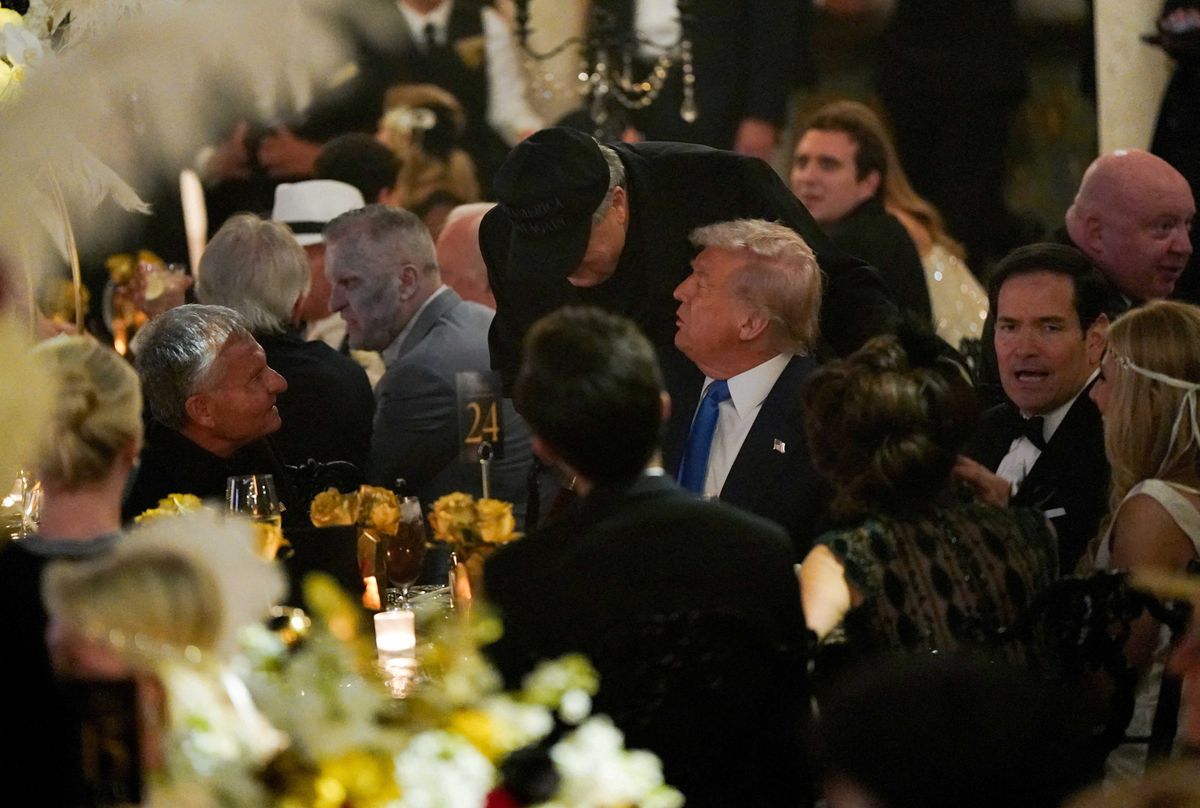
U.S. President Donald Trump and U.S. Secretary of State Marco Rubio attend a Halloween party at Mar-a-Lago in Palm Beach, Florida, U.S., October 31, 2025. REUTERS/Elizabeth Frantz

The Women’s March WIN political action committee launched an ad campaign this weekend with an ad encouraging Immigration and Customs Enforcement Officers to quit their jobs, and kicked off the campaign with ads running in West Palm Beach, Florida, where President Donald Trump is spending his Thanksgiving weekend.

“Our goal behind this is not to agitate the public to dislike ICE – I think that ICE is doing that on its own,” said Rachel O’Leary Carmona, the executive director of Women’s March WIN, speaking with Zeteo in its report Saturday.

“Our goal here is to talk directly to ICE as representatives of the mothers, the sisters, the abuelas, the daughters that they have to come home to after tearing kids’ parents from them and deporting them, and really have them think about the consequences of their actions from the frame of their own family.”

The new ad depicts an ICE agent returning home to their young daughter, who asks them “how was your day?”

“A mask can’t hide you from your neighbors, your children and God; they’ll know,” a voice can be heard saying in the ad. “You can walk away before the shame follows you home.”

Trump’s One Big Beautiful Bill Act, the budget reconciliation package chock full of cuts to taxes, and social services, included a significant funding boost for ICE, increasing the agency’s annual funding from around $10 billion to $28 billion. This funding boost has helped Trump launch among the largest deportation efforts in American history.

Immigration agents had made more than 138,000 arrests nationwide by late July, just six months into Trump’s second term, far exceeding the entire number of immigration arrests from the entire previous fiscal year, with just over 33,000 arrests being made, according to the Department of Homeland Security.

The new ad will first run in Palm Beach, but is also expected to run around Charlotte, North Carolina, and Chicago, Illinois, both cities that have seen significant immigration crackdowns and raids.

“We can find ways to combat this that are in line with our values and don’t have you misaligned with yourself, with your family, with God, with what you believe to be true,” Carmona said, speaking with Zeteo. “And there’s actually nothing but honor in that.”

View the ad below.