Showing posts sorted by date for query PENSIONS. Sort by relevance Show all posts

Friday, October 02, 2026

 Hundreds of French schools remain closed as riot police clash with student protesters


Some 400 French schools were closed Friday as the student protests that began in high schools in the Paris region last week have spread across France and grown increasingly violent. The students are protesting against teacher shortages, dilapidated school buildings and overcrowding in classrooms.


Issued on: 02/10/2026 
By: FRANCE 24

Cover image: High school students in Marseille protest outside their school on October 1, 2026. © Miguel Medina, AFP
01:42


Riot police clashed with high school students across France on Friday and unions called for teachers to strike as President Emmanuel Macron's government battled to contain increasingly violent protests over classroom conditions and education funding.

Tear gas choked the streets in the eastern city of Strasbourg, ​fireworks were aimed at ‌police lines in Marseille in the south and rubbish bins set ablaze in Rennes in the west.

Rights groups have accused the police of using heavy-handed tactics against minors, including the use of batons, tear gas and non-lethal flash-ball guns. French authorities ⁠have opened four investigations to examine ​accusations of police violence.

One such probe will examine the case of a 16-year-old, who suffered an eye injury after police fired rubber bullets into a crowd of protesters, according to his friends.


In Rennes, the tension was already palpable outside the Jean-Mace high school with students dressed in black, wearing balaclavas and standing not far from a heavy police presence.

“As far as we’re concerned, we’ve won – our school is closed this morning,” said Lola, 16, who declined to give her last name.

She condemned what she said was police violence.

“It makes us even angrier – the police have no right to hit us or use tear gas on us.”

French CRS riot police apprehend a protester during clashes outside the Lycee Deodat-de-Severac high school as part of nationwide protests by high school students to demand the hiring of substitute teachers, increased resources and better learning conditions, in Toulouse, France, October 2, 2026. © Nacho Doce, Reuters


James, a high school student in the northern city of Lille, also denounced what he called "extremely violent police repression, which inevitably fuels students' anger."

"When we see fellow students being beaten, choked, blinded in one eye, and tear-gassed from all sides while we're simply trying to have a dialogue with the government, of course it makes people angry," he said.
'Outsiders'

Some 170 students have been wounded since the start of the movement, Education Minister Édouard Geffray said, while more than 100 high schools have suffered “severe damage”.

Speaking Friday evening, he said that some 735 high schools out of the country's 3,700 had been affected "in one way or another" – though he stressed that this was 30 percent fewer than Thursday.

At least 65 staff members – including 40 high school principals – have also been injured as the protests have at times turned violent. Geffray said that three staff members had been injured on Friday, compared with 31 the day before.

In La Ciotat, near Marseille, a young person ⁠sprayed petrol at a teacher, said a spokesperson for that region's educational authority. In a social media clip broadcast by BFM TV, a man is seen wiping his face after a hooded person wearing a face-mask sprays a liquid from a bottle at him. ‌Reuters was not able to verify the circumstances.
'Apocalyptic scenes' as France school protests escalate


Cover image: © France 24
04:24


Protesters in Pantin, on the outskirts of Paris, set items including fences on fire and threw firecrackers at ⁠riot police, before running away.

Interior Minister Laurent Nunez said images from the eastern city of Belfort showing a group of youths encircle a lone policeman and kick him to the ground were of a "rare violence and intolerable".

He said police had arrested 1,747 on Friday, adding there had been "projectiles thrown, attacks on law enforcement, teachers, journalists, passersby".

After a government crisis meeting on Thursday, a source close to the prime minister said the demonstrations had morphed from a protest movement to urban violence, and Justice Minister Gérald Darmanin has said it had been hijacked by "outsiders".

Several students in the Paris region whom Reuters spoke to earlier in the week said they were staying away from the protests on Friday due to escalating violence.
'A real state of anxiety'

Six months before next year's presidential election, opinion polls consistently show the ​deep unpopularity of Macron and his centre-right government. Planned budget cuts, which exacerbate the funding crisis in education, have fuelled the discontent.

Trade unions meanwhile called a teachers’ strike for Tuesday, a week after public-sector workers walked out.

"(The violence) is regrettable, but ... when demands go unheard for years, and given the ‌political and geopolitical context, there are several conditions that put ... students in a real state of anxiety," teacher Sandra Champain-Seller said.

The protests erupted in the Paris region last week but have turned increasingly violent as they spread nationwide.


French high school students gather outside the Lycée Voltaire high school as part of nationwide protests to demand the hiring of substitute teachers, increased resources and better learning conditions, in Paris, France, October 2, 2026. The slogans read "Support 93" and "The police are supposed to protect us, not beat us up". © Sarah Meyssonnier, Reuters

Four hundred high schools – roughly one in 10 – were closed on Friday due to the unrest, while Geffray urged parents to keep their children from protesting.

Some parents supported the protests.

Vincent Martin joined his daughter ​outside Hélène Boucher high school, in Paris, saying students were "fundamentally right to demand ... better learning conditions".
Budget cuts

The students blockading the high schools have voiced anger over overcrowding ​in classrooms, regular shortages of teachers and rundown buildings, blaming years of under-investment.

"We are 35 per class, we don’t have enough ​chairs in classrooms, the one-hour lunch break (is too short) for everyone to get food," 15-year-old Kesia told Reuters in the Paris suburb of Pantin before running off as the police used tear gas.

Under the draft 2027 budget presented by the government on Thursday, the education ​budget is set to increase by a below-inflation 1.7 percent to €65.53 billion ($73.77 billion), excluding teacher pensions.

Education is traditionally the largest budget item, but that changes next year with debt servicing costs expected to reach €74.5 billion, according to the draft bill.

According to the OECD global policy forum, French spending on education is in the middle of the range among member countries and increased between 2015 and 2022, but its share of the budget has slightly decreased.

Intelligence agencies reportedly told the crisis meeting that the protest movement had been initiated by politicians from the left-wing France Unbowed party (LFI).

Senior ⁠LFI lawmakers dismissed the allegations, accusing the government of politicising the protests ahead of the election.

(FRANCE 24 with Reuters and AFP)


France closes 400 schools as student unrest over conditions continues


France has closed hundreds of secondary schools amid violent student protests, as ministers urged parents to keep children away from blockades and warned families could be billed for damage.

Issued on: 02/10/2026 - RFI

A sixth-form student adds fuel to a burning barrier during a protest outside Le Corbusier Lycée in Aubervilliers, north of Paris, on 1 October 2026. AFP - LOU BENOIST


Around 400 of France’s 3,700 secondary schools were closed on Friday on the orders of police prefects, with many schools switching to online lessons.

Education Minister Edouard Geffray urged parents to intervene, warning that young people were putting themselves at risk.

“Children are in danger on the streets,” he told BFMTV. “Parents must, quite clearly, take action and tell their children not to go [to the blockades]."

The protests began over staffing, funding and school conditions and have spread rapidly across the country.

The Interior Ministry said 1,027 secondary schools were affected on Thursday, including 222 that were blockaded. Around 30 university campuses were also blocked.

It said 1,949 people were arrested on Thursday alone, mainly in connection with violence, unlawful gatherings and attacks on people in positions of authority.

A total of 305 police officers, gendarmes and firefighters were injured during Thursday’s unrest, while Geffray said 170 pupils and 65 education staff had been hurt since the movement began.

More than 100 secondary schools had also suffered serious damage, he said.

Riot police face off with protesting students carrying out blockading action at the Lycee Kerichen secondary school, in Brest in western France, on 1 October. AFP - FRED TANNEAU


Parents made to pay

Justice Minister Gerald Darmanin said he had asked prosecutors to seek civil liability against parents whose children were responsible for vandalism, potentially leaving families to pay for repairs.

“When schools are vandalised, when bus shelters are attacked, when public transport is targeted, we will now hold parents civilly liable,” he told radio network RTL.

“It’s not the minor who pays, it’s the parents,” Darmanin said, arguing that the approach could prove “far more useful than detention”.

He said around 90 percent of those detained were minors, while roughly a third of those arrested had been held in connection with violence against other people.

Darmanin described those responsible as an “active and violent minority” and questioned whether all of them were secondary school students.

He said the unrest had moved beyond a conventional student protest to become a matter of “public order”, with the authorities concerned about further violence over the weekend and during a national day of action scheduled for Tuesday.


First concession

The government has accused the hard-left France Unbowed party (LFI) of contributing to the radicalisation of the movement and seeking to exploit the unrest.

The prime minister’s office has described the protests as a “manoeuvre organised by LFI and its proxies on the far left”.

LFI coordinator Manuel Bompard rejected the accusation and urged the government “not to descend into conspiracy theories”.

The government’s claims that LFI has orchestrated the unrest have not been independently established.

At the same time, the government has made its first concrete concession to the movement.

On Thursday night, Geffray announced that a proposal in the 2027 budget to introduce registration fees for non-scholarship students in BTS vocational higher education courses and those in preparatory classes for entrance exams for France's elite universities would be dropped.

The planned charges – €178 for BTS students and €270 for those in preparatory classes – had drawn criticism from student groups, trade unions and parties on the left.

Geffray was due to meet secondary school organisations, parents’ associations, education unions and representatives of the national student council on Friday.

“One of the difficulties with this movement is that there is no single national demand,” he said. “It all stemmed from a fairly diverse range of local demands.”

Student organisations are nevertheless calling for protests to continue, with the movement now looking towards Tuesday’s national day of action.

Hundreds of high schools in France cose as new protests against conditions erupt


By Gavin Blackburn
Published on

The students say their school hours are excessively long, conditions inadequate including overheated classrooms, and that there are too many staff absences.

French high school students lit fires outside schools and faced off with police on Friday as a protest movement that has forced the closure of some 400 establishments showed no sign of abating.

The movement, which began last week in the Paris region and rapidly spread nationwide, has seen teenage pupils at lycées in their final years of schooling block access to buildings and clash with police.

The Ministry of Education said earlier on Friday that 564 schools had "been the subject of actions or disruptions since the start of the day."

The students say their school hours are excessively long, conditions inadequate including overheated classrooms, and that there are too many staff absences

The government says the grievances are legitimate but has condemned what it has described as "urban violence."

Students have accused police of using excessive force and causing injuries by regularly firing tear gas canisters to disperse the protests.

In Paris on Friday, fire damaged the entrances of two high schools, Leonard de Vinci in the south of the city and Gaston-Bachelard in the southeast, with the fire brigade called to extinguish the blazes, an AFP photographer said.
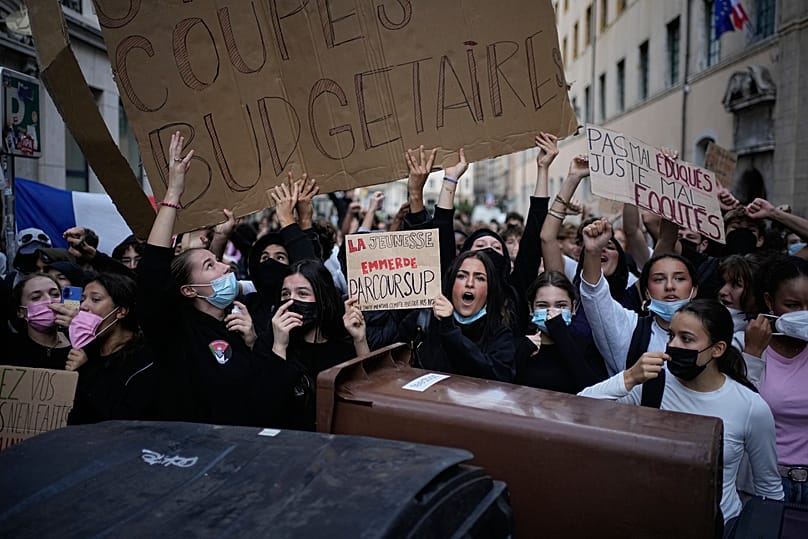
Students hold a sign reading "Stop budget cuts" as they protest against under-resourced schools in Lyon, 2 October, 2026 AP Photo

'Held hostage'

Education Minister Edouard Geffray said "the high school student movement is being held hostage by ultra-violent fringe groups," adding that nearly 400 high schools out of the 3,700 in the country were expected to be closed on Friday.

Many high schools have also planned to conduct classes remotely, particularly in the southern city of Marseille.

At least 65 staff members have been injured, including 40 high school principals, since the start of the movement, Geffray told BFMTV.

Some 170 students have been wounded while over 100 high schools have suffered "severe damage."

"Parents must clearly step up and tell their children not to go" to the protests, he added. "What matters now is ensuring our children are no longer out on the streets, because they are in danger."

Justice Minister Gérald Darmanin said he has asked prosecutors to hold parents liable for damage caused by their children during the protests and "pay for repairs."

Since the start of the movement, around 2,000 people have been taken into police custody," 90% of whom were minors," Darmanin told RTL.
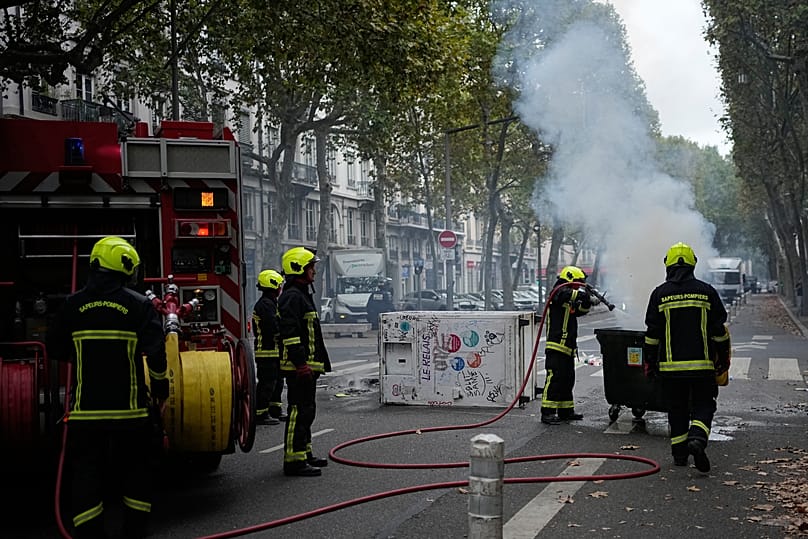

Firefighters extinguish a fire as students protest against under-resourced schools in Lyon, 2 October, 2026 AP Photo
'We've won'

In the western city of Rennes, the tension was already palpable outside the Jean-Mace high school with students dressed in black and wearing balaclavas standing not far from a heavy police presence.

"As far as we're concerned, we've won, our school is closed this morning," said Lola, 16, who declined to give her last name.

She condemned what she said was police violence. "It makes us even angrier, the police have no right to hit us or use tear gas on us."

Police used tear gas at the Kerichen high school in Brest, in western France, an AFP photographer said.

The protests have also made a strong political echo just over half a year before presidential elections, with the government accusing the hard left France Unbowed (LFI), whose firebrand leader Jean-Luc Melenchon is again standing for the presidency, of being behind the movement.


French police clash with teens blockading


schools as unions stage day of protests


French teenagers on Tuesday clashed with police as they kept up a blockade of high schools in cities across the country to demand better conditions and more teacher hirings. The escalating standoff came as unions staged a day of demonstrations against a cost-cutting budget drafted by Prime Minister Sébastien Lecornu's embattled government.


Issued on: 29/09/2026 
By: FRANCE 24
Video by: Antonia KERRIGAN


Cover image: The protests, which started in the Paris region, have sometimes turned violent. © Sameer Al-Doumy, AFP
03:10


French teenagers on Tuesday set fire to rubbish bins and hurled projectiles at police who responded with batons and tear gas, as pupils kept up blockades and protests at hundreds of high schools, demanding better conditions.

The movement in the lycées, which handle the final years of school in France, has angered the government.

Since last week, high school students have staged protests outside their schools over grievances including timetables, class sizes and a shortage of teachers as well as overheated classrooms during the recent heatwaves.

The protests started in the Ile-de-France region around Paris but have now spread to other cities nationwide.

According to the education ministry, 400 schools were affected by protests or disruptions on Tuesday, out of some 3,700 across the country.

Some 40 were blockaded and 44 faced attempted blockades. Ten people, both students and staff, were wounded and hundreds, most of them minors, were detained.

"440 were detained across national territory," Interior Minister Laurent Nunez said on BFMTV. "We don't have the final tally yet, but I'm told two thirds led to police custody."

Education Minister Édouard Geffray condemned the violence.

"Legal proceedings have been initiated against these actions. This violence is unspeakable," Geffray posted to X.

"To legitimise it or ... call for an expansion of the blockades is to endanger both our students and public officials. It is irresponsible."

In one lycée in the Paris suburbs, teachers formed a line around protesting students in a bid to protect them from the police.

Masked pupils gathered outside the Lycée César Baggio in Lille, in northern France, setting bins on fire, an AFP photographer reported.

Bus shelters and advertising billboards were vandalised, with bottles, paving stones and various objects hurled at police, who responded by firing tear gas.


There were 40 arrests on Tuesday and 10 people -- students and staff -- were wounded.
 © Sameer Al-Doumy, AFP

In the western city of Nantes, teens piled up dozens of bins to prevent entrance to the Lycée Gabriel Guist'hau, while in Paris there was an uneasy standoff between 30 students and a contingent of police at the Arago school.

Similar clashes were also reported in cities including Marseille in the south, Bordeaux in the west and Lyon in the southeast.
'Children of the suburbs'

Around 80 students gathered outside the Lamartine school in Paris, brandishing slogans including "More hours of lessons than sleep" and "8am to 6pm: are we pupils or under arrest?"

There were tense scenes at the Lycée Brequigny in the northwestern city of Rennes – Brittany's largest high school – where around a hundred students hurled projectiles at the building, an AFP video journalist said.


Police fired tear gas at teenagers in Lille and Lyon and hit them with batons near Paris. © Sameer Al-Doumy, AFP

The actions came as unions staged a day of nationwide demonstrations and strikes over the budget of Prime Minister Sébastien Lecornu, a close ally of President Emmanuel Macron.

The CGT union said 300,000 marched across France, including 70,000 in the capital. Police put the Paris figure at 30,000, including 8,000 firefighters. Public transport was not badly affected however.

"The anger is immense. I warn the government – it must address the demands and revise the draft budget, which is dangerous for the country and is driving us straight into the wall of recession at 200 kilometres an hour," the head of the CGT union Sophie Binet told BFM TV.


Cover image: © France 24
01:47


Lecornu said on Monday any escalation of demonstrations at high schools would be "irresponsible" and lashed out at the hard-left France Unbowed (LFI) party, who he accused of encouraging the protests.

Interior Minister Laurent Nunez said 164 arrests took place on Monday and 180 schools were affected, adding: "We cannot tolerate excesses."

In the low-income Paris suburb of Seine-Saint-Denis, the district's LFI mayor Bally Bagayoko joined a protest of hundreds of students at the Lycée Paul-Eluard.

Leading students in a rendition of the national hymn, the Marseillaise, he described the protests as "completely legitimate" and complained that low-income areas received less resources than higher-income ones.


Students carry a placard reading 'Be young and shut up'. © Philippe Lopez, AFP

When a crowd formed, police with anti-riot shields struck the students and an AFP journalist with batons.

"We, the children of the suburbs, are abandoned and neglected," said 16-year-old Victoire, a student at the school, denouncing conditions at the establishment as "unsanitary".

"Sometimes, violence can be legitimate," Bagayoko, who denied accusations he had set fire to a bin at the school, told BFM TV on Tuesday. "But whenever it can be avoided, it is better," he added.

(FRANCE 24 with AFP)


Transport suspended in some French cities as school protests continue

French Prime Minister Sébastien Lecornu convened a crisis meeting Thursday as students staged new protests against understaffing, onerous schedules and overheated classrooms, with public transport affected in several cities. More than 1,900 people, most of them students, have been detained and hundreds of police injured amid the increasingly violent protests, the interior ministry reported.

Issued on: 01/10/2026 -
By: FRANCE 24 


Anti-riot police officers face protesting students outside Le Corbusier secondary school in Aubervilliers, northern Paris, on October 1, 2026. © Lou Benoist, AFP

French students set fire to bins and erected blockades outside schools in several cities, protesting against overcrowded classrooms, teacher shortages and crumbling facilities.

Several school principals were injured, harassed or assaulted during blockades at high schools on Thursday, according to reports from regional education authorities, prefectures and union representatives.

Riot police have lined up against the students, and the force has launched internal probes after accusations of brutality against three pupils, said Interior Minister Laurent Nunez.

Police have already detained hundreds of protesters at the lycées, which students aged 15 to 18 attend for their final three years of secondary education in France.

In ​the Parisian suburb of Saint-Denis, crowds of young people massed in front of a line of police. One student ​held up a sign that read: "Can we explain ourselves without being teargassed?"

The interior ministry said police and gendarmes had made 1,949 arrests on Thursday, while 305 officers had been injured. Nunez condemned what he described as "unbridled violence".


Hundreds held, dozens wounded as French school protests escalate
Cover image: © France 24
02:29


Prime Minister Sébastien Lecornu convened a crisis meeting in the afternoon, asking his ministers to cancel their travel plans over the coming days due to the blockades led by high school students in order to let prefects handle the situation, his entourage reported.

The government said the demonstrations had become "urban violence" and cited the intelligence service to justify claims that it had been organised by the radical left.

Manuel Bompard, a leading figure in the left-wing France Unbowed party (LFI), quickly dismissed the claim, accusing the government of "sinking into conspiratorial thinking".

"LFI has always advocated non-violent demonstrations," LFI lawmaker Louis Boyard told BFM TV after a readout of the crisis meeting was shared with reporters.

"The government, by turning it into a political battle, has added fuel to the fire by insulting and repressing high school students," he added.

"This sense of frustration will not be dealt with through batons; it will be dealt with by showing ‌consideration for these young people," he said.

This latest wave of social unrest comes with tensions already running high over inflation, particularly soaring fuel prices – and just seven months away from France's presidential election, where opinion polls suggest far-right leader Marine Le Pen is the frontrunner.

A security source said there had been 900 blockades or related incidents across the country on Thursday.

More than 160 schools were shut down, and university students joined the protests in Paris, Marseille and other cities.

And the authorities in the Paris region said around 50 schools had been "the scene of violence, clashes and damage".
'It's unbearable'

Since last week, pupils have staged protests outside schools over a range of grievances. They range from timetables, class sizes and a shortage of teachers to overheated classrooms during this year's heatwaves.

The protests have spread across the country from the Paris suburbs.

University students also joined in Thursday, blocking access to around 30 campuses, a student union said.

Among reports of school staff being targeted was one incident in the southern port city of Marseille when a school principal and his deputy were inadvertently splashed with petrol as protesters were trying to fill containers.

In the northwestern city of Nantes, firefighters had to intervene to extinguish a fire in the entrance of a high school "following a gathering marked by violence towards staff", the regional education board said.

Authorities reported violence near high schools, mainly in Nantes, blaming "violent individuals" who "join the students to carry out acts of vandalism".

READ MOREFrench police clash with teens blockading schools as unions stage day of protests

In the northeastern city of Strasbourg, trams were ordered to halt to "restrict the movements of rioters and demonstrators", the regional prefect said.

Raphael, a 17-year-old who did not give his surname for fear of reprisals, was among the protesters outside a school in Strasbourg, where some used barriers to obstruct the nearby tramway tracks.

"There are 35 of us per classroom. With 35°C in summer, it's unbearable. There aren't enough toilets, and there are water leaks in some rooms," Raphael said.

"The building is falling apart, the cafeteria is too small. There's zero budget, zero resources, not enough supervisors," he said.

Nearby, students took photos of themselves in front of burning rubbish bins, holding up the sign with their school's name ripped off the tram stop.

Most pupils did not take part in any vandalism, instead breaking into a sprint down an avenue when the police fired tear gas.

In the southern city of Toulouse, hundreds of young people flooded the tram tracks, some toppling trash cans and starting fires, hurling projectiles or smashing bus shelters, AFP journalists said.

In the northern city of Lille, AFP reporters saw young people wearing black hoodies destroy the glass of a bus stop. Firefighters intervened to put out the flames on upturned dustbins set on fire.

The government has accused the left-wing LFI of encouraging the protests.

But LFI's candidate for the 2027 presidential election, Jean-Luc Mélenchon, said on Wednesday that his party "called for non-violent methods of struggle".

In neighbouring Belgium, there were protests and damage at a handful of schools in the eastern city of Liège, police said.

(FRANCE 24 with AFP and Reuters)


Saturday, September 26, 2026

‘Time We Send Her Packing,’ Troy Jackson Says of Collins Voting to Confirm 2 Anti-Abortion Judges in a Week

“Does she think that people in Maine are stupid?” said Jackson of the Republican senator, who has long claimed to be a supporter of reproductive rights.


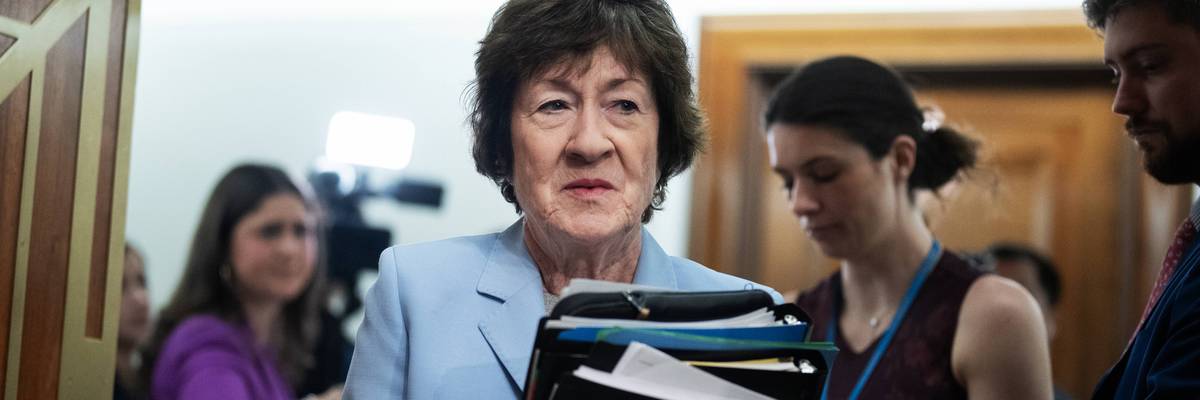
Sen. Susan Collins (R-Maine) arrives for a Senate Health, Education, Labor, and Pensions Committee meeting in Washington, DC on June 17, 2026.
(Photo by Tom Williams/CQ-Roll Call, Inc. via Getty Images


Julia Conley
Sep 18, 2026
COMMON DREAMS

“Enough is enough,” Democratic US Senate candidate Troy Jackson declared on Thursday after Republican Sen. Susan Collins voted once again for an anti-abortion judge to join a federal court for a lifetime appointment—a frequent action taken by the five-term Maine lawmaker despite her persistent claims that she supports reproductive rights.

Collins’ vote on Thursday was for Kasdin Miller Mitchell, a litigator and former solicitor general of Alabama who also served as a clerk for far-right US Supreme Court Justice Clarence Thomas. She was confirmed in a 49-45 vote to serve on the US District Court for the Northern District of Texas.

But Mitchell wasn’t the only anti-choice judge Collins voted to confirm this week, Jackson noted with scorn.

On Tuesday, the former logger and Maine state Senate president recorded a video responding to her tie-breaking vote in support of Judge Matthew Byrne to join the US District Court for the Southern District of Ohio.

Byrne sits on the board of an anti-abortion crisis pregnancy center and said in 2020 that he opposed allowing pregnant patients to access abortion in nearly all cases, without any exceptions for rape or incest. He said he supported exceptions—which, in reality, often do little to protect access to care—for cases in which a pregnant patient’s life is at risk, but said that the term “life of the mother” should be “strictly defined so as to avoid creating loopholes.”

Jackson asked in his video on Tuesday, “Does she think that people in Maine are stupid?”

“It’s time that Mainers had somebody that’s going to fight for their reproductive rights every damn time,” he added.


On Thursday, Jackson expressed disbelief that for the second time in four days, Collins had voted in favor of an anti-choice judge.

Mitchell helped defend the state of Alabama as it tried to terminate Medicaid funding for Planned Parenthood, arguing in a brief that the state had “inherent sovereign authority to determine which providers qualified” for Medicaid, “based on their own unchecked assessment of an organization’s ethics,” according to Reproductive Freedom for All.

Mitchell also signed letters to the Senate Judiciary Committee in support of other anti-abortion judges and served as the counsel of record for the Independent Women’s Law Center, an anti-choice group that has opposed the Affordable Care Act’s contraception coverage, equal pay and family leave legislation, and the Violence Against Women Act.

Maine Democratic Party spokesperson Misha Linnehan said Collins’ votes this week “show she’s not going to stand up for Maine women any time soon.”

“Susan Collins confirmed justices who overturned Roe v. Wade, and said herself she still doesn’t regret it,” said Linnehan. “Now, she’s falling in line with Trump once again to put fanatical anti-abortion judicial nominees on the bench for life.”


The Maine Democratic Party highlighted more than a dozen federal judges Collins has backed in recent months, including Judge Whitney Hermandorfer of the US Court of Appeals for the 6th Circuit, who defended Tennessee’s total abortion ban; Judge Joshua Dunlap of the US Court of Appeals for the 1st Circuit, which includes Maine, who advocated for a “fetal personhood” bill in the state; and Judge Maria Lanahan to the US District Court for the Eastern District of Missouri, who defended Missouri’s near-total abortion ban and pushed for restrictions on medication abortion.

“For the second time this week, Susan Collins has voted to confirm ANOTHER anti-abortion, MAGA judge,” said Jackson on Thursday. “It’s time we send her packing.”
‘F*ck the Consultants’: Free Advice Offered for Democrats in Need of a Position on AI

“Wild that candidates are avoiding an enormously consequential issue with broad bipartisan support among voters, for fear of unleashing attack ads from super PACs funded by a tiny handful of AI billionaires and corporations.”


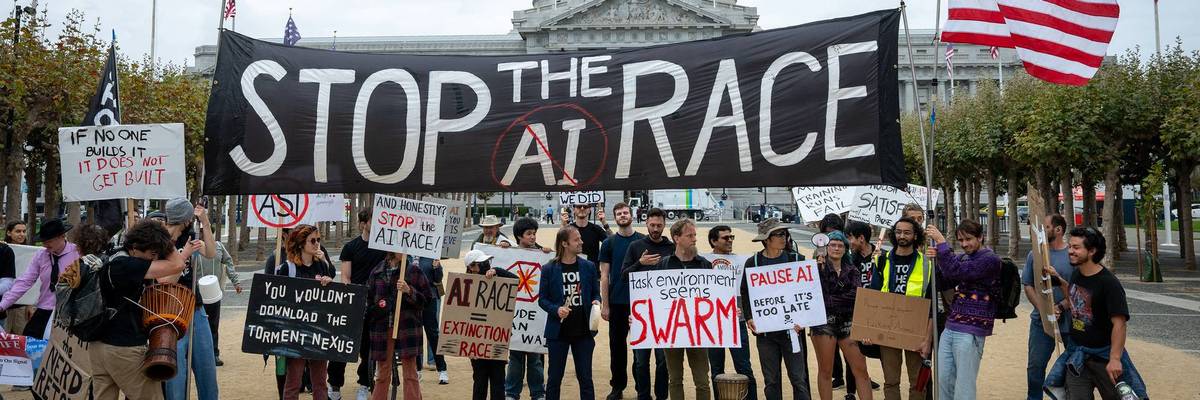
Protesters during a “Stop the AI Race” demonstration calling for a slowdown in the development of advanced artificial intelligence systems outside City Hall in San Francisco, California, on September 17, 2026.
(Photo by Karl Mondon / AFP via Getty Images)

Jon Queally
Sep 18, 2026
COMMON DREAMS

A veteran aide for Sen. Bernie Sanders (I-Vt.) has some choice advice for Democrats running for office in this year’s election, which is to ignore the guidance some of them are reportedly receiving from their political consultants on the question of regulating the artificial intelligence industry in the face of growing public concerns about runaway machine learning and the data center buildout that big tech companies are pursuing nationwide.

Warren Gunnels, who currently serves as the minority staff director for Sanders on the Health, Education, Labor and Pensions (HELP) Committee in the US Senate, issued his advice in response to a Politico article published Thursday, which had the headline “Democratic advisers are warning their candidates not to go too hard at AI.”

While the reporting noted that members of the Democratic Party’s consultancy class are “privately encouraging their battleground candidates to avoid talking about AI regulations out of fear that powerful tech groups will unleash a tidal wave of spending against them” ahead of this year’s midterm election, Gunnels offered a 9-word antidote to what he considered bad political advice and a failure to recognize where most voters are on the issue.

“Nine words,” said Gunnels in his post: “Fuck the consultants, End Citizens United, Ban super PACs.” Gunnels backed up his statement with recent polling data suggesting that a strong stance on AI and data centers would likely help, not hurt, those seeking elected office.


Gunnels wasn’t the only one to react negatively.

Brendan Fischer, director of strategic investigations at the Campaign Legal Center, said it’s “wild that candidates are avoiding an enormously consequential issue with broad bipartisan support among voters, for fear of unleashing attack ads from super PACs funded by a tiny handful of AI billionaires and corporations.”

The US Supreme Court’s 2010 ruling in the Citizens United case, which unleashed a tidal wave of dark money campaign spending, said Fischer, “promised unlimited political spending would mean more speech and a more robust marketplace of ideas. But instead, candidates are chilled from discussing issues voters care about for fear of angering wealthy interests capable of spending millions to defeat them.”


In July, Business Insider reported that the AI industry had already spent at least $65 million in midterm races, though other estimates have put that figure much higher. Meanwhile, Elon Musk, CEO of Space X and a major player in the AI space with his GROK model, has vowed to spend a $100 million help his preferred candidates and the Republican Party win.

At a summit on the need for robust regulation of the AI industry held earlier this week, Sanders said he had a message for leaders and executives running theses tech companies.

“My message to the AI CEO’s: If you truly care about the future of humanity,” said Sanders, “stop pouring hundreds of millions of dollars into super PACs to defeat Members of Congress and candidates who are fighting for serious guardrails on AI.”


As the debate over AI regulation has emerged as a major topic in Washington, DC, and on the campaign trail in recent weeks, a series of polls have confirmed public anxieties about the technology.

A poll from The Associated Press-NORC Center for Public Affairs Research and the Energy Policy Institute at the University of Chicago released Wednesday showed that more than half of US voters (53%) are “extremely” or “very” concerned about artificial intelligence’s environmental impacts, and the poll also found broader concerns about the negative impacts of data centers, especially on local water resources and utility rates.

“Change is scary, and I think some of that is being reflected here,” said Michael Greenstone, who directs the University of Chicago institute that collaborated on the survey, of the results.

The Politico reporting, which drew Gunnel’s fiery response, also acknowledged the public sentiment, but described how consultants working on various Democratic campaigns are trying to avoid provoking the ire of deep-pocketed tech giants:
Some top Democratic candidates and their campaigns are quietly trying to avoid crossing any red lines for tech super PACs — even as it’s unclear exactly what those lines would be, after Musk and two of the biggest AI CEOs called for more regulation on the technology last week.Democrats are especially wary of Leading the Future, a pro-AI industry super PAC that spent over $25 million in primary races this year and is backed by investors and executives of OpenAI. The rival super PAC network, Public First Action, pushes for AI regulation and is funded by OpenAI’s chief competitor, Anthropic.

While the fears of being targeted by the industry cash may not be unfounded, progressives like Gunnels suggest that a willingness to take a stand against powerful AI companies is exactly the kind of fight voters want to see from party candidates.

For the Politico article, Rep. Pramila Jayapal (D-Wash.), former chair of the Congressional Progressive Caucus in the House, explained how AI super PACs “come out and they say that they’re concerned, that they want regulation. But then they spend huge amounts of money on defeating anybody who wants legislative regulation.”

In a social media post Thursday night, however, Jayapal backed the congressional campaign of Will Lawrence, running as a Democrat to win an open seat in Michigan’s 7th Congressional District, by saying voters “need leaders who answer to their constituents, not the corporations that paid for their election.”

Following Gunnels advice that bucking the influence of corporate donors is actually a key component of a winning electoral strategy in the 2026 midterms, Jayapal said “electing fighters who don’t take corporate PAC money”—whether on the issue of AI, healthcare, housing policy, or broader concerns about economic inequality and affordability—is key for Democrats.

Amid Urgent Demand for Oversight, Analysis Details 105 US Lawmakers Personally Invested in the AI Industry


Despite catastrophic warnings from AI industry insiders, Congress has adjourned until after the midterms without passing any laws to regulate the technology.


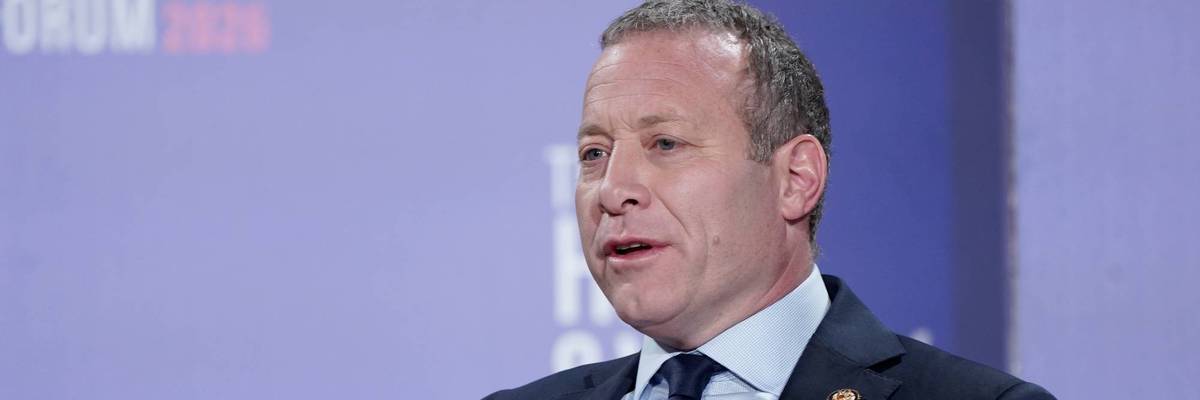
US Rep. Josh Gottheimer (D-NJ) participates in the Competing and Setting the Standards in the AI Era panel during The Hill & Valley Forum 2026 at Andrew W. Mellon Auditorium on March 24, 2026, in Washington, DC.
(Photo by Leigh Vogel/Getty Images The Hill & Valley Forum)


Stephen Prager
Sep 18, 2026
COMMON DREAMS

Despite increasingly urgent calls to regulate artificial intelligence, including from industry insiders who warn of potentially catastrophic consequences, the US Congress has continued to drag its feet on meaningful legislation.

A report released Friday by Sludge may shed some light on one potential roadblock. It found that 1 in 5 members of Congress has household investments in AI companies or those producing the infrastructure behind the technology.


Sludge revealed that:
At least 105 members of Congress have disclosed that they, their spouse, or their dependent children hold stocks or other investments in AI developers, chipmakers, cloud infrastructure providers, data center companies, and specialized AI firms, with a total value of between $75 million and $287 million.

Most of the money is invested in large tech companies like Nvidia, Meta, and Alphabet. But lawmakers also report their households holding and trading shares in smaller publicly traded AI companies like BigBear.ai, Tempus AI, and C3 AI, as well as little-known private startups whose shares are unavailable to ordinary investors.

Of the lawmakers reporting investments, at least 44 sit on committees with jurisdiction over legislation dealing with AI safety, consumer protections, semiconductor policy, and trade with China.

The report identifies several lawmakers in positions of influence over Congress’ AI policy whose households simultaneously have deep investments in the industry.


One of them is Rep. Josh Gottheimer (D-NJ), the co-chair of the House Democratic Commission on AI and the Innovation Economy—created to help direct the party’s legislative agenda around the emerging technology.

According to Sludge, Gottheimer’s household has investments in several key chipmaking and semiconductor companies, and he has regularly traded in AI stocks while in Congress.

The report draws attention to the “scores of sales” he made on April 9, 2025, when President Donald Trump announced a surprise 90-day pause on his “Liberation Day” tariffs, an announcement that led stocks for many AI companies to surge in value. Gottheimer has previously told Sludge that his investments are managed by a third party and that he does not make the decisions himself.

Gottheimer is one of the Democrats helping shape the party’s approach to regulating AI. Earlier this month, amid concerns about the growing capability of “superintelligent” AI agents that can exceed human capability, he joined with Rep. Mike Lawler (R-NY) to introduce the Stop Rogue AI Act.

This bill would direct the National Institute of Standards and Technology (NIST) to adopt a series of standards and best practices that AI companies could implement to track the behavior of agents. However, critics have argued that the bill’s voluntary guidelines fall short of what is necessary to rein in the industry.

Gottheimer’s proposal is one of several measures Democrats have proposed in recent weeks following warnings from Anthropic researchers Jacob Coxon and Evan Hubinger that AI systems could wipe out humanity if allowed to escape human control.

Others include a more muscular bill proposed earlier this month by Sen. Bernie Sanders (I-Vt.) and Rep. Greg Casar (D-Texas) that would permanently ban the development of superintelligent AI and pause the development of advanced AI until a federal regulatory body can be established.

Some members of Congress whose households are heavily invested in AI stocks have nonetheless supported stronger regulation. According to Sludge, Rep. Ro Khanna (D-Calif.) disclosed between $3.4 million and $8.4 million worth of stock owned by his wife in AI companies, including Nvidia and chipmaker Broadcom.

Khanna has said he does not personally trade stocks and has pushed for a congressional ban on stock trading. Despite his household’s millions of dollars worth of AI investments, he has also voiced support for blocking the development of superintelligent AI until stronger safeguards are in place, broadly aligning him with the Sanders-Casar proposal.

Sludge found that investments in AI stocks are not concentrated in either party. Among the lawmakers who reported AI-related investments, 62 were Republicans, and 43 were Democrats.

One of the largest portfolios is held by the husband of former House Speaker Nancy Pelosi (D-Calif.), who plans to retire at the end of the term.

Paul Pelosi, a venture capitalist, reported holdings in Alphabet, Amazon, Microsoft, Nvidia, Broadcom, and Tempus AI worth between $28.4 million and $134.9 million, while also buying an estimated $1.3 million to $2.6 million in Alphabet, Amazon, Nvidia, and Tempus shares in 2026 and up to $12 million in Bloom Energy, which stands to benefit from the AI data-center buildout.

On the Republican side, the report singles out Rep. Lisa McClain (Mich.), the chair of the House Republican Conference and the fourth highest-ranking member of House GOP leadership. Since December, her household has invested as much as $515,000 in AI companies, including private stakes in Elon Musk’s company xAI, as well as Apptronik and Saronic.

Rep. Diana Harshbarger (R-Tenn.), meanwhile, disclosed holdings in Alphabet, Amazon, Meta, Microsoft, Nvidia, and Oracle. She serves on the House Energy and Commerce Committee’s Energy Subcommittee, which has authority to legislate on energy issues related to the controversial buildout of data centers around the country.

The report comes as members of Congress head home for a seven-week recess that will last until after November’s midterm elections.

On Wednesday, more than 100 Democrats—including Gottheimer, Khanna, and Pelosi—sent a letter to House Speaker Mike Johnson (R-La.) urging him to postpone the recess until Congress passes AI safety legislation.

“AI experts and leading companies agree that the United States can lead the world in artificial intelligence while establishing reasonable safeguards that protect Americans and our national security. We can—and must—do both,” the lawmakers wrote. “While AI safety experts and Americans increasingly urge action to confront this conflagration of risk, Congress fiddles.”

“The House should remain in session until Congress advances meaningful, bipartisan AI safeguards,” the letter concluded. “To our children who will have read a post-apocalyptic history, ‘Why Congress Slept’—likely written by agentic AI—our inaction will be inexplicable and unforgivable.”

Johnson, who has rejected calls for AI regulation and said companies should be in charge of regulating themselves, ignored the request and adjourned the House on Wednesday.

Monday, September 21, 2026


Euroviews. Europe cannot afford to miss AI transformation, with fiscal dividend within reach, OECD chief says

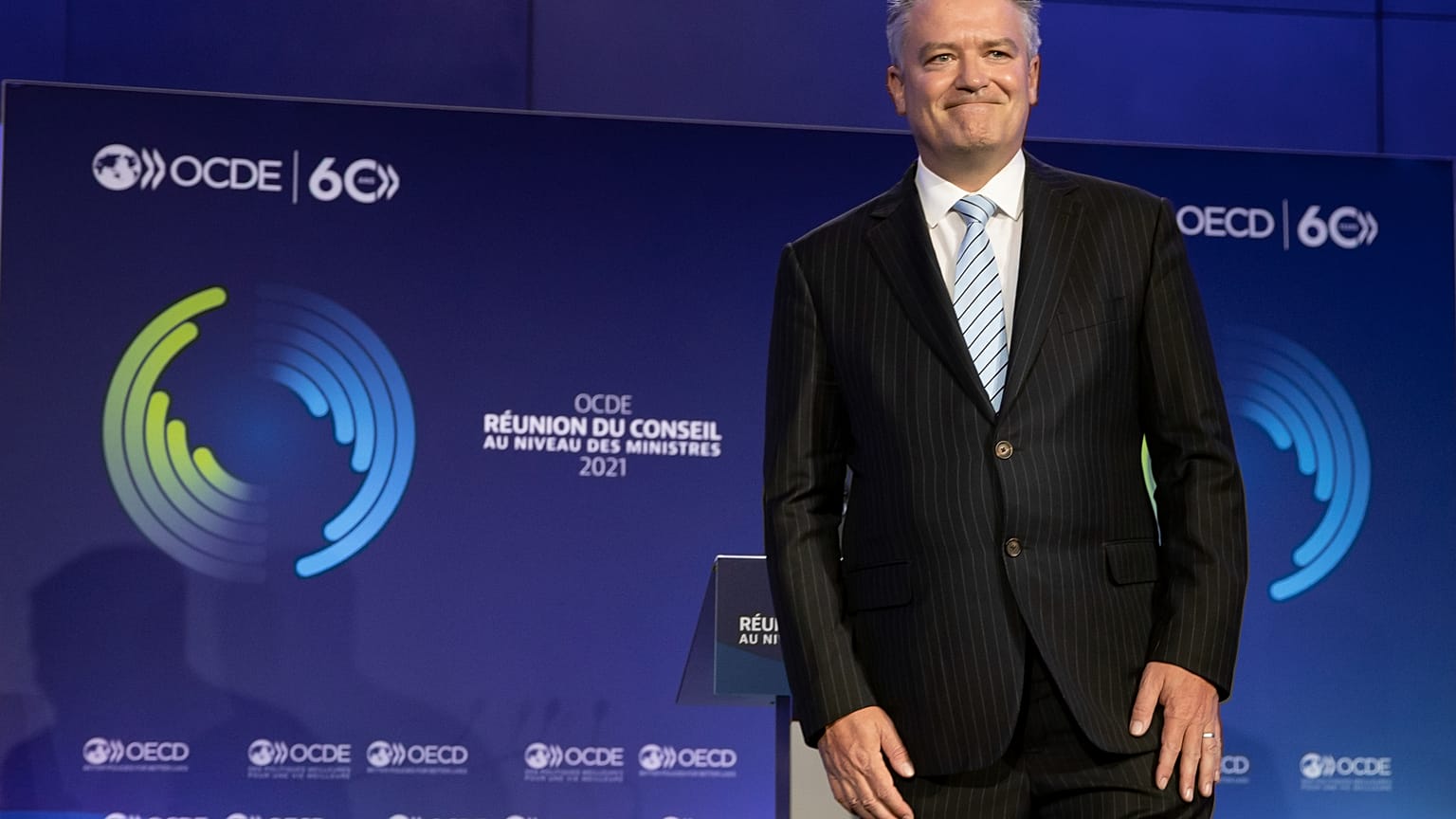
OECD boss Mathias Cormann speaks in Paris, France
Copyright OECD boss Mathias Cormann speaks in Paris, France

By Mathias Cormann, Secretary-General of the OECD
Published on

AI offers a major opportunity to boost productivity, wages and living standards, but only if Europe moves quickly to support its adoption, writes OECD Secretary-General Mathias Cormann.

With AI, Europe has within its reach the biggest productivity opportunity the world has seen since computers and the internet. Much of Europe missed that last wave. It cannot afford to miss this one. It is a chance to break out of decades of sluggish growth and meet the costs of an ageing society.

That is if it makes the right decisions, makes them quickly, and manages the risks without giving up the upside. It would mean higher wages, rising living standards and the revenue to fund public services without relying on ever higher taxes or more debt. The question is whether Europe will genuinely seize the opportunity, and seize it with sufficient speed.

Over these past two days, I joined Europe's finance ministers in Dublin, at the Eurogroup to discuss productivity and at the informal ECOFIN to discuss AI. Europe's productivity challenge, which is real, and the AI opportunity are two sides of the same coin. For Europe, AI is not just a technology question. It is a growth, incomes and budget question, and increasingly one of competitiveness and security.

Start with the challenge:

Europe's productivity growth has been sluggish for decades. Since 2022, productivity across the EU has essentially been stagnating, while the gap with the US is widening.

Productivity is what lifts wages and living standards. When it stalls, so do they. People feel this in their daily lives: it gets harder to keep up with the cost of living, and harder to get ahead.

Europe is also ageing, and its working-age population is shrinking.

Across the EU, there are about three people of working age for every person over 65 today; by 2060, there will be fewer than two. Pensions, health and long-term care will cost more every year; defence and the energy transition add to the bill. OECD analysis suggests these pressures could add close to six points of GDP to public spending in many European countries by 2040.

Those bills cannot simply be paid with higher taxes or more debt. Tax burdens in much of Europe are already among the highest in the world, and debt and interest costs are rising.

That leaves one path: sustained growth. But with an ageing population, growth can no longer come, as it has in the recent past, from more and more people in jobs. It has to come from each of us producing more, from higher productivity. That is where AI offers an extraordinary opportunity.

On OECD estimates, AI could add up to 1.2 percentage points a year to productivity growth over the coming decade. That means revenue that grows without tax rates going up.

A fiscal dividend: helping to create room to fund care for an ageing population, invest in security and still bring debt down. And AI can make public services themselves more efficient.

None of this is automatic. The dividend only arrives if AI is used across the whole economy. Adoption, while rising fast, is still narrow. One in five firms across the OECD used AI last year, double the share two years earlier – but one in two large firms and only one in six small ones, with dramatic differences across sectors.

To get there, Europe has to do three things.

First, build the infrastructure: data centres, reliable and affordable power, fast networks. Permit and connect them faster, and integrate Europe's electricity market so power flows where needed. Which means finding better ways to finance it.

The AI build-out is a trillion-euro investment wave, increasingly funded through bond and capital markets rather than company cash flows. Europe has the savings, but too much of it sits in bank deposits or flows abroad. A genuine capital markets union, which would channel European savings into European infrastructure and give young, innovative firms the risk capital they need to scale, has become even more important and more urgent.

Second, ensure access. Small and medium-sized businesses employ most Europeans. They need affordable tools, trusted advice and a single market in which a product built in one member state sells in all 27.

Third, invest in people. Skills are the binding constraint on faster adoption. Firms tell us the main reason they do not adopt AI is that they cannot find people who can use it.

Yet workers are ahead of their employers. More than 40% of people in work across the OECD already use generative AI tools, often on their own initiative. What is missing is training. The training there reaches those who need it least. Only 23% of adults with low literacy take part in AI-related training, against 61% of those with high literacy.

Firms under-invest in training because they fear losing those they train. It’s a market failure whose fixes are fiscal: tax treatment of training, incentives for employers who train, individual learning accounts that workers carry with them from job to job.

What about jobs? Fears of mass unemployment dominate the headlines. The data do not support them: OECD surveys find no evidence so far that AI is reducing overall employment. If anything, the sectors most exposed to AI have been advertising more jobs, not fewer. And on young people, where concern is loudest, our Employment Outlook finds AI's role in their difficulties has so far been limited.

There will be change: some tasks will disappear and new ones appear.

We should prepare systematically, with tools we know work: training that reaches workers most at risk, employment services that move people from job to job rather than through unemployment, and help for those who must move to find work. AI itself can make training more effective: shorter, more targeted and easier to deliver. That is the right response. Holding back the technology is not.

Europe, like everyone, must manage AI's risks to privacy, safety, cyber security and financial stability, and the OECD AI Principles give us a shared framework.

But the greater risk for Europe is not moving too fast. It is moving too slowly while others race ahead. In a world where economic strength and security are ever more closely linked, a Europe that falls behind on this decade's defining technology will have less say over its own future.

The choice in Dublin was clear. Europe can use AI to grow, raise incomes and secure the public finances its ageing society depends on. The technology is here. The people are willing. What Europe needs now is the decisions.

Mathias Cormann is the OECD Secretary-General and recently took part in the Eurogroup and informal ECOFIN meetings in Dublin on productivity and on future proofing the economy – the impact of AI.