Saturday, June 06, 2026

US Ebola facility in Kenya fuels anger in a country with no cases

With no recorded cases of Ebola, many Kenyans are struggling to understand why their government is allowing the United States to build an Ebola facility in their country to treat US citizens. Despite protests and criticism, the Kenyan government has vowed to press on.


Issued on: 06/06/2026 - RFI

Demonstrators participate during a protest against a US-backed Ebola quarantine plan on the establishment of a facility to host Americans exposed to Ebola, in Nanyuki town, in Laikipia County, Kenya, on 1 June, 2026. REUTERS - John Muchucha

The centre at Nanyuki, near the Laikipia military base 190km north of Nairobi, is set to quarantine Americans arriving from neighbouring Democratic Republic of Congo, which is battling a major Ebola outbreak.

The facility will have 50 isolation beds and be managed by US staff. A US diplomatic source said it was nearing completion and currently had no patients.

Hundreds of Kenyans have taken to the streets in recent weeks to protest against the plan, arguing that the country should not be asked to host people exposed to a disease it has never recorded.

Public anger

"Kenya is not an American colony!" protesters chanted on Tuesday as they carried an Ebola coffin to the health ministry.

"If Ebola is too dangerous for Americans, it's also too dangerous for us," protesters from Nanyuki told RFI.

Two people were killed in central Kenya after police opened fire on Tuesday, Patrick Wahome, one of the organisers of the march, said. A security source also said two people had died but did not specify the cause of death.

There is also anger over what critics see as the neo-colonial nature of the project, with Washington refusing to allow Ebola patients into its own territory while sending them to Kenya.

A demonstrator in a protest against the US-backed Ebola quarantine plan to establish a 50-bed facility at a Kenyan air force base, in Nanyuki town, in Laikipia County, Kenya, on 1 June, 2026. REUTERS - John Muchucha


Laikipia is already home to a long-standing British army base that has brought prosperity to the area but has also been linked to incidents of rape and murder involving local women.

"The proposed establishment of the Ebola quarantine hospital in Laikipia is against the Madaraka [self-governance] principle... That is neo-colonialism," Laikipia Governor Mutula Kilonzo Junior said in a speech.

Kahura Mundia, deputy chairperson of the Kenya Medical Practitioners, Pharmacists and Dentists Union, told Citizen TV that allowing Ebola patients to travel beyond the borders of the DRC and Uganda could contribute to spreading the disease further if countries were not properly prepared.

Opposition MP Willis Evans Otieno questioned Kenya's decision to host suspected Ebola cases, saying that "the powers pushing for this arrangement will be the first to restrict our movements" if a case were detected.
Court challenge

A Kenyan court temporarily suspended the plan on 28 May following a complaint by civil society organisation Katiba Institute – a legal advocacy group.

On Tuesday, Kenya's High Court blocked the proposed facility for another three weeks, and ordered the government to disclose its agreement with Washington.

Judge Patricia Nyaundi barred the government from taking any steps to build or begin operating the facility before the case is resolved.

The judge also ordered the government to disclose all agreements and operating protocols related to the facility within seven days and scheduled the next hearing for 23 June.
The protest turned violent in Nanyuki town, in Laikipia County, Kenya, on 1 June, 2026. REUTERS - John Muchucha

Conflicting accounts

The US government says it is continuing to build the facility despite the protests and court rulings.

US military aircraft have continued flying in staff and equipment in recent days, US officials and diplomatic sources said. Data from flight-tracking website Flightradar24 showed at least nine aircraft had arrived since 24 May.

The facility is intended for Americans who have been exposed to the virus but do not have symptoms. US officials said patients who develop symptoms would be transferred to other countries for treatment.

Health Minister Aden Duale told parliament on Wednesday that the centre would go ahead and would serve both Kenyans and Americans, rejecting claims that it would be exclusive.

"Quarantine is not only for Americans. Even Kenyans will be isolated at the facility," Duale said. "Laikipia air base is one of the 23 quarantine isolation centres we are building. And we will not stop it."
Disputed purpose

However, a US official speaking on condition of anonymity told Reuters the facility would only treat US citizens.

During a state visit to South Africa on Thursday, President William Ruto defended the decision to allow the US to build the centre.

"It would be most unfortunate if on one request by the Americans to set up a facility at their cost, we would refuse, we would look very inhuman," he told a press conference.

The US intends to provide $13.5 million for Kenya's Ebola preparedness efforts.

The outbreak of the rare Bundibugyo strain of Ebola is centred in eastern Congo and several cases have spread into neighbouring Uganda.

There have been at least 344 confirmed Ebola cases in Congo, including 48 deaths, and 116 suspected cases, according to the World Health Organization. Uganda has recorded at least 15 confirmed cases.

(with newswires)


How disinformation in Congo is worsening Ebola epidemic
DW
06/05/2026

The deadly Ebola outbreak isn't the only thing causing concern for health workers in Congo. Rumors and disinformation are hindering efforts to contain the virus. The patterns are well-known — and could be confronted.


Even though people are dying from Ebola, many in Mongbwalu still don't believe in the disease
Image: Gradel Muyisa Mumbere/REUTERS


Three weeks since the start of the latest Ebola epidemic in the Democratic Republic of Congo, there have been 397 confirmed cases, including 63 confirmed deaths, according to the latest figures reported by the African Union's Africa Centres for Disease Control and Prevention.

And yet: "The community does not believe in this disease. Despite the deaths, people don't believe in it," said John Tumujimbe, head of a team for dignified and safe burials in the small town of Mongbwalu, one of the epicenters of the Ebola epidemic in the Congo's northeastern Ituri province.

"We initially thought of malaria, typhoid or diarrheal diseases," Tumujimbe said. "But, after so many deaths, we sent samples to the INRB."

The INRB — Congo's National Institute for Biomedical Research in the capital, Kinshasa — confirmed that these were indeed cases of Ebola. This led health officials to announce the 17th Ebola epidemic to be recorded in Congo since the virus was first discovered in 1976.


Ebola rumors lead to arson attacks


But health officials say many residents in Mongbwalu rejected this scientific answer.

"When there were the first deaths, there was talk that the coffins were a problem, that it spread from there," said one Mongbwalu resident, who did not want to be named.

Tumujimbe also heard this rumor. "That's how it started: people talked about a coffin that kills people. And then more people died."

Another rumor: Aid workers and paramedics were spreading the virus via the antennas of their vehicles.

At the end of May, an angry crowd gathered at Mongbwalu's general hospital. They demanded that authorities return the bodies of their deceased, eventually setting fire to a tent belonging to the aid organization Doctors Without Borders. The organization had to withdraw its staff.

"There was a panic," hospital director Richard Lokudi told DW. "This allowed several suspected cases to escape. Eighteen patients who were under observation have disappeared."

The health workers worry suspected Ebola patients could have passed the disease on to the people who were sheltering them. There is still no vaccine for the Bundibugyo variant of the Ebola virus now circulating.

Familiar rumors blunt Ebola response


Christopher Nehring specializes in researching disinformation, and co-authored a report on the current Ebola epidemic for the Konrad Adenauer Foundation. He said similar rumors pop up in every health emergency.

"They say the disease comes from the lab as a bioweapon; that the vaccination is more harmful than the virus; that there is a simple cure that is being concealed; that the disease is not real. Big Pharma is mentioned either as the profiteer of the crisis or as the ones who originated it," Nehring told DW.

"It's all been known for decades. And it varies, there are 100 different variations of these narratives."

For the report, Nehring sought information from Congolese fact checkers. One of them is Ange Kasongo, founder of Balobaki Check, based in Kinshasa. Talking with DW, she recalled conversations she had with miners — gold mining is important for the economy in the province of Ituri.

"They said that the rumors and myths about death were circulating, but that the people there didn't believe them," Kasongo said.

The explanation she was given went: "If a trader wants to earn or mine a lot of gold, he may also resort to mystical acts to eliminate his competitors."

This suggests that economic pressure is also preventing the epidemic from being dealt with openly.

Kasongo highlights another rumor: Private messages circulating on WhatsApp have claimed a conspiracy between Congolese President Felix Tshisekedi and renowned virologist Jean-Jacques Muyembe — who discovered the virus 50 years ago — to wipe out the population in eastern Congo


The Balobaki Check team was unable to find any supporting evidence of this claim.


Without reliable media, disinformation spreads easily

The global community is making significantly less money available for emergency aid measures, which makes fighting Ebola harder.

US President Donald Trump withdrew the United States from the World Health Organization in 2025, and ordered massive cuts to USAID and the crisis management program at the US Centers for Disease Control and Prevention.

European governments have also cut funding, partly due to the cost of militarization efforts in the wake of the war in Ukraine.


For Nehring, this situation has also encouraged the spread of fake news. "If the money for health aid has already been cut, then you can't talk about bigger budgets for health communication either," said Nehring.

Nevertheless, Ange Kasongo pointed out the authorities were making every effort to communicate clearly. But she also told DW this had its limits. "How can we ensure that information is passed on orally — not just in French, not just in the four national languages?"

According to Kasongo, it;s important to get community leaders on board and give them access to reliable information.


Rachidi Kudra contributed reporting.

This article was originally written in German.

Philipp Sandner Editor


Inside DR Congo’s Ebola Fight: Faith, Fear, And Trust


Health teams in personal protective equipment (PPE) respond to the Ebola outbreak in eastern DR Congo. Photo Credit: WHO/Joël Lumbala

June 6, 2026 
 UN News
By Vibhu Mishra and Cristina Silveiro

In a village in eastern Democratic Republic of the Congo (DRC), health workers arrived a few days ago to help bury a person who had died from Ebola. Instead, they were threatened, told armed rebels would be called if they stayed, and forced to leave.

The family carried out the burial themselves – potentially exposing dozens more people to the virus.

The incident offers a stark illustration of one of the biggest obstacles facing efforts to contain the latest deadly epidemic, which has infected 381 people and claimed 64 lives in DRC as of 3 June.


For Marie Roseline Belizaire, the World Health Organization’s (WHO) Emergency Preparedness and Response Director for Africa, the most challenging part is not always the virus itself – it can be sitting with families who believe the disease is caused by witchcraft, persuading traditional healers to work alongside health teams or health teams returning to communities that threatened them – only days earlier.

“We are not trying to overcome their culture,” she said. “We’re trying to involve the science in their own belief.”

Progress, but not yet control

The outbreak, caused by the rare Bundibugyo strain of Ebola virus – for which there is no vaccine or treatment – continues to spread in eastern DRC while cases have also been reported across the border in Uganda.

Speaking to UN News from Bunia, in Ituri province, Dr. Belizaire said the response has made significant gains in recent weeks, particularly in testing capacity.

At the start of the outbreak, laboratories could process about 40 tests a day. That capacity has now expanded to 800 daily tests, allowing suspected cases to be confirmed or ruled out much more quickly.

“All the tests that we are receiving, we are rolling them out at the same day, almost,” she said. “The time to expect your result has been reduced. Twenty-four, maximum 48 hours you have the result.”

Community alerts are first investigated in the field, with those meeting the outbreak’s case definition tested and either confirmed or ruled out – allowing suspected cases to be cleared from the system more quickly than at the start of the outbreak.

Firmer trace

Contact tracing rates have improved from around 25 per cent to 45 per cent, but that remains far below the 90 to 95 per cent coverage needed to effectively contain transmission.

“We still have a lot of challenges,” she said, adding that the outbreak’s regional dimensions remain a concern.

Uganda has recorded 15 confirmed cases and one probable case linked to the outbreak. One Congolese national also travelled through the United Arab Emirates before arriving in Uganda, highlighting how quickly infectious diseases can move across borders.

“When there is an outbreak and you have mobility, it is always a concern,” Dr. Belizaire said, stressing however that mechanisms such as WHO’s International Health Regulations help countries share information rapidly and coordinate responses.
Trust in public health

For WHO teams on the ground, one of the most complex tasks is building trust. Many communities in affected areas have experienced years of conflict and insecurity. Cultural beliefs and misinformation can also shape how people interpret illness and death.

“The disease symptoms are very malaria-like in the community,” Dr. Belizaire explained.


Some families attribute deaths to witchcraft or poisoning rather than infection.

Health workers therefore focus on coexistence rather than confrontation.

“We don’t stop them to believe in witchcraft, to believe any other things in their culture,” she said. “We just ask them to simultaneously believe in the disease existence also.”
Ancient and modern

Traditional healers are also being engaged as partners rather than excluded.

“We don’t stop them going to traditional healers,” she said. “We ask [the healers], if you see someone with those symptoms, refer it also to us.”

The approach reflects lessons learned from previous Ebola outbreaks, where mistrust often proved as dangerous as the virus itself.

WHO Director-General Tedros Adhanom Ghebreyesus, who recently visited the outbreak’s epicentre, warned that “misinformation is almost as dangerous as the virus itself, and spreads just as fast.”
Reasons for hope

Despite the difficulties, there have been encouraging signs. Seven people have recovered from Ebola, including six healthcare workers.

Most sought treatment early and received intensive supportive care, including rehydration and treatment for symptoms while their immune systems fought the infection.

“They recovered because they went early to the hospital,” Dr. Belizaire said.
Candidate vaccines under development

There is currently no licensed vaccine or approved treatment for the Bundibugyo strain, although candidate vaccines are under development.

But Dr. Belizaire stressed that even a vaccine would not replace the need for early detection and treatment.

“The key is, as soon as you have symptoms, you go to the healthcare centre,” she said.
A survivor’s determination

Among the encounters that have stayed with Dr. Belizaire most is that of a healthcare worker who contracted Ebola while caring for a patient. The female medic later recovered.

Rather than leaving the profession, she said she intends to continue serving others.

“She said she will not stop,” Dr. Belizaire recalled. “She said she was born to give care to others, and it is what she will continue doing.”


That story reflects the resilience of health workers and communities confronting the outbreak every day.

U.S. warns Ebola outbreak on scale of largest ‘is possible’


Doctors Without Borders (MSF) personnel prepare for Ebola treatment in the eastern Democratic Republic of the Congo
Doctors Without Borders (MSF) personnel prepare for Ebola treatment in the eastern Democratic Republic of the Congo – Copyright AFP GLODY MURHABAZI

The U.S. CDC on Friday urged strong public health interventions against the current Ebola outbreak, citing their models that show it could otherwise rival the scale of the 2014 West Africa outbreak.

That eruption of the virus resulted in more than 28,000 cases and more than 11,000 deaths.

“That scale is possible,” said Jason Asher, director of CDC’s Center for Forecasting and Outbreak Analytics, during a press briefing.

The US projections from the Centers for Disease Control and Prevention were part of Morbidity and Mortality Weekly Report documents published Friday.

The worst outcomes could be avoided if “a larger proportion of patients were identified, isolated, and treated,” the agency said in its reports.

But “the public health response to control this outbreak will likely need to be of similar magnitude to the response for the 2014-2016 West Africa Ebola outbreak.”

Asher emphasized the models were “not a forecast” but “a planning tool.”

“They’re designed to support action, not to generate alarm.”

They are based on four possible intervention scenarios ranging from poor (20 percent) to extremely high (95 percent) levels of isolation and treatment.

If isolation levels are what the CDC would consider poor, with no other interventions there is a 65 percent chance cases will top 20,000 within three months, according to the agency.

Satish Pillai, the CDC manager for the Ebola response, said “the total individuals that are infected and requiring isolation remains unclear.”

But he said the situation on the ground would indicate levels of isolation are currently on the lower end.

Also on Friday the World Health Organization and the African Union’s public health agency said $518 million was needed across the next six months to combat the deadly Ebola outbreak in the DR Congo and its neighbors.

The outbreak was declared on May 15 in northeastern DR Congo, but the rare Bundibugyo species of the Ebola virus is believed to have spread for some time beforehand.

According to the WHO’s latest figures, there are 381 confirmed cases in the DRC, including 64 deaths.

The outbreak has hit three provinces, with the epicenter in Ituri, which the Africa CDC says accounts for 90 percent of confirmed cases and 76 percent of confirmed deaths.

Across the northeastern border in Uganda, there have been 16 confirmed cases, including one death.

Seven Ebola patients in the DRC and two in Uganda have recovered.


As Ebola Virus Spreads, We See the Terrifying Effects of Trump Dismantling USAID


Trump slashed more than 30 CDC experts and 140 USAID staff who managed the 2018 Ebola outbreak on the ground in the DRC.

June 4, 2026

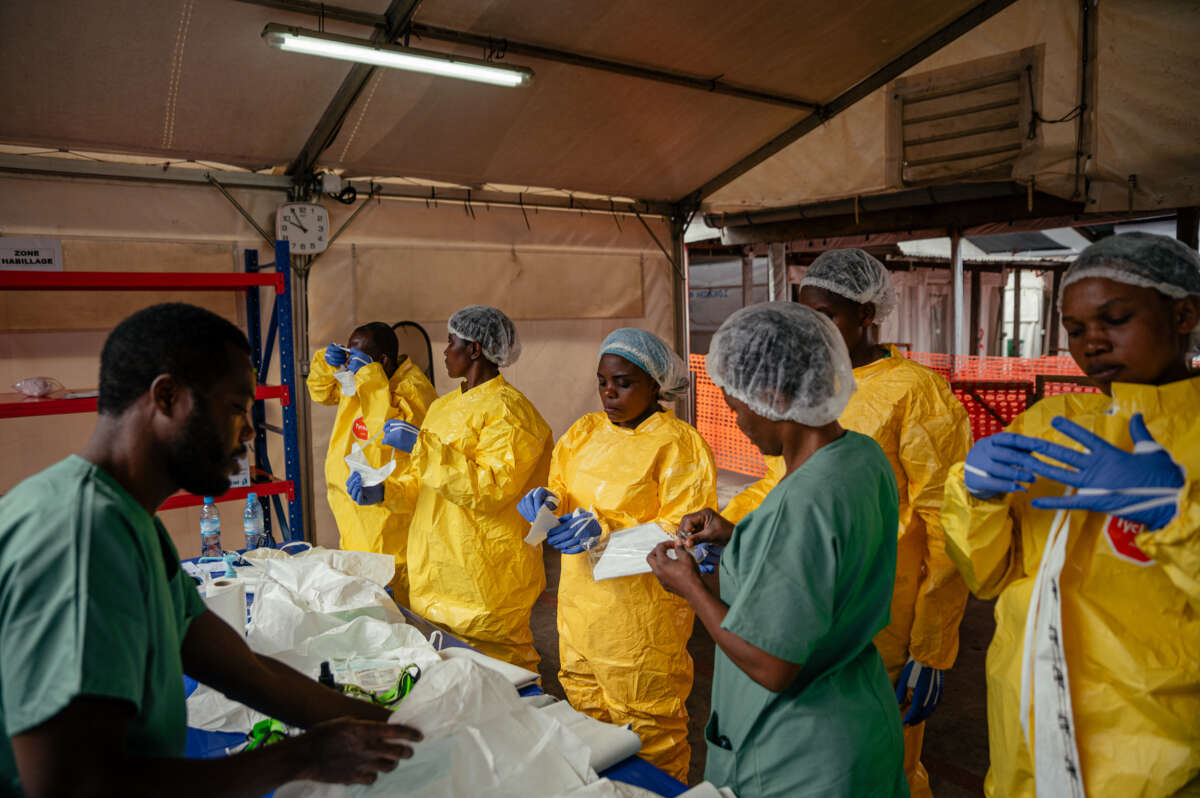
Health care workers put on personal protective equipment before going to examine patients at the Ebola Treatment Center in Munigi, Democratic Republic of the Congo, on June 2, 2026.Jospin Mwisha / AFP via Getty Images

In 2018, when the Democratic Republic of the Congo (DRC) experienced a severe Ebola outbreak, more than 30 experts from the Centers for Disease Control and Prevention (CDC), close to 20 disaster-response specialists from the U.S. Agency for International Development (USAID), and 120 additional USAID staff were on the ground attempting to manage the outbreak, according to estimates from Friends of USAID, an advocacy organization mainly made up of ex-USAID staffers. With that level of staffing in 2018, by and large, they succeeded in limiting the extent to which the disease spread.

This year, as a particularly virulent strain of the Ebola virus — the Bundibugyo strain, against which there is no approved vaccine and for which there are no medicinal cures — runs rampant in the Democratic Republic of the Congo, Friends of USAID estimate there is only one CDC staffer on the ground there, along with five additional State Department personnel. There are of course no USAID workers present, since the Trump administration dismantled USAID during the purges led by the so-called “Department of Government Efficiency” (DOGE) in 2025, summarily firing local health care contractors around the world, including in countries with extreme poverty rates such as the Democratic Republic of the Congo.

In addition, since Donald Trump signed an executive order pulling the U.S. out of the World Health Organization in early 2025 — a pullout that was completed in January of this year — CDC experts are no longer allowed to communicate with World Health Organization personnel. And despite a waiver having been granted for Ebola-related correspondence, in practice there has been a significant breakdown in communication between the two agencies over the past year — a breakdown promoted by the Trump administration, which recently sent out an email reminder to CDC staff not to correspond with the World Health Organization.

The consequences have already been devastating. In past Ebola outbreaks, even before mass testing of disease victims got underway, the CDC and USAID were able to tell when an epidemic was picking up steam based on on-the-ground medical observations and data about excess mortality figures. And, in response, they were able to position medical resources effectively.

In the current outbreak, the decimated remnants of the CDC were caught unawares, only finding out about the outbreak once hundreds, and possibly thousands, of people had already been infected — thus making it far more likely that this outbreak will prove particularly difficult to corral.


Trump Admin Cuts to USAID, WHO, Likely Stalled Response to Ebola, Experts Warn
“Facilities in affected areas are operating without basic protective supplies” due to cuts to USAID, one expert said. By Chris Walker , Truthout May 26, 2026


Because so many experts have been fired over the past 16 months, and because political overseers have been limiting what the remaining scientists can say and write, “the CDC is not really functional anymore,” Angela Rasmussen, professor of virology at the University of Saskatchewan in Canada, told Truthout. Rasmussen, who also serves as science chair for the Save America Movement, a nonpartisan organization that works to stop ongoing assaults on public health, added that the administration was no longer bothering to consult remaining CDC experts when making policy to respond to the outbreak. “It used to be an evidence-driven process and now it’s a political-driven process,” Rasmussen said.


“I equate it to having the mayor’s office taking on a fire without having a fire department or a fire hose.”

“I equate it to having the mayor’s office taking on a fire without having a fire department or a fire hose,” Demetre Daskalakis, former director of the CDC’s National Center for Immunization and Respiratory Diseases, told Truthout. Daskalakis, who resigned last August because he was so concerned about the direction that the Department of Health and Human Services was taking under Robert F. Kennedy Jr.’s leadership, says that when faced with grave public health challenges, the administration is simply resorting to “a lot of posturing, with, I think, bad consequences.”

Faced with the twin public health emergencies of the Ebola virus outbreak in the Democratic Republic of the Congo and Uganda, alongside the hantavirus outbreak on a cruise ship from which people disembarked to the four corners of the Earth, the Trump administration’s response has been, at best, ad hoc. Instead of implementing expert-driven protocols, it has leaned on its nativist instincts to simply attempt to lock the virus out. That attempt proved a colossal failure during the early days of the COVID-19 pandemic. And, according to Rasmussen and Daskalakis, the signs are not auspicious for it being a successful strategy against the global health crises of 2026.

For U.S. residents exposed to hantavirus, the Trump administration has ordered mandatory 42-day quarantines in a secure facility in Omaha, Nebraska — despite the fact that experts say the virus doesn’t spread easily and that home quarantine would be just as effective. For U.S. residents exposed to the Ebola virus in Africa, the response has been to refuse them entry back into the United States and to instead have them isolated and, if need be, treated in Kenya — a situation that Rasmussen and other experts say makes little sense given the huge investments made over the past decade in secure biocontainment units in the U.S. “They’re throwing evidence-based risk assessment out the window, and are trampling people’s 14th Amendment rights,” Rasmussen told Truthout. “If we’re going to take Americans’ freedom away, there should be a real basis for that — and there’s not.”

Telling people in the U.S. that if they get exposed to the Ebola virus, they won’t be allowed back into their home country for months is, experts believe, a surefire way to discourage U.S. doctors and public health professionals from heading to Africa to try to contain the outbreak. In other words, it is a strategy all but guaranteed to make a bad situation worse.

“It took so long for the CDC to say anything about hantavirus or to hear from the DRC about Ebola. Relationships that took decades to build have simply disappeared.”


At the same time, African victims of the disease, who could certainly benefit from access to the treatment center being established in Kenya, are being deliberately excluded from it. “There’s an equity issue,” Daskalakis says of this policy. This, too, will end up hurting public health, as the Ebola patients denied access to the Kenyan facility will, in all likelihood, end up spreading the disease further in their communities or in poorly resourced medical facilities to which some eventually may turn.

Aryn Backus, a CDC employee who has been on administrative leave for more than a year since her job was targeted by DOGE, and who is now deputy executive director of the National Public Health Coalition, told Truthout that the ham-handed U.S. response to the outbreak overseas makes it more likely that the disease will ultimately find its way to the United States. “Diseases don’t understand borders,” she said. And, without detailed international coordination, the likelihood of their spreading far and wide grows.

“We are seemingly not at the table anymore,” Daskalakis added, as he detailed the myriad ways that the U.S.’s role as global public health leader has been corroded. “It took so long for the CDC to say anything about hantavirus or to hear from the DRC about Ebola. Relationships that took decades to build have simply disappeared.”


Hantavirus: Argentina expands probe to trace outbreak source
DW, AFP, AP
06/06/2026 

Experts say tracing passenger movements before and after boarding the ship is critical to preventing the virus from spreading [FILE: May 18, 2026]Image: Mouneb Taim/Anadolu/picture alliance

Argentine and US scientists will test rodents in Mendoza as investigators try to trace the source of a hantavirus outbreak that killed three people.

Argentina is expanding its investigation into the source of a deadly hantavirus outbreak in April to the western province of Mendoza, the Health Ministry said on Friday.

Hantavirus is a rare rodent-borne illness that has multiple strains of varying severity.

The outbreak aboard the cruise ship MV Hondius is linked to the Andes hantavirus strain, endemic to parts of Argentina and Chile, though not in Mendoza.

It infected at least 11 people aboard the ship, killing three, after it departed from the southern Argentine city of Ushuaia in April.

Scientists reconstructing how the virus spread

Authorities said scientists from Argentina's leading center for infectious diseases, the Malbran Institute, and the US Centers for Disease Control and Prevention would conduct field studies in the city of Malargue, Mendoza, from June 8-12.

Argentine scientists, along with experts from the CDC, will trap and test rodents to trace the origin.

Laboratory analysis is also continuing on more than 100 rodents captured in Ushuaia and Tierra del Fuego last month.

Investigators are trying to reconstruct how the virus spread, including tracing the movements of a Dutch couple believed to be among the first infected.

They had travelled through Argentina and Chile before boarding the cruise.

The MV Hondius was sailing from Ushuaia in Argentina to Cape Verde when its journey was disrupted following the outbreak.

Experts suspect exposure to infected rodent droppings or urine caused the outbreak.
WHO says no pandemic threat

Officials said it may never be possible to determine the exact origin of the outbreak, but tracing the chain of transmission would help to understand the spread and management of the disease.

Ushuaia authorities have rejected suggestions the virus originated there, saying that Tierra del Fuego has not recorded a hantavirus case in three decades.

Although the Andes hantavirus has a mortality rate of up to 30% and no approved treatment or vaccine, the World Health Organization (WHO) has said the outbreak does not pose a pandemic threat.

Edited by: Rana Taha
Shakeel Sobhan Covering politics, social, and environmental issues in India.

#METOO BELATED

Debate in Germany after Wim Wenders pulls film over child nudity

04.06.2026, DPA

German director Wim Wenders - German director Wim Wenders attends the German Film Award ceremony. (is associated with: «Debate in Germany after Wim Wenders pulls film over child nudity»)

Photo: Sebastian Gollnow/dpa

By dpa correspondents

The decision by German director Wim Wenders to withdraw a 1975 film over a nude scene depicting a 13-year-old has sparked widespread debate in Germany on whether artworks should be changed retroactively, with some industry figures hailing the moment as a "big opportunity."

The controversial scene in the 1975 film "Wrong Move," a modern adaption of a novel by Johann Wolfgang von Goethe, features then 13-year-old actress Nastassja Kinski with a bare upper body.

Kinski, now 65, has said that she had asked Wenders for years to remove the 2-minute scene.

Wenders publicly apologized to Kinski in a statement released on Wednesday, announcing that he would withdraw the film from distribution until "a mutually agreed solution" was found.

Reacting to the move, the German Film Academy said on Thursday it would hold a meeting in September to address the issues raised by Wenders' decision.

Academy presidents Vicky Krieps and Florian Gallenberger noted the question inherent in Wenders' decision - whether films and other works of art should, must or are permitted to be altered after their release - had sparked “intense debate” not only in the public sphere but also within the institution.

It would take time to consider the legal, ethic, artistic and cultural dimensions in equal measure, meaning a decision on how the academy would deal with the film in the future should be expected following the meeting in September at the earliest, they said.

German director Julia von Heinz, who described Wenders' move as a "big opportunity" for the industry in an op-ed for Germany's Süddeutsche Zeitung daily, noted that her colleague had several options to deal with the scene.

Wenders could either grant Kinski her request and remove it, she said, or provide a “softer form of reparation” by creating supplementary material and allowing Kinski to contribute an interview or essay to be distributed alongside the film.

Von Heinz argued that Wenders' concern over the film's legacy could only be explained with a concept of genius “which assumes that a film is created frame by frame – that is, shot by shot – and that this form is the only true one and must not be altered.”

Yet films are often the result of chance, she wrote.

In his statement from Wednesday, Wenders writes that "it is necessary for our society to find appropriate ways of dealing with controversial film works from the 20th Century and to face new learning processes and inclusive perspectives regarding cinema."

He also said that he would seek dialogue with film institutions and other industry figures on the issue.

Before Wenders' announcement, Kinski's lawyer Christian Schertz had said that the acclaimed director had “refused for years” to discuss the scene with his client in person and announced that she would take legal action.

Schertz welcomed Wenders' decision to withdraw the film, while describing it as "long overdue."

"I also regret that this only came about as a result of public pressure, after he had initially tried to shift the blame in his speech at the German Film Awards and indirectly dismissed Nastassja Kinski’s request as censorship, which was truly despicable."

The 80-year-old director, whose films include "Paris, Texas," "Wings of Desire," and "Perfect Days," used his acceptance speech at the German Film Awards, where he received an honorary award last week, to call for a broader discussion about how the film industry should handle controversial scenes in older works.

Referring to the controversy linked to "Wrong Move," Wenders said he would not shoot the scene the same way today. However, he said he was "at a loss" as to how to deal with films made in a different era, as cutting the scene would set a precedent for all films to come.

Prague's Václav Havel Library on the brink of closure

05.06.2026, 13:28 Uhr

The renowned Václav Havel Library in Prague is facing closure following the withdrawal of several sponsors and a change in the stance of the widow of the former Czechoslovak and Czech president who gave the library its name.

Speaking to the CTK news agency on Friday, Václav Havel's widow, Dagmar Havlová said she no longer had the strength to continue supporting the project, despite always having believed in its objectives. 

Havlová's withdrawal caps a period of escalating tensions within the institution. This culminated in the resignation last month of the entire staff in protest against the allegedly chaotic management style of Tomáš Sedláček, who has been director since March 2025.

Sedláček, a 49-year-old economist who won acclaim for his 2011 book "The Economics of Good and Evil," has refused to step down despite the departure of the staff.

Final rescue attempts

The remaining members of the library's supervisory and administrative board say they will still seek a solution to the crisis. This could prove difficult, as Havlová holds the rights to her late husband's name.

Modelled on US presidential libraries, the library was founded in 2004 while Havel was still alive. As well as housing a large archive, it also serves as a vibrant venue for political and social debates.

The playwright and civil rights activist Havel, who died in 2011, became the first freely elected president of what was then Czechoslovakia following the democratic transition of 1989.

Following the peaceful separation from Slovakia in 1993, he became the first president of the new Czech Republic and remained in office until February 2003. He is known for plays such as "The Garden Party" and an extensive body of essays.


New Hungarian leader restricts permits for migrant workers

06.06.2026, DPA

Hungary PM Magyar restricts permits. - Hungarian Prime Minister Peter Magyar arrives at the Wawel Hill during his visit in Krakow. Magyar is in Poland for his first state visit since taking office, embarking on a three-city tour of Krakow, Warsaw and Gdansk to signal a major European diplomatic reset. (is associated with: «New Hungarian leader restricts permits for migrant workers»)

Photo: Kai Jane/ZUMA Press Wire/dpa

The new Hungarian Prime Minister Péter Magyar restricted the influx of migrant workers from non-EU countries by a government decree published on Saturday, keeping a promise he made to voters. 

New residence permits under the migrant worker scheme introduced by the previous government under former prime minister Viktor Orbán will no longer be issued with immediate effect. The decree has just been published in the Hungarian Official Gazette.

Magyar took office on May 9, after his centre-right Tisza Party won a clear victory in the parliamentary elections in April. Some 90,000 workers from non-EU countries are employed in Hungary, accounting for around 2% of the workforce, according to estimates. 

Most work in the battery and automotive industries, in construction, as seasonal workers in agriculture and in delivery services. The majority come from the Philippines, Ukraine, China, Vietnam and India.

Restricting the influx of migrant workers was among the promises Magyar made while campaigning to replace long-time leader Orbán. The new leader justified the vow by arguing that more Hungarians should be getting jobs and that companies should be prevented from driving down wages by employing foreigners, though there is a labour shortage in many sectors in Hungary, according to industry and employers’ associations.

The new regulation stipulates that existing residence permits remain valid until their expiry. It does not specify whether expiring permits can be extended. 

It does not signify a complete end to the granting of residence permits to non-EU citizens. Instead, the ban refers to the Orbán government’s simplified guest worker scheme, which enabled the relatively smooth recruitment of workers from outside the EU through agencies controlled by Orbán. Magyar slammed this practice during campaigning.

WHITE REPLACEMENT THEORY

U.S. Vice President blames British student’s murder on migrant ‘invasion’


US Vice President JD Vance has been a fierce critic of European migration policies
US Vice President JD Vance has been a fierce critic of European migration policies – Copyright AFP Kent NISHIMURA

US President JD Vance on Friday blamed Britain’s handling of the murder of a white student by a Sikh man on what he called civilizational decline caused by an “invasion” of migrants.

Vance’s comments on the case of 18-year-old Henry Nowak sparked a swift denunciation from British Prime Minister Keir Starmer’s office, which rejected attempts to “interfere in our democracy.”

“Henry Nowak died the same way a civilization dies: abandoned, handcuffed by authorities who neither trusted nor cared for him, and accused of hate crimes he did not commit,” Vance said on X.

“His murder is as tragic as it is enraging.”

Vance, a longtime critic of European migration policies, called for “righteous anger” in response to the case.

The case of Nowak, who was handcuffed by police as he lay dying after being stabbed by Vickrum Digwa in the southern city of Southampton in December, has become a lightning rod for right-wing anger around the world and sparked riots in Britain.

Digwa, 23, lied and told police he was the victim and that Nowak had racially insulted him.

US tech tycoon Elon Musk, the billionaire owner of X and a friend of Vance’s, has posted numerous times on the platform about the police response to the stabbing.

The US State Department then weighed in on Thursday condemning what it said was “ideological conditioning and two-tiered policing” that had led to the case.

Vance is now the highest-ranking official in US President Donald Trump’s to comment.

“He should still be alive today, and he would be if the last few generations of European elites had stood their ground against the politics of self-hatred and the mass invasion of migrants, many of whom despise the West and the people who love it,” Vance added.

“Henry was far from the first to so needlessly lose his life, and I fear he won’t be the last.”

Vance is one of the most vocal proponents of the Trump administration’s pushing of theories of Western civilizational decline due to mass migration.

The British government rejected the US intervention in the case.

“We have seen people trying to interfere in our democracy and seeking to stir up division on our streets,” a spokesperson for British premier Starmer said in a statement.

The spokesperson added that the family of student Henry Nowak had said they did not want his killing “to be used to create further division, hatred or tension.” 

Starmer himself accused billionaire Musk on Thursday of “trying to whip up division” in Britain.

Hegseth urges Europe on D-Day to counter present-day ‘invasion’ on beaches


US Secretary of Defense Pete Hegseth urged allies to stand shoulder-to-shoulder with America
US Secretary of Defense Pete Hegseth urged allies to stand shoulder-to-shoulder with America – Copyright AFP LOU BENOIST

US Defense Secretary Pete Hegseth on Saturday urged Europe to counter what he termed an “invasion” of its coastline by migration, as he marked the 82nd anniversary of the World War II D-Day landings in northern France.

Hegseth also called on European countries to do more to contribute to their defence, in a speech at the American military cemetery in Colleville-sur-mer in Normandy.

He was however conspicuously set to skip the main international ceremony marking the anniversary of the landings, which heralded an end to World War II, later in the afternoon.

“Sadly, today different European beaches are stormed by different dangerous ideologies,” Hegseth said.

On “beaches in Spain and Italy and Greece and Bulgaria, boats and men arrive,” he said.

“When will European capitals do something about that invasion? Or is it too late?”

His comments echoed the argument of the administration of US President Donald Trump that mass migration represents a danger to European civilisation.

US Vice President JD Vance on Friday blamed Britain’s handling of the murder of a white student by a Sikh man on what he called civilisational decline caused by an “invasion” of migrants.

“May we learn from this past,” Hegseth said in reference to the pivotal involvement of American troops in the Allied landings.

“The men buried here fought in a war-fighting alliance where every partner… brought its full measure of industry, courage and sacrifice,” he said in front of the 9,387 white crosses of American soldiers killed in action during the Battle of Normandy.

“Not empty slogans, not lavish summits, not communiques.

“Real allies doing real things, taking real losses for a shared cause worth fighting and dying for.”

– Peace ‘through strength’ –

He said that while America “will lead” its “capable allies must be right there with us, shoulder-to-shoulder in the breach when it matters”.

The Trump administration has also accused Europe of not pulling its weight to ensure the continent’s security and has even floated pulling out of NATO.

“Peace is secured only through strength,” he told the audience including French armed forces Minister Catherine Vautrin, without referring explicitly to the US-Israeli war against Iran.

“And it’s strength on both sides of the Atlantic, fortified by readiness, shared military capabilities and an unwavering political will,” he added.

The Normandy landings on June 6, 1944, were the largest amphibious operation in history. 

An armada of 6,939 ships and 132,700 British, Canadian, American, Belgian, Norwegian, and Polish troops stormed 80 kilometres (50 miles) of Normandy beaches. 

The operation contributed decisively to the victory over Nazi Germany, which was also being squeezed by USSR forces to the east.


US defence chief Hegseth demands West's backing on 

D-Day anniversary

Hegseth made a highly charged comparison between the Normandy landings in Nazi-occupied France and migrant crossings in the Mediterranean, which he labelled an "invasion." 

06.06.2026 DPA


Pete Hegseth - FILE PHOTO - US Secretary of Defense Pete Hegseth attends the meeting between US President Trump and German Chancellor Merz at the White House. (is associated with: «US defence chief Hegseth demands West's backing on D-Day anniversary»)

Photo: Kay Nietfeld/dpa

US defence chief Pete Hegseth on Saturday called on Western allies to provide greater support to Washington in defending peace and freedom, in a speech marking the 82nd anniversary of the D-Day landings in Normandy.

"Peace is secured only through strength and its strength on both sides of the Atlantic, fortified by readiness, shared military capabilities, and an unwavering political will," said Hegseth at the US war cemetery in Collville-sur-Mer. 

"Our world is safer and more prosperous when the United States of America and our allies are strong, free, and unapologetic in defence of our Western tradition of freedom."

Hegseth said "America will lead," but insisted that "capable allies must be right there with us, shoulder to shoulder in the breach when it matters."

"We stand by our allies, and we expect our allies capable and ready to stand alongside us," he added. 

The politician - dubbed the secretary of war by US President Donald Trump - argued that "much of the West" has grown "comfortable" since World War II. 

"We forgot that freedom is not free. We forgot that peace is not wished into being. It is bought with purpose, with honour, and with strength," he insisted. "The men who landed on these beaches knew this."

Hegseth made a highly charged comparison between the Normandy landings in Nazi-occupied France - which began on June 6, 1944 and played a key role in the defeat of Adolf Hitler's Third Reich - and migrant crossings in the Mediterranean, which he labelled an "invasion." 

"Sadly, today, different European beaches are stormed by different dangerous ideologies," he said, highlighting landings in Spain, Italy, Greece and Bulgaria.

Hegseth was accompanied by his French counterpart, Catherine Vautrin, at the commemoration on Saturday.

Ukraine launches fresh drone attack on St. Petersburg region on final day of ‘Russian Davos’

Ukraine on Saturday fired hundreds of drones targeting the St. Petersburg region in the second such attack on Russia’s second-largest city in less than a week. The attack came on the final day of the St. Petersburg International Economic Forum, President Vladimir Putin’s annual investment forum known as “Russia’s Davos”.

Issued on: 06/06/2026 - 
By: FRANCE 24

Satellite image provided by Vantor shows fire crews working to control the fires onboard the Russian guided-missile corvette Boikiy at the Kronstadt naval base west of St. Petersburg, Russia, June 3, 2026. Vantor via AP

Residents of St. Petersburg were told not to leave their homes after a large-scale Ukrainian drone attack targeted Russia’s second-largest city Saturday morning, underscoring Kyiv’s growing ability to hit deep inside Russia.

The attack came a day after Russian President Vladimir Putin refused an offer to meet his Ukrainian counterpart.

St. Petersburg Governor Alexander Beglov advised the residents not to go outside and warned of possible disruptions to mobile internet service, while regional Governor Alexander Drozdenko said 141 drones were shot down over the surrounding Leningrad region.

Russia’s Defence Ministry said its air defences shot down 376 Ukrainian drones.

“Last night, our drones covered a distance of about 1,000 kilometres to the St. Petersburg region – to the enemy navy’s arsenals and a base in Kronstadt,” Ukrainian President Volodymyr Zelensky wrote on X.


Although no casualties were immediately reported, the renewed attack on St. Petersburg is the latest embarrassing blow to Putin’s efforts to cast the conflict as a distant event that doesn’t affect Russian daily life.

Cars are seen parked near banners with branding for the St. Petersburg International Economic Forum (SPIEF) at the forum's venue as black smoke rises in distance in Saint Petersburg on June 3, 2026, where Ukrainian drones hit energy and military sites. © AFP
02:03


A Ukrainian drone strike set ablaze an oil terminal in the city and hit a nearby naval base Wednesday, hours before the opening of the St. Petersburg International Economic Forum, Putin’s annual showcase for investment.

Speaking at the forum, Putin said Thursday that Russia will strengthen its air defences to counter recent Ukrainian drone attacks, which have reached deep inside his country and cast a cloud over the event in his hometown of St. Petersburg.

Putin on Friday rejected a proposal by Zelensky for a face-to-face meeting on the four-year-old conflict, saying he sees “no point” in it. Thursday’s letter, the first public message Zelensky has written directly to Putin since Russia sent troops into Ukraine in 2022, was a sweeping critique of the Russian leader’s 26 years in power, as well as some taunts about his age.

Responding to Putin's dismissal of the proposed meeting, Ukrainian Foreign Minister Andrii Sybiha said Saturday that things would “only get worse for Russia.”

"Failures will get more humiliating," he wrote on X, warning that there are “no safe places in Russia that can be exempt” from Ukrainian long-range attacks, and that the intensity of attacks “will continue to grow.”

With the front line barely moving as swarms of drones hinder advances, both sides have sought an edge by launching long-range strikes.

In Ukraine, one person was killed and three wounded overnight into Saturday in the Dnipropetrovsk region, as Russian forces struck three districts nearly 30 times with drones and artillery, regional head Oleksandr Hanzha said.

In Zaporizhzhia, seven people sought medical care after a Russian drone strike started a fire at a parking lot, according to regional head Ivan Fedorov.

Russia targeted Ukraine overnight with 272 strike drones, and air defences shot down 249 of them, the Ukrainian air force said Saturday.

(FRANCE 24 with AP)

Ukraine banks on its defence industry to drive economic growth

06.06.2026, DPA

Ukrainian drone from Quantum Frontline Industries - FILE PHOTO - Ukrainian President Volodymyr Zelensky is presented with a drone during a visit to drone manufacturer Quantum Frontline Industries ahead of the Munich Security Conference. (is associated with: «Ukraine banks on its defence industry to drive economic growth»)

Photo: Sven Hoppe/dpa

Ukraine regards its defence industry as a lasting source of economic strength, Finance Minister Serhii Marchenko said on Saturday.

“The demand we have created in Ukraine has given rise to an economic sector that is now practically booming. It is therefore a very important part of our future,” Marchenko said at the annual meeting of the European Bank for Reconstruction and Development (EBRD) in Riga. 

The key now is to strengthen the industry, provide it with development capacity and open up its military potential to a broader market, he explained. To this end, Ukraine is facing the decision to allow the export of military goods.

According to Marchenko, expanding and utilizing this potential could lead to more than just further progress in military equipment and weapons. 

“I believe these developments can help create a natural civilian environment after the war. Because some of the production we currently use for military purposes can also be used for civilian purposes,” the Ukrainian official added.

With Western assistance, Ukraine is defending itself against a Russian invasion – and, in the fifth year of its defensive struggle, is regarded as a world leader in drone warfare. 

At the same time, the government in Kiev hopes to receive the first tranche of funds from a €90 billion ($105.5 billion) European Union loan as early as June, which is also to be used for defence purposes. Given the ongoing war, it is quite problematic and difficult to attract private investors, said Marchenko.