Sunday, June 07, 2026


Shadow banking is out of control – but how can it be fixed?



JUNE 6, 2O26

Mike Phipps reviews The Global Casino: How Wall Street Gambles with People and the Planet, by Ann Pettifor, published by Verso, and We Need to Tax Billionaires, by Gabriel Zucman, published by Basic.

Global financial markets and their gambling habits are largely invisible to most people, Ann Pettifor tells us in this new analysis. Nor are the economies we inhabit really governed by elected politicians, however much our current government thinks they are: “Instead the value of an economy and  of a nation’s currency and its interests rates as well as the levels of investment that ought to provide livelihoods and both economic and ecological security are all economic levers largely wielded by unaccountable and irresponsible financiers.”

Growing financial globalisation is especially dangerous, because financial assets are intangible, based on something ephemeral: money. And money, contends the author, is a social construct: credit, a promise to pay, based on trust, upheld by regulation and law.

But the global financial system is largely lawless and unregulated. Shadow banking – beyond the regulatory boundaries of states – currently gambles with assets estimated to be worth $217 trillion.

The system has a demonstrable power to destabilise governments. It ignores democratic priorities, for example, by funding the fossil fuel industry. The 2007-9 Global Financial Crisis showed little will to regulate the problem. Generous state bailouts gave financial institutions the belief that they were too big to fail and too big to jail.

Political institutions have hollowed out and centrist politicians have no answers about what to do about government by the markets. This fuels the rise of the populist right, Pettifor pointed out in a recent interview, as people say “Give me a strongman to protect me from markets that strip me of the right to a decent roof over my head, food, education, health.”

The dismantling of the financial system’s guardrails, argues Pettifor, began in 1971 with President Nixon’s suspension of the convertibility of the US dollar into gold. The shift away from a national bank-based system to a global unregulated market paved the way for the recurring financial crises subsequently experienced.  At the same time, the over-valuation of the dollar as the world’s reserve currency collapsed manufacturing in the US rustbelt and expanded US consumption of goods and services produced in China and elsewhere, worsening the US trade deficit. But it also harmed the economies of poorer countries which were now forced to buy oil and pharmaceuticals in a currency much stronger than their own.

Today, the export orientation of almost all of the world’s richest economies has led to record levels of overproduction of stuff that can’t be consumed simply because people cannot afford to buy it. So, rather than, as we are frequently told, the public living beyond their means – which forces people into debt – it’s the economy that is operating beyond the means of the public.

There is a lot to chew over here, such as how money cannot and should not be a tradeable commodity, and how households have been exposed to global financial markets thanks to the privatisation of pension funds. The essential point is that the colossal sums of money circulating in global markets are forever seeking lucrative new investments to increase their value – and this is destabilising agricultural markets. Prices mushroomed in 2005-8, causing hunger, despite more food being produced than ever before.

Energy and housing markets are also adversely affected.. The number of houses, even in London and the southeast, has grown faster than the household count, but prices continue to rocket – because they are often deliberately intended to be financial assets, rather than affordable homes.

Pettifor proposes to “urgently transform” financialised capitalism. It’s a Keynesian, reformist perspective: it can be done, we are told, because it’s been done before. But can it? The levels of public food storage and energy stockpiling required to counter the inflationary effects of financial speculation seem vast. But both China and India have food storage policies and the US Department of Energy operates an energy reserve. Pettifor wants the UN to lead in these fields, but that look unlikely in a context of chronic underfunding and superpower sidelining.

On housing, the speculative market could be controlled by the state building more affordable stock, imposing rent controls and taxes on property, second homes and buy-to-let.

Tackling international markets directly, Pettifor proposes constraints on capital mobility, but ideas like the Tobin Tax are very modest in the face of the scale of the problem. One thing is clear: Trump’s rage against globalisation is unlikely to go beyond tariffs unless the power of Wall Street is confronted, and there is very little likelihood of that.

Returning to where we started, one giant step would be to move away from the US dollar being the world’s reserve currency. Given the huge advantages this gives to its economy, the US is unlikely to yield on this without a fight – literally. Attempts by Iraq, for example, to stop trading oil in dollars was identified by some analysts as a motive for US military intervention in 2003, although Pettifor doesn’t look at this.

“Government by organised money has become unbearable for human society,” the author said in a recent article in Tribune. But greater regulation of a sector that appears “vast and unstoppable” may not be enough, and hoping that the world will come to its senses in the event of a major catastrophe smacks of desperation. More radical solutions are needed.

“If the cause of all our woes globally is an uncontrolled financial sector, why does Pettifor not call for the public ownership of the banking system in the major economies and the closure of hedge funds and other speculative forms of finance capital?” asked economist Michael Roberts in a recent review. It’s a fair question.
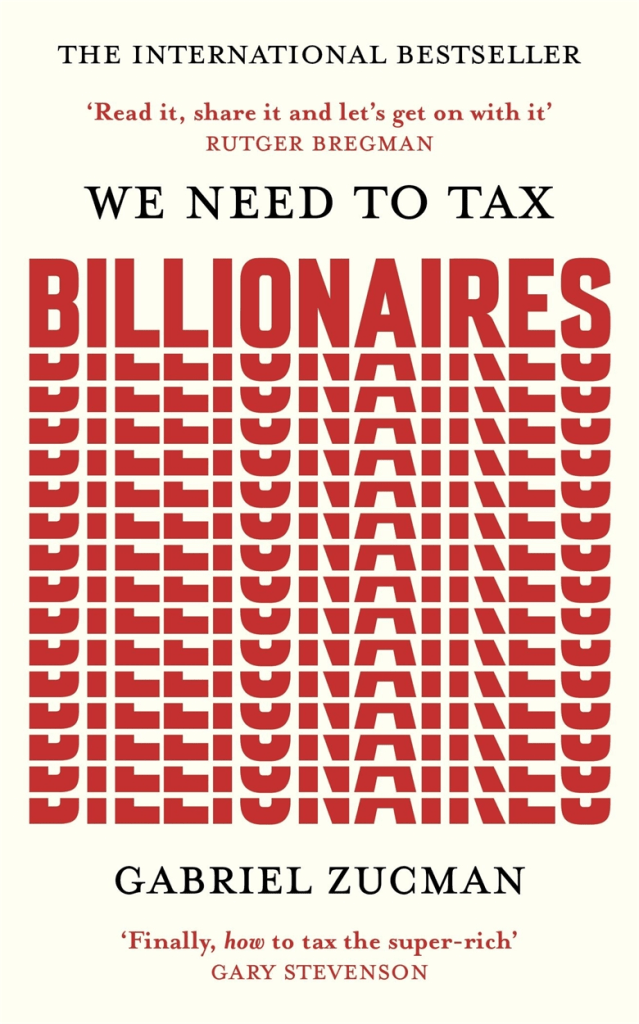
After the complexities of Ann Pettifor’s book, We Need to Tax Billionaires is comparatively straightforward – but still an eye-opener. Economics professor Gabriel Zucman calculated French citizens pay on average 51% of their income in tax, if all forms of tax, including VAT, are considered. For the working class, it’s around 45%, but for billionaires, it’s just 13%.

If France’s billionaires all moved to the Cayman Islands tomorrow, the loss of tax revenue to the country would be insignificant – around 0.03%. And the same is true throughout Europe.

It’s remarkably easy for the super-rich to structure their finances in such a way that their personal income – and income tax bills – are as low as possible. This is easily done via holding companies. At the same time, the easier it is to avoid paying tax, the easier it is to accumulate more wealth.

Targeting holding companies, as the US government has in the past, just leads the filthy rich to seek other loopholes. The answer, says Zucman, is to tax wealth itself. Even a 2% tax on individuals worth over $100 million would, in France, bring in around 20 billion euros a year.

“Billionaires cannot be allowed to live in some parallel society,” concludes Zucman. “With great wealth comes great power.” The fact that Elon Musk’s Tesla company didn’t turn a profit for 17 years until 2020 didn’t stop him acquiring Twitter two years later for $44 billion, allowing him to turn the social network into a platform for a range of ideological causes, including getting Donald Trump re-elected, with all the rewards that that brought him. If wealth confers power, democracy alone requires it be constrained.

Mike Phipps’ book Don’t Stop Thinking About Tomorrow: The Labour Party after Jeremy Corbyn (OR Books, 2022) can be ordered here.

UK


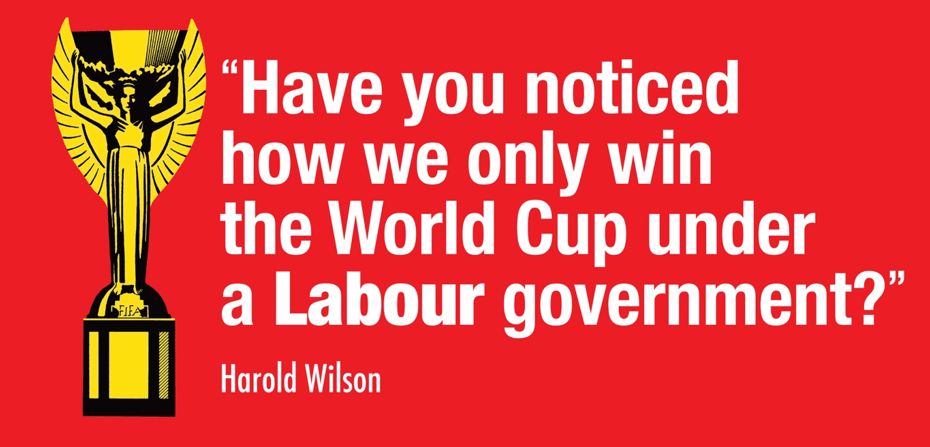
“Have you noticed how we only win the World Cup under a Labour government?”

JUNE 5, 2026

Politicians seldom get it right when they talk about football, argues Mark Perryman.

In March 1966 Harold Wilson’s Labour Party won a landslide victory and just four months later Harold was there to celebrate when England for the first, and to date last, time lifted the World Cup at Wembley. 

Never mind the (disgraced) Peter Mandelson, England’s victory spurred Harold to the greatest piece of Labour spin-doctoring ever. Of course, Harold had been at the Final; infamously Harold sent one of his advisers to the BBC matchday studio to suggest he join commentator Kenneth Wolstenholme for some half-time punditry – an invitation that was promptly turned down. Perhaps they lacked the silky charm of (disgraced)  Peter Mandelson?!

Four years later, most unwisely Labour risked their 1970 General Election chances by choosing a date slap-bang in the middle of England’s defence of their World Cup at Mexico 1970.  The quarter-final defeat to West Germany  was widely blamed for Labour’s defeat just four days later.

Yes, really. Wilson’s Minister of Sport, and former League referee, Denis Howell, was better-placed than most to justify the impact: “The moment goalkeeper Bonetti made his third and final hash of it on the Sunday, everything simultaneously began to go wrong for Labour for the following Thursday.”

Labour and football, eh? Be careful what you wish for. Still at least 1970 General Election victor Ted Heath and his sundry Tory Prime Minister successors have proved incapable of robbing Harold’s sound-bite of it’s enduring truth.

But any kind of relationship between politics and international football in the particular context of England has a broader purpose than simply, win lose or draw supposedly being dependent on the party in government at the time. 

There is one crucial word that Harold gets spectacularly wrong: ‘we’. Great Britain is unique in international football, represented by four – and for the purposes of football at least – independent nations: England, Scotland, Wales and Northern Ireland.  It doesn’t require either pedantry or nationalism to recognise this. It’s a fact perhaps lost on Harold, or Keir, who every time a summer football tournament comes around will promptly, and very publicly, choose an England shirt for his go-to leisure wear. This tells us, or at least it should, everything we need to know about Labour Unionism.

Gordon Brown might have thought he was being helpful travelling out to  support England at World Cup 2006 as the British Prime Minister. Precious few England fans were won over while in his native Scotland it went down like a lead proverbial. Of course, not all Scotland fans are nationalists. But when in 1992 Jim Sillars lost his Govan seat that he’d won in an infamous 1988 SNP by-election defeat of Labour and angrily described the Tartan Army as “90-minute nationalists,” it was a very different era to now. The SNP are no longer a minor party, but, via the Scottish Parliament, a governing party with a formidable number of MPs at Westminster. If Harold could have got away with ‘we’ in 1966, in Scotland, Wales and the North of Ireland, he certainly couldn’t today; yet Keir wears his `England shirt regardless.

Such confusion is both muti-faceted and deep-rooted in Englishness. World Cup Quiz question: which is the only team at this summer’s tournament to line up before kick-off without a National Anthem of their own for them and their fans to belt out? England! God Save the King is the National Anthem of the United Kingdom, not England and just try asking the Scotland team to dop Flower of Scotland to join in too!

This isn’t pedantry, it gets to the core of Englishness, a contradictory mix of nationalism and unionism. The most vivid example of this is the spate of hanging flags, Union Jacks and St George Crosses, from lamp posts in a movement to ‘Unite the Kingdom’. Much of this is wrapped up in a version of English patriotism which does little to distinguish itself from bad old-fashioned racism.

Contrast this to what Harold’s ‘we’ has become. The Wembley 1966 final was full of Union Jacks, the St George scarcely present. The tournament mascot  ‘World Cup Willy’ wore a Union Jack. Yes, the only time England has not only won, but hosted too a World Cup and the FA got our flag wrong! 

Few England fans this summer will make this mistake: the St George Cross is Universal, home and away. And in sheer numbers it will absolutely dwarf those of the lamp post hangers too.  And the purpose dwarves them too. A St George Cross celebrating a multicultural team managed by a German on its own doesn’t make for an anti-racist, Europeanised nation, but given the popular-political will is a very welcome first step in both directions.

In July 2024 Keir Starmer’s Labour Party won a landslide victory and just two years later Keir was there to celebrate when England for the second time lifted the World Cup at the New York New Jersey stadium. 

Well, that’s one Labour pledge all of England can get behind. 

Mark Perryman is the co-founder of the self-styled ‘ sporting outfitters of intellectual distinction’ aka Philosophy Football.

Special Offer The Philosophy Football Harold Wilson T-shirt is available to Labour Hub readers at 25% off and postage free. Quote coupon code LHWC26 at checkout. From here

Borders, Ballgames and Global Players


 June 5, 2026

Victor Wembenyama at 2025 NBA Cup. Photograph Source: Daiei Onoguchi – CC BY 4.0

The upcoming June 14 vote on limiting Switzerland’s population to 10 million is a daily reminder here in Geneva that nativist populism remains a powerful political force. In France, Marine Le Pen continues to build support on anti-immigration politics. Nigel Farage pushes similar anxieties in Britain. The AfD does the same in Germany. Donald Trump’s version is familiar: build walls, tighten borders, send ICE into cities. Across much of the West, hostility toward foreigners has become ordinary politics.

Which is why the recent announcement of the National Basketball Association’s All-NBA First Team was so striking. At the very moment politics is warning against outsiders, American sports is celebrating them. Four of the five players selected to the NBA’s top team were born outside the United States. The city game has gone global. (The phrase city game for basketball was popularized in Pete Axthelm’s The City Game, his classic account of New York basketball in the late 1960s.)

Chosen by a panel of 100 sportswriters and broadcasters covering the league, the All-NBA First Team included: Shai Gilgeous-Alexander of the Oklahoma City Thunder, from Canada; Nikola Jokić of the Denver Nuggets, from Serbia; Victor Wembanyama of the San Antonio Spurs, from France; Luka Dončić of the Los Angeles Lakers, from Slovenia. Only Cade Cunningham of the Detroit Pistons was American. Four of the league’s five best players were born abroad, representing four countries and starring in four different American cities.

That is not symbolic. It reflects a broader reality. As of the 2025–26 season, 135 NBA players were born outside the United States, the highest number in league history. They come from 43 countries across six continents. Roughly one in four players in the NBA is now international.

Now, for those who are not basketball fans, allow me to briefly explain the importance of basketball in the United States. It is one of America’s defining sports: invented in Springfield, Massachusetts, and perfected on playground courts like Rucker Park in Harlem. As Vinson Cunningham observed, “Basketball is one of New York’s great public spectacles: you can’t walk far without passing a hoop.” It is American in origin and mythology, embedded in the streets of New York, Detroit, Chicago, and Los Angeles. Yet the league’s brightest stars increasingly arrive with accents, translators, and passports from elsewhere.

My beloved New York Knicks reflect the same global pattern: OG Anunoby was born in London, Pacôme Dadiet in France, Ariel Hukporti in Germany, and Karl-Anthony Towns represents the Dominican Republic in international competition.

Although New York’s Madison Square Garden (MSG) is considered the sport’s Mecca, the sport reaches far beyond cities. Even in Midwestern rural states like Indiana, basketball courts are woven into everyday life in countless driveways. “Mr. Indiana Basketball” is a major statewide honor—closer to a civic title than a routine sports award. (For anyone curious about Indiana basketball culture, Gene Hackman’s Hoosiers remains the reference point.)

Basketball is not a simple sports niche—it is a major entertainment industry. The NBA Finals regularly draw between 10 and 20 million U.S. viewers per game. The NBA generates billions in annual revenue; franchise valuations are among the highest in global sports, with a huge merchandising market (jerseys, sneakers, etc.).

Basketball is not alone in this globalization. The pattern of more and more foreign stars repeats in what has long been considered the American sport, baseball. On Major League Baseball’s opening day in 2026, 249 players—26.3 percent of the league—were born outside the United States. The Dominican Republic led with 93 players, Venezuela had 60, Cuba 20, Canada 19, and Japan 14. Others came from Mexico, Puerto Rico, Panama, Curaçao, Colombia, South Korea, Australia, Aruba, the Bahamas, Honduras, Nicaragua, Taiwan, and South Africa.

The reigning king of American baseball is a non-American. Shohei Ohtani, born in Japan, is now arguably the most extraordinary player the sport has ever seen. Both an elite pitcher and an elite hitter, Ohtani rightly challenges Babe Ruth as the sport’s greatest player. He is already a four-time Most Valuable Player winner. More and more postgame interviews now happen through translators because many of the game’s biggest stars, like Ohtani, are not native English speakers.

Politicians increasingly tell voters to fear foreigners. In Switzerland, we are told non-Swiss workers cause traffic jams and drive up housing costs. But Switzerland’s own national soccer team offers a similar picture of globalization. Several of its most prominent players have dual citizenship or family roots abroad. Yet the same anti-immigration voters will root for the entire team during the upcoming World Cup.

Like Swiss soccer fans, Americans cheer foreign-born athletes not despite where they come from but because of what they bring: talent, discipline, style, and victory. Tens of thousands of fans in Oklahoma City rise for a Canadian. Denver adores a Serbian. San Antonio chants for a Frenchman. Los Angeles embraces a Slovenian. Baseball stadiums roar for a Japanese superstar.

Sports does not erase xenophobia. It does not resolve the asylum debate or settle border politics despite the Olympic ideal. There is an important paradox. The rhetoric of exclusion collides every day with a simpler reality: people admire excellence wherever it comes from when it helps their team win. The crowds see winners before they see nationality, even as many of them vote for politicians running on xenophobia. U.S. sports crowds—many of whom voted for Trump and admire his hard line on immigration—seem perfectly happy cheering non-Americans.

The NBA’s first team may say something larger about the country. Politicians may still campaign on borders and walls. Donald Trump and Stephen Miller may continue to denigrate foreigners, but America’s sports fans keep rooting for the world.

To understand the importance of the Knicks to New York, see The New Yorker editor David Remnick’s recent description of the first time the Knicks won the NBA crown: “May 8, 1970, was the night of all sporting New York nights,” he wrote. “Bliss it was in that dawn to be alive! So proclaimed the voices of the Knicks: John F. X. Condon at the Garden, Marv Albert on the air.”

How I remember that night! “Bliss it was to be alive.” After decades of waiting to see the Knicks back in the Finals and more than half a century since we last won the title, I just want my team to win this year, no matter who hits the winning baskets, American or otherwise. Go Knicks!

Daniel Warner is the author of An Ethic of Responsibility in International Relations. (Lynne Rienner). He lives in Geneva.

Saturday, June 06, 2026

A Regional Crisis or a Protracted International Disorder?

What began as Israel’s obliteration in Gaza now extends to Lebanon, Iran and the Gulf, thanks to US arms and finance. If diplomacy fails to interrupt this trajectory, the expansive arc of war will transform a regional conflict into a prolonged international disorder.

by | Jun 5, 2026

On May 31, Lebanese Prime Minister Nawaf Salam gave a televised address in which he condemned Israel’s invasion and intensified attacks on southern Lebanon as a dangerous escalation, warning that a “scorched-earth policy” will never bring security to Tel Aviv: “Israel must understand that with its scorched-earth policy, collective punishment, and the bulldozing of villages and towns, it will gain neither security nor stability.”

As Salam said, this process is now advancing. “Israel is practicing mass displacement that amounts to collective punishment. It no longer targets only specific locations or areas, but has adopted a policy of comprehensive destruction of cities, towns, and all aspects of life within them.”

Tactical wins, strategic devastation

Israel’s Obliteration Doctrine is a lethal mix of scorched earth policy, collective punishment and civilian victimization, coupled with massive indiscriminate bombardment and systematic use of artificial intelligence (AI), as I have demonstrated in The Obliteration Doctrine (2025) and The Fall of Israel (2024).

This doctrine often goes hand in hand with ecocide, which Israel has committed in Gaza and is committing in Lebanon. The net effect is ethnic cleansing and, given continued and unhindered escalation, genocidal atrocities.

Whether Prime Minister Netanyahu, former PM Naftali Bennett or former head of the Israeli defense forces Gadi Eisenkot will win the 2026 Israeli legislative election is effectively immaterial. With or without Netanyahu, the Obliteration Doctrine will prevail.

Netanyahu brought to power the most far-right Messianic government in Israeli history. Naftali Bennett is a millionaire politician and the ex-leader of a religious Zionist far-right party. Ironically, the more “moderate” of the three is the ex-military chief Gadi Eisenkot who first tested the Obliteration Doctrine in Dahiya, a Shia enclave in Beirut in 2006.

The greatest threat to Israel’s long-term future is not external enemies alone, but the transformation of military escalation into a permanent governing principle. Once security policy becomes inseparable from territorial expansion, ethnic cleansing and perpetual warfare, the consequences extend far beyond the battlefield.

From Gaza to Lebanon and Iran – and back

The Gaza war has already produced one of the gravest humanitarian crises of the 21st century. Across much of the Global South, public opinion increasingly interprets the destruction of Gaza through the lens of displacement, collective punishment and ethnic cleansing. Understandably, the expansion of military operations into Lebanon has reinforced those perceptions.

This divergence in perception is becoming one of the defining geopolitical fault lines of our era. In the view of the Global South, military realities on the ground continue to outpace diplomacy. The question is no longer whether the conflict will reshape the region, but how extensive that transformation will become.

In The Obliteration Doctrine, my greatest concern was that “what happens in Gaza won’t stay in Gaza.” It is now a lethal blueprint and a broader regional template. Hence, the large-scale destruction of towns, repeated displacement of civilians, and continuing cross-border operations in Lebanon.

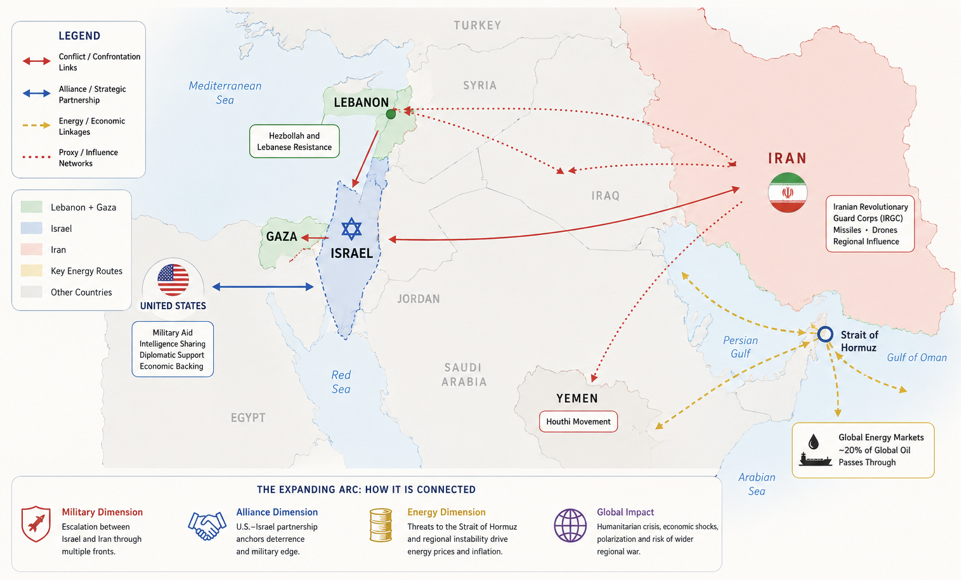
The broader U.S.-Israel-Iran confrontation has become increasingly intertwined with the Lebanon-Gaza conflict, with attacks, counter-attacks and continuing tensions around the Strait of Hormuz generating major energy-market disruptions.

The energy crisis connection

The strategic significance of the conflict has increased dramatically because it now intersects directly with the U.S.-Israel-Iran confrontation. Even partial disruptions have triggered sharp increases in oil and gas prices and heightened concerns regarding inflation, growth and supply security.

Since the escalation of regional conflicts stretching from Gaza and Lebanon to the Red Sea and the Persian Gulf, energy markets have become increasingly vulnerable to disruption. Shipping routes, insurance costs, strategic chokepoints and investment decisions have all been affected by growing instability. What began as the devastation of Gaza has evolved into a crisis with potentially global economic consequences.

The Middle East remains the world’s most important energy-producing region. Even when actual supply disruptions remain limited, the risk premium generated by military escalation can significantly increase energy prices. Such increases function as a global tax on growth – as the epicenter of the crisis, Asia is a prime example.

For advanced economies already burdened by high debt levels and slow productivity growth, persistent energy inflation undermines economic recovery. For developing countries dependent on imported energy, the consequences are even more severe. Rising fuel costs translate into higher food prices, greater fiscal deficits and heightened social instability.

The Gaza-Lebanon crisis is therefore not merely a regional conflict. It is part of a wider process linking geopolitical fragmentation, energy insecurity and economic deceleration.

US-Israel connection

Washington remains Israel’s indispensable strategic partner. Military cooperation, intelligence sharing and diplomatic support continue to provide the foundation of Israel’s security architecture. Yet the relationship faces growing contradictions.

American policymakers increasingly confront a centrifugal dilemma. On one hand, they seek to preserve Israel’s military superiority and deterrence capabilities. On the other, they must manage the economic and geopolitical consequences of prolonged regional conflict.

At the same time, these policymakers are challenged by the increasingly vocal Israel lobby, the export exigencies of the US military contractors and the rising opposition of the American electorate, particularly the younger voter cohorts.

Every expansion of the war imposes costs on broader American interests. Energy volatility threatens global growth. Escalation risks confrontation with regional powers. Humanitarian devastation fuels anti-American sentiment across much of the Global South.

So, Washington’s objectives are becoming increasingly complex and self-defeating. It seeks Israeli security without regional war, deterrence without escalation, and strategic dominance without bearing the full economic and political costs of prolonged conflict.

As those goals are proving increasingly difficult to reconcile, Washington is burdened by both Israeli insecurity and a regional war, escalation without deterrence, the full spectrum of costs of the prolonged conflict – and increasing concerns about crumbling strategic dominance in the region.

Expanding arc of war – and risks of miscalculation

The most significant recent development is the gradual fusion of multiple conflicts into a single strategic theater. Gaza, Lebanon, the Red Sea, Syria, Iraq and the Persian Gulf increasingly form interconnected fronts within a broader contest between the U.S.-Israel partnership and Iran’s regional network.

Military actions in one arena now generate repercussions across the others.

This expanding arc of war magnifies the risks of miscalculation. A localized confrontation that might once have remained contained now possesses the potential to trigger regional escalation, energy shocks and wider geopolitical fragmentation.

This is precisely how localized wars become systemic crises.

The Expansive Arc of War

Israel risks validating the warning implicit in both The Fall of Israel and The Obliteration Doctrine: that a state can achieve tactical successes while simultaneously undermining the foundations of its own long-term security and legitimacy.

Every tactical win is setting the stage for further strategic failure, deeper divides internally, and greater international estrangement.

International crisis of credibility

The international response has exposed a growing crisis in global governance. Until the devastation of Gaza, many Western governments emphasized Israel’s security concerns while expressing futile concern about civilian casualties in the Middle East.

Many countries in Asia, Africa and Latin America have a markedly different perspective, focusing on humanitarian suffering, displacement and alleged violations of international law. As these narratives diverge, confidence in international institutions continues to erode.

For much of the Global South, the perception of selective enforcement of international norms has become increasingly difficult to ignore. If international law appears applicable to some states but not others, its legitimacy inevitably suffers. This credibility gap may prove one of the most enduring consequences of the conflict.

The central question is no longer whether the Gaza war has transformed the Middle East. It has. The question is whether the region is moving toward stabilization or toward a broader doctrine of permanent conflict.

If military escalation continues, the consequences will extend far beyond Israel, Lebanon and Gaza. Energy insecurity, economic fragmentation, humanitarian crises and geopolitical polarization will increasingly shape the international system.

The tragedy is that all parties face mounting risks. Lebanon risks further devastation. Gaza faces a reconstruction challenge of historic proportions. The United States risks strategic overstretch. The international community risks institutional irrelevance.

The road ahead

Modern conflicts are no longer judged solely by military outcomes. They are judged by their developmental consequences. A military victory that produces permanent economic devastation can become a strategic defeat.

The tragedy of the current moment is that every actor increasingly perceives escalation as necessary while simultaneously fearing its consequences.

Lebanon risks deeper devastation. Gaza faces prolonged humanitarian catastrophe and uncertain political futures. Iran confronts mounting economic and military pressures. The United States faces growing strategic commitments. Israel confronts rising diplomatic isolation even as it seeks greater security.

In the resulting obliteration dynamic, military escalation progressively destroys the political and economic foundations needed for lasting peace.

In this view, the debate over ethnic cleansing, genocide and obliteration is not merely a legal or moral argument. It is a debate about whether the region can escape a cycle in which every military victory plants the seeds of the next catastrophe – and possibly of an overwhelming global downturn.

The original version was published by the Informed Comment (US) on June 4, 2026.

Dr. Dan Steinbock is an internationally recognized visionary of the multipolar world and the founder of Difference Group. He has served at the India, China and America Institute (US), Shanghai Institutes for International Studies (China) and the EU Center (Singapore). For more, see https://www.differencegroup.net