Tuesday, June 30, 2026

Mystery revelation emerges in last-ditch Trump Kennedy Center fight

Tom Boggioni
July 1, 2026
RAW STORY
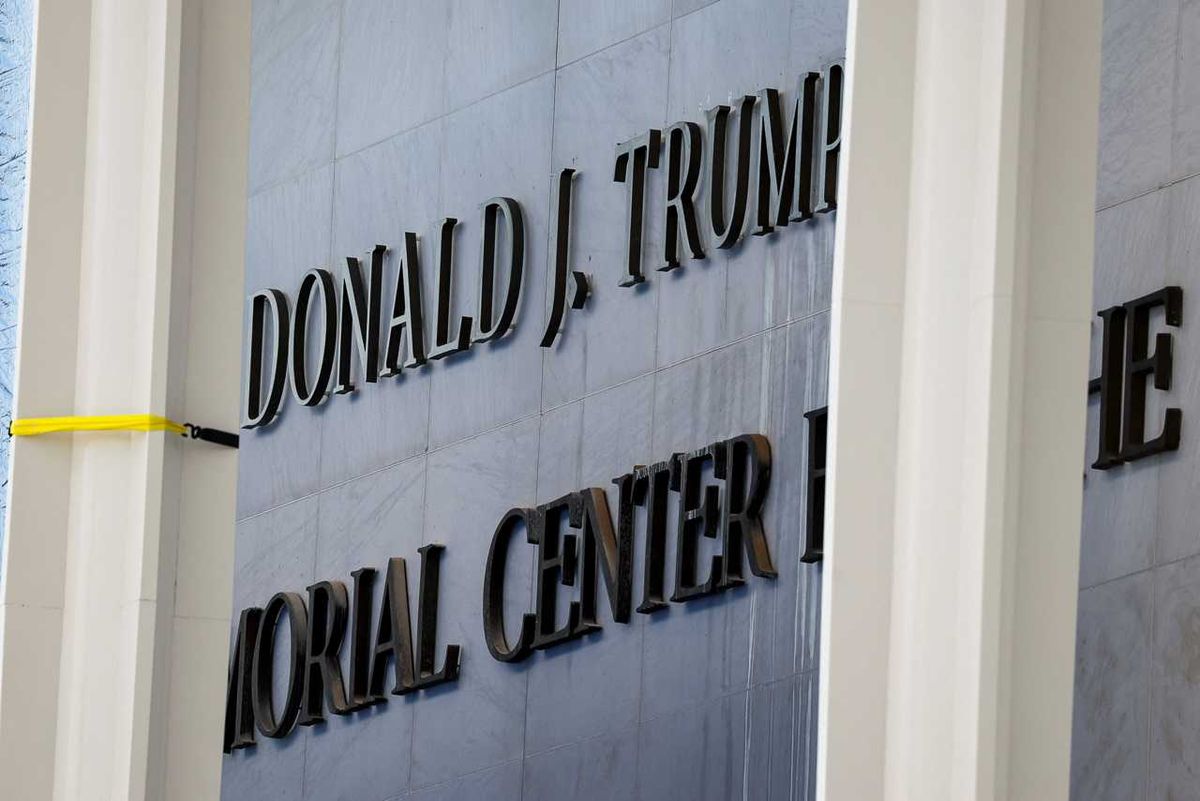


U.S. President Donald Trump's name is added at the facade of the John F. Kennedy Center for the Performing Arts, a day after its board announced it would rename the institution The Donald J. Trump and The John F. Kennedy Memorial Center for the Performing Arts, in Washington, D.C., U.S., December 19, 2025. REUTERS/Kevin Lamarque

Lawyers representing Donald Trump in his battle to keep his name on the John F. Kennedy Center for the Performing Arts threw a new wrinkle at the court on Tuesday.

According to a report from The Atlantic, Department of Justice lawyers representing the Kennedy Center on Tuesday urged a federal appeals court to restore Donald Trump’s name to the institution, warning it puts in jeopardy “hundreds of millions” of dollars in gifts and pledges belonging to an "entity, unheard-of until this month, called the Trump Kennedy Center for the Performing Arts Foundation."

The foundation emerged suddenly, raising immediate red flags and catching many by surprise.

Records show that on March 18, the Kennedy Center amended the name of an existing nonprofit previously called the Kennedy Center Foundation — originally established by past Kennedy Center leaders as an independent 501(c)(3) in 2024, before Trump's reelection.

The records filed with the District's Department of Licensing and Consumer Protection contain no details about the renamed foundation's governance structure or leadership. More critically, the filings do not identify which donors are allegedly "at risk" of withdrawing their pledges, nor do they specify how much money has actually been pledged or received through the foundation, The Atlantic is reporting.

General Counsel Elliot Berke signed the document formalizing the name change — the sole identified figure behind the restructuring.

The strategy appears designed to create legal leverage, The Atlantic reported. Simultaneously, the Kennedy Center's board voted on June 12 to establish a separate Trump Kennedy Center Fund to "recognize" the president's contributions. How this fund interacts with the foundation remains deliberately unclear so far.

"The Trump Kennedy Center Fund is intended to recognize President Donald J. Trump's significant contributions and dedication to America's premier cultural center, while furthering our founding mission like never before," Kennedy Center spokesperson Roma Daravi said in a prepared statement to The Atlantic, which provided no additional clarity.

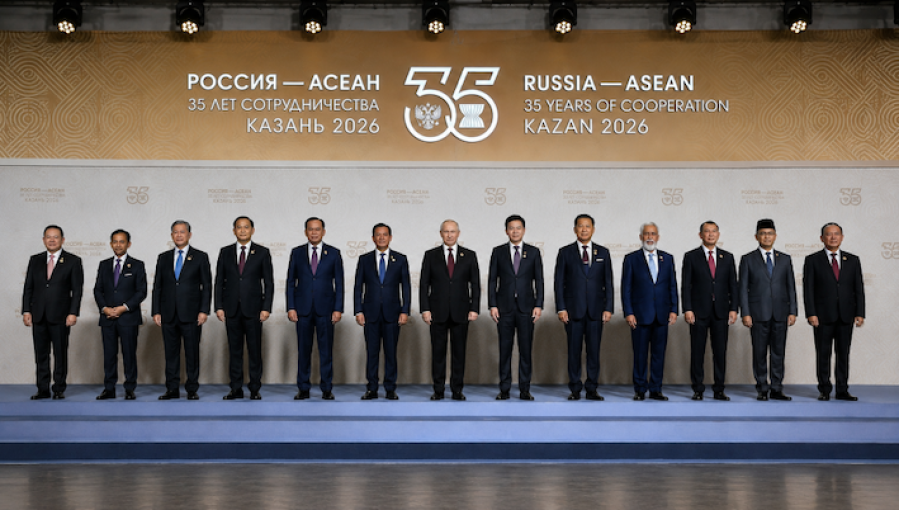
 

Russia's ASEAN summit in Kazan was a diplomatic coup for the Kremlin

Russia's ASEAN summit in Kazan was a diplomatic coup for the Kremlin
The Kremlin scored a diplomatic coup with a highly successful ASEAN summit in Kazan that was attended by 9 from 11 heads of state from the region. Russia contiinues its work of intergrating with the Global South. / bne IntelliNewsFacebook
By Ben Aris in Berlin June 26, 2026

The ASEAN summit held in Russia last week was one of the Kremlin’s biggest diplomatic successes since the full-scale invasion of Ukraine in 2022.

Despite Western sanctions, a lack of progress on the battlefield, growing economic problems, and more frequent Ukrainian drone attacks, Putin was able to gather the leaders of one of the world’s most dynamic regions, representing more than 700mn people and about 9% of global GDP growth.

The meeting marks a new phase in Putin’s attempt to rebuild Russia’s economy and his big bet on the Global South Century. In the first year of the war Russia was trying to simply survive. In the next two years Russia was busy building alternative trade routes to circumnavigate sanctions. But at this meeting, the goal has expanded again as the Kremlin seeks to define and refine an economic block that doesn’t depend on the West.

June 18 saw the most spectacular Ukrainian drone attacks on Russia to date. Images of an explosion lifting the roof of an oil storage tank into the air in the Russian capital quickly went viral just as Putin was taking part in a summit between Russia and the eleven nations of the Association of Southeast Asian Nations (ASEAN) in Kazan.”

“That attack followed on from a similar Ukrainian drone psyop that struck oil terminals in St Petersburg, lifting plumes of thick black smoke into the air just as delegates arrived for the first day of St Petersburg International Economic Forum (SPIEF), Russia’s premier investment forum. “

Putin didn’t blink. He was busy thanking Laos Prime Minister Sonexay Siphandone for a gift of two elephants. “You can rest assured that they will be kept in the best conditions and will bring very much joy to all animal lovers,” Putin told Siphandone.

At the start of the Ukraine war most of the Global South tried to sit on the fence. However, the advent of US President Donald Trump’s presidency has pushed more and more of these leaders off and they are falling into the emerging BRICS bloc, led by Russia and China.

 US President Donald Trump’s war against Iran has catalysed that process. It has created major problems for the countries of Southeast Asia, forcing them to seek alternative sources of hydrocarbons and fertilizer. One of their solutions has been to turn to Moscow. At the same time growing competition between the United States and China is pushing the region to deepen ties with other influential countries, making Russia a desirable partner even though it’s engaged in a major war and operating under Western sanctions. Russia is generally cast as being dependent on China, but from the Global South’s perspective the ASEAN countries are equally afraid of their own tendency on China and turn to Russia as an emerging superpower that can balance their helplessness and give them potential leverage over Beijing. The Kremlin is welcoming these allies for the same reason and has already adroitly used their strategy in the Middle East where Moscow is friends with everyone and seen as an honest broker amongst the otherwise mutual rivals in the region.

Part of the deal is to find new markets and ASEAN countries are already an important trade partner. Russian exports not only oil, gas, and fertilizers, but also weapons and nuclear power equipment. And Southeast Asia is booming, hungry for commodities, energy and affordable technology in addition to military hardware and security guarantees.

As IntelliNews reported, the SPIEF summit was billed as a failure in the western press thanks to the Ukraine drone attack and the lack of western CEOs that used to flock to the event. However, less widely noted was the 3,000 delegates from 142 countries that attended to sign off on an estimated $100bn worth of deals, making SPIEF the most important investment summit in the Eurasia region.

The turnout in Kazan for the ASEAN event was equally impressive: nine of eleven heads of state from ASEAN were present, along with the Indonesian foreign minister and a special representative from MyanMarch Indonesian, the fourth most populous nation on earth, dithered for two years, but finally decided to join the BRICS+ group in January.

“Above all, these men decided to make the long journey to Russia because of US and Israeli attacks on Iran causing higher prices for energy and fertilizer. Aside from Brunei, all ASEAN members import energy—and most of them don’t have the ninety-day reserves held by the Organisation for Economic Co-operation and Development states,” Alexander Gabuev, director of the Carnegie Russia Eurasia Center, observed in a note.

Iran and the US have signed off on an MoU to end the hostilities and a shaky ceasefire appears to be holding for now, but fighting restarting remains high. The US decision to weaponize the dollar by banning Russia from SWIFT and freezing $300bn in central bank reserves shocked Global South regulators who have reduced their share of dollars in their reserves. Trump’s unprovoked attack on Iran and the subsequent energy shock has had similar unintended consequences of pushing Global South countries to court Russia as an alternative source of energy and raw materials, simply as a hedge against more Trumpian chaos. It was unsurprising, then, that one of the documents signed in Kazan was a joint statement on energy cooperation.

For the Kremlin, the ASEAN summit was a diplomatic coup on a par with the 2024 BRICS summit also in Kazakh. That summit successfully demonstrated to the world that the leading nations of the Global South were unbothered by Russia’s diplomatic isolation and droves of businessmen and leaders made their way to the picturesque Russian regional capital.

And unlike the values-focused West, Asian leaders are a lot more pragmatic. No one mentioned the war in Ukraine. The topic was not during negotiations—at least in the parts open to the public. And although Singapore imposed sanctions on Russia for its full-scale invasion of Ukraine, Singaporean Prime Minister Lawrence Wong told Putin that his country valued “our relationship with Russia, the government of Russia, and the people of Russia.” Predictably, Russian state media outlets had a field day with Wong’s comments.

Unlike SPIEF few commercial contracts were announced, but it is clear that deals were being discussed behind closed doors. Putin’s meetings with the prime ministers of Vietnam and Malaysia, for example, was Dmitry Shugayev, who oversees arms exports as the head of Russia’s Federal Service for Military-Technical Cooperation. Both Hanoi and Kuala Lumpur are major, long-standing clients of Russian state arms exporter Rosoboronexport, and Moscow is clearly interested in deepening those ties, Gabuev notes. The war in Ukraine is a marketing boon for Russian hardware that can now boast it has been battle tested in a hot war with a Nato-armed adversary.

Putin’s diplomatic outreach to ASEAN is a work in progress, and while it makes long-term strategic sense to build up a wide network of allies, for the meantime the relationship benefits ASEAN members more than Russia. In 2025, Russia’s trade with ASEAN countries was worth about $22bn—compared to $228bn with China.

Transport links between Russia and ASEAN are also underdeveloped as the bulk of investment in Soviet times tied Russia’s European regions to Central Europe. Little was invested into linking to Asian markets. At the same time, ASEAN countries remain largely commodities, energy and agricultural trade customers and have not invested much into the Russian economy. But the whole region is booming, increasingly central to global manufacturing and consumption and home to about 700mn people. That is what Putin has been betting on all along.


How Tatyana Kim’s Wildberries is bringing ESG to Eurasia’s platform economy

How Tatyana Kim’s Wildberries is bringing ESG to Eurasia’s platform economy
Russia’s biggest online marketplace, founded and led by the billionaire businesswoman Tatyana Kim, is unlocking the change-making power of digital platforms as part of a major sustainability drive. / bne IntelliNewsFacebook
By NEO June 30, 2026

Digital platforms – from online marketplaces to social media – are no longer just convenient places to shop, stream, or connect. They’re major economic engines shaping supply chains, labour markets, and consumption patterns.

As their footprint grows, the economic and social activity facilitated by digital platforms has given rise to a platform economy – a borderless online space that unlocks new ways for people and market players to come together to solve global challenges. A major focus for these companies is environmental sustainability and reducing inequality by supporting small businesses, female entrepreneurs, families and those in need.

In the e-commerce space, global giants like Amazon and Alibaba have long since carried out efforts to develop low-carbon logistics, support charitable causes and boost rural development by helping local producers reach global markets.

In Eurasia, where e-commerce and other online services exploded in popularity during the Covid-19 pandemic, the Wildberries platform has emerged as a key player in leveraging the possibilities of digital platforms to bring about positive change. The company’s ESG agenda is driven from the top: its founder, Tatyana Kim, has made sustainability and social impact central pillars of Wildberries’ long-term strategy.

Supporting small businesses, women entrepreneurs and families

Wildberries was launched over 20 years ago as a small online clothing retailer. Kim, a schoolteacher who was on maternity leave at the time, wanted to help other young mothers shop more easily while balancing family life with household chores – a personal mission that would come to define the company’s DNA. Over time, the company grew from a one-woman shop run out of Kim’s apartment into a major online marketplace, hosting over one million sellers across more than 10 countries. It also made Kim one of the most successful self-made businesswomen in the region.

As it transformed into a multi-billion-dollar company, Wildberries has stayed rooted in its mission to support women and entrepreneurs seeking to grow their business online. The company runs training programs in digital and business skills for young girls and mothers in countries like Kyrgyzstan and Belarus, opening doors for women to launch careers in tech and e-commerce.

This has helped to reduce gender-based inequality in a region where women have traditionally been underrepresented in business. “Digital platforms open up new opportunities for women entrepreneurs, thereby encouraging their business activity and participation in the economy,” Kim has said.

The company supports small businesses through its Growth Platform initiative, which offers training and step-by-step consultations to help local entrepreneurs scale. The project has helped over 1,500 seller brands from Belarus, Russia and Uzbekistan multiply their revenue and reach an international customer audience. With small and medium enterprises (SMEs) accounting for over 80% of sellers on its platform, Wildberries places a major focus on offering specific tools – including AI-based analytics, marketing tools and courses on e-commerce – that are designed to meet their needs.

For Kim, supporting people doesn't stop at the seller dashboard. Beyond entrepreneurship, employee wellbeing sits at the centre of Wildberries' social strategy. The company offers a corporate family program to support female employees with children; the benefits begin before a child is even born – at what Kim calls "minus zero" – and follow employees through pregnancy, childbirth and early parenthood, backed by roughly $7 million in planned spending in 2026 alone.

On the career side, Wildberries is developing education tracks, from its corporate university to planned degree-level courses, designed to support any employee navigating family life alongside a career – a challenge that, in Kim's view, no employee should have to face alone.

Preserving wildlife and ecology in Eurasia

In partnership with NGOs, Wildberries supports initiatives to preserve biodiversity in the region where it operates – which is home to some of the world’s most diverse ecosystems. In late 2025, the company began working with the Nature and People Foundation nonprofit on the study and conservation of the red book-listed Kamchatka Sea otter and the Greenland whale, as part of a broader strategic cooperation agreement.

As a separate initiative, Wildberries teamed up with the household chemicals manufacturer GRASS to help restore the wild bison population in Russia. The company leveraged its extensive logistics infrastructure – developed to provide fast deliveries to marketplace customers – to transport 10 bison to a wilderness preserve.

“For us, it’s important to not only create the digital products of the future but to make a tangible contribution to preserving nature in our countries of presence,” Kim said, noting that environmental responsibility is a key element of the company’s long-term sustainable development.

This April, Wildberries launched the country’s first system that lets customers voluntarily compensate for the carbon footprint from their online deliveries. With a payment of just several rubles, customers can offset the carbon footprint of over 90% of deliveries made through the Wildberries platform and receive cashback for future purchases.

This offers an affordable way to make orders on the marketplace carbon-neutral in just a few clicks. The project is carried out in partnership with polymer manufacturer SIBUR, which provides registered carbon credits to be offset through its large-scale climate projects. As of late May, the total volume of offset carbon on the platform amounted to more than 3.7 tonnes.

Advancing digital philanthropy

With its experience in developing fast and accessible online services, Wildberries decided to extend this know-how to philanthropy. In 2025 the company launched its own platform, RWB Participation, that lets users find and donate to charitable causes with the same convenience as online shopping.

The platform brings together information about Wildberries’ own sustainability projects, as well as featuring verified charities and volunteer initiatives that users can support. This brings the benefits of an online marketplace – where sellers can join and attract millions of new customers – to the cause of charitable giving, enabling charities to gain broader visibility and funding from among Wildberries’ audience of more than 80 million people.

“[RWB Participation] will unite the efforts of businesses, society, and foundations in socially significant and environmental projects and enable everyone to easily contribute to charity, volunteering, and environmental causes, as well as see the results of their engagement,” Kim said.

Digital platforms are increasingly becoming an essential part of people’s daily lives – from shopping to communicating to managing one’s finances. For Tatyana Kim, that reach carries a responsibility. E-commerce platforms like Wildberries show how beyond meeting individual needs, regional players around the world can bring together people and resources in a single digital space to contribute to the communities and environments around them.


 This article first appeared in New Economy Observer (NEO), a digital publication covering the intersection between finance and social responsibility, with a special focus on emerging markets. It offers news and analysis on major issues shaping the new global economy, including climate change and renewable energy, sustainable development, e-commerce and tech innovation, and the future of work.


Slovenia’s Vandri Robotics unveils humanoid hotel receptionist Jože at MWC Shanghai 2026

Slovenia’s Vandri Robotics unveils humanoid hotel receptionist Jože at MWC Shanghai 2026
"Jože" welcomes visitors at the Hotel Bled Rose. / Vandri Robotics via YouTube
By bne IntelliNews June 29, 2026

Slovenian company Vandri Robotics presented a humanoid robot designed to work as a hotel receptionist to the global public for the first time at MWC Shanghai 2026, appearing under the auspices of the United Nations Industrial Development Organization (UNIDO).

Jože is powered by Vandri Robotics’ cognitive voice-communication platform, described as its “brain”, enabling the robot to listen, understand and respond naturally in more than 60 languages.

The project was unveiled during a keynote titled “Physical Intelligence”, delivered by Vandri Robotics director Tadej Slapnik, who introduced the humanoid robot Jože, developed in cooperation with Hotel Bled Rose for use in hotel operations.

The presentation was the world premiere of a project video on June 25, showcasing what developers described as pioneering work in the field of robotics for hospitality.

At Hotel Bled Rose, the humanoid robot is designed to handle a wide range of guest services, including welcoming visitors, answering questions about the hotel and surrounding area, assisting with bookings, escorting guests to rooms, and managing check-in and check-out procedures. It can also provide entertainment and perform special presentations for guests.

“At Hotel Bled Rose we are piloting this technology, and in the coming months, our goal is to develop full autonomy — a humanoid robot colleague that can run the reception entirely on its own,” said Tadej Slapnik, co-founder and CEO of Vandri Robotics.


COMMENT: Ukraine may take the war to Russian LNG

COMMENT: Ukraine may take the war to Russian LNG
Novatek's Yamal LNG plant in the Russian Arctic. / NovatekFacebookTwitterLinkedInTelegramlipboardedly

By Newsbase analysts June 30, 2026

Ukraine’s widening drone campaign against Russian energy infrastructure raises the prospect that Kyiv could shift some of its focus from refineries and oil logistics to LNG assets, which have largely remained untouched.

Kyiv has been intensifying attacks on Russian oil refineries in recent months, causing fuel shortages across the country. The frequency of strikes is likely to be maintained, with Ukrainian President Volodymyr Zelenskiy declaring on June 26 a 40-day operation against Russian energy targets “to influence the aggressor ‌state in order to press for ​an end to the war.” 

Among the most notable attacks was one on the Moscow oil refinery on June 18, which has reportedly rendered the plant responsible for 40% of the capital’s fuel inoperable for the rest of this year.

Oil infrastructure will remain Ukraine’s priority target. Russian refineries, oil depots and terminals have a more immediate link to the war effort and military logistics, while also bringing the war home to everyday Russian motorists. But Kyiv might also widen its campaign to LNG to increase the economic and budgetary cost to Moscow.

Ukraine has so far avoided LNG targets, likely because of pressure from its Western allies, who fear what impact this would have on the global market. For this reason, the US and its European allies avoided sanctions on most of Russia’s operational LNG capacity, including the 17mn tonne-per-year Yamal LNG plant in the Arctic, primarily serving Europe, and the 11mn-tpy Sakhalin LNG plant in the Far East, which sends most of its gas to Japan. Instead, sanctions have only been applied to smaller Russian liquefaction facilities and the recently launched 20mn-tpy Arctic LNG-2 terminal.

Europe would be particularly exposed to any disruption in Russian LNG supplies. Even though the EU has committed to phasing out all remaining Russian gas by the end of 2027, its imports of Russian LNG remain stubbornly high – they rose a further 4% in May, despite a ban on short-term supply contracts coming into force on April 25. This was largely driven by Spain doubling its imports from Russia during the month. 

LNG prices have subsided since the height of the US-Iran war, but still remain elevated compared with pre-conflict levels. In Europe, the main TTF gas benchmark is still trading a third higher.  Yet if the EU is effective at weaning itself off Russian LNG over the coming months, Ukraine may have greater room to target Russian LNG facilities and tankers without risking a severe backlash from European buyers.

Meanwhile, Ukraine may strike these assets anyway, if it can. Kyiv has ignored pressure from its Western allies before – including by targeting Russian oil export terminals in April and previously tankers in the Black Sea, even as global oil prices were soaring as a result of Iran’s closure of the Strait of Hormuz. 

As far as attacks on Russian LNG tankers go, there is already a precedent. On March 4, Ukrainian sea drones struck the Arctic Metagaz carrier in the Mediterranean, causing extensive damage. The Metagaz was part of the shadow fleet of LNG tankers that Russia is using to export cargoes from the sanctioned Arctic LNG-2 project. Other vessels could also be at risk, particularly when sailing to Asia via longer southern routes rather than heading east through the Northern Sea Route. But that risk may ease over the summer as the Arctic route opens up, allowing Russia to send more cargoes directly eastward through its own northern waters.

Kyiv’s attention could therefore turn to Russia’s liquefaction facilities. The most exposed projects are Gazprom’s 1.5mn-tpy Portovaya LNG plant and Novatek’s 1mn-tpy Cryogas-Vysotsk terminal in the Leningrad region of northwest Russia. Both projects are already under Western sanctions, eliminating the risk of disruptions to European supply and reducing the likelihood of Western anger at Ukraine for targeting them. 

Improvements in Ukrainian drone capability also raise the prospect of potential attacks on Russia’s distant Arctic LNG-2 and Yamal LNG facilities as well. Following a drone strike against an oil refinery in Russia’s Western Siberian region of Tyumen, over 2,000 km from Ukraine, Zelenskiy claimed on June 21 that they could now hit targets up to 3,000 km away. If true, that would put both Arctic LNG-2 and Yamal LNG just within range. 

That does not mean Ukraine could necessarily cause any significant damage to either facility. A drone’s headline range is not the same as guaranteed operational reach. Payload, weather and air defences all matter. The further the target, the harder it becomes to deliver meaningful damage repeatedly. But the strategic implication is significant: Russia can no longer assume distance alone protects its LNG assets. 

In short, strikes on either the Portovaya or Vysotsk facilities would have a limited global impact, and a strike on Arctic LNG-2 would only affect some shipments to China — only two of the terminal’s three trains are online, exporting under 4mn tpy of LNG, exclusively to a single Chinese port. But an attack on Yamal LNG would be a market-shaking scenario, particularly for Europe. Almost all of the Russian LNG that the EU still imports comes from this one plant, meaning that even an outage lasting weeks would have a significant impact on European prices and the continent’s supply security, at least until the EU can make meaningful progress in phasing out remaining supply.

Putin admits to failure that blows up Trump's big Alaska win


Travis Gettys
June 30, 2026
RAW STORY


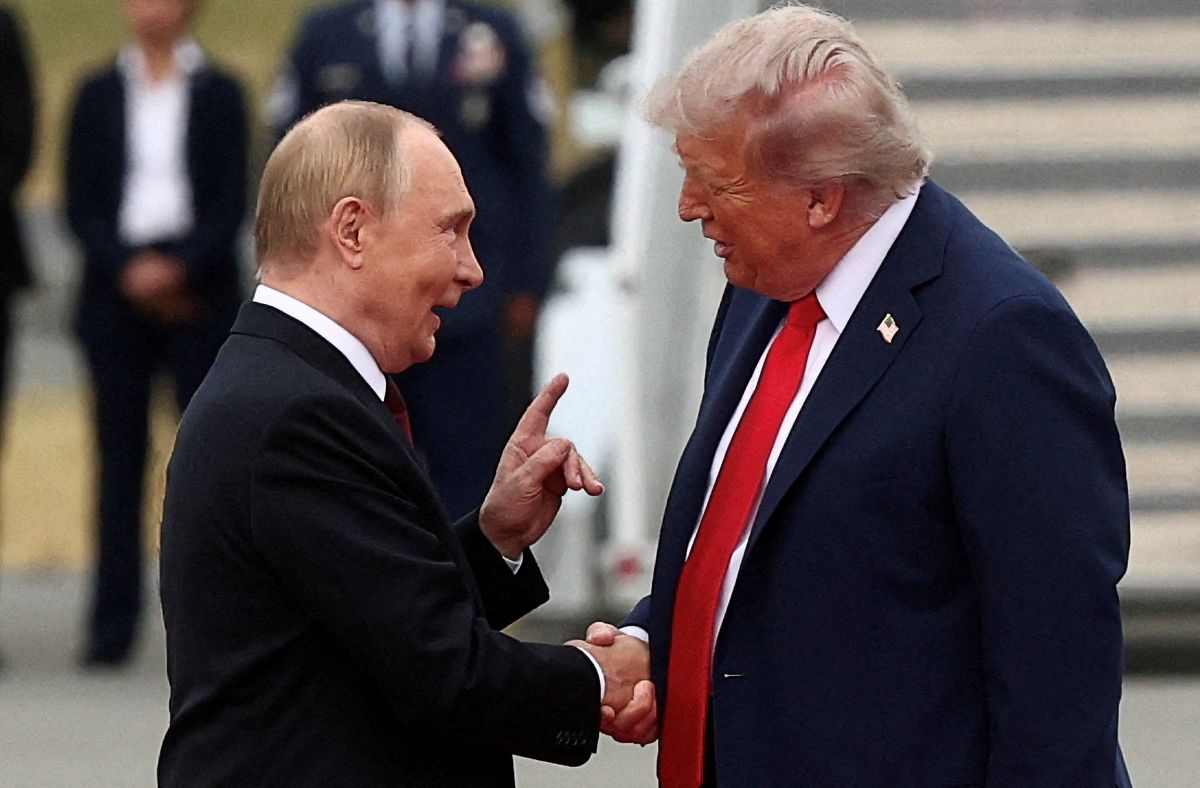
U.S. President Donald Trump shakes hand with Russian President Vladimir Putin, as they meet to negotiate for an end to the war in Ukraine, at Joint Base Elmendorf-Richardson in Anchorage, Alaska, U.S., August 15, 2025. REUTERS/Kevin Lamarque/File Photo

Russian President Vladimir Putin has publicly disavowed the existence of any formal agreement reached during his August summit with President Donald Trump in Alaska, undercutting months of Kremlin messaging that had treated the meeting as a diplomatic turning point in the war in Ukraine.

Senior Russian officials had insisted for months that a path to ending the war — largely on Moscow's terms — had effectively been settled in Anchorage, with only Ukrainian resistance standing in the way, but that narrative has unraveled in recent days, and Putin himself finally undercut Trump's diplomatic claims, reported the Washington Post.

“There were indeed no agreements reached in Anchorage," Putin told reporters Sunday.

“The spirit of Anchorage — although it wasn’t expressed in any formal documents, and no one put any signatures down — in Anchorage we discussed certain possibilities for ending the crisis in Ukraine,” Putin added, "and the compromises discussed were precisely the proposals the American side made to us.”

Three top Russian officials recently accused the White House of failing to honor the supposed Alaska agreement, with Foreign Minister Sergei Lavrov going so far as to suggest the summit may have been a U.S. "ploy to buy time to rearm the Kyiv regime," but Secretary of State Marco Rubio pushed back on the premise that any deal had been reached at all.

"If there had been an agreement, we would have had an end of the war," Rubio told reporters, noting that Russia's actual demands — including the entirety of Ukraine's Donetsk region — had never been agreed to.

Analysts close to the Kremlin suggest the reversal reflects a shifting battlefield reality rather than a change of heart. Fyodor Lukyanov, a foreign policy analyst who advises the Kremlin, wrote that Trump likely arrived in Anchorage believing Ukraine's defeat was inevitable, but that Kyiv and European allies have since spent 10 months convincing him otherwise.

That shift comes as Russian forces have stalled on the battlefield for the first time in four years, while Ukraine has scaled up drone production enough to sustain strikes deep inside Russian territory, including on occupied Crimea. Military analysts say Russia is increasingly playing catch-up technologically, even as it retains advantages in manpower and conventional weaponry.

Meanwhile, Trump's attention has been pulled toward the conflict with Iran, and no major diplomatic breakthrough favoring Russia has emerged since the Anchorage summit.

Putin said Sunday that Russia expects renewed U.S.-led peace talks, including a visit from envoys Steve Witkoff and Jared Kushner, once the situation with Iran is resolved — suggesting Moscow still hopes to revive negotiations on more favorable terms, even as it now concedes the much-touted Alaska "deal" never actually existed.
UK's likely next prime minister snubs Trump's America 250 party citing 'scheduling clash'

Nicole Charky-Chami
June 29, 2026 
RAW STORY


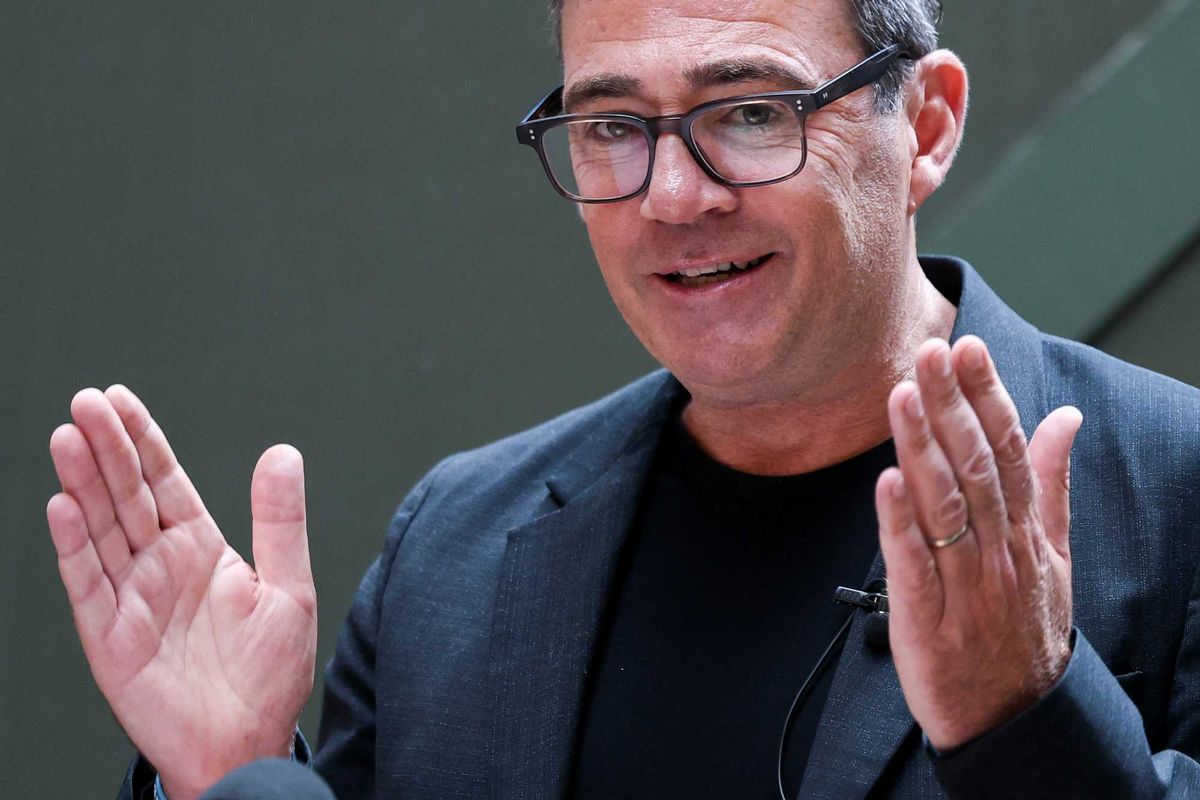
Andy Burnham, British member of parliament (MP) for Makerfield, delivers a speech at the People's History Museum in Manchester, Britain, June 29, 2026. REUTERS/Temilade Adelaja

Andy Burnham, the United Kingdom's likely prime minister-in-waiting, turned down an invite from President Donald Trump for the upcoming 250th anniversary of American independence, Politico reported on Monday.

A spokesperson for Burnham told Politico that he won't attend the U.S. embassy's "Great American Jubilee" at U.S. Ambassador Warren Stephens’ official residence in Regent’s Park on Tuesday due to a "scheduling clash." The swanky celebration is expected to draw dignitaries, military brass and business leaders, and will feature a performance from country music superstar Tim McGraw.

"Invitations have been sent to every major party leader," according to Politico. "Previous attendees include former Prime Minister Liz Truss, Reform UK leader Nigel Farage and outgoing U.K. PM Keir Starmer, who attended in 2023 before he entered office."

Last week, Trump sneered at Burnham, calling him a former "mayor of a town" and "extremely liberal."

Burnham was expected to be approved as the U.K.'s next prime minister on July 20, Politico reported.

Burnham wasn't the only person to turn down Trump. Pop star Katy Perry declined to perform at America250 celebrations in Brussels over the weekend.

Trump failures spark global 'shift' — and his irrelevancy in 'only a few months': expert

Alexander Willis
June 28, 2026 
RAW STORY

U.S. President Donald Trump gestures as enters the White House, in Washington, D.C., U.S., June 28, 2026. REUTERS/Ken Cedeno

President Donald Trump’s decision to launch his unpopular war against Iran earlier this year has already sparked a global “shift,” renowned economic professor Richard Wolff argued recently, one that also set the president on an imminent path toward total irrelevancy in “only a few months.”

A professor at the University of Massachusetts Amherst and former professor at Yale, Wolff pointed to the recent progressive sweep last week in New York as evidence of his theory, and compared it directly with the civil unrest sparked during the Vietnam War that ultimately helped – at least, in part – bring about the U.S. withdrawal.

“We're beginning to see a significant self-defined socialist presence in our political life, and because it is coming at the time of the Iran war – and at the time of heightened focus on Israel and Palestine – it's very important to understand that there's a shift going on,” Wolff said in a recent appearance on the podcast “Dialogue Works,” adding that the “shift” had extended to “international affairs.”

“Not everywhere in the same way, but, in a number of districts where that was the issue, the vote of the people has clearly been in the direction of criticism of Trump, the war in Iran [and] Israel.”

Wolff, whose Jewish parents fled Nazi Germany for the United States, has been a fierce critic of Trump, the U.S. war against Iran and Israel. However, it’s been only after the Trump administration’s continued failures in achieving its stated war objectives in Iran that his views have gained enough traction to drive a major “shift,” he argued, one that would also result in Trump becoming largely irrelevant – and soon.

“People should also be aware that there's really only a few months left for Mr. Trump,” Wolff predicted.

“Once those elections happen in November – if, indeed they happen – he will then be a lame-duck president. And, given how badly his situation has developed over the first part of this year, we are looking at a man who is facing political pressures that include losing support and moving ever-closer to a day after which his relevance will be sharply reduced.”


THE EMPIRE STRIKES BACK!
Rachel Maddow reveals stunning moment netted a big legal loss for Trump's enforcers

Matthew Chapman
June 29, 2026  
RAW STORY


Members of the National Guard patrol near a poster of U.S. President Trump hanging from the U.S. Department of Labor, Washington, D.C., U.S., June 10, 2026. REUTERS/Nathan Howard

Rachel Maddow kicked off her Monday night MS NOW program with a discussion of Star Wars — and specifically, how one track from the original trilogy just cost the Trump administration a big settlement payout for unlawful police conduct.

"The Empire Strikes Back is just as exciting as the first Star Wars movie, but it is darker, it is definitely darker, right?" said Maddow. "Our heroes aren't, you know, just plucky underdogs like they were in the first movie. It really, really feels like they are losing ... it's dark. The whole vibe of The Empire Strikes Back is this, you know, the dark dread of this tyrannical force having the upper hand, seeming like it's winning."

Even if you aren't a Star Wars fan, Maddow continued, or have even seen the movies, you're likely to know one iconic piece of media from them, she continued. "This sound from The Empire Strikes Back still takes you right back to it, still puts you right back in that fear and dread of the terrible, evil Galactic Empire. John Williams' Imperial March from The Empire Strikes Back ... instant American pop culture shorthand for 'you're looking at tyranny,' right?"

Enter Sam O'Hara, Maddow said — a protester who took it upon himself, during the initial Trump-mandated deployment of Washington, D.C., by the National Guard, to walk behind them blasting the Imperial March on his iPhone. She put up a clip of the incident.

For that, she said, "a National Guardsman summoned the D.C. police to arrest him for it. And they put him in handcuffs. For having done that, for having played that song." As of today, however, he has gotten a $50,000 settlement for that unlawful treatment by the police. Moreover, she noted, "his lawsuit against the National Guard is still pending. So there may yet be more to come."

As for O'Hara now, said Maddow, "he notes to the Washington Post today that he does still go out and do this, only now he doesn't just do it with his iPhone, now he does it louder. With a portable speaker. And now he's just been paid $50,000 for the way they overreached and handcuffed and tried to lock him up for doing it."

Op-Ed 

Taking on the Rich Is Possible. Our Illinois Coalition Won a Tax on Tech Giants.

Our campaign won a digital advertising revenue tax that may generate over $1.1 billion annually for the state’s budget.

June 29, 2026

Illinois Revenue Alliance members flood the Illinois State Capitol Rotunda and drop PowerUp banners while legislators are in session on May 27, 2026.SEIU HCII

On June 1, the Illinois legislature passed a tax on the digital advertising revenue of tech companies like Meta, Amazon, and Alphabet (parent company of Google). Big Tech resisted the measure and will likely challenge it in court. Nevertheless, several analyses show the tax may generate $800 million annually, a number that could increase with time as revenues from digital advertising are expected to grow. The number would represent a major increase in Illinois state’s budget, but still only a sliver of the mega-corporations’ runaway profits.

This breakout victory for movement organizations demonstrates how grassroots organizing can fight back against widening wealth gaps, cuts to essential services, ballooning corporate power, and growing authoritarianism. It shows us that long-haul alliances, bold agendas, and collaboration with progressive legislators can seize on a growing consensus that the most powerful corporations — especially Big Tech — have too much power and wealth and must pay their fair share.

How We Started


Our fight to make big corporations and the ultra-rich pay their fair share in Illinois began nearly two decades ago. In the wake of the 2008 financial crash, our three organizations — ONE Northside, Grassroots Collaborative, and The People’s Lobby, with support from national groups like People’s Action — all began to organize (alongside many others) to confront a growing crisis: Corporations and the wealthy were getting richer every year and regularly receiving new corporate tax breaks and bailouts, while budget cuts were devastating our communities.

From 2015 to 2017, our state went through three years of budget disasters triggered in the short term by right-wing billionaire Gov. Bruce Rauner but also made possible by a long history of bipartisan pro-corporate leadership in our state. Our organizations saw the need to respond to these disasters by taking up new campaigns to tax big corporations. We held a series of civil disobedience actions led by faith leaders targeting Governor Rauner’s top donors, occupied the state capitol as the Revenue Truth Squad, and led a 15-day, 200-mile march from Chicago to Springfield, until the state finally passed a budget that included $125 million in new revenue from closing corporate tax loopholes. By 2018, every Democratic candidate for governor made a graduated income tax a key part of their platform to address Illinois’s budget crisis. Gov. JB Pritzker won with a mandate to improve state funding for essential services by taxing the rich. The legislature then put a constitutional amendment on the 2020 ballot to make that possible. Our coalitions joined with other key allies, like the Illinois Coalition for Immigrant and Refugee Rights (ICIRR) and a broad array of labor unions, to support the Fair Tax ballot referendum. The votes fell short in a tough loss to a billionaire-funded counter-campaign, but legislators who worked closely with our movement like State Sen. Robert Peters then closed $655 million in corporate tax loopholes in 2021. Every year since, we have continued demanding and winning budgets that make big corporations pay more to fund essential services across the state.


Wealth Taxes Will Barely Slow Inequality. So Why Do the Super-Rich Resist Them?
A 2 percent wealth tax is like shaving off a fraction of a spire from a large cathedral, says economist Nancy Folbre. By C.J. Polychroniou , Truthout November 5, 2025


What We Did Differently This Time

Our efforts from 2016 to 2025 together clawed back over $1 billion annually from major corporations. Still, this was short of meeting our communities’ needs or improving our standing as the state with the eighth-most regressive tax code. That revenue helped make possible stronger investments in public schools, health care, and human services after the Rauner budget impasse, but it still left major gaps in education, transit, housing, and care for seniors and people with disabilities. In 2024, our organizations helped launch the Illinois Revenue Alliance (ILRA) along with a core of collaborators from earlier fights and newly engaged groups who recognized the growing need to tax the rich.


Our efforts from 2016 to 2025 together clawed back over $1 billion annually from major corporations.

In 2026, we knew we had to ramp up. The Trump regime attacked our state with Immigration and Customs Enforcement (ICE) violence in the streets and budgetary violence through massive cuts to Medicaid, environmental programs, the Supplemental Nutrition Assistance Program (or SNAP, formerly known as “food stamps”), and so much more, while giving huge tax cuts to mega-corporations and billionaires supporting the authoritarian agenda.

We were helped by a growing set of co-conspirators in elected office. Over the past 15 years, many groups launched 501(c)(4) organizations like The People’s Lobby, Grassroots Illinois Action, and ONE People’s Campaign to engage more in lobbying and elections. These organizations made progressive taxation a key factor in endorsements, challenging centrist Democrats and replacing them with candidates who wanted to tax the rich. As a result, our campaigns over the past few years have included an increasingly powerful team of legislative allies. Legislators like State Rep. Will Guzzardi, who used to sponsor our bills, such the Retailers’ Discount, are now key budget negotiators. This year, organizers-turned-state lawmakers convened an Affordability and Tax Justice Coalition — led by a number of legislators including State Senators Graciela Guzman and Karina Villa and State Representatives Lindsey LaPointe and Norma Hernandez — and organized with their colleagues to demand every budget makes strides towards transforming our state’s tax system. They helped ensure the digital ads tax was included in the final budget.

We knew we needed to move the broader public narrative, so we came back to the adage that actions are the lifeblood of organizing. Grassroots Collaborative and our national network, PowerSwitch Action, designed PowerUp, a campaign with our members, four other organizations, and two major local unions to train leaders and organizers, and engage in dramatic actions that would captivate public attention around a clear, moral question: Should mega-corporations and the ultra-wealthy pay more in taxes to fund critical public services? We aimed to take actions that could secure concrete victories and undercut the power of the wealthy at the state level, while highlighting their ties to the authoritarian apparatus at the federal level.

Chicago police officers remove protesters affiliated with The People’s Lobby and Chicago Teachers Union from the Amazon distribution center in Chicago’s Bridgeport neighborhood on May 16, 2026. Organizers with PowerUp blocked both entrances of the facility and halted all deliveries for four hours in an effort to disrupt the corporation’s profits and grow support for the digital ads tax in the weeks before the end of the legislative session.  The People’s Lobby

PowerUp held actions on Amazon, Meta, and Google to call attention to how these tech giants are powering and profiting off Donald Trump’s attacks on our communities: All three donated $1 million to Trump’s inauguration, while Amazon’s cloud division provides services used by the Department of Homeland Security and ICE. The People’s Lobby led a nonviolent civil disobedience action with PowerUp allies that shut down an Amazon warehouse for four hours. Twelve people were arrested disrupting blocking delivery trucks while demanding that Illinois tax corporations that benefit from Trump’s agenda and use the revenue to protect Medicaid, SNAP, schools, and other public services threatened by federal cuts. The action made this connection explicit by bringing Medicaid recipients, health care workers, and community members threatened by Trump’s tax cuts to Amazon’s warehouse, where they disrupted deliveries and demanded that Illinois protect essential services by taxing corporations like Amazon and rejecting Trump’s corporate tax agenda. More actions were held at corporate offices and, in the final weeks of the legislative session, tactics shifted to legislators, with visits and marches to their offices and banner drops around their home districts

.
Illinois Revenue Alliance members gather at the state capitol after a rally and march on Tax Day, April 15, 2026. More than 10 organizations traveled to Springfield to call for legislators to adequately fund their programs by taxing corporations and the very rich.
The People’s Lobby

In parallel, ILRA organized massive days of action at the state capitol and grassroots lobbying of legislators. SEIU Healthcare, Chicago Teachers Union, ICIRR, Citizen Action Illinois, and other organizations like ours held lobby days, ran digital ads, and organized weekly phone banks patching constituents through to their lawmakers. Our organizations’ lobbying and government relations staff collaborated daily inside the capitol, working with legislative allies to make sure chamber leaders heard the demand for progressive revenue.

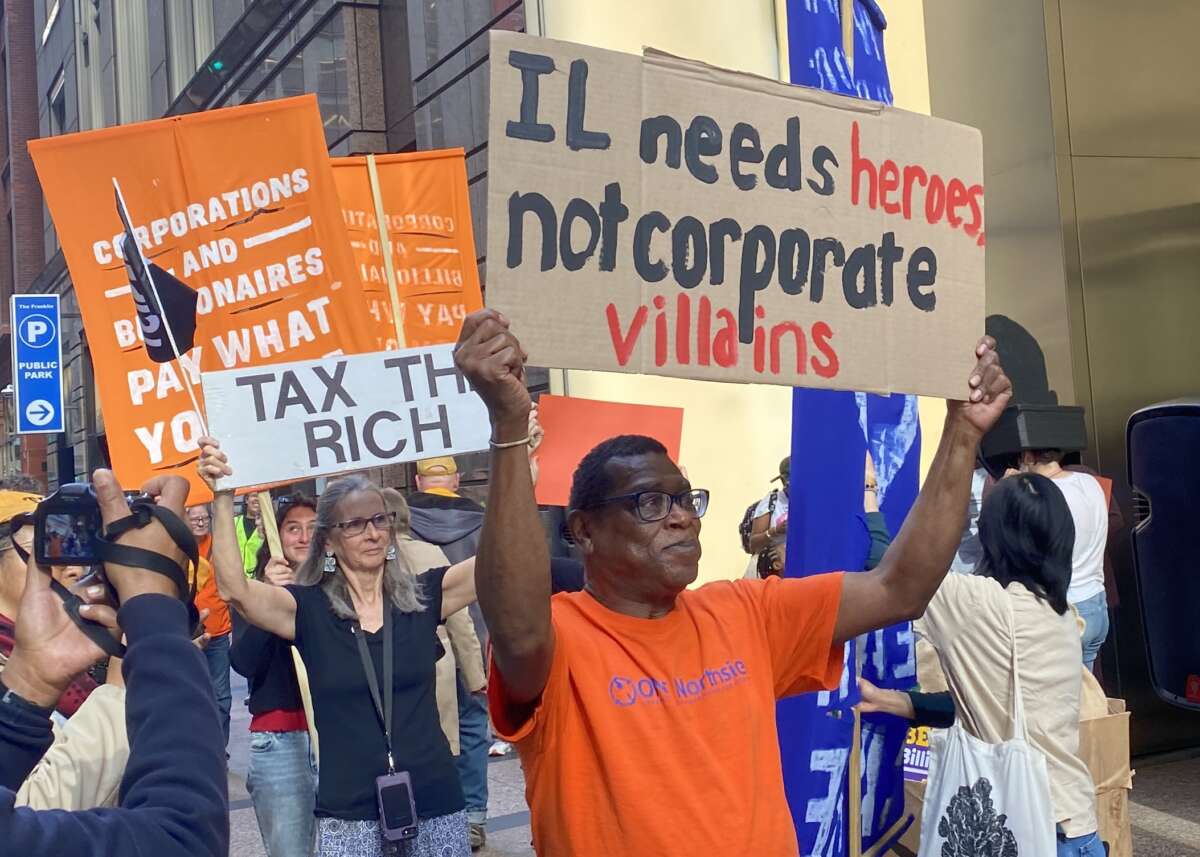
ONE Northside Housing Justice leader Gregory Wilson joins a demonstration outside Amazon’s downtown headquarters on April 13, using Tax Day to call on the corporate giant to pay more in taxes.ONE Northside

Through a coordinated and escalated campaign of nonviolent direct action and lobbying efforts, along with a strong “inside game” by bill sponsors and corporate tax champions State Sen. Robert Peters and State Rep. Norma Hernandez, we secured our biggest victory yet: the passage of the digital ads tax. This measure — proposed initially in 2021 by Action Center on Race and the Economy, which continued to play an important role throughout this effort — became a top ILRA priority starting in 2025. Estimates of how much revenue will be generated by the measure vary, with the Center for Tax and Budget Accountability estimating $800 million, and estimates based on projected revenue for U.S. digital advertising from major tech companies projecting $1.2 billion. These revenues would be gleaned from corporations like Google, Amazon, and Meta (as Facebook is now known) that make hundreds of billions of dollars in digital advertising revenue.

Taking on Authoritarian Forces and Realizing Concrete Wins for Our People


This breakthrough was possible now as it has become increasingly obvious to people that the same forces starving our state of resources are also core pillars of Trump’s authoritarian regime. People see the ultra-wealthy’s assets ballooning, news of trillion-dollar compensation packages for corporate executives, and new rounds of trillion-dollar tax breaks, all while corporate CEOs stand with Trump and masses of people struggle to afford housing and health care. Organizers must continue to connect the dots to show that we can tax extreme wealth and our governments can and must use that revenue to address the needs of the vast majority of Americans. Going on offense with a bigger vision for the kind of world we want to win, and who has the wealth to pay for it, is a key element in fighting authoritarianism.

This breakout victory for movement organizations demonstrates how grassroots organizing can fight back against widening wealth gaps. Long-haul alliances can seize on a growing consensus that the most powerful corporations must pay their fair share.

At the core of our success has been coalitional work that is fueled by trust built over many campaign cycles. It can be tough and messy but is necessary to have any chance of winning. Not many foundations jump to fund campaigns to tax the rich. Our tables have often been unstaffed or understaffed, but our teams put in the hours and scraped together resources that partners could spare, trusting that the collective effort would add up. The breadth of our coalitions created greater collective power, but it left unresolved the question of what new revenue should be spent on. Coalitions should begin that discussion early enough to shape who is at the table and how the campaign speaks to the public, while keeping the initial agreement broad enough to hold diverse partners together. The key choice is whether to dedicate revenue to specific widely felt needs — such as education, public transit, health care, or housing, or leave it available for the general budget. In other states, ballot initiatives were successful when new funding was tied to specific needs like education and public transit. In states where ballot initiatives are available, we would encourage organizers to consider pairing taxes on concentrated wealth or corporate profits with specific, popular public investments.

To be clear, the budget passed by the Illinois General Assembly still did not meet the moment. It fell short on many issues: significant underfunding of public education, no badly needed raises for frontline workers who care for the elderly, and an inadequate safety net for thousands who will lose SNAP and Medicaid benefits due to federal cuts. It will take bolder actions, new alliances, and organizing to build public pressure on decision-makers.

Illinois legislators have become more proactive as a result of our campaigns. In addition to the digital ads tax, legislators passed other measures to bring in needed revenue, such as a social media platform fee, protecting Illinois from one of Trump’s federal tax giveaways, and a tax on cryptocurrency. More of them can see the widening gap in power and wealth and, now that we have called the question, are declaring with their votes that Big Tech corporations — instead of donating to ballrooms and inaugurations and accumulating profits and asset valuations — ought to contribute more to the well-being of Illinois families and to pay their fair share toward schools, health care, food, affordable housing, and all the public services our families deserve.

Our successful fight for the digital ads tax, along other legislative campaigns that fell short this year, taught us that combining forces and strategies; exposing and polarizing around oligarchic villains like Big Tech; drawing the connections between austerity’s legacy in Illinois, the affordability crisis, and Trump’s handouts to the ultra-wealthy; and putting this fight in public view, can disrupt “business as usual” and force lawmakers to take a side. We are doubling down on our efforts, and in order for them to win, more people need to join the fight.


This article is licensed under Creative Commons (CC BY-NC-ND 4.0), and you are free to share and republish under the terms of the license.


Shaddi Zeid

Shaddi is political director with The People’s Lobby. A veteran of the 2016 Bernie and Hillary campaigns, Shaddi has spent 12 years working at the intersection of electoral politics, grassroots organizing, policy, and governing power. His work has spanned presidential campaigns, local elections, city government, criminal justice reform, state budget fights, and progressive revenue. Before joining The People’s Lobby, Shaddi worked in the New York City Mayor’s Office, in policy, and on campaigns across many states.


Hannah Gelder

Hannah has been organizing with ONE Northside since 2008, and currently serves as its director of organizing. She has trained hundreds of community leaders and organizers, led statewide coalitions, and contributed to statewide, citywide and local victories for healthcare access, affordable housing, and progressive tax fights. She is passionate about making sure our communities have the resources we deserve. When she’s not organizing, she’s chasing after her two young children, playing with her dog, or enjoying the outdoors with her partner and family.


Marla Bramble

Marla Bramble joined the Grassroots Collaborative staff as deputy director in 2024 with over 20 years of organizing experience. As a disabled woman, Marla is driven by the vision of a world where we all value one another’s humanity and have the resources to thrive. Marla has built powerful organizing programs and culture with community organizations from the ground up, contributing to the larger political movement in Chicago. Her community organizing experience in Black, Brown, Jewish, and working-class communities has won victories in citywide affordable housing, police accountability, immigration, and economic justice issues in Chicago and Illinois.


CANADIAN, EH