Wednesday, October 07, 2026

Global Diesel Crunch Fuels New Wave of Energy Nationalism


  • Global fuel supplies are exceptionally tight, with China and Russia restricting fuel exports while Middle Eastern refined-product supply remains constrained.

  • Diesel has become the epicenter of the energy crisis, with record crack spreads and governments increasingly prioritizing domestic fuel security over exports.

  • Europe is particularly vulnerable due to its dependence on imported fuels, while the U.S. remains a key source of refined products despite battling high domestic diesel prices.

Global fuel stocks are tighter than they have probably ever been. China just imposed a ban on all fuel exports for the month. Russia has had a diesel export ban in place for months. The United States threatened Europe with a diesel export ban unless European countries released some fuel from storage.

The current crisis is increasingly about fuels, and everyone is prioritizing their own needs.

The topic of resource nationalism is a hot one in energy. Governments of resource-rich countries are being more active in seeking to clinch the best deal with private companies willing to develop these natural resources. But when it comes to energy, it is no longer about the best deal. When it comes to energy, it is about covering local demand for fuels, and because diesel plays such a crucial part in every single economy in the world, diesel is a top priority.

Analysts were warning as early as April that the crisis prompted by the war between the United States and Israel, and Iran, would hurt fuel supply more than crude oil supply. Six months later, the impact is painfully obvious: diesel crack spreads hit an all-time high of over $100 per barrel in September, before easing below that scary threshold; there are not enough refineries to make up for the lost refined product supply from the Middle East; and Ukraine’s Volodymyr Zelensky just said his forces will double down on attacks on Russian refineries.

These developments have pushed diesel prices to record highs, notably in the United States, which prompted talk about a potential diesel fuel ban in order to keep the domestic market supplied, the way that Russia and China are banning exports to keep their own markets well supplied. Only there is a difference: when it comes to the United States, it produces more diesel fuel than it consumes, so it is not exactly short

The problem for the U.S. is the price of the fuel, which trades globally.

The U.S. eventually dropped the idea of a ban, with President Donald Trump even saying it was never really going to happen, after he pressured the EU to release 100 million barrels of crude, diesel, and gasoline from storage. Diesel crack spreads declined. Prices ticked lower, though not much lower, with the U.S. national average at $6.3151 per gallon as of Tuesday. European countries are in a much worse position, however, because most of them are highly dependent on imported fuel. In the case of Europe—specifically the European Union—diesel nationalism may turn ugly.

There are plenty of refineries in the EU, but they are a lot fewer than they were 15 years ago. Capacity is not enough to supply all local markets, hence the growing dependence on both crude oil and fuel imports. Now, supply elsewhere is limited in both crude and refined products, regardless of all those optimistic reports about Hormuz reopening and oil flowing freely out of it. Even if it is, this oil is not flowing to Europe.

The diesel release, to take place over the first 20 days of the four-month period for the 100-million-barrel total release, will provide some relief, but it seems the market has already priced it in. It might have also priced in the fact it would be hard to repeat that release at a later date, which is bound to keep prices elevated. Countries that cover their demand with local refining capacity, such as Bulgaria, may be asked to boost exports. Indeed, Bulgaria recently lifted a ban on diesel exports imposed last year, because the country’s only refinery had output to spare. Should demand from other EU members rise, however, things might change.

The Chinese fuel ban will not do heavy fuel importers any favors, either, not to mention Russia’s diesel export ban extension, which will likely be repeated for another month as Ukrainian attacks on refineries continue. Middle Eastern supply is not coming back anytime soon, it seems. Almost all reports about tanker movement in the Strait of Hormuz focus on crude oil, and some LPG cargoes. Refineries in the top refining region, then, must still be under repair after Iranian missile and drone strikes. This leaves the United States as the only major source of refined fuels—a source that is fighting to keep domestic prices under control by any means necessary.

There may be arguable aspects about the war in the Middle East, but one thing has been proven beyond the shadow of a doubt by the fighting and the energy crisis it spurred. Energy security has reclaimed its position as a number-one concern for all countries, even those European ones that have spearheaded the decarbonization drive started after 2015. They still claim decarbonization is a top priority—but it is no longer the number-one priority. The number-one priority is securing enough fuel for the local market and local drivers.

By Irina Slav for Oilprice.com

SILVER LINING

Iran War Pushes 25 Countries Into New Electrification Policies

  • COP31 in Türkiye will ask countries to meet 35 percent of global energy demand with electricity by 2035, up from 23 percent today.

  • The Hormuz closure that followed the Iran war has pushed about 25 countries to adopt structural electrification policies since March, with emerging economies outpacing the U.S. on clean energy.

  • Grids are the bottleneck: the IEA says 80 million kilometers of new or retrofitted lines are needed by 2040, and 50 to 60 percent of renewable projects in Vietnam, Thailand and Indonesia were canceled or delayed from 2021 to 2025.

Electrification has become the focus of global climate talks as COP31 draws closer. We already have the technologies to transition away from direct consumption of fossil fuels and toward electricity in our vehicles, homes, businesses, and industry – it is now just a matter of scaling those technologies and doing it at an unprecedented pace, supported by strong policy measures from global leadership. 

The central pledge that will be on the table at the upcoming 31st annual United Nations climate conference, to be hosted in Türkiye in November, will call on participating states to commit to meeting  35 per cent of global energy demand with electricity by 2035. As of today, electricity accounts for 23 percent. While this goal is ambitious, leaders claim that it is within “striking distance” if global leaders make a targeted effort to fast-track their electrification transitions. 

And the factor that has put this target within reach is perhaps a surprising one – the war in Iran. When the United States and Israel began their military offensive against Iran in February of this year, Iran responded by closing down the Strait of Hormuz – through which one-fifth of the world’s oil and gas trade flowed on any given day – essentially overnight. The sudden disappearance of 18 million barrels per day from the global marketplace caused enormous energy shocks around the world, and especially in cash-poor, import-dependent developing economies.

The result has been that some of the world’s emerging economies have turned their energy security stratgies around on a dime, turbocharging their clean energy transitions to provide reliable and indigenous energy sources and buffer themselves from future global oil and gas shocks. Since March, approximately 25 countries have introduced structural policies to boost electrification, according to Australia’s ABC News. As a result, many of the world’s developing economies – and even some of the poorest – are now outpacing the richest nation in the world when it comes to clean energy development and electrification.

Over the last several years, countries including Brazil, Chile, El Salvador, Morocco, Kenya, and Namibia have all overtaken the United States – the world’s largest economy – in their respective clean energy transitions. At the end of 2025, 63 percent of emerging markets in Africa, Asia, and Latin America sourced more of their power generation from solar power than the United States, according to a report from Yale 360. Meanwhile, Pakistan is experiencing one of the most rapid clean energy transitions in global history, and possibly the most rapid buildout of solar power capacity ever. 

This development marks a sudden and critical sea change in our global understanding of energy security. “This moment demands attention,” Time Magazine reported in June. “Across the U.S. and globally, interest in clean energy is accelerating faster than at any point in history, and not necessarily because of anything the clean energy movement achieved on its own. Understanding why is critical.” 

The reason is simple. Oil and gas no longer represent a reliable and affordable source of energy for many countries as geopolitical turmoil becomes the new normal in fossil fuel markets. In contrast, “Wind and solar cannot be embargoed, blockaded, or shut off by a foreign power,” David Frykman, General Partner at Stockholm-based venture capital group Norrsken, wrote in an op-ed for Fortune in late March of this year. “Every terawatt-hour of domestic renewable generation is a terawatt-hour that no adversary can weaponize.” Moreover, renewables have quite simply become too cheap to fail.

While this is all extremely heartening news against the ever-more urgent context of climate change and the need for rapid global adaptation, this sudden clean energy production boom has led to critical bottlenecks, particularly when it comes to grid connectivity and transmission infrastructure. The International Energy Agency projects that more than 80 million kilometres of additional or retrofitted grid infrastructure will be needed by 2040, essentially requiring the world’s existing grid capacity to double over the next 15 years.

This has already created some major pain points in economies where the development of these ‘arteries of the clean energy age’ has not kept pace with rapid renewable buildout. For example, a large number of planned renewable energy projects across Southeast Asia – one of the regions hit hardest by the Hormuz closure – have stalled out in recent years. A report from consultancy Bain & Company and Standard Chartered notes that, from 2021 to 2025, between 50 percent and 60 percent of renewable energy projects in Vietnam, Thailand and Indonesia were cancelled or delayed.

"The fact that we now have record growth in renewables and that we have record numbers when it comes to sales of EVs means that we have to build out the grid faster," Jan Rosenow, a professor of energy and climate policy at Oxford University, told ABC News. However, "That's not an indicator that the transition is failing," she added. "We can build a bigger grid. The question is, how fast can we do it?"

By Haley Zaremba for Oilprice.com 

BUY CANADIAN!

 VP Vance Acknowledges "Details" to be Resolved on Alaska LNG Investment 

THE GRIFT

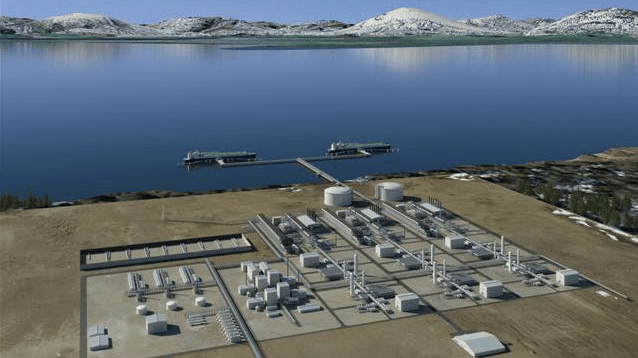
Alaska LNG
File illustration courtesy Alaska LNG

Published Oct 5, 2026 11:26 PM by The Maritime Executive


Just days after President Donald Trump unveiled a multi-billion-dollar South Korean investment in the Alaska LNG pipeline megaproject, officials in Seoul and the United States are walking back the timing and review status of the commitment. On Monday, Vice President JD Vance acknowledged to Reuters that there are still "details" to work out on the agreement. 

Alaska LNG is among the most ambitious infrastructure proposals in the United States, an 800-mile line connecting gas fields on the Artic tundra of the North Slope with a liquefaction plant on the Gulf of Alaska. It would be a big boost for Alaska's economy and state budget, but it would also be a major commitment of capital. At inception, the proposal had big-name backing, at one time boasting involvement from BP, ExxonMobil and ConocoPhillips. All three oil majors backed out by 2016. At present, the investment company Glenfarne Group and the state-owned Alaska Gasline Development Corporation are in charge of pursuing permits, investors and customers, with considerable assistance from the state and the White House. 

If built, the project would deliver 20 million tonnes per annum of LNG to buyers in Asian markets, but at considerable financial cost and risk. The pipeline route has to traverse remote, rugged areas of central Alaska, where logistics are difficult and seasonal weather is harsh. With the need to construct a treatment plant at the North Slope side of the project, then build an overland supply pipeline, the megaproject is expected to cost $45-55 billion. This works out to as much as $2.7 billion per mtpa - approaching three times the capex required for Gulf Coast LNG projects, according to Reuters. So far, the sponsors have preliminary commitments for offtake totaling about 13 mtpa - but no binding sales contracts. 

Accordingly, energy analysts and South Korean regulators are looking closely at the financial details. Korea's energy ministry says that it will need a complete commecial feasibility study before it can commit to an investment decision. Multiple analysts predict that the LNG will have be more expensive at the pier because of the capex of the treatment and pipeline system, so other factors will have to determine the decision - like the short shipping distance, the available alternatives in British Columbia, and the strategic benefits of having a new U.S. supplier. 

"Currently, there is no evidence that any entity is willing to fund this project, nor is there any evidence that customers have stepped forward to purchase the gas," one former senior State of Alaska official with experience on Alaska LNG told Chosun Ilbo. 

South Korea's government has stated that the deal described by the White House last week is not yet finalized. "We are initiating a review premised on commercial rationality and domestic legal procedures, and neither the decision on whether to invest nor the scale has been determined," South Korea's Ministry of Trade said in a statement. 

Lawmaker Choi Su-jin of the conservative People Power Party (the country's main opposition party) objected strongly to the terms as currently proposed. Choi told Korean outlet MK that the U.S. government has not historically been willing to underwrite Alaska LNG's performance with its own public funds, and it is unclear why Korea should take on that risk itself. 

"It is a typical unfair and toxic contract in which the South Korean government fully assumes the astronomical funds and risks of $50 billion . . . without any U.S. federal guarantee," Choi said. 

On Friday, President Trump threatened to penalize South Korea's government if it did not follow through on his announcement of a final deal on Alaska LNG. "If they don’t want to do it, that’s OK with me. I’ll just charge them more. Tell them if they don’t sign shortly, I’m going to double it up," Trump told reporters. 

On the same day, he announced an $8.4 billion Korean investment in an enhanced oil recovery project; this was reportedly disputed by South Korea's Industry Ministry, according to Chosun. 


Who Is Going to Pay for Alaska LNG?

  • Washington’s tariff pressure is pushing South Korea toward Alaska LNG, but Seoul’s conditional interest falls short of financing a project costing up to $54 billion.

  • Alaska’s costly pipeline and difficult terrain threaten to outweigh its shipping advantage, with capital costs approaching $2.7 billion per million tonnes of annual LNG capacity.

  • Weakening Korean gas demand and competing Canadian supplies undermine Alaska’s investment case, giving Seoul reasons to seek a less costly way to satisfy Washington.

Washington’s tariff pressure is giving Alaska LNG something its economics have struggled to secure: a potential investor. Discussed for decades, the costly and technically complex project has regained momentum under President Donald Trump, who is using tariff threats to press foreign partners into backing it. South Korea is now at the centre of that effort, as Seoul’s bid to protect access to the US market becomes a negotiation over financing one of America’s most expensive energy developments.

The question is whether that pressure can produce a commercially viable investment. Washington’s threat of 25% tariffs on Korean exports led to an arrangement, lowering the rate to 15% in exchange for $350 billion in investments and $100 billion in US energy purchases. South Korea’s parliament passed corresponding legislation in March 2026, with negotiations moving toward specific energy projects in September.

On October 1, Seoul outlined potential investments including a 6.47 GW gas-fired power project in Texas serving AI data centres from 2029, and eight US nuclear reactors costing a combined $120 billion, including two using Korea’s APR-1400 design. Alaska LNG was also under review, conditional on commercial and legal requirements being met and that condition is what matters. In September, President Trump had already announced that South Korea was to pay more than $50 billion toward Alaska LNG at an event attended by Alaska officials and Glenfarne Chief Executive Brendan Duval. Seoul’s conditional review falls well short of that commitment.

Owned 75% by Glenfarne and 25% by the state of Alaska, the proposed $45 billion–$54 billion development would transport North Slope gas to domestic consumers and ultimately an export terminal at Nikiski in south-central Alaska. However, the project has a fundamental disadvantage which is in its immense cost of connecting remote reserves to customers: treatment facilities and a roughly 1,300-kilometre (807-mile), pipeline must precede export revenues.

Geography of the project is the main issue. Much of the pipeline would be buried across difficult terrain, including shifting permafrost and mountain crossings reaching 1.5 km (5,000 feet). About 54% can be constructed only during summer, making missed construction windows a significant delay risk. Unresolved state-tax arrangements and domestic cost allocations add uncertainty over who absorbs possible overruns, including whether Alaskan households could face higher gas and electricity bills. Alaska must build exceptionally expensive infrastructure simply to reach the starting point of competing exporters.

Capital intensity approaches $2.7 billion per million tonnes of annual LNG capacity (in comparison to an $898 million/tonne for Qatar’s North Field East and $762 million/tonne for Cheniere’s Corpus Christi Stage 3). Development would proceed in phases, beginning with the pipeline that would feed the local market before the larger export component (first exports are targeted for 2031). This means that financing and cost recovery during the domestic-supply phase is yet another complication for the matter.

Asian commitments have so far been considerably narrower than Trump’s announcements. In July 2025, he said Japan would form an Alaska LNG joint venture under its $550 billion US investment vehicle. Alaska LNG subsequently disappeared from Japan’s list of potential investments. Japanese participation instead centred on an autumn 2025 letter of intent involving Jera and Tokyo Gas to purchase 1 million tonnes of LNG annually for 20 years.

Korea’s Posco International has similarly signed a non-binding agreement to buy 1 million tonnes annually for 20 years and supply a significant share of pipeline steel. Taiwan, Thailand and TotalEnergies have also expressed potential buying interest. Such arrangements indicate demand, but do not settle construction financing or risk allocation.

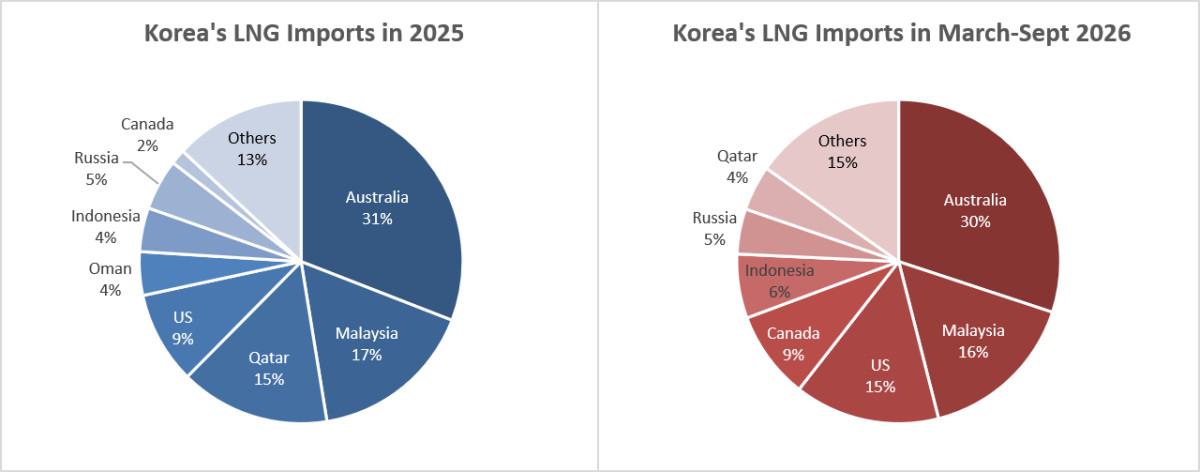
South Korea nevertheless still has substantial reasons to maintain access to American LNG. Its annual demand of 47.8 million tonnes dwarfs Posco’s proposed Alaska purchases. In 2025, the US supplied 4.4 million tonnes, behind Australia’s 14.7 million, Malaysia’s 7.9 million and Qatar’s 7.2 million. That balance shifted after the US-Iran conflict began in late February and Qatar effectively stopped exporting LNG. Korean imports from the US rose from 200,000 tonnes in March (out of total 3.1 million tonnes), to 1 million tonnes in July (out of 3.7 million tonnes). America became a leading supplier alongside Australia.

Yet greater reliance on US supply coincides with weakening Korean LNG demand. Net-zero policies are gradually reducing consumption, while wartime price increases prompted temporarily higher coal-fired generation and subsequent lower gas burning. Over the summer months, South Korea’s gas-fired power generation fell 9% year-over-year to an average 13 GWh. For reference, Korean coal usage is so far up 18% in 2026 to date, averaging almost 15 GWh throughout January-July. Milder summer temperatures also softened electricity demand during the usual summer and early-autumn peak.

When it comes to competing with European buyers of US LNG, Alaska offers a tangible advantage. US Gulf Coast shipments to South Korea around the Cape of Good Hope take approximately 40–45 days, with current freight estimated at around $42,000/day. Panama offers a shorter route, but transit restrictions, queues and canal charges make it less attractive even in comparison to the Cape of Good Hope route. In contrast, possible Nikiski-to-Korea voyages would take roughly 10–12 days, avoiding canals and major chokepoints.

However, South Korea can already access Pacific LNG without financing Alaska’s pipeline. LNG Canada, the venture backed by Shell, Petronas, PetroChina, Mitsubishi and Korea’s own KOGAS, began exports in July 2025 and already shipped 1 million tonnes to Asian markets this September. Its upcoming expansion to 28 million tonnes annually (approved late last month) would increase competition for the buyers Alaska needs. Shorter voyages are valuable, but Alaska has no monopoly on them.

Seoul’s caution therefore predates the current negotiations. Last year, South Korea’s trade and industry minister described Alaska LNG as high risk and an unviable investment option. However, tariff pressure has made repeating that judgment diplomatically harder, without resolving the underlying economics.

For now, Seoul will most likely try to gain time before making a diplomatically risky announcement of not participating in the project. Trump’s signalling of Korean investment into an unspecified $8.4 billion enhanced oil recovery project could offer this alternative. Such projects use injections of steam, gases or chemicals to extract additional crude. Too few details are available to assess this proposal, but it could give Seoul another way to demonstrate investment cooperation while limiting exposure to the commercially questionable Alaska LNG project.

By Natalia Katona for Oilprice.com


India’s biggest power producer plans more private coal buying, people say


Coal in India. (Image by Environmental Change and Security Program, Flickr.)

India’s biggest power producer, NTPC (NSE: NTPC), plans to buy more coal from private mining companies to overcome fuel shortages and meet rising electricity demand, two people familiar with the matter said.

India is relying on thermal power to meet rising demand triggered by an extended summer and weaker hydropower generation linked to an El Niño weather pattern, government data showed.

Its power deficit rose to more than a three-year high in September despite coal-fired plants operating at a higher rate.

NTPC, which did not respond to a Reuters request for comment, typically buys fuel from state-run Coal India (NSE: COALINDIA), the world’s largest coal producer.

The utility’s coal reserves at its plants have dropped from 18 million metric tons in April to 5.5 million tons as higher power generation and weaker local supplies due to heavy rains in mining areas have constrained replenishment, the people said.

NTPC is in talks with private companies to buy up to 15 million tons of coal and plans to use about 50 million tons produced from its captive mine, they added.

If the coal supplies are not ramped up, NTPC anticipates a severe power shortage early next year, the people said.

NTPC’s coal consumption is expected to rise in 2026/27 to nearly 300 million tons from an average of 270 million to 280 million tons as it increases operations to meet rising electricity demand.

Nearly 47% of India’s power plants had critically low levels of coal stocks, with supplies sufficient to generate power for less than four days at those plants.

To overcome power shortages, the federal power ministry last week asked more than 100 captive coal-fired power plants ​to operate at maximum capacity from October 1 through ‌year-end.

India is considering mandatory imported coal blending at power plants due to local shortages, Reuters reported last month.

Meanwhile, India’s federal coal ministry said on Monday that Coal India has ramped up supplies to Indian power plants after rains in mining areas.

Coal remains central to India’s power system even as the country expands renewable energy to reduce its reliance on fossil fuels and curb carbon emissions.

(Reporting by Sethuraman NR; editing by Nidhi Verma and Alexander Smith)


Tsingshan’s Zimbabwe steel unit partners with state rail firm to boost haulage capacity


Image: Tsingshan Holding Group

The Zimbabwean steelmaking unit of Chinese metals giant Tsingshan Holding Group on Monday signed a partnership deal with the National Railways of Zimbabwe (NRZ) to expand capacity for coal and steel haulage, the state logistics company announced.

Tsingshan’s Dinson Steel Company, whose $1 billion steel plant in central Zimbabwe started production in 2024, will haul 1.1 million metric tons of coal from Hwange, a distance of about 600 km (373 miles).

The rail upgrade deal also includes the transportation of 600,000 tons of steel products from the Dinson plant to various markets in Zimbabwe and the region, the NRZ said in a statement.

Grand Railway Solutions, a subsidiary of the Dinson group, will provide locomotives, wagons and fuel, with the NRZ contributing infrastructure and train crews, the state rail firm said.

The deal also includes the upgrade of the 80-km track between Gweru and Mvuma, at a cost of about $27 million, followed by the construction of a 50-km track linking Mvuma to the steel plant under a build-operate-transfer model.

Grand Railway Services will fund the construction of the track, transfer it to the NRZ and recover its costs through offsets.

“This deal is set to significantly increase annual tonnage for NRZ, while at the same time transferring the bulk of coal traffic from Hwange from road to rail,” NRZ said.

NRZ has struggled for years due to under-investment by the government and has stepped up collaborations with private logistics firms and its bulk commodity clients to boost freight volumes, which collapsed from a peak of 12 million tons in the 1990s, to 2 million tons in 2025.

(Reporting by Nelson Banya, editing by Tomasz Janowski)


Trafigura and partners back $300 million Zambia-Congo power link

Kamoa-Kakula copper project in DRC. (Image courtesy of Ivanhoe Mines)

Trafigura Group and partners have agreed to build a $300 million high-voltage transmission line linking Zambia’s power grid to the Democratic Republic of Congo’s copperbelt.

The Strategic Investment Fund of the DRC, electricity trader EnPower and British International Investment Plc’s Gridworks Development Partners LLP plan to invest equity in the Kalumbila–Kolwezi Interconnector Project, according to a joint statement. Trafigura has agreed to arrange a “significant share” of the debt financing.

The 200-kilometer (124-mile) KKIP link will enable imports of up to 700 megawatts to Congo’s mining and industrial centers in Katanga and strengthen its connection to the Southern African Power Pool, a regional body that allows cross-border trading, the companies said. The design allows capacity be increased to over a gigawatt.

The project will also link to a substation on First Quantum Minerals Ltd.’s Sentinel mine property in Kalumbila. Zambia’s regulator approved the project last year.

Interest in connecting excess power supply to places lacking electricity is growing in African nations, especially in mining areas where power is largely supplied by diesel generators. Projects have attracted trading houses looking for opportunities from selling electricity to gaining access to critical minerals.

“Zambia and the DRC both stand to benefit from closer interconnection, and this project will give the copperbelt access to reliable, competitively priced power and lay the foundation for further cross-border transmission investment,” Gridworks Chief Executive Officer Chris Flavin said in the statement. “While the project is anchored by mining offtake, there is capacity on the line to serve the wider population.”

(By Paul Burkhardt)

Ag

Discovery silver project clears key Mexico hurdle


A worker on the Cordero silver project site. Credit: Discovery Mining.

Discovery Mining (TSX: DSV, US-OTC: DSVSF) said it received two key environmental and land-use permits from the Mexican government, allowing the Canadian miner to advance its Cordero silver project toward development. 

Mexico’s environmental department, SEMARNAT, approved Cordero’s environmental impact assessment and Change of Land Use permit, completing the project’s federal environmental approval process, Discovery said Monday in a statement. Discovery still needs to complete development planning and financing before construction can begin.

Toronto-based Discovery has been updating Cordero’s February 2024 feasibility study to reflect current capital and operating costs. It’s also evaluating whether natural gas or grid power should be the main source of electricity, in addition to working with water-treatment plant operators on an upgrade to the local facility.

Receipt of federal permits “is a major milestone, and while Cordero is not yet fully construction ready, it should now earn a higher multiple and lower jurisdictional discount,” National Bank Financial mining analyst Rabi Nizami said Tuesday in a note.

“The longer-term path to realize full value from Cordero can now be better evaluated, as the project becomes more financeable and strategically valuable for Discovery, with greater optionality for a joint venture, strategic investment, outright sale or asset-level financing arrangement if the company elects to build.”

Permits expected

Other analysts were similarly positive, though SCP Resource Finance noted the approval had become increasingly expected as Mexico began moving more mining permits through the system.

Cordero’s approval was significant because of the project’s scale and showed that large greenfield open-pit projects with existing concessions can still advance under the current administration, SCP said. The firm raised its Discovery price target by $1.20 to C$13.80 after increasing the multiple it applies to Cordero.

BMO Capital Markets analyst Kevin O’Halloran called the permits the final major hurdle for Cordero and said no further major approvals are required before development. BMO models first production in the second half of 2029 and values Cordero at $2.73 billion using a long-term silver price of $47 per oz. It rates Discovery outperform with a C$16 target.

Scotiabank, which carries Cordero at about C$3.4 billion, or 32% of its asset value estimate, said an updated feasibility study using current metals prices could show “meaningful upside” to the project’s economics.

Large reserves

Discovery acquired Cordero in 2019 and has since invested more than $100 million (C$140 million) in exploration and technical work on the project. The 2024 feasibility study outlined a 19-year mine producing an average of 37 million oz. of silver equivalent annually during its first 12 years. It estimated average all-in sustaining costs below $12.50 per silver-equivalent oz. during the first eight years.

Located in the northern part of Mexico’s Central Mexican Silver Belt, a prolific mining region in Chihuahua state, Cordero ranks among the world’s largest undeveloped silver reserves

It holds 327 million proven and probable tonnes grading 29 grams silver per tonne, 0.08 gram gold, 0.41% lead and 0.72% zinc for contained metal of 302 million oz. silver, 840,000 oz. gold, 3 billion lb. lead and 5.2 billion lb. zinc, according to a February 2024 resource.

About 240 million tonnes of measured and indicated resources lie outside the pit used in the feasibility study, providing potential for future mine-life expansion, Discovery says.

Using a silver price of $22 per oz., Discovery estimated initial capital costs of $606 million and an after-tax net present value of $1.2 billion.

Discovery shares fell 2.3% to C$11.92 in Tuesday morning in Toronto as investors took profits following the widely anticipated permit approvals. The stock has nearly tripled over the past year and recently traded as high as C$13.43. The company has a market capitalization of C$9.7 billion ($6.8 billion).

Au

Newmont CEO urges discipline in gold industry despite higher prices


Natascha Viljoen. (Image courtesy of Natascha Viljoen |LinkedIn.)

The CEO of Newmont (NYSE: NEM), the world’s largest gold miner, on Wednesday urged the industry to control spending and invest wisely despite higher gold prices, saying the favourable market presented an opportunity for investors to benefit from expanding margins.

Gold rallied sharply in 2025 on safe-haven demand, hitting a record high of $5,595 an ounce in January 2026 and helping producers like Newmont report higher profits.

Though gold is down 4.7% so far this year due to expectations of interest rates staying higher for longer, industry experts forecast that the precious metal could reach $5,013 an ounce over the next 12 months.

“With the structural shift in gold prices, we see that there is an opportunity for stakeholders to get the benefit of increasing margins,” Newmont CEO Natascha Viljoen told a mining conference in Johannesburg.

“The biggest mistake we can make is losing discipline in terms of capital allocation because it really becomes very attractive,” she said, responding to a question about mistakes mining executives can make at the top of a commodity cycle.

Viljoen said the best thing the industry could do was maintain cost discipline despite high commodity prices, warning that losing focus could lead to bad decisions when the cycle turns.

She added that gold was currently “a store of long-term value” amid global geopolitical uncertainty.

“Gold is a low-risk investment,” said Viljoen. She said governments, fund managers and individual investors were increasingly holding physical gold as part of their reserves or portfolios.

(Reporting by Olivia Kumwenda-Mtambo and Nelson Banya, Editing by Xevi Fontdegloria)


Gold industry expects price rise to $5,013 an ounce over 12 months


Gold bullion. (Image by the London Bullion Market Association, Instagram.)

The price of gold is expected to hit $5,013 a troy ounce over the next 12 months, up from the current level of $4,170, delegates to the London Bullion Market Association’s (LBMA) annual gathering in Sorrento, Italy predicted on Tuesday.

Gold is down 3% so far this year due to expectations of interest rates staying higher for longer amid the Iran war. It jumped 64% in 2025, which was its biggest yearly rise since 1979, and hit a record high of $5,595 an ounce in January.

A year ago the delegates of the same conference expected gold to be at around $4,980 by now.

A poll of delegates from around the world at the LBMA conference also predicted that silver prices would jump to $97 per ounce in a year’s time from around $61 on Tuesday.

Silver has fallen 14% so far this year, after rallying 147% in 2025.

Results gathered at LBMA’s annual poll and shown to delegates at the conference, also showed forecast that platinum prices would increase to $1,914 an ounce from the current $1,706 and palladium would rise to $1,415 from around $1,174.

Platinum and palladium are down 17% and 28%, respectively, so far this year.

(Reporting by Polina Devitt; Editing by Joyjeet Das)

Gold liquidity deep enough for Asian, Western hubs to coexist, HK and Singapore say

Stock image.

Global gold market liquidity is deep enough to support the growth of emerging Asian hubs alongside established Western trading centres, representatives from Hong Kong and Singapore told a precious metals conference on Tuesday.

The two Asian financial centres are expanding their gold trading ecosystems, prompting worries in the West that this would mean direct competition for liquidity with the London bullion market, the world’s largest for over-the-counter trade, overseen by the London Bullion Market Association.

This is especially focused on Hong Kong with its connection to mainland China, the world’s top metals consumer. The territory plans to launch the first central clearing and settlement system for gold in early 2027 and aims to have more than 2,000 metric tons of gold storage capacity within two years.

“We are positioning ourselves as a super connector and also a super value adder,” Christopher Hui, secretary for financial services and the treasury in the Hong Kong government, told the LBMA’s annual conference in Sorrento, Italy.

“We are connecting the LBMA standards and also its internationalism with the Asian liquidity.”

To complement, not displace

Hong Kong in July launched a “Delivery Connect” programme with the Shanghai Gold Exchange to facilitate cross-border gold settlements.

“Towards the end of this year, you will see a number of things happening: we will announce details of a renminbi physically delivered gold futures to be launched on our stock exchange,” Hui said.

Singapore, meanwhile, is starting up central bank gold-vaulting services this month and establishing an OTC gold clearing system. The Southeast Asian city-state already has commercial vaulting capacity of more than 2,000 metric tons.

Singapore sees strong growth in Asian gold demand as the main driver for this expansion, Lim Cheng Khai, head of the financial markets development department at the Monetary Authority of Singapore, told the conference.

“I think both Hong Kong and Singapore, we are under no illusion that we are trying to displace, but we are trying to complement price discovery in the Asian time zone,” he said.

“People are looking to diversify gold holding storage”, he added. “The demand coming from both sovereigns, institutional investors, as well as high net worth individuals puts us in a good place to provide and build up that entire ecosystem.”

(Reporting by Polina Devitt;Editing by Alison Williams)

Beaver Creek: Mining’s next generation takes the wheel

Moderator Paul Harris, Charles Funk, President & CEO, Heliostar Metals; Mani Alkhafaji, President & Chief Corporate Development Officer, First Majestic Silver; Frederick Bell, President & COO, Elemental Royalty.

Mining is entering a generational handover as veteran founders and dealmakers begin stepping back, leaving a younger group of executives to prove they can build lasting companies through changing commodity cycles.

That shift was on display this week at the Precious Metals Summit in Beaver Creek, Colo., where Elemental Royalty (TSX, NASDAQ: ELE) CEO Frederick Bell, First Majestic Silver (TSX: AG; NYSE: AG) president Mani Alkhafaji and Heliostar Metals (TSXV: HSTR; US-OTC: HSTXF) CEO Charles Funk outlined markedly different tests ahead: a $290-million acquisition, succession at an established silver producer and the planned construction of a new gold mine.

“Most CEOs pass their careers without really doing much of note,” panel moderator Paul Harris said Tuesday. “That’s one of the reasons why the elite teams stand out, because they’re the movers and shakers who actually do things and get things done.”

For investors accustomed to following mining figures such as Pierre Lassonde, Ross Beaty and the Lundin family, the question is whether the next generation can turn early successes and greater access to capital into durable companies and gains per share, rather than simply accumulating ounces, assets and debt.

Market test

Gold’s retreat offers an immediate test of those plans. Front-month futures settled at $4,345.80 per oz. on Monday, down 0.9% on the day and about 18% below their January record settlement of $5,318.40, according to Dow Jones market data.

With bullion no longer lifting every gold stock, acquisitions, mine builds and financing decisions will have to stand up on their own merits. Execution and returns per share matter more when the metal price offers less cover.

Funk designed Heliostar to avoid being stranded by the next downturn.

A physics graduate who moved into geophysics and geology, he travelled widely for large Australian miners before moving to Canada with his wife in 2016. He intended to buy a project, but another company got there first. A job with a junior explorer followed, then a discovery that raised his profile and opened doors to capital.

That success also pigeonholed him as an explorer. Funk wanted a company that could generate cash, build mines and buy assets when others couldn’t.

“I wanted to build a business that worked all through the cycle,” he said.

Heliostar’s acquisition of the La Colorada and San Agustin mines moved it towards that goal, but left Funk with another label: turnaround specialist. Now he wants to show Heliostar can build a mine.

“Spite’s an underrated motivator,” he said. “The first version of Heliostar failed as well.”

Building Ana Paula

Ana Paula will test that ambition. Heliostar expects to finish a feasibility study in the second quarter of 2027 and make a construction decision around mid-year, according to its Monday update. The company targets first gold before the end of 2028 but still needs approval for its revised underground plan and a construction financing package.

Heliostar plans to use cash from La Colorada and San Agustin with new debt to fund the project, reducing its reliance on another equity issue. It plans to order equipment with long delivery times in the fourth quarter.

Funk targets annual production of 500,000 oz. by the end of the decade and eventually wants four or five large gold mines. He said that growth must also improve performance per share.

“Our biggest goal is that when people see our company’s name, like certain other companies out there, there’s an assumption of good work,” Funk said. “That’s what we aspire to in five to 10 years.”

Deal scale

Bell learned early how quickly a commodity downturn can overturn a business plan.

The history graduate entered mining through an Australian uranium explorer whose shares lost 80% after the Fukushima disaster. A gold exploration venture then ran into another market collapse. Those experiences drew him to royalties, which can generate cash without requiring the holder to build and operate mines.


Elemental’s first acquisition was worth less than $2 million. To complete it, the company raised half the money and gave a private equity fund half the economics, Bell recalled. Its latest deal shows how much its capacity has changed.

“We still do the $10-million deals, but we can also do the sort of $290-million deals today,” he said.

Elemental’s greater scale now allows it to retain more of the upside rather than syndicate deals. “But that’s taken time and that’s taken building a track record and team,” Bell said.

Elemental agreed to pay Orion Mine Finance $200 million in cash and $90 million in shares for the portfolio. It secured a commitment to increase its revolving credit line to $250 million. The acquisition is expected to close in the fourth quarter, subject to conditions.

Bell expects the portfolio to help lift annual output from about 20,000 gold-equivalent oz. this year to 50,000 oz. in 2031. Larger operators and financed mine expansions support much of that outlook, but those operators still have to deliver while Elemental services its acquisition debt.

Succession plans

Alkhafaji said his promotion to president and chief corporate development officer formed part of First Majestic’s succession planning, though he declined to characterize himself as CEO Keith Neumeyer’s eventual replacement.

“I’m not going to speak on behalf of Keith, but it is part of succession planning,” he said.

Alkhafaji has worked with Neumeyer for 14 years, serving as a mine general manager and leading supply chain functions before taking his current role. He said learning the business from the ground up prepared him to make financing and acquisition decisions.

First Majestic’s reputation and trading liquidity helped it raise $350 million in December through convertible notes paying annual interest of 0.125% and maturing in 2031. The initial conversion price was about $22.36 a share. The company used part of the proceeds to repurchase older debt and retained the balance for corporate purposes, including acquisitions.

Beaver Creek video: Gold gains new role vs bonds


There’s been a change in the usual inverse relationship between gold and bonds. Credit: Adobe Stock Photo by fergregory.

Gold’s growing role as a monetary alternative to government bonds and the U.S. dollar could mark a structural shift rather than another cyclical bull market, Sprott managing partner John Hathaway and Incrementum partner Ronald-Peter Stöferle told the Precious Metals Summit in Beaver Creek, Colo., on Sept. 22.

The pair pointed to persistent central-bank buying, de-dollarization and gold’s ability since 2022 to rise even as bond yields climbed. Stöferle said the key question for investors is whether gold is in a normal cycle or a broader “remonetization cycle,” arguing the evidence increasingly supports the latter.

Hathaway said the changing relationship between gold and bonds reflects weakening confidence in fixed income as a safe haven. At the same time, institutional and retail participation in gold remains remarkably low, leaving significant room for capital to move into bullion and mining shares if traditional portfolios begin shifting away from bonds.

Both also argued that gold miners remain undervalued despite stronger balance sheets, margins and cash flow than a decade ago. But attracting generalist investors will require the industry to communicate its case more clearly and positively, Stöferle said, rather than relying on the familiar language of crisis, inflation and financial collapse.

Watch the full conversation here: