It’s possible that I shall make an ass of myself. But in that case one can always get out of it with a little dialectic. I have, of course, so worded my proposition as to be right either way (K.Marx, Letter to F.Engels on the Indian Mutiny)
Sunday, July 05, 2026
Canadians Rip Carney for ‘Pouring Fuel on the Flames of the Climate Emergency’ With Pipeline Push “This country needs an alternative to the Liberal-Conservative consensus that is doubling down on a future of climate-wrecking corporate welfare,” said New Democratic Party Leader Avi Lewis.
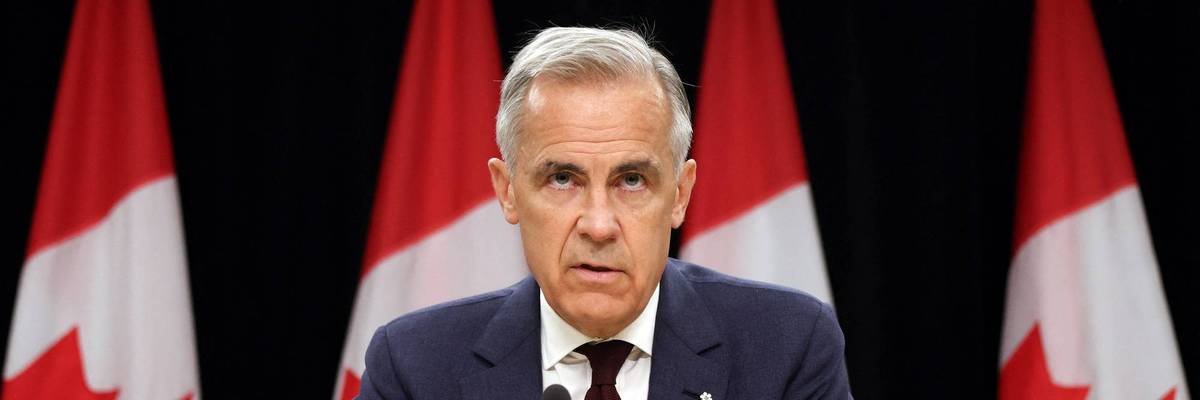
Canadian Prime Minister Mark Carney speaks during a news conference at the National Press Theatre in Ottawa, Canada on June 25, 2026. (Photo by Dave Chan/AFP via Getty Images)
On the heels of young Canadians suing over Prime Minister Mark Carney’s climate “failure” and people across the country mobilizing to urge the government to “stop fast-tracking destruction,” the Liberal leader on Thursday made a pair of fossil fuel-related announcements that sparked fresh anger.
Carney and Alberta Premier Danielle Smith of the United Conservative Party announced that the province is partnering with the federally owned Trans Mountain Corporation and Calgary-based Pembina Pipeline Corporation for a proposed tar sands pipeline that would bring more oil to British Columbia’s west coast.
“The proposed pipeline would generally follow the existing footprint of the federally owned Trans Mountain pipeline, running from Bruderheim, northeast of Edmonton, to the Roberts Bank export terminal in Delta, BC, south of Vancouver,” the Canadian Broadcasting Corporation reported. “Smith said the project would send more than 1 million barrels to Asian markets every day, reducing Canada’s reliance on the US.”
“The Alberta government’s submission to the federal government’s Major Projects Office said the project would cost between $35.2 billion and $43.7 billion, including contingencies. Construction would start as early as 2027 and finish by 2034,” CBC noted. “As for who foots the bill, Smith said detailed funding and the cost for taxpayers ‘remains to be negotiated.’”
Sounding the alarm about the plans with a Friday blog post, 350 Canada country manager Atiya Jaffar wrote, “In other words, we can get ready to expect $35-100 billion of our taxpayer dollars wasted on building this dangerous pipe dream.”
“Canada is headed in a dangerous direction. Expanding tar sands and the fracked gas industry is like pouring fuel on the flames of the climate emergency,” she argued, urging Canadians to pressure their members of Parliament to sign what the advocacy group is calling a “People’s MOU,” a jab at the memorandum of understanding the federal and Alberta governments signed last year.
Smith and Carney’s pipeline press conference came after shortly after the PM and BC Premier David Eby announced a “cooperative prosperity agreement” that the Wilderness Committee condemned as “an abandonment of both governments’ efforts to fight climate change and protect the environment,” given its provisions on the province’s liquefied natural gas (LNG) and mining endeavors.
Although Eby, a member of the New Democratic Party (NDP), “has been a prominent critic of the Carney government’s work with Alberta on pipeline plans,” Politico reported Thursday, the provincial leader cut short a trip to Beijing, where he traveled to meet with PetroChina executives about LNG production, “to be at the prime minister’s side” for the announcement.
Eby tried to stress that “this agreement doesn’t require us to support any pipeline proposal from Alberta. However, as I’ve said before, we recognize our constitutional position, and we do not have the authority to stop a new pipeline. We will not be going to court to fight a pipeline project. Instead, we will ensure we fulfill our constitutional obligations in good faith.”
“Pipelines are federal jurisdiction,” he continued. “That’s why this agreement matters. It ensures that the northern tanker ban stays in place, and it ensures that if a pipeline goes ahead, that British Columbians are fairly compensated for the environmental risks we would take on any new pipeline project.”
The Wilderness Committee’s conservation and policy campaigner Lucero González responded, “Eby said he will ensure British Columbians are compensated for the environmental damage of another pipeline, but there is no compensation for the extinction of the southern resident orcas.”
“How do you compensate for the unimaginable pain of an endangered orca like Tahlequah who has shown us her dead calves throughout the Salish Sea while each new megaproject continues to destroy their habitat?” González inquired.
Pointing to not only the potential increase in tanker traffic and oil spill risk but also the federal government’s “proposed evisceration” of the Species at Risk Act, González declared that “Carney is showing us his enthusiastic willingness to accept and fund the extinction of endangered species and a future where oil and private profit are more valuable than the entire Salish Sea ecosystem.
As Politico highlighted, the prime minister’s motivations for pushing the new pipeline include combating a separatist movement in one of the involved provinces: The project is also aimed at easing separatist tensions in Alberta, where voters will decide in October if they want to hold a referendum to separate from Canada. Smith has blamed “10 years of bad Liberal policy” under former Prime Minister Justin Trudeau for fueling western alienation, pointing to climate rules and energy regulations she says hurt Alberta’s economy.
In a 17-minute video posted to his YouTube channel earlier this week, Carney acknowledged that his government’s energy policies will increase emissions. He argued that the climate policies championed by Trudeau had become a political wedge—and fodder for Alberta separatists.
Even before the video, advocacy organizations had partnered with a trio of young citizens in June to take legal action over the prime minister failing to bring Canada’s 2030 emissions reduction plan into compliance with a key federal law.
Julia Levin of Environmental Defence, one of the groups behind the case, said last month that “PM Carney is betraying Canadians by taking a wrecking ball to our hard-fought climate progress. It is Canadians who are paying the price through wildfires, heat domes, rising food insecurity and high costs of living.”
The Wilderness Committee’s associate director, Torrance Coste, similarly said Friday that “at a time when people across the country are suffering in extreme heat, wildfire evacuations, and devastating floods, pursuing the expansion of Canada’s most polluting industry is utterly despicable.”
“In the fight against climate change, Prime Minister Carney and Premier Eby are issuing their surrender, and resigning us to a future of ecological and economic decline,” Coste added.
While Eby flew home to be by the prime minister’s side for Thursday’s first announcement, the NDP’s recently elected national leader, Avi Lewis, delivered a scathing rebuke of a federal government that he said “will protect above all else: the profits of Big Oil.”
“As we mark the five-year anniversary of a heat dome that killed 619 people in British Columbia—and as many communities across the country are facing extreme weather right now—Canadians deserve leadership that protects us,” Lewis argued on social media. “Instead, this government is doubling down on yesterday’s failed solutions and dragging us into further danger, risk, and insecurity.”
The pipeline’s “opaque and confusing public-private partnership ownership structure means it’s very likely that we, the public, will not only bear the risks and the damages, but also the lion’s share of the costs,” he warned. “Canada’s New Democrats unequivocally oppose this pipeline proposal. If anything, this is a pipeline to the courts. It ignores the federal government’s legal responsibility to meaningfully consult Indigenous nations, including Treaty 8 nations in Alberta, threatens endangered species, and accelerates climate change. It will sow the very divisions the prime minister claims he wants to avoid.”
“We do not achieve unity or prosperity from projects that pit communities against one another, all while a handful of oil and gas CEOs walk away with enormous profits,” he continued. “While we’re stuck fighting yesterday’s battles over pipelines, and the prime minister openly admits that our emissions will rise, the rest of the world is racing ahead on renewables. We cannot afford to fall behind while other countries build the industries of the future. ”
According to the NDP leader: “Canadians deserve better than being told our only choice is another fight over another pipeline. This country needs an alternative to the Liberal-Conservative consensus that is doubling down on a future of climate-wrecking corporate welfare.”
“New Democrats are ready to build something bigger, safer, and better—a Canada that is a renewable energy superpower, with an east-west clean electricity grid and good green jobs in every region,” he concluded. “Lower costs for families with home retrofits and heat pumps for all. Investing in the care economy as a nation-building project. That’s what it looks like to build big things that actually unite this country.”
‘Get the Flock Out’: Nationwide Backlash Grows Against AI-Powered Surveillance Tech
Since 2021, 82 Flock contracts have been canceled across 28 US states—39 of them during the first five months of this year alone.
A Flock Safety camera monitors traffic in this undated company photo. (Photo by Flock Safety)
Resistance is mounting across the United States against the increasing use of surveillance tech company Flock Safety’s cameras, with a growing number of cities canceling contracts as the artificial intelligence-powered license plate readers are quietly being installed in thousands of locations nationwide.
State and local police departments first used the Atlanta-based company’s automated license plate reader (ALPR) systems for standard law enforcement purposes, but they are now being employed for a much broader range of uses, including immigration-related searches and other actions supporting US Immigration and Customs Enforcement (ICE) during the Trump administration’s deadly anti-immigrant crackdown.
“We have cameras that are used for everything from illegal dumping to drug houses to hotels that are just big problems,” Flock Safety engineer Kevin Cox told prospective customers during a demonstration of the company’s Condor Camera, according to a Thursday report in The Washington Times.
“There are endless, endless uses for what we can do with these things,” Cox added.
Those uses include spying on constitutionally protected protest activity and enforcing abortion bans by tracking pregnant people’s travel across states—even ones in which the medical procedure is legal.
The ACLU—which recently launched a “Get the Flock Out” campaign to “fight creepy ALPR cameras”—says there are currently between 80,000 and 100,000 Flock devices installed nationwide that conduct more than 20 billion scans per month. More than 5,000 law enforcement agencies use the cameras, and some of them keep their locations a secret.
“Flock’s ALPR cameras aren’t like your normal traffic cameras,” the ACLU explained. “This surveillance technology records and tracks every car that comes into view, and then an AI algorithm catalogs the make, model, color, license plate number, bumper stickers, and even scratches. This personal information is then uploaded into a nationwide database that any law enforcement agency with a Flock contract can search—with few regulations or oversight on how they use what they find.”
The backlash against creeping state surveillance has even transcended the partisan divide.
“I think our country is in a kind of uniquely anti-surveillance environment right now, which is to say that, in a time where it seems there is nothing that is not partisan, opposition to government surveillance is nonpartisan,” ACLU privacy and surveillance attorney Chad Marlow told The Washington Times on Thursday.
There is growing action—both legal and otherwise—to end the use of ALPRs across the country.
According to the public information project Ban Flock Cameras, 82 Flock contracts were terminated across 28 states between August 2021 and May 2026, with 39 of those cancellations occurring in the first five months of 2026 alone.
Even Amazon-owned Ring announced earlier this year that it would stop doing business with Flock Safety.
Susie O’Hara, a member of Santa Cruz, California’s nominally nonpartisan City Council, told WBUR earlier this year that she grew increasingly concerned about local use of eight Flock cameras last year after learning that police were sharing data gleaned from the cameras with the company’s national network without city officials’ knowledge, a violation of state laws banning the practice.
O’Hara became increasingly convinced that Santa Cruz should cancel its Flock contract after an ICE agent fatally shot Renee Good, a US citizen, in Minneapolis in January.
“I have goose hbumps on my arms thinking about the absolute chaos that was happening in Minneapolis,” she said. “And just the absolute insanity of what we were seeing... It was totally clear to me that we should in no way consciously be in this system at all—just no way.”
Less than a week after Good’s killing, the Santa Cruz City Council voted to terminate the city’s Flock contract, becoming the first municipality in California to do so.
“For us, the threat to our civil liberties was greater than any benefit we could get from the flawed product,” Santa Cruz Mayor Fred Keeley told KQED at the time.
Chad Kemp, who represents District 32 on the nonpartisan Dane County Board of Supervisors in Wisconsin—which in April voted to stop funding two dozen cameras leased from Flock—told The Washington Times that “there’s a public safety issue here, but there is also a privacy issue.”
“There are serious concerns about individuals who can be monitored without their knowledge, or if it is even constitutional or ethical to track people without a warrant,” he added.
At the national level, US Reps. Robert Garcia (D-Calif.) and Raja Krishnamoorthi (D-Ill.) last year launched an investigation into the use of Flock cameras to track pregnant people across state lines for abortion care and to conduct unauthorized immigration enforcement operations.
Krishnamoorthi and Sen. Ron Wyden (D-Ore.) have also urged the Federal Trade Commission to investigate Flock Safety “for failing to implement cybersecurity protections, allowing Americans’ personal data to be exposed to hackers, criminals, and spies to steal.”
Their demand came after the cybersecurity firm Hudson Rock revealed that hackers stole passwords and data from at least 35 Flock customer accounts.
In May, US Reps. Jesús “Chuy” Garcia (D-Ill.) and Scott Perry (R-Pa.) introduced a bipartisan amendment to a bill that would prohibit state and local governments receiving federal highway funds from using ALPRs for purposes other than electronic toll collection.
It’s not just Flock. Axon, Vigilant Solutions—a subsidiary of Motorola Solutions—Genetec, PlateSmart, Innova Systems, Rekor, ELSAG, Perceptics, Jenoptik, and other firms market ALPRs to law enforcement agencies, private companies, and others.
“It doesn’t matter which company has its creepy cameras in your neighborhood,” the ACLU said, “they all have the same problems: a lack of transparency, oversight, and regulation into how they collect, store, and use our data, and how to hold public and private actors accountable if they abuse it.”
As High Heat Cancels July 4 Plans, US Must ‘Declare Our Independence From Fossil Fuels’ “How we confront the climate crisis will determine a lot about the next 250 years of American history, including if we make it that long,” one climate advocate said. “The revolution we need today is the clean energy revolution.”
A young visitor shields themself from the sun at the Great American State Fair during Fourth of July celebrations on the National Mall on July 4, 2026 in Washington, DC. (Photo by Finn Gomez/Getty Images)
The US reliance on and promotion of fossil fuels is interfering with its ability to celebrate its 250th birthday, as several July 4 events were canceled due to a dangerous, record-breaking heatwave in the Central and Eastern US that scientists say would have been “virtually impossible” without the climate emergency.
As millions of people sweltered under heat alerts, extreme heat and humidity led to the cancellation of both Washington, DC and Philadelphia’s Independence Day parades. Nearly 30 other events in states including Alabama, Delaware, New Jersey, New York, Pennsylvania, Maryland, and Virginia were modified, postponed, or canceled, according to USA Today.
“The US having to cancel major 4th of July celebrations because of extreme heat is almost too spot on as a metaphor for the country’s failure to combat global warming,” Fossil Free Media director Jamie Henn told Common Dreams. “How we confront the climate crisis will determine a lot about the next 250 years of American history, including if we make it that long. The revolution we need today is the clean energy revolution so we can finally declare our independence from fossil fuels.”
Temperature records were tied or broken in 22 locations on Thursday and 17 on Friday, according to CNN, with DC breaking a 120-year record on both days with temperatures above 102°F.
The heat forced the temporary closure Friday afternoon of the Great American State Fair on the National Mall, and seven attendees required “advanced life support,” probably due to heat exposure, according to CNN.
Matt Rein, the Democratic National Committee’s influencer and creative partnerships director, reported from the state fair on Saturday that local emergency workers said guests were “dropping like flies” due to the heat.
Meanwhile, one group who tried to draw attention to the climate emergency at a July 4 event was evicted for its efforts by the US Coast Guard, as the Times Union reported. The nonprofit Hudson River Sloop Clearwater had attempted to join Saturday’s Sail4th 250 parade of tall ships to New York Harbor when its sailboat was removed by the guard. The Coast Guard later said it was due to banners the boat was displaying reading, “Save the Clean Water Act” and “Indigenous rights, racial justice, climate solutions,” despite the fact that the group had the event organizer’s permission to participate.
The heat dome that has settled over the Central and Eastern US over the July 4 weekend is so dangerous in part because it includes high humidity along with high heat, with heat indexes of 105-115°F expected in some places. This corresponds with a Wet Bulb Global Temperature (WBGT)—a measurement that accounts for heat, humidity, and air flow—of 28-30°C, at which point it is dangerous for even healthy people to be physically active outdoors. According to World Weather Attribution, the current heatwave broke regional records for WBGT.
“It is still a relatively rare event even in today’s climate, that has warmed by 1.4°C due to the burning of fossil fuels. In a 1.4°C cooler climate, WBGTs as high as those forecast in early July 2026 would have been so extreme as to be virtually impossible,” the group wrote on Friday.
Friederike Otto, a professor of climate science at Imperial College London, told CNN, “When a historic 4th of July celebration is disrupted, and World Cup matches are played in conditions that are unsafe for players and fans, it shouldn’t take another scientific study to wake people up.”
Otto continued, “Climate change is here, it’s already impacting the things we enjoy in our everyday lives, and it will continue to get worse the longer we drag out the inevitable transition to net zero emissions.”
Climate scientist and communicator Katharine Hayhoe encouraged people to use this opportunity to talk about the climate emergency to their friends and family: Heatwaves aren’t new. But I’m a climate scientist, and I can tell you heatwaves like this are virtually impossible without fossil fuel pollution. Not only that, but when extreme weather hits, research shows that connecting it to climate change helps people understand why it matters. And you know who the most trusted people to do that are? Not scientists. You! Yes, people we know are the most effective messengers to have these conversations. So if you’re worried about what’s happening and how extreme heat puts us at risk—talk about it!
“Trump’s promotion of coal burning and cancellation of wind turbines make him the Benedict Arnold of America’s current struggle, not its George Washington.”
Just two days before the nation’s birthday, Energy Secretary and fracking CEO Chris Wright bragged on social media that the Trump administration would end subsidies for new wind and solar on July 4.
Climate scientist Rebekah Jones shot back: “During a record heatwave, no less. Fossil fuel industries have received $549 BILLION in direct subsidies, and $7 TRILLION in tax benefits. They average $30 billion per year in upfront taxpayer money. All of renewable energy recieved $400 million per year from 1994-2009.”
Tennessee state Sen. Heidi Campbell (D-20) also called out the move: “Talk about ‘slugs for salt’—it’s 119 degree heat index in the Eastern US this week—these guys are all in on the rapture.”
In a July 4 post, scholar Juan Cole argued that President Donald Trump’s climate policies were tantamount to treason.
“Since 2018, some 13,000 Americans have died from heat,” he said. “Trump’s promotion of coal burning and cancellation of wind turbines make him the Benedict Arnold of America’s current struggle, not its George Washington.”
Cole pointed out that the current heatwave was part of a pattern of hotter summers in the nation’s capital due to the climate emergency, noting that the last decade was its hottest on record.
He continued: The bad news is that this is only the beginning. Summers in the capital are going to be more dangerous every decade unless we halt dangerous carbon emissions.
The average summer temperature in DC could be 97°F in the 2080s if we go on farting out CO2 at our current rate. Humidity will also increase, as the Atlantic heats up and puts more water vapor in the atmosphere. The ability of the atmosphere to hold water vapor increases 7% with every 1°C increase in temperature.
That combined with more frequent storms and sea-level rise opens up the possiblity that DC “will be unlivable in the summers within the lifetime of my younger readers,” he wrote.
“Trump is helping climate change accomplish what British military might could not, putting in question the future of America in places like Washington, DC and Baltimore, at least in the summers,” Cole said.
'Young Washington' is the July 4 movie MAGA needs — but won’t understand
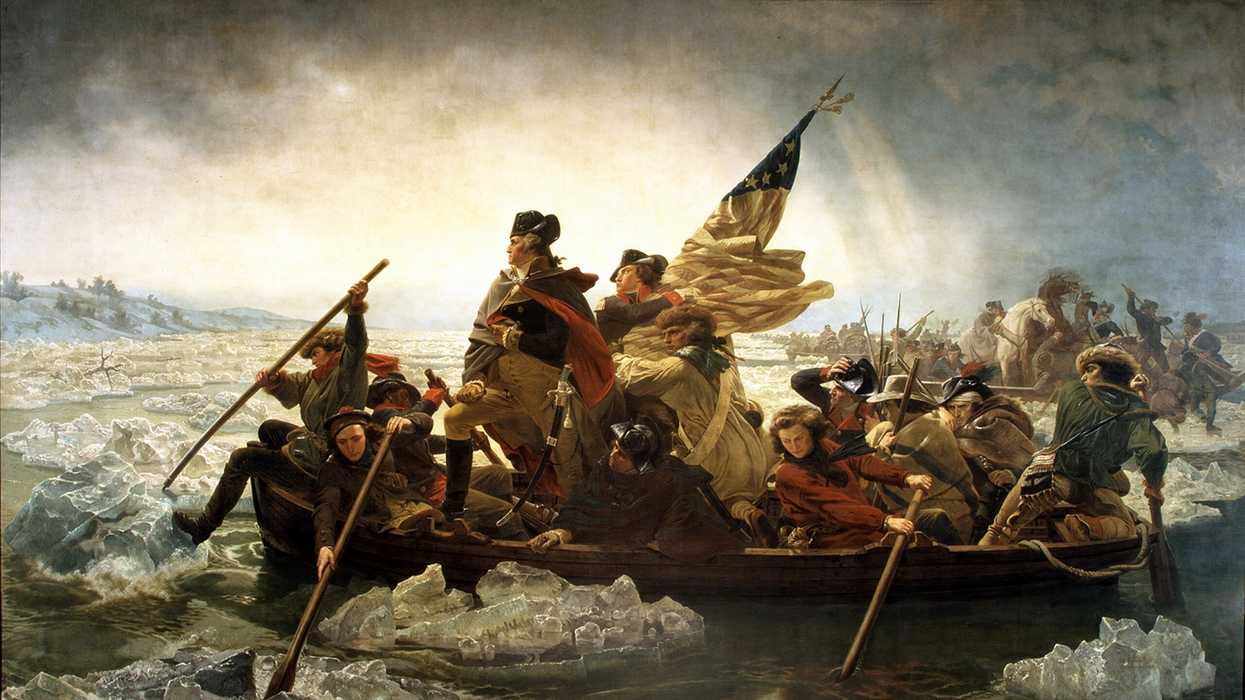
By Emanuel Leutze - The Metropolitan Museum of Art, Public Domain, https://commons.wikimedia.org/w/index.php?curid=9520770
Both before and after seeing "Young Washington," I spoke with members of the audience to get a sense of who was seeing the film and what they thought of it. Virtually everyone was there because they loved American history, wanted to celebrate the 4th of July and/or both. With one exception (a woman who was bored to tears), the eight people who spoke to me on the record all thought "Young Washington" was a fun, action-packed historical epic that celebrated Washington's early military career while still revealing his human side.
There was one notable exception, though, amidst this patriotic good cheer. One elderly woman, upon hearing that I'm a journalist, demanded in a loud voice, "Wait, are you MAGA?" I politely replied, "No, I am not" and said good day to her while her glaring eyes bore a small hole in the back of my head.
If anyone needed to be better informed about what Washington stood for, it was that lady.
My favorite scene from "Young Washington"
In a key scene from “Young Washington,” America’s future revolutionary leader and first president seizes the opportunity to read books with the eagerness that modern children display for video games, Instagram videos and AI slop. Reflecting the real George Washington’s interests, he intellectually imbibes the ideas of classical scholars like Plutarch and Seneca, classical heroes like Cato and Cincinnatus and the late 16th century French Jesuit text “Rules of Civility and Decent Behaviour In Company and Conversation.” Through these books, which Washington reread and took extensive notes on, he developed ideals that he embraced for the rest of his life — compassion for the less fortunate, enjoyment of scholarly learning, comporting oneself with modesty and dignity, being humble and taking accountability for one’s mistakes.
Most importantly for the future country he would lead, they taught Washington to embrace republican forms of government. It is impossible to imagine the young military leader growing up into a democratically-elected president who refused to accept kingship without these ideas first being inculcated into his young mind. “Young Washington” is, at its core, the story of how these principles shaped the man who would become a great free nation’s founding father.
Because it has been released on America’s 250th birthday, and at a time when the United States is led by a president who rejects every single one of those aforementioned values, it is also inevitably a commentary about Donald Trump.
Trump Derangement Syndrome?
I can see Trump supporters rolling their eyes at this point in the review, accusing me of Trump Derangement Syndrome and asking why I must bring him up when they’re just trying to enjoy a movie. In the case of “Young Washington,” though, it is obscene to not juxtapose the man whose courage created America and the one whose physical and moral cowardice is destroying it. The contrast is inevitable for thoughtful and honest people — and necessary to appreciate why “Young Washington” is both a masterpiece on its own terms and a vital reminder that the man whose movement says it will “Make America Great Again” has in fact done the exact opposite of that. When I listed all of the positive qualities Washington developed from his education earlier in this review, I can't avoid noticing that they are all qualities Trump has actively rejected.
“Young Washington,” which will be released on the 4th of July weekend 2026, was directed by Jon Erwin, co-written by Erwin, Tom Provost and Diederik Hoogstraten and starring William Franklyn-Miller, Ben Kingsley, Andy Serkis, Joel Smallbone, Kelsey Grammer, Mary-Louise Parker and Mia Rodgers. As the title indicates, it shows audiences Washington’s youth, focusing on the period from his father’s death (in 1743, when Washington was 11) to his personal (though not military) victory during the French and Indian War in the Battle of the Monongahela (in 1755). Instead of putting Washington on a pedestal, “Young Washington” shows him during a period when he failed over and over again — in love, in his military career, in controlling his pride and stubbornness. Long before he became “first in war, first in peace, and first in the hearts of his countrymen,” Washington was the social-climbing son of a modestly affluent planter and merchant who faced constant discrimination for being a provincial without distinguished forebears.
This is an important tale to tell, and for two big reasons. First, it obliterates the popular image of Washington as an infallible, God-like figure; we see him make foolish strategic choices, succumb to demoralization and cringe-inducingly misread social milieus. (He also chops a lot of trees, but the movie steers clear of reaffirming the famous cherry tree fable about his youth.) This is done not to tear down Washington’s image, but to make him easier to admire. Humans cannot easily relate to divine figures, but plucky and precocious youths who figuratively trip over their own feet are quite another matter. The Washington whose face appears on the $1 bill and on Mount Rushmore is a myth; the one whose incompetence inadvertently helped spark the French and Indian War was a human being. If the goal is to inspire people to emulate America’s founding fathers, it is far easier to do so when we see them as humans rather than myths.
“Washington's experience during the French and Indian War involved learning a great deal, both about military culture and strategy, but also about his place in the complex world of the British military,” Gautham Rao, a historian at American University and editor-in-chief of the journal Law & History Review (as well as this author’s adviser when he wrote his master’s thesis about a different president, Grover Cleveland), told AlterNet. Referring to Washington’s loss in the Battle of Jumonville Glen, Rao explained that “from this Washington would learn about the delicate norms that governed the use of force. Washington also learned, in a different theater, about the difficulties of guarding advanced positions in areas not entirely under control, as the task of patrolling between disparate forts led to significant casualties. Finally, Washington learned the importance of careful planning from General John Forbes, beneath whom he worked in the effort to seize Fort Duquesne in 1758.”
Why Washington despised aristocrats
Not all of these events are depicted in “Young Washington,” but one key detail is conveyed — namely, that Washington learned about the inherent unfairness of aristocratic systems, which ultimately informed his sympathy for the American Revolution.
“The entire experience also taught Washington about the glass ceiling in the British service for a colonist, and by the time he resigned his commission, he was well aware that he would not have the ability to advance further as a military man,” Rao told AlterNet.
Second — and more relevant to the year of its release — it demonstrates why Washington grew into the man who would not become king. Although “Young Washington” does not cover this period in his life, the man’s most important legacy was repeatedlyrefusing to become a king because he sincerely believed in democracy. Washington’s “I won’t be a king, even when the opportunity presents itself” era began near the end of the American Revolution. When it was suggested in 1782 that the Army believed he could become a monarch, he replied "no occurrence in the course of the War, has given me more painful sensations than your information of there being such ideas existing in the Army as you have expressed, and I must view with abhorrence, and reprehend with severety [sic]."
This attitude continued through the end of his second term. In his Farewell Address, Washington famously warned that political partisanship might one day create the conditions for a president to become a dictator by refusing to accept the will of the people when he loses an election.
“The alternate domination of one faction over another, sharpened by the spirit of revenge, natural to party dissension, which in different ages and countries has perpetrated the most horrid enormities, is itself a frightful despotism,” Washington (with the help of his one-time Secretary of the Treasury, Alexander Hamilton) co-authored in 1796. “But this leads at length to a more formal and permanent despotism. The disorders and miseries which result gradually incline the minds of men to seek security and repose in the absolute power of an individual; and sooner or later the chief of some prevailing faction, more able or more fortunate than his competitors, turns this disposition to the purposes of his own elevation, on the ruins of public liberty.”
Washington and Trump's Big Lie
Because of Washington’s precedent, every president who served after him accepted the will of the people after it was time for them to leave power — until, that is, Donald Trump rejected his loss to Joe Biden in the 2020 election. As conservative columnist and Ronald Reagan 1980 campaign adviser George F. Will wrote in February, Trump's loss to Biden is beyond reasonable doubt, and is only questioned by those with partisan motives.
“Someone should read to him ‘Lost, Not Stolen,’ a 2022 report by eight conservatives (two former Republican senators, three former federal appellate judges, a former Republican solicitor general, and two Republican election law specialists),” Will explain for The Washington Post. “They examined all 187 counts in the 64 court challenges filed in multiple states by Trump and his supporters. Twenty cases were dismissed before hearings on their merits, 14 were voluntarily dismissed by Trump and his supporters before hearings. Of the 30 that reached hearings on the merits, Trump’s side prevailed in only one, Pennsylvania, involving far too few votes to change the state’s result.”
Will added, “Trump’s batting average? .016. In Arizona, the most exhaustively scrutinized state, a private firm selected by Trump’s advocates confirmed Trump’s loss, finding 99 additional Biden votes and 261 fewer Trump votes.”
It is inconceivable that Washington would not have been horrified and disgusted by Trump’s manipulation of Republican partisanship to convince millions that an election he legitimately lost was stolen from him, as well as turn into a cult of personality for Trump as a man. Washington also would have opposed the idea that Trump should lead America by creating a climate of fear rather than developing a legacy that deserved respect; as one character instructs Washington in “Young Washington,” America’s first president understood that “obedience can be commanded. Respect must be earned.”
Dean Caivano, a professor of political science at Lehigh University (where this author studied for his PhD in history until his dissertation adviser died, leaving him ABD), elaborated on Washington's skepticism toward power when speaking to AlterNet.
"At several key moments, Washington accepted limits," Caivano said. "He resigned his military commission after the revolution. He accepted constitutional authority. He left the presidency after two terms. Those decisions helped establish the idea that public office is temporary and that military authority must be subordinate to civilian rule."
He added, "That lesson is very relevant in the Trump era. Contrary to his actions and rhetoric, the presidency is not personal property. The military is not a private instrument. Law enforcement is not supposed to function as an extension of personal loyalty. A constitutional republic depends on the refusal to collapse public authority into the will of one person."
The seeds of Washington's refusal to believe himself superior to others, and therefore worthy of being a king, were planted as he was humbled during the 1750s. A direct line can be drawn from the flawed youth in "Young Washington" and the great man who became America's first president — not a grandiose king, but a humble, intellectually curious and democratically-elected leader of finite duration.
Washington Derangement Syndrome?
I'm not without criticisms of this movie, or of Washington the man. “Young Washington” is imperfect in its depiction of American history. In addition to a host of smaller details, the movie inaccurately depicts the death of his close friend Christopher Gist for dramatic effect and glosses over Washington's racist views toward African Americans and Native Americans, likely to avoid offending right-wingers who refuse to acknowledge Washington's moral warts.
“Washington is historically significant, having helped establish norms of restraint and peaceful transfer of power. But he was also part of a political world built through slavery, Indigenous dispossession, and exclusion," Caivano told AlterNet. "This, of course, does not make Washington useless for the present. In fact, I think it makes him more useful if we read him honestly. His career helps us see one of the central problems of American politics: how a republic born through war and exclusion could also produce real principles of constitutional restraint, public responsibility, and limits on executive power.”
That is why, despite these shortcomings, “Young Washington” still soars as a movie. It depicts its protagonist as a relatable person, and relays this part of his biography with much gusto. While my review up to this point might make “Young Washington” seem like a somber affair, it has the atmosphere of high fantasy epics like the TV series “Game of Thrones” or the film trilogy “The Lord of the Rings,” all of which combined sweeping scores, beautiful cinematography, strong character development and top-notch acting to make distant worlds feel paradoxically immediate and yet worthy of being escaped into. Set both in colonial Virginia and the Ohio Country (which today includes Ohio, northwestern West Virginia, western Pennsylvania and eastern Indiana), “Young Washington” brings this bygone era to vivid life. It also moves at a brisk clip, feeling far more like an action-packed epic than a stodgy period piece.
In short, "Young Washington" is the best kind of history film — entertaining as well as edifying.
The greatness of "Young Washington" — and America
The educational aspect, as said before, could not be better timed. Before seeing “Young Washington,” I reached out to former Harvard Law professor Alan Dershowitz, who defended President Donald Trump during his first impeachment trial. When I spoke with Dershowitz for a 2019 Salon interview, he guaranteed that the then-first termer would never refuse to step down if he lost the 2020 election.
"No president will refuse to step down if his opponent is elected in his place,” Dershowitz told me at Salon at the time. “It just will not happen, and the American public would never tolerate it.”
Similarly, in response to my question in advance of "Young Washington" about how his earlier quote holds up in light of Trump's coup attempt and talk of staying in power after his second term ends, Dershowitz told AlterNet that Washington “would be distressed if Trump were to try for a third term, even if it were constitutionally permissible.” Washington, after all, set the precedent which held that presidents should only serve for two terms, more than a century and a half before the 22nd Amendment made it law. Aside from Ulysses Grant in 1880 and Franklin Roosevelt in 1940 and 1944, no president before Trump has ever tried to get elected more than twice.
Dershowitz wasn't alone in saying Trump could learn from Washington's approach to power. Caivano, when asked what lessons Trump should draw from Washington, said that Trump should realize “the presidency is temporary. It is not owned by the person who occupies it. The basic lesson I would draw from Washington is that power has to be limited to remain republican.”
He added, “Strength is not the same thing as domination. Executive power is not legitimate because a single person can command attention or loyalty. It is legitimate only when it remains bound by law, constitutional limits, and public accountability. That is the message Trump should take from Washington.”
Rao similarly observed that Washington, unlike Trump, learned from his past poor decisions to be measured, cautious and studied, even when it aggravated his allies.
"Washington at his best was a deliberate and careful decision-maker," Rao told AlterNet. "This applied as much to his time at the helm of the Continental Army as it did to his time as Commander-in-Chief."
Since I doubt Trump will ever pay attention to what anyone has to tell him, even the first occupant of the office he now holds, I instead urge Trump supporters and those who wish to persuade Trump supporters to pay attention to the message of “Young Washington.” For all of his shortcomings, Washington personified and implemented ideals involving freedom, scholarship and decency that allowed America to contribute massively to the welfare of both its own citizens and humanity overall. Trump has put all of that into jeopardy, and the main question one has after finishing “Young Washington” is whether the Washingtonian philosophy has merely been wounded by Trumpism or outright murdered.
Political scholar exposes surprise gender gap in GOP’s July 4 mania
President Donald Trump gestures as he attends UFC Freedom 250 on the South Lawn of the White House in Washington, D.C., June 15, 2026. REUTERS/Evan Vucci
Much has been said about the partisan divide at play in the ways that Americans react to President Donald Trump, but as one political scholar revealed for The Hill, there is also a surprising gender gap going on, and it is most striking in relation to the celebration of America's 250th birthday.
Melissa K. Miller is a professor of political science at Bowling Green State University in Ohio, and to mark the Fourth of July, she published a new piece for The Hill revealing the findings of a national poll her school conducted with YouGov. According to the poll, she explained, gender is a significant driver of sentiment and engagement with the country's 250th anniversary, having a notable impact on whether or not the respondents said they would take part in festivities, but also on what they believed to be important to celebrate about the occasion.
"Compared to men, women are less engaged with the 250th anniversary of the Declaration of Independence," Miller explained. "They also hold significantly different views on what events surrounding the historic occasion should emphasize: less founding fathers, more bringing people together. Data from a national poll conducted by my university, Bowling Green State University, in conjunction with YouGov, makes the gender gap plain."
She continued: "Interest in America’s 250th anniversary is 10 points lower among women than men: 60 percent versus 70 percent. Women are also significantly less likely than men to say they will participate in an activity marking the occasion: 45 percent versus 54 percent. Asked to choose up to two possible emphases for the celebrations, nearly twice as many men as women select commemorating America’s founding fathers as a primary focus: 26 percent versus 14 percent. The tables turned when we asked about bringing 'Americans together across differences.' Nearly half of women, 48 percent, choose this as a focus for the semiquincentennial, versus 37 percent of men."
Miller further stressed that these findings do not appear to be the result of women statistically favoring the Democratic Party more than men. When broken down by party, there remains a major gender gap between Republican men and women, and almost no gap at all between Democratic men and women, when "controlled" for partisan affiliation, though she did note that women in both parties are less likely to celebrate based on the raw data.
"In terms of a primary emphasis on commemorating the founding fathers, the gender gap among Republicans is 16 points, with Republican women less enamored than Republican men," Miller wrote. "Among Democrats? The gender gap is statistically insignificant. The same goes for bringing Americans together across differences. While there is no gender gap among Democrats, it’s 19 points among Republicans. A majority of Republican women favor a bring-the-people-together focus for the festivities, versus just one-third of Republican men — 52 percent versus 33 percent."
She concluded: "Mindful of this exception, the Republican gender gap over America’s historic anniversary remains noteworthy. Democrats might want to take note. Low turnout among Republican women could make the difference in close House and Senate races this fall. Cue the clips of cage fighting on the White House lawn. There were no women on the card. They were hard to spot in the audience as well."
Progressive Patriotism for America’s 250th Birthday
Progressive believe that the core claims of this nation—fairness, equality, freedom, and justice—are their own. And they are right
“This year as a time when democracy itself is under serious threat, progressives are seeking ways to claim their patriotism and recapture the flag,” write Dreier and Flack. (Photo by Bradyn Shock on Unsplash)
July 4 is the big occasion for Americans to express patriotism, none more so than this year, the 250th anniversary of the nation’s founding. But the ways we do so are as diverse as the country. People and groups from right to left celebrate in conflicting ways and with conflicting views—from “love it or leave it” to “love it and fix it.”
This year as a time when democracy itself is under serious threat, progressives are seeking ways to claim their patriotism and recapture the flag.
“America is beautiful, contradictory, unfinished,” wrote Zohran Mamdani last July 4 before he had been elected mayor of New York City. “I am proud of our country even as we constantly strive to make it better, to protect and deepen our democracy, to fulfill its promise for each and every person who calls it home. Happy Independence Day. No Kings in America.”
Since the American Revolution, each generation of progressives has expressed an American patriotism rooted in democratic values that challenged jingoism and “my country—right or wrong” thinking, rejecting blind nationalism, militaristic drum beating, and sheep-like conformism. Democratic movements—abolition of slavery, farmers’ populism, women’s suffrage, workers’ rights, civil rights, environmentalism, gay rights, and others—sought to overturn the established order while claiming to fulfill America’s promise. They believed that America’s core claims—fairness, equality, freedom, justice—were their own.
Even the founders would be aghast at how far Trump, and his courtiers, as well as most Republican politicians, have gone to establish an authoritarian state.
As Rev. Dr. Martin Luther King, Jr., declared in a speech during the Montgomery bus boycott in 1955, “The great glory of American democracy is the right to protest for right.”.
Donald Trump consciously and cynically has been re-enacting the long tradition of patriotism as jingoism, nationalism, flag waving, and “America first” sloganeering. What seems new is his systematic drive to debase major symbols of national identity—such as the White House, the reflecting pool, and Arlington Cemetery—while wrecking the entire national plan to celebrate America at 250.
Although they disagreed on many issues, the founders were adamant that they didn’t want the country to be run by an all-powerful king. Yet here we are 250 year later, governed by a president publicly claiming such power, with a Supreme Court majority acting as his enablers,
Of course, many of the founders were skeptical of a robust democracy. They created institutions, including the Supreme Court, the Senate, and the Electoral College, that were never intended to completely reflect the voice of the people.
Even the founders, however, would be aghast at how far Trump, and his courtiers, as well as most Republican politicians, have gone to establish an authoritarian state, exploiting the opportunities provided by the Constitution’s elitist features.
The Gallup poll regularly asks Americans what the founders would think of America today. This year, only 19% think the signers of the Declaration of Independence would be pleased with how the country has turned out. Over three quarters (77%) now say the founders would be disappointed. This compares with 42% in 2001.
Americans’ disappointment with the country is obviously tied to Trump’s performance and his low favorability ratings in the polls. We expect our nation’s leaders, especially our president, to express a deep loyalty to a vision bigger than one person. But Trump has no overarching vision. Besides grabbing power and wealth for himself, his major commitment appears to white nationalism—turning America into a country for the uber rich and white people only. In contrast to the patriotism expressed in Emma Lazarus’ poem at the base of the Statue of Liberty (“Give me your tired, your poor, your huddled masses yearning to breathe free”), Trump wants, to rid the nation of immigrants of color, whom, in his eugenicist view, he thinks “pollute” the country with bad genes.
Trump and his coterie have systematically acted to undermine the spirit and letter of the Constitution. One of America’s core beliefs since its founding has been that elections should determine who becomes president and that it is important to ensure the orderly transfer of power. But insurrectionists at the Capitol building on January 6, 2021—urged on by and loyal to Trump— attempted to stop that process, while. carrying American flags. Many of these were convicted and sentenced for insurrectionary crimes. Trump’s blanket pardon and embrace of the convicted was an announcement of his autocratic hopes and plans.
As the 250th anniversary approaches, Trump is intensifying his campaign to end the right to vote—the fundamental idea of the American Revolution. Abetted by the Supreme Court majority’s dismantling of the Voting Rights Act (a key victory of the 1960s), and building on the ongoing GOP campaign to maintain power as they lose their capacity to win the national popular vote, Trump is trying to undermine states’ control over the electoral process.
He’s used his powers to eviscerate other cherished rights, including free speech, a free press, and freedom of assembly and dissent. He has used the tools of government—including the FBI, the Justice Department, and the IRS—to unleash his revenge on protesters, the media, immigrants, Democrats, and all others he considers his opponents.
Right wingers have always wrapped themselves in the flag under the guise of being the true patriots. ‘“Americanism” campaigns in the early 20th century were designed to undermine the labor movement and limit immigration. Congressional and state legislative “Unamerican Activities” committees collaborated with the FBI beginning in the 1930s, to build blacklists against leftwing activists and artists,
Even American Nazis sought to be seen as patriots. On Feb. 20, 1939, 20,000 of them filled Madison Square Garden for a “Pro-America Rally.” They erected a massive 30-foot banner of George Washington (it was timed to celebrate his birthday) surrounded by American flags and swastika banners.
Trump’s own MAGA rallies feel like modern-day versions of that Nazi event. He fetishizes the American flag and other patriotic symbols, even while displaying a shallow, ahistorical, and bizarre understanding of what they meant.
Once, at a campaign rally in Tampa, as his cult followers chanted, “Build that wall,” Trump interrupted his speech to give a bear hug to an American flag on the stage behind him.
“We want to make sure that anyone who seeks to join our country, shares our values and has the capacity to love our people,” Trump said at a rally at the Kennedy Center in 2017.
“We all salute the same great American flag,” Trump said in his 2017 inauguration address—a line he has repeated in many speeches since then.
To Trump and his followers, the flag is synonymous with “America First.” It was a slogan used to unite isolationists and Nazi sympathizers against involvement in the European war in 1939. For Trump, it means reporting undocumented immigrants and caging their children in detention centers, restricting visitors from Muslim countries, withdrawing from the Paris climate accord and other international agreements, and engaging in friendships with like-minded dictators.
Trump’s faux patriotism and its clownish griftiness has been providing a wide space for coalitions of resistance. The “No Kings” protests and the slogan itself help provide a very fitting frame for revitalizing a progressive, democratic, populist patriotism. Many participants waved American flags.
America now confronts a new version of the Gilded Age, brought upon by Wall Street greed and corporate malfeasance.
President Barack Obama said: “I have no doubt that, in the face of impossible odds, people who love their country can change it.” He observed that, “loving your country shouldn’t just mean watching fireworks on the Fourth of July. Loving your country must mean accepting your responsibility to do your part to change it. If you do, your life will be richer, our country will be stronger.”
President Joe Biden said that “we’re all part of a chain of patriots” who fought for democracy, freedom, fair play, peace, security, and opportunity. Patriots, he explained, seek “the right to equal justice under the law; the right to vote and have that vote counted; the right to breathe clean air, drink clean water, and know that our children and grandchildren will be safe on this planet for generations to come; the right to rise in the world as far as your God-given talent can take you, unlimited by barriers of privilege or power.”
In the Sixties, as hundreds of thousands of American youth were radicalized by the senseless Vietnam war, resistance included acts of defiance of patriotic symbols and rhetoric. Flag burnings would sometimes combine with the burning of draft cards. But other radicals took a different stance. In 1968, in a famous speech against the Vietnam war, Norman Thomas, the aging leader of the rather moribund Socialist Party, proclaimed, “I come to cleanse the American flag, not burn it.”
“It was as a Socialist, and because I was a Socialist, that I fell in love with America,” wrote Michael Harrington, the founder of Democratic Socialists of America, in his 1973 book, Fragments of a Century. “In saying that, I am not indulging in romantic nostalgia about youthful days on the road but rather underlining a crucial political truth. If the Left wants to change this country because it hates it, then the people will never listen to the Left and the people will be right. To be a Socialist is to make an act of faith, of love even, toward this land. It is to sense the seed beneath the snow; to see, beneath the veneer of corruption and meanness and the commercialization of human relationships, men and women capable of controlling their own destinies. To be a radical is, in the best and only decent sense of the word, patriotic.”
Harrington was identifying with the many radicals and progressive reformers who proudly asserted their patriotism. To them, America promised democratic fulfillment—economic and social equality, mass participation in politics, free speech, and civil liberties, elimination of the second-class citizenship of women and people of color, a welcome mat for the world’s oppressed people. The reality of corporate power, right wing xenophobia, and social injustice only fueled progressives’ allegiance to these principles and the struggle to achieve them.
It is largely underrecognized that some of the most important and popular ways all Americans experience and express patriotism were the creation of radical writers and artists. What they created continues to inspire.
Francis Bellamy, a Baptist minister and Christian socialist who lived from 1855 to 1931, wrote the Pledge of Allegiance in 1892 to express his outrage at the Gilded Age’s widening economic divide. He had been ousted from his Boston church for his sermons depicting Jesus as a socialist, and for his work among the It was the Gilded Age, an era marked by major political, economic, and social conflicts. Progressive reformers were outraged by the widening gap between rich and poor, and the behavior of corporate robber barons who were exploiting workers, gouging consumers, and corrupting politics with their money. Workers were organizing unions. Farmers were joining forces in the so-called Populist movement to rein in the power of banks, railroads, and utility companies. Reformers fought for child labor laws, against slum housing, and in favor of women’s suffrage. Socialists and other leftist radicals were gaining new converts.
In foreign affairs, Americans were battling over the nation’s role in the world. America was beginning to act like an imperial power, justifying its expansion with a combination of white supremacy, manifest destiny, and the argument that it was spreading democracy. At the time, nativist groups across the country were pushing for restrictions on immigrants—Catholics, Jews, and Asians—who were cast as polluting Protestant America. In the South, the outcome of the Civil War still inflamed regional passions. Many Southerners, including Civil War veterans, swore allegiance not to the American but to the Confederate flag.
Bellamy, a cousin of Edward Bellamy, author of two bestselling socialistic books, Looking Backward and Equality, believed that unbridled capitalism, materialism, and individualism betrayed America’s promise. He hoped that the Pledge of Allegiance would promote a different moral vision to counter the rampant greed he argued was undermining the nation.
When composing the Pledge, Bellamy had initially intended to use the phrase “liberty, fraternity, and equality,” but concluded that the radical rhetoric of the French Revolution wouldn’t sit well with many Americans. So he coined the phrase, “one nation, indivisible, with liberty and justice for all,” to express his more egalitarian vision of America, and a secular patriotism aimed at helping unite a divided nation.
In 1891, Youth’s Companion, a magazine for young people published in Boston with a circulation of about 500,000, hired Bellamy to organize a public relations campaign to celebrate the 400th anniversary of Christopher Columbus’ so-called discovery of America by promoting use of the flag in public schools.
Bellamy gained the support of the National Education Association, along with President Benjamin Harrison and Congress, for a national ritual observance in the schools, and he wrote the Pledge of Allegiance as part of the program’s flag salute ceremony.
Bellamy thought such an event would be a powerful expression on behalf of free public education. Moreover, he wanted all the schoolchildren of America to recite the pledge at the same moment. He hoped the pledge would promote a moral vision to counter the individualism embodied in capitalism and expressed in the climate of the Gilded Age.
In 1923, over the objections of the aging Bellamy, the National Flag Conference, led by the American Legion and the Daughters of the American Revolution, changed the opening, “I pledge allegiance to my flag,” to “I pledge allegiance to the flag of the United States of America.” Ostensibly, it was revised to make sure that immigrant children—who might have thought that “my flag” referred to their native countries—knew that they were pledging allegiance to the American flag.
In 1954, at the height of the Cold War—when many political leaders believed that the nation was threatened by godless communism—the Knights of Columbus led a successful campaign to lobby Congress to add the words “under God.”
A year after Bellamy composed the pledge, Kathryn Lee Bates wrote the poem “America the Beautiful,” which was later set to music by Samuel Ward, the organist at Grace Episcopal Church in Newark, New Jersey
Like Bellamy, Bates was a Christian socialist. A well-respected poet and professor of English at Wellesley College, Bates (1859-1929) was also a lesbian who lived with Katharine Coman, an economics professor. They belonged to progressive circles in the Boston area that supported labor unions, advocated for immigrants, and fought for women’s suffrage. She was an ardent foe of American imperialism.
“America the Beautiful” was initially published in 1895 to commemorate the Fourth of July. The poem is usually heard as an unalloyed paean to American virtue. But a close reading of her words makes it clear that she had something more in mind. She wrote:
America! America! God shed His grace on thee Till selfish gain no longer stain, The banner of the free!
Bates hoped that a progressive movement could overcome the Gilded Age’s greed. And when sung by Ray Charles and other African American artists, listeners can’t help but be inspired by the song’s plea for brotherhood – or, as the left calls it, solidarity.
Lazarus, author of the poem inscribed on the Statue of Liberty, was a Jewish poet of considerable reputation in her day, who was a strong supporter of Henry George and his “socialistic” single-tax program, and a friend of William Morris, a leading British socialist. Her welcome to the “wretched refuse” of the Earth, written in 1883, was an effort to project an inclusive and egalitarian definition of the American Dream.
In the Depression years and during World War II, the fusion of populist, egalitarian, and anti-racist values with patriotic expression reached full flower. The rise of fascism was countered in the US with efforts to build a center-left coalition in critical support of the New Deal and a parallel cultural upsurge.
Langston Hughes’ poem, “Let America Be America Again,” written in 1936, contrasted the nation’s promise with its mistreatment of his fellow African-Americans, the poor, Native Americans, workers, farmers, and immigrants:
O, let my land be a land where Liberty Is crowned with no false patriotic wreath But opportunity is real, and life is free Equality is in the air we breathe.
It’s a poem that encapsulates the anger and the hope integral to the American experience.
In 1939, composer Earl Robinson teamed with lyricist John La Touche to write “Ballad for Americans,” which was performed on the CBS radio network by Paul Robeson, at the time one of the best-known performers on the world stage, accompanied by chorus and orchestra. This 11-minute cantata provided a musical review of American history, depicted as a struggle between the “nobody who’s everybody” and an elite that fails to understand the real, democratic essence of America.
Broadcasts and recordings of “Ballad for Americans,” (by Bing Crosby as well as Robeson) were immensely popular. In the summer of 1940, it was performed at the national conventions of both the Republican and Communist parties. The work soon became a staple in school choral performances, but it was literally ripped out of many public school songbooks after Robinson and Robeson were identified with the radical left and blacklisted during the McCarthy period. Since then, “Ballad for Americans” has been periodically revived, notably during the bicentennial celebration in 1976, when a number of pop and country singers performed it in concerts and on TV. This might be the year to revive and revise it.
Earl Robinson wrote the melody for another important patriotic song of the World War 2 era -- “The House I Live In.” The lyric was written by Lewis Allen, the pen-name of a New York teacher, activist and poet named Abel Meeropol, who had, a few years earlier, written the anti-lynching anthem “Strange Fruit” for Billie Holiday.
The song was the centerpiece of an Oscar winning short film starring Frank Sinatra. In the film, Sinatra uses the song to instruct a group of kids who were bullying a Jewish classmate. Sinatra made the song a hit in 1945. Other versions were recorded by Robeson and by Josh White. Sinatra kept it in his repertoire for his whole career, even though he publicly associated with the Republican right (abandoning his earlier left-wing sympathies). Sinatra performed the song as the finale to a nationally broadcast celebration of the Statue of Liberty centenary, addressing it to Ronald and Nancy Reagan on the platform with him. Only a few watching were aware of the song’s origins.
Composer Aaron Copland’s “Fanfare for the Common Man” and “A Lincoln Portrait,” both written in 1942, are now patriotic musical standards, regularly performed at major civic events. Copland was a member of a radical composers’ group as well as a gay man.
Many Americans consider Woody Guthrie’s song “This Land Is Your Land,” penned in 1940, to be our unofficial national anthem. Guthrie, a radical, was inspired to write the song as an answer to Irving Berlin’s popular “God Bless America,” which he thought failed to recognize that it was the “people” to whom America belonged.
The song reflects Guthrie’s belief that patriotism and support for the underdog were interconnected. He celebrated America’s natural beauty and bounty, but criticized the country for its failure to share its riches. This is revealed in the song’s last and least-known verse, which Pete Seeger and Bruce Springsteen performed at Obama’s pre-inaugural concert in 2009 in front of the Lincoln Memorial, with Obama in the audience:
One bright sunny morning; In the shadow of the steeple; By the relief office; I saw my people. As they stood hungry; I stood there wondering; If this land was made for you and me.
You can find Spanish and Native American versions of the song. Guthrie would have approved. Both he and Seeger, who were part of Communist circles, helped popularize socially conscious music reflecting the country’s diversity. They are now viewed as American icons.
During the 1960s, American progressives continued to seek ways to fuse their love of country with their opposition to the government’s policies. The March on Washington in 1963 gathered at the Lincoln Memorial, where Martin Luther King famously quoted the words to “My Country ‘Tis of Thee,” repeating the phrase “Let freedom ring” 11 times. That 19th century song seems politically neutral, but it was a defiantly anti-monarchy anthem, written as a kind of parody of “God Save the King.” An abolitionist version soon followed its initial release. Marian Anderson, the great African American contralto, sang the song on the steps of the Lincoln Memorial in 1939 because the Daughters of the American Revolution refused to allow her to perform at its Constitution Hall due to her race.
Phil Ochs, then part of a new generation of politically conscious singer-songwriters who emerged during the 1960s, wrote an anthem in the Guthrie vein, “The Power and the Glory,” that coupled love of country with a strong plea for justice and equality. The words to the chorus echo the sentiments of the anti-Vietnam War movement:
Here is a land full of power and glory; Beauty that words cannot recall; Oh her power shall rest on the strength of her freedom; Her glory shall rest on us all.
One of its stanzas updated Guthrie’s combination of outrage and patriotism:
Yet she’s only as rich as the poorest of her poor; Only as free as the padlocked prison door; Only as strong as our love for this land; Only as tall as we stand.
This song later became part of the repertoire of the U.S. Army band.
In recent decades, Springsteen has closely followed in the Guthrie tradition. From “Born in the USA” to his songs about Tom Joad (the militant protagonist in John Steinbeck’s The Grapes of Wrath), to his anthem about the 9/11 tragedy (“Empty Sky”), to his album Wrecking Ball (including its opening song, “We Take Care of Our Own”), Springsteen has championed the downtrodden while challenging America to live up to its ideals. In January, Springsteen wrote “Streets of Minneapolis,” which describe how “a city aflame fought fire and ice ‘neath an occupier’s boots,” which Springsteen calls “King Trump’s private army.” He wrote it in response to the second deadly shooting by federal immigration agents in Minneapolis and dedicated it to the people of that city. At the opening of Obama’s new presidential center in Chicago, Springsteen sang his song, “Land of Hope and Dreams,” which includes lines adopted from Guthrie’s song, “This Train is Bound for Glory.” The train – a metaphor for America -- carries “saints and sinners,” “losers and winners,” and “fools and kings.”
America now confronts a new version of the Gilded Age, brought upon by Wall Street greed and corporate malfeasance. Americans are upset by the unbridled selfishness and political influence-peddling demonstrated by banks, oil companies, drug companies, insurance companies, and other large corporations. They are angry at the growing power of American-based global firms who show no loyalty to their country, outsource jobs to low-wage countries, avoid paying taxes, and pollute the environment.
During the ICE raids in Minnesota a group called “Singing Resistance” emerged to encourage singing during protests. Troubadours of multiple generations sang new and classic songs of protest on stage and via You Tube.
One fascinating moment happened at this year’s Super Bowl when Coco Jones sang “Lift Every Voice and Sing.” For 100 years that song has been the African American national anthem. It lyrics include these lines:
Sing a song full of the faith that the dark past has taught us, Sing a song full of the hope that the present has brought us; Facing the rising sun of our new day begun, Let us march on ‘til victory is won.
To have it performed at the Super Bowl, alongside the “Star Spangled Banner,” may have been an affront to right-wingers, , but it was an inspiring moment for many other Americans. Cong. James Clyburn (D-South Carolina) has sponsored a bill to make “Life Every Voice” the national hymn.
Throughout American history, progressive movements had won major victories and also experienced setbacks. When those setbacks occur, it is understandable that people sometimes lose hope, and even give up the fight. But our history also teaches us that we can’t give up, because we must keep the struggle alive for a new generation.
Our work is licensed under Creative Commons (CC BY-NC-ND 3.0). Feel free to republish and share widely.
Peter Dreier Peter Dreier is the E.P. Clapp distinguished professor of politics at Occidental College. He joined the Occidental faculty in January 1993 after serving for nine years as Director of Housing at the Boston Redevelopment Authority and senior policy advisor to Boston Mayor Ray Flynn. He is the author of "The 100 Greatest Americans of the 20th Century: A Social Justice Hall of Fame" (2012) and an editor (with Kate Aronoff and Michael Kazin) of "We Own the Future: Democratic Socialism, American Style" and co-author of "Baseball Rebels: The Players, People and Social Movements That Shook Up the Game and Changed America" (2022). Full Bio >
Dick Flacks Dick Flacks is research professor of sociology at the University of California Santa Barbara. His books include: "Making History: The American Left and the American Mind;" "Beyond the Barricades: The Sixties Generation Grows Up;" "The Port Huron Statement: Sources and Legacies of the New Left's Founding Manifesto" His research and teaching centers on issues of political participation, commitment and protest. His weekly radio program, "Culture of Protest," has been on Santa Barbara radio for 25 years. Full Bio >
Robert Reich reveals July 4th plan for 'mourning' US ideals assaulted by Trump
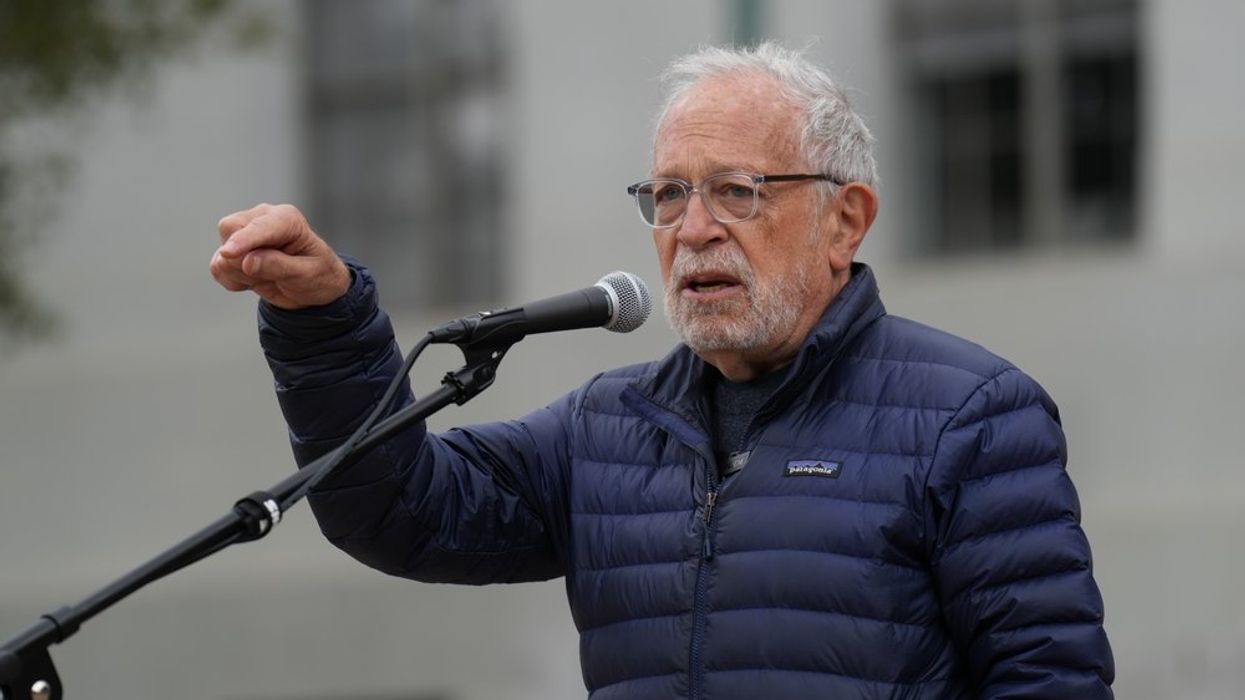
Economist Robert Reich on April 17, 2025 (Phil Pasquini/Shutterstock.com)
As the U.S. celebrates its 250th birthday, the "ideals that this country began with" are under assault by President Donald Trump, prompting commentator and economic equality activist Robert Reich to plan a symbol "mourning" to mark this year's Fourth of July.
Reich is a veteran lawyer who previously served as the first Secretary of Labor under former President Bill Clinton, and he remains an outspoken liberal political voice. In the latest edition of his "Coffee Klatch" video series, he revealed the surprisingly mournful way he intended to mark the country's 250th on Saturday, in order to convey the gravity of damage done by Trump and his allies.
"Well, this is a pretty special 250th," Reich told co-host Heather Lofthouse. "I'm going to wear a black armband, because it's mourning... in America, with regard to the ideals that this country began with, and I think it's important to recognize this is not just a celebration today."
Reich also added that he planned to read aloud the Declaration of Independence in a small town square in California that he is "very fond of," with the public welcome to join him.
Speaking further about this year's historic Fourth of July proceedings, Lofthouse and Reich mourned as well the degree to which Trump has stolen the spotlight of the momentous occasion away from the country, and put it on himself.
"He takes the oxygen out of whatever room, whatever celebration," Reich said. "You know, there was originally going to be, Congress set aside years ago... some money for a special commission that would do all of these Fourth of July on the [National] Mall and every place else, and he supplanted it, and he created his own 'Freedom 250'... It's all just gaudy and gilded, but it's all about Trump... It's a big campaign celebration of Donald Trump."
Lofthouse argued that Trump must now be fuming, given how badly the Freedom 250 events are "failing," rendering him and his plans a global "laughingstock." Reich suggested that Trump is too surrounded by "sycophants" to ever hear about how poorly his plans are going over with voters.
"He really learned from his first term," Lofthouse said. "He learned to get rid of people who had opinions and strength and obligation to some kind of moral code."