Sunday, July 05, 2026


Training Ship Golden Bear Nears End of its Final Voyage After 30 Years

California training ship
California's training ship Golden Bear is finishing her last voyage after 30 years of service (Cal Poly Maritime Academy)

Published Jul 3, 2026 2:56 PM by The Maritime Executive

The last of the older U.S. state maritime school training ships, the Golden Bear, is preparing for her retirement after completing her final training cruise. One of the older ships that was used to train merchant mariners, the ship will be replaced in 2027 by the last of the National Security Multi-Mission Vessel (NSMV) program being implemented by the Maritime Administration (MARAD). 

Golden Bear is scheduled to return to Vallejo, California, on July 6, following the completion of Summer Sea Term 2026. She is bringing home 283 Cal Poly Maritime Academy cadets after a 12,500-mile voyage across the Pacific Ocean. This year's voyage took cadets across the Pacific Ocean with port calls in San Diego, Tahiti, Fiji, and Honolulu. 

Along the way, students stood watch on the bridge and in the engine room, operated complex ship systems, participated in emergency drills, and developed the skills required of future maritime officers. 

It is a bittersweet moment for the staff and crew. For three decades, Golden Bear has served as a floating classroom where thousands of cadets transformed classroom knowledge into practical experience at sea. 

Golden Bear has helped prepare generations of maritime professionals through hands-on training at sea,” said Rear Adm. Eric C. Jones, U.S. Coast Guard (Ret.), superintendent of Cal Poly Maritime Academy. “More than a training vessel, Golden Bear represented an ethos that has guided the education of maritime leaders at this academy for nearly a century. We are grateful for the ship’s service and the role it has played in shaping thousands of careers.”

She, along with another now former training ship, was built in the 1990s for the U.S. Navy as the fastest and largest oceanographic ship in the United States fleet. Known as USNS Maury (T-AGS-39) she was delivered to the Navy on March 31, 1989. However, her career would be short, as in 1994 she was placed out of service. 

USNS Maury was transferred to California Maritime Academy on May 4, 1996, and rechristened as the TS Golden Bear. Her sister ship USNS Tanner (T-AGS-40), followed a year later, being delivered to the Maine Maritime Academy and assuming her role as a training ship, TS State of Maine, in June 1997.

The transition to the new training ship comes as the academy is also in transition. Founded in 1901, it became part of the California State University system in 1960. Cal Maritime recently merged with Cal Poly as part of a reorganization of the state school program. Now known as Cal Poly Maritime Academy, it remains the West Coast’s only degree-granting maritime academy. 

The Academy has been operating its school at sea which began with Training Ship California State (1931–1946). Since then, there has been a series of Golden Bear vessels, including the first Training Ship Golden Bear (1946–1971), the second Training Ship Golden Bear (1971–1995), and the third and current Training Ship Golden Bear, which has been in service since 1996.

 

The fourth training ship, Lone Star State, recently conducted her sea trials (TOTE photo courtesy of Texas A&M Maritime) 

Cal Poly Maritime Academy is preparing for the arrival of new Golden State, a National Security Multi-Mission Vessel (NSMV) that will become the academy’s next training ship. Expected to arrive in Vallejo in 2027, Golden State will provide expanded training capabilities, modern instructional spaces and new opportunities for hands-on learning at sea. She is the fifth vessel of the class, with New York, Massachusetts, and Maine having already deployed their ships on training missions.

Texas A&M Maritime Academy reported in June that its new vessel, Lone Star State, had returned from sea trials after spending several days off the coast of Delaware and Virginia testing propulsion and safety systems. The team reported that all went well, and only minor deficiencies needed to be corrected before delivery. The ship is nearing completion, and additional system startup and commissioning is ongoing. 


U.S. Finalizes Contract for Six Arctic Security Cutters

Arctic Security Cutters USCG
The contracts finalized the initial awards from December 2025 for six Arctic Security Cutters (Aker Technologies)

Published Jul 3, 2026 6:06 PM by The Maritime Executive

The U.S. Coast Guard reported this week that it has finalized the contracts for six Arctic Security Cutters to be built by Finland’s Rauma Marine Constructions and Bollinger Shipyards Lockport. It completed the order, which was first announced in December 2025, for a total of 11 icebreakers, with the other portion going to the Davie partnership, including Helsinki Shipyard and the new Davie shipyard in Texas.

The finalized contracts awarded to Bollinger Shipyards Lockport, of Lockport, Louisiana, four ASCs, valued at approximately $2.2 billion, and Rauma Marine Constructions of Rauma, Finland, two ASCs, valued at approximately $1.1 billion. The first vessel under this contract is scheduled to be delivered in 2028, and all six vessels are scheduled to be delivered by 2031.

The interim agreements announced in December allowed the shipbuilders to begin planning, said the USCG, while the final details were negotiated. Helsinki Shipyard reported when it finalized its contract in May that it was already making preparations and that construction of the first vessel is scheduled to commence in the summer at the Helsinki and Pori shipyards. Reports indicate that Bollinger has also started work ahead of the finalized contract.

The Trump administration is placing a high priority on speed for this project. Reports have indicated the first two vessels will come from the two yards in Finland, and the Finnish partners will also work with their U.S. colleagues to develop the necessary shipbuilding skills for these icebreakers. It builds on a partnership between the United States, Canada, and Finland, first announced under the Biden administration.

Bollinger emphasizes that by leveraging a design already selected by close allies and supported by an established supply chain, the program offers significant advantages in sustainment, training, interoperability, and lifecycle affordability.

For the four cutters to be built by Bollinger, it emphasizes that it will leverage its integrated manufacturing network. Bollinger has a network of facilities along the Gulf Coast.

The other tranche of the program calls for two of five vessels to be built at Helsinki Shipyard in close collaboration with Sata Shipbuilding, with the remaining three to be built in the United States at the group’s Gulf Copper facilities in Texas. The first vessel is scheduled for delivery in 2028, with the program running through 2035.

The USCG reports the ASC program is a cornerstone of the strategy to defend U.S. sovereignty, secure critical shipping lanes, protect energy and mineral resources, and counter adversary presence in the Arctic. It says these new cutters will enable the Coast Guard to control, secure, and defend U.S. Alaskan borders, facilitate maritime commerce vital to economic prosperity and strategic mobility, and respond to crises and contingencies in the region.

The Coast Guard recently announced that two of the first of the new cutters would be homeported in Kodiak, Alaska. It also plans to put a third in Seward, Alaska, once port facilities can be built. It has been said that a fourth cutter will also likely be homeported in Alaska. This is in addition to the efforts underway to develop a homeport in Juneau, Alaska, for the Storis, which the USCG acquired as an interim vessel to expand its operations until the new vessels are delivered.

Bollinger is also executing the program for the new Polar Security Cutters. The project to build the heavy icebreakers to modernize the U.S. fleet has been badly delayed, with the first vessel now scheduled for delivery in May 2030.
 

Defiance Against Trump Drives Rise of Democratic Socialist in DC Mayor’s Race

Grassroots organizers offer a look inside the movement that helped Janeese Lewis George win the Democratic primary.

July 4, 2026
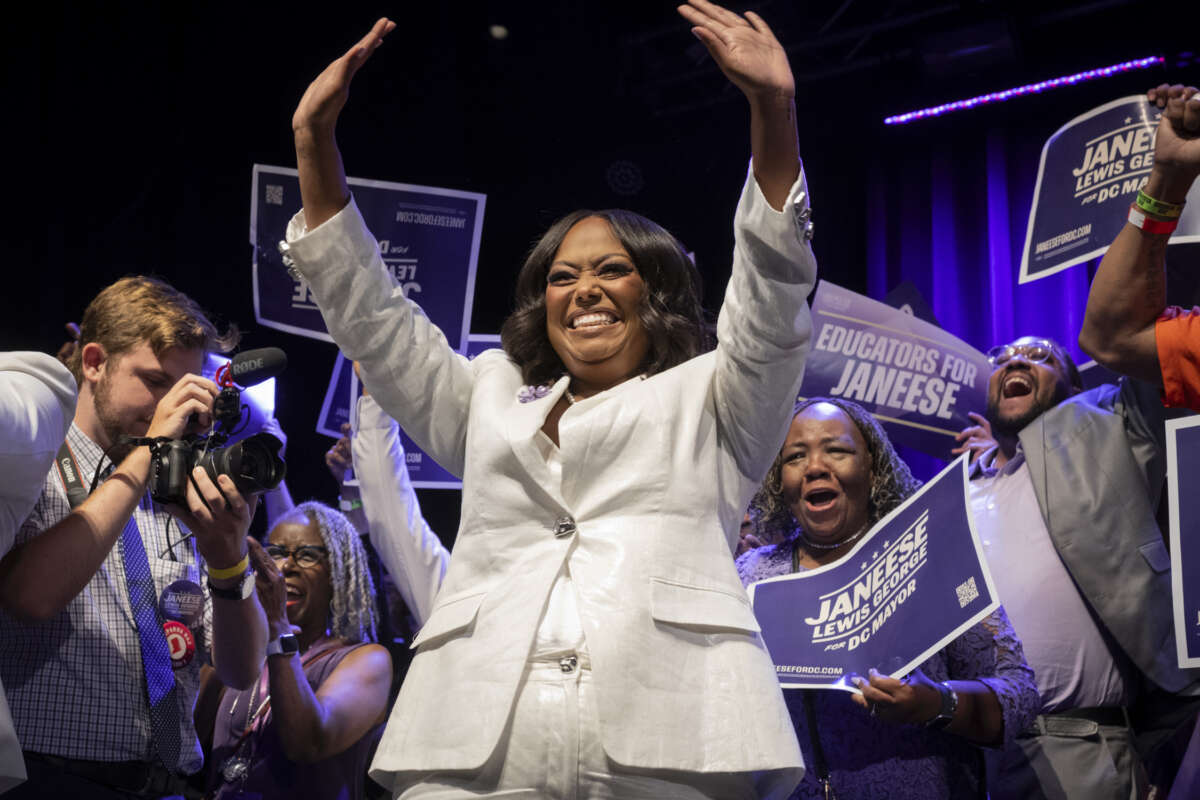
Mayoral candidate Janeese Lewis George celebrates her early lead at her election night party at the Howard Theatre on June 16, 2026, in Washington, D.C.Maxine Wallace / The Washington Post via Getty Images

On August 11, 2025, President Trump initiated a federal takeover of Washington, D.C. Nearly 11 months later, Washingtonians organized around one of the most progressive candidates in the District’s mayoral history, a democratic socialist named Janeese Lewis George.

Since August 2025, every corner of the District of Columbia has swarmed with thousands of National Guard troops, from major metro stations to residential neighborhoods. In September, thousands of residents gathered at Malcolm X Park and marched from Ward 1 all the way to the White House for the “We Are All DC” march. The event was attended by thousands and was the single largest demonstration against Trump’s takeover of D.C.

Countless bright red signs were scattered all over the marching masses, printed with the same words that the crowds were chanting: “Free DC.” This also happens to be the name of the organization that co-hosted the march, alongside labor unions and community groups. Free DC is a fiscally sponsored special project of Community Change, and according to Washingtonians, one of the biggest reasons that Lewis George won big in the Democratic primary.

“We are the only country in the world where the citizens of the capital city do not have full political protections, full legal protections,” said Alex Dodds, campaign director and co-founder of Free DC. “And we know from other countries where dictatorships have taken root, that dictators and authoritarian leaders will always seek to control the capital city, because it’s a really easy way for them to silence dissent.”

While this group was founded just a few years ago, the Free DC movement has roots in the 1960s, when Marion Berry, who would later be elected as the second mayor of Washington, D.C., mobilized students and communities to participate in acts of civil disobedience to protest the lack of representation for D.C. residents. In 1974, Washington got its very first elected mayor after Congress passed the Home Rule Act. The legislation gave power to D.C. residents in the form of day-to-day governance but still withheld representation from Washingtonians at the federal level. This lack of real representation is the power imbalance that was central to this year’s mayoral primary, according to organizers.


After the DSA’s Political Earthquake in NYC, Will the Tremors Be Felt Elsewhere?
Establishment Democrats are on the back foot after candidates backed by Democratic Socialists of America swept races. By Sam Rosenthal , Truthout  June 25, 2026


“She is a progressive Black woman who is not a status quo candidate. She is unapologetically a democratic socialist and someone who sees D.C. for exactly what it is, a city that should be a state.”

Lewis George was one of just two candidates that Free DC chose to endorse this cycle, alongside Robert White, who won his race for delegate to the U.S. House of Representatives. According to Dodds, the endorsement process involved an in-depth questionnaire, a forum, and a community voting process. After everything was tallied, Lewis George was head and shoulders above the other candidates being considered.

“Janeese’s campaign was really focused on building the power of the people together to do things very aligned with a Free D.C. … no one is coming to save us but us. And so we have to do this together,” Dodds told Truthout.

Lewis George’s platform included universal affordable child care, an issue of particular importance to Washingtonians as D.C. has the highest average child care costs in the country. Transportation was also a focus of her campaign, as she promised to make buses free for residents enrolled in SNAP food assistance programs and invest in bike lanes and the metro system. Lewis George also focused heavily on affordability, listing her intention to expand rent stabilization programs, fund affordable housing, and invest in down payment assistance programs to increase homeownership across D.C.

Lewis George’s candidacy as a democratic socialist came at a time when D.C. residents could see the effects of Trump’s takeover on every street across the city. Under the president’s orders, Washington, D.C., has become ground zero for Immigration and Customs Enforcement (ICE) raids and detentions. Just days before the election, Trump even threatened a deeper federal takeover if Lewis George is elected mayor. In response, Lewis George doubled down on her defense of her hometown.

“We are not going to get ICE off our streets by fearing this president. We are not going to protect our rights or Home Rule by obeying in advance,” Lewis George wrote in a statement. “Threatening Home Rule because you do not like how residents vote is an attack on democracy itself. The people of D.C. elect the mayor of D.C., and they want someone who will stand up to Donald Trump.”

Lewis George’s supporters say this response was one of many reasons why so many D.C. residents swung toward her platform.


The Free DC movement aims to do more than accomplish statehood — it is a response to authoritarianism and federal occupation.

“Donald Trump doesn’t get to decide who represents Washington, D.C.,” Delvone Michael told Truthout. “The voters do.”

Michael, who is a senior political strategist at the Working Families Party, another group that endorsed Lewis George, added: “I think they saw strength in her response to him. And just like any bully you stand up to, the bully will fold.”

Voters largely saw through these attacks, understanding that threats to home rule would be coming down the line no matter who won the primary; the biggest concern for many was how a leader handled those threats.

“The reality is, President Trump will do exactly what he wants to do. It doesn’t matter who is elected mayor of Washington, D.C.,” Preston Mitchum — a Black queer attorney, activist, and supporter of Lewis George — told Truthout. “I think people use that against Janeese in particular because she is a progressive Black woman who is not a status quo candidate. She is unapologetically a democratic socialist and someone who sees D.C. for exactly what it is, a city that should be a state.”

Lewis George is a D.C. council member, a third-generation Washingtonian, and a former prosecutor. On paper, her experience is not unlike that of the other leading candidate in the mayoral race, Kenyan McDuffie. McDuffie is a fourth-generation Washingtonian and, like Lewis George, is also a D.C. council member and a former prosecutor. McDuffie, however, was regularly aligned with current Mayor Muriel Bowser.

“Kenyan ran a very uninspiring campaign about what couldn’t be done,” said Michael. “We’re in a change moment, and right now the status quo is not going to be enough.”

While both candidates are former prosecutors, an issue that defines their differences is how they hoped to address public safety. One of the most heated issues this cycle was youth curfew zones and “teen takeovers.” The current mayoral administration has used emergency youth curfew zones, specific areas of the city where young people are not permitted after a certain hour, to address the mass gathering of teenagers. After a viral “teen takeover” at a Chipotle in D.C.’s Navy Yard neighborhood, McDuffie attacked Lewis George for her votes against curfew zones, labeling her soft on crime. Critics of the curfew strategy have labeled it as inherently racist, saying it targets Black young people for simply existing in public.

Lewis George has instead recommended expanded programming and job pathways for young people in the District. On another issue related to policing, while both candidates spoke in favor of defunding the police in 2020, they have also both voted to increase funding for the Metropolitan Police Department while serving on the Council of the District of Columbia. While McDuffie pledged to immediately add additional officers to the force, Lewis George ran on promises to invest in alternatives to policing while increasing police accountability.


Lewis George’s embrace of the movement against occupation was the magic that delivered her a victory by nearly 20 points.

According to voters and organizers, Free DC was the hinge that pushed Lewis George across the finish line. The vast majority of D.C. residents want statehood; that is no secret. But the Free DC movement aims to do more than accomplish statehood — it is a response to authoritarianism and federal occupation.

“Lewis George has commitments to stand up against Trump as opposed to Bowser and McDuffie’s stance of appeasement and compliance in advance,” said Kurtis Hagans, chair of the Metro D.C. Democratic Socialists of America (DSA). “We have laws on the books about the sanctuary status of the District. And we’ve been lied to by the current mayor, Mayor Bowser, about the cooperation of our police forces and our local government with ICE … Janeese Lewis George has said that she will make sure that that cooperation truly stops.”

Bowser’s administration has been criticized for its quickness to comply with the White House’s demands. In March 2025, Mayor Bowser folded to Trump’s pressure and painted over Black Lives Matter Plaza, a memorial to the racial justice protests of 2020 following the murder of George Floyd. In August 2025, Mayor Bowser praised the president for the federal takeover and its effects on crime in D.C., although recent data indicates the National Guard has had little to no effect on crime across the District.

According to a 2025 poll conducted by We Are Labor, the majority of D.C. voters rated Bowser’s performance as mayor unfavorably, 59 percent wanted a new candidate for mayor, and 72 percent disagreed with the mayor’s cooperation with Trump. Voters were looking for the change that Lewis George represented, and the defiance that she led with.

Lewis George was not the only progressive who won in D.C. this cycle. Aparna Raj, a democratic socialist and tenant organizer, won her race to represent Ward 1 on the D.C. Council. Robert White, a current council member, overwhelmingly beat a more moderate opponent in the primary for delegate to the U.S. House. D.C. shadow representative Oye Owolewa, also a democratic socialist, won the at-large council seat in a crowded field (D.C. representatives to Congress are known as “shadow representatives” because they are not granted voting power).

Organizers say these results prove that D.C. wants more people-powered movements and fewer machines that run on the status quo.

“The United States is descending at groundbreaking speed towards fascism and authoritarianism…,” said Dodds. “What works in moments like that is not lawyers. It is not legislation; it is not policy. It is not wealthy people coming in to save you. It is people power. It is mass movements.”

Free DC has been at the center of these mass movements since the takeover. Its members have done canvassing, engaged in election protection work, held community events, and organized protests attended by thousands. Lewis George’s embrace of the movement against occupation was the magic that delivered her a victory by nearly 20 points.

“Talking more about jobs and centering labor unions built the broadest coalition that I have ever seen D.C. create in the time I have been here,” said Mitchum. “It wasn’t just about the name of Free DC; it’s what Free DC and Janeese represented.

This article is licensed under Creative Commons (CC BY-NC-ND 4.0), and you are free to share and republish under the terms of the license.

Nick Fulton

Nick Fulton is a queer social movement journalist who has covered politics, protests, elections, and culture for over a dozen outlets, including Salon, Prism, Common Dreams, and Queerty. Nick is also the editor of The Fourth Estate, a publication covering the journalism industry’s fight for survival.
Op-Ed 

The Anti-Indigenous Slur in the Declaration of Independence Speaks Volumes

The US Declaration of Independence frames Indigenous resistance as aggression and colonial violence as self-defense.
July 4, 2026

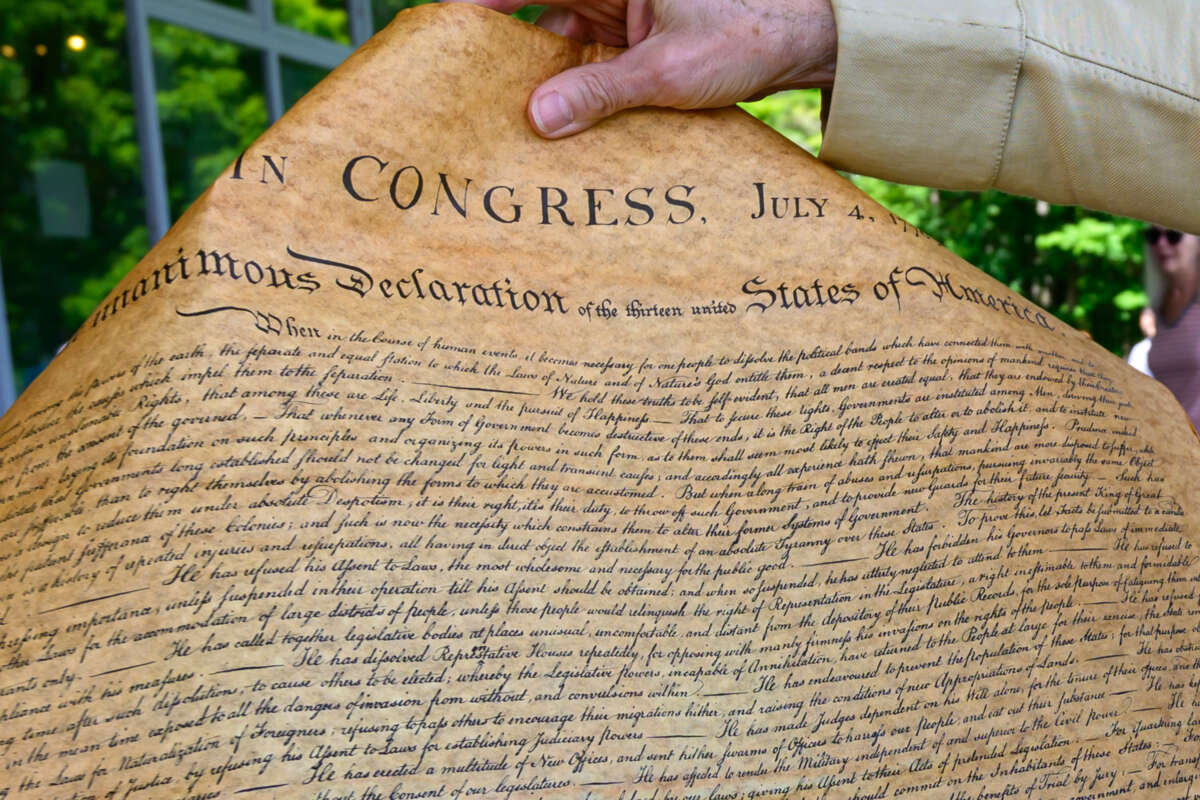
Joe Craig, a park volunteer, holds a copy of the Declaration of Independence on July 4, 2025, at the Saratoga National Historical Park in Stillwater, New York.Jim Franco / Albany Times Union via Getty Images

Every Fourth of July, the Declaration of Independence is the cornerstone of the U.S.’s celebrations. It’s read aloud in radio, television, and public celebrations. But it carries a contradiction expressed through a slur that Native people have never been able to ignore — a scathing reference to “merciless Indian Savages.” Even as the framers promised a nation of equality and liberty for all, they also made it clear that Indigenous people are not included in their notion of “all.” So, within Native communities, the yearly invocations of the Declaration Independence are also a reminder of how long we have been struggling to resist, survive, and defeat every effort to silence, erase, and eradicate us.

While most public readings of the Declaration of Independence include the full passage, others read around its anti-Indigenous slur or omit that line entirely. The omission says just as much as the words themselves. The U.S. wants the Declaration’s promises without its confession, its dreams of liberty without regard for the people it dehumanized and oppressed, and its proclamation of independence without any acknowledgment of the crimes against humanity that made it possible for the U.S. to exist.

The commemoration of this country’s founding every July 4 asks the public to celebrate a United States that begins with the myth of a nation born of nothing but courage and liberty, on lands not yet tamed or developed. Native people know another beginning. Our nations were already here, with governments, laws, languages, and infrastructure.

The United States is only the latest nation to exist on these lands. As it celebrates 250 years of “independence,” it still has not rescinded or made an effort to correct the violence and policies that followed from the framing of Native people as “merciless Indian Savages.” Instead, it has expanded the strategy of using dehumanizing language against migrants, trans people, anti-fascists, and other targeted communities in an effort to reframe their resistance as “antithetical to freedom and the American way of life.
“Merciless Indian Savages”

The phrase “merciless Indian Savages” isn’t just an unfortunate remnant of a different time; it was an intentional and strategic political move that set a precedent for anti-Native ideology and policies that persist today.

Related Stor
y
500-Year-Old Slave Revolt of 1526 Redefines Freedom as US Turns 250
Before 1776 or 1619, enslaved Africans seized freedom in 1526 on land that would become the United States. By Jesse Hagopian , Truthout May 2, 2026

Historian and member of the Yamasee Nation Donald Grinde Jr. described the phrase as political rhetoric used to justify frontier wars and the taking of Native land. The phrase collapsed hundreds of Native nations into a new enemy and stripped them of their humanity. If Natives were “merciless savages,” their resistance could be framed as aggression, and colonial violence could then be positioned as self-defense, maintaining the optics of innocence and exceptionalism as the newly formed republic looked to build its empire.

“Merciless Indian Savages.” These three words set into motion centuries of brutal anti-Native policy from the Indian Removal Act of 1830 to the Dawes Act to the reservation and boarding school systems — every policy carrying the weight of those three words into every new era.

How the Phrase Impacts Natives Today


The intent and danger of the phrase “merciless Indian Savages” is alive and well. It’s threaded through our contemporary realities every time the federal government treats Native people, land, water, and treaty rights as acceptable casualties of profit and so-called progress.

Donald Trump’s first administration made that painfully clear almost immediately. In January 2017, he issued a memorandum to expedite the controversial Dakota Access Pipeline, despite the massive Native-led protest at Standing Rock, in which Water Protectors were subjected to military-style counterterrorism tactics and compared to terrorists. That same year, he revived theKeystone XL Pipeline that had already met with years of organized resistance from Tribal Nations, environmental organizations, and local ranchers and farmers, who were labeled extremists for efforts ostensibly impeding U.S. jobs and energy independence. By December 2017, his administration had moved against Bears Ears National Monument, cutting it by roughly 85 percent and weakening protections for a landscape that Tribal Nations had spent years fighting to protect.

In a commencement speech to the U.S. Naval Academy’s class of 2018, Trump praised settlers who “tamed a continent” and declared that: “We will not apologize for America.” His words appeared to do the same work as the phrase “merciless Indian Savages.” They dehumanize us, making Native people and lands sound wild and dangerous, while settlers are remembered as courageous. His administration carried that attitude into policy when the Interior Department moved to revoke the Mashpee Wampanoag Tribe’s land-in-trust status, pushed oil and gas leasing near Chaco Canyon in New Mexico, and treated treaty rights and federal trust responsibilities as barriers to development. In 2020, border wall construction near the Tohono O’odham Nation and Organ Pipe Cactus National Monument caused lasting environmental and cultural damage. During the COVID-19 crisis, tribes were left fighting each other over access to the $8 billion CARES Act tribal relief fund and then having to sue the government for the funds to be released, while the Native American Health Center reported receiving body bags instead of the personal protective equipment (like masks and gloves) it had ordered.

Trump’s second term has taken it a step further, increasing the danger to Native communities. Federal freezes and proposed cuts have threatened programs tied to treaty and trust obligations, including health care, education, housing, public safety, and social services. Reporting on Trump’s fiscal 2026 budget exposed proposed cuts of more than $700 million from Bureau of Indian Affairs programs and $239 million from tribal housing programs. His administration’s attack on birthright citizenship dragged Native citizenship back into public debate, forcing Native legal advocates to remind the country that Native people born in the United States are U.S. citizens and that tribal citizenship cannot be erased by federal political panic. Immigration raids have also raised alarms in Native communities, where Native citizens have reportedly been questioned, detained, or targeted because agents racially profiled them due to appearance, language, or proximity to the border. The legacy behind the three-word slur in the Declaration of Independence has not changed since 1776, and Trump’s administration has taken them to heart in its glorification of Manifest Destiny.

Ahead of the semiquincentennial, Trump leaned into the revival of national mythmaking and exceptionalism. In May, the White House released a statement celebrating the 222nd anniversary of the Lewis and Clark Expedition, praising it for fulfilling Manifest Destiny and carrying “prosperity” across the continent.

The Lewis and Clark story is personal for me. My people, the Otoe-Missouria, were the first Native people to hold council with Meriwether Lewis and William Clark. On August 3, 1804, near present-day Fort Calhoun, Nebraska, tribal leaders met the expedition at what became known as Council Bluffs. The official story treats that meeting as a diplomatic milestone. Lewis and Clark arrived in full military display, made some speeches and promises, gave some gifts, and showcased the technologies of the time: an air gun, a magnet, a spyglass, a compass, and a watch. But despite the pomp and circumstance, they didn’t really accomplish much beyond establishing a routine for future councils on the expedition.

For my people, the U.S.’s westward story does not begin with wonder nor does it end with conquest, the way the U.S. would like the world to believe. We are not a conquered people. We’re still here and still resisting the narratives and violence that have followed those three words from 1776 to our present day.

Who Have the “Merciless” and “Savage” Ones Been?

The semiquincentennial celebrations urge us to turn westward expansion into a patriotic stage set, but Native people know what gets left outside the frame: truth. Before the celebration moves on from the Declaration of Independence to the fireworks, the U.S. needs to acknowledge the gravity of the words the founding fathers chose for us — “Merciless Indian Savages” — and to recognize the brutality of colonialism.

When we look at history, who have the actual cruel ones been? Who was “merciless” and “savage” when Native communities were massacred? When treaties were signed and broken? When children were taken to residential boarding schools, and when their graves were found on those same school grounds? When sacred sites were destroyed, and pipelines were forced through our lands?

Who is “merciless” and “savage” now, as immigration raids tear through communities and as families live under the threat of detention, disappearance, and deportation? Who is acting with cruelty when federal troops are sent into cities in response to protests against immigration enforcement? When the genocide in Gaza is streamed in real time and the lives of Palestinians are treated as negotiable?

Who is “merciless” and “savage” when disabled people are threatened by policies that force institutionalization and punish people for needing support? When the trans community is targeted by executive orders, health care restrictions, school policies, prison restrictions, and public campaigns built to erase trans people from law and daily life? When women and pregnant people are forced to fight for bodily autonomy while reproductive health care is attacked across the country?

The words “merciless Indian Savages” taught the U.S. how to turn targeted people into threats. The authors of the Declaration of Independence called us “merciless Indian Savages” because they needed a justification for the violence and death upon which the U.S. was founded, for the violence and death that would continue to structure this nation. After 250 years, the phrase still carries the weight of that violence. This country needs to answer one question before asking anyone to celebrate: Is this legacy of violence really what we want to continue building on and celebrating for the next 250 years?


This article is licensed under Creative Commons (CC BY-NC-ND 4.0), and you are free to share and republish under the terms of the license.


Johnnie Jae

Johnnie Jae (Otoe-Missouria and Choctaw) is a writer, speaker, and founder of Red POP! News and the late A Tribe Called Geek. Known for her journalism, mental health advocacy, and digital activism, she is dedicated to amplifying Native voices through storytelling, media, and art. You can find her in the Bluesky and Instagram.


Op-Ed

Trump’s UFC Cage Fight Is an Apt Metaphor for a Nation Built on Colonial Violence

The White House’s Freedom 250 spectacle grotesquely exposed the settler-colonial legacy of 1776.

July 2, 2026

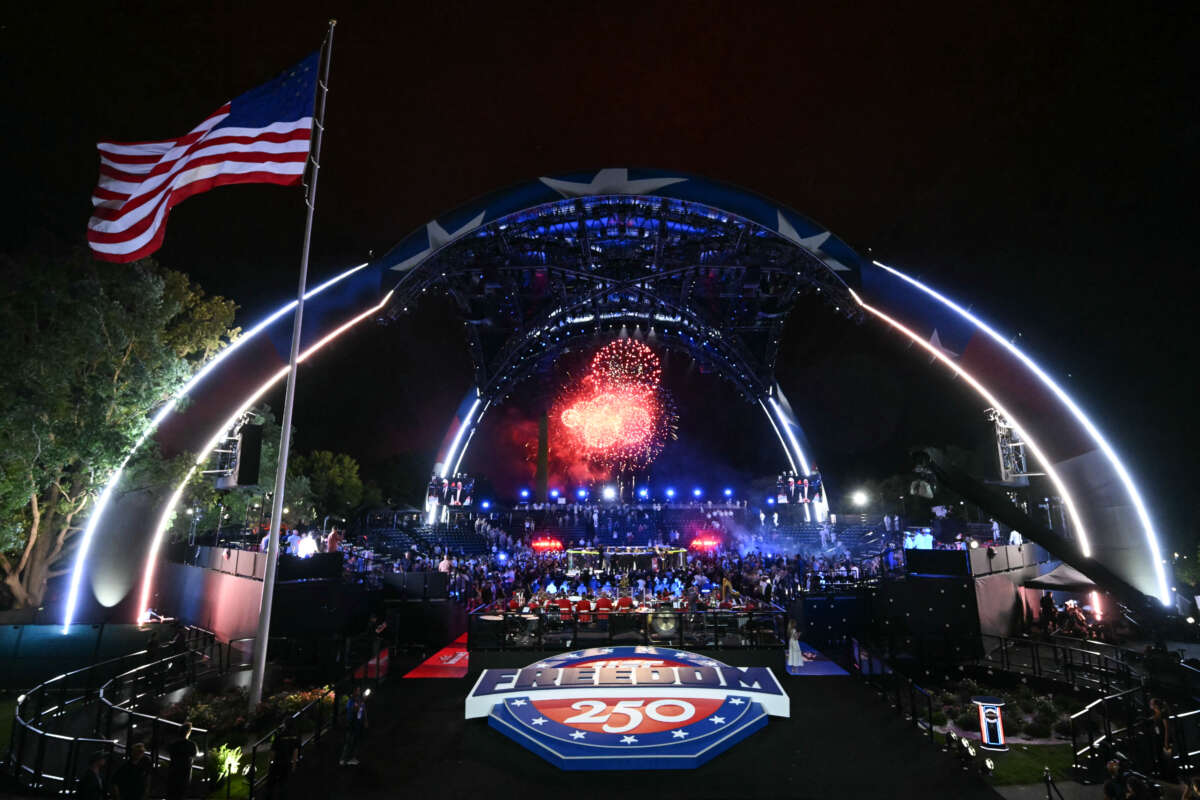
Fireworks go off during "UFC Freedom 250" mixed martial arts event on the South Lawn of the White House on June 15, 2026, in Washington, D.C.Saul Loeb - Pool / Getty Images


“On July 4th, 1776 … the United States became the greatest force for freedom, justice, equality, and prosperity in the history of the world,” President Donald Trump declared in a promotional video for the Freedom 250 campaign, the administration’s flagship initiative commemorating the U.S.’s semiquincentennial. Among the centerpiece events planned for the nation’s 250th birthday celebration was an Ultimate Fighting Championship (UFC) cage fight on the grounds of the White House.

The June 14 event, which occurred on Trump’s birthday and Flag Day, delivered exactly what he promised: a pageant of power, violence, and nationalism staged at the seat of U.S. power. Thousands gathered around an octagonal cage erected on the White House grounds; cabinet secretaries mingled with senators, tech billionaires with celebrity athletes, media personalities with corporate sponsors, all beneath military flyovers and pyrotechnic displays. Under the lights, fighters bloodied one another as the crowd roared its approval.

Liberals found the event crass. Sen. Patty Murray called it “out of touch.” New York Times opinion columnist Michelle Goldberg wrote, “On the 250th anniversary of our country’s founding, America’s increasingly senescent president turned the White House lawn into a tacky, bloody gladiatorial arena.” Meanwhile, CNN quoted one historian who asked, “What does a UFC fight have to do with America’s greatness?”

The historian’s question assumes that the values represented by the spectacle — domination, hierarchy, and the glorification of power — are fundamentally at odds with the ideals of the founding of the United States. But what if the contradiction lies not between the cage match and the American Revolution, but between the history that people in the U.S. are taught and the history that actually unfolded? To answer that question, it helps to begin with an observation from Martinican poet and anti-colonial theorist Aimé Césaire: “No one colonizes innocently.”

By fusing combat, militarism, celebrity culture, and nationalism into a single public performance, the White House cage match endeavored to cast repression, xenophobia, and extreme inequality not as threats to freedom but as expressions of national strength.

Americans are taught that their nation was born in the cradle of liberty. But Césaire’s insight requires us to confront a more disquieting truth: The U.S. republic emerged from another womb altogether — the smoke of burning villages, the holds of slave ships, and the ambitions of a colonial elite willing to unleash unspeakable violence in pursuit of wealth and power. Indeed, what better way to party like it’s 1776 than with a spectacle of combat staged at the center of U.S. empire?

The cage fight, surrounded by representatives of every branch of the armed forces, was part of Trump’s effort to cultivate a cult of personality. Writing under Nazi rule, cultural theorist Walter Benjamin described fascism as the “aestheticization of politics” — the transformation of political life into spectacle in order to generate emotional attachment to authority. By fusing combat, militarism, celebrity culture, and nationalism into a single public performance, the White House cage match endeavored to cast repression, xenophobia, and extreme inequality not as threats to freedom but as expressions of national strength.

As the United States approaches its 250th anniversary, the country faces rising authoritarianism, ongoing state violence against Black communities, a worsening affordability crisis, widening wars, climate catastrophe, attacks on immigrants and LGBTQ+ people, and an escalating siege on critical education. We can no longer afford to leave the meaning of 1776 to Donald Trump, establishment Democratic Party politicians, billionaire-funded media outlets, or the sanitized narratives found in many textbooks. Only by confronting the republic’s colonial foundations — and recovering the traditions of freedom forged by those who resisted them — can we pursue a different future.


National Innocence or Colonial Brutality?


Trump’s over-the-top jingoism obscures a deeper truth: The refusal to reckon with the United States as a settler-colonial project is a bipartisan affliction. As President Barack Obama declared: “The patriots of 1776 did not fight to replace the tyranny of a king with the privileges of a few or the rule of a mob. They gave to us a republic, a government of, and by, and for the people, entrusting each generation to keep safe our founding creed.” President Joe Biden similarly argued, “Deep in the heart of America burns a flame lit almost 250 years ago — of liberty, freedom, and equality.” Trump did not invent the founding fairytale of innocence; he inherited and radicalized this bedtime story that has from the beginning called the United States the “fairest of them all” to obscure its colonial origins.

The U.S. republic emerged from the smoke of burning villages, the holds of slave ships, and the ambitions of a colonial elite willing to unleash unspeakable violence in pursuit of wealth and power.

It’s clear Trump has exploited the bipartisan faith in American exceptionalism to suppress dissent and concentrate executive power. Yet his authoritarianism is less an aberration than the latest expression of a recurring pattern. From slavery and Indigenous dispossession to Jim Crow, Japanese American incarceration during World War II, McCarthyism, COINTELPRO, and NSPM-7 today, authoritarianism has repeatedly resurfaced. Its roots lie in the colonial foundations of the republic, where conquest, racial hierarchy, and state violence became enduring instruments of governance. The 20th century’s most infamous authoritarian movements did not emerge from nowhere. They drew upon centuries of colonial practice. For example, Adolf Hitler openly admired the United States’ genocide of Indigenous peoples. In a 1928 speech, he praised white American settlers for having “gunned down” millions of Indigenous people until only a “few hundred thousand” remained. As James Q. Whitman, author Hitler’s American Model, notes, “Beyond its laws, the Nazis also admired America’s conquest of the West.” Nazi leaders viewed the United States’ seizure of Indigenous lands and westward expansion as precedents for their own project of Lebensraum (“living space”) — the conquest and ethnic cleansing of Eastern Europe.

The Nazi fascination with the U.S. frontier was rooted in a historical reality that many accounts of 1776 still minimize. As historian Nick Estes, a citizen of the Lower Brule Sioux Tribe, writes, the Haudenosaunee remember George Washington as the “town destroyer” for ordering the destruction of dozens of Haudenosaunee towns during the Revolutionary War. “In a very real sense,” Estes concludes, “the founding of the United States was a declaration of war against Indigenous peoples.” One of the principal grievances driving many advocates of independence was the British Crown’s attempt to restrict westward expansion after the Seven Years’ War. The Declaration of Independence itself denounced Indigenous peoples as “merciless Indian Savages,” revealing that Native nations were viewed as obstacles to colonial expansion rather than sovereign peoples. Independence swept aside those restraints and accelerated a centuries-long project of dispossession, forced removal, and genocide.

For anti-colonial thinkers such as Aimé Césaire, W. E. B. Du Bois, and Walter Rodney, fascism was not a departure from colonialism but one of its logical destinations. As historian Robin D. G. Kelley argues in his introduction to Césaire’s Discourse on Colonialism, one of the book’s most important contributions was its effort to “locate the origins of fascism within colonialism itself.” Kelley and the anti-colonialists he draws on have shown that white supremacy, dispossession, dehumanization, and state violence did not begin with fascism. Those methods had long been refined through colonial conquest, empire, and racial domination before they were turned inward against Europe itself.


Only by confronting the republic’s colonial foundations — and recovering the traditions of freedom forged by those who resisted them — can we pursue a different future.

Most people in the U.S. have been taught to view 1776 as the starting point for understanding the origins of freedom. But the choices confronting enslaved people during the American Revolution reveal the limits of the “patriot” vision. In 1772, Lord Mansfield ruled in favor of James Somerset, an enslaved African who resisted being returned from England to slavery in Jamaica, alarming colonial slaveholders who feared Britain might eventually restrict slavery. Those fears intensified in 1775 when Lord Dunmore, Virginia’s royal governor, offered freedom to enslaved people owned by rebel colonists if they escaped and joined the British side. Thousands fled to British lines. So threatening was the prospect of enslaved people claiming freedom that the Declaration of Independence condemned George III for having “excited domestic insurrections amongst us” — a phrase widely understood as a reference to Dunmore’s proclamation. For many colonial elites, one of the gravest dangers posed by British rule was that it might undermine slavery itself.

The American Revolution looked very different from the tobacco and cotton fields than it did from the plantation house or Independence Hall. Take the question Frederick Douglass asked in his famous speech, “What to the Slave Is the Fourth of July?” and consider his conclusion:

This Fourth of July is yours, not mine. You may rejoice, I must mourn. To drag a man in fetters into the grand illuminated temple of liberty, and call upon him to join you in joyous anthems, [is] inhuman mockery and sacrilegious irony.

More than a century later, the Black revolutionary and anti-colonial thinker Malcolm X advanced a similar critique, urging Black people to reject the assumption that their freedom originated with the American founding:

We are Africans, and we happen to be in America. We are not Americans. We are a people who formerly were Africans who were kidnapped and brought to America. Our forefathers weren’t the Pilgrims. We didn’t land on Plymouth Rock; the rock landed on us. We were brought here against our will … We were not brought here to enjoy the constitutional gifts that they speak so beautifully about today.

Malcolm X’s challenge forces us to confront the reality that the American Revolution was shaped by conquest, slavery, and elite rule. Once we abandon the assumption that 1776 represents the highest expression of freedom, another revolution comes into view — one that pushed the ideals of liberty and equality far beyond anything the U.S. founders were willing to imagine.


Fear of a Black Republic


To understand the limits of the American Revolution, we need only compare it to the Haitian Revolution, which erupted shortly thereafter in the same Atlantic world. The Haitian Revolution breached the walls U.S. and European empires had erected around the idea that freedom was the sole property of white people, and rescued the idea of emancipation as the natural human condition.

Beginning in 1791, enslaved people in the French colony of Saint-Domingue revolted against one of the most brutal slave systems in the world. Under the leadership of figures such as Toussaint Louverture and Jean-Jacques Dessalines, they defeated French, Spanish, and British armies and, in 1804, established Haiti — the first Black republic and the only nation ever created through a successful slave revolution.


At a moment when the United States restricted citizenship and political power along racial lines, Haiti offered a strikingly different vision — one in which solidarity with the struggle against slavery and colonialism mattered more than ancestry or skin color.

The contrast with the United States is striking. Haiti’s 1805 Constitution declared that “Slavery is forever abolished” and that “all acception of color” was “necessarily to cease,” while the U.S. Constitution protected slavery and racism through the Three-Fifths Clause and the Fugitive Slave Clause. Haiti’s commitment to freedom was not limited to people of African descent. After independence, Haitian leaders granted citizenship and full rights to many Polish soldiers who had defected from Napoleon’s army and joined the revolutionary cause. At a moment when the United States restricted citizenship and political power along racial lines, Haiti offered a strikingly different vision — one in which solidarity with the struggle against slavery and colonialism mattered more than ancestry or skin color.

Yet Haitian revolutionaries also understood that freedom’s greatest enemies often masqueraded as its guileless defenders.

Toussaint Louverture, the brilliant Haitian general who led the revolution, understood that systems of domination rarely announce themselves as such and prefer to hide behind a mask of innocence. Writing in 1799, Louverture warned of “the unity that exists between the proprietors of St.-Domingue who are in France, those in the United States, and those who serve under the English banner.” These slaveholding interests from powerful nations, he argued, were united behind an “unequivocal and carefully constructed” plan for “the restoration of slavery.” Yet they did not openly proclaim themselves enemies of freedom. Instead, he observed, they sought to “envelop themselves in the mantle of liberty in order to strike it more deadly blows.”

As historian Leslie M. Alexander explains in her book, Fear of a Black Republic, Haitian independence “transformed global conceptions of freedom and challenged existing assumptions about who possessed human rights and who did not.” The revolution exposed the lie that slavery was natural or permanent and proved that enslaved people could overthrow their oppressors and govern themselves.

The panic was immediate among enslavers and the leaders of the new United States. As historian Brian Jones notes in his book, Black History Is For Everyone, over a nearly two-year period from 1791 to 1793, U.S. officials sent approximately $726,000 to Saint-Domingue to support enslavers attempting to crush the uprising.

As the uprising spread across Saint-Domingue in 1791, President George Washington declared, “Lamentable! To see such a spirit of revolt among the Blacks.” Alexander Hamilton described the Haitian Revolution as a “calamitous event.” In 1793, Thomas Jefferson — the author of the July 4, 1776, Declaration of Independence — feared that the Haitian Revolution threatened the entire slave system of the Americas, worrying that “all the West India Islands will remain in the hands of the people of colour” and that slaveholders south of the Potomac might one day have to “wade through” similarly “bloody scenes.” Fearing that the rebellion would inspire enslaved people in the United States, Jefferson warned that unless slaveholders and the U.S. government acted quickly to contain its influence, they would bring ruin upon themselves: “If something is not done, and done soon, we shall be the murderers of our own children.”

By 1802, Jefferson expressed the great fears of freedom-loving enslavers everywhere when he said that Haiti had already “given considerable impulse to the minds of the slaves” and that “a great disposition to insurgency has manifested itself among them.”

The hostility was not merely rhetorical. After becoming president, Jefferson imposed an economically devastating embargo on Haiti, and the United States refused to formally recognize Haitian independence until 1862. Haiti’s greatest crime, in the eyes of enslavers, was that it cracked open history and revealed another future waiting inside — a future in which Black people not only won their freedom but established their own sovereign nation.

This history undermines one of the most common defenses of the founders: that they were merely people of their time. The Haitian Revolution demonstrates that the brutality of slavery was not beyond the moral imagination of the 18th century. Enslaved people, abolitionists, Maroons, and Indigenous resisters understood it well. Haiti proved that a republic could be built on abolition rather than slavery. The question was never whether a broader vision of freedom was possible, but whether those who benefited from oppression would surrender power.

The fact of the Haitian Revolution also demolishes the claim that the United States led the world toward abolition. As PragerU — the far right propaganda organization that produces videos for children — asserts, “America was one of the first places on earth to outlaw slavery.” Or as one of their flagrantly inaccurate videos proclaimed, “White people were the first to formally put an end to slavery … white men led the world in putting an end to the abhorrent practice.”


If the next 250 years are to bring us closer to freedom than the last, we must reject the colonial lie that the founding of the United States marked the fulfillment of freedom.

The truth is the United States maintained slavery longer than every independent nation in the Americas except Brazil and Paraguay (with the Spanish colonies of Cuba and Puerto Rico abolishing slavery later as well). Black Haitians abolished slavery in 1804 — long before Britain, France, or the United States — and helped spread emancipation throughout the Americas, including through its support for Simón Bolívar’s anti-colonial struggles. It took the bloodiest war in U.S. history to finally destroy the institution of slavery in 1865 because so much of the nation’s political and economic system was built upon it.

The history of emancipation in the Americas reveals that the most expansive visions of freedom emerged not from white men with silver shoe buckles and powdered wigs, but from barefoot Black revolutionaries with natural curls and the scars from leg irons. At stake in our interpretation of the American Revolution is more than the reputation of the founders; it is the kind of society we believe is possible and the future we are struggling to create.

The Fight for the Next 250


If the next 250 years are to bring us closer to freedom than the last, we must reject the colonial lie that the founding of the United States marked the fulfillment of freedom. Yet rejecting that lie does not mean denying its significance.

The American Revolution did help demonstrate that kings could be overthrown and challenged hereditary rule. Its language of liberty was seized upon by women, laborers, abolitionists, and democratic radicals who insisted that freedom meant far more than independence from Britain. Take formerly enslaved Boston abolitionist Prince Hall, who seized upon the American Revolution’s own language to demand the abolition of slavery. In a 1777 petition to the Massachusetts legislature, Hall and seven other free Black men insisted that enslaved people possessed “a natural and unalienable right to that freedom” bestowed “equally on all mankind.” Thomas Paine was another such radical. His bestselling pamphlet Common Sense helped ignite the American Revolution, while his 1775 essay “African Slavery in America” denounced slavery as “an outrage against humanity” and called for its abolition. As Hall and Paine demonstrate, the American Revolution raised expectations for freedom that many of its most powerful leaders worked just as fiercely to keep from becoming universal.

To decolonize our understanding of 1776, however, is not simply to recover missing voices to the story of the American Revolution. It is to recognize that the most expansive traditions of freedom were not the product of a colonial elite, but instead lived in Indigenous resistance to conquest, in slave rebellions, in the Haitian Revolution, in abolitionism, in Reconstruction, and in the many social movements for collective liberation.

It is no accident that these traditions are being targeted today. Voting rights are under attack. State violence continues to be inflicted on Black communities. The United States continues to occupy Native land and refuses to honor treaties it signed with Indigenous nations. Educational gag orders and book bans seek to prevent people from learning about racism, colonialism, and inequality. As the United States celebrates its 250th birthday, it also celebrates an economic order that has produced both 44 million people living in poverty and, however briefly, the world’s first trillionaire, Elon Musk — whose fortune has been propelled in part by his investments in SpaceX, a company dedicated to colonizing Mars.


Once we understand that some of the deepest roots of authoritarianism lie within the colonial foundations of the republic itself, we can better grasp the scale of the transformation necessary to achieve genuine freedom.

Perhaps the deepest legacy of colonialism is not only the conquest of land, but also the conquest of political imagination itself. Two hundred and fifty years after 1776, we are still taught that the highest expression of freedom is expansion — ever more power, ever more wealth, ever more conquest. The colonial imagination of the U.S. elite can conceive of colonies on Mars more readily than justice on Earth. We are asked to believe that colonizing another planet is a realistic and noble ambition while guaranteeing housing, health care, education, and dignity for every person is dismissed as utopian fantasy.

More than 70 years ago, Aimé Césaire warned that “a civilization that chooses to close its eyes to its most crucial problems is a stricken civilization.” His warning remains our own. Once we understand that some of the deepest roots of authoritarianism lie within the colonial foundations of the republic itself, we can better grasp the scale of the transformation necessary to achieve genuine freedom. Decolonizing 1776 therefore requires more than rethinking the past; it requires reclaiming our capacity to imagine a different future that can guide the struggle for the next 250 years.

As Louverture declared during the Haitian Revolution: “I want Liberty and Equality to reign … I work to bring them into existence. Unite yourselves to us, brothers, and fight with us for the same cause.”

This article is licensed under Creative Commons (CC BY-NC-ND 4.0), and you are free to share and republish under the terms of the license.


Jesse Hagopian

Jesse Hagopian is a Seattle educator, the director of the Zinn Education Project’s Teaching for Black Lives Campaign, an editor for Rethinking Schools, and the author of the book, Teach Truth: The Struggle for Antiracist Education. You can follow him at IAmAnEducator.com, Instagram, Bluesky or Substack.


Interview

Frederick Douglass’s Words Are More Relevant Than Ever on US’s 250th Birthday


In his powerful speech, “What, to the American slave, is your 4th of July?” Douglass spoke truth to power.

July 2, 2026
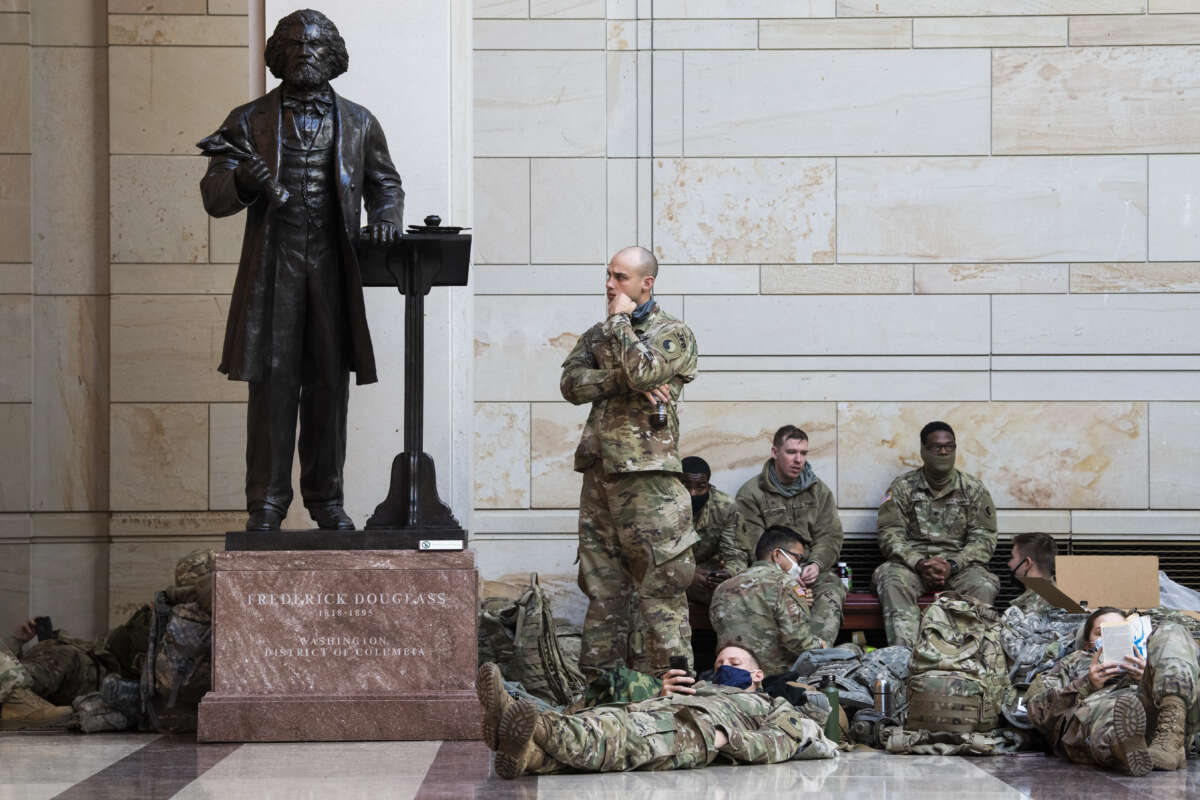
Members of the National Guard are seen near a statue of Frederick Douglass in the Capitol Visitor Center as the House debates an article of impeachment against President Donald Trump on January 13, 2021, in Washington, D.C.Tom Williams / CQ-Roll Call, Inc via Getty Images

Narratives of American “greatness” abound surrounding July 4, but by whom and for whom are they created?

As we observe the U.S.’s 250th birthday, I am reminded of the words of James Baldwin, who wrote that, in the true pursuit of justice, one does not lend an ear to those who are invested in maintaining power, but instead, “one goes to the unprotected — those, precisely, who need the law’s protection most! — and listens to their testimony.”

If we heed Baldwin’s call to listen to the testimonies of those who are unprotected by the law (or dehumanized precisely by the law), it leads us back to the powerful indictment of the U.S. that Frederick Douglass gave on July 5, 1852, when he asked: “What, to the American slave, is your 4th of July?

Douglass was unafraid to tell the truth about the hypocrisy inherent in the U.S.’s continued deep investment in the brutal enslavement of Black people. Douglass wrote:

The rich inheritance of justice, liberty, prosperity and independence, bequeathed by your fathers, is shared by you, not by me. The sunlight that brought life and healing to you, has brought stripes and death to me. This Fourth July is yours, not mine. You may rejoice, I must mourn. To drag a man in fetters into the grand illuminated temple of liberty, and call upon him to join you in joyous anthems, were inhuman mockery and sacrilegious irony.


Despite the State’s Attempts to Stamp Out Opposition, Our Movements Persevere
Echoes of anti-slavery and civil rights struggles reverberate through the current uprising against ICE. By Austin C. McCoy , Truthout June 19, 2026


On this July 4, I will personally continue to confront the truth that Black people in this country continue to mourn, continue to suffer under anti-Blackness, and continue to experience and resist deep forms of abjection, political threats, and the realities of anti-democratic practices. There is nothing defeatist in facing this reality — the objective is Baldwinian: to refuse illusions, to face human suffering, to tarry with the U.S.’s (largely white) narrative of “justice.” As the country celebrates 250 years of independence, I want to keep Douglass’s courage alive — his refusal to participate in empty political discourse and national pageantry.

To better understand the contemporary implications of Douglass’s powerful critique, I turned to philosopher Tim Golden, who is visiting professor of philosophy at Whitman College in Walla Walla, Washington. He is the editor of Racism and Resistance: Essays on Derrick Bell’s Racial Realism, and his most recent book is entitled, Frederick Douglass and the Philosophy of Religion: An Interpretation of Narrative, Art, and the Political. The interview that follows has been lightly edited for clarity and length.

George Yancy: Could you talk about Douglass’s emphasis on “the slave’s point of view” within the context of the cold existential reality of Black brutality under American slavery?

Tim Golden: When James Baldwin declares the importance of beginning with the testimony of the oppressed, he is working in the long tradition of Black political activism that dates back at least as far as Douglass, and even further. Indeed, the tradition of “the slave’s point of view,” as you put it, is present in the 18th century in the work of Phillis Wheatley, Olaudah Equiano, Jupiter Hammon, and Benjamin Banneker. This tradition continued into the 19th century in the activism of Maria Stewart, Henry Highland Garnet, and, of course, Douglass.

Douglass’s use of “the slave’s point of view” is powerful as it demonstrates the slave’s humanity while destabilizing the white gaze. To demonstrate the former is to destroy the latter, as slavery and humanity are conceptually inconsistent with one another. This conceptual inconsistency means that Black humanity produces a reality that the white gaze cannot comprehend, thus causing the white gaze to turn to a mythology of whiteness as the exclusive site of humanity to maintain its conceptual and ontological coherence. The quoted language from Douglass’s Fourth of July speech in your question refers to Douglass having a “soul,” and being concerned about the nation’s “character and conduct.” Such references indicate a Black humanity inconsistent with the white gaze. Thus, in order to sustain its pseudo-ontology, whiteness turns to a specious but powerful mythology. Indeed, such metaphysical and moral concerns of a Black mind cannot be those of chattel but rather can only be those of a human being. Douglass’s use of “the slave’s point of view” is akin to what Friedrich Nietzsche calls philosophizing “with a hammer.” One side of the hammer (the mallet) builds and the other side of the hammer (the claw) tears down. Such is the work of Douglass from the slave’s point of view: It establishes Black humanity and razes the world of the white gaze, which must then turn to mythology. It is that mythology that the Black body grapples with today.

Understanding how human beings suffer under conditions of racial terror and oppression, Frantz Fanon writes, “I want my voice to be harsh, I don’t want it to be beautiful, I don’t want it to be pure.” Speaking without equivocation, Douglass is also clear, where he writes, “I will use the severest language I can command; and yet not one word shall escape me that any man, whose judgment is not blinded by prejudice, or who is not at heart a slaveholder, shall not confess to be right and just.” Given our contemporary moment in which political dissent and critical discourse against U.S. hypocrisy is framed by many in the “highest offices” of the land as “anti-Americanism,” please explain the importance of using our “severest language” when it comes to speaking truth to power, especially given what is at stake for Black people 250 years after independence.

Using the “severest language” demands some nuance, I think. To be sure, we can think of “severest” in terms of how the language itself sounds. We see this in Black art. For example, this is found in the profanity and harsh language of hip hop and Black poetry and literature. Such language is powerful, but it comes with a profound risk: being tuned out by respectability politics. With a simple invocation of a superficial morality that confuses the effect for the cause, many who most desperately need to hear the hard speech simply do not listen to it and feel justified in ignoring it because of its delivery. Why do I say “confuses effect for the cause”? It is because the profanity complained about that inhabits Black art is not as profane as the conditions that caused the profane expression in the first place. Hence, there is a critique of rap lyrics which advocate criminal, even homicidal behavior without any critique of the systemic racism, unemployment, educational deficits, etc., that lead to perpetual police surveillance and mass incarceration in Black communities. Understood in this way, then, “severest language” comes with a risk and potential of remaining unheard because whiteness is easily masked by superficial moral “outrage” that itself is immoral.


Douglass would say to today’s white Christian nationalism what he said in 1852: Stop hiding behind abstract philosophical debate and start accepting responsibility!

Another way of understanding “severest language” is in terms of its effects rather than its delivery. While the latter runs the risk of deepening alienation, the former, often delivered ironically and thus indirectly, is no less harsh in its intended results, but can be much more effective. Here I am thinking of Douglass’s use of irony in his Fourth of July speech. There, he begins the speech in self-deprecation, claiming that he has “little experience” in public speaking, which is plainly false, as by the time of the 1852 speech, Douglass had years of public speaking experience. Douglass is not trying to be dishonest, rather he is concealing himself in rhetorical irony. Through “self-humiliation,” Douglass disarms his audience, leaving them in a disposition of pity and empathy toward him. It is this irony that the occasion of America’s anniversary demands. Douglass says, “At a time like this, scorching irony, not convincing argument, is needed. O! had I the ability, and could I reach the nation’s ear, I would, to-day, pour out a fiery stream of biting ridicule, blasting reproach, withering sarcasm … The feeling of the nation must be quickened.” Douglass quickened national feeling through the “severest language” he could muster, albeit indirectly, through a rhetorical disarming of his audience that aligned Douglass’s words with the demands of the occasion.

As a philosopher and legal theorist, identify what you see as some of the major contradictions in this country when it comes to the U.S.’s professed ideals and its treatment of Black people. Black people continue to suffer because of the gap between such professed ideals and the hell that they catch because of a country that continues to see them as second-class citizens — indeed, as sub-persons. Do you think that the fury that informed Douglass’s speech back in 1852 remains applicable as the U.S. celebrates 250 years of independence?

Yes. The fury Douglass delivered after his rhetorical self-concealment and repositioning of whites from authority to empathy is badly needed today. The source for this must be through Black forms of speech and Black works of art. Malcolm X once criticized the Black community for having athletes and entertainers as civil rights spokespersons or leaders. Although I often agree with Malcolm X on many points and even understand to an extent his point here, it is nevertheless important to appreciate the role of Black art in the Black community’s liberation struggle. What cannot be said in political debate can often be said in elegy, as with Billie Holiday’s “Strange Fruit,” which is as profoundly moral and political as it is aesthetic. The song’s condemnation of the moral, spiritual, and political abomination of lynching is an act of leadership, not merely entertainment and aesthetics.

We are two Black philosophers informed by and shaped by the radical love embodied within Christianity. Yet, there are those within this country who wield Christianity as an ideological weapon in support of xenophobia, white nationalism, fanaticism, and hatred. Douglass’s critique of Christian hypocrisy under American slavery remains relevant and powerful. Speaking of those white Christian churches and white Christian devotees, he writes, “They strip the love of God of its beauty, and leave the throne of religion a huge, horrible, repulsive form. It is a religion for oppressors, tyrants, man-stealers, and thugs.” For me, Pete Hegseth and other Christians who have religiously bought into MAGA have also stripped the love of God of its beauty. What is Hegseth but a military thug? Please speak to the continuing relevance of Douglass’s insights into the ways in which Christianity is weaponized at this moment.

Cornel West brilliantly captures the distinction between these two sorts of Christianity in his book, Democracy Matters. There, he distinguishes between “prophetic Christianity” and “Constantinian Christianity.” I think that you and I are part of the Black prophetic tradition of Christianity that speaks truth to power. The Constantinian brand of Christianity protects power from truth. West would argue that the Pete Hegseths of the world, like Constantine, appropriate the Gospel of Jesus Christ for political and military conquest, treating Christianity as a means to the end of consolidating and preserving their political influence. Douglass’s critique of Christianity is a critique of Constantine’s Christianity, not of those of the biblical prophets, who took the side of the poor and oppressed. Keeping West’s distinction in mind, we must be ever careful to separate the “sheep from the goats” in American Christianity. Douglass understood this. Hence his disclaimer at the beginning of the appendix to his 1845 narrative that he wanted to distinguish between the religion of Jesus Christ and slaveholding Christianity.

There is always the danger of presentism, but what do you think a contemporary version of Douglass’s famous 1852 speech would say to white America as it celebrates the Fourth of July with so much nationalist pride?

Substitute the conditions of chattel slavery with its legacy today — police surveillance of Black communities, mass incarceration, police killings of unarmed Black people, political polarization, the obfuscation of whiteness protecting itself in political theory, the wealth gap, the education gap, housing discrimination, the religion of whiteness in white Christian nationalism, etc. — and a contemporary iteration of Douglass’s Fourth of July critique would strike a critical, spiritual, and deeply moral tone toward today’s white Christian nationalism remarkably similar to his 1852 rhetorical masterpiece. Why? Because white Christian nationalism is heavily invested in maintaining the legacy of chattel slavery. So, to address the former is to address the latter.

In his Fourth of July speech, Douglass, just prior to his claim that the conscience of the nation needed to be “roused” and the “feeling of the nation” had to be “quickened,” criticized philosophical debate as the means for addressing the problem of chattel slavery in three ways.

First, he says: “Would you have me argue that man is entitled to liberty? that he is the rightful owner of his own body? Must I argue the wrongfulness of slavery … Is it to be settled by the rules of logic and argumentation as a matter beset with great difficulty, involving a doubtful application of the principle of justice, hard to be understood?”

Second, he says: “What, am I to argue that it is wrong to make men brutes … to starve them into obedience and submission to their masters?”

And third, he wonders if he should argue that slavery is not divine. In each of these instances, Douglass is pointing to the moral problem with the deployment of philosophical argumentation under certain situations: it makes that which ought not be debatable the subject of debate.

The freedom of humankind was true as a matter of natural law for Douglass. The very reason that revealed the natural freedom of human beings was the same reason that ought not be indulged to prove such a self-evident truth. For Douglass, to argue for the humanity of the slave or the moral wrongness of slavery would be akin to debating if a bachelor is an unmarried man. Douglass thus advances a “critique of pure reason” all his own. Like Immanuel Kant, Douglass argues that there is no need to argue or debate analytic truth. It must simply be accepted. Persistence in arguing over that which we all know to be true as a matter of natural law — the humanity of Black people — is a waste of time.

So, for Douglass, we must turn from wasting valuable time arguing about the humanity of Black people and toward more subjective matters like “rousing conscience” and “quickening feeling.” And today, Douglass’s words ring through the ages as a rebuke to the deployment of certain uses of philosophical argumentation — a rebuke to rights discourse; a rebuke to the symmetry and reciprocity of neoliberal political arrangements; a rebuke to John Rawls’s original position; a rebuke to arguing abstract ethical and legal doctrine. In short, Douglass would say to today’s white Christian nationalism what he said in 1852: Stop hiding behind abstract philosophical debate and start accepting responsibility! Douglass would quicken the national conscience and rouse the national feeling this Fourth of July by demanding deep phenomenological reflection and real existential change in American race relations and public policy. He would demand that the Constantinian Christianity of white Christian nationalism become a thing of the past. He would remind white Christian nationalists of their profound spiritual and moral failings, calling for a radical responsibility that leads to meaningful institutional change rather than a philosophically abstract obfuscation that maintains the oppressive status quo. “Enough philosophical debate!,” I can hear Douglass saying on an internet live stream. “What we need is acceptance of Black people’s humanity, followed by a plan to eliminate any law, policy, or practice that distorts their humanity, plain and simple!”

Douglass would not only have a message for white Christian nationalism; he would also have a message to rouse the conscience and quicken the feelings of the entire nation, especially Black people. Douglass would tell us that the United States Constitution belongs to everyone. He would wax eloquent about how accepting the logic of Dred Scott as a matter of ontology or being is foolish. Dred Scott, an aberrant, racist logic for some, is not the standard for all. An Afropessimist would disagree, but Douglass would remain undeterred, retorting that the very document that the Afropessimist denies can overcome the category of the slave is the same document that protects their ideas as a matter of First Amendment freedom of speech; the same document decried as irredeemably unfit for justice is the same document that applies to Black and white alike when one is arrested and charged with a crime. Yes, there are problems with the American legal system. But the very classification of circumstances as “problems” implies that things are falling short of a standard of justice, which is the Constitution itself. I can hear Douglass saying to us today, in order to quicken our national feelings and rouse our conscience that there is nothing wrong with the Constitution, while there is everything wrong with how we execute it. Dred Scott may be the way the Constitution has been misinterpreted, but its misinterpretation and distortion by some is not its futility for all.

May Douglass’s would-be Fourth of July speech this Saturday, July 4, 2026, rouse our national conscience and quicken our national feeling. We need both so badly!


This article is licensed under Creative Commons (CC BY-NC-ND 4.0), and you are free to share and republish under the terms of the license.


George Yancy

George Yancy is the Samuel Candler Dobbs professor of philosophy at Emory University and a Montgomery fellow at Dartmouth College. He is also the University of Pennsylvania’s inaugural fellow in the Provost’s Distinguished Faculty Fellowship Program (2019-2020 academic year). He is the author, editor and co-editor of over 25 books, including Black Bodies, White Gazes; Look, A White; Backlash: What Happens When We Talk Honestly about Racism in America; and Across Black Spaces: Essays and Interviews from an American Philosopher published by Rowman & Littlefield in 2020. His most recent books include a collection of critical interviews entitled, Until Our Lungs Give Out: Conversations on Race, Justice, and the Future (Rowman & Littlefield, 2023), and a coedited book (with philosopher Bill Bywater) entitled, In Sheep’s Clothing: The Idolatry of White Christian Nationalism (Roman & Littlefield, 2024).