AI Monitor: The Boom is Not in the Data
Here are the most recent numbers:
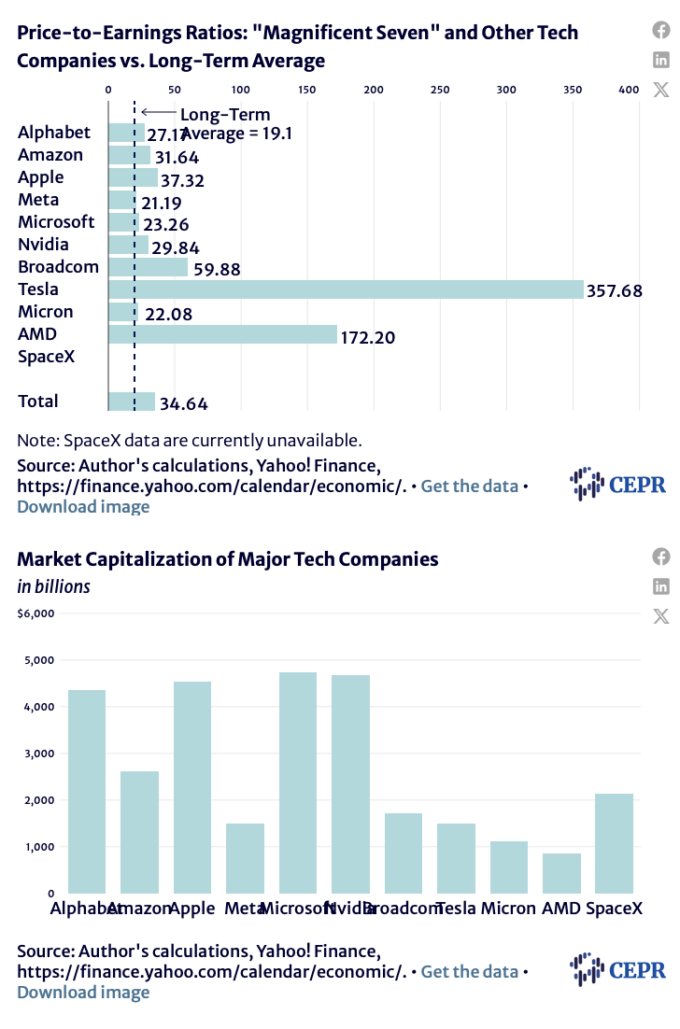
Fans of an AI-driven stock boom should be aware that they are making three big bets, all of which are far from certain.
1) The first is that productivity growth will soar to rates never seen before. Unless there is an unprecedented further redistribution from wages to profits, which are already at a near-record share of GDP, the only way profits can rise enough to make sense of current share prices would be for productivity to grow in a 4-5 percent range.
2) The second bet is that AI companies will be the main beneficiaries of higher productivity in the form of higher profits. This assumes that competition will not drive down prices to limit profits. If that sounds far-fetched, this is what happened with the Internet. Leading internet providers like Verizon and Comcast are large, profitable companies, but they only have a tiny fraction of the gains society has received from the Internet. It is possible to imagine a comparable story with AI, where there are large benefits, but the major AI companies end up with relatively modest profits since competition forces down prices.
3) The third bet is closely related to the second one: that US AI companies will capture the bulk of the profits. As I noted a couple of months ago, the AI provided by Chinese companies almost matches the cutting-edge US models on technical standards but sells for one-fifth or even one-tenth the price charged by US companies.
This is the reason China has a large and rapidly growing share of the world AI market. If Chinese AI makers are able to gain a large share of the benefits of the technology, it will leave less for US producers. Perhaps more importantly, Chinese AI makers can provide the competition that depresses prices, even if US antitrust policy is too weak to do so.
But the first question is simply whether there will be the big productivity surge that creates the benefits to be divided. And that story is not looking very good just now.
Productivity: What It Is and Why We Care
Just to back up for a moment, productivity is the value of output that an average worker produces in an hour of work. If productivity were to double, it would mean they produce twice as much output per hour. Instead of producing one pair of shoes in an hour, if productivity doubled a worker could now produce two pairs of shoes.
In the real world, the story is considerably more complicated, since we produce much more than shoes, but this is the basic story. However, instead of trying to measure output of a single product, we measure all the goods and services produced in the economy. And we adjust for inflation. We’re interested in the extent to which we’re actually producing more goods and services in an hour of work, not the extent to which prices have risen.
As I have pointed out before, any story where current valuations of tech and AI companies — and indeed the stock market as a whole — make sense has to assume that productivity growth will soar. Instead of having the 1.5-2.0 percent growth we’ve seen in recent years, we would need productivity growth of 4.0-5.0 percent a year to allow profits to grow enough to provide the sort of returns that stock investors have historically expected.
This sort of productivity growth would also imply something like the rapid displacement of workers by AI that concerns people. At a 4 percent growth rate, it would take roughly 18 years for workers’ productivity to double. At a 5 percent growth rate the doubling would occur after 14 years. Even this pace of productivity growth may not mean the sort of mass layoffs that people fear, but it would lead to an extraordinary transformation of the workplace and society.
And to be clear, this is an economy-wide average, not a specific industry. There are stories (maybe invented) of software makers cutting their staff by 50,60, or 70 percent because AI is now doing the work. There could be specific industries where this is the case, but getting economy-wide productivity gains means that we have to be seeing benefits everywhere, including sectors like hotels and restaurants, hospitals, retail outlets, hair salons, and just about everywhere else. Alternatively, the gains in the sectors where AI is affecting productivity have to be massive.
It is also important to recognize that there are sure to be negatives, where AI requires additional labor, just as has been the case with computers and the Internet. We had no need for virus detection and computer repair before we had the Internet and computers.
Economists’ Projections Don’t Support the Productivity Boom Story
There are a wide range of estimates of the likely impact of AI on productivity growth, and they don’t tell the story of the sort of massive uptick that would justify current stock prices. Torsten Slok, the chief economist for Apollo Global Management, compiled a list of academic studies on the productivity impact of AI.
The most optimistic was by Antonin Bergeaud. It showed an increase in annual productivity growth of 0.3-0.6 percentage points, with a cumulative gain of 6-12 percent, which would be realized over 10-20 years. That is a good story, but hardly game-changing in terms of what we should expect from the economy.
The most pessimistic assessment came from Nobel Prize-winning economist Daren Acemoglu. He put the annual gain at 0.07 percentage points, with a cumulative productivity gain of 0.7 percent after 10 years. There is always a lot of uncertainty with these sorts of projections, but it is striking that the economists who have tried to look at the issue closely do not see an enormous productivity impact, and none of them see anything like the job apocalypse that is bantered about in political conversations about AI.
The Boom Is Not in the Data
Finally, we can look at the data we have to date for an AI-driven productivity uptick. Thus far, we aren’t seeing it. The graph shows moving five-year average rates of productivity growth. The reason for taking a five-year average is to smooth out the effects from unusually bad or good quarters.
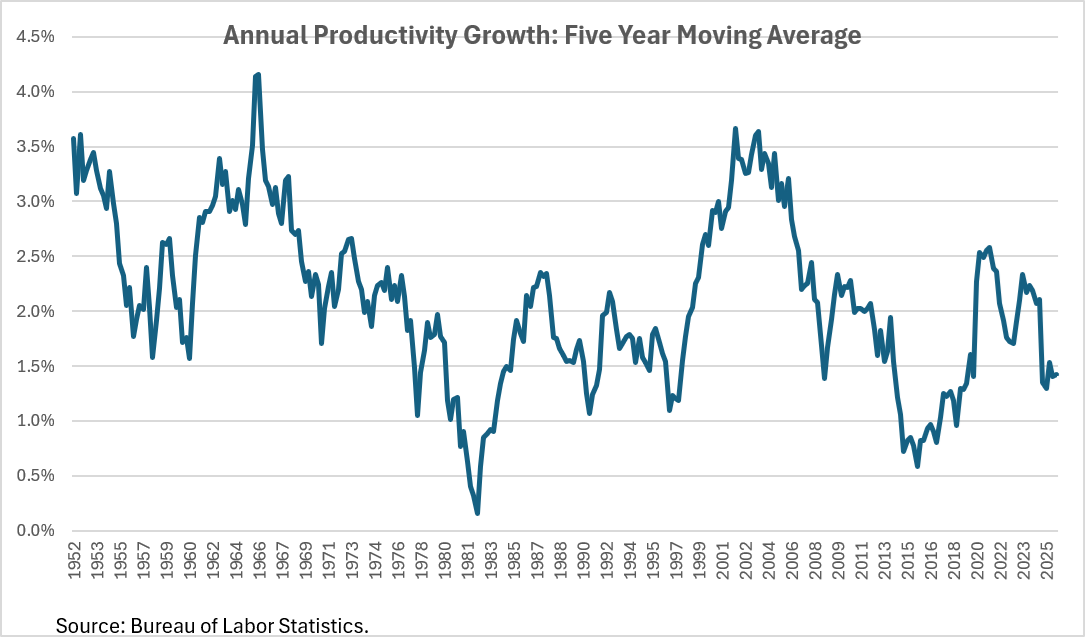
As can be seen, the recent years don’t look especially good. There was a period where the average just crossed 2.5 percent around the pandemic, before slumping again. We got back over 2.0 percent in 2023 and 2024, where there may have been some AI impact, but recently productivity growth has slumped again. The average for the last three quarters has been just 1.1 percent. (I’m assuming a 1.3 percent rate for the second quarter based on hours growing at a 1.3 percent rate and expected GDP growth close to 2.5 percent.)
It’s worth noting that even the best stretch of the recent past doesn’t come close to reaching the rates of over 3.5 percent seen at the peak of the Internet boom or the 3.0 percent growth seen through much of the 1950s and 1960s. In short, the data to date give us no reason to believe the productivity impact of AI will be earth-shaking.
It’s also worth noting that at the point where the 1990s stock bubble was hitting its peak in March of 2000, the productivity pickup had been going on for more than four and a half years. Perhaps we will still see a big uptick in productivity growth from AI, but it’s clear that in this case the stock market is way ahead of where it was in the 1990s bubble. That should not be reassuring.
This first appeared on Dean Baker’s Beat the Press blog.