Saturday, July 11, 2026

A Rejection Letter: Some Serious Problems with an Essay Submission from Thomas Jefferson


 July 10, 2026

The following recent archival discovery may be of interest to CounterPunch readers one week after the nation’s 250th anniversary.

Dear Thomas Jefferson:

We hope that you and your slaves are enjoying your summer in Monticello. We certainly appreciate the hard work and elaborate word-crafting that has gone into your submission on national independence, but regret that we cannot publish it for the following reasons:

1. The fact that you and other signers of your declaration are slaveowners renders crassly hypocritical your eloquent statement that “All men are created equal” and “endowed by their Creator with certain unalienable Rights, that among these are Life, Liberty and the pursuit of Happiness.” It is richly ironic that you combine this statement with the complaint that the British king has “excited domestic insurrections amongst us,” which we take to mean that London has offered freedom to your slaves. Insofar as your complaint is true, we say three cheers for the British crown.

2. There is no evidence for the existence of a “Creator,” which we take to mean a God.

3. Human rights are fought for and won by human beings working collectively for their emancipation from exploitation and oppression; they are not granted by a deity.

4. There is no such thing as a “self-evident truth.” Truth is determined by the extent to which it corresponds to material and historical reality. Truths must be demonstrated by evidence, deeply and scientifically understood.

5. Governments have NOT been formed to “secure” the rights you mention, “deriving their just powers from the consent of the governed.” The historical evidence is quite the opposite. States/governments emerged from and function to this day as enforcers, protectors, and coordinators of ruling class power, the dictatorship of those who own and control the lion’s share of society’s productive resources and wealth. This is no less true under republican and electoral systems than it is under feudal monarchy and “the divine right of Kings.”

6. We know very well that your flowery rhetoric, portraying your fledgling republic as the noble and idealist victim of the British Empire, is driven by you and your fellow propertied insurgents’ fierce and explicit aim to create a continental empire of your own – to expand your profit-centered and slave-based regime across all of North America, murdering Native Americans’ en masse along the way.

7. We find it richly ironic that your bill of grievances against the British crown includes the claim that the king has inflicted on you “the merciless Indian Savages, whose known rule of warfare, is an undistinguished destruction of all ages, sexes and conditions.” This is truly the pot calling the kettle black! It is you and your colonizing brethren who have brought genocidal war to your continent!

On a happier note, we heartily approve of your argument that “whenever any Form of Government becomes destructive” of liberty and happiness – when a state becomes “tyrannical” and “despotic” — “it is the Right of the People to alter or to abolish it, and to institute new Government, laying its foundation on such principles and organizing its powers in such form, as to them shall seem most likely to effect their Safety and Happiness.” That is a right to revolution.

We believe the new government you propose to form will serve the narrow and oppressive interests of your hoped-for independent nation’s wealthy Few. We expect your desired state to be despotically destructive of liberty and happiness for vast swaths of your population, and for others who stand in the way of your transparently imperial ambitions.

May the rights of revolution and independence that you uphold against England be wielded by your new nation’s slaves, women, wage-earners tenant farmers, artisans, Indigenous peoples, and laborers! We hope those rights are upheld by your own domestic subjects against you and other arrogant, imperial, and parasitic North American slaveowners, merchant capitalists, gentry, and their publicists, generals, and lawyers!

I regret that we don’t have better news about your interesting and thoughtful essay, which we recommend you send to your aptly named Continental Congress.

Sincerely,

Historical Truth Commission

Editorial Board

July 1, 1776

Paul Street’s latest book is This Happened Here: Amerikaners, Neoliberals, and the Trumping of America (London: Routledge, 2022).

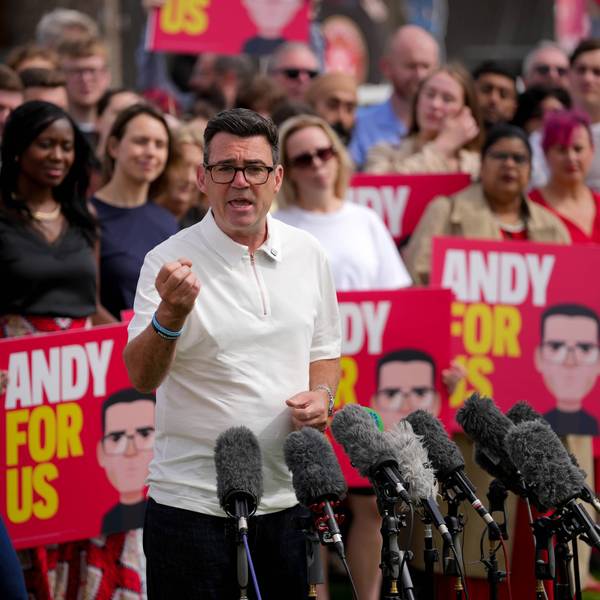
Presumptive British PM Burnham’s Gaza Apology Met With Skepticism

“Andy Burnham knows that war crimes are being committed in Gaza, but has he got the courage to do anything about it?” asked the Greens’ deputy leader.


UK Labour MP Andy Burnham is seen following a media interview in London on July 2, 2026.
(Photo by Dan Kitwood/Getty Images)

Brett Wilkins
Jul 10, 2026
COMMON DREAMS

Labour MP Andy Burnham, who is on track to become Britain’s next prime minister following Keir Starmer’s resignation last month, apologized Thursday for his party’s initial response to Israel’s genocidal war on Gaza—but critics said his circumspect atonement fell short of the mark.

“Let me start by saying the unbearable suffering in Gaza is a scar on our collective conscience,” Burnham, the erstwhile Manchester mayor who won last month’s Makerfield by-election, said in a three-minute video. “It’s completely unacceptable that innocent Palestinians, including children, continue to be killed, that there’s still a humanitarian crisis with too little aid getting in, and that the Israeli military continues to expand the area it controls in Gaza.”


Starmer Expected to Resign as PM, But UK Left Warns of ‘More of the Same’ From His Replacement


“We’ve got to do more to put pressure on the Israeli government,” he asserted. “The response has too often not been good enough. We need to do better. Yes, we have taken some important steps. These include recognizing the Palestinian state, placing sanctions on Israeli ministers, and imposing waves of sanctions on violent settlers and the organizations that support them.”


“But let’s be honest, the UK was too slow to call for a ceasefire, and we must now do more to strengthen our approach,” Burnham continued. “Israel continues to violate the ceasefire agreement, killing innocent Palestinians. We’re seeing a surge in settler violence in the West Bank and East Jerusalem and the continued expansion of illegal settlements, displacing Palestinian communities.”

The lawmaker accused Israeli Prime Minister Benjamin Netanyahu’s far-right government of “clearly attempting to make a two-state solution impossible.”

“That’s why we need to do more, which includes looking at further sanctions, both on those involved in the violence in Gaza, but also looking at measures to ban trading goods with illegal settlements,” he said.

“There’s increasing evidence that war crimes appear to have been committed,” Burnham added. “There must be accountability for the depth of the suffering the people of Gaza have experienced. Ultimately, however, it must be for the international courts to determine, rather than politicians.”

The International Criminal Court has already issued arrest warrants for Netanyahu and Yoav Gallant, his former defense minister, for alleged crimes against humanity and war crimes in Gaza, where more than 250,000 Palestinians have been killed or wounded, most of them civilians, since the Hamas-led attack of October 7, 2023. The International Court of Justice is currently weighing a genocide case against Israel filed by South Africa and formally supported by nearly 20 nations.

While some Zionist UK MPs denounced Burnham’s comments as anti-Israel, Burnham’s pledge of a “fair and balanced approach” to Israel and Palestine, his placing of the onus on courts and not elected officials, and the fact that he did not say the word “genocide” in his apology drew criticism from Palestine defenders.

“Gaza has now endured more than 1,000 days of genocide,” Green Party Leader Zack Polanski said in response to the video. “Andy Burnham must answer: As prime minister, will he end Britain’s participation in genocide or continue it?”

Deputy Green Leader Mothin Ali told The Guardian that Burnham is hiding behind international courts “because admitting that the British government knows war crimes are being committed would trigger a legal duty to immediately halt arms sales.”


Adnan Hmidan, chair of the Palestinian Forum in Britain, said that Burnham’s “recognition that far stronger action is needed to confront the grave violations committed against the Palestinian people” is an important step.

“But the scale of devastation, killing, starvation, and forced displacement inflicted upon Gaza demands far more than acknowledgement,” he continued. “It requires courageous political action.”

“As an increasing number of legal experts and international human rights organizations have concluded, we hope more British political leaders will recognize that the atrocities committed in Gaza constitute genocide under international law, and will support the measures necessary to ensure accountability, end impunity, and uphold international law without exception or double standards,” Hmidan added.

British political commentator Saul Staniforth said on social media that “it was clear from the very start that what Israel was doing in Gaza was genocide... and yet over two-and-a-half years later, Burnham still refuses to call it genocide. Why? Because if he did, he’d have to take action as PM.”

“Burnham only made his statement yesterday on Gaza because of pressure, and meaningful action by a government led by him will only happen because of pressure,” Staniforth added.

Queen Mary University of London politics professor Tim Bale told Al Jazeera that Burnham is “trying to repair damage, but his remarks are probably more symbolic than substantive.”

Noting that Labour has “only just recovered from the accusations of antisemitism that were swirling around it during the [Jeremy] Corbyn era,” Bale asserted that “the UK is already at the edge of what it’s likely to do and say on Israel.”

“It also has to worry about maintaining relations with a profoundly pro-Israel US administration,” the professor added.

When the World Sleeps; Stories, Words and Wounds of Palestine: Francesca Albanese’s Courageous Witness Against Genocide and Silence


July 10, 2026

Cover art for the book When The World Sleeps by Francesca Albanese

Francesca Albanese’s When the World Sleeps (originally published in Italian as Quando il Mondo Dorme) is not just another book on Palestine. It is a profound moral and intellectual intervention at a time when much of the world has chosen to look away from one of the most documented genocides in modern history. As the UN Special Rapporteur on the Occupied Palestinian Territories, Albanese has consistently refused to soften her language or dilute her analysis. This book stands as the culmination of that courage — a work that combines rigorous legal scholarship with deeply personal testimony, forcing readers to confront the human reality behind the statistics.

Structured around ten intimate and political portraits, each chapter revolves around a different individual whose life has shaped Albanese’s understanding of Palestine. These are not abstract case studies. They are windows into the human cost of a decades-long colonial project.

The book opens with the heartbreaking story of six-year-old Hind Rajab, killed by Israeli forces in January 2024 along with her family in Gaza. Albanese uses Hind’s tragedy as a devastating entry point into the reality faced by Palestinian children under occupation. She writes poignantly: “Hind was not collateral damage. She was the target. A six-year-old girl, trapped in a car, begging for help while the world watched and did nothing.” Through Hind, Albanese forces us to confront the moral weight of a system that treats Palestinian children as collateral damage — a generation born into violence, denied childhood, and too often denied life itself.

Subsequent chapters introduce readers to ordinary Palestinians whose resilience shines through unimaginable suffering. One powerful portrait follows Abu Hassan, a tour guide in Jerusalem, revealing the daily humiliations of life under occupation in East Jerusalem — the checkpoints, the constant surveillance, the bureaucratic cruelty designed to make life unbearable. Albanese captures the suffocating reality: “Every day is a negotiation with power — a checkpoint, a permit, a soldier’s whim. This is not life. This is managed existence.”

Another chapter centers on George, a bookstore owner, juxtaposing the vibrant but besieged Palestinian cultural life in East Jerusalem with the false normalcy of West Jerusalem. Albanese reflects: “Culture is resistance. Books are weapons when words are the only things they cannot fully take from you.” These stories humanize the statistics, showing how occupation infiltrates every aspect of daily existence — from movement to memory to simple acts of living.

Albanese also turns her lens toward remarkable Jewish voices who have influenced her thinking. She pays tribute to Eyal Weizman, the forensic architect whose work with Forensic Architecture has exposed Israeli state violence through spatial analysis, revealing how architecture itself becomes a tool of domination. Gabor Maté, the renowned trauma expert, helps Albanese understand the intergenerational wounds of both Palestinians and Israelis, offering profound insights into how trauma is transmitted across generations and how it shapes political behavior. And Alon Confino, the late Holocaust historian, challenges simplistic narratives and insists that the Palestinian case must be treated as a political issue to be resolved through international law, not reduced to a humanitarian crisis.

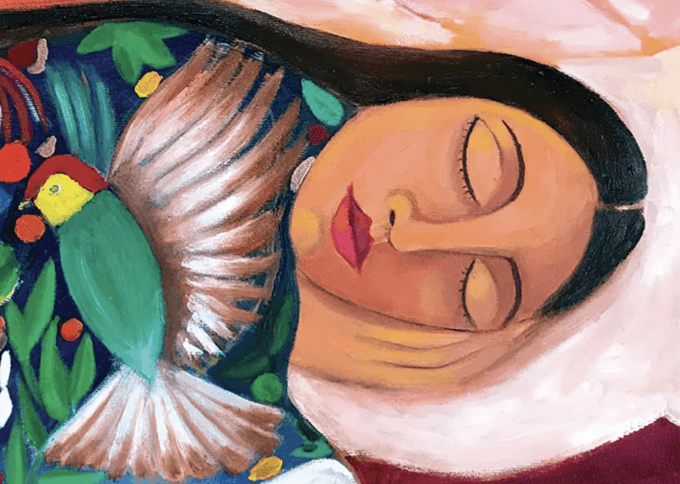
The book also features Palestinian artists and activists, such as Malak Mattar, whose artwork graces the cover and whose story illustrates the power of creative resistance under siege. Mattar’s journey from a child survivor of multiple wars to an internationally recognized artist becomes a testament to the indomitable Palestinian spirit. Albanese writes of her: “Art is how we refuse to disappear.”

What makes When the World Sleeps particularly devastating is Albanese’s refusal to let the international community off the hook. She documents not only Israeli violations — the apartheid system, the collective punishment, the deliberate destruction of life-sustaining infrastructure — but also the active and passive complicity of Western governments and institutions that have enabled this horror. Her critique of the United Nations itself, the very body she serves, is unflinching. She reveals an institution too often paralyzed by power politics, where the protection of the powerful consistently outweighs the defense of the oppressed. Albanese writes: “The UN was built to prevent the repetition of horrors like the Holocaust. Today, it stands by as another horror unfolds, paralyzed by the very powers that created it.”

Albanese writes with clarity, compassion, and intellectual precision. She does not shy away from the emotional weight of what she has witnessed — the pain of Palestinian mothers, the resilience of children in rubble, the quiet defiance of those who continue to resist. Yet she never allows emotion to replace rigorous legal reasoning. The book is both a personal journey and a political indictment. It forces the reader to confront a simple but devastating question: how long will the world continue to sleep while a genocide unfolds in real time?

In an era when speaking plainly about Israeli crimes can cost careers, reputations, and personal safety, Albanese’s steadfastness is remarkable. She has faced relentless smears, character assassinations, and even U.S. sanctions for simply doing her job. The fact that she continues — undeterred, precise, and morally grounded — makes her work all the more powerful. When the World Sleeps stands as both testimony and warning: silence in the face of genocide is not neutrality — it is complicity.

This is essential reading for anyone seeking to understand not only what is happening in Gaza, but why it has been allowed to happen for so long. Albanese strips away the propaganda, the legal sophistry, and the false equivalences. What remains is the naked face of settler-colonial violence and the moral failure of the international system that enables it.

In a time of carefully calibrated statements and performative concern, Francesca Albanese has chosen clarity over comfort. When the World Sleeps is a powerful reminder that the world may try to sleep, but books like this ensure that the truth refuses to stay buried. It deserves the widest possible readership — not only for what it reveals about Palestine, but for what it demands of all of us.

Read it. Share it. Let it disturb your sleep — because the world has slept for far too long.

This Book Review was originally published in Thinking Palestine, a project of Palestine Chronicle 

Michael Leonardi lives in Italy and can be reached at michaeleleonardi@gmail.com