Trump’s Bombastic UN Diatribe Marked a New Low for US Leadership
In directly challenging an international system that is arguably dead, his diatribe puts front and center the state of American decline on the global stage.
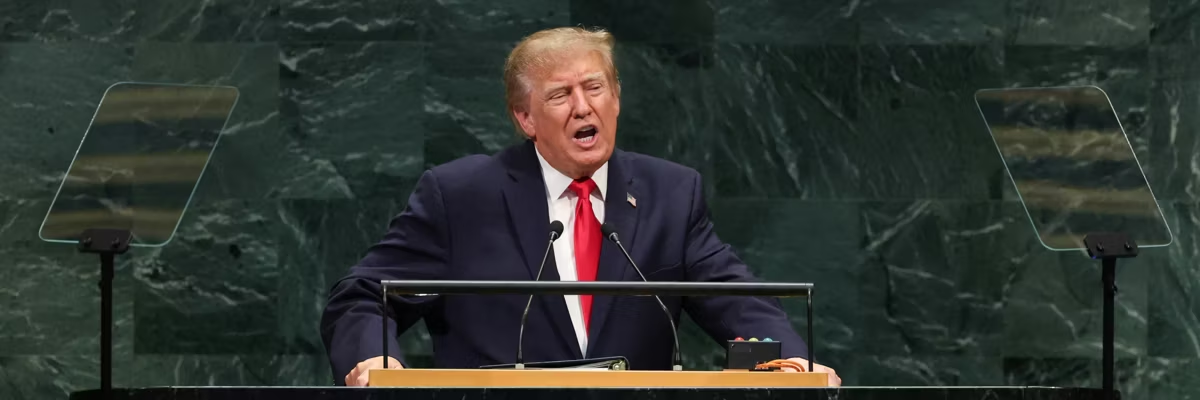
US President Donald Trump addresses the 81st United Nations General Assembly at the United Nations Headquarters in New York, on September 22, 2026.
(Photo by Timothy A. Clary / AFP via Getty Images)Common Dreams
Hegemonic decline comes in many different forms. From the Roman empire to the Islamic caliphates of old, great powers of the world have repeatedly risen and collapsed under the weight of their excess. While the arc of human history and empire carry diverse experiences and paths, it is near the end of the imperial line that often sees some of humanity’s most volatile moments. Today, the United States represents the end of that line in a rapidly transforming world, with US President Donald Trump’s United Nations General Assembly speech embodying a challenge to the international system and the American decline accompanying and driving it.
To be sure, no one should be surprised by bombastic rhetoric at the UNGA’s annual gatherings. World leaders often use the international forum more as an opportunity to bolster their domestic image at home than for diplomacy and problem solving, as intended. This dynamic is understandable: As the adage goes, “All politics is local.”
Yet it is this exact cliché that makes Trump’s speech different.
The world understands the United States in this context: An empire at the height of its decline, hellbent on aggrandizement in a desperate attempt to grip what remains of its global primacy, even at the expense of the international system.
Approaching the UNGA podium on day one of the plenary session speeches by world leaders from countries like Brazil, Türkiye, and France, Trump understood his political position. The supposed leader of the free world, the American president is in his second and final term in the White House, which has reached a pinnacle moment that will define his legacy.
That moment and legacy are imperiled, if not already ruined. Trump’s sinking domestic approval rating, at its lowest across his two presidential terms, stems from a disastrous domestic and global economy hitting the working class and most vulnerable. His ongoing forever war with Iran and its allies in the Middle East with no end or direction drives those economic problems and the worsening polls.
As such, Trump finds himself underwater politically. His response has been clear: He is as stubborn as ever.
The president launched into a tirade at the UNGA. Opening with a statement that could understandably be confused for a stump speech on a campaign trail or rhetoric meant for the State of the Union, he boasted about his would-be accomplishments at home and abroad. Trump repeated his old lie that he has single-handedly ended multiple wars across the globe. He claimed to have saved the United States, kicking of a “Golden Age of America” while arguing that the country has never been stronger.
Yet it was his rhetoric on multiple American wars in 2026 that should speak. On Venezuela, Trump openly bragged about overthrowing a neighboring country to extract their natural resources—in this case, oil. He gloated about military strikes on alleged cartel boats in the Caribbean Sea, actions amounting to extrajudicial killings. He threatened military action against another neighbor—Cuba—in the near future.
If these boasts reflect a foreign policy disconnected from international law, then Trump’s comments on Iran mark an insult to humanity. In this regard, the American president openly used genocidal language to threaten the country he has taken the United States to war with for the last seven months, openly pondering: “Do I annihilate the Islamic Republic and do it quickly… Do I drive them into hell with no chance of survival and no hope of future greatness [f]or generations?”
To use such bombastic rhetoric at the UNGA—the heart of global diplomacy, even for all the UN’s warts—marks a new low for American leadership and foreign policy. In directly challenging an international system that is arguably dead, his diatribe puts front and center the state of American decline on the global stage.
These words represent the mindset of an American president who chose a war of aggression against a sovereign state without authorization from the US Congress, meaning American citizen approval, the UN Security Council, or any real international legal basis. These checks—largely cast aside in recent decades—exist with their own warts specifically because this war represents a strategic and humanitarian disaster, as have the wars of the past that informed the international legal system the world understands today.
Instead of leaning into concepts of diplomacy and humanity, playing a leading role in bringing nations together through diplomacy and in support of the principles of international law, the president of the United States has leaned deeper into imperial and interventionist desires, going so far as to hearken to a pre-World War II system of chaos in which the world operated on a simple rule: “To the winner goes the spoils.” Trump used this cliche when discussing American efforts to steal Venezuelan oil.
Instead of recognizing the pain that war, in no small part waged by US weapons and defended in the UNSC by American diplomats, Trump espoused the importance of it in perpetuity to fight some ill-defined “evil.” Instead of recognizing how the inertia of US foreign policy has become an illness for people at home and abroad alike that many akin to the true “evil,” he crowed on about war and violence as if they constitute abstract concepts and games, not real consequences for people around the globe.
The people of Minab, where American missiles hit a school full of children and teachers, killing over 150 civilians, would dispute the abstractness of American power and the giddy willingness to use it in such brutal fashion. Iranians writ large can and do contest the use of genocidal language against their country and civilization. The American people, tired of war amid major domestic problems at home, do not see strength in their president bragging about his would-be personal accomplishments abroad that reflect more of the same mistakes of the past.
People around the world did not see a man espousing American greatness at the UNGA. They witnessed a leader with immense power brag about his ability to cause unspeakable pain and suffering at will as his popularity at home collapses. This comes as the United States proves itself incapable of seriously using its position as a global power to enact real change for the better abroad. In fact, it uses that position in increasingly malign ways and has done so for years.
The world understands the United States in this context: An empire at the height of its decline, hellbent on aggrandizement in a desperate attempt to grip what remains of its global primacy, even at the expense of the international system.
From Ukraine to Gaza to Iran, the old world is regressing to a time before the international legal system was crafted in a way that proclaimed and systematized a simple term: “Never again.” While states will always act with raw power considerations and national interests in mind, the international system marked a valid and worthwhile attempt to temper humanity’s worst instincts. Trump and other leaders of the world, like Russia’s Vladimir Putin and Israel’s Benjamin Netanyahu, represent those worst instincts, explaining why they work to destroy ideals that ultimately improve the human experience—diplomacy, cooperation, development, and human rights.
The UNGA, despite Trump’s ramblings, can and should remind the world that these values matter, just as pure national interests can still be informed by such principles. Such an approach to foreign policy is not a contradiction as strength and humanism are not mutually exclusive. Instead, they must form the basis of how Washington and other capitals approach the world now and in the future.
Our work is licensed under Creative Commons (CC BY-NC-ND 3.0). Feel free to republish and share widely.
Alexander Langlois
Alexander Langlois is a foreign policy analyst focused on US foreign policy, restraint, and progressive realism in the Middle East. He is currently the senior editor for Democracy for the Arab World Now's (DAWN) Democracy in Exile journal.
Full Bio >
Deep-Dive Investigation Examines Minab School Bombing: ‘One of the Worst US War Crimes Since Vietnam’
“There was no school left,” said the father of a 6-year-old girl killed in the attack. “I thought I was asleep and having a nightmare.”
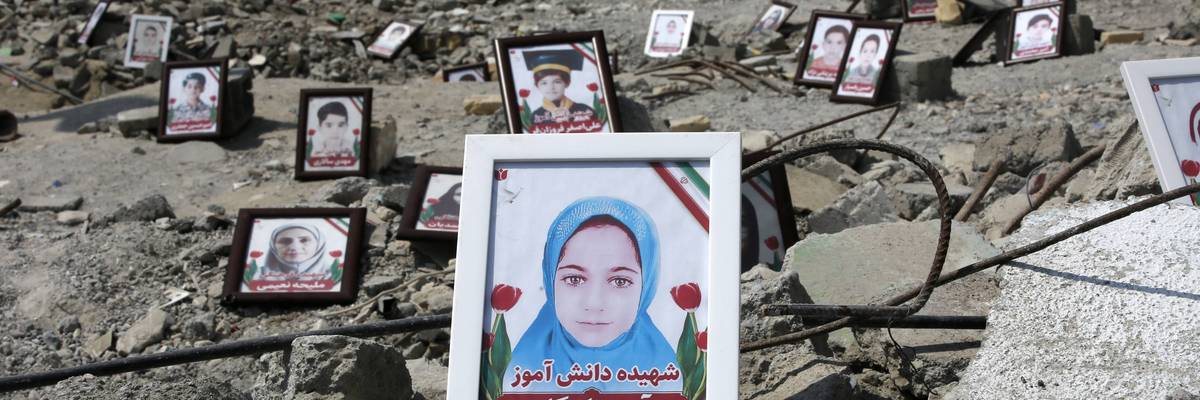
Photos of children and others killed in the US strike on the Shajareh Tayyebeh School in Minab, Iran are displayed in the rubble of the site on September 10, 2026.
(Photo by Fatemeh Bahrami/Anadolu via Getty Images)
Stephen Prager
Sep 30, 2026
COMMON DREAMS
Survivors, parents, and first responders provided harrowing firsthand accounts of the US bombing of an elementary school on the first day of the US-Israeli war with Iran as part of a new Drop Site News investigation demonstrating that the school had publicly operated as a civilian institution for more than a decade.
The report, published Wednesday, provides new eyewitness accounts from those who lost loved ones when US Tomahawk missiles hit the Shajareh Tayyebeh School in Minab, which killed 120 children and dozens of others, and has been described as “one of the worst US war crimes since Vietnam.”
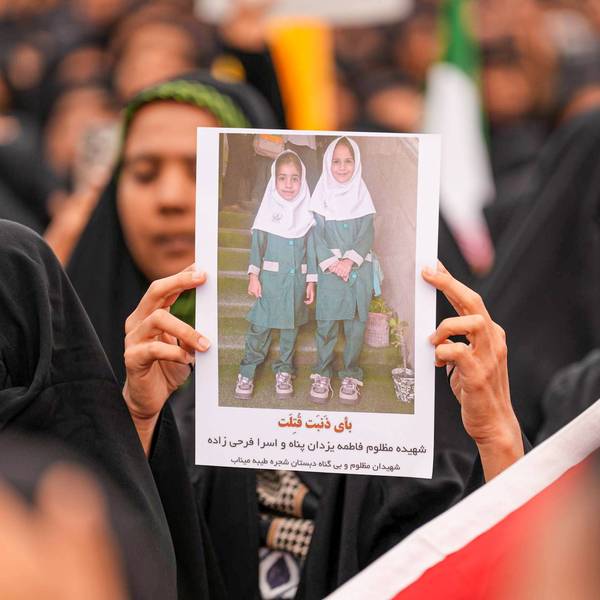
UN Experts Say US War Crimes Likely in Iran School, Sports Complex Massacres
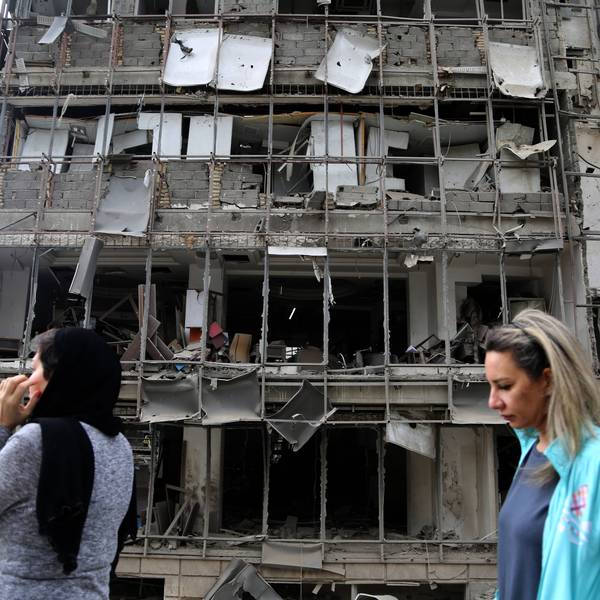
Amnesty Says US-Israeli Attacks With Indiscriminate Weapons in Tehran May Have Been War Crimes
“The children were five years old and all they did was yell, ‘Miss! Miss!’ and were crying. I ran to the children. I just said, ‘Get under the table!” recalled preschool teacher Hossniyeh Salem. “I didn’t think they were going to strike the school. I just thought that some place had been hit. I said, ‘Don’t be afraid, sit down.’”
“Two simultaneous sounds. They’re still in my ear. My son even describes them—'Wooosh, boom! Woosh, boom!’—and then the explosion very close by,” Salem said. “Plaster was falling, the ground was shaking, and at that moment I just looked at my preschool girls and my son, and I said to myself, ‘It’s over. Now is the time when we go under the rubble, it’s going to fall now,’” she continued. “Then there were no more sounds. The class was full of smoke and dust.”
Yaghoub Yazdanpanah, a literature teacher at another school about eight miles from Minab, described the moment he learned that the school his 6-year-old daughter, Fatemeh, attended had been bombed.
“I left my classroom, ran home, took my car, and sped to Minab. When I arrived, I said, ‘Oh no!’ The unimaginable had happened,” he said. “There was no school left. Two-thirds of the school, maybe more, had been destroyed. Smoke was rising from all over the school. It had turned into rubble. For a moment, I thought I was asleep and having a nightmare.”
Yazdanpanah said he already knew the worst had happened well before he received his daughter’s body at an overwhelmed hospital that night.
“We knew our children had been martyred; we knew our children were no longer with us,” he said. “When they brought Fatemeh, she was in one piece because she had been in her teacher’s arms [when she died].”
“There was no school left.”
The US has still not accepted responsibility for the Minab attack, even though an internal Pentagon investigation has concluded that US forces struck the school using two Tomahawk missiles. In the initial days after the attack, President Donald Trump claimed that Iran had been responsible before backing off the claim, stating, “I just don’t know enough about it.”
Drop Site obtained images of the missile fragments from the site, which an independent weapons inspector said “all appear to be remnants of Tomahawk missiles.” Iran is not known to possess Tomahawks. A UN fact-finding mission report released earlier this month determined that the school had been “the intended point of impact” rather than collateral damage.
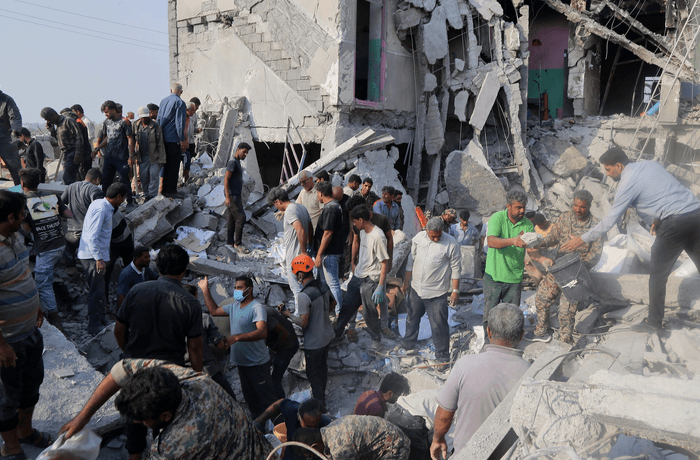
People are seen scouring the wreckage at the site of the February 28, 2026 bombing of the Shajareh Tayyebeh girls’ elementary school in Minab, Iran. (Photo by Mehr News Agency/Wikimedia Commons)
Adm. Brad Cooper, the commander of US Central Command (CENTCOM) told Congress in May that the school was “located on an active [Islamic Revolutionary Guard Corps] cruise missile base.”
Wes Bryant, a former senior targeting adviser at the Pentagon, told Drop Site he’d never seen any indication that the school was on an active missile site and explained that even if it was, “it doesn’t matter.”
“Those children, all those civilians, are still non-combatants and protected, so it’s really disgusting to hear that,” he said. “This wasn’t even fragmentation that hit a school next to another target. This was deliberately targeted very, very clearly and obviously. So at the very least, [it was a] complete mischaracterization of the target.”
There was abundant evidence of the school’s civilian use that would have been available to those who conducted the strike. The school was part of a compound that included barracks for the elite IRGC but was redeveloped for civilian use beginning in 2014. It had publicly and officially operated as a school since 2015.
The school had a very active online presence with a website that prominently displayed classroom activities and school events. Meanwhile, satellite imagery captured just two months before the attack showed children standing in the schoolyard outside the building.
An investigation from Bloomberg found that the school had been placed on a list of targets for the war’s opening salvo that was assembled in part using the Maven artificial intelligence system developed by Palantir, which reportedly did not classify it as a school.
The UN report emphasized that even if the attack can be boiled down to an intelligence failure, it still likely amounted to a war crime because the US attacked despite readily available evidence that the building was a school, a failure investigators said went “beyond mere negligence” and amounted to recklessness toward the risk of striking civilians.
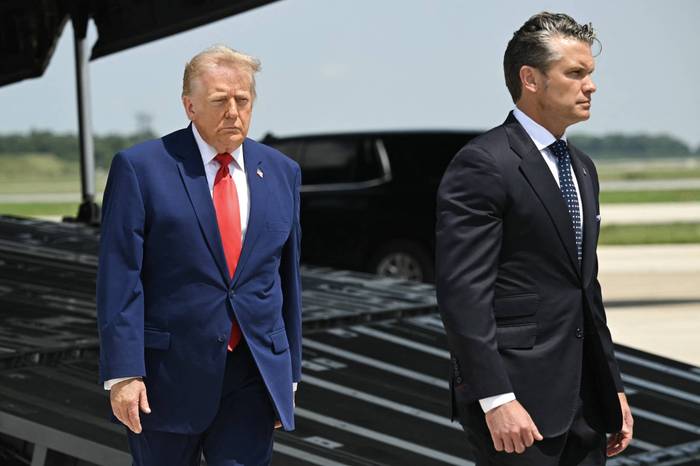
US President Donald Trump and Secretary of Defense Pete Hegseth attend a dignified transfer event for US service members killed during operations in the Middle East, at Dover Air Force Base in Dover, Delaware, on July 22, 2026. (Photo by Saul Loeb/AFP via Getty Images)
Hala Rharrit, a career former US Foreign Service officer who spent 17 years at the State Department before resigning in 2024, remains unsatisfied by the government’s efforts to downplay the attack as a “mistake.”
“There’s no way to say that this was some type of error,” Rharrit told Drop Site. “You’re either saying that our US Military is completely incompetent, that despite the multiple layers of review, everybody messed up—or there was something very, very sinister about this strike.”
According to data from the Human Rights Activists News Agency, the vast majority of US-Israeli strikes during the first 40 days of the war did harm to civilians or civilian infrastructure, contradicting repeated claims that the US “never targets civilians.” At minimum, the data shows at least 1,701 civilians have been killed, but HRANA has stressed that the true death toll is likely substantially higher.
Defense Secretary Pete Hegseth has spent his tenure dissolving guardrails meant to prevent civilian casualties, denouncing “stupid rules of engagement,” and saying the military should pursue “lethality” over “legality.” Trump, meanwhile, has repeatedly threatened mass destruction upon Iran, including that the “entire civilization” would “die.”
“The administration and Hegseth have made it quite clear that they don’t really care about civilian casualties. That may also have been true of previous bombing campaigns that predate the Trump administration, but it is even more the case than in the past, and they have made it clear that troops do not need to be concerned about consequences,” said Harrison Mann, a former US Army major and intelligence analyst for the Defense Intelligence Agency (DIA).
“There is no mystery about what coordinates those missiles hit, and that question would have been answerable on the day of the strikes,” he told Drop Site. “The only way that CENTCOM would not know is that they are choosing to be willfully ignorant.”
Updated Google Satellite Images Show ‘Apocalyptic’ Destruction of Gaza by Israel
One Palestinian from Gaza said the imagery “shows you the Israeli barbarism and terrorism that the world lets happen.”
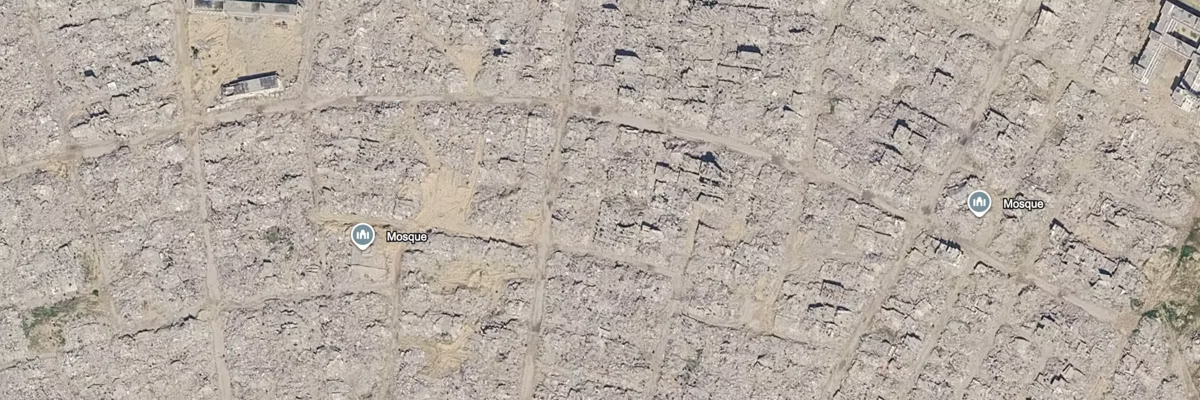
This Google Earth satellite image shows Israel’s total destruction of the Tal as Sultan refugee camp in Rafah, Gaza, Palestine.
(Photo by Google Earth)
Brett Wilkins
Sep 28, 2026
COMMON DREAMS
Updated Google satellite imagery shared Monday on social media provides a new perspective on the staggering scale of Israel’s obliteration of the Gaza Strip, showing entire neighborhoods reduced to rubble and vast stretches of a formerly dense urban landscape transformed into barren wasteland.
The images from Google—which is accused of complicity in the Gaza genocide—can be viewed on both Google Earth and Google Maps and show extensive destruction throughout the Palestinian territory. In some locations, roads and familiar landmarks remain visible amid enormous fields of gray rubble where homes, businesses, schools, and other civilian structures once stood.
“I’ve walked through much of the destruction in Gaza myself, but I couldn’t bear looking at the map,” Palestinian journalist Abubaker Abed posted on social media. “It shows you the Israeli barbarism and terrorism that the world lets happen.”
“I’ve been to those places, I have seen the scale of the destruction—it was really heartbreaking,” Abed told The New Arab. “But when you see all the destruction in just one active website, it really broke my heart. I couldn’t even bear continuing looking at that because seeing the place where I grew up, seeing the place where I was born, [lying] in ruins in that way was absolutely heart-shattering.”
US writer Linda Mamoun noted that “Google Maps shows photos and reviews for thousands of places in Gaza that don’t exist anymore. You can scroll through an entire world that Israel destroyed.”
The Google images help affirm independent assessments documenting the extraordinary scale of Gaza’s destruction. According to the United Nations Satellite Center (UNOSAT), 201,290 structures—or approximately 82% of all structures in Gaza—had sustained damage as of June. More than 134,400 structures were classified as destroyed, while over 13,800 were severely damaged. UNOSAT also estimated that 328,627 housing units had been damaged.
The devastation shown in the new imagery is particularly stark in Rafah in southern Gaza. Israel ignored a May 2024 order from the International Court of Justice to “immediately halt” its assault on the city of approximately 275,000 people, as well as other acts enumerated in Article II of the Genocide Convention. A South Africa-led genocide case against Israel at the ICJ is currently in the written phase, which will continue until at least May 2029.
“You can scroll through an entire world that Israel destroyed.”
“Look at these satellite images of Gaza and listen to the inconsistency, the hypocrisy, and the ugliness of the soul of the deniers... who will tell you above all not to use the word genocide,” wrote Rima Hassan, a French leftist member of European Parliament.
In a social media post, UK journalist David Yelland said: “I recommend spending a few minutes on Google Earth today looking at Gaza. Keeping the media out has meant we have not seen this before. Make your own mind up.”
Another British journalist, Piers Morgan, called the images “horrifying.”
“Now we know why [Israeli Prime Minister Benjamin] Netanyahu continues to ban international media from Gaza,” he added.
A UN report published last week estimates that approximately 1.9 million of Gaza’s roughly 2.2 million people have been displaced by Israel’s assault—many of them more than once—and around 60% of the strip’s residents have lost their homes. The publication also said that 92% of economic establishments in Gaza were destroyed or damaged, and that the territory needs about $71.5 billion for reconstruction and recovery.
Since launching the war in retaliation for the Hamas-led attack of October 7, 2023, Israeli forces have killed at least 74,022 Palestinians and wounded upward of 175,980 others, according to Gaza officials. The majority of those killed, they say, were women and children. At least 1,421 Palestinians have been killed and 4,983 wounded since the October 2025 ceasefire took effect.
Netanyahu and Yoav Gallant, his former minister of defense, are wanted by the International Criminal Court in The Hague for alleged war crimes and crimes against humanity in Gaza, including murder and forced starvation.
Some Israelis and their supporters expressed satisfaction and even pride in the satellite images of Gaza’s annihilation.
“If updated Google satellite images of Gaza have not troubled you, see a doctor,” said Lebanese diplomat Mohamad Safa. “Supporting mass killing and distribution on this scale is really a pathological issue.”
‘Taxpayers Deserve Answers’: US Senate Urged to Support Bill to Spotlight Israeli Abuses in West Bank
“Demanding transparency and enforcing US laws governing military aid should be the bare minimum for any senator.”

Palestinians survey the damage after Israeli settlers raided the West Bank village of Al-Mughayyir, setting Palestinian-owned vehicles on fire and spraying racist slogans in Hebrew on September 29, 2026.
(Photo by Issam Rimawi/Anadolu via Getty Images)
Jake Johnson
Sep 29, 2026
COMMON DREAMS
The US Senate is expected to vote as soon as Tuesday evening on a resolution that would require the Trump administration to produce an official report on Israel’s human rights practices in the illegally occupied West Bank, where the US-backed Israeli government is engaging in large-scale land confiscations, displacing Palestinians en masse, and enabling deadly settler violence.
The Senate measure, known as S.Res.852, cites Section 502B(c) of the Foreign Assistance Act of 1961 to formally request “an unclassified statement” from the US State Department “regarding Israel’s human rights practices.” The filibuster-proof resolution, led by Sen. Chris Van Hollen (D-Md.), notes that at least nine Palestinian Americans have been killed by Israeli settlers or security forces in the West Bank since 2022, and that “Israeli military authorities have detained, interrogated, prosecuted, and imprisoned approximately 13,000 Palestinian children” since 2000.
If passed by the Senate, Van Hollen’s resolution would require the State Department to produce a report within 30 days on the Israeli government’s human rights conduct in the West Bank. Some US military assistance to Israel would be frozen if the State Department failed to issue the mandated report by the deadline.
Following release of the potential State Department’s report, “the Congress may at any time thereafter adopt a joint resolution terminating, restricting, or continuing security assistance for such country,” according to the Foreign Assistance Act, which prohibits US military aid to any country that “engages in a consistent pattern of gross violations of internationally recognized human rights.”
Cavan Kharrazian, senior policy adviser with the advocacy group Demand Progress, urged senators to back Van Hollen’s resolution, saying that “US taxpayers deserve answers about what happened and what our government is doing to prevent its military aid from fueling human rights violations and ethnic cleansing in the West Bank.”
“We know that Americans have been killed by Israeli forces and settlers and that Palestinian children face detention and abuse in Israeli military custody,” said Kharrazian. “Demanding transparency and enforcing US laws governing military aid should be the bare minimum for any senator. This resolution is a long-overdue first step. Every senator should support it, then follow through by supporting resolutions to block any new arms sales to Israel.”
Amnesty International USA also expressed support for the resolution, saying in a Monday statement that it “provides an important opportunity to press the Trump administration on its policies and the lack of accountability for the Israeli government’s human rights abuses and violations of international law.”
“This vote comes at a critical juncture in the occupied Palestinian territory as Israel continues its ethnic cleansing campaign against Palestinians in the West Bank,” said Elizabeth Rghebi, the group’s advocacy director for the Middle East and North Africa. “This campaign must also be understood as occurring within a broader context of Israel’s ongoing genocide against Palestinians in the occupied Gaza Strip, illegal occupation, and an apartheid system over all Palestinians.”
Last year, the Trump State Department—led by Marco Rubio—issued a sparse report on Israel’s human rights practices that said nothing about Israel’s annexation efforts, home demolitions, aiding of settler violence, and other abuses in the occupied West Bank.
Far from working to mitigate Israeli atrocities in the occupied Palestinian territories, the Trump administration is actively fueling them. Earlier this month, The Washington Post reported that the administration is planning to send Israel tens of thousands of additional 2,000-pound bombs in what the newspaper described as “the largest single sale of the controversial munition in recent years.”
“For years, the US has failed to get justice for Americans—those killed in the West Bank and detained by the Israeli government—or accountability for Palestinians who are being brutalized with the government’s complicity,” Van Hollen wrote in a social media post on Monday. “This week I will force a vote on this resolution to get answers.”
Despite Historic Support, Fetterman Joins GOP in Blocking Effort to Expose Israeli Abuses in West Bank
“Tonight, 47 senators supported my resolution to get accountability for the nine Americans killed on the West Bank and for Palestinians who face injustices daily,” said Sen. Chris Van Hollen.
Israeli army soldiers stand behind a masked man hurling stones at Palestinians in the occupied West Bank, on October 10, 2025.
(Photo by Jaafar Ashtiyeh/AFP via Getty Images)
Jake Johnson
Sep 30, 2026
COMMON DREAMS
Democratic US Sen. John Fetterman joined nearly every Republican senator on Tuesday in voting against a resolution that would have required the Trump administration to produce an unclassified report on Israeli abuses in the illegally occupied West Bank, including the imprisonment and killing of Palestinian Americans.
The resolution, led by Sen. Chris Van Hollen (D-Md.), narrowly failed 47-51, with Sen. Rand Paul (R-Ky.) joining every Democrat except Fetterman in supporting the measure. Van Hollen and other supporters of the resolution lamented the failed vote but celebrated the historic support it received as public opposition to Israeli atrocities—and US funding of Israel’s military—continues to grow.
“Tonight, 47 senators supported my resolution to get accountability for the nine Americans killed on the West Bank and for Palestinians who face injustices daily,” Van Hollen wrote in a social media post. “That’s more support than we’ve ever had in this fight. Republicans blocked us, but we won’t stop until we get justice.”
In 2024, just 11 senators—all members of the Democratic caucus except Paul—backed a similar resolution led by Sen. Bernie Sanders (I-Vt.).
“Listen to the American people: NO MORE MILITARY AID TO ISRAEL,” Sanders wrote in response to Tuesday’s vote.
If passed, Van Hollen’s resolution would have required the US State Department to issue a report within 30 days on Israeli human rights practices in the West Bank, where Palestinians have faced a historic level of violence by Israeli settlers and soldiers this year.
The resolution, which invoked Section 502B(c) of the Foreign Assistance Act of 1961, specifically called on the Trump administration to provide “all credible information of which the Department of State is aware concerning the alleged killing of United States citizens by the Israel Defense Forces, other Israeli security forces, or Israeli settlers since January 1, 2022,” as well as “an assessment on any United States citizens currently held in Israeli prisons.”
Under the Foreign Assistance Act, a failure to produce the required report would have resulted in a freeze on some US military assistance to Israel.
Josh Ruebner, policy director at the IMEU Policy Project, said that while the resolution “narrowly failed” due to near-unanimous Republican opposition, “make no mistake: this is historic.”
The resolution’s text highlights the case of Sama Safi, a 20-year-old Palestinian American student with a chronic health condition who was abducted by Israeli forces during a West Bank raid in June and has reportedly been detained without charge for months.
On Tuesday morning, Zeteo highlighted the case of Abdalkareem Issa Ahmed Safi, “an American teenager with Texas roots” whom Israeli forces snatched “from his family’s West Bank home in the middle of the night” in late June. Zeteo noted that he is the third young American known to be “languishing in Israeli prison.”
“Only one Republican voted to even somewhat hold Israel accountable for acts like this,” Zeteo’s Prem Thakker wrote late Tuesday.
Violent Riot by Israeli Settlers Prevents Return of Displaced Palestinian Family
“Israeli officials are now condemning settler terror, but the state itself is backing this violence.”
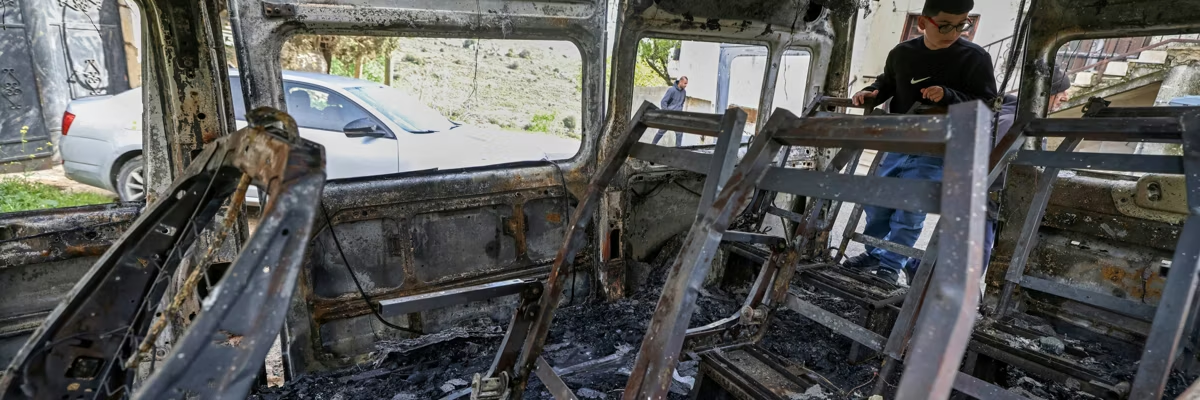
A Palestinian boy looks at a burnt vehicle following an attack by Israeli settlers in the Jalud village of the illegally occupied West Bank on March 22, 2026.
(Photo by Jaafar Ashtiyeh/AFP via Getty Images)
Jake Johnson
Sep 29, 2026
COMMON DREAMS
More than 100 Israeli settlers in the illegally occupied West Bank rioted in the early hours of Tuesday morning to prevent the return of a Palestinian family that was driven from its home in the village of Jalud.
The Israel Defense Forces (IDF), which was forced by a court ruling to facilitate the Tubasi family’s return, said in a statement that rioting settlers “blocked roads,” “set fires” to structures and vehicles, and hurled rocks at security forces as they tried to escort the Tubasis. Haaretz reported that after IDF forces failed to prevent rampaging Israeli settlers from storming the family’s homes, “they put the family members into an armored military vehicle and evacuated them from the scene.”
One family member told Haaretz that “half an hour later, smoke began to rise from the homes.” The IDF said that three Israelis were detained for taking part in the riots.
Israeli Prime Minister Benjamin Netanyahu, whose government has been accused of “actively enabling” mass violence against Palestinians in the West Bank, issued a statement early Tuesday condemning the attacks while downplaying them as the work of a “handful of rioters.”
The Jerusalem Post reported that the Tubasi family’s return “had been coordinated after they were previously forced to evacuate following attacks by extremist settlers.”
“The attempted return followed a September 6 High Court of Justice order requiring Israeli authorities to arrange within 14 days for three Palestinian petitioners and their families to return to their homes in Jalud,” the outlet added. “The court ordered the IDF and police to protect the families during the return and allow them to bring in supplies needed to repair the homes and restore water and electricity.”
Tuesday’s riots were just the latest eruption of violence in the West Bank, where Israeli settlers are committing attacks on Palestinians at an unprecedented rate, according to data from the United Nations.
“Israeli officials are now condemning settler terror, but the state itself is backing this violence,” said Breaking the Silence, an Israeli advocacy organization. “The Tubasi family had been expelled because the IDF backed terrorists who besieged their house for weeks. They allowed terrorists to roam free while barring journalists and solidarity activists from accessing them.”
“Even after committing a pogrom, the vast majority of them, if not all, will never be held accountable and will continue to terrorize Palestinians,” the group added. “Why? Because the state backs it.”
The settler attack came days after the leading Israeli human rights organization B’Tselem published a report characterizing the Israeli government’s actions in the West Bank, including large-scale land seizures, as “an elimination project,” noting that Israel has “sharply escalated longstanding policies of control, violence, and dispossession, implementing them more openly, more violently, and at a faster pace.”
“What Palestinians are living through in the West Bank is not a series of separate incidents,” said Yuli Novak, B’Tselem’s executive director. “It is a single political project that reaches into every part of life. Communities are being expelled, the economy is being pushed toward collapse, and millions are living in constant fear of Israeli military or settler violence.”
“These mechanisms work together to dismantle Palestinian collective life while entrenching a permanent system of Jewish supremacy across the West Bank,” Novak added. “The world is watching and still failing to respond with anything close to the urgency this demands.”
Battle Over Illegal E1 Settlement in Occupied West Bank Escalates a Month Before Israeli Election
Critics around the world continue to call the proposed settlement “a plan to progress the forced displacement and ethnic cleansing of Palestinians.”
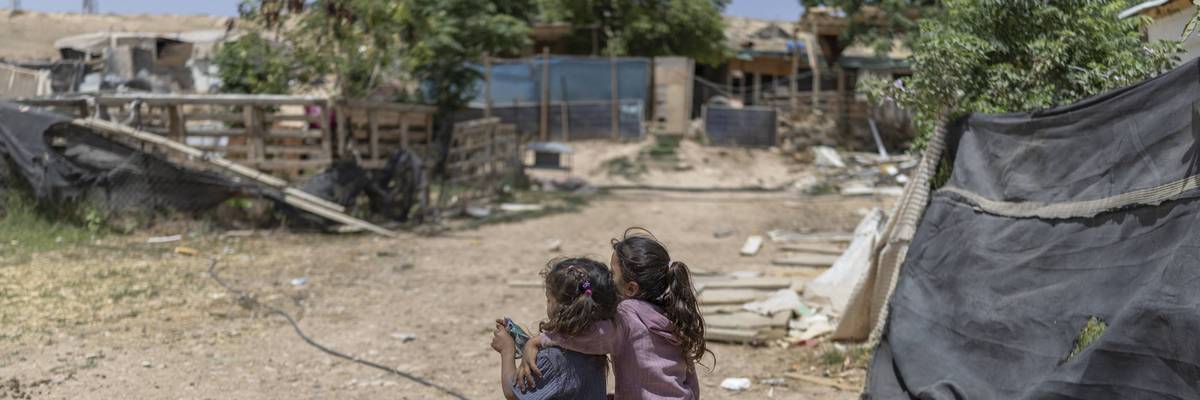
Palestinian Bedouin children walk in the community of Khan al-Ahmar, near land Israel plans to use for its controversial E1 settlement, in the occupied West Bank.
(Photo by Ilia Yefimovich/AFP via Getty Images)
Jessica Corbett
Sep 27, 2026
COMMON DREAMS
Israel’s far-right finance minister and other settlers living in the illegally occupied West Bank fumed on Sunday after their country’s attorney general pushed a key deadline for the widely condemned E1 project until after the Israeli Knesset election.
Although the International Court of Justice, plus governments and human rights groups around the world, have concluded that all Israeli settlements in the occupied Palestinian territory violate international law, Prime Minister Benjamin Netanyahu’s government has charged ahead with expansion plans, granting final approval for the building of 3,401 housing units in the E1 area last year.
Israeli Finance Minister Bezalel Smotrich had celebrated that decision, declaring that the project “buries the idea of a Palestinian state,” as it would split the West Bank in two by connecting Jerusalem and the settlement Ma’ale Adumim. While signing a related agreement a year ago, Netanyahu similarly said that “there will be no Palestinian state.”
Despite an ongoing legal challenge to the E1 plan from Bedouin Palestinians who live in the area and Israeli peace groups, Israel’s Ministry of Construction and Housing last month issued a tender to build seven residential compounds with 1,234 units, giving contractors until October 19—a week before the October 27 election—to submit bids.
“This is a last-minute maneuver that is part of the scorched-earth policy the government is pursuing at the end of its term to secure long years of conflict and bloodshed for Israel,” the Israeli watchdog Peace Now said at the time. “The government is trying to sign contracts with contractors before the elections so that it will be much harder for the next government to cancel the construction.”
The office of Israeli Attorney General Gali Baharav-Miara this week ordered a monthlong postponement of the deadline for bids, “so that it will fall after Election Day, thereby reducing the concern that the tender could be used for prohibited election propaganda.”
Smotrich on Sunday accused her of “trying to stop the construction in E1” and “interfering in the election campaign” to help Gadi Eisenkot, the Yashar party leader who could lead a coalition government that ousts Likud’s Netanyahu, depending on the results.
The finance minister called on Supreme Court Justice Noam Sohlberg, who chairs the Central Elections Committee (CEC), to intervene to “ensure that the attorney general and her people do not turn into active players in the election campaign in an attempt to back up the left, prevent the right from forming a government, and to enable the establishment of a Palestinian state that would endanger the existence of the state of Israel.”
Ma’ale Adumim also challenged the attorney general’s move on Sunday, with a petition to the High Court of Justice. Mayor Guy Yifrach said that “if the claim is that continuing the tender is political, I say exactly the opposite: Stopping it now is an intervention with political implications.”
“The E1 plan is already facing heavy international pressure, and developers and contractors need certainty,” Yifrach added. “Is it not enough that outside Israel they are trying to deter them from the project, now we are adding uncertainty from within our home as well?”
Earlier this month, the United Kingdom, France, and Canada jointly announced bans on imports from illegal Israeli settlements, and partnered with nine other nations—Denmark, Finland, Iceland, Ireland, Norway, Poland, Portugal, Spain, and Sweden—for a statement that describes the situation in the West Bank as “rapidly deteriorating amid unprecedented levels of settler violence and settlement expansion, including the unacceptable decision to publish tenders for the E1 settlement project.”
Then, 19 US Senate Democrats on Wednesday introduced a bill to sanction people or companies that facilitate the construction for Israeli settlers in the E1 area, with Sen. Elizabeth Warren (D-Mass.), one of the lead co-sponsors, condemning the project as “a move towards de facto annexation of the West Bank.”
Sen. Chris Coons (D-Del.), another lead sponsor and longtime supporter of Israel, said on social media Friday that “the Netanyahu campaign to extinguish the possibility of a future Palestinian state by building Israeli settlements in the E1 area of the West Bank must end. I’m leading a new effort to sanction those involved in its development and preserve a future pathway for peace.”
In addition to pushing for the expansion of settlements in the West Bank, since the Hamas-led October 7, 2023 attack on Israel, Netanyahu has overseen a genocidal war against Palestinians in the Gaza Strip. Despite a ceasefire agreement reached nearly a year ago, Israeli attacks continue, and the official death toll keeps rising, topping 74,000 on Sunday.
The bleak milestone came two days after The New York Times corroborated Haaretz’s recent reporting that in September 2023, United Arab Emirates President Mohammed bin Zayed Al Nahyan warned Netanyahu about now-deceased Hamas leader Yahya Sinwar’s plans “for a major event” targeting Israel. The Israeli leader has denied those reports, and even threatened to sue Haaretz.
However, in a signal that Netanyahu and his allies are worried about the upcoming election, the CEC this week voted to disqualify all Arab-majority political parties from the election, while declining to take similar action against Smotrich’s Religious Zionism, far-right National Security Minister Itamar Ben Gvir’s Otzma Yehudit, and Zehut, founded by Moshe Feiglin, a former Likud member. The Supreme Court is set to review the disqualifications this week.
Meanwhile, Eisenkot suggested this weekend that the barred parties would not be part of any government he leads. As Haaretz summarized, he said that “all coalition partners would have to recognize Israel as a Jewish and democratic state, uphold the values of the Declaration of Independence, support mandatory military service, and recognize Hamas as a terrorist organization that must be destroyed.”
Yoav Segalovich from the United Arab List’s Knesset slate responded that anyone seeking to lead the country must “show leadership and not fold in the face of the Likud’s scare campaign,” adding: “Israel needs deep change and genuine partnership, through courageous leadership. Eisenkot will not have a government without the United Arab List.”
‘Your Struggle Is Our Struggle’ Says Hasidic Anti-Zionist Rabbi Facing ICE Deportation Over Pro-Palestinian Protest
A lawyer for 35-year-old Yehonatan Ovadia said his arrest by ICE demonstrates how “equating anti-Zionism with antisemitism produces absurd results.”

Yehonatan Ovadia takes part in a pro-Palestinian demonstration alongside other anti-Zionist Hasidic Jews.
(Photo by Eric Lee/X)
Stephen Prager
Oct 01, 2026
COMMON DREAMS
The Trump administration has spent months targeting anti-Israel protesters for deportation as part of what it portrays as a fight against “antisemitism.” One of its latest targets is a Hasidic Jewish rabbi.
Yehonatan Ovadia, a 35-year-old Israeli citizen, was arrested by US Immigration and Customs Enforcement (ICE) on August 28 after being summoned to immigration court in Manhattan. He now sits in Brooklyn’s Metropolitan Detention Center, according to The New York Times, which broke news of his detention on Wednesday.
Ovadia, a father of five children, has lived in New York’s Rockland County since coming to the United States on a religious worker visa in 2022. He is a member of the Satmar Hasidic sect, an ultra-Orthodox movement that opposes Zionism on religious grounds, holding that Jews should not establish a sovereign state in the land of Israel before the coming of the Messiah.
Some members of Satmar have vocally protested against US support for Israel’s genocidal military assault in Gaza since it began in 2023.
“We demonstrated for Gaza, for the liberation of Gaza, for the rights of the Palestinians and to show to the world that the Jews, real Judaism, want to have peace,” Ovadia told the Times from detention.
As the death toll in Gaza has mounted, Ovadia has continued to attend anti-Israel marches across New York and New Jersey. Earlier this year, the government revoked his legal status after he appeared at one of these protests.
In November 2023, Ovadia joined a group of anti-Zionist Hasidic Jews to protest the display of a large Israeli flag at the Ramapo Town Hall. Some attendees were recorded cutting the flag down with scissors. Ovadia and another man were charged with hate crimes over the incident—charges that were later dropped.
Ovadia later pleaded guilty to a misdemeanor offense of disorderly conduct, for which he paid a $200 fine plus an additional $125 charge. He says he was not one of the men who took down the flag and that he did not know about the other attendees’ plans to do so.
The formal reason for Ovadia’s deportation, according to the Department of Homeland Security (DHS), was that he “overstayed his welcome and refused to depart” the US after losing his status. But the reason he lost that status is more revealing.
Though it acknowledged that Ovadia was eligible to maintain his religious worker status, the US Citizenship and Immigration Services (USCIS) ultimately revoked it “as a matter of discretion.” It cited what it said were “adverse factors” stemming from the 2023 Israeli flag protest.
DHS stated even more explicitly that the content of Ovadia’s speech was the real issue.
“The Trump administration acted well within its statutory and constitutional authority, as it does with any alien who advocates for violence, glorifies and supports terrorists, harasses Jews, and steals property,” DHS said.
At the beginning of his second term, President Donald Trump issued an executive order directing DHS to target noncitizens who have participated in pro-Palestinian protests, which it has deemed antisemitic.
The order has led to nonviolent political organizers, like the Columbia University graduate student Mahmoud Khalil and many others, having their legal immigration statuses abruptly revoked and being whisked into ICE detention without warning. Federal courts have struck down this policy on First Amendment grounds.
Ovadia’s attorneys have filed a lawsuit in federal court alleging that DHS had unlawfully retaliated against Ovadia for his protected speech. They argue that by targeting Ovadia over activism that stems from his religious beliefs, the government has taken “an official position” favoring “one religious position within Judaism” while penalizing “an adherent of another.”
Many Jewish protesters have been arrested during demonstrations in solidarity with Palestinians, including dozens who were arrested at a Jewish Voice for Peace event last week to protest Israeli Prime Minister Benjamin Netanyahu’s speech at the United Nations General Assembly. But Ovadia’s attorneys believe he may be the first Jewish protester to have his immigration status stripped.

Supporters of Yehonatan Ovadia gather outside his immigration court hearing in Manhattan on September 30, 2026. (Photo from Eric Lee/X)
Eric Lee, one of Ovadia’s attorneys, has emphasized the case as an example of why “equating anti-Zionism with antisemitism produces absurd results.”
“Trump’s DHS says ICE detention of Yehonatan Ovadia is justified because he was ‘harassing Jews,’” Lee wrote in a post on social media. “A rabbi detained for participating in a Hasidic demonstration against Israel three years ago was harassing... himself? What a joke!”
Ovadia, whom a judge has denied bond, appeared in immigration court on Wednesday, while dozens of supporters, many in traditional Hasidic dress, assembled outside.
And from detention, the man DHS has accused of “harassing Jews” continued to describe his activism not as hostility toward his own people, but as an expression of Jewish solidarity with Palestinians.
“From the Jewish people to our Palestinian brothers and sisters in Gaza and the West Bank and all over occupied Palestine: We didn’t forget you!” Ovadia said in a statement shared by Lee. “We are following you, and we know that you are facing genocide! Please be strong and continue to believe! Because your struggle is our struggle and your liberation is our liberation!”
“We will SHOUT and DEMONSTRATE for you,” he continued, “from New York, Washington, Canada, London, and from every place that we can in the free world.”
“Your liberation is near,” Ovadia concluded, “and it will bring peace and liberation to all of us.”
Judge Lets Lawsuit Proceed After Police Target Miami Beach Resident Who Criticized Pro-Israel Mayor“Ordering a police visit to an individual’s home to discuss the individual’s speech can constitute a restriction on speech that would support a viewpoint discrimination claim,” wrote a federal judge.
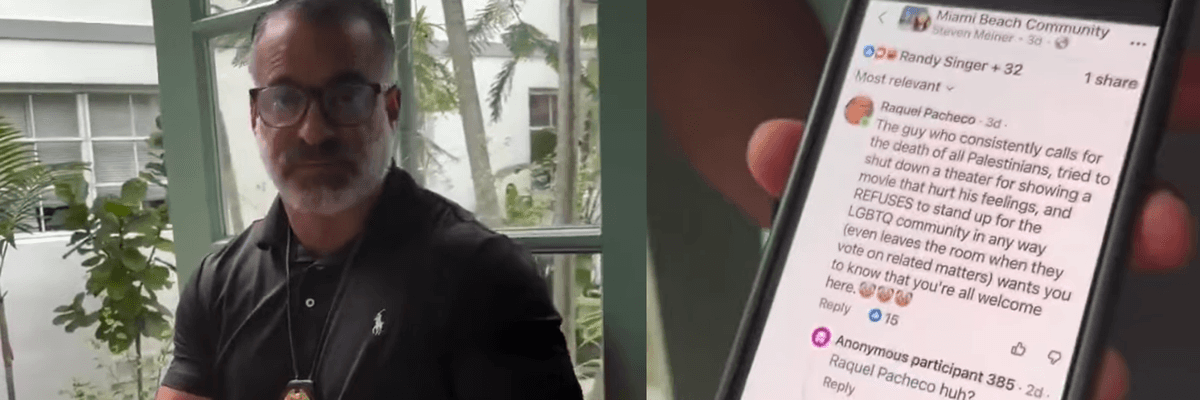
A Miami Beach police officer questions Raquel Pacheco about a Facebook post on January 12, 2026 in Miami Beach, Florida.
(Screenshots from a video by Raquel Pacheco)
Stephen Prager
Sep 29, 2026
COMMON DREAMS
A federal judge has allowed a First Amendment lawsuit to proceed against Miami Beach Mayor Steven Meiner after he allegedly had police sent to a resident’s house to question her over a social media post criticizing his support for Israel.
Judge Cecilia Altonaga of the US District Court for the Southern District of Florida on Monday denied defendants’ motion to dismiss claims filed on behalf of Miami Beach resident and veteran Raquel Pacheco.
Altonaga said that “ordering a police visit to an individual’s home to discuss the individual’s speech can constitute a restriction on speech that would support a viewpoint discrimination claim.”
On January 12, a pair of Miami Beach police officers showed up at Pacheco’s door to question her about a post she made on Facebook criticizing Meiner, an outspoken supporter of Israel and its military assault on Gaza, which has killed more than 74,000 Palestinians, including over 21,000 children.
Pacheco referred to Meiner as someone who “consistently calls for the death of all Palestinians” and “tried to shut down a theater for showing a movie that hurt his feelings,” referring to his attempt to have an independent theater’s lease terminated after it held screenings of No Other Land, an Oscar-winning documentary made by Palestinian and Israeli filmmakers about the displacement of Palestinians and demolition of homes by Israeli settlers in the occupied West Bank.
Video of the interaction shows police asking Pacheco if the post came from her account and ignoring her as she told them she would not speak to them without a lawyer.
“This is freedom of speech,” Pacheco responded. “This is America, right?”
The officers acknowledged that Pacheco was “not going to jail” and did not claim that she had threatened Meiner. One of the officers then explained that “what we’re just trying to prevent is someone else getting agitated or agreeing with the statement.”
He added that Pacheco’s statements could “probably incite somebody to do something” before telling Pacheco to “refrain from posting things like that.” The officers then left and Pacheco was never charged with a crime.
Represented by the American-Arab Anti-Discrimination Committee (ADC), Pacheco filed a lawsuit in March alleging that Miami Beach officials had used police power to violate her First Amendment rights and deter her from criticizing the mayor and Israel. The lawsuit described it as part of a broader effort by officials to chill pro-Palestinian speech.
Emails released weeks after the incident revealed that Meiner personally flagged Pacheco’s post to police, referring to it as a “dangerous escalation. Speaking to reporters on February 4, he defended his decision to alert the cops, saying that Pacheco’s post was ”absolutely false“ and referring to it as ”age-old antisemitism.“
But Altonaga said Meiner’s statements supported Pacheco’s allegation that “her viewpoint motivated Meiner’s decision to send police to her home,” allowing her viewpoint discrimination claim against him to proceed.
The court also allowed the ADC to proceed with its claim that the City of Miami Beach itself—including the mayor and police chief—had demonstrated a broader pattern of viewpoint discrimination against pro-Palestinian speech. The lawsuit cites Meiner’s attempt to shut down the local theater, as well as its law banning government contractors from boycotting Israeli businesses, including those operating in territories illegally occupied by Israel.
It also cites Meiner and other Miami Beach officials’ repeated pattern of arguing with and cutting off Pacheco and other pro-Palestinian speakers during city commission meetings while allowing pro-Israel speakers to talk with little obstruction.
During one meeting, Meiner reduced public comments for pro-Palestinian speakers to 60 seconds when they criticized the police response to Pacheco while allowing speakers who defended the police action or criticized Pacheco’s pro-Palestine viewpoint to speak for around two minutes uninterrupted.
Jenin Younes, ADC’s president and national legal director, said Monday’s ruling was “a significant victory for Raquel Pacheco, for the First Amendment, and for all Americans who care about the right to free speech and dissent.”
“The city downplayed what happened to Ms. Pacheco as a routine police visit,” Younes said. “The court disagreed, recognizing that sending police to someone’s home to question and intimidate them over their protected political speech can itself violate the First Amendment.”
“The government does not have to arrest you, prosecute you, or formally censor you to violate the First Amendment,” he added. “The chilling effect of these actions is obvious.”
Dems Rebuke Trump’s Ultra-Rich Treasury Chief Over $910,000 in Unpaid Medicare Taxes
“Until he pays what he owes, Secretary Bessent is placing himself above the law,” said Sen. Ron Wyden.
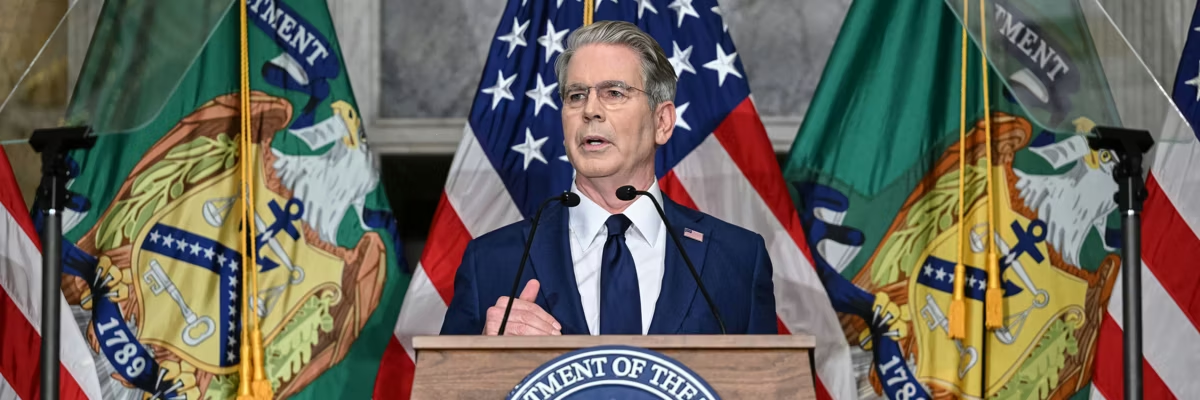
US Treasury Secretary Scott Bessent speaks during a press conference on August 24, 2026
(Photo by Mehmet Eser/Anadolu via Getty Images)
Jake Johnson
Sep 30, 2026
COMMON DREAMS
A group of Senate Democrats on Wednesday pushed US Treasury Secretary Scott Bessent to pay back the nearly $1 million in Medicare payroll taxes that he reportedly owes from his years as a hedge fund manager.
In a letter to Bessent, the senators pointed to a recent court ruling clarifying the scope of a self-employment tax loophole that is widely exploited by hedge fund managers and private equity executives. During his confirmation hearing last year, Bessent cited the then-pending litigation to justify his decision not to pay $910,000 in payroll taxes he potentially owes the Internal Revenue Service, and pledged to set up a “reserve fund to address any contingency related to this issue.”
“We write to ask whether you will uphold your commitment to pay the Medicare tax you avoided during your time as a hedge fund manager in light of last week’s Second Circuit opinion about the scope of the limited partner exception,” the Senate Democrats wrote in their letter. “Your avoidance and delay tactics have already cost the Medicare trust fund hundreds of thousands of dollars. Now that the appellate court has spoken, will you use your reserve fund to pay the avoided tax?”
Bessent, who has an estimated net worth of around $500 million, currently oversees the IRS as head of the Treasury Department, and he previously served as the tax agency’s acting commissioner.
Sen. Ron Wyden (D-Ore.), the ranking member of the Senate Finance Committee and one of the letter’s signatories, said in a statement on Wednesday that Bessent “is the highest ranking tax official in America and he is failing to lead by example by exploiting tax loopholes to avoid payroll taxes that every working American pays out of each paycheck.”
“In Trump’s America, you have to pay your fair share of taxes, but the ultra-rich like Scott Bessent get to pay what they want, when they want,” said Wyden. “Many Americans are financially struggling in Trump’s economy. Until he pays what he owes, Secretary Bessent is placing himself above the law.”
The New York Times reported last year that “like many firms on Wall Street, Mr. Bessent’s hedge fund, Key Square Capital Management, was set up as a limited partnership.”
“Through that structure, Mr. Bessent avoided paying roughly $910,000 in Medicare taxes on money he made running his hedge fund in 2021, 2022, and 2023,” the Times reported, citing a memo prepared by Democratic Senate staffers ahead of Bessent’s confirmation hearing. “Mr. Bessent’s decision to not pay the additional tax has now put him in the unusual spot of personally opposing—and having a personal stake in—how the IRS interprets tax law. And since he took office, the Treasury and IRS have backed away from developing regulations to address it.”
Under Bessent’s leadership, the Treasury Department has worked to deliver fresh tax breaks to large corporations, championed President Donald Trump’s deficit-exploding tax cuts for the wealthy, overseen the gutting of IRS staff, and refused to close loopholes leveraged by the richest people in the US—including one that benefits private jet owners.


