Saturday, October 03, 2026

Farmers unite worldwide against what they call ‘chemical colonisation’

Farmers and activists around the world are mobilising on Saturday for an international day of action against pesticides – denouncing products sold by major agrochemical companies that they say are damaging their health and destroying their livelihoods.


Issued on: 02/10/2026 - RFI

"No more cancer. Stop fumigating us," reads the banner of Exaltacion Salud protesters in Argentina demonstrating against the use of pesticdes. © Cortesía Virginia Roldán

By:  Zeenat Hansrod

“Pesticides are manufactured in France and exported to the Global South by companies who know full well that these pesticides contain molecules banned here," said Fleur Breteau, founder of Cancer Colère, one of four French organisations behind Saturday’s campaign.

"They are making money in breach of French regulations and in defiance of human rights laws.”

Farmers and organisations from countries including Pakistan and Argentina have joined the mobilisation, sharing what Breteau describes as the same anger over “chemical colonisation”.

“We, farmers, need to unite because of chemical colonialism by these very powerful agrochemical firms. As a Western person, as a French person, it is a big no because they are making money while breaching French laws,” said Breteau, who is battling breast cancer for a second time.


Illegal spraying of pesticides in Parada La Lata (Exaltación de la Cruz) in 2020, less than 1 km from a house and a rural school. © RFI/Agustín Brun


Health concerns in Argentina

In Argentina, Agustín Brun, an activist with Exaltacion Salud, a group fighting the use of chemical pesticides, also supports the campaign. He lives in Exaltacion de la Cruz in Buenos Aires province, a town closely surrounded by fields heavily sprayed with pesticides.

“The European Union and China, big buyers of our grains, export pesticides – some of which are banned in their own countries – while importing commodities at a cheaper price without having to face the socio-environmental costs and health issues of pesticide contamination at home,” Brun told RFI.

“In other words, those countries are outsourcing their problems.”

Developed countries “extract” products from Argentina that mostly benefit large pharmaceutical and agrochemical companies such as Bayer-Monsanto and Syngenta, Brun said.

“In my town we have found several agrochemicals molecules, including atrazine, in the soil, water and human blood samples. There is a high rate of cancer and other chronic diseases, higher in Exaltación de la Cruz than in nearby cities,” he said.

A landmark study by researchers at the National University of Rosario Faculty of Medical Sciences found that young people living in agricultural villages exposed to pesticide fumigation were 2.5 times more likely to develop and die from cancer than those living in areas unexposed to agrochemicals.

“We can feel it in our own bodies, you know?” Brun said. “Several members of our groups died of cancer.”


We need to unite to fight against chemical colonialism. As a Western person, we say that we refuse that firms produce forbidden pesticides in our country and send them to the global south. It's a big no. It's against the French laws.
01:00
Fleur Breteau from Cancer Colère association in FranceZeenat Hansrod

Scientific evidence has linked atrazine exposure to cancer. Scientists have described atrazine as an endocrine disruptor and said it can have neurotoxic, teratogenic and genotoxic effects, as well as harming the liver and kidneys.

Atrazine was first developed by agrochemical company Syngenta, Brun said. Syngenta is one of four global giants in the seed and pesticide sector, alongside BASF, Bayer and Corteva, and is also one of Argentina’s biggest pesticide suppliers.

Atrazine has been banned in 60 countries, including across the European Union.

In 2019, a small aircraft illegally sprayed pesticides over a school near Brun’s town.

“The children and school staff were poisoned and suffered health damage,” Brun said. “A ban against aerial spraying of pesticides was then introduced throughout our municipality, not the province, but we’ve been campaigning for such a ban since 2012.”
Global mobilisation

Exaltacion Salud is among the organisations taking part in Saturday’s global protest. Actions are also planned in countries including Costa Rica, Pakistan, the United States, Belgium and Indonesia, as well as Hawaii.

“We’ve realised that anger is healthy,” Breteau told RFI. “And it’s led us to come together and unite our forces. There are millions of us and we’re right to be angry. When we bring all this helplessness and distress together, we can become very powerful. And this is what we will demonstrate on Saturday 3 October.”

France’s emergency agriculture bill passed, amid divisions over pesticides

In France, protesters will march outside one of Syngenta’s pesticide manufacturing plants in Saint-Pierre-la-Garenne, about 100 kilometres north-west of Paris, with several actions also planned in a neighbouring field.

Farmers, cancer patients, people affected by pesticide contamination, health workers, cancer researchers and lawyers are expected to join the demonstration.

“Four giants of pesticide and seed manufacturing industry, BASF, Bayer, Corteva and Syngenta, have formed a sort of oligopoly where they wield immense power worldwide,” Breteau said. “They are patenting living organisms and are making farmers dependent on their pesticides, seeds and technology to grow food.”

Syngenta was acquired in 2017 by Chinese state-owned ChemChina, itself a subsidiary of Sinochem Holdings.

“A seed from Syngenta won’t grow if you simply put it in the ground on its own, it needs pesticides to thrive,” Breteau said. “It’s as if you were putting pesticides in a child’s feeding bottle and saying, ‘It will make them grow faster’. It’s madness.”
Syngenta's response

Syngenta told RFI that farmers must be able to rely on a range of solutions and technologies to address the interconnected challenges of agricultural production, climate change and food security.

It said it strives to develop innovative solutions for all farmers and farming models.

“We fully respect the right to assemble and protest,” a Syngenta spokesperson said. “However, organising a protest at the Saint-Pierre-la-Garenne site seems ill-founded given the reality of its current operations: 70 percent of the site’s current output is suitable for use in organic farming.”

In Kenya, Susan Owiti of the Kenyan Peasants League told RFI that most pesticides used in the country are banned in the United Kingdom. She also described their sale in poorer countries as a form of chemical colonisation.

“Whoever feeds you, controls you,” she said. “Food sovereignty is about taking control and ownership. Control over what you are growing. So, by dumping their banned products onto us, the Global South, they want to take control of our food systems.”

The Kenyan Peasants League, a social organisation representing around 5,000 peasant farmers transitioning to agroecology, is taking part in the 3 October mobilisation on social media. It plans a “Twitter storm” and Facebook posts to raise awareness about pesticides and showcase the experiences of its farmers.

Owiti, a small farmer and activist from Migori in western Kenya, said she has farmed all her life.

“Agroecology farming has been a family tradition for as long as I can remember,” she said. “It means that we work closely with nature. I use my own seeds, make my own manure and develop my own pesticides based on knowledge passed on from my grand-mother and our elders.”

“We do not rely on agrochemical companies.”

In Kenya where the majority of farmers are women, they regularly help each other when there is a lot of work. Here in Apuoyo village, female farmers are weeding a maize and beans field, September 2025. © RFI/Kenyan Peasants League

Pesticides sold by major agrochemical companies, some of which may contain banned molecules, are degrading soil, affecting the health of farmers and their families and trapping them in debt, Owiti said.

“Because they need the pesticides for the seeds purchased from these companies, the farmers find themselves borrowing money from banks to pay loans to pesticide companies,” she said.

Owiti said she had seen many women – who make up most farmers in Kenya – suffering from skin and pulmonary diseases because they do not use protective equipment when handling pesticides.

“The government needs to implement the Agroecological strategic plan launched by the ministry of Agriculture in 2024,” she said.

The National Agroecology Strategy for Food System Transformation covers the period from 2024 to 2033.

Sharing the ancestral knowledge of older farmers is another way to “fight the big companies”, Owiti said.

“The older farmers, they are like libraries holding years and years of research,” she said.

She said passing this knowledge between generations and on to younger farmers would help preserve it and allow them to move away from agribusiness practices.

Why France's agriculture law may not help the farmers it claims to defend
Political battle

Breteau also accuses lawmakers of being influenced by major agrochemical companies.

“Today the red line has been crossed and ethics trampled over,” she said. “Lawmakers, mostly from the centre to the far-right, are casting doubts over the scientific evidence between some pesticides and the diseases they cause.

“Laws are being passed that reintroduce pesticides which were previously banned due to their toxicity to human health.”

Breteau became known in July 2025 when she shouted from the public gallery of the French parliament: “You are in league with cancer and we will make sure everyone knows it.”

French MPs were debating the Duplomb Bill, which included lifting restrictions on the use of pesticides, including acetamiprid.

“There’s a political ploy to force even more pesticides upon us, not to make the life easier for farmers or food sovereignty, it is simply matter of profit,” Breteau said.

“Pesticides are designed to boost production and increase yields at the expense of our health, biodiversity, clean water whilst using as few workers as possible.”

The European Parliament will examine the Food and Feed Safety Simplification Omnibus in October. It aims to streamline food and feed legislation, while its proposal for “efficient renewal procedures for pesticides” has come under criticism.

“It will authorise more than 90 percent of the pesticides currently in circulation, even if scientific studies show they are toxic,” Breteau said.

“In other words, once voted we won’t be able to take them off the market, despite their proven toxicity. So, this is very serious because it creates an unrestricted European market for these pesticide manufacturers.

“Any Member of the European Parliament who vote for this Omnibus law, we’ll regard them as criminals.

“How are we all supposed to get better in a world that poisons us a little more every day?”

NUKE NUT

Putin says all weapons 'on agenda' if Russia's Kaliningrad attacked

Russian President Vladimir Putin speaks at the session of the Valdai Discussion Club in Moscow, Thursday, 1 October 2026.
Copyright Copyright 2026 The Associated Press. All rights reserved

By Gael Camba
Published on

Russia would consider using "all types of weapons" if its exclave of Kaliningrad was attacked, Russian President Vladimir Putin said Thursday, while insisting that Moscow had "no intention of attacking anyone."

Russian President Vladimir Putin threatened the West that he would use "all weapons" in its arsenal — including nuclear — if Kaliningrad were attacked.

Putin comments came as tensions mounted over Kaliningrad — Russia's heavily militarised territory that borders Poland, Lithuania and the Baltic Sea.

"If it comes to a direct attack on the Russian Federation... then, of course, the question of the Russian Federation deploying all types of weapons at our country's disposal will inevitably and immediately be on the agenda. This is inevitable," Putin said at the annual Valdai forum.

In recent months, NATO countries have conducted several military exercises along Kaliningrad's borders. That prompted Moscow to issue a statement condemning what it called "provocative statements and actions of the North Atlantic Alliance's leadership and NATO member states".

NATO in turn has denounced Russia's "threat of force, including any irresponsible nuclear rhetoric".

On Thursday, Putin once again condemned the "successive military exercises in the Baltic Sea" and the "attempts to intercept" Russian vessels.

"All this constitutes an escalation," he said.

"We have no intention of attacking anyone — neither in 2029, nor in 2030, nor in 2050," Putin said.

"However, if we face aggression, we will be compelled to respond. Citizens of European countries need to clearly understand this," he added.


Russia leads world in cat ownership — yet has 2.8 million strays

FILE; An elf cat at an international cat show in Sochi, 29 January 2022
Copyright AP Photo

By Irina Aleksandrova
Published on

Nearly 59% of Russian households own at least one cat, the highest rate globally, but the 2022 mobilisation order left hundreds of thousands of animals abandoned when owners fled the country or were sent to the front in Ukraine. Up to 98% of Russia's stray cats and dogs were once domestic pets.

Russia has the highest rate of cat ownership in the world, with nearly 59% of households keeping at least one cat — and an estimated 2.8 million stray cats living on its streets, a number that rose sharply after the 2022 mobilisation order sent thousands of pet owners fleeing the country or to the front amid Russia's ongoing all-out war in Ukraine

According to a 2024-2026 study by analytics platform Seasia Stats, Russia ranks first globally for cats as pets. Romania ranks second in Europe at 48%, followed by Poland at 41%, Latvia at 37% and Hungary at 35%.

Outside Europe, Indonesia, the Philippines, Thailand, New Zealand and the US also make the top 10. The Seasia Stats findings are consistent with a 2023 study by insurer Ingosstrakh and the Financial University, in which 58.8% of Russian respondents described themselves as cat owners.

A woman walks a cat on a lead in Moscow, Wednesday, 11 March 2026. Pavel Bednyakov/Copyright 2026 The AP. All rights reserved.

The stray figures come from a separate study by the Centre for Animal Nutrition and Well-being Studies, the Nika animal charity and research firm Ipsos.

They put the total stray animal population in Russia in 2025 at nearly 3.6 million, of which 2.8 million are cats and 800,000 are dogs.

Of those, around 170,000 were in shelters at the time of the study, while the rest were living on the streets. Researchers say up to 98% of stray cats and dogs were once domestic pets abandoned by their owners.

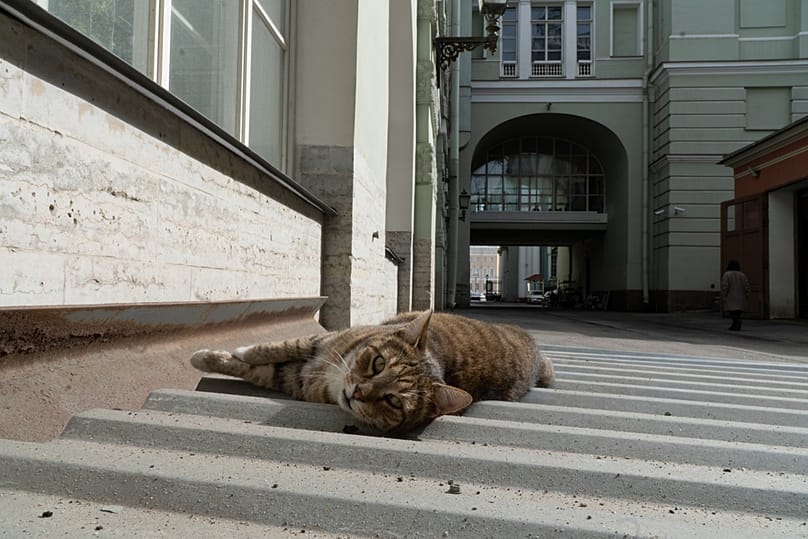
A cat living in the basement of the State Hermitage Museum in St Petersburg, Russia, 10 April 2024. Kirill Zarubin/AP

Animal welfare organisations recorded a sharp increase in abandonments after Russia announced partial mobilisation in September 2022.

Men who received call-up papers were either leaving the country or preparing for deployment and in many cases could not arrange care for their animals or find shelter places.

On classified advertising websites, owners threatened to have pets put down if no one took them. Shelter volunteers reported similar ultimatums from people surrendering animals in person.

Russia has 819 shelters, the overwhelming majority privately run, alongside hundreds of charities and tens of thousands of volunteers. Together they care for between 170,000 and 250,000 animals — no more than 5–7% of the estimated stray population.

A woman hugs a performer in a cat costume next to a portrait of Russian President Vladimir Putin on Palace Square in St Petersburg, Russia, 21 May 2023. Dmitri Lovetsky/Copyright 2023 The AP. All rights reserved

The popularity of cats in Eastern Europe has historical roots: before industrialised agriculture, cats served a practical function on farms, where their presence and scent deterred rodents.

In Southeast Asia, researchers link rising ownership to urbanisation and the growth of a middle class.

Cats have lived alongside humans for around 10,000 years. Today, they are human companions of choice, alongside dogs.


Spain faces housing protests in more than 50 cities after parliament rejects tenant protections

Protest are expected in Madrid and other major cities
Copyright AP Photo


By Simon Ormiston
Published on

The eviction of an 87-year-old woman has turned anger over rents that have nearly doubled in ten years into a threat to Pedro Sánchez's minority government.

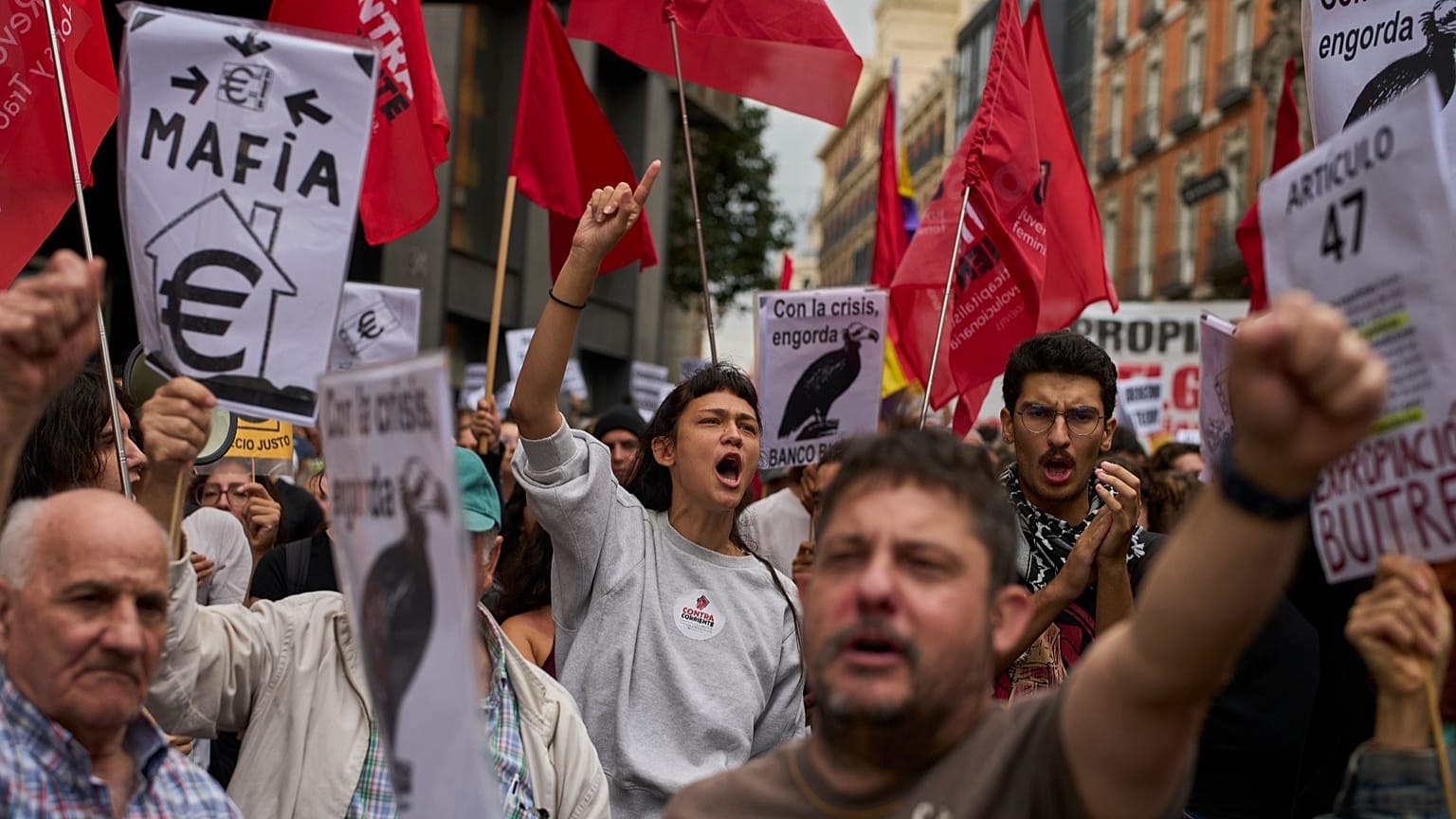
Demonstrators are set to march in more than 50 Spanish cities on Saturday, a day after parliament voted down two government decrees meant to give tenants stronger protection.

The Tenants' Union, which has been coordinating the protests, called the demonstrations. "There is an irreparable disconnect between what the people want and what the parties vote for," it said in a statement.

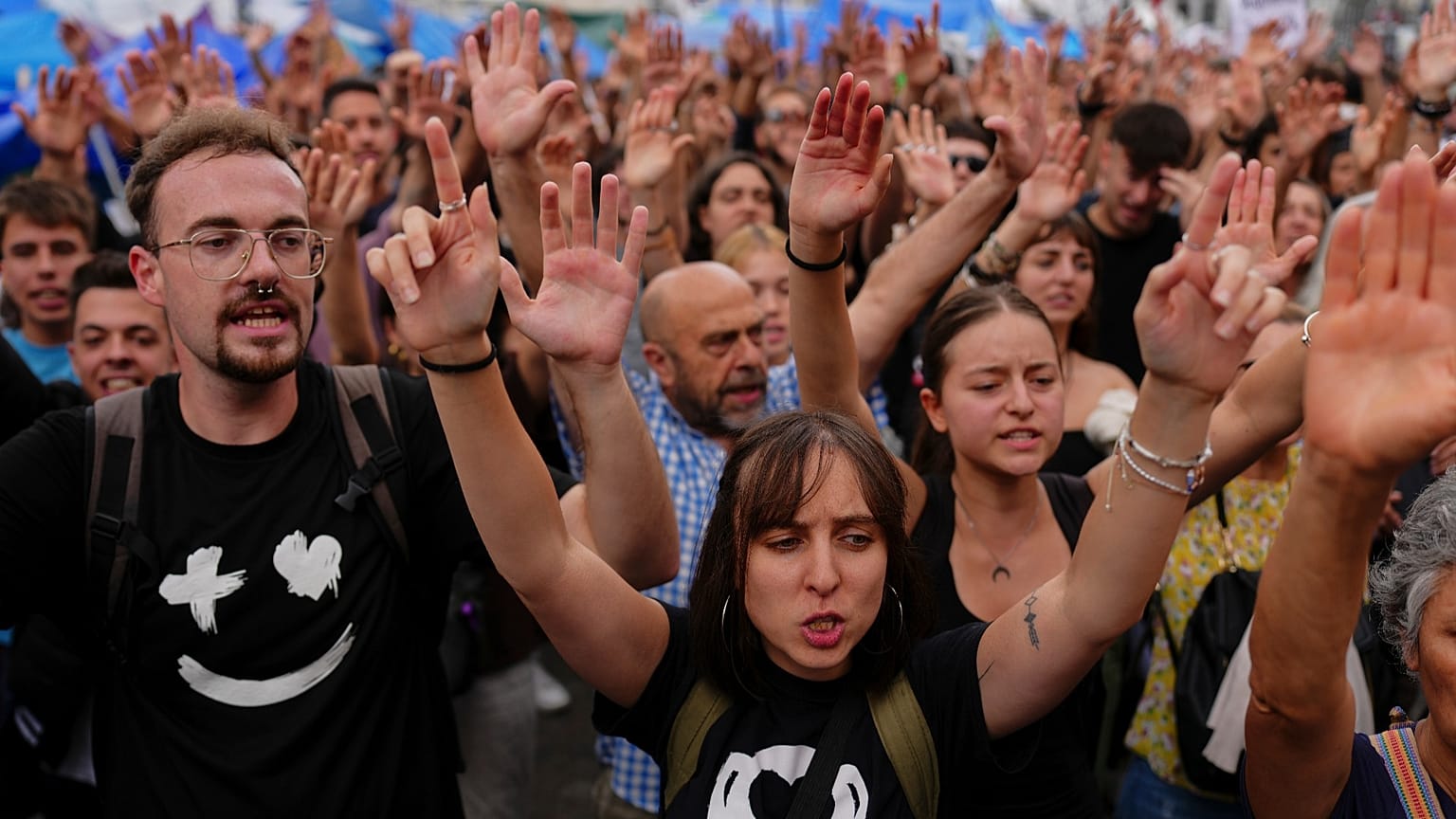
In Madrid, marchers are due to leave from several points around the city at noon and converge on Plaza de Cibeles in the centre. Activists have already been camped for about a week in Puerta del Sol, one of the capital's main tourist squares.

The anger was triggered by the eviction of 87-year-old Maricarmen Abascal, who was carried out on a stretcher from the Madrid flat where she had lived for around seven decades. Housing campaigners say an investment company had bought the property and sought to raise her rent by 275 percent. After the backlash, the new owners agreed to let her return at a low rent.

Calls for a general election

The government drew up its measures in response to the nationwide protests that followed. The package rejected on Friday would have renewed rental contracts automatically when they expired and restricted evictions of vulnerable tenants. It also took aim at so-called vulture funds, investment firms that buy properties cheaply in pursuit of higher returns.

The decrees needed the votes of the Catalan separatist party Junts, which opposed them on the grounds that they lacked rigour.

The defeat is a further setback for Socialist Prime Minister Pedro Sánchez. It has revived doubts over whether his minority government can last until the next scheduled general election in 2027.

Alberto Núñez Feijóo, leader of the conservative Popular Party (PP), the main opposition, urged Sánchez after the vote to "call elections as soon as possible". After eight years in power, he said, the prime minister had the backing of "neither the streets nor parliament". Recent opinion polls have generally put the PP ahead of the Socialists.

Housing has been a leading concern for Spaniards for years, with supply falling short of demand and costs soaring, as they have elsewhere in the European Union. Average rents have almost doubled over the past decade and asking prices for homes are up about 90 percent, according to the real estate website Idealista.


Sánchez begins reflection on early election as protesters call for general strike

Activists protest at Madrid's Puerta del Sol in Spain on Friday, 2 October 2026.
Copyright Foto AP/Manu Fernández


By Christina Thykjaer
Published on


Spanish Prime Minister will decide this weekend whether to call early elections after his two housing decrees were rejected, as housing activists prepare fresh protests and consider a general strike as the next step.

Pedro Sánchez enters a period of reflection. The Prime Minister will use this weekend to decide whether to bring forward the general election after Congress on Friday threw out two housing decrees put forward by his Socialist government.

The parliamentary defeat leaves the government facing a new scenario and Sánchez having to decide on the future of the legislature. According to government sources cited by several national media outlets, the prime minister will, over the coming days, consider whether to call elections before the end of the year.

Hours before the votes, the government had played down that possibility and insisted that an early election was not on the table because "hoy no toca" (today is not the day). After the result unfolded, the executive said it would analyse the situation without ruling out any option.

The two decrees were rejected after more than four hours of debate. The first fell by 178 votes to 172, with the Popular Party, Vox, Junts, and UPN all voting against. The second was defeated by 184 votes to 166, after the PNV and Canary Islands Coalition joined the 'no' camp.

Sánchez's political future hanging

While Sánchez's political future hangs in the balance, the reaction outside Congress has been immediate. Protesters who had been camped out for days in Puerta del Sol marched to Congress on Friday to follow a vote they regarded as crucial to their demands.

Once the rejection of the first decree was confirmed, some of the protesters headed back to Sol chanting "general strike". A general assembly was scheduled for the afternoon to decide the next steps in the movement and the future of the camp itself.

The Confederation of Tenants' Unions has also called demonstrations this Saturday in more than 50 Spanish cities and is already signalling an escalation in protest: "the next step is a general strike", the organisation said.

The spokesperson for the Tenants' Union, Alicia del Río, had already on Friday called for a general strike over housing and warned that the mobilisation would not end with the vote in Congress.

A weekend with two unknowns

The fall of the decrees opens a weekend marked by two key questions. The first will be answered in the political arena: whether Sánchez chooses to continue the legislature or bring forward the general election.

The second lies on the streets. Protests will continue this Saturday in dozens of cities, and housing campaign groups will have to decide how far to step up their mobilisation and how to put into practice their call for a general strike.

Two very different responses to the same vote, which has put on hold both the government's next move and that of a housing protest which, for now, shows no sign of ending.


Spanish Congress rejects housing laws despite Sánchez's warning: 'They'll be judged sooner than they think'


By Rafael Salido
Published on

Spanish Congress rejects two key housing measures aimed at quelling public uproar over housing affordability. The bills' rejection after last-minute talks leaves Pedro Sánchez's government without two key housing measures and exposes its struggle to win support in Congress.

Spain's parliament on Friday rejected two housing decree-laws promoted by the government of Prime Minister Pedro Sánchez, aimed at tackling a housing crisis that has spurred nationwide protests.

The two votes are a heavy political blow to Prime Minister Pedro Sanchez and went ahead as hundreds of protesters gathered outside parliament.

These rejections, delivered in a voice vote, represent a parliamentary setback for the executive and came after a sitting marked by last-minute negotiations and uncertainty over the support of its parliamentary partners. Sánchez spoke for a few minutes before the vote to urge MPs to "do the right thing or history will judge you sooner than you think and more harshly than you can imagine."

After the first of the decrees was rejected by 172 votes in favour and 178 against, a demonstration marched to Madrid's central Puerta del Sol square, chanting "General strike!" The second decree was then also voted down.

Housing affordability crisis

The government decrees were intended to quell a public uproar following the televised eviction of an 87-year-old woman last week in Madrid that sparked protests and a camp-in that has occupied Madrid’s most important square ever since. Barring a surprise, the progressive coalition of Sánchez will suffer a costly legislative defeat that will likely fan the flames of the protests.

The average rent in Spain has almost doubled in the past 10 years. The average price per square meter has risen from €8.20 in 2016 to €15.1 this year, according to the real estate website Idealista.

The elderly woman whose eviction sparked the protests, Maricarmen Abascal, has become a symbol for the fight for lower housing costs in the southern European country, where many people are priced out of buying a home and are being squeezed by a small rental market.

The company that evicted her finally caved under immense public and political pressure this week and said that she can return to the apartment. Abascal is currently in a hospital since being removed from her home on a stretcher, but her lawyer said she is happy to know she will be going home.

Crushing votes

The vote came after a morning of speeches in which the housing minister, Isabel Rodríguez, urged the different groups to back the measures, having explicitly asked Junts per Catalunya to vote in favour or abstain, after the pro-independence party announced on Thursday night that it would oppose both texts and submit its own proposal to the government. In the end, Sánchez's PSOE, Spain's social democratic party, refused to withdraw the two decrees, as the Catalan party had demanded.

Rodríguez told the chamber that one of the two decrees incorporated many of the proposals (source in Spanish) put forward by Junts. "Ninety per cent of what they handed to the prime minister is now set out in the Official State Gazette," said the housing minister, who pledged to process the decrees as a bill so that "clarifications or technical corrections" requested by the groups could be incorporated later.

The minister also warned in her speech about the consequences of the vote and appealed to MPs' sense of responsibility. "With this vote, we are deciding whether we do not want another eviction or are willing to face the next one," Rodríguez said, while hundreds of people gathered outside the Congress of Deputies, Spain's lower house of parliament, to demand a solution to the housing crisis gripping the country.

Diverging positions

The sitting began at 11:00, after Sánchez was greeted with an ovation from the socialist benches on his arrival at Congress. During the debate, the groups stuck to the positions they had set out in the preceding hours, albeit with different nuances.

The PNV, the Basque Nationalist Party, announced that it would support one of the decrees "with many doubts". Its spokesperson, Maribel Vaquero, lamented that it had not been possible to reach the minimum agreement her party had called for.

The Canarian Coalition party, a regionalist centre to centre-right party, for its part, confirmed its favourable vote on the first decree because it sees it as "a starting point."

Spain's far-left party Podemos confirmed its four votes in favour of both texts, although its secretary-general, Ione Belarra, criticised the government for having "chopped up" the measures. "It's just another excuse. People don't want excuses; they want solutions," she argued during the sitting.

EH Bildu, another Basque nationalist party leaning left, also expressed its displeasure during the debate. Its MP Oskar Matute said he was "deeply angry" at the prospect of particular interests prevailing over the measures proposed to tackle the housing problem, brought into sharp focus by Maricarmen's eviction and which culminated last weekend in a protest camp in the central Puerta del Sol square.

Opposition from conservative parties PP and Vox, together with Junts' rejection, had left the government facing particularly tight parliamentary arithmetic. The coalition executive needed to win support from different parties to get the initiatives through a chamber in which socialist parties PSOE and Sumar do not have an absolute majority.

Possible early election

The vote on the housing decrees had also sparked, within the PSOE and the government, a debate about the possibility of bringing the elections forward if Congress rejected the initiatives.

Sánchez's office insists that no decision has been taken, although government and PSOE figures had floated the possibility of Sánchez calling elections if the decrees were voted down. At the same time, other socialist leaders have urged caution and argued that the consequences of any eventual call need to be carefully weighed.

The issue is therefore tied to the outcome of a vote the government has presented as a test of the chamber's ability to reach agreements on one of the main problems facing Spanish society. Sánchez had already urged the parliamentary groups to show "a sense of perspective" in backing the measures and argued that housing should be kept out of "partisan confrontations."

While the sitting was underway, around a hundred people gathered outside Congress, mobilised by the Tenants' Union. Protesters chanted slogans against PP, Vox, and Junts and also held a banner critical of PSOE and Sumar. Police had deployed a large security operation around the chamber.


UAE says FlyDubai co-pilot attacked captain with axe in “terrorist” act

An FlyDubai plane carrying Israeli passengers who had earlier been aboard another FlyDubai aircraft that made an emergency landing in Saudi Arabia approaches near Tel Aviv.
Copyright Copyright 2026 The Associated Press. All rights reserved.

By Peter Barabas & Jane Witherspoon & Toby Gregory
Published on

The FlyDubai co-pilot who nearly crashed the Tel-Aviv bound flight is an Omani national named Hamam al-Hammami. He was barred from flying by Oman amid concerns he showed signs of extremist views. The incident threw the already hard-hit regional travel industry into crisis.

The co-pilot accused of attacking the captain of an Israel-bound FlyDubai flight used a crash axe against the captain and “attempted to carry out a terrorist attack”, the United Arab Emirates’ prosecutor general said on Saturday. A crash axe is a tool in the cockpit for the pilots to use in an emergency.

Prosecutor general Hamad Saif al-Shamsi said the co-pilot of FlyDubai flight FZ1073 tried to take control of the aircraft and that the investigation continues “to uncover all the circumstances of the incident, its motives, and related connections, in addition to completing technical examinations and examining physical and digital evidence”, according to UAE state news agency WAM.

The co-pilot who nearly crashed the Tel-Aviv bound flight with 182 people aboard is an Omani national named Hamam al-Hammami, according to Associated Press’ sources who also reported, alongside the Wall Street Journal, that he was banned from flying by Oman over concerns that he held radical ideological views.

The co-pilot was then hired by UAE-based airline FlyDubai, a source told the Associated Press. It was not immediately clear to what extent the co-pilot was vetted when hired.

The co-pilot was born in the UAE and worked with Oman’s national airline but was removed from flying because of concerns that he showed signs of extremist views. He was moved to an administrative job at Oman Air, officials said. Little else was immediately known about the co-pilot’s background. His Instagram account was active until the day of the flight and then deleted.

How the co-pilot managed to be working in the cockpit on Wednesday morning is a central question for investigators. Israel says has it has agreements with foreign carriers to keep pilots from flying into the country if they are citizens of nations that don’t maintain diplomatic relations with it. Israel and Oman do not have formal diplomatic relations.

Security agencies from four regional countries were working to establish the co-pilot’s motives, aided by the United States and other Western governments, according to the AP.

Israeli Prime Minister Benjamin Netanyahu on Friday said the co-pilot had undergone “Islamist radicalization,” but provided no evidence. There was no immediate comment Saturday from Israel’s government.

The FlyDubai captain, Indian national Smit Machchhar told India’s Prime Ministe Narendra Modhi in an emotional video from his hospital bed in Saudi Arabia on Thursday that he used his remaining energy while being attacked to unlock the cockpit door, allowing passengers and crew to come in, subdue the co-pilot and stabilise the plane.

Hailed as a global hero for saving the passengers, Machchhar said "I was fighting for my life," adding that "when I was lying on the floor I could feel the aircraft was going down. I knew exactly that this would be the last push. I told myself that if I didn't get up, there would be a problem. I managed to open the door, and then everyone else came in."

UAE presidential advisor Anwar Gargash said “the Indian pilot at Flydubai, Smit Machchhar, deserves every bit of appreciation, for he embodied the meaning of courage and responsibility in the face of a dangerous terrorist act and a potential disaster. His professionalism and moral sense in the darkest of circumstances make him a true hero.”

“Far from the easy reduction of what happened or the adoption and promotion of conspiracy theories, vigilance and caution remain essential in confronting the risks of extremism and terrorism,“ Gargash added.

Amid shock and disbelief within the UAE’s sprawling pilots community, the attack left the region’s travel industry in crisis, raising questions about aviation security and further unsettling a Middle East already shaken by the US-Iran war.

The UAE cancelled all flights to Israel, while Israel’s El Al airline cancelled its scheduled flights to the UAE following the incident. Israel and the UAE agreed on repatriation flights to bring back passengers.

The Empty Chair: Why Asia’s Youth Still Show Up – OpEd


Key Takeaways:

The essay traces India’s Cockroach Janta Party to a May 2026 chief-justice remark and NEET leak anger: spoon-and-plate sit-ins, empty chairs for students who died, and Education Minister Dharmendra Pradhan’s July resignation plus compensation and a pledge not to prosecute protesters.

It sets that beside other youth flashpoints—Myanmar since 2021, Cambodia, Sri Lanka, Bangladesh 2024, Nepal’s 2025 revolt, the southern Philippines, Indonesia’s meal-program cut—as separate stories sharing disappointment that effort does not beat proximity to power.

A second wager is World Youth Day in Seoul in August 2027 (“Take courage”), a minority Catholic event; the author says Delhi’s empty chair is a memorial and Seoul’s an invitation, and that showing up is not proof it will work.


(UCA News) –It started, more or less, with an insult. In May 2026, India’s chief justice made an offhand remark in open court about young people who can’t find work, likening them to cockroaches.

He later said he had meant something narrower — people entering professions with fake degrees — but the word was already loose in the world.

A 30-year-old postgraduate student in Boston felt something snap and posted a question online: what if all the cockroaches came together? Within days, there was a website, a mascot and a name that parodied the ruling party’s name.


The Cockroach Janta Party began as a joke and quickly became the most serious youth movement India has seen in years.

What kept it going was not the joke. It was an exam. The national medical entrance test, NEET, the exam that helps determine who becomes a doctor and who does not, had been dogged by allegations of leaks and other irregularities. Anger settled on one demand: Education Minister Dharmendra Pradhan should resign.

At sit-ins in Delhi, protesters banged spoons against steel plates — an echo of the gesture Prime Minister Narendra Modi once asked citizens to make for frontline workers during the pandemic, now directed against him. Organizers also asked people to bring candles for students who had taken their own lives after failing exams they said were rigged.

That detail tends to stop people mid-scroll. Being angry about a leaked test is one thing. Grieving over one is another.

At Jantar Mantar, protesters began leaving a steel plate and an empty chair at the edge of the sit-in — places for students who would never take another exam.


The protests eventually achieved one of their central demands. Pradhan resigned in July, after weeks of demonstrations over the NEET controversy. The government also accepted other demands from the protesters, including compensation for families of students who had died and a pledge not to pursue legal action against protesters.

But the story did not end there.

None of this occurs in isolation. Across South and Southeast Asia, a string of Gen Z‑led uprisings has reshaped politics since 2021.

The story begins in Myanmar, where the military’s 2021 coup triggered mass protests, a brutal crackdown, and a grinding civil war. Five years on, youth‑led People’s Defence Forces fight alongside ethnic armed groups, while the junta relies on air raids, conscription and foreign support to regain ground.

In Cambodia, a government assault on civil and political rights has seen record arrests for speech and activism in 2025–26, even as garment workers — many of them young — strike over unpaid wages, union discrimination and a minimum wage that does not cover rising living costs.

In Sri Lanka, mass protests in 2022 against economic collapse and elite rule helped topple a president and, two years later, brought a leftist coalition to power — yet young people still face high unemployment and austerity.

In Bangladesh, a 2024 student movement ended Sheikh Hasina’s long rule and restored a mainstream opposition party, but the underlying grievances — jobs, corruption, authoritarian habits — remain.

In Nepal, the Sept. 2025 “Gen Z” revolt began over social media bans and swelled into anger at corruption, nepotism and blocked opportunities. It forced a prime minister’s resignation, led to an interim government and fresh elections, and produced a ten‑point agreement on free education and healthcare, employment guarantees and digital rights — though activists marking the one‑year anniversary say many promises are unfulfilled and youth unemployment hovers near 20%.


Old insurgencies in the southern Philippines keep reigniting despite treaties meant to end them.

Indonesia has quietly trimmed its free meal program, a cut that will land hardest on families with the least room to absorb it.

These are not the same stories wearing different costumes; they are separate ones that happen to share a mood. That is a smaller and more honest claim than the grand, sweeping narratives op‑eds often reach for.

The mood, if it must be named, is disappointment rather than rage. Rage tends to burn out; this has not.

A leaked exam does more than cheat students who studied honestly. It signals, in plain terms, that integrity was optional and they weren’t told.

That is a bitter lesson at 20, just when people are supposed to learn whether effort or proximity to power pays. Disappointment is what you feel when the chair you were promised is still empty, and no one will say when it will be filled.

And yet none of this reads as despair.

Despair does not organize. It does not turn a judge’s insult into a movement with spokespeople sitting across from government ministers. Nothing was resolved in those early meetings in Delhi, but people showed up. Those who have truly given up stay home. The ones still in the streets are betting that noise works, even when the evidence for that bet is thin.

Halfway across the region, a quieter gathering is making a stranger version of the same wager.

In August 2027, Seoul will host World Youth Day, the global Catholic gathering that has never before landed in a country where Christians are a minority.

Only about one in ten South Koreans is Catholic, and roughly half describe themselves as having no religion at all, which makes the choice of venue almost provocative on its own terms.

Preparations began in November 2024, when young Koreans received the event’s traveling cross and a Marian icon from Portuguese pilgrims inside St. Peter’s Basilica, on the feast celebrating Christ the King.

The theme, borrowed from the Gospel of John, is short and pointed: “Take courage; I have overcome the world.” It reads less like a slogan and more like something said to someone who is, in fact, currently losing.

In Seoul, the cross will move through a city where most people have no religion; the pews will be full for a week, then empty again. The wager is the same: set a place, show up, and hope someone sits. But there is a difference. In Delhi, the empty chair is a memorial to futures stolen by leaks and lies. In Seoul, the empty chair is an invitation: a minority church, born in secrecy and martyrdom, is betting that a week of song, prayer and shared meals can make a dent in a secular, hyper‑competitive society where young people are among the most stressed and least hopeful on earth.


I don’t imagine the protesters in Delhi and the pilgrims in Seoul would recognize themselves in one another. Most have never heard of one another and never will. But both are staking something on the same unfashionable idea: showing up still matters even without much proof that it does. That is a strange kind of courage — no guarantees attached, no way of knowing whether it will be worth it. In both cities, someone is arranging chairs: one row for the dead, one row for the living.

Governments may respond to this particular wave, or they may not. Trust, once spent, does not refill itself through silence. And I do not think anyone involved — protester, pilgrim, or minister — actually knows which way this one goes.

Neither do I.


The views expressed in this article are those of the author and do not necessarily reflect the official editorial position of UCA News.


About Dr. Fr. John Singarayar
Dr. Fr. John Singarayar, SVD, is a member of the Society of the Divine Word, India Mumbai Province, and holds a doctorate in Anthropology. He is the author of seven books and a regular contributor to academic conferences and scholarly publications in the fields of sociology, anthropology, tribal studies, spirituality, and mission studies. He currently serves at the Community and Human Resources Development Centre in Tala, Maharashtra.
View all posts by Dr. Fr. John Singarayar →