Spain faces housing protests in more than 50 cities after parliament rejects tenant protections
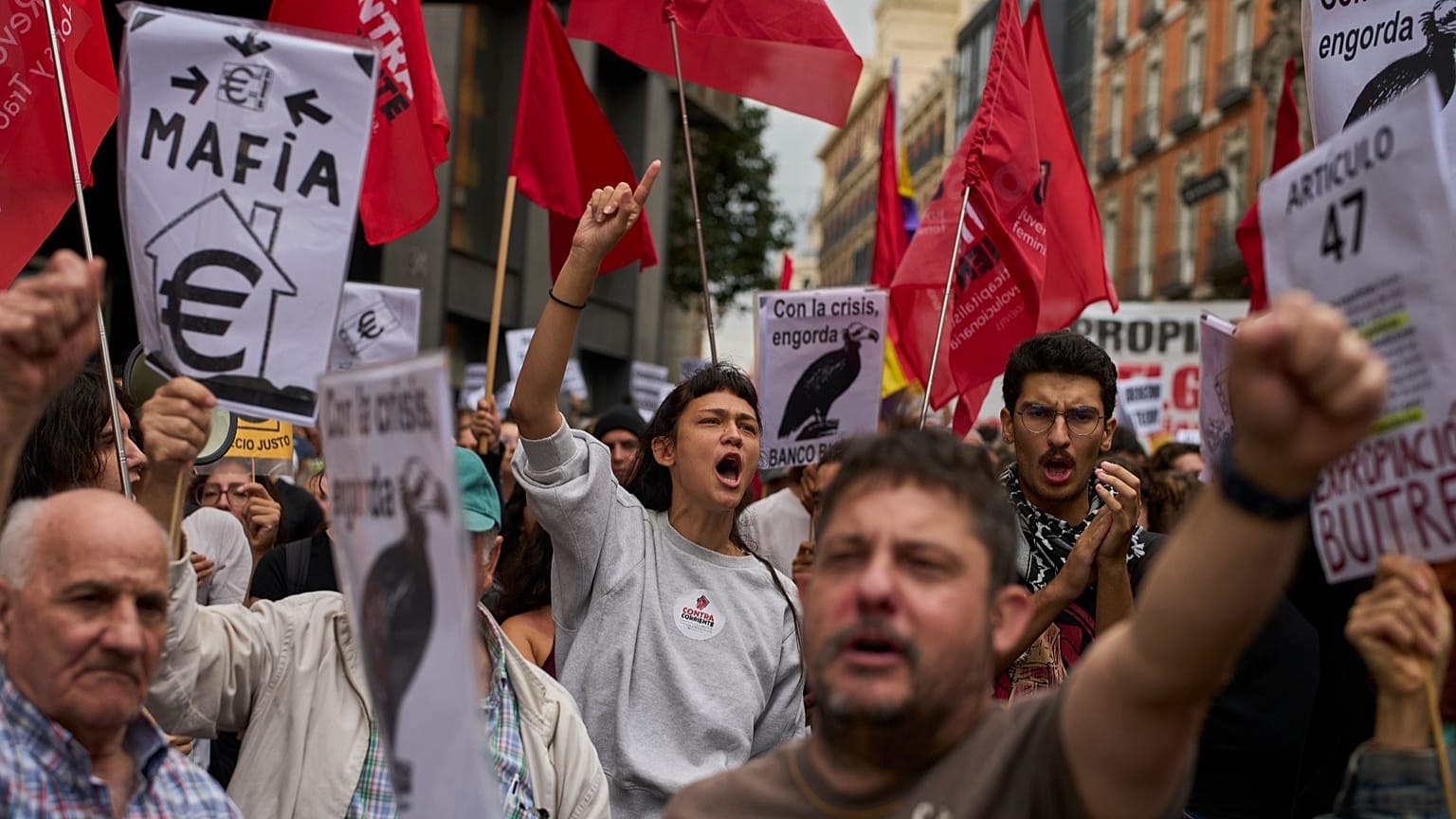
The eviction of an 87-year-old woman has turned anger over rents that have nearly doubled in ten years into a threat to Pedro Sánchez's minority government.
Demonstrators are set to march in more than 50 Spanish cities on Saturday, a day after parliament voted down two government decrees meant to give tenants stronger protection.
The Tenants' Union, which has been coordinating the protests, called the demonstrations. "There is an irreparable disconnect between what the people want and what the parties vote for," it said in a statement.
In Madrid, marchers are due to leave from several points around the city at noon and converge on Plaza de Cibeles in the centre. Activists have already been camped for about a week in Puerta del Sol, one of the capital's main tourist squares.
The anger was triggered by the eviction of 87-year-old Maricarmen Abascal, who was carried out on a stretcher from the Madrid flat where she had lived for around seven decades. Housing campaigners say an investment company had bought the property and sought to raise her rent by 275 percent. After the backlash, the new owners agreed to let her return at a low rent.
Calls for a general election
The government drew up its measures in response to the nationwide protests that followed. The package rejected on Friday would have renewed rental contracts automatically when they expired and restricted evictions of vulnerable tenants. It also took aim at so-called vulture funds, investment firms that buy properties cheaply in pursuit of higher returns.
The decrees needed the votes of the Catalan separatist party Junts, which opposed them on the grounds that they lacked rigour.
The defeat is a further setback for Socialist Prime Minister Pedro Sánchez. It has revived doubts over whether his minority government can last until the next scheduled general election in 2027.
Alberto Núñez Feijóo, leader of the conservative Popular Party (PP), the main opposition, urged Sánchez after the vote to "call elections as soon as possible". After eight years in power, he said, the prime minister had the backing of "neither the streets nor parliament". Recent opinion polls have generally put the PP ahead of the Socialists.
Housing has been a leading concern for Spaniards for years, with supply falling short of demand and costs soaring, as they have elsewhere in the European Union. Average rents have almost doubled over the past decade and asking prices for homes are up about 90 percent, according to the real estate website Idealista.
Sánchez begins reflection on early election as protesters call for general strike

Spanish Prime Minister will decide this weekend whether to call early elections after his two housing decrees were rejected, as housing activists prepare fresh protests and consider a general strike as the next step.
Pedro Sánchez enters a period of reflection. The Prime Minister will use this weekend to decide whether to bring forward the general election after Congress on Friday threw out two housing decrees put forward by his Socialist government.
The parliamentary defeat leaves the government facing a new scenario and Sánchez having to decide on the future of the legislature. According to government sources cited by several national media outlets, the prime minister will, over the coming days, consider whether to call elections before the end of the year.
Hours before the votes, the government had played down that possibility and insisted that an early election was not on the table because "hoy no toca" (today is not the day). After the result unfolded, the executive said it would analyse the situation without ruling out any option.
The two decrees were rejected after more than four hours of debate. The first fell by 178 votes to 172, with the Popular Party, Vox, Junts, and UPN all voting against. The second was defeated by 184 votes to 166, after the PNV and Canary Islands Coalition joined the 'no' camp.
Sánchez's political future hanging
While Sánchez's political future hangs in the balance, the reaction outside Congress has been immediate. Protesters who had been camped out for days in Puerta del Sol marched to Congress on Friday to follow a vote they regarded as crucial to their demands.
Once the rejection of the first decree was confirmed, some of the protesters headed back to Sol chanting "general strike". A general assembly was scheduled for the afternoon to decide the next steps in the movement and the future of the camp itself.
The Confederation of Tenants' Unions has also called demonstrations this Saturday in more than 50 Spanish cities and is already signalling an escalation in protest: "the next step is a general strike", the organisation said.
The spokesperson for the Tenants' Union, Alicia del Río, had already on Friday called for a general strike over housing and warned that the mobilisation would not end with the vote in Congress.
A weekend with two unknowns
The fall of the decrees opens a weekend marked by two key questions. The first will be answered in the political arena: whether Sánchez chooses to continue the legislature or bring forward the general election.
The second lies on the streets. Protests will continue this Saturday in dozens of cities, and housing campaign groups will have to decide how far to step up their mobilisation and how to put into practice their call for a general strike.
Two very different responses to the same vote, which has put on hold both the government's next move and that of a housing protest which, for now, shows no sign of ending.
Spanish Congress rejects housing laws despite Sánchez's warning: 'They'll be judged sooner than they think'
Spanish Congress rejects two key housing measures aimed at quelling public uproar over housing affordability. The bills' rejection after last-minute talks leaves Pedro Sánchez's government without two key housing measures and exposes its struggle to win support in Congress.
Spain's parliament on Friday rejected two housing decree-laws promoted by the government of Prime Minister Pedro Sánchez, aimed at tackling a housing crisis that has spurred nationwide protests.
The two votes are a heavy political blow to Prime Minister Pedro Sanchez and went ahead as hundreds of protesters gathered outside parliament.
These rejections, delivered in a voice vote, represent a parliamentary setback for the executive and came after a sitting marked by last-minute negotiations and uncertainty over the support of its parliamentary partners. Sánchez spoke for a few minutes before the vote to urge MPs to "do the right thing or history will judge you sooner than you think and more harshly than you can imagine."
After the first of the decrees was rejected by 172 votes in favour and 178 against, a demonstration marched to Madrid's central Puerta del Sol square, chanting "General strike!" The second decree was then also voted down.
Housing affordability crisis
The government decrees were intended to quell a public uproar following the televised eviction of an 87-year-old woman last week in Madrid that sparked protests and a camp-in that has occupied Madrid’s most important square ever since. Barring a surprise, the progressive coalition of Sánchez will suffer a costly legislative defeat that will likely fan the flames of the protests.
The average rent in Spain has almost doubled in the past 10 years. The average price per square meter has risen from €8.20 in 2016 to €15.1 this year, according to the real estate website Idealista.
The elderly woman whose eviction sparked the protests, Maricarmen Abascal, has become a symbol for the fight for lower housing costs in the southern European country, where many people are priced out of buying a home and are being squeezed by a small rental market.
The company that evicted her finally caved under immense public and political pressure this week and said that she can return to the apartment. Abascal is currently in a hospital since being removed from her home on a stretcher, but her lawyer said she is happy to know she will be going home.
Crushing votes
The vote came after a morning of speeches in which the housing minister, Isabel Rodríguez, urged the different groups to back the measures, having explicitly asked Junts per Catalunya to vote in favour or abstain, after the pro-independence party announced on Thursday night that it would oppose both texts and submit its own proposal to the government. In the end, Sánchez's PSOE, Spain's social democratic party, refused to withdraw the two decrees, as the Catalan party had demanded.
Rodríguez told the chamber that one of the two decrees incorporated many of the proposals (source in Spanish) put forward by Junts. "Ninety per cent of what they handed to the prime minister is now set out in the Official State Gazette," said the housing minister, who pledged to process the decrees as a bill so that "clarifications or technical corrections" requested by the groups could be incorporated later.
The minister also warned in her speech about the consequences of the vote and appealed to MPs' sense of responsibility. "With this vote, we are deciding whether we do not want another eviction or are willing to face the next one," Rodríguez said, while hundreds of people gathered outside the Congress of Deputies, Spain's lower house of parliament, to demand a solution to the housing crisis gripping the country.
Diverging positions
The sitting began at 11:00, after Sánchez was greeted with an ovation from the socialist benches on his arrival at Congress. During the debate, the groups stuck to the positions they had set out in the preceding hours, albeit with different nuances.
The PNV, the Basque Nationalist Party, announced that it would support one of the decrees "with many doubts". Its spokesperson, Maribel Vaquero, lamented that it had not been possible to reach the minimum agreement her party had called for.
The Canarian Coalition party, a regionalist centre to centre-right party, for its part, confirmed its favourable vote on the first decree because it sees it as "a starting point."
Spain's far-left party Podemos confirmed its four votes in favour of both texts, although its secretary-general, Ione Belarra, criticised the government for having "chopped up" the measures. "It's just another excuse. People don't want excuses; they want solutions," she argued during the sitting.
EH Bildu, another Basque nationalist party leaning left, also expressed its displeasure during the debate. Its MP Oskar Matute said he was "deeply angry" at the prospect of particular interests prevailing over the measures proposed to tackle the housing problem, brought into sharp focus by Maricarmen's eviction and which culminated last weekend in a protest camp in the central Puerta del Sol square.
Opposition from conservative parties PP and Vox, together with Junts' rejection, had left the government facing particularly tight parliamentary arithmetic. The coalition executive needed to win support from different parties to get the initiatives through a chamber in which socialist parties PSOE and Sumar do not have an absolute majority.
Possible early election
The vote on the housing decrees had also sparked, within the PSOE and the government, a debate about the possibility of bringing the elections forward if Congress rejected the initiatives.
Sánchez's office insists that no decision has been taken, although government and PSOE figures had floated the possibility of Sánchez calling elections if the decrees were voted down. At the same time, other socialist leaders have urged caution and argued that the consequences of any eventual call need to be carefully weighed.
The issue is therefore tied to the outcome of a vote the government has presented as a test of the chamber's ability to reach agreements on one of the main problems facing Spanish society. Sánchez had already urged the parliamentary groups to show "a sense of perspective" in backing the measures and argued that housing should be kept out of "partisan confrontations."
While the sitting was underway, around a hundred people gathered outside Congress, mobilised by the Tenants' Union. Protesters chanted slogans against PP, Vox, and Junts and also held a banner critical of PSOE and Sumar. Police had deployed a large security operation around the chamber.

No comments:
Post a Comment