Monday, October 12, 2026


Musk backs Trump call to replace Ukraine's Zelenskiy as diesel row deepens

Musk backs Trump call to replace Ukraine's Zelenskiy as diesel row deepens
Ukraine's main backer is easing sanctions on Moscow, the owner of its battlefield internet wants a new president in Kyiv and Europe has few cards to play. / bne IntelliNewsFacebook
By Ben Aris in Berlin October 11, 2026

Elon Musk has backed Donald Trump's call for Ukraine to replace President Volodymyr Zelenskiy, deepening a row over Russian diesel that has left Kyiv more isolated from Washington than at any time since the 2025 Oval Office clash.

"Zelensky has gone too far," the SpaceX owner wrote on X on October 10, hours after Trump told reporters at Joint Base Andrews that "I think it's time for Ukraine to get a new president," the Kyiv Post reported on October 11. Trump was furious that Ukrainian drones kept hitting Russian refineries after he had told Zelenskiy to stop. "I said to him, 'Do what you want. Don't hit refineries,' and he went out, and he hit," Trump said. "He's better damn well stop."

Zelesnkiy retorted in an interview: "Donald Trump has no power to remove me from office. I believe many people in the United States still stand with Ukraine, and I will fight until the end, until the Ukrainian people, whom I love so deeply, finally see victory."

Musk's company runs Starlink, the satellite network Ukraine's troops and drone units rely on for battlefield communications. The Trump administration has threatened to cut Ukriane off from US satellite intelligence that would be a serious military disadvantage and impare its ability to target Russian assets, including refineries. Kyiv now faces a US administration that is also easing sanctions on Moscow rather than tightening them, at a time where Russia's winter barrage of cities and key power facilities is building rapidly. Ukraine's European allies are rallying behind Zelenskiy but hold few of the cards that would decide any deal with Russia and have no leverage over the White House decisions. 

Starlink as leverage

Nobody in Washington has threatened to switch Starlink off, but Musk has already shown he is willing to limit how Ukraine uses it. In August he refused Kyiv's request to let Starlink guide strikes deep inside Russia, arguing that it risked escalation, The Atlanticat the time. SpaceX had turned down a similar request over Crimea in 2022 and has since restricted the service's use for drone operations, Euromaidan Press reported on October 5.

Kyiv knows the risk. Zelenskiy has said Ukraine is working on its own Starlink-style system and that the groundwork is in place, and Fire Point co-founder Denys Shtilerman has said the drone and missile maker launched two satellites this year and plans dozens more in 2027. None of that will replace Starlink on the front line this winter.

In parallel, Russia is building its own version of Skylink, Rassvet, that is much more advanced with a dozen satellites already in orbit and is expected to cover all of Ukriane's territory by 2027. 

Ukraine's government has closed ranks behind the president. "He has the support of the Ukrainian people, and they have the right to decide. Statements from abroad only confirm that he is doing his job well," Foreign Minister Andrii Sybiha wrote on X the next day.

Misreading Washington

The White House sees Kyiv's anger as a miscalculation. "Zelensky is misreading the room. By continuing to hit refineries, he is eroding the good will that he has built with Trump over the last six months," a US official told Axios' Barak Ravid on October 10.

Zelenskiy had called the diesel waiver "absolutely terrible" and a "birthday present for Putin", and said Ukraine's negotiators in Miami had been used as "cover" while Trump and Putin settled fuel supplies. The delegation, led by Rustem Umierov and Kyrylo Budanov, flew home on October 10 without holding a planned second day of talks with US envoys Steve Witkoff and Jared Kushner. The first day "ended up being longer and with a slightly different flavour," presidential communications adviser Dmytro Lytvyn told journalists.

The row is the latest in a long run of public clashes. Trump sent Zelenskiy home from the White House after their Oval Office shouting match in February 2025, called his refusal to recognise Crimea as Russian "very harmful" to peace talks in April 2025, and accused Ukraine's leadership of showing "ZERO GRATITUDE" when Kyiv pushed back against Washington's 28-point peace plan in November 2025. By September this year Trump was telling Zelenskiy that he "has to stop knocking out diesel fuel in Russia".

Trump now presents Putin as the more willing partner, following a "very friendly" one and half hour call the two held the same day as the Ukrainian delegration was meeting the US envoys in Miami.

"President Putin would like to see a settlement, strongly," Trump said on October 10, describing his phone call with the Russian leader the previous day, AFP reported. "I think he should have an election," he said of Zelenskiy. The Kremlin's own account of the call, from aide Yuri Ushakov, was that Putin had ruled out peace talks for now and would press on until Russia achieved "all its objectives".

Moscow has seized on the split. Kremlin spokesman Dmitry Peskov told Russian media on October 11 that Zelenskiy was in a state of hysteria. "If Zelenskiy were capable of considered actions, he would show a readiness for peace talks," Peskov said, according to local reports.

The Kyiv City State Administration advised capital residents on October 11, to stockpile at least three days of food and water, charge portable batteries, and insulate living spaces ahead of winter following Russian attacks on regional energy facilities. Municipal guidelines recommended three liters of drinking water and 10 to 12 liters of technical water daily per adult, after weekend strikes disrupted the metro network, knocked water pumping stations offline, and triggered emergency blackouts.

A diesel deal that changes little

Under the deal Trump announced on October 9, Russia will supply 300,000 tonnes of diesel immediately, 500,000 tonnes in November and 1mn tonnes after that, possibly rising to 3mn tonnes depending on the state of its refineries. The US Treasury has issued a general licence for Russian diesel transactions running to April 7, 2027, only three weeks after Trump signed the Graham sanctions act, the sweeping sanctions bill that was meant to squeeze Moscow's energy revenues. Several commentators noted that the license runs for six months starting on October 7, Putin's 74th birthday. 

Moscow may have given little away. Russian diesel output has probably been running ahead of domestic demand for weeks, by about 130,000 b/d in September according to an estimate by Kpler, and demand has fallen further since the harvest, the Russian Oil & Gas Monitor analysis account noted on X. Russia's export ban would probably have been lifted by November 1 regardless, it said.

The deal would only lower prices if it raised Russian refinery runs, which have been down by between a third and a half since May as Ukraine's drones hit about four plants a week. That puts Trump's goal of cheaper fuel at home, where retail diesel is approaching $6 a gallon a month before the midterm elections, in direct conflict with Ukraine's most effective weapon against Russia's economy, at a time when defences dwindle and Kyiv has already been blacked out ahead of the first winter snows. 

Zelenskiy offered a way out on October 11. Ukraine is ready to stop striking Russian refineries if Moscow stops attacking Ukraine's energy infrastructure, he said, but any de-escalation must be "mutual and come with real guarantees," Reuters reported. The toll from Russia's strike on Zaporizhzhia on October 10 had risen to 23, including four children, he said, as missile strikes hit Ukrainian cities on a daily basis. The mayor of Kyiv has already advised those residents that can to leave the city. 

Congress pushes back, Europe rallies

Opposition in Washington is building in Trump's own party. Republican congressman Brian Fitzpatrick is drafting a bipartisan "Ronald Reagan Peace Through Strength Act" to ban all purchases of Russian oil and petroleum products, and fellow Republican Don Bacon has said he will co-sponsor it, the Kyiv Post reported on October 11.

"I consider the president's policy regarding Russia and Ukraine a failure," Bacon told Ukrainska Pravda. The bill would still have to pass both chambers and face a likely veto.

Europe is offering words of support and more consultations. Coalition of the Willing discussions were scheduled for October 10-12, though "the format is still being worked out," Lytvyn said, and Zelenskiy said he would speak to European leaders again on October 11. EU foreign ministers are due to approve a fresh round of sanctions listings on October 12. But Europe cannot offer Kyiv what only Washington can: intelligence, Patriot interceptors and a seat at the table with Putin.

Zelenskiy has spent most of the autumn trying to win Trump back, pitching an energy truce in September even as he was sounding increasingly desperate over air defence. Trump has meanwhile backed plans to trade sanctions relief for prisoners and Putin has been invited to the G20 summit in Miami in December. The diesel deal is the clearest sign yet that the White House sees doing business with Moscow as a bigger prize than keeping Kyiv onside.

 

Missile War Monitor: Russia hits Kharkiv power plant hours after Trump's energy ceasefire call

Missile War Monitor: Russia hits Kharkiv power plant hours after Trump's energy ceasefire call
Russia struck a Kharkiv power plant on October 11 shortly after Donald Trump announced an energy ceasefire, Volodymyr Zelenskiy said, as Ukrainian drones shut a third Yandex data centre. / bne IntelliNews
By Ben Aris in Berlin October 12, 2026

Russia struck Kharkiv's CHP-5 power plant on October 11, shortly after US President Donald Trump announced an "energy ceasefire", President Volodymyr Zelenskiy said, the Kyiv Independent reported.

"Effective immediately, there is an ENERGY CEASEFIRE in the War between Russia and Ukraine. Both parties have agreed," Trump wrote on Truth Social, giving no terms or duration, AP reported. Moscow did not immediately comment. A senior Ukrainian official told the Kyiv Independent that Kyiv had no information about the ceasefire, and the Presidential Office confirmed that the Kharkiv strike came after Trump's post.

"Just now, there was a strike on CHP-5 in Kharkiv - on Kharkiv's energy infrastructure," Zelenskiy said.

He later told European Commission President Ursula von der Leyen that Russia had hit a power plant in Kyiv with a Shahed drone before their call, cutting power to many districts, and then energy facilities in the Kharkiv region, Ukrinform reported. Kharkiv regional prosecutors said an energy facility in the city's suburbs was attacked with what were preliminarily identified as Banderol-type missiles, Ukrinform said.

Zelenskiy said Ukraine was "ready to refrain from striking Russian energy infrastructure - and we count on the same readiness from Russia", AP reported. Earlier on October 11 he had offered to stop hitting Russian oil refineries if Russia stopped attacking Ukraine's grid, with "real guarantees", UNITED24 reported. The Kremlin rejected an energy truce in late September, IntelliNews reported.

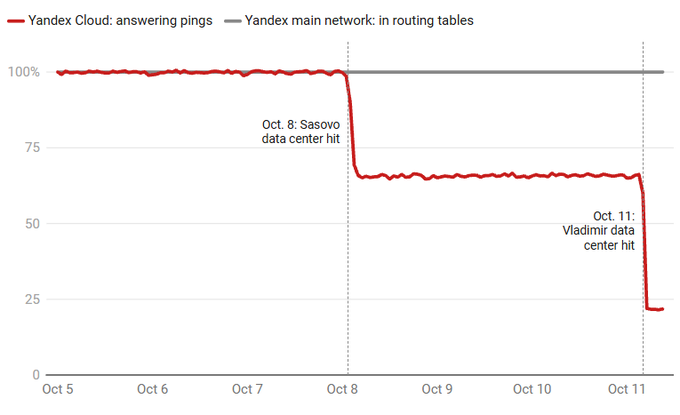
Overnight on October 11 Ukrainian drones shut a third Yandex data centre in four days, in Vladimir. "Operations at the data center have been completely halted. There were no injuries," Yandex Cloud said, AP reported.

Share of Yandex Cloud addresses answering pings, October 5-11, 2026, falling after the Sasovo and Vladimir data-centre strikes. Chart posted by OSINTtechnical, citing IODA internet-outage data; not independently verified.

Neither Ukraine's Air Force nor Russia's defence ministry had published a tally for the night of October 11-12 at the time of writing, and the Russian side of last night is not yet fully reported at the time of writing.

Refinery strikes

Nationwide: no new Ukrainian strike on a Russian refinery was reported for October 11 or the night of October 11-12 at the time of writing. Plants reported halted or cut so far in October account for about 14.8mn tonnes a year, or 5% of Russia's 327mn tonnes nameplate capacity, by IntelliNews' refinery ledger, and up to 162.9mn tonnes, or 50%, if halts reported earlier still hold. Deputy Prime Minister Alexander Novak put capacity under repair at about 10% in early September.

Ukraine: Zelenskiy's offer ties any pause in the refinery campaign to an end to Russian strikes on Ukraine's grid. "Ukraine will be ready to stop strikes on Russian oil refineries if Russia stops attacking our energy infrastructure. Any de-escalation measures must be reciprocal and backed by real guarantees," he said, UNITED24 reported. AFP, via Malay Mail, quoted a slightly different translation of the same post.

Metal plants hit

Dnipropetrovsk region: Russia attacked four districts more than 50 times on October 11 with drones and artillery, damaging infrastructure and a gas station in the Kryvyi Rih district, a warehouse in Samar and businesses in the Nikopol district, with no casualties, regional military administration head Oleksandr Hanzha said, Ukrinform reported. No strike on a named steel, iron ore, coke, ferroalloy, pipe or non-ferrous plant was reported for October 11 or the night of October 11-12 at the time of writing.

Oil depots, factories and military targets in Russia

Vladimir region: Yandex Cloud said the platform was in emergency mode and told customers to activate disaster-recovery plans, Al Jazeera reported. The Kyiv Post said more than 80 services were disrupted, from the Alice voice assistant and Yandex Music to banking apps and the Magnit and Fix Price retail chains, and that Yandex had removed its data-centre locations in four regions from its maps. Governor Alexander Avdeyev said heat and water had been restored, and about 80% of power, by the morning of October 11, the paper said.

Zelenskiy had said after the first strike, on Sasovo, that Ukraine responds "in mirror-like fashion" because Russia has been hitting Ukrainian data centres, Al Jazeera reported.

Moscow: Mayor Sergei Sobyanin said 16 drones heading for the capital were destroyed overnight on October 12, with no damage or casualties reported, Interfax reported.

Kaluga region: Governor Vladislav Shapsha said 37 drones were destroyed over the evening and night, with preliminarily no casualties or damage, Interfax reported.

Krasnodar region: drone debris fell on the grounds of Sochi airport overnight on October 11 and set fire to an administrative building, which was quickly put out, with no casualties, the regional operational headquarters said, AiF reported.

Samara region: in an update, Ukraine's General Staff said it struck Transneft's Samara oil pumping station near Prosvet again on the night of October 9-10, after strikes on October 2 and October 7, and that the damage was being clarified, Espreso reported. There was no Russian confirmation.

Occupied Donbas: the General Staff said it hit supply depots near Horodyshche and Makiivka, a repair unit near Chystiakove and troop concentrations near Irmino, Purdivka and Lysychansk on the night of October 10-11, Interfax-Ukraine reported.

Nationwide: Russia's defence ministry claimed 479 Ukrainian drones were destroyed between 20:00 on October 10 and 08:00 on October 11, and 112 more between 08:00 and 20:00, Ukraina.ru reported. Both are defence ministry claims.

Ukraine under fire

Nationwide: Russia launched 116 strike drones from 18:00 on October 10, 95 of them jet-powered Shahed types, and 94 were downed or suppressed by 08:30, with 10 hitting seven locations, the Air Force said, Ukrinform reported. Over the past week Russia launched about 1,450 guided bombs, 75 missiles and more than 1,640 attack drones, about 60% of them jet-powered, Zelenskiy said, UNITED24 reported.

Zelenskiy also counted more than 200 Russian strikes on power generation and transmission and 17 on gas and oil facilities over the week, the Kyiv Independent reported.

Kyiv: Mayor Vitali Klitschko said a high-voltage line was damaged on October 11 and water pressure fell on both banks of the Dnipro, and DTEK reported short outages across the city, the Kyiv Independent reported. The city administration told residents to stock at least three days of food and water, three litres of drinking water and 10 to 12 litres of technical water per adult a day, after strikes on October 10 halted all three metro lines and knocked out water pumping, the Kyiv Post reported.

Kharkiv region: a missile strike on a residential area of Pisochyn at about 19:25 on October 11 killed three people, a 16-year-old boy and women aged 19 and 51. Governor Oleh Syniehubov said 22 people were injured, Ukrinform reported, while the National Police put the figure at 25, the Kyiv Independent reported.

Kharkiv: a guided bomb on the Nemyshlianskyi district on October 11 killed a 36-year-old woman and injured nine people, including a seven-year-old boy, the State Emergency Service said, Ukrinform reported. The Kyiv Post earlier gave her age as 35 and the injured as 10, with 35 houses damaged.

Zaporizhzhia: in an update on the October 10 guided-bomb strike, the State Emergency Service said the search was over, with 20 dead, including four children, and 17 injured, including three children, Ukrinform reported. UNITED24 put the toll at 23, including four children, citing Ukrainian authorities.

Ivano-Frankivsk: a drone strike on the evening of October 11 killed three service members and injured three, Mayor Ruslan Martsinkiv said, the Kyiv Independent reported.

Donetsk region: three FAB-250 bombs with guidance kits hit a residential area of Sloviansk at about 09:45 on October 11, injuring seven people and damaging nine apartment buildings and a shop, and two people were injured in Yasnohirka, regional prosecutors said, Ukrinform reported. The mandatory evacuation zone for children was widened in Kramatorsk.

Dnipropetrovsk region: a child was killed and at least nine people were injured on October 11, including two eight-year-old girls, regional authorities said, the Kyiv Independent reported.

Sumy region: a drone hit an ambulance on a call, and both medical workers survived, the Kyiv Post reported. Two men were injured by drones in the region, the Kyiv Independent said.

Kyiv region: four people were injured as drones hit housing, civilian facilities and energy infrastructure, the regional military administration said, the paper reported.

Data centres, telecoms, media and R&D

Ukraine: no new Russian strike on a Ukrainian data centre, telecoms operator, broadcaster or research site was reported for October 11 or the night of October 11-12 at the time of writing. The last was the October 10 strike on TeNet's technical site in Odesa.

Weapons and technology

United States: Lockheed Martin unveiled the PAC-3 Edge interceptor on October 9 for the US Army's Future Interceptor programme, saying it is designed to engage air, missile and hypersonic threats at higher altitudes and longer ranges than current systems. It gave no range or speed figures. Testing is due to start in 2027, with rapid deployment targeted for 2031.

Russia: jet-powered Shaheds made up 95 of the 116 drones Russia launched on the night of October 10-11, the Air Force said. The Kharkiv prosecutors' identification of Banderol-type missiles in the attack outside Kharkiv is preliminary.

Arson and sabotage in the EU and the UK

Europe: Russia is stepping up plans to kill defence-industry executives and key staff in Europe, including at smaller drone and component makers, the Financial Times reported on October 11, citing intelligence officials from five European countries, according to UNITED24 and spotmedia.ro. European officials said the GRU military intelligence agency coordinates the main operations, increasingly through organised crime networks, and that several had been disrupted. No company other than Rheinmetall was named, and no new incident was described.

Poland: the security services reported a suspected plot to assassinate Prime Minister Donald Tusk and Defence Minister Wladyslaw Kosiniak-Kamysz, and Interior Minister Marcin Kierwinski said police had detained a man who allegedly planned an attack on Tusk, Notes from Poland reported. Officials named no perpetrator and no foreign link, and the case is not in the sabotage ledger.

Montenegro: in an update on the October 9 expulsion of Rybar founder Mikhail Zvinchuk, OCCRP named five people expelled, against four in earlier reports, and said police seized a drone, cameras and phones.

Tit for tat

Within hours of Trump declaring an energy ceasefire, Russia hit power plants in Kharkiv and Kyiv, Zelenskiy said, and Moscow said nothing about the truce. Kyiv says it will stop hitting refineries only when Russia stops hitting its grid.

Ukraine's drones have meanwhile moved on to Russia's computing backbone, shutting three Yandex data centres in four days, which Zelenskiy presents as a mirror of Russian strikes on Ukrainian data centres. On the night of October 11-12 Russia reported drones over Moscow and Kaluga, and Ukraine had not yet published its own count.

The ledgers

The running ledgers are kept as six public spreadsheets at permanent addresses. The first three are non-exhaustive, every row is sourced, and where only one side has spoken the row says so. Defence ministry figures are recorded as claims, and in the sabotage ledger attribution is given exactly as the authorities state it and no further. The fourth tracks what has happened to Ukraine's steel, iron ore, coke, ferroalloy and non-ferrous plants since 2021, grouped by owner. The fifth tracks strikes on data centres, telecoms, media and research sites; the sixth tracks refinery strikes.

RUSSIA STRIKES LEDGER: Russian strikes on Ukraine's economic infrastructure, 415 rows

UKRAINE STRIKES LEDGER: Ukrainian strikes on economic infrastructure in Russia and occupied territory, 257 rows

ARSON & SABOTAGE LEDGER: Arson, sabotage and drone incursions in the EU and the UK, 80 rows

METAL STRIKES LEDGER: Ukraine's metals and mining assets: 2021 baseline against status in September 2026, 38 plants and mines

DATA CENTRE & TELECOM STRIKES LEDGER: Data centres, telecoms, media and research sites hit in Ukraine, 38 rows

REFINERY STRIKES LEDGER: Russian oil refineries hit, and how badly, 27 refineries

RefineryRegionCapacity (mn t/yr)StrikesLatest hitWorst damage (0-4)Status now
RyazanRyazan region17.115September 6, 20264Halted (September 10, 2026)
Moscow (Kapotnya)Moscow125September 20, 20264Halted (September 22, 2026)
Kirishi (KINEF)Leningrad region20.18August 30, 20264Halted (September 15, 2026)
Yaroslavl (Slavneft-YANOS)Yaroslavl region1515September 17, 20264Halted (September 17, 2026)
Nizhny Novgorod (Lukoil NORSI, Kstovo)Nizhny Novgorod region1710August 26, 20264Partly operating (~25%) (September 15, 2026)
VolgogradVolgograd region14.812October 2, 20264Halted (October 6, 2026)
SaratovSaratov region710September 11, 20264Halted (September 16, 2026)
SyzranSamara region8.510September 15, 20264Halted (September 16, 2026)
NovokuibyshevskSamara region8.37August 22, 20264Unknown after 22 Aug 2026 fire (August 22, 2026)
Kuibyshev (Samara)Samara region76September 23, 20264Unknown after 22 Sep 2026 strike (September 23, 2026)
TuapseKrasnodar region1211May 27, 20264Halted (no restart reported) (April 21, 2026)
AfipskyKrasnodar region6.215August 25, 20261No halt reported (August 27, 2026)
IlskyKrasnodar region6.614September 26, 20263Halt claimed by Ukraine's Fire Point, not confirmed (September 26, 2026)
Slavyansk ECOKrasnodar region5.29September 13, 20264No halt reported after 13 Sep 2026 (September 17, 2026)
KrasnodarKrasnodar region32August 30, 20251No halt reported (August 30, 2025)
NovoshakhtinskRostov region57September 25, 20264Halted (temporarily suspended) (September 25, 2026)
Ufa group (Bashneft: Ufaneftekhim, Novoil, UNPZ)Bashkortostan23.415September 23, 20262Operating, units under repair (September 22, 2026)
SalavatBashkortostan106October 8, 20264Halted (no restart reported) (August 14, 2026)
Nizhnekamsk (TANECO)Tatarstan167September 13, 20264Unclear / partly operating (September 18, 2026)
Nizhnekamsk (TAIF-NK)Tatarstan7.31July 8, 20260Operating (July 27, 2026)
Perm (Lukoil)Perm region13.16September 25, 20264Halted (September 25, 2026)
OrskOrenburg region6.64August 11, 20264Halted (repairs up to six months) (August 13, 2026)
OmskOmsk region212October 8, 20264Unclear (restarted late July; later reported stopped) (September 15, 2026)
Tyumen (Antipinsky)Tyumen region93July 25, 20264Halted (no restart reported) (July 28, 2026)
Ukhta (Lukoil)Komi Republic4.23October 9, 20261Unknown (February 12, 2026)
Pervyi Zavod (Kaluga mini-refinery)Kaluga region1.22May 10, 20241Operating (November 19, 2025)
Nevsky Mazut (St Petersburg)St Petersburg 1January 31, 20241Unknown (January 31, 2024)

Russian oil refineries hit by Ukrainian strikes, as of October 12, 2026. Non-exhaustive; strike counts are floors. Damage: 0 claimed, no damage confirmed; 1 fire or minor damage; 2 secondary unit damaged, output reduced; 3 primary distillation unit damaged; 4 refinery halted. Plants reported halted or cut in Oct 2026 account for about 14.8 mn t/yr, about 5% of the 327 mn t/yr nameplate total; up to 162.9 mn t/yr (50%) if earlier halts still hold. Russian officials put capacity under repair at about 10% (Deputy Prime Minister Alexander Novak, early September). Status mostly from unnamed industry sources cited by Reuters. Full sourced ledger: https://docs.google.com/spreadsheets/d/1AHjZvX9Hf-6jdKxcTE8Dw7f6O2_svY0kX54sqKPyU_s

Production note

This article was produced with the help of IntelliNews Lambda analytical tool