Tajikistan launches crackdown on ‘witchcraft’ and fortune-telling
By AFP
January 24, 2025

Mountainous Tajikistan has recently launched a crackdown against fortune tellers, clairvoyants, mediums and 'witches' - Copyright AFP JADE GAO
Bruno KALOUAZ
In a block of flats in Tajikistan’s capital Dushanbe, a turbaned woman cautiously opened the door of her apartment a chink, letting out a waft of incense.
“I’m not taking on new clients. It could be a set-up,” she says, as she closes the door again and locks it.
“I risk a heavy fine. I do not want people outside on my landing,” speaking through the door.
A majority Muslim country in Central Asia, mountainous and impoverished Tajikistan has recently launched a crackdown against fortune tellers, clairvoyants, mediums and “witches”.
Practitioners of the occult are keeping a low profile to avoid arrest and public shaming because of a government-led campaign against them.
Tajik police have stepped up raids against what they call “parasites engaged in some of the most detestable activities imaginable — divination and witchcraft”.
Other countries in Central Asia are also cracking down on what have become widespread practices with roots in pre-Islamic traditions.
– Thousands of arrests –
The fight against occult practices is part of wider strict controls imposed in the authoritarian country, which is seeking to curb both radical Islam and ancestral beliefs.
“Illegal religious teaching leads to scams, divination and witchcraft. Tajiks! The Prophet categorically forbade going to diviners and sorcerers,” President Emomali Rakhmon, who has ruled the country since 1992, said last year.
Rakhmon also last year announced the arrest of 1,500 people “engaged in witchcraft and divination” as well as “more than 5,000 mullahs” who promised healing through prayer.
A repeat offence is now punishable by two years’ imprisonment and a fine of 12,800 euros ($13,300) — the equivalent of six years’ average salary for a Tajik.
Witches and fortune tellers have adapted to avoid police raids.
“I no longer receive people in my home. I go to them,” Adalat, a 56-year-old fortune teller, said during a session on the outskirts of Dushanbe.
She swung a string of pearls over some instructions scribbled on a piece of paper, mumbling a few words after asking her client some questions.
She said she is particularly skilled at reconciling fighting couples and seeing their future.
“Even as a child, I was tormented by nightmares which made me want to help people. But I only show my gift to people close to me,” she said.
The price of consultations can range from a few euros to gold jewels depending on the client requests but Adalat said she “cannot live” off her fortune telling and relies on money sent to her by her son who works in Russia.
– ‘Social inequality’ –
One of her clients, Gulbakhor, said she had “turned to fortune tellers and healers mainly because of health problems”.
“It’s cheaper than conventional medicine, which is very expensive,” the 42-year-old housewife told AFP.
Since the fall of the Soviet Union and a civil war in the early 1990s, Tajikistan has been plunged into poverty.
According to Mehrigiul Ablezova, a professor of sociology at the American University of Central Asia, “the attraction of witchcraft and fortune-telling may be linked to social inequality and a lack of access to public services”.
“In countries where health or welfare systems are limited, people may seek alternative sources of treatment and support,” she told AFP.
She said repression alone would not be enough to counteract these “deeply rooted traditions and beliefs in Central Asia that predate the introduction of Islam”.
By AFP
January 24, 2025
Mountainous Tajikistan has recently launched a crackdown against fortune tellers, clairvoyants, mediums and 'witches' - Copyright AFP JADE GAO
Bruno KALOUAZ
In a block of flats in Tajikistan’s capital Dushanbe, a turbaned woman cautiously opened the door of her apartment a chink, letting out a waft of incense.
“I’m not taking on new clients. It could be a set-up,” she says, as she closes the door again and locks it.
“I risk a heavy fine. I do not want people outside on my landing,” speaking through the door.
A majority Muslim country in Central Asia, mountainous and impoverished Tajikistan has recently launched a crackdown against fortune tellers, clairvoyants, mediums and “witches”.
Practitioners of the occult are keeping a low profile to avoid arrest and public shaming because of a government-led campaign against them.
Tajik police have stepped up raids against what they call “parasites engaged in some of the most detestable activities imaginable — divination and witchcraft”.
Other countries in Central Asia are also cracking down on what have become widespread practices with roots in pre-Islamic traditions.
– Thousands of arrests –
The fight against occult practices is part of wider strict controls imposed in the authoritarian country, which is seeking to curb both radical Islam and ancestral beliefs.
“Illegal religious teaching leads to scams, divination and witchcraft. Tajiks! The Prophet categorically forbade going to diviners and sorcerers,” President Emomali Rakhmon, who has ruled the country since 1992, said last year.
Rakhmon also last year announced the arrest of 1,500 people “engaged in witchcraft and divination” as well as “more than 5,000 mullahs” who promised healing through prayer.
A repeat offence is now punishable by two years’ imprisonment and a fine of 12,800 euros ($13,300) — the equivalent of six years’ average salary for a Tajik.
Witches and fortune tellers have adapted to avoid police raids.
“I no longer receive people in my home. I go to them,” Adalat, a 56-year-old fortune teller, said during a session on the outskirts of Dushanbe.
She swung a string of pearls over some instructions scribbled on a piece of paper, mumbling a few words after asking her client some questions.
She said she is particularly skilled at reconciling fighting couples and seeing their future.
“Even as a child, I was tormented by nightmares which made me want to help people. But I only show my gift to people close to me,” she said.
The price of consultations can range from a few euros to gold jewels depending on the client requests but Adalat said she “cannot live” off her fortune telling and relies on money sent to her by her son who works in Russia.
– ‘Social inequality’ –
One of her clients, Gulbakhor, said she had “turned to fortune tellers and healers mainly because of health problems”.
“It’s cheaper than conventional medicine, which is very expensive,” the 42-year-old housewife told AFP.
Since the fall of the Soviet Union and a civil war in the early 1990s, Tajikistan has been plunged into poverty.
According to Mehrigiul Ablezova, a professor of sociology at the American University of Central Asia, “the attraction of witchcraft and fortune-telling may be linked to social inequality and a lack of access to public services”.
“In countries where health or welfare systems are limited, people may seek alternative sources of treatment and support,” she told AFP.
She said repression alone would not be enough to counteract these “deeply rooted traditions and beliefs in Central Asia that predate the introduction of Islam”.
by Vladimir Rozanskij
It was founded in 1931 to transform a desert area into a model metropolis by mobilizing the best architects, engineers and builders of the Soviet Union. And despite the country's backwardness even today this city continues to be enriched with new streets, squares and city parks.
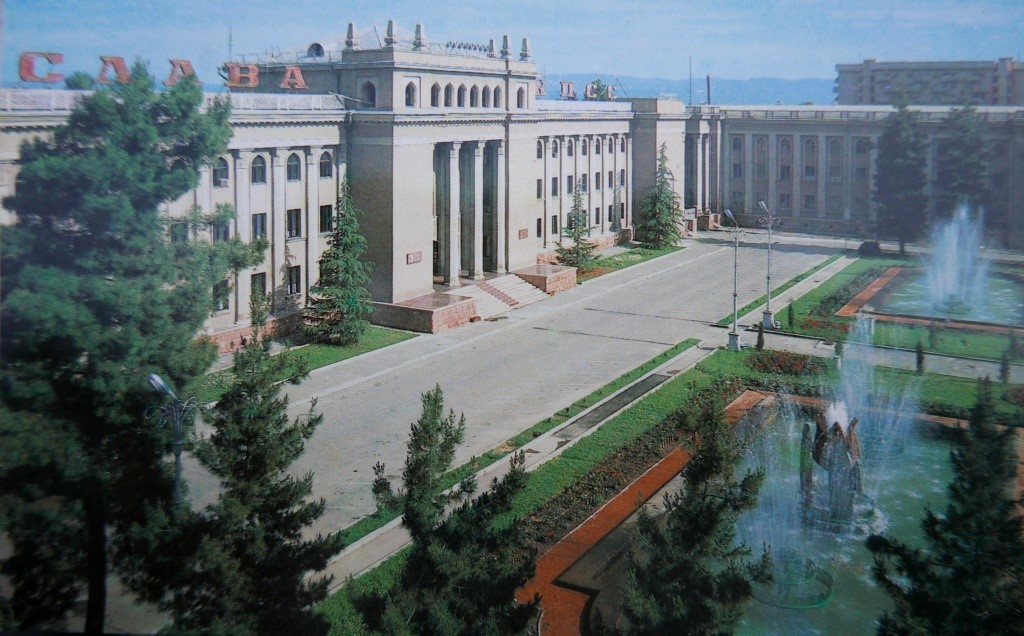
Dushanbe (AsiaNews) - Tajikistan's capital city of Dushanbe celebrated a very special anniversary on Jan. 21, that of its founding 93 years ago on this date in 1931. By then in the midst of the Soviet Stalinist regime, one of the most symbolic projects of the time, the so-called Tadžikgosproekt, of a city that was intended to become the “capital of all Asia,” was begun.
It concentrated the efforts of many architects, engineers and builders who came together in what was then still called Djušambe-Stalinabad, to transform a highland desert area into one of the most beautiful metropolises in Central Asia.
By 1930, by which time Stalin had taken full control of the party, it was decided to make Tajikistan's capital a pilot project, uniting centers and worker villages in a demonstration “five-year building plan” for the entire Soviet Union.
In the first three months of 1931 the project took off, and Dushanbe grew very fast, in ways that amazed even specialists in the field. Thus wrote in the early 1930s one of Tajikistan's leading scientists, the founder of modern mineralogy Nikolai Fedorovsky: “The city is being planned by ghost-architects, with houses far apart from each other, it is clear that they want to build the new capital of the whole of Asia.”
Famed Soviet geochemist Aleksandr Fersman gave an interview in 1935, in which he recounted that the “new Stalinabad, which is being built in the localities of Djušambe villages, represents a new type of particularly visionary planning,” as a model “for the Urals, for Siberia, the Polar Circle and other central regions of the Union.” It extolled the “special and original thinking of a new city, taking into account the special climatic conditions, with the excesses of sun and dust, positive and negative factors.”
In ten years, between 1931 and 1941, top Soviet specialists had hundreds of social and residential buildings built, including the “S. Ajni” Opera and Ballet Theater, the Supreme Soviet building that now houses the Olij Mažilis, the Parliament of Tajikistan, the Academy of Sciences, the Safina Philharmonic, and many other first-rate institutions.
In 1938 the Tadžikgosproekt was divided into two sectors, that of planning and building more cities and towns throughout the country. In 1941 most of the architects and other specialists were called into the Red Army troops to counter the invasion of Hitler's army in “Operation Barbarossa.”
Dušanbe was thus directed to wartime needs, including to house industrial companies evacuated from war zones. After the wartime phase, construction projects were resumed in 1957, incorporating Tadžikgosproekt into state institutions, where it remained until the end of the Soviet Union.
In the 1950s and 1960s, projects multiplied for many cities in Tajikistan, as a model for the entire region, resulting in the cities of Nurek, Rogun, Turnuzade, Javan, and others, with an exhaustive complex of social, production, logistical, and engineering infrastructure.
The project institute was transformed into a joint-stock company with the end of the USSR, and to this day it remains one of the key project organizations for urban management in Tajikistan.
What is now called the “ ŠakhrodarCompany ” is in charge of the construction and development plans for a number of cities including Bokhtar, Khudžand, Kuljab, with continuous plans for new city spaces including in the capital Dushanbe, new streets and squares, city parks, and very contemporary suburbs with multi-story buildings and new office facilities.
Despite being the most economically backward country in Central Asia, Tajikistan shows more than most the progress inherited from the Soviet period, striving not to be marginalized, but to make a particularly significant contribution to the development of the entire region.

No comments:
Post a Comment