It’s possible that I shall make an ass of myself. But in that case one can always get out of it with a little dialectic. I have, of course, so worded my proposition as to be right either way (K.Marx, Letter to F.Engels on the Indian Mutiny)
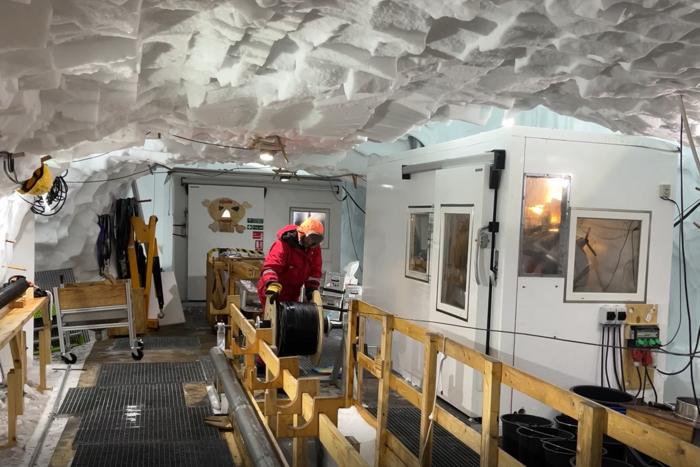
A researcher lowers a fibre-optic cable 1,500 metres into the borehole in or-der to record signals from inside the ice stream continuously for 14 hours.
• In Greenland, an international team of researchers led by ETH Zurich has discovered that countless tiny ice quakes take place deep inside ice streams.
• These quakes are responsible for the fact that ice streams also move with a continuous stick-slip motion and not only like viscous honey as previously considered.
• The researchers recorded seismic data from inside the ice stream using a fibre-optic cable in a 2,700-metre deep borehole.
The great ice streams of the Antarctic and Greenland are like frozen rivers, carrying ice from the massive inland ice sheets to the sea – and a change in their dynamics will contribute significantly to sea-level rise. In order to estimate just how much sea levels will rise, climate researchers rely on computer simulations of the ice streams. Until now, they have based these simulations on an assumption that the ice streams flow slowly but steadily into the sea like thick honey.
However, satellite measurements of the flow speed of ice streams show that such simulations are inaccurate and have shortcomings to correctly reflect reality. This leads to considerable uncertainties in estimates of how much mass the ice streams are losing and how quickly and how high sea levels will rise.
Ice streams both judder and flow
Now, a team of researchers led by ETH professor Andreas Fichtner has made an unexpected discovery: deep within the ice streams, there are countless weak quakes taking place that trigger one another and propagate over distances of hundreds of metres. This discovery helps to explain the discrepancy between current simulations of ice streams and satellite measurements, and the new findings should also impact the way ice streams are simulated in the future.
“The assumption that ice streams only flow like viscous honey is no longer tenable. They also move with a constant stick-slip motion,” says Fichtner. The ETH professor is confident that this finding will be integrated into simulations of ice streams, making estimates of changes in sea level more accurate.
Riddles relating to ice cores resolved
Moreover, the ice quakes explain the origin of numerous fault planes between ice crystals in ice cores obtained from great depths. These fault planes are the result of tectonic shifts and have been known to scientists for decades, although no explanation had been found for them until now.
“The fact that we’ve now discovered these ice quakes is a key step towards gaining a better understanding of the deformation of ice streams on small scales,” explains Olaf Eisen, Professor at the Alfred Wegener Institute and one of the study’s co-authors.
The study by this international research team led by ETH Zurich has just been published in the journal Science and also involved researchers from the Alfred Wegener Institute, Helmholtz Centre for Polar and Marine Research (AWI), the University of Strasbourg, the Niels Bohr Institute (NBI), the Swiss Federal Institute WSL and other universities.
Fire and ice are related
The fact that these ice quakes cannot be observed at the surface and have therefore remained undiscovered until now is due to a layer of volcanic particles located 900 metres below the surface of the ice. This layer stops the quakes from propagating to the surface. Analysis of the ice core showed that these volcanic particles originate from a massive eruption of Mount Mazama in what is now Oregon (USA) some 7,700 years ago. “We were astonished by this previously unknown relationship between the dynamics of an ice stream and volcanic eruptions,” Fichtner recalls.
The ETH professor also noticed that the ice quakes start from impurities in the ice. These impurities are also leftovers from volcanoes: tiny traces of sulphates that entered the atmosphere in volcanic eruptions and flew halfway around the world before being deposited on the Greenland ice sheet in snowfall. These sulphates reduce the stability of the ice and favour the formation of microfissures.
A 2,700-metre borehole in the ice
The researchers discovered the ice quakes using a fibre-optic cable that was inserted into a 2,700-metre-deep borehole and recorded seismic data from inside a massive ice stream for the first time. This borehole was drilled into the ice by researchers from the East Greenland Ice-core Project (EastGRIP), led by the Niels Bohr Institute and strongly supported by the Alfred Wegener Institute, resulting in the extraction of a 2,700-metre-long ice core. Once drilling work was complete, the researchers took the opportunity to lower a fibre-optic cable 1,500 metres into the borehole and record signals from inside the ice stream continuously for 14 hours.
The research station and borehole are located on the North East Greenland Ice Stream (NEGIS), around 400 kilometres from the coast. The NEGIS is the biggest ice stream of the Greenland ice sheet, whose retreat is a large contributor to current rising sea levels. In the area of the research station, the ice is moving towards the sea at a speed of around 50 metres per year.
As ice quakes occur frequently over a wide area in the researchers’ measurements, ETH researcher Fichtner believes it is also plausible that they occur in ice streams everywhere, all the time. To verify this, however, it will be necessary to take seismic measurements of this kind in other boreholes – and there are already plans to do just that.
###
References
Fichtner A, Hofstede C, Kennett B L N, Svensson A, Westhoff J, Walter F, Ampuero J-P, Cook E, Zigone D, Jansen D, Eisen O, Hidden cascades of seismic ice stream deformation. Science. 6.2.2025, DOI: 10.1126/science.adp8094
In this Special Issue of Science, 3 Reviews and a Policy Forum highlight research on Earth’s frozen places – from the Arctic to the Antarctic – and how it’s changing due to climate change and the geopolitical challenges this important work faces. In the first Review, Julienne Stroeve and colleagues provide a preview of what the Arctic region may look like in a warmer world. Without stronger climate action, global temperatures are set to rise +2.7°C above preindustrial levels, causing irreversible Arctic transformation. Under this future, Stroeve et al. show that nearly all days in the region would exceed past temperature extremes, summers would see an ice-free Arctic Ocean, Greenland’s melt zones would quadruple, and permafrost would shrink by half. While these changes would severely disrupt ecosystems, and damage Arctic communities and infrastructure, the authors note that stronger climate action could significantly mitigate these consequences, preserving the Arctic’s stability and resilience. In a second Review, Helen Fricker and colleagues focus on Antarctic ice, which plays a crucial role in regulating Earth’s climate, global sea levels, ocean circulation, and planetary reflectivity. Fricker et al. highlight key knowledge gaps in these processes, which create uncertainties in the stability of the Antarctic ice sheet and the potential impacts of its continued loss. According to Fricker et al., progress in these areas depends on high-resolution satellite monitoring, targeted field studies, improved modeling, and strengthened interdisciplinary collaboration to reduce uncertainties and refine future projections. A third Review focuses on Antarctic biodiversity. According to Luis Pertierra and colleagues, Antarctica hosts myriad unique life forms, yet much of the region’s biodiversity and ecological functioning remains poorly understood. Outside of a few well-known vertebrate species, much about the region’s invertebrate, plant, and microbial life remains unknown. Here, Pertierra et al. highlight the shortfalls in Antarctic biodiversity research, explain how these gaps hinder ecological insight and conservation in the region, and offer a framework for addressing them. Lastly, in a Policy Forum, Jennifer Spence and colleagues discuss the geopolitical challenges facing Arctic research. The Arctic is at the forefront of critical global issues, including the uneven impacts of climate change, the challenge of balancing economic development with conservation, and the complexity of governance across multiple boundaries. These issues are complicated further by rising populism, geopolitical tensions, and distrust in governmental institutions. Spence et al. highlight three key issues, including understanding the regional and global effects of climate change, ensuring research benefits Arctic communities, and maintaining international cooperation in the face of growing geopolitical pressures. However, despite these challenges, the Arctic region has pioneered innovative governance models that prioritize Indigenous engagement, as well as fostering international cooperation through institutions like the Arctic Council to promote sustainable development and environmental protection.

No comments:
Post a Comment