"We will not stand by and allow the impact that dismantling the Department of Education would have on the nation's students, parents, borrowers, educators, and communities."
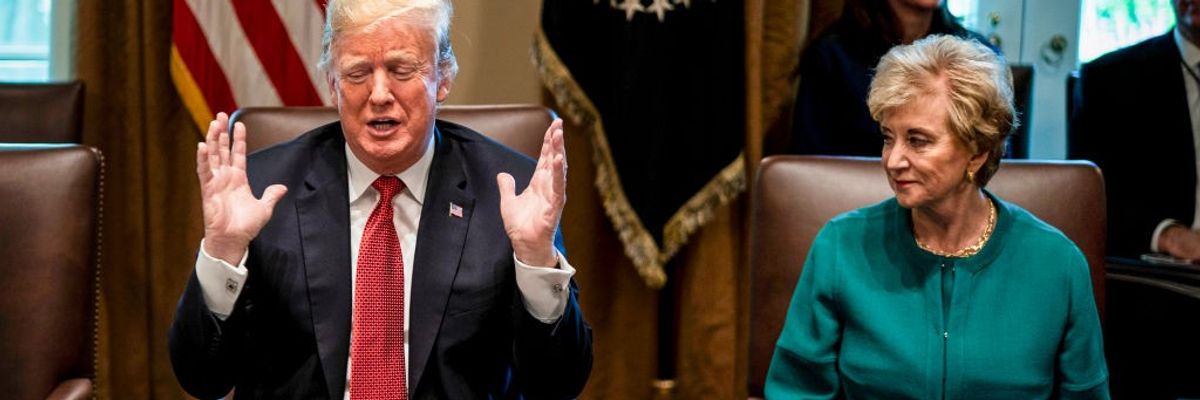
U.S. President Donald Trump gestures as Linda McMahon—who then led the Small Business Administration—looks on during an October 17, 2018 Cabinet meeting in the White House in Washington, D.C.
(Photo: Jabin Botsford/The Washington Post via Getty Images)
Brett Wilkins
Feb 06, 2025
COMMON DREAMS
U.S. Sen. Bernie Sanders on Thursday led five members of Congress in a warning against the Trump administration's plan to "unilaterally dismantle" the Department of Education and demanded answers from the acting head of the agency about recent moves "to put federal workers on administrative leave, coerce employees into leaving their jobs, provide access to students' sensitive data, and illegally freeze vital funding."
"Over the course of two weeks, the Trump administration issued sweeping executive orders and sought to broadly and illegally freeze federal financial assistance," the lawmakers—Sanders (I-Vt.), Sen. Patty Murray (D-Wash.), Sen. Tammy Baldwin (D-Wis.), Rep. Bobby Scott (D-Va.), and Rep. Rosa DeLauro (D-Conn.)—wrote in a letter to acting Education Secretary Denise Carter.
"Federal employees have been targeted, in some cases for simply following the law. Elon Musk is attempting to shut down the work of entire agencies while gaining access to some of the federal government's most far-reaching and sensitive data systems. Media reports indicate a similar effort may be underway at the Department of Education," the lawmakers noted.
The letter continues:
The Department [of Education] has been a target of President [Donald] Trump and his unelected advisers since even prior to his inauguration. And recently, the department has put workers on administrative leave for attending trainings promoted by former Secretary Betsy DeVos, once touted among results achieved by the department, and coerced employees into leaving their jobs. Workers at the department—like those across the government—have been made to fear their jobs will be reclassified so that they lose employment protections. Some staff from the entity referred to as the Department of Government Efficiency have reportedly gained access to internal department data systems, including financial aid systems that include personally identifiable information on millions of students. These actions appear to be part of a broader plan to dismantle the federal government until it is unable to function and meet the needs of the American people.
"We will not stand by and allow this to happen to the nation's students, parents, borrowers, educators, and communities," the lawmakers stressed. "Congress created the department to ensure all students in America have equal access to a high-quality education and that their civil rights are protected no matter their ZIP code."
"We urge you to provide information on the steps the department is taking to ensure the continuity of programs that Americans depend on, the ability of the department to effectively administer programs for their intended purposes without waste, fraud, and abuse, and the safeguards in place to protect student data privacy," the legislators added.
Specifically, the letter asks for a list of officials "who have been granted access to personally identifiable or sensitive information," an "explanation of all steps the department has taken to protect" such data, the names of "all individuals placed on administrative leave or terminated" since Trump took office and all department communications to such employees, and confirmation that the department "has not frozen, paused, impeded, blocked, canceled, or terminated any awards or obligations since January 20."
The lawmakers' letter came on the same day that nearly 100 Democratic members of the House of Representatives wrote to Carter requesting a meeting to discuss "reports that the Trump administration has plans to illegally dismantle or drastically reduce" the Department of Education via executive order.
Both letters came ahead of next week's scheduled Senate confirmation hearing for Linda McMahon, a top fundraiser for Trump's campaign whom the president subsequently nominated for education secretary. McMahon—a billionaire who led the Small Business Administration during Trump's first term—is expected to face tough questions from Democratic senators about what one campaigner called her "documented history of enabling sexual abuse of children and sweeping sexual violence under the rug" during her tenure as World Wrestling Entertainment CEO.
The very future of the Department of Education is uncertain, as Trump has repeatedly vowed to abolish the agency, which was established during the administration of President Jimmy Carter in 1979.
"I told Linda, 'Linda, I hope you do a great job and put yourself out of a job,'" Trump quipped earlier this week.
A funny thing happened on the way to closing the Department of Education
Julia Steiny, Rhode Island Current
February 7, 2025
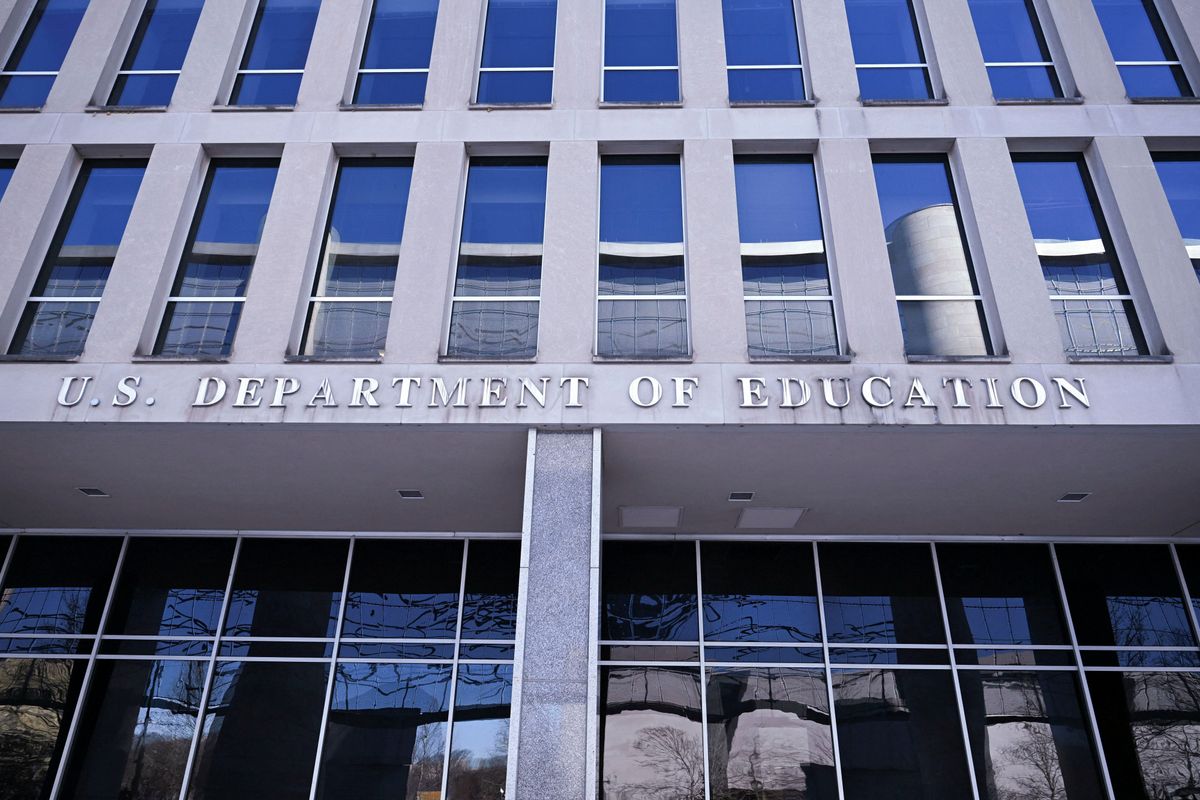
A view of the U.S. Department of Education building in Washington, D.C., U.S., February 1, 2025. REUTERS/Annabelle Gordon
The Trump administration continued its head-scratching appointments by anointing billionaire Linda McMahon as Secretary of Education — even though he had campaigned on a pledge to abolish the department. The president has expressed his hope that McMahon would eventually “put herself out of a job.”
She has been part of the president’s inner political circle, but is best known as president and co-founder, with her husband, of World Wrestling Entertainment. McMahon used to be a wrestler herself. Her only K-12 experience was a brief stint on the Connecticut Board of Education, although she feels wrestling showed her what all students should learn about respect, leadership and such.
But then – surprise! – the deputy education secretary spot went to Penny Schwinn, who is far more famous to the likes of us education writers. Schwinn’s deep, impressive bona fides include becoming a teacher through Teach for America, followed by service as a classroom history teacher, school principal and then a swift ride up high-level administrative posts in various states including Texas. In 2019, at 43, she became Tennessee’s Commissioner of Education.
In Education Next’s extended interview, Schwinn emphasizes that educators must aim every single decision not merely toward achievement, but toward the best interests of kids. This “North Star” helps her to sift through irrelevant political chaff so she can stay with her agenda even in the face of constant opposition.
“That is always going to be personal and emotional; however, we must find a way to engage in hard conversations without taking them personally,” she said.
Schwinn’s biggest claim to fame was an all-hands-on-deck initiative designed to shift reading instruction from the terrible 3-cueing system that teaches kids to guess words, to one that is science-based. At the time, COVID raged. But for her, reading is a “nonnegotiable goal.” In a mere two years, Tennessee’s third graders improved by eight percentage points on their state reading assessment. The state has just under 1 million K-12 students, with 74,000 third graders, so eight points is a big average jump for a cohort that size.
Furthermore, the just released 2022 NAEPs showed Tennessee with a slight increase while most all other states’ results declined to varying degrees. (Rhode Island’s scores declined by three percentage points.) Tennessee also did well in math, which can be a side benefit of helping kids unpack word problems and written directions.
When first appointed, Schwinn turned to Carey Wright, the education commissioner who pulled off what is known as the “Mississippi miracle,” a show-stopping leap from Mississippi’s frequent dead last ranking to becoming the only state that didn’t tank in the 2019 national NAEP reading test.
Last summer, Wright and Schwinn wrote an op-ed for The74 begging political leaders to listen to what the research is saying about learning, especially reading. They note that in the late 1990s, the feds poured $9 billion into excellent research, which then went largely ignored. Their dedication to data-driven decisions means Schwinn wants to beef up federal research, not shut it down. (Yes, I know the feds are angling to shutter the Department of Education. But why would she take the job if that were really the goal?)
I’m hard pressed to think of another current politician or education leader with such credible dedication to kids, no matter what.
What really wins my heart are leaders who can change their minds with the right evidence and articulate reasons to make the change.
For example, in 2021, true to the Republican playbook, the Tennessee Legislature passed a law mandating holding back third graders who did not pass a reading proficiency test. Without apparent appetite, Schwinn acknowledged it was her job to implement state laws. While punishing third graders did boost scores in some states, the long-term effects of removing 9-year-olds from their age and friend cohort is almost never good. Schwin did not fight the law, but her “Reading 360” initiative did reduce the vast numbers of retained kids. It opened many pathways to the fourth grade including intensive tutoring, after-school and summer reading camps, allowing families to agree to intervention during fourth grade, and more.
Also, to help kids from the educational get-go, she established the only national teacher apprenticeship program designed to drag higher education’s butt into the 21st century with preparation driven by current research and contemporary children.
Mind you, Schwinn is far from everyone’s cup of tea. She’s a Republican. But that’s hard to tell from the totality of her actions. Her work has infuriated both the orthodox left and right.
Eventually, for example, her efforts to sidestep the culture wars proved to be too obstructive to stay focused on the work. In 2023, Tennessee passed a law designed to scrub curricula of information about race and gender. Again, Schwinn said she’d honor state law. But no hardliner, her directive to the field was to “limit” such discussions, enraging culture warriors on both sides of the aisle. In the end, her efforts got swallowed up in those unproductive battles, so she quit that summer.
Did the president’s vetters know what they were getting into? The two appointments to the federal DOE seem like a contradiction in terms — a wrecking ball and a design-build contractor. But Schwinn doesn’t seem like the kind of woman to put her North Star away, so she must have been convinced she could do real work.
Of course, we’ll see. The best interests of the kids could use a true champion. Good luck, Deputy.
Julia Steiny, Rhode Island Current
February 7, 2025
A view of the U.S. Department of Education building in Washington, D.C., U.S., February 1, 2025. REUTERS/Annabelle Gordon
The Trump administration continued its head-scratching appointments by anointing billionaire Linda McMahon as Secretary of Education — even though he had campaigned on a pledge to abolish the department. The president has expressed his hope that McMahon would eventually “put herself out of a job.”
She has been part of the president’s inner political circle, but is best known as president and co-founder, with her husband, of World Wrestling Entertainment. McMahon used to be a wrestler herself. Her only K-12 experience was a brief stint on the Connecticut Board of Education, although she feels wrestling showed her what all students should learn about respect, leadership and such.
But then – surprise! – the deputy education secretary spot went to Penny Schwinn, who is far more famous to the likes of us education writers. Schwinn’s deep, impressive bona fides include becoming a teacher through Teach for America, followed by service as a classroom history teacher, school principal and then a swift ride up high-level administrative posts in various states including Texas. In 2019, at 43, she became Tennessee’s Commissioner of Education.
In Education Next’s extended interview, Schwinn emphasizes that educators must aim every single decision not merely toward achievement, but toward the best interests of kids. This “North Star” helps her to sift through irrelevant political chaff so she can stay with her agenda even in the face of constant opposition.
“That is always going to be personal and emotional; however, we must find a way to engage in hard conversations without taking them personally,” she said.
Schwinn’s biggest claim to fame was an all-hands-on-deck initiative designed to shift reading instruction from the terrible 3-cueing system that teaches kids to guess words, to one that is science-based. At the time, COVID raged. But for her, reading is a “nonnegotiable goal.” In a mere two years, Tennessee’s third graders improved by eight percentage points on their state reading assessment. The state has just under 1 million K-12 students, with 74,000 third graders, so eight points is a big average jump for a cohort that size.
Furthermore, the just released 2022 NAEPs showed Tennessee with a slight increase while most all other states’ results declined to varying degrees. (Rhode Island’s scores declined by three percentage points.) Tennessee also did well in math, which can be a side benefit of helping kids unpack word problems and written directions.
When first appointed, Schwinn turned to Carey Wright, the education commissioner who pulled off what is known as the “Mississippi miracle,” a show-stopping leap from Mississippi’s frequent dead last ranking to becoming the only state that didn’t tank in the 2019 national NAEP reading test.
Last summer, Wright and Schwinn wrote an op-ed for The74 begging political leaders to listen to what the research is saying about learning, especially reading. They note that in the late 1990s, the feds poured $9 billion into excellent research, which then went largely ignored. Their dedication to data-driven decisions means Schwinn wants to beef up federal research, not shut it down. (Yes, I know the feds are angling to shutter the Department of Education. But why would she take the job if that were really the goal?)
I’m hard pressed to think of another current politician or education leader with such credible dedication to kids, no matter what.
What really wins my heart are leaders who can change their minds with the right evidence and articulate reasons to make the change.
For example, in 2021, true to the Republican playbook, the Tennessee Legislature passed a law mandating holding back third graders who did not pass a reading proficiency test. Without apparent appetite, Schwinn acknowledged it was her job to implement state laws. While punishing third graders did boost scores in some states, the long-term effects of removing 9-year-olds from their age and friend cohort is almost never good. Schwin did not fight the law, but her “Reading 360” initiative did reduce the vast numbers of retained kids. It opened many pathways to the fourth grade including intensive tutoring, after-school and summer reading camps, allowing families to agree to intervention during fourth grade, and more.
Also, to help kids from the educational get-go, she established the only national teacher apprenticeship program designed to drag higher education’s butt into the 21st century with preparation driven by current research and contemporary children.
Mind you, Schwinn is far from everyone’s cup of tea. She’s a Republican. But that’s hard to tell from the totality of her actions. Her work has infuriated both the orthodox left and right.
Eventually, for example, her efforts to sidestep the culture wars proved to be too obstructive to stay focused on the work. In 2023, Tennessee passed a law designed to scrub curricula of information about race and gender. Again, Schwinn said she’d honor state law. But no hardliner, her directive to the field was to “limit” such discussions, enraging culture warriors on both sides of the aisle. In the end, her efforts got swallowed up in those unproductive battles, so she quit that summer.
Did the president’s vetters know what they were getting into? The two appointments to the federal DOE seem like a contradiction in terms — a wrecking ball and a design-build contractor. But Schwinn doesn’t seem like the kind of woman to put her North Star away, so she must have been convinced she could do real work.
Of course, we’ll see. The best interests of the kids could use a true champion. Good luck, Deputy.

No comments:
Post a Comment