Canada could soon have G7’s first small modular nuclear reactors. Here’s what that means

For the last 15 years, there’s been a lot of talk about the possibilities of small modular reactors – mini nuclear plants that could be factory built and power an industrial site or a small city. Now, Ontario is pressing ahead with a plan to build four of them – the first in the western world.
“A lot of governments are watching to see how this goes,” said Brendan Frank with the group Clean Prosperity, a non-profit.
Significantly smaller in size and power output compared to a traditional nuclear plant, small modular reactors (SMRs) are based on the same science. Fission is used to generate heat, which is then used to make electricity.
“SMRs are basically shrunken down technology, about a third or quarter in size, but have many of the same principals,” said Frank.
Ontario is giving the green light for Ontario Power Generation to spend $7.7 billion to build the first of the reactors and common systems for all four next to the Darlington power plant east of Toronto.
The modular plant, called the BWRX 300, was designed by American based G.E. Hitachi Nuclear Energy and will be able to provide 300 megawatts of electricity, which is enough to power 300,000 homes.
Saskatchewan next?
It’s hoped the finished plant will show both the feasibility and benefits of SMRs and encourage broader adoption. Their compact size and modular design means they could be suitable for remote locations.
“The Saskatchewan government is considering the same reactor model,” said Frank.
“They’re basically hinging their decision on whether to build their first nuclear reactor based on whether or not things go well in Ontario.”

Alberta, New Brunswick?
Alberta and New Brunswick are also considering SMRs, and Ontario has been helping to try and export the technology to countries like Poland and Estonia.
Frank says there’s a global commitment to triple existing nuclear capacity by 2050.“Canada can be a huge contributor to global efforts to build out that capacity while generating jobs and growth here at home.”
More than 80 Ontario companies will be involved in the construction. The plant is expected to be online by 2030. All four will cost nearly $21 billion and are scheduled to run by 2035.
Ontario’s government says the plants will help meet energy demands in the future which are expected to rise by 75 per cent by 2050. The province’s minister of energy and mines Stephen Lecce says construction will employ 18,000 people and adds the plants should last 65 years.
“This is a bold decision we’re making,” said Lecce.
Tech is vulnerable to U.S. whims: critic
But the project isn’t without its critics. Jack Gibbons is with the Ontario Clean Air Alliance. He says an analysis by his group shows solar and wind power would be much cheaper.
He also believes going with the reactor design by U.S.-based GE Hitachi is not good for national security.
“These new American reactors will require us to import enriched uranium from the United States,” said Gibbons. “That enriched uranium could be cut off by President Trump at any moment.”
John Vennavally-Rao
Senior Correspondent,
OPG gets go-ahead to build first SMR in Canada
The Province of Ontario has approved Ontario Power Generation to start construction of the first of four small modular reactors planned at the Darlington New Nuclear Project site.
_74545.jpg)
It will be the first new nuclear build in Ontario in more than three decades and Ontario Power Generation (OPG) said it was set to be the first commercial grid-scale small modular reactor (SMR) in North America, with an in-service target date of 2030.
The GE Hitachi BWRX-300 SMR will be able to generate 300 MW, enough to power about 300,000 homes.
Nicolle Butcher, OPG’s President and CEO, said: "This is truly a historic moment. This made-in-Ontario project will support provincial companies, create jobs for Ontarians, and spur growth for our economy. OPG is proud to be leading this first-of-a-kind project. With the province’s robust nuclear supply chain and our successful track record on nuclear projects, particularly our Darlington Refurbishment, we are confident we will be able to deliver the first SMR unit for Ontario, on-time and on-budget."
The support from the provincial government for OPG's CAD20.9 billion (USD15 billion) budget for the Darlington New Nuclear Project came after OPG received a Licence to Construct in April from the Canadian Nuclear Safety Commission.
Ontario's Ministry of Energy and Mines said its approval of OPG's plan would create up to 18,000 Canadian jobs and inject CAD500 million annually into the Ontario economy, with the construction, operation and maintenance of the four units set to add CAD38.5 billion to the country's GDP over 65 years. It said the provincial government and OPG have worked together to ensure that 80% of project spending goes to companies in Ontario.
Stephen Lecce, Minister of Energy and Mines, said; "This is a historic day for Canada as we start construction on the first small modular reactor in the G7 ... this nation-building project being built right here in Ontario will be led by Canadian workers using Canadian steel, concrete and materials to help deliver the extraordinary amount of reliable and clean power we will need to deliver on our ambitious plan to protect Ontario and unleash our economy."
The Independent Electricity System Operator for Ontario said that the Darlington New Nuclear Project was the "best option to meet growing demand in terms of costs and risks, when compared against non-emitting generation alternatives".
GE Vernova Hitachi SMR Canada's Lisa McBride said: "This is a proud moment for GE Vernova Hitachi and Ontario as we move from vision to reality with construction of the G7's first SMR, the BWRX-300. With dozens of Ontario-based suppliers contributing to this project, we’re not just building a reactor - we are generating thousands of good-paying jobs, driving investment into communities across the province, and reinforcing Ontario’s global leadership in clean energy technology. That leadership is already opening doors to international export opportunities for Ontario companies, helping position our province as a global hub for next-generation nuclear innovation. GE has been part of Canada’s nuclear story from the very beginning, and we're honoured to carry that legacy forward by delivering a made-in-Ontario solution that strengthens our economy and powers our future."
Article researched and written by WNN's Alex Hunt
Chinese Candu reactor sets operating records
Unit 1 of the Qinshan Phase III nuclear power plant near Shanghai in China's Zhejiang province was taken offline on 1 May after 738 days of continuous operation. It has set a new record for the longest uninterrupted operation of a power reactor in China as well as a world record for an operating run for a Candu-6 reactor.
_73139.jpg)
During the latest operating cycle, which began on 24 April 2023, Qinshan III unit 1 has generated more than 12.5 billion kilowatt-hours of electricity, equivalent to reducing standard coal consumption by 3.8 million tonnes and reducing carbon dioxide emissions by 9.97 million tonnes, China National Nuclear Corporation (CNNC) noted.
A total of nine Candu-6 reactors are currently in operation around the world. These are units 1 and 2 of Romania's Cernavoda plant, Argentina's Embalse plant, Canada's Point Lepreau plant, units 1 and 2 of China's Qinshan III plant and units 2-4 of South Korea's Wolsong plant.
Candus are pressurised heavy water reactors (PHWRs), which are designed to be refuelled without being shut down. The world record for continuous operation of a nuclear reactor is currently held by Darlington unit 1 in Canada - also a PHWR - which was taken offline on 5 February 2021 after 1106 days of operation.
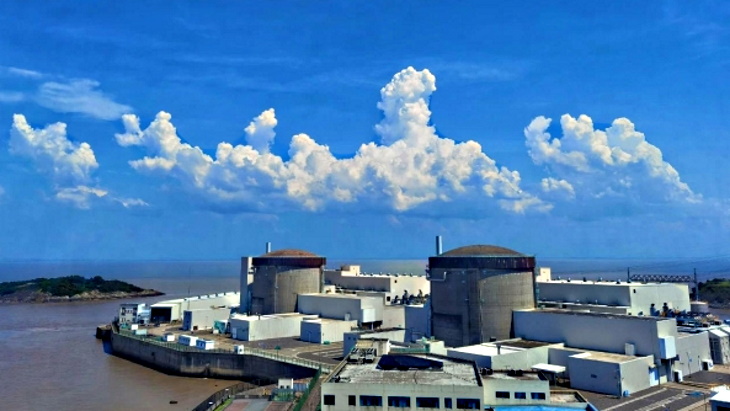
(Image: CNNC)
Units 1 and 2 of the Qinshan Phase III plant - majority owned by CNNC - use the Candu-6 pressurised heavy water reactor technology, with Atomic Energy of Canada Limited (AECL) being the main contractor of the project on a turnkey basis. Construction began in 1997 and unit 1 started up in September 2002 and unit 2 in April 2003.
The two reactors are now approaching the end of their initial 30-year design life. Operator Third Qinshan Nuclear Power Company is undertaking a programme to refurbish the reactors and associated fuel channels. The refurbishment will allow the Candu units to continue generating power for a further 30 years.
Candu reactors feature a large horizontal calandria vessel with 480 tubes through which cooling water flows at high temperature. Each one has two end fittings which allow it to be isolated so the fuel bundles it contains can be replaced without having to shut down the whole reactor. Refurbishment to prolong the life of the power plant requires all this as well as thousands of auxiliary components to be dismantled.
Article researched and written by WNN's Warwick Pipe
World Nuclear News

No comments:
Post a Comment