As attacks on Christians rise in Israel, Netanyahu's snub of Francis is a dangerous step
(RNS) — Even a perfunctory tweet from the Foreign Ministry was quickly deleted under pressure from far-right coalition members.
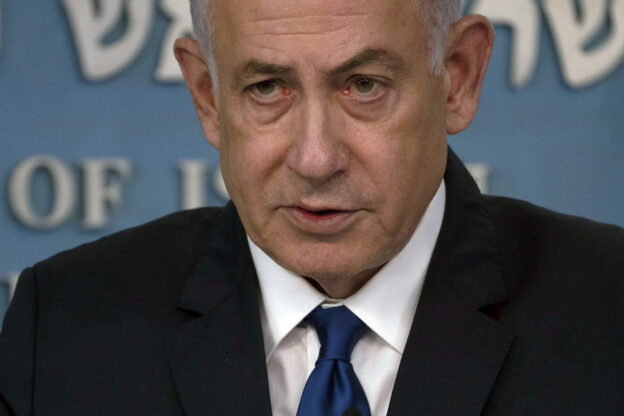
Israeli Prime Minister Benjamin Netanyahu delivers a speech in Jerusalem, March 17, 2024. (AP Photo/Leo Correa)
Daoud Kuttab
May 6, 2025
(RNS) — At a session of the Israeli Knesset’s Immigration, Absorption and Diaspora Affairs Committee on Monday (May 5), Aida Touma-Sliman, a Christian legislator from northern Israel, sounded the alarm about a disturbing pattern of harassment of Christians in the country. During Holy Week, many Christians from the West Bank were denied entry into Jerusalem, and on Holy Saturday, the eve of Easter, Israeli police prevented worshippers from reaching churches.
The disruptions were a continuation of a sharp increase in attacks against Christians documented in a March 2025 report by the Rossing Center for Education and Dialogue that showed rising incidents of violence: clergy spat on, church property vandalized, crosses desecrated and pilgrims harassed. In many cases, police were slow to respond — if they responded at all.
RELATED: Pope Francis will be remembered for fighting antisemitism
“If this country respects all religions,” Touma-Sliman said, “what is happening against Christian clergy should have caused a huge uproar and upended the country.”
Touma-Sliman also condemned the Israeli government’s glaring failure to recognize the death of Pope Francis. The government of Israeli Prime Minister Benjamin Netanyahu sent a lower-level aide to Francis’ funeral, along with the Israeli ambassador to the Holy See, while the leaders of some 130 other nations attended. The excuse given — that the funeral fell on the Jewish Sabbath — rang hollow, especially in light of the Israeli ambassador’s presence at the service.
The Israeli government sent only a bland, formal message of condolences on the day of Francis’ death, and even a perfunctory tweet from the Foreign Ministry was quickly deleted under pressure from far-right coalition members.
This relative silence, particularly from a nation that brands itself a defender of religious freedom, was not simply a diplomatic oversight. It was a calculated act of disrespect, and a concession to elements of Netanyahu’s coalition, many of whom revile the pope for his moral clarity, especially when it came to Palestinians. As Touma-Sliman warned, “It sends a dangerous message that encourages demented extremists to continue their attacks on religious sanctities.”
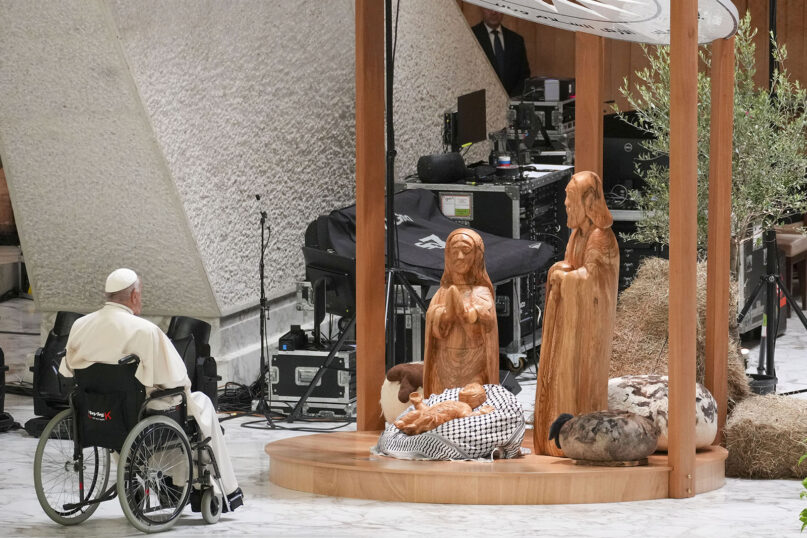
Pope Francis prays in front of a Nativity scene that was crafted in the West Bank city of Bethlehem, in the Paul VI Hall at the Vatican, Dec. 7, 2024. The Nativity scene caused controversy because it featured baby Jesus in a kaffiyeh. (AP Photo/Andrew Medichini)
From the beginning of the Gaza conflict, Francis called the congregants of the Holy Family Church in Gaza City, the only Catholic church in the strip, offering comfort to them as they sheltered against Israeli attacks on that city.
But he also offered solace to both Christians and Muslims enduring unimaginable devastation. At his final Christmas in St. Peter’s Square, he oversaw a Nativity Scene in which baby Jesus was wrapped in a Palestinian kaffiyeh — a quiet but powerful statement. In an extraordinary gesture of solidarity, the pope bequeathed his popemobile to Gaza so that it can be converted into an ambulance.
A solemn Mass was held at the Holy Family Church in Gaza City, and Christians and Muslims came to grieve a man they saw as a rare Western leader willing to speak truth to power. “A person who thinks only about building walls, and not building bridges,” he once said, “is not Christian. This is not in the gospel.”
While it might be argued that these very acts motivated Netanyahu to withhold proper recognition of Francis’ death, Netanyahu publicly expressed condolences for U.S. President Jimmy Carter, a sharp critic of Israeli policies.
Wadie Abu Nassar, a Catholic from Haifa and coordinator of the Forum of Christians in the Holy Land, called the government’s response to the pope’s death a betrayal: “He was the leader of the most important church in the world. … He has followers among people who are Israeli taxpayers. The man deserves some respect.”
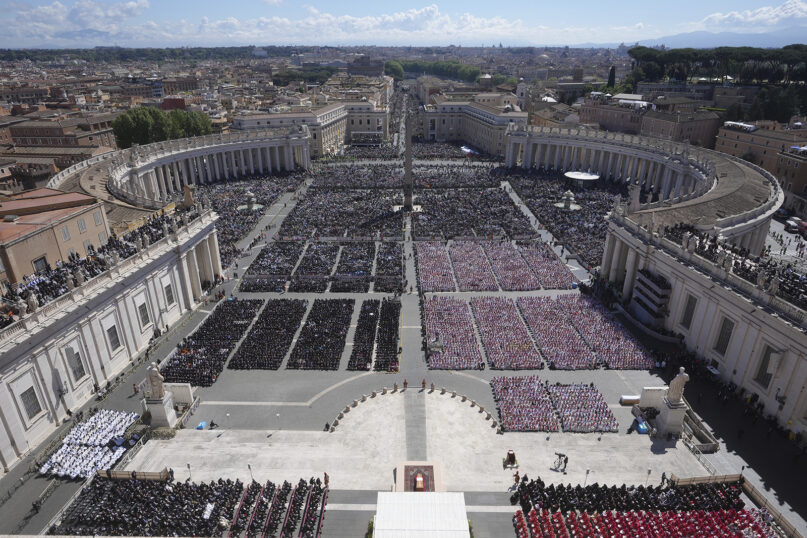
A view of the funeral of Pope Francis in St. Peter’s Square at the Vatican, April 26, 2025. (AP Photo/Alessandra Tarantino)
The silence is not just about the pope. The Israeli government’s refusal to protect its Christian citizens, who have built schools, hospitals and cultural institutions, is more than neglect. It is complicity. Netanyahu’s response is about a deeper moral erosion taking place as nationalism, religious identity and political expediency take precedence over shared citizenship.
Touma-Sliman on Monday demanded a clear national policy to combat religious hatred and racism in Israel, holding the police accountable for their role in fostering a culture of impunity. “The police must bear full responsibility for their violent, arbitrary practices and degrading behavior, especially during religious occasions,” she said.
But this is not an Israeli question alone. The global church and the world at large must not look away, but honor Francis by heeding his call: Demand peace, uphold dignity, and reject the normalization of hatred, whether against Palestinians or against the Christians trying to serve them.
RELATED: Charlie Kirk doesn’t feel safe in Bethlehem. It’s his worldview that’s to blame, not my city.
History will remember this moment. It will remember who stood for respect and who deleted it out of fear. It will remember which governments chose silence over truth, walls over bridges, and expedience over principle. It will remember Francis for how he lived: boldly, compassionately and unflinchingly on the side of the oppressed.
(Daoud Kuttab, an award-winning Palestinian journalist, is the author of “State of Palestine NOW” and the publisher of a website for Christians in Jordan and Palestine. Follow him on X @daoudkuttab. The views expressed in this commentary do not necessarily reflect those of RNS.)
Islam Beyond Phobia
Christian leaders love Francis' popemobile gesture, but not the people it will now serve
(RNS) — Faith leaders celebrate the repurposing of the popemobile but can’t bring themselves to call for a ceasefire.

Final work is being carried out to transform the popemobile used by Pope Francis during his 2014 Holy Land pilgrimage into a mobile health unit for Gaza.
“If this country respects all religions,” Touma-Sliman said, “what is happening against Christian clergy should have caused a huge uproar and upended the country.”
Touma-Sliman also condemned the Israeli government’s glaring failure to recognize the death of Pope Francis. The government of Israeli Prime Minister Benjamin Netanyahu sent a lower-level aide to Francis’ funeral, along with the Israeli ambassador to the Holy See, while the leaders of some 130 other nations attended. The excuse given — that the funeral fell on the Jewish Sabbath — rang hollow, especially in light of the Israeli ambassador’s presence at the service.
The Israeli government sent only a bland, formal message of condolences on the day of Francis’ death, and even a perfunctory tweet from the Foreign Ministry was quickly deleted under pressure from far-right coalition members.
This relative silence, particularly from a nation that brands itself a defender of religious freedom, was not simply a diplomatic oversight. It was a calculated act of disrespect, and a concession to elements of Netanyahu’s coalition, many of whom revile the pope for his moral clarity, especially when it came to Palestinians. As Touma-Sliman warned, “It sends a dangerous message that encourages demented extremists to continue their attacks on religious sanctities.”
Pope Francis prays in front of a Nativity scene that was crafted in the West Bank city of Bethlehem, in the Paul VI Hall at the Vatican, Dec. 7, 2024. The Nativity scene caused controversy because it featured baby Jesus in a kaffiyeh. (AP Photo/Andrew Medichini)
From the beginning of the Gaza conflict, Francis called the congregants of the Holy Family Church in Gaza City, the only Catholic church in the strip, offering comfort to them as they sheltered against Israeli attacks on that city.
But he also offered solace to both Christians and Muslims enduring unimaginable devastation. At his final Christmas in St. Peter’s Square, he oversaw a Nativity Scene in which baby Jesus was wrapped in a Palestinian kaffiyeh — a quiet but powerful statement. In an extraordinary gesture of solidarity, the pope bequeathed his popemobile to Gaza so that it can be converted into an ambulance.
A solemn Mass was held at the Holy Family Church in Gaza City, and Christians and Muslims came to grieve a man they saw as a rare Western leader willing to speak truth to power. “A person who thinks only about building walls, and not building bridges,” he once said, “is not Christian. This is not in the gospel.”
While it might be argued that these very acts motivated Netanyahu to withhold proper recognition of Francis’ death, Netanyahu publicly expressed condolences for U.S. President Jimmy Carter, a sharp critic of Israeli policies.
Wadie Abu Nassar, a Catholic from Haifa and coordinator of the Forum of Christians in the Holy Land, called the government’s response to the pope’s death a betrayal: “He was the leader of the most important church in the world. … He has followers among people who are Israeli taxpayers. The man deserves some respect.”
A view of the funeral of Pope Francis in St. Peter’s Square at the Vatican, April 26, 2025. (AP Photo/Alessandra Tarantino)
The silence is not just about the pope. The Israeli government’s refusal to protect its Christian citizens, who have built schools, hospitals and cultural institutions, is more than neglect. It is complicity. Netanyahu’s response is about a deeper moral erosion taking place as nationalism, religious identity and political expediency take precedence over shared citizenship.
Touma-Sliman on Monday demanded a clear national policy to combat religious hatred and racism in Israel, holding the police accountable for their role in fostering a culture of impunity. “The police must bear full responsibility for their violent, arbitrary practices and degrading behavior, especially during religious occasions,” she said.
But this is not an Israeli question alone. The global church and the world at large must not look away, but honor Francis by heeding his call: Demand peace, uphold dignity, and reject the normalization of hatred, whether against Palestinians or against the Christians trying to serve them.
RELATED: Charlie Kirk doesn’t feel safe in Bethlehem. It’s his worldview that’s to blame, not my city.
History will remember this moment. It will remember who stood for respect and who deleted it out of fear. It will remember which governments chose silence over truth, walls over bridges, and expedience over principle. It will remember Francis for how he lived: boldly, compassionately and unflinchingly on the side of the oppressed.
(Daoud Kuttab, an award-winning Palestinian journalist, is the author of “State of Palestine NOW” and the publisher of a website for Christians in Jordan and Palestine. Follow him on X @daoudkuttab. The views expressed in this commentary do not necessarily reflect those of RNS.)
Islam Beyond Phobia
Christian leaders love Francis' popemobile gesture, but not the people it will now serve
(RNS) — Faith leaders celebrate the repurposing of the popemobile but can’t bring themselves to call for a ceasefire.
Final work is being carried out to transform the popemobile used by Pope Francis during his 2014 Holy Land pilgrimage into a mobile health unit for Gaza.
(Photo courtesy of Caritas Jerusalem)
Omar Suleiman
May 6, 2025
(RNS) — It is one of the most surreal images to emerge from the genocide in Gaza: The former popemobile, once the armored symbol of papal ceremony, reconfigured into a mobile health clinic. Once used to carry Pope Francis through cheering crowds, it is now meant to be packed with medical supplies and loaded onto a cargo ship, with the hope that it will reach Gaza and serve children trapped beneath siege.
If it makes it past the Israeli blockade — a blockade that has suffocated Gaza for nearly two decades — it will become a mobile clinic, equipped with oxygen tanks, medicine, and surgical tools for children who are bleeding, starving and surviving under conditions unimaginable to most of the world.
RELATED: Pope Francis the diplomat relied on personal encounters that had global reach
This was not a PR stunt. According to Vatican officials, this was one of the pontiff’s final wishes. In his last days, he asked that his vehicle be used not for spectacle, but for service. Especially in Gaza.
It is a powerful image. But the hypocrisy that surrounds it is even louder.
Western Christian leaders and commentators are applauding this gesture and showering the pope with praise, but some of the commentators celebrating the popemobile’s new purpose are the same ones who remained silent as tens of thousands of children were bombed and starved. Or worse, they cheered it on.
You cannot love the symbol and abandon the substance.
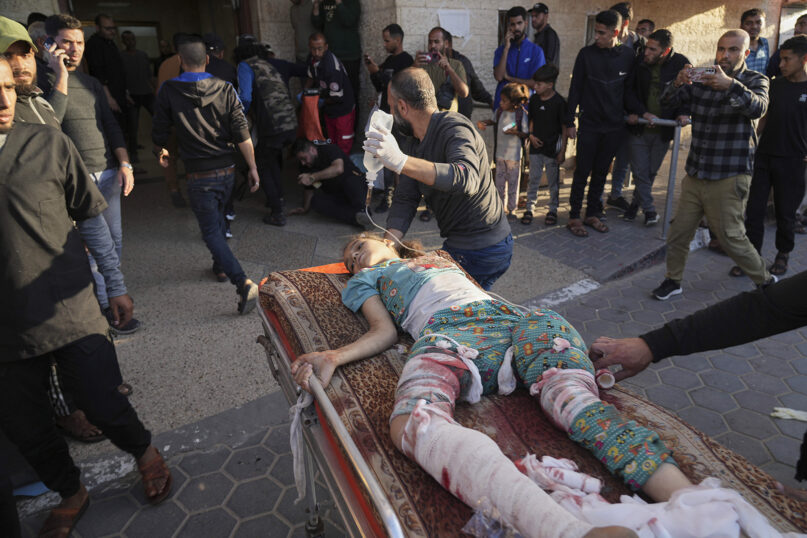
A Palestinian girl wounded in an Israeli airstrike on a school in Bureij refugee camp is brought to Al-Aqsa Martyrs Hospital in Deir al Balah, central Gaza Strip, on May 6, 2025. (AP Photo/Abdel Kareem Hana)
When Francis died, words like “humble,” “gentle,” “compassionate” echoed across official tributes. But missing from most of them was the one place he had spoken about more than almost any other in his final months: Gaza.
Francis called the siege “shameful.” He spoke daily with members of Gaza’s tiny Christian community. He condemned the killing of civilians, the starvation of children, the systematic destruction of homes, churches and hospitals. He didn’t tiptoe around Gaza. He embraced it.
But somehow, in the official remembrances, that part of his legacy is already being erased.
This silence is not new. But it is deeply telling.
In a recent conversation, the Rev. Munther Isaac, a Palestinian Christian leader from Bethlehem, spoke to me of the heartbreak of watching fellow Christians in the West remain silent, or worse, support the violence. He reminded us that solidarity is not seasonal and that the church’s failure to stand with the oppressed in Gaza will be remembered.
What does it say about a faith that celebrates the repurposing of the popemobile but can’t bring itself to call for a mere ceasefire? That mourns the suffering of the poor but justifies the mass killing of Palestinian children? That praises the pope’s compassion while ignoring his final message?
You cannot celebrate the legacy of Francis while erasing the people he wanted to be remembered with.

Pope Francis waves to people from his popemobile along the Copacabana beachfront as he arrives for the Stations of the Cross procession in Rio de Janeiro, July 26, 2013. (AP Photo/Andre Penner, File)
You cannot quote Jesus (peace be upon him) while ignoring those being crucified by bombs made in your country and dropped on civilians you refuse to name.
You cannot speak of a God who loves humanity while giving the religious language to the dehumanization that continues to further this genocide.
RELATED: Pope Francis encouraged Christian-Muslim dialogue and helped break down stereotypes
The popemobile now waits at the blockade — silent but loud in its witness. It stands as a symbol of rebuke to those who continue to betray their so-called prophetic witness for bankrupt political expediency.
If the vehicle makes it through, it will deliver not just supplies, but a statement. That the people of Gaza matter. That their lives are sacred. That their children deserve more than silence.
WHY FRANCIS SHOWED EMPATHY FOR LGBTQ PEOPLE
Religion Hub
Why ‘The Calling of Saint Matthew’ by Caravaggio was Pope Francis’ favorite painting − an art historian explains
(The Conversation) — The motto that Francis selected for his papacy, ‘looking at him with mercy, he chose him,’ was inspired by Caravaggio’s painting.
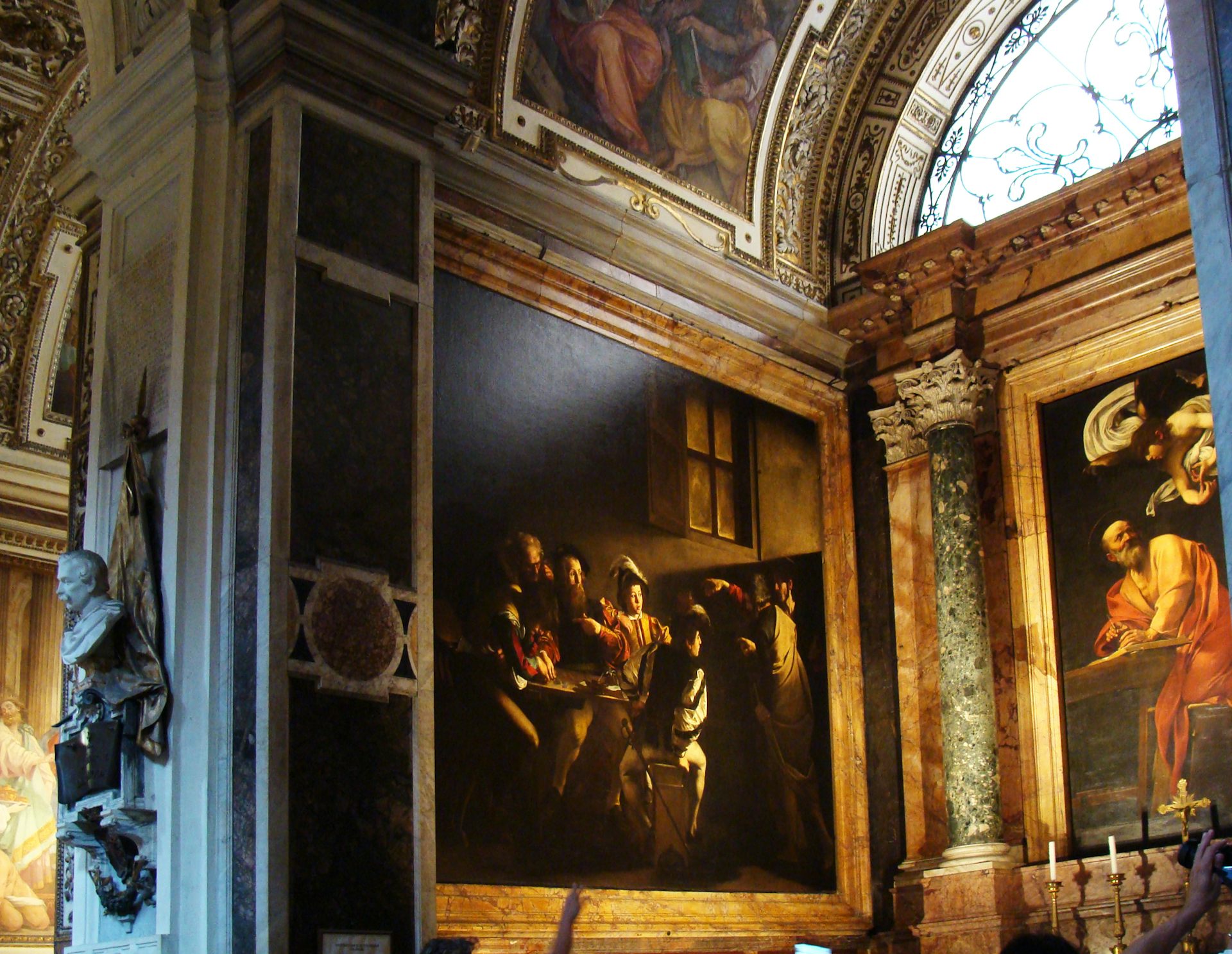
'Calling of Saint Matthew,' in Chapel San Luigi. (Virginia Raguin, CC BY)
Virginia Raguin
May 7, 2025
(The Conversation) — Pope Francis left a lasting legacy, not least his appreciation for art.
In his 2025 biography, “Hope,” Francis spoke of his admiration for the Baroque painter Caravaggio. He recalled that during his travels to Rome as a cardinal, he prayed in front of the painting by Caravaggio – “The Calling of Saint Matthew.”
The painting is found in the chapel dedicated to St. Matthew in the Church of San Luigi dei Francesi. The donor of the chapel was a French cardinal, Matthieu Cointerel, who died in 1585. This was the first commission for Michelangelo Merisi da Caravaggio, who was hired in July 1599. A year later, “The Calling of Saint Matthew” and “The Martyrdom of Saint Matthew,” depicting the beginning and the end of the apostle Matthew’s ministry, were installed.
The motto that Francis selected for his papacy, “miserando atque eligendo,” translated as “looking at him with mercy, he chose him,” is directly connected with this painting. The words “miserando atque eligendo” come from a sermon on the calling of Matthew written in the eighth century by the celebrated monk and historian Bede the Venerable. It is used in the readings for the Feast of St. Matthew on Sept. 21.
‘The Calling of Saint Matthew’
Matthew is described in the Bible as a tax collector, viewed at the time as a highly dubious occupation. In the painting, Christ enters the room from the right. We see only his silhouetted head and outstretched arm pointing in Matthew’s direction.
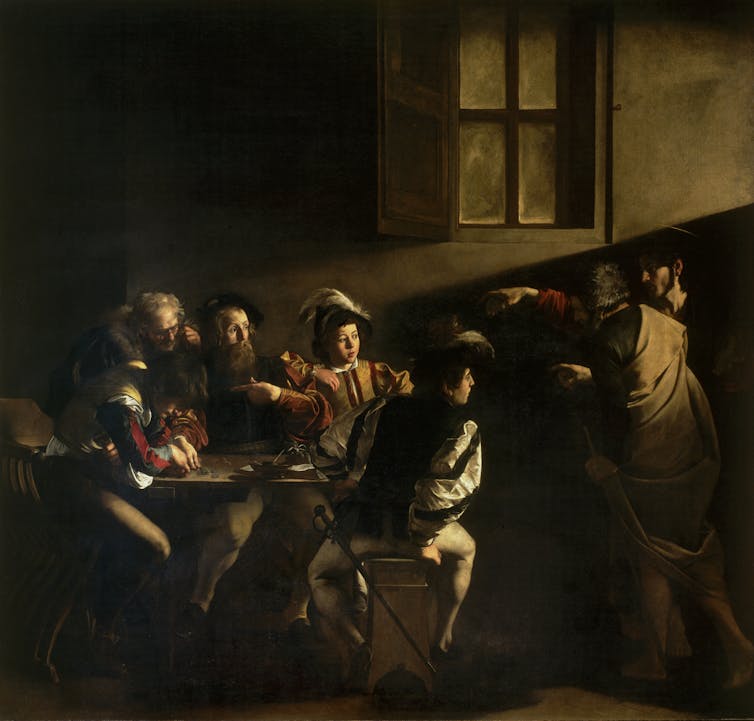
The ‘Calling of Saint Matthew,’ by Caravaggio.
Caravaggio via Wikimedia Commons
Light from the window behind Christ, which aligns with the actual light from the window in the chapel, falls on a group of men, including some handsome youths in fancy clothes, counting money. Matthew, the bearded man in the center, makes a gesture that suggests, “Who, me?”
Matthew became one of four disciples of Christ – along with Mark, Luke and John – whose accounts of Christ’s life, called Gospels, are included in the Bible.
Francis and Jesuit training
Francis’ thinking about this painting was shaped by his training as a Jesuit, a Catholic order that he entered in 1958. Jesuits practice something called a process of “discernment.” The painting represents God calling to Matthew to show him his will for the future, one that requires discernment. The founder of the order, Ignatius of Loyola, stressed a humble but vigorous effort to understand God’s will for each individual, as part of this process.
Ignatius’ own life demonstrated this search for God’s will. His initial career as a soldier ended when he was gravely wounded in the battle of Pamplona in 1521, permanently damaging his leg. He subsequently tried to follow the life of a hermit, meditating in solitude, and then tried to become a missionary to the Holy Land.
At the age of 33, he entered a university in order to become a priest, ultimately initiating the most influential transformation of religious education since the Middle Ages. Jesuits became a great teaching force, stressing individual study and debate over memorization. Ignatius was named a saint in 1622.
‘The Inspiration of St. Matthew’
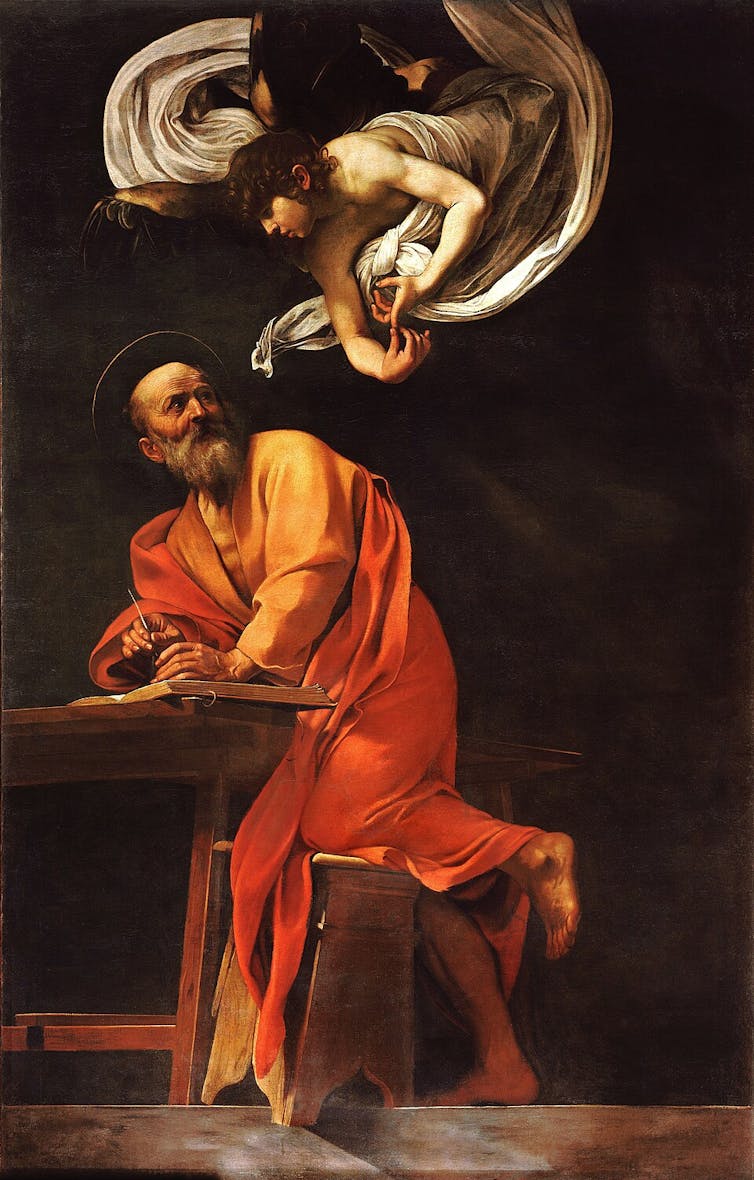
Caravaggio’s ‘The Inspiration of St. Matthew.’
Gonzaloferjar via Wikimedia Commons, CC BY-SA
The central painting in the chapel, “Inspiration of Saint Matthew” is Caravaggio’s third painting, which was put in place in 1602. The patrons originally planned to install statues at the center, but upon their arrival they rejected the idea and commissioned Caravaggio instead. This painting also shows the saint searching to understand God’s directions.
In this painting, Matthew is in conversation with his symbol, a winged man. Each of the four evangelists are represented in art through symbols. The winged man symbol for Matthew refers to the beginning of his Gospel that records the genealogy of Christ.
The angel-like figure, resembling one of the young men depicted alongside the saint in Caravaggio’s “The Calling of St. Matthew,” appears to hold his left index finger with his right hand, as if to signal that this is the first and most important point. Matthew seems careworn, even distracted, struggling to write while leaning his knee on a bench.
Francis remarked in his biography that Caravaggio increased viewers’ empathy by using “contemporary figures from the artist’s own time.” The figures in the painting are dressed in clothes worn in Italy in the late 16th century, so that the viewers in Caravaggio’s time could see themselves in the painting.
Viewers come to art with different perspectives derived from their own experiences and challenges. Francis, too, connected to art through his own experiences.
(Virginia Raguin, Distinguished Professor of Humanities Emerita, College of the Holy Cross. The views expressed in this commentary do not necessarily reflect those of Religion News Service.)

The Conversation religion coverage receives support through the AP’s collaboration with The Conversation US, with funding from Lilly Endowment Inc. The Conversation is solely responsible for this content.
Omar Suleiman
May 6, 2025
(RNS) — It is one of the most surreal images to emerge from the genocide in Gaza: The former popemobile, once the armored symbol of papal ceremony, reconfigured into a mobile health clinic. Once used to carry Pope Francis through cheering crowds, it is now meant to be packed with medical supplies and loaded onto a cargo ship, with the hope that it will reach Gaza and serve children trapped beneath siege.
If it makes it past the Israeli blockade — a blockade that has suffocated Gaza for nearly two decades — it will become a mobile clinic, equipped with oxygen tanks, medicine, and surgical tools for children who are bleeding, starving and surviving under conditions unimaginable to most of the world.
RELATED: Pope Francis the diplomat relied on personal encounters that had global reach
This was not a PR stunt. According to Vatican officials, this was one of the pontiff’s final wishes. In his last days, he asked that his vehicle be used not for spectacle, but for service. Especially in Gaza.
It is a powerful image. But the hypocrisy that surrounds it is even louder.
Western Christian leaders and commentators are applauding this gesture and showering the pope with praise, but some of the commentators celebrating the popemobile’s new purpose are the same ones who remained silent as tens of thousands of children were bombed and starved. Or worse, they cheered it on.
You cannot love the symbol and abandon the substance.
A Palestinian girl wounded in an Israeli airstrike on a school in Bureij refugee camp is brought to Al-Aqsa Martyrs Hospital in Deir al Balah, central Gaza Strip, on May 6, 2025. (AP Photo/Abdel Kareem Hana)
When Francis died, words like “humble,” “gentle,” “compassionate” echoed across official tributes. But missing from most of them was the one place he had spoken about more than almost any other in his final months: Gaza.
Francis called the siege “shameful.” He spoke daily with members of Gaza’s tiny Christian community. He condemned the killing of civilians, the starvation of children, the systematic destruction of homes, churches and hospitals. He didn’t tiptoe around Gaza. He embraced it.
But somehow, in the official remembrances, that part of his legacy is already being erased.
This silence is not new. But it is deeply telling.
In a recent conversation, the Rev. Munther Isaac, a Palestinian Christian leader from Bethlehem, spoke to me of the heartbreak of watching fellow Christians in the West remain silent, or worse, support the violence. He reminded us that solidarity is not seasonal and that the church’s failure to stand with the oppressed in Gaza will be remembered.
What does it say about a faith that celebrates the repurposing of the popemobile but can’t bring itself to call for a mere ceasefire? That mourns the suffering of the poor but justifies the mass killing of Palestinian children? That praises the pope’s compassion while ignoring his final message?
You cannot celebrate the legacy of Francis while erasing the people he wanted to be remembered with.
Pope Francis waves to people from his popemobile along the Copacabana beachfront as he arrives for the Stations of the Cross procession in Rio de Janeiro, July 26, 2013. (AP Photo/Andre Penner, File)
You cannot quote Jesus (peace be upon him) while ignoring those being crucified by bombs made in your country and dropped on civilians you refuse to name.
You cannot speak of a God who loves humanity while giving the religious language to the dehumanization that continues to further this genocide.
RELATED: Pope Francis encouraged Christian-Muslim dialogue and helped break down stereotypes
The popemobile now waits at the blockade — silent but loud in its witness. It stands as a symbol of rebuke to those who continue to betray their so-called prophetic witness for bankrupt political expediency.
If the vehicle makes it through, it will deliver not just supplies, but a statement. That the people of Gaza matter. That their lives are sacred. That their children deserve more than silence.
WHY FRANCIS SHOWED EMPATHY FOR LGBTQ PEOPLE
Religion Hub
Why ‘The Calling of Saint Matthew’ by Caravaggio was Pope Francis’ favorite painting − an art historian explains
(The Conversation) — The motto that Francis selected for his papacy, ‘looking at him with mercy, he chose him,’ was inspired by Caravaggio’s painting.
'Calling of Saint Matthew,' in Chapel San Luigi. (Virginia Raguin, CC BY)
Virginia Raguin
May 7, 2025
(The Conversation) — Pope Francis left a lasting legacy, not least his appreciation for art.
In his 2025 biography, “Hope,” Francis spoke of his admiration for the Baroque painter Caravaggio. He recalled that during his travels to Rome as a cardinal, he prayed in front of the painting by Caravaggio – “The Calling of Saint Matthew.”
The painting is found in the chapel dedicated to St. Matthew in the Church of San Luigi dei Francesi. The donor of the chapel was a French cardinal, Matthieu Cointerel, who died in 1585. This was the first commission for Michelangelo Merisi da Caravaggio, who was hired in July 1599. A year later, “The Calling of Saint Matthew” and “The Martyrdom of Saint Matthew,” depicting the beginning and the end of the apostle Matthew’s ministry, were installed.
The motto that Francis selected for his papacy, “miserando atque eligendo,” translated as “looking at him with mercy, he chose him,” is directly connected with this painting. The words “miserando atque eligendo” come from a sermon on the calling of Matthew written in the eighth century by the celebrated monk and historian Bede the Venerable. It is used in the readings for the Feast of St. Matthew on Sept. 21.
‘The Calling of Saint Matthew’
Matthew is described in the Bible as a tax collector, viewed at the time as a highly dubious occupation. In the painting, Christ enters the room from the right. We see only his silhouetted head and outstretched arm pointing in Matthew’s direction.
The ‘Calling of Saint Matthew,’ by Caravaggio.
Caravaggio via Wikimedia Commons
Light from the window behind Christ, which aligns with the actual light from the window in the chapel, falls on a group of men, including some handsome youths in fancy clothes, counting money. Matthew, the bearded man in the center, makes a gesture that suggests, “Who, me?”
Matthew became one of four disciples of Christ – along with Mark, Luke and John – whose accounts of Christ’s life, called Gospels, are included in the Bible.
Francis and Jesuit training
Francis’ thinking about this painting was shaped by his training as a Jesuit, a Catholic order that he entered in 1958. Jesuits practice something called a process of “discernment.” The painting represents God calling to Matthew to show him his will for the future, one that requires discernment. The founder of the order, Ignatius of Loyola, stressed a humble but vigorous effort to understand God’s will for each individual, as part of this process.
Ignatius’ own life demonstrated this search for God’s will. His initial career as a soldier ended when he was gravely wounded in the battle of Pamplona in 1521, permanently damaging his leg. He subsequently tried to follow the life of a hermit, meditating in solitude, and then tried to become a missionary to the Holy Land.
At the age of 33, he entered a university in order to become a priest, ultimately initiating the most influential transformation of religious education since the Middle Ages. Jesuits became a great teaching force, stressing individual study and debate over memorization. Ignatius was named a saint in 1622.
‘The Inspiration of St. Matthew’
Caravaggio’s ‘The Inspiration of St. Matthew.’
Gonzaloferjar via Wikimedia Commons, CC BY-SA
The central painting in the chapel, “Inspiration of Saint Matthew” is Caravaggio’s third painting, which was put in place in 1602. The patrons originally planned to install statues at the center, but upon their arrival they rejected the idea and commissioned Caravaggio instead. This painting also shows the saint searching to understand God’s directions.
In this painting, Matthew is in conversation with his symbol, a winged man. Each of the four evangelists are represented in art through symbols. The winged man symbol for Matthew refers to the beginning of his Gospel that records the genealogy of Christ.
The angel-like figure, resembling one of the young men depicted alongside the saint in Caravaggio’s “The Calling of St. Matthew,” appears to hold his left index finger with his right hand, as if to signal that this is the first and most important point. Matthew seems careworn, even distracted, struggling to write while leaning his knee on a bench.
Francis remarked in his biography that Caravaggio increased viewers’ empathy by using “contemporary figures from the artist’s own time.” The figures in the painting are dressed in clothes worn in Italy in the late 16th century, so that the viewers in Caravaggio’s time could see themselves in the painting.
Viewers come to art with different perspectives derived from their own experiences and challenges. Francis, too, connected to art through his own experiences.
(Virginia Raguin, Distinguished Professor of Humanities Emerita, College of the Holy Cross. The views expressed in this commentary do not necessarily reflect those of Religion News Service.)
The Conversation religion coverage receives support through the AP’s collaboration with The Conversation US, with funding from Lilly Endowment Inc. The Conversation is solely responsible for this content.

.jpg)
.jpg)
No comments:
Post a Comment