24 July 2025~
Expert comment~
Written byPrachi Agarwal
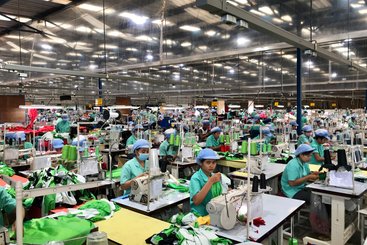
Image credit:Source: I Love Coffee dot Today- ShutterStock
This Week in Macroeconomics – Issue 16
Welcome to the latest issue of This Week in Macroeconomics, your essential guide to navigating the forces shaping the global economy. This week, Research Fellow Prachi Agarwal exposes a critical consequence of US trade policy: its disproportionate impact on women’s livelihoods across Least Developed Countries (LDCs). Prachi unpacks the data, revealing a gendered supply chain shock rippling through the global garment industry.
Beyond trade wars: women garment workers bear the brunt of US tariff recalibration
As geopolitics reshape global trade, the fallout from a contentious US tariff policy is spreading far beyond its intended targets. Least Developed Countries (LDCs) – many of which play only a minor role in the US trade imbalance that Washington seeks to address – are being swept up in this recalibration. What is emerging is more than simple trade disruption. It is a gendered supply chain shock, with women employed in the garment industry in countries like Lesotho, Bangladesh, Haiti, Madagascar and Cambodia paying a high price.
For over two decades, Lesotho, a small landlocked nation, successfully integrated itself into global value chains through the garment sector. Approximately 90% of its exports to the US are from the apparel industry, supported, until recently, by preferential tariffs under the African Growth and Opportunity Act (AGOA).
However, with AGOA set to expire in September 2025 and new reciprocal US tariffs – some as high as 50% – now imposed, Lesotho’s competitive edge has collapsed, forcing the country to declare a national state of disaster. Factory closures are accelerating, putting over 5,000 jobs at risk. The majority of those affected are women, who comprise 80% of the workforce and usually support their families.
This is a part of a wider pattern. There was a moment of cautious optimism in some LDCs when the US-China trade war intensified. The hope was that US buyers shifting away from China would create opportunities for other garment exporters to step in and fill the gap. In theory, this was plausible. But in practice, the US implemented blanket tariffs on many countries, including small, trade-dependent LDCs caught in the crossfire.
Women on the frontline of trade disruptions
Take Bangladesh, for example. It exports nearly US$9 billion in apparel annually to the US. Now, the sector is being squeezed by higher input costs and order uncertainty, forcing suppliers to trim operations. The result: factory workers – again, largely women (60% of the workforce) – face rising precarity in a sector already grappling with wage stagnation and limited protections.
The story is even worse in Haiti, where nearly 99% of apparel exports go to the US (Figure 1), mostly under long-standing preferential agreements (HOPE/HELP), also expiring in 2025. Factories in Port-au-Prince have already begun shedding jobs. Of the 35,000 workers in the industry, the most affected are young women already on disproportionately low wages.
A Flourish chart

In Madagascar, over 60,000 jobs are on the line across the industry due to a 47% tariff, leading to garment factories scaling back operations. The majority of those being laid off are, again, women – many of whom migrated to cities in search of economic security. In Cambodia, a newly-negotiated 36% tariff is undermining competitiveness and threatening a workforce that is overwhelmingly female.
The picture across LDCs suggests a gendered supply chain shock to the garment industry. As women’s jobs disappear, the knock-on effects are immediate: increased food insecurity, children taken out of school and a potential rise in domestic violence. In Lesotho, these risks are already materialising through increased workplace exploitation and gender-based violence.
So what options do LDCs have?
Diversifying trade is part of the answer. Lesotho and Madagascar should explore opportunities within SADC, South Africa and the African Continental Free Trade Area (AfCFTA). Other LDCs could perhaps diversify towards their European or North American partners. While these markets cannot fully replace US demand, they can help cushion the impact. Former AGOA beneficiaries could also negotiate collectively with the US for better terms, while finalising AfCFTA’s rules of origin to boost intra-African exports.
At the same time, governments can adopt gender-responsive strategies to absorb trade shocks. These include re-skilling programmes, wage support for unemployed women, and social protection mechanisms that activate when factories close. Recognising that most LDCs lack the necessary fiscal space, development banks can play a vital role in providing financial support, as they did during the post-pandemic recovery.
Ultimately, trade policy is never gender neutral. As the US recalibrates its global trade relationships, its policies are unintentionally harming women in vulnerable economies. In LDCS, where women are overrepresented in export-led garment industries, the costs of trade disruptions are deeply gendered. If trade is to be a vehicle for inclusive development, it must be guided by principles of equity – both among nations and within them.

No comments:
Post a Comment